Disclosure: topratedkitchenware.com is reader-supported. When you buy through links on our site, we may earn an affiliate commission from Amazon and other retailers, at no extra cost to you.
Where to buy
This guide to the best space saving toaster ovens applies a strict test, and it is fairer to state it before the list: an oven is linked here only when its verified listing describes a design that actually gives counter space back — a flip-up storage body, or a genuinely compact 4-slice footprint. Two of the six verified models in our pool pass that test and carry Amazon links, so you can check the latest price on Amazon and confirm the details. The other four are capable ovens whose listings claim capacity, not compactness, so they are reviewed in prose as alternatives, with no link and no photo.
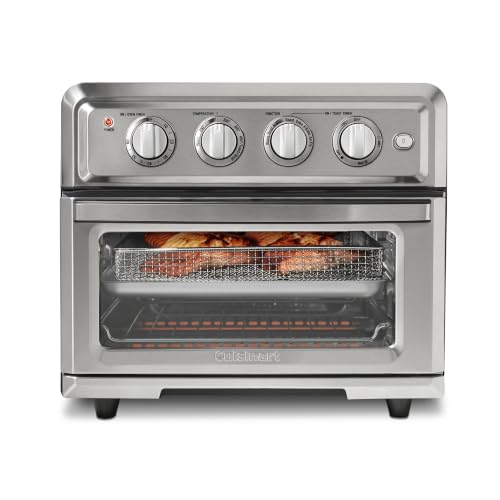
- Cuisinart Air Fryer Toaster Oven Combo TOA-55 — prose-only below. A capable 0.6 cu. ft. mid-size oven whose listing makes no space-saving claim.
- Emeril Lagasse 26QT French Door Air Fryer Toaster Oven — prose-only below. Its listing says extra large interior, which is a capacity claim, not a space claim.
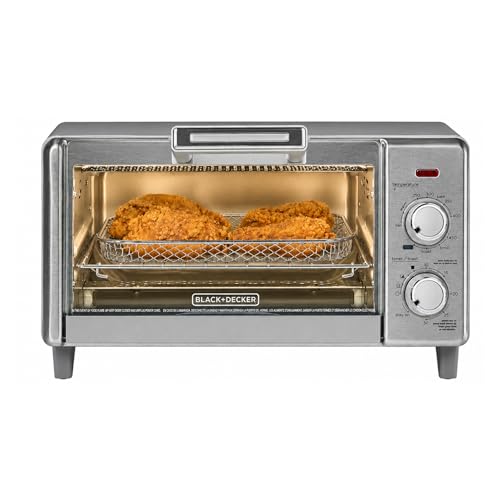
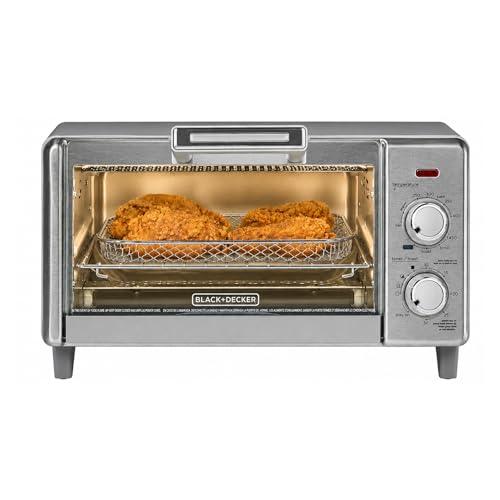
- BLACK+DECKER 4-Slice Air Fry Toaster Oven — Best Compact Footprint. A true 4-slice body built around a 9 inch pizza.
- Ninja Digital Air Fry Countertop Oven SP101 — Best Space Saving Design. The listing’s own words: flip up and away.
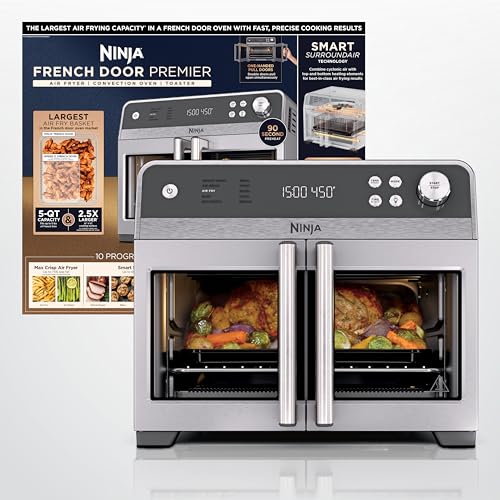
- Ninja French Door Premier Air Fry Oven FO101 — prose-only below. A 20.3 quart French door oven with no space-saving claim in its listing.
- Gourmia Toaster Oven, 6-Slice — prose-only below. A 6-slice French door combo whose listing claims presets and capacity, not compactness.
Read the full guide ↓ for the detailed reviews, the honest limitations of every pick, and the three kinds of counter space — footprint, clearance and storage — that a space saving claim has to respect.
The search for the best space saving toaster ovens usually begins in a kitchen where something has to give: the counter is short, the cabinets are low, or the worktop is shared with a coffee maker, a kettle, a knife block and the day’s post. What makes the search treacherous is that space saving is claimed far more often than it is engineered. A slim photograph is not a small footprint. A French door is not a storage system. The verified pool for this guide contains one oven with a genuine space-returning design, one honestly compact oven, and four machines that are space consumers wearing no disguise at all once you read their listings carefully — extra-large interiors, 20-plus quart capacities, 6-slice trays. We have sorted them accordingly, and the sorting is the service.
It helps to separate the three spaces an oven touches. Footprint is the rectangle it occupies while cooking. Clearance is the invisible box around it — room for the door to open, for heat to escape, for your hands to work. Storage is where the oven’s bulk lives the other twenty-three hours of the day. A design can win on one axis and lose on the others: a flip-up oven concedes width while cooking and wins it back in storage; a compact 4-slice oven wins footprint outright but still needs its clearance; a French door oven softens the clearance problem at the front while occupying a family-size footprint. This guide scores every pick against all three axes, links the two that genuinely save space, and reviews the rest as what they are — good ovens for kitchens that have space to spend. If your constraint is specifically a small cooking cavity rather than storage, our companion guide to smaller ovens approaches the same pool from the capacity side, and the finish-focused shortlist at Best Stainless Toaster Ovens covers the steel-bodied end of the category.
Key Takeaways
- Only two of the six verified picks save space by their own listing evidence — the flip-up Ninja SP101 and the compact BLACK+DECKER 4-Slice — and only those two are linked.
- Space comes in three kinds: footprint while cooking, clearance while working, and storage the rest of the day. Judge every claim against all three.
- The SP101 cooks wide and shallow, then flips up against the backsplash to return counter depth — the only true storage design in this pool.
- The BLACK+DECKER 4-Slice saves space the old way: by being a small oven, with a 9 inch pizza ceiling as the honest price.
- French doors reduce front clearance drama but do not shrink a footprint; the three French door models here are all prose-only for that reason.
- No prices or ratings are printed in this guide, because both change constantly; the linked picks carry Check on Amazon links instead.
In this guide
Quick Picks
| Pick | Badge | Space evidence from the verified listing | Link |
|---|---|---|---|
| Cuisinart Air Fryer Toaster Oven Combo TOA-55 | Mid-Size All-Rounder (prose-only) | 0.6 cu. ft., fits a 12 inch pizza; no space-saving claim stated | Prose-only — no link |
| Emeril Lagasse 26QT French Door Air Fryer Toaster Oven | Maximum Capacity Alternative (prose-only) | 26 quart extra large interior stated | Prose-only — no link |
| BLACK+DECKER 4-Slice Air Fry Toaster Oven | Best Compact Footprint | 4-slice class, room for a 9 inch pizza | Check on Amazon |
| Ninja Digital Air Fry Countertop Oven SP101 | Best Space Saving Design | Flip up and away storage stated in the listing | Check on Amazon |
| Ninja French Door Premier Air Fry Oven FO101 | French Door Step-Up (prose-only) | 20.3 quart capacity stated; no space-saving claim | Prose-only — no link |
| Gourmia Toaster Oven, 6-Slice | Preset-Rich Alternative (prose-only) | 6-slice capacity and 17 presets stated; no space-saving claim | Prose-only — no link |
Two rows of that table carry links, and the reason is visible in the evidence column: one listing describes an oven that physically gets out of the way, and one describes an oven that was small to begin with. The other four listings describe capacity — quarts, cubic feet, slice counts above the compact class — and capacity is a fine thing to sell, but it is the opposite of the promise this keyword makes. Read the reviews with the three-space framework in mind and the right choice for your kitchen usually announces itself before the comparison table.
How These Picks Were Chosen
We built this shortlist from a verified product pool checked through the Amazon Creators API on 2026-11-20. Every product name, ASIN, specification and image in this article comes from that verified data, and the accompanying sources file records each pick’s ASIN, API title, image URL and check date. Where a listing does not state a figure, this guide does not state it either.
The defining step was the space audit. For each model we asked what its verified title actually claims about space. The Ninja SP101 states a flip up and away design — an explicit storage mechanism — and passes as a space saving design even though its cooking footprint is wide. The BLACK+DECKER 4-Slice states a 4-slice class and a 9 inch pizza, the compact end of this category, and passes on footprint. The Cuisinart TOA-55 states 0.6 cubic feet and a 12 inch pizza with no space claim of any kind. The Emeril states a 26 quart extra large interior. The Ninja FO101 states 20.3 quarts. The Gourmia states a 6-slice capacity. Those four make no space-saving claim in their verified data, so they are prose-only: fully reviewed, honestly badged, and unlinked.
This is a research-led guide built on verified specifications and manufacturer descriptions, not on hands-on cooking, and nothing below pretends otherwise. Where we explain how a design behaves — how a flip-up body changes a storage routine, how French doors change front clearance — that is the documented geometry of the design, offered so you can map it onto your own kitchen. Prices and ratings are omitted deliberately: both change too quickly to print honestly, so linked picks carry Check on Amazon links and prose picks carry qualitative positioning.
The 6 Best Space Saving Toaster Ovens, Reviewed One by One
Cuisinart Air Fryer Toaster Oven Combo TOA-55
Badge: Mid-Size All-Rounder (prose-only)
Strengths
- 1800 watts, convection and a stated 450 degree maximum — serious cooking power.
- Seven functions including air fry, in a stainless steel build.
- Fits a 12 inch pizza, so it can serve as a small household’s main oven.
Trade-offs
- A 0.6 cu. ft. oven is a mid-size footprint; nothing in its listing claims otherwise.
- No storage trick, no compact class — the counter space it takes, it keeps.
- Prose-only in this guide: no link and no image, because it makes no space-saving claim.
Mini spec box
- Model: TOA-55
- Functions: 7-in-1 countertop combo with air fry
- Power: 1800W
- Interior: 0.6 cu. ft., convection capability
- Maximum temperature stated: 450°F
- Capacity cue: fits a 12 inch pizza
- Cleaning: removable crumb tray
- Finish: stainless steel
The TOA-55 is the oven many space shoppers end up buying, and it is worth understanding why the temptation is rational even though the fit is wrong. It is a genuinely complete countertop oven — seven functions, strong power, convection, a proper temperature ceiling, a stainless build and a crumb tray — sized at the point where a small household can treat it as the main oven. Nothing about it is a compromise except the one thing this guide is about: it occupies a mid-size rectangle of counter, permanently, and offers no mechanism for giving any of that rectangle back.
Choose it if your kitchen has a settled, dedicated oven spot and your real question was capability per appliance rather than space. Do not choose it as a space saving purchase, because on the morning after delivery the counter will be exactly as full as the dimensions said it would be. In this guide it stands prose-only as the capability benchmark — the machine the two linked picks must justify themselves against — and on that comparison both linked picks win for the kitchens this keyword serves: one by being small, the other by disappearing upwards when the cooking is done. Kitchens with a dedicated spot and a heat-management worry will find the related discussion in Best Stainless Steel Toaster Ovens That Don T Overheat more relevant than this page’s storage framework.
Best for: kitchens with a fixed oven spot that want one complete mid-size appliance / Not suited for: any space saving brief
Emeril Lagasse 26QT French Door Multi-Function Air Fryer Toaster Oven
Badge: Maximum Capacity Alternative (prose-only)
Strengths
- A 26 quart interior — the largest capacity in this pool.
- 24 one-touch presets and six included accessories.
- French doors that open from the centre, softening front clearance.
Trade-offs
- Its listing says extra large interior; it is the pool’s biggest space commitment.
- French doors help at the front only — width, depth and storage bulk are unchanged.
- Prose-only in this guide: no link and no image, because it claims capacity, not compactness.
Mini spec box
- Capacity stated in listing: 26QT
- Door style: French door
- Presets: 24 one-touch options
- Type: countertop convection cooker
- Included: six cooking accessories
The Emeril 26QT earns its place in this guide as the clearest possible contrast. Everything about its verified description is a capacity statement: 26 quarts, extra large interior, two dozen presets, a bundle of accessories. Even its one space-adjacent feature, the French doors, is about access rather than storage — the doors part sideways, so you do not need the clear arc a drop-down door demands, and you can stand closer to a hot cavity. That is a real ergonomic benefit in a tight galley, and we credit it. It does not make the oven smaller by a single inch in any dimension that a tape measure respects.
Read this review as a calibration tool. If the capacity language excites you more than the flip-up mechanism in the Ninja review below, your kitchen has room and your household has appetite, and the honest purchase is a big oven bought on a big-oven brief. The failure mode this guide exists to prevent is the reverse purchase: a 26 quart machine arriving in a kitchen that measured itself in hope. Prose-only, unlinked, and described at its true size, the Emeril marks the far end of the scale so the linked picks’ claims can be judged against something real.
Best for: large households with counter space to spend on maximum capacity / Not suited for: space saving shoppers in any dimension
BLACK+DECKER 4-Slice Air Fry Toaster Oven
Badge: Best Compact Footprint
Strengths
- A genuine 4-slice footprint — the smallest cooking rectangle among the linked picks.
- Five functions including air fry and keep warm, so small does not mean basic.
- EvenToast technology aimed at the patchy-toast problem small ovens are known for.
Trade-offs
- The 9 inch pizza ceiling is the footprint’s price, and it is non-negotiable geometry.
- It saves space by being small, not by transforming — it still needs full clearance while running.
- Air fry loads are single-layer portions for one or two, not family batches.
Mini spec box
- Capacity class: 4-slice
- Functions: 5-in-1 — air fry, bake, broil, toast, keep warm
- Technology named in listing: EvenToast
- Capacity cue: room for a 9 inch pizza
- Type: countertop air fry toaster oven
There are two philosophies of space saving in this pool, and the BLACK+DECKER 4-Slice is the traditional one: do not engineer around a big oven, just build a small one. Its verified listing states the compact facts plainly — a 4-slice class, room for a 9 inch pizza — and the consequence is the smallest day-one footprint of any pick here. On a short counter run, in a dorm, in an RV galley or beside a hob in a studio flat, that rectangle is the difference between an oven that lives out permanently and one that must be fetched from a cupboard, which in practice means the difference between an oven that gets used and one that does not.
The pleasant surprise is how little function the small body surrenders. Five modes cover the modern week — air fry for snacks and reheats, bake, broil, toast, keep warm — and EvenToast technology addresses the historic weakness of cheap compacts, toast that stripes. What the format cannot do is volume, and the review would be dishonest not to repeat it: air frying is a single-layer exercise here, and a family pizza does not fit, full stop. But for the one-and-two-person cooking that dominates real toaster oven use, this is the space saving answer with the fewest moving parts, the simplest storage story — it is already small — and a footprint you can verify against your counter with a tape measure before you spend anything.
Best for: short counters, small households and anyone whose oven must live out permanently / Not suited for: family pizzas or batch air frying

Ninja Digital Air Fry Countertop Oven SP101
Badge: Best Space Saving Design
Strengths
- Flip up and away storage, stated in the listing: the oven stands against the backsplash when idle.
- Eight functions with 1800 watts — no capability apology attached to the storage trick.
- A wide, shallow cavity that suits sheet-style foods and toasts for a table.
Trade-offs
- While cooking, it is a wide oven — the listing itself labels it XL — so the cooking footprint is not small.
- The flip-up routine only saves space if you actually do it; left down, it is a wide oven on your counter.
- Shallow geometry limits tall dishes, covered pots and stacked racks.
Mini spec box
- Model: SP101
- Functions: 8-in-1 — air fry, air roast, broil, bake, toast, bagel, dehydrate, keep warm
- Power: 1800W
- Colour: Silver
- Design: flip up and away storage
- Size label in listing: XL
The SP101 is the one genuinely inventive answer to the space problem in this pool, and its listing states the mechanism in four words: flip up and away. The insight behind it is that a countertop oven’s cost is not only the rectangle it cooks on but the rectangle it monopolises at breakfast, at lunch prep, and at every moment in between. Ninja’s oven cooks in a wide, shallow format — the shape of a sheet tray — and then, when the cooking is done and the body has cooled, the whole unit rotates up to stand against the backsplash, returning the counter depth in front of it to chopping boards, mixing bowls and ordinary kitchen life.
Judged on the three-space framework, it is a fascinating split decision. Footprint while cooking: wide, honestly labelled XL by its own listing, and not a small oven by any tape measure. Clearance: the shallow body is easy to load and the wide cavity takes trays that cube-shaped ovens refuse. Storage: the best in this pool by a distance, provided the household builds the flip-up habit. That proviso is the honest limitation, and it is behavioural rather than mechanical — a space saving design that depends on a daily gesture will save exactly as much space as the gesture gets performed. For tidy cooks in depth-starved kitchens, this is the standout pick of the guide. For cooks who know the oven would live down forever, the compact BLACK+DECKER above is the more honest purchase.
Best for: depth-starved counters and tidy cooks who will use the flip-up storage daily / Not suited for: narrow counters, tall dishes, or households that never put appliances away
Ninja French Door Premier Air Fry Oven FO101
Badge: French Door Step-Up (prose-only)
Strengths
- Ten functions with cyclonic air up to a stated 450 degrees.
- A PFAS-free surface claim stated in the listing, uncommon in this category.
- Stainless French door format with sear crisp among its modes.
Trade-offs
- A 20.3 quart capacity is a family-size footprint with no storage mechanism.
- French doors ease front access; they do not return counter space.
- Prose-only in this guide: no link and no image, because its listing claims capacity and functions, not space saving.
Mini spec box
- Model: FO101
- Functions: 10-in-1 — air fry, sear crisp, bake, broil, toast, dehydrate and more as listed
- Capacity stated in listing: 20.3 Qt
- Temperature: 450F cyclonic air
- Surface: PFAS-free, per listing
- Finish: Stainless
- Door style: French door
The FO101 is Ninja’s other answer in this pool, and it answers a different question. Where the SP101 innovates on storage, the FO101 innovates on cooking: ten functions, cyclonic air at a stated 450 degrees, a sear crisp mode, a PFAS-free surface claim that will matter to buyers who track coating questions, all in a stainless French door body of 20.3 quarts. It is a premium, family-capacity machine, and on a capability brief it would be a headline pick.
On this brief it is prose-only, because nothing in its verified listing claims to save space, and a 20.3 quart oven does not save space by being well designed in other respects. We flag one nuance for fairness: French doors do reduce the front clearance penalty compared with a drop-down door, since they open sideways rather than leaning a hot door into your workspace. In a kitchen whose only problem is door swing, that is a genuine, if modest, spatial benefit — and it is still not a space saving oven. Readers for whom the FO101’s capability list is the real attraction should buy it on a capability keyword, where it is linked; readers on this page should note it as the premium step-up and return to the two linked picks.
Best for: premium buyers stepping up to family capacity with a French door format / Not suited for: space saving briefs
Gourmia Toaster Oven, 6-Slice, Digital French Door
Badge: Preset-Rich Alternative (prose-only)
Strengths
- 17 cooking presets, the second-longest preset list in this pool.
- FryForce 360 degree air fry technology with adjustable time and temperature.
- Dishwasher-safe trays, a cleaning convenience few listings state.
Trade-offs
- A 6-slice capacity is above the compact class; the footprint follows the capacity.
- No storage design and no compact claim anywhere in its verified listing.
- Prose-only in this guide: no link and no image, because it fails the space saving test.
Mini spec box
- Capacity class: 6-slice
- Display: digital
- Door style: French door
- Presets: 17 cooking presets
- Technology named in listing: FryForce 360°
- Controls: adjustable time and temperature
- Cleaning: dishwasher-safe trays
- Colour: Black
The Gourmia is the pool’s value-flavoured all-rounder: a 6-slice French door air fryer combo with a digital display, seventeen presets, a named air circulation technology and the quietly excellent detail of dishwasher-safe trays. As a specification sheet it competes well above its likely tier, and for a household replacing both a toaster and a basket air fryer with one mid-size machine, it is an easy appliance to argue for.
None of that argument is about space. Six slices of capacity means a family-size cavity, the French doors manage access rather than storage, and the listing — read carefully, as this guide reads every listing — never claims compactness, a small footprint or a storage feature. It therefore closes our review section prose-only, as the preset-rich alternative: a good oven for a kitchen with room, included here so that its absence from the linked list reads as a classification rather than an oversight. Space shoppers should take the hint the listing itself gives and look at the two linked picks, whose listings make the claims this keyword requires.
Best for: mid-size kitchens wanting many presets and dishwasher-safe trays / Not suited for: space saving briefs
Comparison Table
| Pick | Badge | Space evidence | Functions stated | Standout feature | Link |
|---|---|---|---|---|---|
| Cuisinart TOA-55 | Mid-Size All-Rounder (prose-only) | 0.6 cu. ft., 12 inch pizza, no space claim | 7-in-1 with air fry and convection | 1800W, 450°F maximum | Prose-only — no link |
| Emeril Lagasse 26QT | Maximum Capacity Alternative (prose-only) | 26 quart extra large interior | 24 one-touch presets | Six accessories included | Prose-only — no link |
| BLACK+DECKER 4-Slice Air Fry | Best Compact Footprint | 4-slice, 9 inch pizza | 5-in-1: air fry, bake, broil, toast, keep warm | EvenToast technology | Check on Amazon |
| Ninja SP101 | Best Space Saving Design | Flip up and away storage stated | 8-in-1 with dehydrate | 1800W wide shallow cavity | Check on Amazon |
| Ninja FO101 | French Door Step-Up (prose-only) | 20.3 Qt, no space claim | 10-in-1 with sear crisp | 450F cyclonic air, PFAS-free surface | Prose-only — no link |
| Gourmia 6-Slice | Preset-Rich Alternative (prose-only) | 6-slice capacity, no space claim | 17 presets, air fryer combo | FryForce 360°, dishwasher-safe trays | Prose-only — no link |
The evidence column is the table’s argument. Two listings make a space claim that survives reading; four make capacity claims that were never space claims at all. If you take one habit from this guide, take that one: read the manufacturer’s own size language, believe it, and let the marketing photography argue with someone else’s counter.
How to Choose a Space Saving Toaster Oven
Decide which space is actually scarce. Kitchens run out of room in different ways. A short counter run is a width problem, solved by a compact footprint like the 4-slice class. A deep counter that doubles as your only prep surface is a storage problem, solved by a flip-up design that vacates the surface between meals. Low cabinets are a height-and-heat problem, solved by a shallow body and disciplined clearance. Name your scarcity precisely, because the three problems have three different answers and the wrong answer wastes money in a familiar shape.
Measure the working box, not the shelf. The space an oven needs is its body plus the open door, plus the tray pulled towards you, plus a hand’s width of breathing room behind and beside, plus clear air above. Measure that whole box against your counter and cabinets. Drop-down doors are the usual ambush: the oven fits the shelf beautifully and then cannot be opened without shoving it backwards. French doors and flip-up bodies exist precisely because this ambush is common, which is why this pool contains so many of them — the category’s designers know where ovens actually fail to fit.
Interrogate every space claim. A real space saving claim names a mechanism or a measurement: flip up and away, a stated width, a slice class, a pizza diameter. A fake one offers an adjective — slim, sleek, counter-friendly — with no number attached. This guide linked the picks whose listings provide mechanisms and measurements and prose-only’d the rest; apply the same standard in any shop, on any site, including the combination-appliance territory of Best Toaster Microwave Ovens, where two functions in one body is a legitimate space strategy with its own depth costs.
Do not trade away the cooking you actually do. Space saved by buying an oven too small for your week is space repaid in batches, workarounds and eventual replacement. If your cooking is sheet-shaped and feeds four, the wide SP101 flipped up after use beats a compact oven that forces two rounds of everything. If your cooking is toast and reheats for one, the compact wins outright. The correct unit of analysis is your last two weeks of meals, not your aspirations and not the listing’s photographs.
Count the accessories in the storage budget. Trays, racks, baskets and crumb trays all live somewhere. A big oven with six accessories consumes cupboard space as well as counter space — a hidden cost the Emeril’s generous bundle illustrates. A compact oven with one rack and one pan consumes almost none. When you measure your kitchen for an oven, measure a home for its parts as well, or the space you saved on the counter reappears as clutter in a drawer.
How to Set Up a Space Saving Toaster Oven in a Small Kitchen
Placement, step by step. First, choose the oven’s permanent home before it arrives and clear that exact rectangle, because an oven that must be moved for every use will eventually stop being used. Second, check the cabinet height above the spot with the oven’s clearance needs in mind — heat rises, and the underside of a low cabinet is the first casualty of optimism. Third, confirm the outlet position; a short cord stretched across a prep surface converts saved space into daily irritation. Fourth, for a flip-up model, rehearse the motion empty: the oven needs wall clearance behind it to stand, and the backsplash run must be free of sockets, rails and utensil crocks along its arc. Fifth, run the first empty heat cycle with ventilation, as any new heating appliance deserves.
Daily habits for small kitchens. Build the reset into the routine: when the oven has cooled, trays go back inside it (the cavity is free storage), and a flip-up model goes up. Keep the counter zone in front of the oven sacred — it is your landing strip for hot trays, and clutter there is how small kitchens turn a compact appliance into a hazard. Wipe the crumb tray on a schedule rather than on evidence; in a small kitchen the oven sits closer to everything, including the cook, and burnt-crumb smoke has nowhere to dissipate.
Troubleshooting.
- Problem: the oven fits the counter but the door cannot open fully → the working box was measured as the shelf; pull the oven forward so the door arc clears the counter edge, or reconsider a French door or flip-up format.
- Problem: cabinets above the oven feel hot after cooking → clearance above is insufficient; lower the rack of your expectations and raise the gap — move the oven to a spot with more headroom or choose a shallower body.
- Problem: the flip-up oven keeps ending up left down → the storage habit has failed, not the design; either recommit the gesture to the after-dinner reset, or accept that your real pick was the compact oven and exchange accordingly.
Footprint vs Capacity: The Trade the Listings Hope You Skip
Every countertop oven listing is a negotiation between two numbers the maker would prefer you not to hold simultaneously: the space the oven takes and the space it offers. Capacity is marketed in quarts, cubic feet and pizza diameters because bigger sounds better; footprint is left in the specification table because smaller is harder to boast about. The result is a category where a shopper can read six enthusiastic listings and learn nothing about the only question they brought. This guide’s prose-only classifications are simply that missing comparison, done in public. The Emeril offers the most cooking space and takes the most counter. The BLACK+DECKER offers the least of both. The SP101 cheats the trade by moving its bulk vertically when idle — which is why a design from a previous product generation, traced in Best Toaster Ovens 2008 comparisons of how this category evolved, still anchors a modern space guide. When you shop beyond this page, replicate the method: put the takes column and the offers column side by side, in the maker’s own stated figures, and refuse to buy from any listing that will only fill in one of them.
Small Kitchen Layouts: Where Each Design Belongs
The studio galley. A single short run of counter, everything within arm’s reach. The compact 4-slice footprint is the only format that lives here permanently without evicting the kettle, and its single-layer cooking matches one-person meals. The family kitchen with a prep island problem. Counter length is fine but the surface is contested all day; the flip-up SP101 earns its keep by vanishing between meals while still cooking family-width trays. The low-cabinet kitchen. Height is the constraint: shallow bodies, disciplined clearance, and no tall French door towers — measure upward before anything else. The shared or office kitchenette. Counter space is political; a compact oven with a small, obvious footprint causes the fewest arguments and the least resentment. Matching the design to the layout, rather than to the feature list, is what separates a space saving purchase from a smaller regret. Readers still torn between generations of these designs will find the dated-keyword archaeology in Best Toaster Ovens 20118 surprisingly practical — the space problem has not changed, only the mechanisms offered for it.
Renters, Dorms and Shared Counters: The Etiquette of a Small Footprint
Space saving stops being a private preference in shared housing, where the counter is a commons and an oversized appliance is a political act. A few grounded rules follow from the designs in this guide. First, in a dorm or shared flat, footprint is courtesy: the compact 4-slice class takes the least shared surface, heats the smallest volume of shared air, and is the easiest format to justify to housemates who did not ask for a countertop oven at all. Second, storage designs change the negotiation entirely — a flip-up oven that vacates the prep surface between meals can be acceptable in a kitchen where a permanently parked family oven would start an argument, because what housemates actually resent is not the cooking but the occupation. Third, heat and smell travel further in small shared spaces, so the clearance discipline in our setup section is also an etiquette discipline: an oven run tight against a wall or under a low shelf announces itself to the whole flat. Fourth, renters should weigh the moving question — an oven you will carry between tenancies favours the compact class, whose box is a one-person lift and whose simplicity survives packing, over a wide or French door machine that travels like furniture. None of these rules appears on a listing, and all of them decide whether a space saving purchase stays welcome in the home it was bought for. The two linked picks map cleanly onto the shared-housing cases: the compact for the smallest commons, the flip-up for the contested prep surface.
Common Buying Mistakes
- Measuring the shelf instead of the working box. Body plus door arc plus tray pull plus clearance is the real footprint. Measure that, or rehearse the return.
- Believing slim photography. A wide oven photographed on a vast counter looks compact. Only stated dimensions and mechanisms count as evidence.
- Counting French doors as space saving. They solve door swing, not storage. Three prose-only picks in this guide are French door models with family-size footprints.
- Buying a storage design you will not operate. A flip-up oven left down is a wide oven. Be honest about your habits before paying for a mechanism.
- Forgetting the accessories. Bundled trays and racks need a home too; an uncounted accessory bundle quietly spends the space you saved.
- Shrinking below your cooking. An oven too small for your week gets replaced, and the replacement costs more than the step-up would have.
Final Recommendation
For most space-pressed kitchens, the standout answer is the Ninja SP101: it is the only pick whose listing describes a mechanism that returns counter space after cooking, and it pairs that flip-up design with eight functions and 1800 watts, so the space saving costs you nothing in capability. Choose the BLACK+DECKER 4-Slice Air Fry Toaster Oven instead when your counter run itself is short — width, not depth, is your scarcity — because its compact footprint solves the problem permanently, with no daily gesture required, and its five functions cover the small-household week.
The other four models are good ovens on the wrong brief, and this guide leaves them prose-only on purpose. If the Cuisinart’s capability, the FO101’s premium function list or the Emeril’s capacity is what you actually want, buy that oven gladly — on the keyword it matches. Space, like money, should be spent deliberately, and the two linked picks are the ones that spend the least of it.
Frequently Asked Questions
What actually makes a toaster oven space saving?
A mechanism or a measurement: a body that flips up or folds away for storage, or a genuinely compact footprint stated in the listing — a small width, a 4-slice class, a 9 inch pizza limit. Adjectives like slim or sleek, with no figure attached, are not evidence. This guide linked only the two picks whose verified listings provide a mechanism or a compact measurement.
Do French door toaster ovens save space?
They save front clearance, because the doors open sideways instead of dropping a hot door into your workspace. They do not reduce the footprint or the storage bulk, and the French door models in this pool are 20-plus quart family machines. Treat the door style as an access improvement, not a space saving design, unless the listing also states compact dimensions.
Is the flip-up Ninja SP101 hard to live with?
The mechanism is simple; the discipline is the variable. The oven must cool before it goes up, and it only saves space on the days you actually flip it. Tidy cooks in depth-starved kitchens get a genuinely emptier counter for most of the day. Households that know they will leave it down should buy the compact pick instead and save space by size rather than by routine.
How small is too small for a family?
When the oven’s stated limits collide with your weekly cooking: a 9 inch pizza ceiling fails a family pizza night, and a 4-slice toast class means breakfast in shifts for five people. Occasional collisions are fine — the big oven exists — but weekly collisions mean the space saving is being repaid in friction. At that point the flip-up design, which keeps family-width cooking and returns the counter afterwards, is usually the better answer.
Can I store things on top of a toaster oven to save space?
No. The top surface is part of the oven’s heat path, and storing items on it is a fire and damage risk as well as a clearance violation. The space above a toaster oven belongs to its ventilation. If your storage plan depends on stacking onto the oven, the honest solution is a smaller oven or a flip-up design, not a warmer shelf.
Why are four of the six picks not linked?
Because their verified listings make no space-saving claim: they state mid-size or large capacities — 0.6 cubic feet, 20.3 quarts, 26 quarts, 6 slices — and offer no storage mechanism. We review them fully in prose so you can step up deliberately if capacity is your real need, but linking them under a space saving headline would misrepresent what they are.
What should I measure before ordering?
The working box: counter width for the body, depth for the body plus the open door and a pulled-out tray, and height for the body plus clear air above it, with a hand’s width behind and beside. For a flip-up model, also check the backsplash run for sockets or rails in the oven’s arc. Compare those numbers only against dimensions the listing actually states.