Disclosure: topratedkitchenware.com is reader-supported. When you buy through links on our site, we may earn an affiliate commission from Amazon and other retailers, at no extra cost to you.
Where to buy
The best simple toasters are defined specifically in this guide: a lever, a shade control, buttons only for jobs you actually do, and nothing that needs a manual after the first morning. All six toasters below qualify as pop-up machines you can learn in one breakfast, but they sit at different points on the simplicity scale, and the reviews are honest about which end each one occupies.
- bella Fits-Anywhere Slim Toaster — Check on Amazon — one long slot, four slices, the fewest decisions of any pick here.
- BLACK+DECKER 2-Slice Toaster with Extra-Wide Slots — Check on Amazon — a familiar dial-and-lever layout with an extra lift for small slices.
- Hommater 2 Slice Wide Slot Smart Toaster — Check on Amazon — a countdown display — helpful, but the least minimal design in this guide.
- Amazon Basics 2 Slice Toaster — Check on Amazon — three honest buttons, a dial and a cord wrap; simplicity done properly.
- Elite Gourmet ECT1027B Cool-Touch Toaster — Check on Amazon — cool-touch sides and a short, clear control set for thick bread and bagels.
- Hamilton Beach 22634 Extra-Wide Slot Toaster — Check on Amazon — bagel and defrost buttons plus toast boost, still learnable in a minute.
Read the full guide ↓
The best simple toasters share a virtue that spec sheets cannot capture: nobody in the house needs to be taught how to use them. Bread goes in, the lever goes down, the shade dial stays where it was left, and toast comes up the same way it did yesterday. This guide compares six current pop-up toasters through that single lens — how little thinking each one asks of you at seven in the morning — from a one-slot slim design with almost no controls to argue about, to a display model that is included deliberately as the boundary case.
Simplicity is not the same as cheapness or missing features. A defrost button is simple when your bread lives in the freezer, because it replaces guesswork with one press. A countdown screen can be simple in a busy household for the opposite reason: it answers a question everyone asks. What makes a toaster complicated is not the number of controls but the number of decisions, and each review below counts those decisions honestly so you can pick the level of plain that suits your kitchen.
Key Takeaways
- The Amazon Basics is the purest simple pick: dial, three named buttons, removable tray, cord wrap, nothing to configure.
- The bella removes a whole category of decisions — one slot, one cycle — and suits households that toast one kind of bread.
- The Hommater is the boundary case: its countdown is genuinely useful, but it is the least simple design here and is badged that way.
- Extra lift (BLACK+DECKER) and Toast Boost (Hamilton Beach) are simple ideas that remove the daily small-slice fumble.
- Cool-touch sides on the Elite Gourmet simplify life in households where the toaster is within everyone’s reach.
- Judge simplicity by decisions per breakfast, not by counting buttons.
In this guide
Quick Picks
Badges here grade the simplicity proposition of each model, not its raw capability. The most capable machine in the list carries the most honest badge in the guide: if you want truly simple, it is the one to skip, and it is included so you can see exactly where the line sits.
| Toaster | Badge | Why it is here | Availability |
|---|---|---|---|
| bella Fits-Anywhere Slim Toaster | Best Simple Space-Saver | One slot, one cycle — the fewest moving decisions here. | Check on Amazon |
| BLACK+DECKER 2-Slice Toaster with Extra-Wide Slots | Best Classic Dial Pick | The classic layout most people already know by muscle memory. | Check on Amazon |
| Hommater 2 Slice Wide Slot Smart Toaster | Most Features — Least Simple | Countdown display and nine shades: capable, not minimal. | Check on Amazon |
| Amazon Basics 2 Slice Toaster | Best Truly Basic Pick | Dial plus defrost, cancel and bagel. That is all, and it is enough. | Check on Amazon |
| Elite Gourmet ECT1027B Cool-Touch Toaster | Best Cool-Touch Simple Pick | Six shades, cool-touch body, thick-bread slots. | Check on Amazon |
| Hamilton Beach 22634 Extra-Wide Slot Toaster | Best Simple Family Pick | Two special buttons and a lift boost; still a one-minute learn. | Check on Amazon |
If your household includes children making their own toast, guests in a rental, or anyone who simply refuses to learn appliances, start with the Amazon Basics, BLACK+DECKER and Elite Gourmet. If your household argues about timing and doneness instead, the Hommater’s display may paradoxically be the simplest life — read its review carefully before deciding.
How These Picks Were Chosen
Each candidate was assessed on decision load: how many choices stand between a sleepy person and finished toast. That meant reading the verified listings for control type (dial versus display), the number and clarity of named functions, slot logic (two slots versus one shared slot), and retrieval and cleaning design, because a toaster that is simple to operate but annoying to empty is only half simple. Anything a title does not state is described as unstated, never assumed.
The selection deliberately spans the simplicity spectrum rather than pretending every toaster is equally plain. At one end, the Amazon Basics and BLACK+DECKER represent the classic dial machine. In the middle, the Elite Gourmet and Hamilton Beach add exactly one or two considered conveniences. At the far end, the Hommater tests the definition: a screen and nine settings, included because many buyers searching for a simple toaster actually mean a predictable one, and a countdown makes browning predictable in a way a dial cannot.
As with every guide in this series, the work is research-led: listings were compared attribute by attribute, and behavioural comments reason from the stated design and from how pop-up toasters generally work. No hands-on testing is claimed. Prices are deliberately absent — check the latest price on Amazon on each linked listing — because a simple buying decision should not rest on a number that may have changed since publication.
The 6 Best Simple Toasters in Detail
Reviews are ordered from the fewest decisions to the most, so the guide reads as a simplicity gradient. Spec boxes repeat only what each verified listing title states.

bella Fits-Anywhere Slim Toaster
Badge: Best Simple Space-Saver
Strengths
- The only pick here whose listing states a slim profile
- One extra-long slot takes long artisan slices that defeat standard slots
- Four-slice capacity in a narrow body is a rare combination
Trade-offs
- The listing title states no shade count, so verify the dial range on the product page
- The title states no wattage and names no bagel or defrost mode
- A single shared slot means four slices share one browning cycle
Key specs from the listing
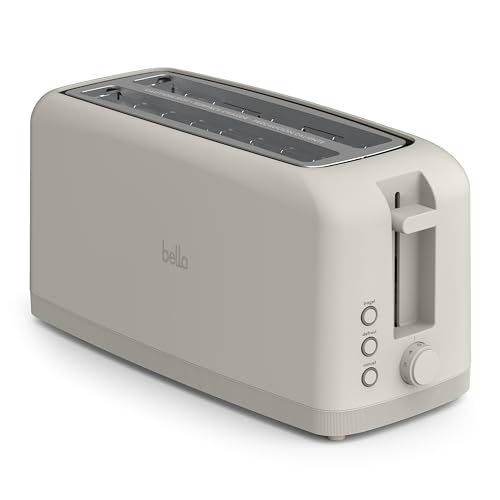
- Format: slim toaster with one extra long and wide slot
- Capacity: 4 slices in the long slot
- Profile: slim, Fits-Anywhere design
- Colour: Oatmilk
The bella Fits-Anywhere reduces toasting to its minimum viable form: one extra long and wide slot, one cycle, up to four slices at a time. There is no left-slot-versus-right-slot thinking, no matching of two carriages, and its slim body removes the other daily decision — where the toaster lives — by fitting into narrow strips of counter that defeat conventional machines. For a household that buys one loaf style and toasts it the same way every day, this is arguably the simplest appliance in the guide.
Simplicity has edges, though. The listing title states no shade count and names no bagel or defrost mode, so a buyer who needs those specifics must check the product page rather than assume them. Four slices also share one browning outcome, which is simple only if the household agrees on doneness. Where it fits, it is beautifully plain; where tastes diverge, its simplicity becomes a queue.
Best for: one-loaf households and narrow counters that want zero slot decisions / Not suited for: households split between light and dark toast at the same sitting
BLACK+DECKER 2-Slice Toaster with Extra-Wide Slots
Badge: Best Classic Dial Pick
Strengths
- Extra lift lever raises small items clear of the slots
- Seven shade settings give fine control at the darker end
- Removable crumb tray keeps cleaning straightforward
Trade-offs
- No defrost or reheat function is named in the listing title
- No wattage is stated in the title
- Utilitarian styling will not be the reason anyone chooses it
Key specs from the listing
- Format: 2-slice pop-up toaster
- Slots: extra-wide slots
- Shade settings: 7
- Functions named in the listing: bagel mode
- Lever: extra lift lever
- Crumb tray: removable
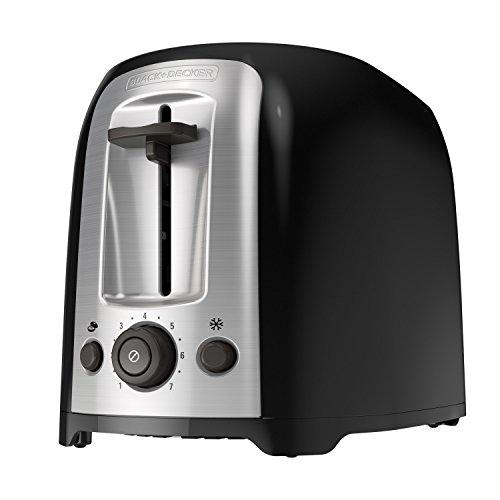
The BLACK+DECKER is the toaster most adults already know how to use, because its layout — dial, lever, bagel mode, seven shade settings — is the template the category settled on years ago. Muscle memory is a genuine simplicity feature: guests, teenagers and grandparents all operate it without instruction. The extra lift lever is the one thoughtful addition, raising short slices and muffin halves clear of the slots so retrieval never becomes the complicated part of breakfast.
Its limits are the classic ones. The listing names no defrost or reheat function, so frozen bread means a manual shade adjustment, and no wattage is stated. Neither flaw involves daily complexity; they are absences, not complications. If your definition of simple is “the toaster I grew up with, with wider slots”, this is your pick, and the removable crumb tray keeps its upkeep equally old-fashioned and easy.
Best for: anyone who wants the familiar dial layout with easier small-slice retrieval / Not suited for: frozen-bread households that need a named defrost function
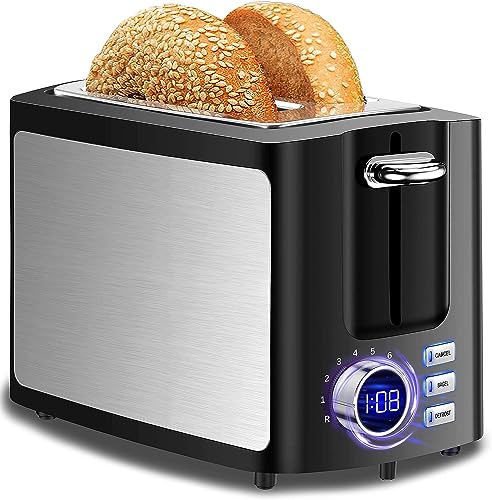
Hommater 2 Slice Wide Slot Smart Toaster
Badge: Most Features — Least Simple
Strengths
- LCD countdown removes the guesswork from waiting
- Nine shade settings are the widest range in this group
- Reheat function is named, which several rivals here omit
Trade-offs
- The display and smart positioning make it the least minimal design here
- No crumb tray is mentioned in the title
- No wattage is stated in the title
Key specs from the listing
- Format: 2-slice pop-up toaster
- Slots: wide slot design
- Shade settings: 9
- Display: LCD digital countdown timer
- Functions named in the listing: bagel, defrost, cancel, reheat
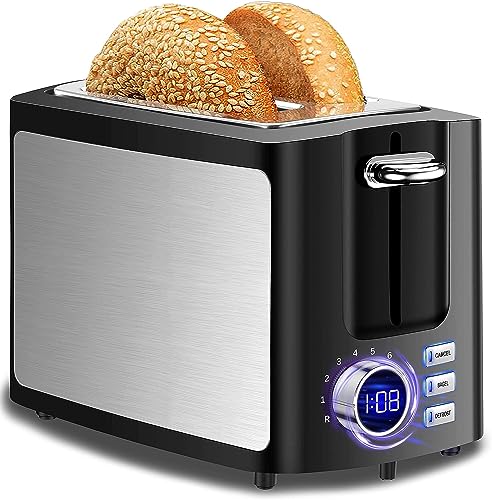
Honesty first: the Hommater is in this guide as the control case. An LCD digital countdown timer and nine shade settings are the opposite of minimal, and if your search for a simple toaster means a dial and nothing else, skip to the next picks with our blessing. It earns its place because for some households the countdown is the simplification: it ends the hovering, the guessing and the “is it nearly done” lever-checking that makes a shared toaster feel complicated in practice.
The function list is the fullest here — bagel, defrost, cancel and reheat are all named — and nine shades let a household dial in two or three memorised numbers for different breads. The costs are real: a display to keep clean, more electronics than a dial design, and no crumb tray mentioned in the title. Treat it as the predictability pick, not the simplicity pick, and it will not disappoint.
Best for: households that find a countdown simpler than guessing / Not suited for: true minimalists — choose the Amazon Basics instead

Amazon Basics 2 Slice Toaster
Badge: Best Truly Basic Pick
Strengths
- The only pick whose title states its wattage, which helps comparison
- Cord wrap keeps a small counter tidier between uses
- Defrost, cancel and bagel buttons cover the full everyday set
Trade-offs
- Six browning settings are the joint-narrowest range here
- Plain black and silver styling is functional rather than decorative
- No extra-lift or toast-boost feature is named in the title
Key specs from the listing
- Format: 2-slice pop-up toaster
- Slots: extra wide slots, sized for bagels
- Browning settings: 6
- Power: 900W (the only wattage stated in this group)
- Functions named in the listing: defrost, cancel, bagel
- Crumb tray: removable
- Storage: cord wrap
- Finish: black and silver
The Amazon Basics is what simple looks like when it is done deliberately. A dial with six browning settings, three buttons whose names are their entire instructions — defrost, cancel, bagel — extra-wide slots so bread never needs forcing, a removable crumb tray, and a cord wrap for tidy storage. It is also the only listing here that states its power, 900W, which suits the simple philosophy: the facts you need, stated plainly, with nothing left to decode.
There is nothing to configure, no display to interpret and no mode hierarchy to memorise, which makes it the strongest recommendation in this guide for rentals, first kitchens, offices and anyone buying for a less technical household member. Its trade-offs are absences rather than annoyances: no lift aid for very short slices and the joint-narrowest shade range here. For standard bread, bagels and frozen slices, it simply works.
Best for: rentals, first kitchens and anyone buying for a non-technical user / Not suited for: bakers of long artisan loaves

Elite Gourmet ECT1027B Cool-Touch Toaster
Badge: Best Cool-Touch Simple Pick
Strengths
- Cool-touch exterior is reassuring in busy or small kitchens
- Extra-wide slots are sized for bagels and thick-cut bread
- Six shade settings cover the everyday light-to-dark range
Trade-offs
- No defrost or reheat function is named in the listing title
- No crumb tray is mentioned in the title, so check the listing detail before assuming one
- No wattage is stated in the title
Key specs from the listing
- Format: 2-slice pop-up toaster
- Slots: 1.25-inch extra-wide slots
- Shade settings: 6
- Functions named in the listing: cancel, bagel
- Exterior: cool-touch, black finish
- Model: ECT1027B
The Elite Gourmet ECT1027B keeps its controls to the classic minimum — six shades, cancel and bagel handling — and spends its design effort on physical simplicity instead: a cool-touch exterior and 1.25-inch extra-wide slots. Wide slots are an underrated simplicity feature, because bread that drops in freely never needs pushing, turning or rescuing, and thick-cut and bakery slices stop being a special case. Cool-touch sides likewise remove a whole category of caution in a crowded kitchen.
The listing names no defrost or reheat function and mentions no crumb tray in its title, so frozen-bread households and keen cleaners should verify those details on the product page. Within its stated scope — fresh bread, bagels and thick slices, browned without fuss or hot sides — it is one of the most straightforward machines here, and a kind one to share a counter with.
Best for: shared kitchens that value cool-touch sides and thick-bread slots / Not suited for: households that toast from frozen daily
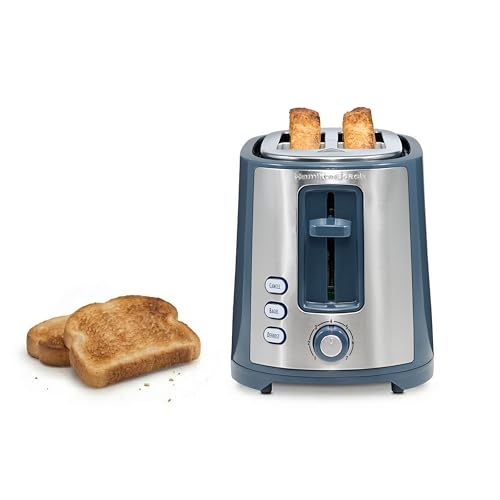
Hamilton Beach 22634 Extra-Wide Slot Toaster
Badge: Best Simple Family Pick
Strengths
- Toast Boost lifts small slices higher for safer retrieval
- Bagel and defrost buttons cover the two most common special cases
- Slide-out crumb tray makes routine emptying quick
Trade-offs
- The blue finish will not suit every kitchen scheme
- No reheat or cancel function is named separately in the title
- No wattage is stated in the title
Key specs from the listing
- Format: 2-slice pop-up toaster
- Slots: extra-wide slot design
- Shade settings: 7
- Functions named in the listing: bagel, defrost, auto shutoff, toast boost
- Crumb tray: slide-out
- Colour: Kitchen Makeover Blue
- Model: 22634
The Hamilton Beach 22634 adds two buttons to the classic layout and earns both. Bagel and defrost cover the two situations where a plain cycle genuinely underperforms, auto shutoff removes a background worry, and Toast Boost solves the small-slice problem by lifting finished toast higher. Seven shade settings and a slide-out crumb tray complete a package that a new user can still learn in a single breakfast, which is the working definition of simple used throughout this guide.
It is the most family-oriented of the straightforward picks: the controls map to real household events (frozen waffles, bagel halves, a muffin that sits low) rather than to novelty. The blue finish is the only real divider — charming in the right kitchen, distracting in the wrong one. If your household’s mornings involve variety but not patience for appliance learning curves, this is the balanced choice.
Best for: families whose simple still includes bagels and frozen slices / Not suited for: buyers who need a neutral finish
Comparison Table
Compare these models by decision load as much as by features. The highlights column repeats only listing-stated attributes; a function described as not named is absent from the title, which is itself useful simplicity information.
| Toaster | Badge | Listing-stated highlights | Link |
|---|---|---|---|
| bella Fits-Anywhere Slim Toaster | Best Simple Space-Saver | Slim; one extra long and wide slot; 4 slices per cycle; shade count not stated in title | Check on Amazon |
| BLACK+DECKER 2-Slice Toaster with Extra-Wide Slots | Best Classic Dial Pick | 2-slice; extra-wide slots; 7 shades; bagel mode; extra lift lever; removable tray | Check on Amazon |
| Hommater 2 Slice Wide Slot Smart Toaster | Most Features — Least Simple | 2-slice; wide slot; 9 shades; LCD countdown; bagel, defrost, cancel, reheat | Check on Amazon |
| Amazon Basics 2 Slice Toaster | Best Truly Basic Pick | 2-slice; extra wide slots; 6 settings; 900W stated; defrost, cancel, bagel; cord wrap | Check on Amazon |
| Elite Gourmet ECT1027B Cool-Touch Toaster | Best Cool-Touch Simple Pick | 2-slice; 1.25-inch extra-wide slots; 6 shades; cancel and bagel named; cool-touch | Check on Amazon |
| Hamilton Beach 22634 Extra-Wide Slot Toaster | Best Simple Family Pick | 2-slice; extra-wide slot; 7 shades; bagel and defrost; toast boost; slide-out tray | Check on Amazon |
The pattern to notice is that simplicity lives in different places: in the bella’s single slot, in the Amazon Basics button set, in the Hamilton Beach’s problem-named buttons. If counter width is your real constraint rather than controls, compare these with Best Slim Toasters, where the narrow-body specialists are judged on footprint first.
How to Choose the Best Simple Toasters for Your Household
Define simple for your actual household before looking at any product. For a solo cook with one loaf, simple means fewest parts and fewest choices: the bella or the Amazon Basics. For a family, simple means the toaster absorbs variety without teaching sessions: the Hamilton Beach, whose buttons are named after the situations themselves. For a household that shares one machine across strong preferences, simple can even mean the Hommater’s countdown, because predictability ends arguments. The word only helps once it is attached to your mornings.
Count decisions, not buttons. Dropping bread in, choosing a shade you chose last month, and pressing a lever is one decision. Remembering that slot two runs hot, that frozen bread needs shade plus two, and that muffins need fishing out with a fork is five decisions wearing a plain disguise. Lift aids (BLACK+DECKER’s extra lift lever, Hamilton Beach’s Toast Boost), wide slots that accept bread without persuasion, and a named defrost button all delete decisions, which is why they appear throughout this guide.
Be honest about the freezer. A truly simple life with frozen bread requires a defrost function, named in the Hamilton Beach, Hommater and Amazon Basics listings. Without one, the simple toaster becomes a daily experiment in shade compensation. Bagel households should similarly insist on a named bagel mode or button, present across most of this group. Functions you use weekly are simplicity; functions you use never are clutter, and the distinction is personal rather than universal.
Cleaning is the hidden complexity. Every toaster in this guide is simple at breakfast; they diverge at the crumb tray. Slide-out and removable trays (Hamilton Beach, BLACK+DECKER, Amazon Basics) turn cleaning into a ten-second habit, while designs whose titles do not mention a tray deserve a product-page check before purchase. A simple toaster that smokes by month three because its crumbs were inaccessible has failed at the only job that matters long-term. Our guide to Best Slim 2 Slice Toasters shows how these same cleaning designs play out in compact two-slice machines.
Finally, resist both directions of overthinking. Paying for motorised everything rarely survives contact with a school morning, and buying the barest box can mean daily workarounds that are their own complexity. The middle of this guide — a dial, the buttons your freezer and your bagels require, a tray you can empty — is where simple actually lives. Check the latest price on Amazon for your shortlist on the day you buy, and let the decision stay as uncomplicated as the appliance.
How to Keep a Simple Toaster Simple: Setup and Daily Routine
Set up once, properly. On day one, toast your usual bread at the middle setting, judge the result, and move one step in the needed direction. Write the winning number on a note inside a nearby cupboard door if the household shares the machine; a shared reference ends the daily dial debate that makes even a simple toaster feel fussy. Run one empty cycle first if the manual advises it, to clear new-appliance odours before they meet real bread.
Build the two-second habits. Centre slices in the slots, halve bagels evenly so they sit flat, and use the named buttons rather than improvised shade changes: defrost for frozen, bagel for cut-side browning, reheat on the Hommater for a slice that cooled while you were pouring coffee. These habits are the entire operating manual of a simple toaster, which is rather the point.
Problem: one side of the toast is always darker. → Centre the slice, empty the crumb tray, and check whether a sugary crumb cluster is sitting against one element; rotate your loaf storage so slices are uniform. Problem: the lever will not stay down. → Confirm the toaster is plugged in and the outlet live — most pop-up latches are electromagnetic and will not hold on a dead circuit — and clear any crumb jam around the carriage. Problem: toast is pale even on high settings. → Very fresh, moist bread browns slowly; a first low cycle to dry, then a browning cycle, beats maximum shade in one scorching pass.
Clean on the simplest possible schedule: tray out and emptied every week, a gentle upside-down shake over the bin, exterior wiped while the machine is cool and unplugged. The cord wrap on the Amazon Basics and the slim profile of the bella both reward households that put the toaster away; the counter models reward a fixed home with clear space above, since heat and steam rise straight into cabinet undersides.
Teach the house once. Show every user where the cancel control is, agree that metal never enters a slot, and agree that the lever is never forced. A simple toaster stays simple when the whole household shares the same three rules. Readers whose real constraint is a household of one may find Best Single Slot Toasters an even plainer answer, with a single slot and a single cycle to learn.
Simple Toasters for Rentals, Offices and First Kitchens
Some toasters are bought for people who will never read about them: tenants, guests, colleagues, students. In those settings the buying criteria invert. The best choice is the machine a stranger operates correctly at first touch, which is why the Amazon Basics and BLACK+DECKER lead this use case — labelled buttons, a legible dial, no display language to interpret, and trays that a cleaner can find without instructions. The Elite Gourmet’s cool-touch body adds a safety margin where the toaster sits in shared space.
Durability in these settings is about forgiveness: levers that tolerate enthusiasm, slots wide enough that nobody forces bread, and finishes that wipe clean. It is also about replaceability without resentment, which is a tier question rather than a price figure — check the latest price on Amazon and weigh it against how many strangers will use the machine. A simple toaster in a rental is infrastructure, and infrastructure should be boring in the best way.
When a Display Makes Life Simpler — and When It Does Not
The Hommater forces the interesting question in this guide. Its LCD countdown undeniably adds a component, a cleaning surface and a small learning moment. It also removes the most common complication of shared toasting: uncertainty. Kitchens run on parallel tasks, and knowing a cycle has forty seconds left lets a cook time eggs and coffee around it instead of hovering. For single users with one bread and one shade, that information is worthless; for a family production line, it is the difference between calm and queueing.
The honest rule is to buy information only if you will act on it. If nobody in your house times anything, choose the dial models and enjoy their plainness. If your mornings are choreographed, the countdown is not a gimmick but a coordination tool. Simplicity, in the end, is measured in friction per breakfast — and friction is a household property, not a product property.
The Three-Minute Test: Judging Simplicity in a Shop or Listing
You can grade any toaster’s simplicity in three minutes with three questions. First: can a stranger produce toast without instruction? That tests the control layout — a dial and labelled buttons pass, a menu fails. Second: can a stranger retrieve a short slice safely? That tests lift design, where the BLACK+DECKER’s extra lift lever and the Hamilton Beach’s Toast Boost earn their keep. Third: can a stranger find and empty the crumb tray? That tests the cleaning design, where slide-out and removable trays pass and hidden arrangements fail. A toaster that passes all three is simple in the ways that compound daily.
Apply the test to this guide’s boundary case and it becomes more interesting: the Hommater passes the first question only after a short explanation of its display, passes the second unremarkably, and leaves the third unconfirmed by its title. That mixed report card is exactly why it is badged as the least simple pick while still being recommended to timing-driven households. Simplicity is a profile, not a pass mark — and profiles can be matched to people with unusual precision once you stop treating simple as a synonym for basic.
Simple Toasters and Accessible Kitchens
Simplicity and accessibility overlap heavily, and this guide’s criteria serve both. Large, labelled buttons beat touch panels for users with limited dexterity or vision; a dial with distinct steps beats a smooth slider; a lever that stays where it is put beats a sensor. Cool-touch exteriors, as on the Elite Gourmet, reduce the consequences of a steadying hand landing on the machine. Extra lift mechanisms reduce the reach into hot slots that challenges anyone with reduced grip or sensation.
If you are equipping a kitchen for an ageing parent, a teenager with additional needs, or a holiday let used by strangers, run the three-minute test with that specific user in mind and weight retrieval and touch-safety above all else. In this guide that points to the Amazon Basics for its labelled plainness, the BLACK+DECKER for its lift, and the Elite Gourmet for its cool sides — three different machines answering three different bodies, all under the one honest heading of simple.
What Simple Toasters Leave Out — and Why That Is Fine
Every simple toaster is an argument about what breakfast does not need. It does not need connectivity, because toast cannot be improved by a notification. It does not need a motorised carriage for most users, because a lever is a solved mechanism. It does not need a dozen bread programmes, because shade, bagel and defrost cover the physical situations bread actually presents. The machines in this guide leave out different things — the bella leaves out a second slot, the Amazon Basics leaves out display and lift aids, the BLACK+DECKER leaves out a named defrost — and each omission is defensible because each maps to a household that will never miss it.
The discipline for buyers is to list their own non-negotiables before admiring anyone’s omissions. Write down the three things your mornings genuinely require — frozen bread, bagels, small muffins, thick slices, a countdown for a choreographed kitchen — and then choose the simplest machine that contains all three. Everything beyond that list is complexity you will clean, store and eventually repair, purchased with money and counter space alike.
Teaching the House: The One-Page Manual That Should Not Exist
A truly simple toaster needs no house manual, and yet writing one — mentally, at least — is the best audit of whether you bought one. If your instructions fit three lines (bread in the wide slots, dial stays at the house number, tray empties on Fridays), you own a simple machine. If they need a paragraph about which slot runs hot, which button combination defrosts, and which utensil is safe for retrieval, the machine is asking your household to memorise its compromises. The models in this guide were graded, in effect, by the length of the manual they would need.
Run the audit on your current toaster before replacing it, because sometimes the complexity lives in the household rather than the machine: three breads, two freezers’ worth of stock and five shade opinions will make any appliance feel complicated. Simplifying the inputs — one house loaf, one agreed setting, a tray routine — can rescue a decent toaster. But where the machine itself is the problem, the plainest picks here, the Amazon Basics and the BLACK+DECKER, are the correction.
Simple Toasters in Guest Houses, Lets and Second Homes
Properties that host strangers are the purest test of simplicity, because every user arrives without context and leaves before forming habits. The winning specification in that setting is boring in the best way: labelled buttons, a legible dial, wide slots that forgive unfamiliar bread, a tray a cleaner can find, and an exterior that survives enthusiastic wiping. The Amazon Basics and BLACK+DECKER fit that specification most completely in this guide, with the Elite Gourmet’s cool-touch body as the safety-conscious alternative for properties hosting children.
Hosts should also think about failure hospitality: when a simple toaster eventually fails in a let, it fails obviously and is replaced in kind within a day, with no guest ever meeting a smart interface mid-holiday. That replaceability is a tier property — check the latest price on Amazon when the time comes — and it is one more reason the simple end of this market endures while cleverer machines cycle through rentals and are quietly removed by their owners.
The Lever, the Dial and the Button: An Appreciation
The three controls of the classic toaster deserve a moment of respect, because each is a small masterpiece of legibility. The lever commits: it is either down, toasting, or up, finished, and its state can be read across a room. The dial remembers: it holds yesterday’s decision so today needs none. The button specialises: bagel, defrost and cancel each say their whole meaning in their name. Machines in this guide that keep that trio — the Amazon Basics and BLACK+DECKER above all — inherit a century of interface refinement that no touchscreen has improved for this task.
When you shop beyond this guide, grade every interface against those three virtues: state you can read at a glance, memory that spares you decisions, and controls named after the situations they serve. A toaster that fails those tests may still toast well, but it will tax every morning slightly, and slight taxes on daily rituals are the ones that compound into replacement purchases.
Simple Toasters for Caravans, Boats and Tiny Living
Mobile and miniature living spaces stress-test simplicity in useful ways: power is budgeted, storage is contested, and every appliance must justify itself weekly or be left behind. The plain two-slice machines in this guide travel conceptually well — no displays to confuse an inverter-fed supply, no standby draw to speak of, controls that work by lantern light. The bella’s slim residency suits a fixed tiny kitchen; the Amazon Basics’ cord wrap suits a machine that is genuinely stowed and deployed.
Whichever profile fits, the tiny-living rule is the simple rule intensified: one appliance, fewest decisions, easiest cleaning, because there is nowhere to hide a complicated machine from yourself in forty square feet. Readers outfitting such a space should run the three-minute test from this guide in the space itself, tape measure in hand, before any purchase is final.
Why Simple Machines Age Gracefully
There is a longevity argument for simplicity that has nothing to do with nostalgia. Fewer components means fewer failure modes; mechanical controls degrade gradually and visibly rather than suddenly and digitally; and a machine whose whole interface is a lever and a dial remains fully usable on the day its least important feature fails. The simple toasters in this guide are, in that sense, the low-risk holdings of the category — unlikely to delight technophiles, equally unlikely to strand a household mid-breakfast.
Graceful ageing also has a human side: a simple toaster can be inherited, lent, donated and re-homed without a manual changing hands, and it will be understood in its new kitchen within one breakfast. In a consumer landscape of orphaned smart devices, that transferability is a genuine, if unglamorous, virtue — and one more reason the plain centre of this market refuses to disappear.
Common Buying Mistakes
The classic mistake is equating simple with featureless, then living with the workarounds: no defrost button for a freezer household, no lift aid for muffin lovers, slots too narrow for the household loaf. Each missing function becomes a daily improvisation, and improvisation is the opposite of simple.
The opposite mistake is buying a smart, connected or display-heavy machine for a user who wanted a dial — often a gift purchase for parents or a first flat. If the recipient did not ask for information, a screen is a burden with a power draw. Match the machine to the user’s temperament, not to your own.
Finally, do not overlook retrieval and cleaning when judging simplicity in the shop. Press the lever, imagine a short slice at the bottom of the slot, and find the crumb tray with your eyes. Ten seconds of that rehearsal predicts more daily satisfaction than any feature list — and it is exactly the rehearsal the lift levers, boost features and slide-out trays in this guide were designed to pass.
Final Recommendation
If one recommendation must stand for the whole guide, it is the Amazon Basics: a dial, three plainly named buttons, wide slots, a removable tray, a cord wrap and a stated 900W. It asks nothing of its user and answers every ordinary need, which is the complete definition of a simple toaster.
Adjust for your household. Families with frozen stock and bagels should take the Hamilton Beach. Anyone who already knows the classic layout by heart should take the BLACK+DECKER and its extra lift. Space-poor one-loaf households should take the bella. And if your household runs on timing, take the Hommater without guilt — predictable is its own kind of simple.
Check the bella Fits-Anywhere Slim Toaster on Amazon. Check the BLACK+DECKER 2-Slice Toaster with Extra-Wide Slots on Amazon. Check the Hommater 2 Slice Wide Slot Smart Toaster on Amazon.
Frequently Asked Questions
What is the simplest toaster in this guide?
The Amazon Basics, by decision count: one dial, three named buttons, wide slots and a removable tray, with no display or configuration. The bella is a close rival for one-loaf households because its single slot removes slot choice entirely, though its listing leaves shade details to the product page.
Is a toaster with a screen ever simple?
For the right household, yes. The Hommater’s countdown does not simplify the machine, but it can simplify the morning by making the cycle predictable for everyone sharing it. If nobody will use the timing information, a dial model is genuinely simpler and should be chosen instead.
Do simple toasters toast as well as advanced ones?
For standard bread, yes. Browning quality depends mainly on element design, slot fit and consistency, none of which require electronics. Advanced models add precision and information — finer shade steps, countdowns, reheat modes — which help specific households but do not change the physics of good toast.
Which simple toaster is best for an elderly relative?
Choose labelled buttons over symbols, a dial with clear steps, an easy lift for small slices and a cool-touch or safely placed body. In this guide, the Amazon Basics and BLACK+DECKER fit that brief best, with the Elite Gourmet’s cool-touch exterior a strong alternative where hot sides are the main concern.
Can a simple toaster handle frozen bread and bagels?
Yes, if the right buttons are present. Defrost is named in the Hamilton Beach, Hommater and Amazon Basics listings, and bagel handling is named across most of the group. Simple does not mean one-function; it means the functions present are the ones your household actually uses, clearly labelled.
How do I keep a simple toaster working for years?
Empty the crumb tray weekly, never force the lever or insert metal utensils, and let cycles finish rather than repeatedly cancelling mid-way. These machines have few failure points, and most early failures trace back to crumb build-up or a jammed carriage rather than electronics.
Should I choose one slot or two?
Two slots suit households that toast different breads or shades at once. One long slot, as on the bella, suits one-loaf households and long artisan bread, and removes a layer of choice. Our dedicated guide to Best Single Slot Toasters explores that trade-off in full.