Disclosure: topratedkitchenware.com is reader-supported. When you buy through links on our site, we may earn an affiliate commission from Amazon and other retailers, at no extra cost to you.
Where to buy
This guide to the best toasters 2 slice buyers can choose from is a study of the classic format, and it begins with a small act of housekeeping: five of the six verified listings behind this guide are genuine two-slice toasters, and those five are linked below, each name leading to its Amazon listing where you can check the latest price on Amazon. The sixth, the bella Fits-Anywhere Slim Toaster, is a four-slice machine in a slim body; it is reviewed in full as a prose-only pick because it is the alternative many two-slice shoppers are secretly weighing, but it carries no link in a guide whose promise is two slices. Within the five, the spread is wider than the shared format suggests: a display-led machine with nine shade settings, two seven-setting traditionalists with serious lift features, a button-led simplicity pick with the pool’s only stated wattage, and a cool-touch model with the pool’s only stated slot width. Read the full guide and the format will choose its own winner for your kitchen.
- Hommater 2 Slice Wide Slot Smart Toaster — Best Overall. Best for countdown feedback and the finest shade ladder in the format.
- BLACK+DECKER 2-Slice Toaster with Extra-Wide Slots — Best Extra Lift. Best for small items that sit low in the slot.
- Amazon Basics 2 Slice Toaster — Best Button Simplicity. Best for labelled buttons, a cord wrap and a stated 900W.
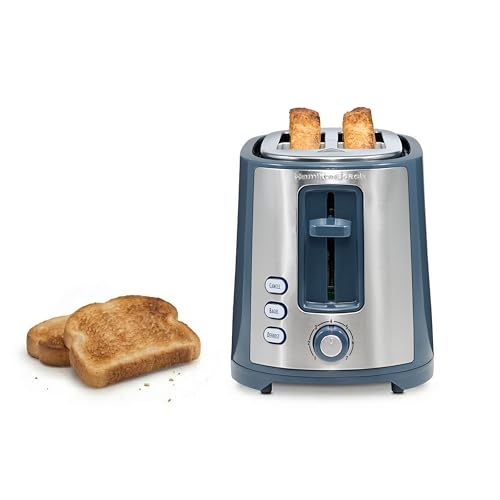
- Hamilton Beach 22634 Extra-Wide Slot Toaster — Best Toast Boost. Best for a higher lift, auto shutoff and a blue finish.
- Elite Gourmet ECT1027B Cool-Touch Toaster — Best Cool-Touch. Best for thick bread and tight, touch-prone placements.
- bella Fits-Anywhere Slim Toaster — Best If You Actually Need Four Slices (prose-only in this guide). Best for families whose breakfast has outgrown two slots.
Read the full guide ↓
Introduction: The Format That Refuses to Retire
The best toasters 2 slice shoppers keep buying, decade after decade, survive because the format matches the arithmetic of most breakfasts. One or two people, one or two slices each, a machine that heats fast, sits modestly and asks little. Four-slice toasters promise family throughput, long-slot designs promise bakery geometry, and oven-style machines promise a second oven, yet the two-slice pop-up remains the default answer because most mornings are small. Choosing well inside the format is therefore a real decision, not a default: the difference between a two-slice toaster that merely occupies the counter and one that quietly perfects a daily ritual lives in slot width, lift height, shade granularity and the honesty of its controls.
The five verified two-slice listings behind this guide map that decision space neatly. At one pole sits the Hommater, which treats the format as a small information appliance, with an LCD countdown and nine shade settings. At the other pole sit the lever-and-dial traditionalists, the BLACK+DECKER with its extra lift and the Hamilton Beach with its Toast Boost and auto shutoff, machines that compete on the physical moments of toasting rather than the informational ones. Between them, the Amazon Basics makes the case for labelled-button legibility and the pool’s only stated wattage, while the Elite Gourmet makes the case for a stated slot width, thick bread named outright, and sides that stay cool in tight quarters. The prose-only bella stands at the edge of the guide as the honest temptation: four slices in a slim body, for readers whose two-slice arithmetic may simply be wrong. Readers narrowing the format further by slot geometry will want our Best Toasters 2 Slice Wide Slot research, and those shopping the format from Britain should detour through Best Toasters 2 Slice Uk for the voltage and plug picture before comparing features.
Key Takeaways
- Five of the six verified picks here are true two-slice toasters and are linked; the four-slice bella is reviewed prose-only as the format alternative.
- Within one format, the real differences are slot width, lift, shade steps and feedback: a countdown display and nine settings at one end, levers and lift mechanisms at the other.
- Extra-wide slots appear in every linked listing here, so bagels and thick slices are table stakes in this pool, not upgrades.
- Lift features, the BLACK+DECKER’s extra lift lever and the Hamilton Beach’s Toast Boost, decide daily satisfaction for muffin and crumpet households.
- The Amazon Basics is the pool’s only listing with a stated wattage, 900W, and the Elite Gourmet the only one with a stated slot width, 1.25 inches.
- Two slices suit one and two person breakfasts run in a single pass; if your mornings regularly queue, the prose-only four-slice discussion is required reading.
In this guide
Quick Picks
| Pick | Badge | Shades | Standout listed feature | Link |
|---|---|---|---|---|
| Hommater 2 Slice Wide Slot Smart Toaster | Best Overall | 9 | LCD countdown, bagel/defrost/cancel/reheat | Check on Amazon |
| BLACK+DECKER 2-Slice Toaster | Best Extra Lift | 7 | Extra lift lever, bagel mode | Check on Amazon |
| Amazon Basics 2 Slice Toaster | Best Button Simplicity | 6 | Labelled buttons, cord wrap, 900W stated | Check on Amazon |
| Hamilton Beach 22634 | Best Toast Boost | 7 | Toast Boost, auto shutoff | Check on Amazon |
| Elite Gourmet ECT1027B | Best Cool-Touch | 6 | 1.25 inch slots, thick bread named | Check on Amazon |
| bella Fits-Anywhere Slim Toaster | Best If You Actually Need Four Slices | Not stated | Four slices, one long slot, slim body | Prose-only |
Notice the pattern in the standout column: each machine champions a different moment of the toasting cycle. One informs you, two lift for you, one simplifies for you, one stays cool for you, and the prose-only outlier simply feeds more of you. Choosing a two-slice toaster is choosing which moment of your morning most needs help, and the reviews below are organised to make that choice concrete.
How These Picks Were Chosen
This guide is research-led. We have not run hands-on trials, toasted a set number of slices or lived with any of these machines for a month, and we will not dress up listing research as laboratory work. The method was to take the six verified listings assigned to this keyword, confirm the format each one states, and apply the linking rule the keyword demands: a pick is linked as a two-slice toaster only when its own listing states a two-slice format. Five pass cleanly, the Hommater, BLACK+DECKER, Amazon Basics, Hamilton Beach and Elite Gourmet, each describing two slices in its title. The bella states four slices, so despite its slim body and its genuine relevance to space-conscious shoppers, it is covered in full as a prose-only alternative with no link and no image, and the article says why at every step.
Ranking among the five followed the features that separate two-slice machines in daily use. Feedback and shade granularity came first, which puts the display-led Hommater on top. Retrieval came next, because the stuck small item is the format’s most common daily failure, lifting the two lift-equipped machines. Legibility, housing and stated specifications filled out the order: labelled buttons and a wattage figure for the Amazon Basics, a shutoff for the Hamilton Beach, a measured slot and cool sides for the Elite Gourmet. Specifications are quoted only where listings state them, and silences, the bella’s shade count among them, are reported as silences. That restraint is what lets a short format guide stay honest: two slices is a simple promise, and this page keeps it simply.
The Best Toasters 2 Slice Buyers Should Consider, in Detail
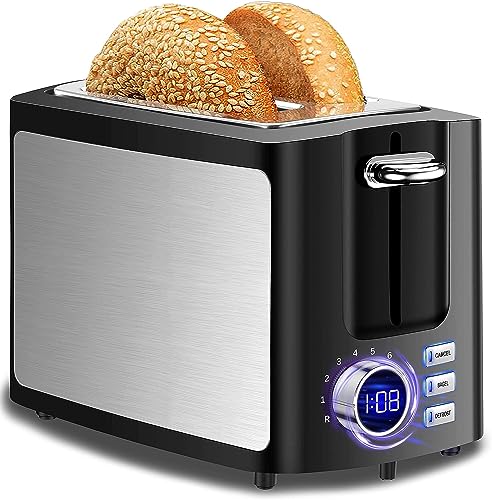
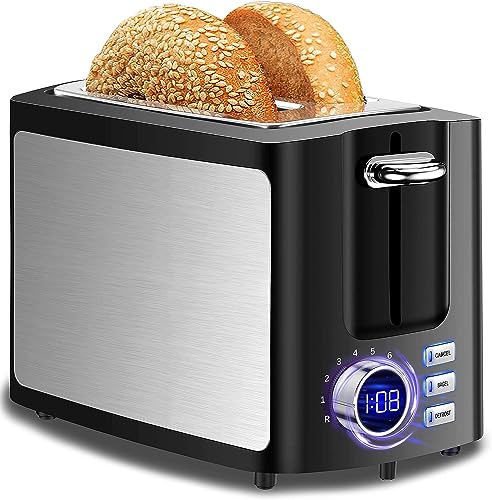
Hommater 2 Slice Wide Slot Smart Toaster
Badge: Best Overall
Strengths
- LCD digital countdown timer turns the two-slice cycle into scheduled information.
- Nine shade settings are the finest ladder in the format here.
- Bagel, defrost, cancel and reheat functions are all listed in one control layout.
Trade-offs
- Its slot is described as wide rather than extra-wide, with no width figure stated.
- A display-led panel asks more learning than a dial, and shows splashes more readily.
- No lift feature is named for small items.
Mini spec box
- Format: 2 slice, wide slot
- Display: LCD digital countdown timer
- Shade settings: 9
- Listing-stated functions: bagel, defrost, cancel, reheat
The Hommater tops this guide because it gives the classic format the one thing the format has always lacked: information. Two slices is a small, fast job, and precisely because it is fast, its timing collides with everything else in a tight breakfast, the eggs, the coffee, the departure. A countdown display dissolves those collisions, and nine shade settings mean the result, when it lands, is the result you meant. The function set is complete for the format’s real work: defrost for the frozen loaf that two-slice households, with their smaller freezers and faster turnover, rely on heavily; reheat for the slice orphaned by a phone call; bagel for the halved case; cancel for the human case.
The honest limitations are a slot described in the pool’s most modest width language and the absence of a named lift, so small-item retrieval is conventional. If your two-slice life is mostly standard slices on a schedule, neither limitation will ever surface, and this is the most capable machine in the format here. If your life is mostly muffins, read the next review first.
Best for: schedule-driven one and two person households that want feedback and fine shades / Not suited for: buyers whose priority is small-item lift
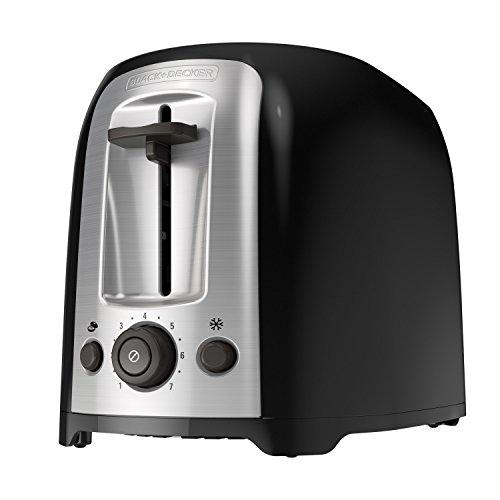
BLACK+DECKER 2-Slice Toaster with Extra-Wide Slots
Badge: Best Extra Lift
Strengths
- Extra lift lever raises small items clear, the format’s most useful mechanical kindness.
- Extra-wide slots and a bagel mode cover thick slices and halved bagels.
- Seven shade settings give a finer ladder than the six-setting picks.
Trade-offs
- No defrost or reheat function is named in the listing.
- Slot width is described rather than quantified.
- Feedback is experience-based; there is no display.
Mini spec box
- Format: 2 slice, extra-wide slots
- Shade settings: 7
- Listing-stated functions: bagel mode, extra lift lever, removable crumb tray
If the Hommater is the format’s brain, the BLACK+DECKER is its hands. The extra lift lever addresses the two-slice toaster’s signature annoyance, the small item that finishes below fingertip level, and it does so mechanically, instantly, without a setting to learn. In households where breakfast alternates between full slices and muffins, crumpets or the ends of loaves, that lever quietly becomes the feature the machine is loved for. Extra-wide slots and a bagel mode keep the entry side of the cycle equally thoughtful, and seven shades are enough ladder for most households to find and keep their numbers.
The honest limitations are the unnamed defrost and reheat functions, which freezer households will miss, and the absence of any stated slot figure for buyers who like their width in inches. Neither flaw is hidden by the listing, and both are the kind of trade a traditional design makes openly. For the buyer who wants the classic format executed with mechanical intelligence, this is the benchmark.
Best for: mixed-item households that toast small things daily / Not suited for: buyers who need a named defrost or reheat function

Amazon Basics 2 Slice Toaster
Badge: Best Button Simplicity
Strengths
- Labelled defrost, cancel and bagel buttons make every mid-cycle decision obvious.
- The only stated wattage in the pool, 900W, gives planners a concrete figure.
- Cord wrap and a removable crumb tray keep a small footprint tidy.
Trade-offs
- Six browning settings are the format’s coarsest ladder here.
- No lift feature or display is listed.
- The black and silver finish shows crumbs readily.
Mini spec box
- Format: 2 slice, extra wide slots for bagels
- Browning settings: 6
- Power: 900W (the only wattage stated in this pool)
- Listing-stated functions: defrost, cancel and bagel buttons, removable crumb tray, cord wrap
The Amazon Basics model is the two-slice format at its most legible. Three buttons say what they do, the slots are extra wide and described as for bagels, and the whole machine can be understood by a guest in one glance, which in shared households is a form of quality no specification sheet captures. The stated wattage is a welcome piece of concreteness in a pool that mostly declines to offer one, and the cord wrap acknowledges that a two-slice toaster’s natural home, the modest counter, is exactly where cable clutter hurts most. Readers who comparison-shop across channels, including the aisle logic explored in Best Toasters At Walmart, will recognise this as the straightforward end of the format, and there is a large, sensible market for exactly that.
The honest limitations are granularity and retrieval: six settings split the browning journey more coarsely than its seven and nine setting rivals, and small items ride at standard height. A single-taste household will never feel the first; a muffin household will feel the second weekly. Buy it for clarity and tidiness, and it will not disappoint.
Best for: shared households and first flats that value legible controls / Not suited for: buyers who want fine shade steps or a high lift
Hamilton Beach 22634 Extra-Wide Slot Toaster
Badge: Best Toast Boost
Strengths
- Toast Boost raises finished items higher, answering the same retrieval problem as a lift lever.
- Auto shutoff is listed, a passive safety behaviour for rushed households.
- Seven shades with bagel and defrost buttons cover a wide range of two-slice work.
Trade-offs
- The blue finish will not suit every kitchen.
- Slot width is described rather than quantified.
- No countdown or display feedback is offered.
Mini spec box
- Format: 2 slice, extra-wide slot
- Shade settings: 7
- Listing-stated functions: bagel and defrost buttons, auto shutoff, Toast Boost, slide-out crumb tray
- Finish: Kitchen Makeover Blue
- Model: 22634
The Hamilton Beach is the BLACK+DECKER’s closest rival and its mirror in one respect: where the rival lifts with a lever you raise, this one boosts the finished item upward as part of the cycle’s end, and the practical result, small items presented rather than buried, is much the same. Around that shared virtue it builds a slightly different case, adding a defrost button the rival’s listing does not name and an auto shutoff that suits households whose mornings end in a dash for the door. Seven shades and a slide-out crumb tray complete a package that treats the two-slice format as a finished idea rather than a basic one.
The honest limitations are the unquantified slot and the finish, which is a genuine decision: Kitchen Makeover Blue will anchor a pale kitchen cheerfully and fight a patterned one daily. There is no display, so schedule-driven cooks should look up the page to the Hommater. As a head-to-head with the BLACK+DECKER, choose defrost and shutoff here, or the lever and the removable tray there; on the format’s fundamentals they are well matched.
Best for: households that want boost lift, defrost and a safety shutoff in one machine / Not suited for: buyers who need a neutral finish or display feedback

Elite Gourmet ECT1027B Cool-Touch Toaster
Badge: Best Cool-Touch
Strengths
- Slots are stated at 1.25 inches, extra-wide, with bagels and thick bread named, the format’s clearest slot evidence.
- Cool-touch housing widens placement options in tight kitchens.
- Six shades and a cancel function keep the controls uncomplicated.
Trade-offs
- Six shades are the coarsest ladder alongside the Amazon Basics.
- No defrost, reheat or lift feature is named.
- The black finish is understated.
Mini spec box
- Format: 2 slice, cool-touch body
- Slot width: 1.25 inches, extra-wide
- Shade settings: 6
- Listing-stated functions: cancel; bagels and thick bread suitability
- Model: ECT1027B
The Elite Gourmet is the two-slice pick for the household whose bread runs thick and whose counter runs tight. It brings the format’s only measured slot, an explicit welcome for thick bread, and a housing that stays cool enough to forgive the placements small kitchens impose. In a two-slice guide those are heavyweight virtues, because they answer the two questions the format’s buyers actually ask after capacity: will my loaf fit, and where will the machine live. The controls stay deliberately plain, six shades and a cancel, which will read as simplicity to some households and as absence to others.
The honest limitations are exactly that plainness: no defrost for the freezer household, no lift for the muffin household, no ladder finer than six for the split-preference household. It is the specialist of the five, and specialists are bought for their specialism. If thick slices and tight placement are your two facts, this is your two-slice toaster.
Best for: thick-bread households with tight, touch-prone counters / Not suited for: buyers who need defrost, reheat or a fine shade ladder
bella Fits-Anywhere Slim Toaster
Badge: Best If You Actually Need Four Slices (prose-only in this guide)
Strengths
- Four slices per cycle from a slim body with one extra long and wide slot.
- Long slices toast whole in a single pass.
- The slim shape fits narrow counters that defeat conventional four-slice bodies.
Trade-offs
- It is not a two-slice toaster, which is why it is prose-only here.
- The listing states no shade count and names no bagel or defrost functions.
- One shared slot means one browning decision per batch.
Mini spec box
- Format: 4 slice, single extra long and wide slot
- Design claim: slim, fits-anywhere body
- Finish: Oatmilk
- Listing-stated functions: none named beyond the slot format
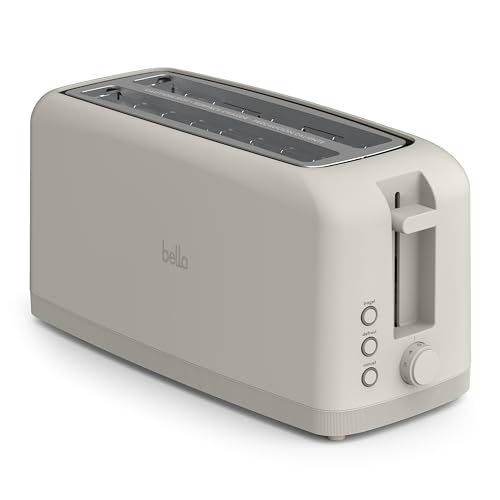
Every two-slice guide owes its readers one honest interruption, and this is it. If your household’s breakfast regularly queues, two people waiting while two slices toast, the format itself is your bottleneck, and no feature inside it will fix that. The bella exists for that realisation: four slices at once, in a body slim enough for the counters that usually force the two-slice choice, with a long slot that additionally swallows the bakery slice whole. It is reviewed here, without a link, because a two-slice guide that hid the four-slice alternative would be serving its keyword rather than its readers. Buyers who conclude that capacity is indeed their issue will find the wider field mapped in Best Toasters 4 Slice.
The honest limitations, beyond the format mismatch that defines its place here, are an unstated shade count, no named functions and a shared slot that makes one browning decision serve the whole batch. Households of mixed shade loyalties should weigh that carefully. But for the family that has been running a two-slice machine in relays and calling it normal, this prose-only pick may be the most useful review on the page.
Best for: families whose breakfast has genuinely outgrown two slots / Not suited for: buyers committed to the two-slice format or to per-batch shade variety
Comparison Table
| Pick | Format | Shades | Standout listed feature | Link |
|---|---|---|---|---|
| Hommater 2 Slice Smart Toaster | 2 slice, wide slot | 9 | LCD countdown, reheat listed | Check on Amazon |
| BLACK+DECKER 2-Slice Toaster | 2 slice, extra-wide slots | 7 | Extra lift lever | Check on Amazon |
| Amazon Basics 2 Slice Toaster | 2 slice, extra wide slots | 6 | Labelled buttons, 900W stated | Check on Amazon |
| Hamilton Beach 22634 | 2 slice, extra-wide slot | 7 | Toast Boost, auto shutoff | Check on Amazon |
| Elite Gourmet ECT1027B | 2 slice, 1.25 inch extra-wide slots | 6 | Cool-touch body, thick bread named | Check on Amazon |
| bella Fits-Anywhere Slim Toaster | 4 slice, one long slot | Not stated | Slim body, long loaves whole | Prose-only |
One format, five linked personalities and one honest alternative. The table compresses the guide to a single question: which moment of your two-slice morning, timing, retrieval, clarity, safety or fit, most needs a machine’s help.
How to Choose a 2 Slice Toaster
Confirm the format fits your mornings before you compare a single feature. Count the slices your household toasts in its busiest quarter hour, including second rounds for the person who always wants another. If the answer is two, or two twice without time pressure, the format is right and the rest of this section applies. If the answer involves a queue, reread the prose-only bella review and the capacity discussion with fresh eyes, because features cannot fix arithmetic. Format settled, compare slots. Every linked pick here claims wide or extra-wide slots, but only the Elite Gourmet states a width, so if your loaf is genuinely thick, either choose the stated figure or verify the others on their product pages.
Then choose your moment. If breakfast is a timetable, feedback is your feature and the countdown-led Hommater is the template. If breakfast is a retrieval struggle, lift is your feature, in lever or boost form. If breakfast is a shared, multi-user negotiation, legibility is your feature and labelled buttons win. If breakfast happens in a tight corner, housing is your feature and cool-touch sides widen your placement options. Shade steps thread through all of it: mixed households should prefer seven or nine steps, single-taste households can happily live with six. Finally, read the listing’s silences as carefully as its claims, a discipline that matters in every corner of this market, from the model-number searches gathered under Best Toasters 22016 to the duplicate-aisle variants in Best Toasters At Walmarts, where the same machine can appear under slightly different descriptions and only the stated specification tells you whether you are looking at one product or two.
How to Use and Care for a 2 Slice Toaster
Daily use rewards three habits. First, learn your number: spend the first week noting which shade setting suits your usual loaf, fresh and frozen, and let the household write its numbers where the cook can see them, because a two-slice machine’s small capacity means its settings get used more deliberately than a big machine’s. Second, respect the second batch: a hot cavity browns faster, so step the shade down for repeat cycles or accept a brief rest between rounds, especially when the second round is for the pale-toast person. Third, use the functions as labelled rather than improvising around them, defrost for frozen, bagel for halved, reheat where it exists for the interrupted slice, because each exists to solve a timing problem that raw shade adjustments solve badly.
Care is a crumb routine and a cool-down routine. Empty the tray weekly, twice weekly in seeded-loaf households, choosing a machine whose tray style, removable or slide-out, matches your patience. Wipe the top plate and exterior once cool, keep the slots clear of foil and packaging, and never reach into a plugged-in machine with metal. Store the cord as the machine intends, wrapped where a wrap is listed, and give the toaster clear air above it in use, whatever its size. A two-slice toaster asks little; these small consistencies are the whole of its rent.
The first week with any of these machines deserves a name: calibration week. Every toaster’s shade scale is a private language, and the same number means different browning on different models, different breads and even different slots of the same machine. Spend the first few days treating breakfast as light research. Toast your usual loaf at the middle setting, look at the result with genuine attention, and adjust one step at a time rather than swinging the dial. Do the same for your frozen setting, because freezer households live or die by the gap between fresh and frozen behaviour. If the machine has a display, note the times that pair with your settings; if it has buttons, learn which of them you actually press by the second week, since the pressed ones define the machine you really bought. Households that do this small work once are rewarded with years of unconsidered accuracy, while households that skip it often conclude, unfairly, that their toaster is inconsistent, when in fact it was never introduced to their bread.
Calibration week is also the moment to settle placement and routine. Decide where the machine lives when it is hot, where it lives when it is not, and how the cord travels between the two, because a two-slice toaster is moved more often than its size suggests, pulled forward for clearance, pushed back for counter space, turned for the tray. Set the tray rhythm by your crumb production rather than by the calendar’s symmetry, and agree, if the household is shared, on the house rule for the second batch shade step, the single most argued-over setting in any two-slice kitchen. These are tiny domestic treaties, but a toaster is a daily appliance, and daily appliances are governed by treaty or by friction, with nothing in between.
Troubleshooting
Problem: one slot browns darker than the other → check for crumb build-up or a leaning slice in the paler slot, and centre the bread; persistent one-sided results after cleaning are a reason to consult the product’s support route. Problem: small items finish too low to reach → use the lift feature fully if your model lists one; if it does not, let the item cool briefly so it firms, and lift with a wooden utensil only once the cycle has fully ended. Problem: toast is right on the first round and dark on the second → the cavity is heat-soaked; drop one shade step for repeats, the most universal fix in this entire category.
Two Slices or Four: The Capacity Question Answered Honestly
There is a third path worth naming for completeness, because some readers arrive at this keyword having half-decided against the pop-up format altogether: the toaster oven and the air fryer hybrid, which toast as a side job. Those machines earn their counter space when the household genuinely roasts, bakes and reheats in them weekly; as pure toast appliances they are slower to the slice and larger on the counter than anything in this guide. The two-slice pop-up’s defence is specialisation: it does one job, at the speed and size that job deserves. Readers who conclude that their kitchen really does need the multi-job machine should shop that category on its own terms rather than asking a two-slice guide to bless the detour, and readers who conclude the opposite, that toast is the job and the job is daily, are exactly the readers the five linked picks above were chosen for.
Because this guide contains both formats, it can answer the capacity question without an agenda. Two slices win on footprint, warm-up feel and price-of-entry in the qualitative sense, and they match the way one and two person households actually eat. Four slices win the moment a third person’s breakfast becomes a daily event rather than a weekend exception, because relay toasting costs the scarcest morning resource, which is not electricity but sequential attention. The slim long-slot design complicates the old trade-off by shrinking the four-slice footprint, and it adds the long-loaf gift, but it charges for both with a shared browning decision. The mature way to decide is to watch your own kitchen for three mornings: if a queue forms, capacity is your problem; if a slice gets stuck, retrieval is; if shades disappoint, control is. Buy for the problem you observed, not the one the category advertises.
Five Machines, Five Households: Matching the Pick to the Morning
Abstract comparisons sharpen when they are attached to households, so consider the five linked picks as five answers to five recognisable mornings. The first household runs on a timetable: a commuter who times the train, eggs that must land with the toast, a kitchen choreographed to the minute. For that household the Hommater’s countdown is not a luxury but the organising fact of breakfast, and its nine shade steps end the negotiation between the two adults because both can have a number that is truly theirs. The second household is the mixed-item household, where breakfast is as likely to be crumpets, muffins or the heel of yesterday’s loaf as it is to be a standard slice. Its defining sound is the small clatter of a utensil rescuing something from a slot, and the BLACK+DECKER’s extra lift lever is aimed precisely at silencing it. The third household is the shared one: flatmates, guests, a teenager’s friends, a rotating cast of competent strangers. Its toaster must be self-explanatory, and the Amazon Basics’ labelled buttons are a user interface that needs no induction, while its cord wrap keeps the shared counter from becoming a cable argument.
The fourth household is the colourful, slightly chaotic one, where breakfast ends with a dash and the cook is as likely to be distracted as not. The Hamilton Beach speaks to it twice over, with an auto shutoff that forgives the dash and a Toast Boost that presents the muffin before anyone reaches for a fork, all in a blue finish that admits the kitchen has a personality. The fifth household bakes or buys thick, lives in a kitchen where the toaster is wedged between the kettle and the wall, and has burned a knuckle on a hot housing before. The Elite Gourmet is its machine: a stated slot width for its loaves and cool sides for its wedges and reaches. Notice that none of these matches is about quality in the abstract; each pick in this guide is the best two-slice toaster for a household shape, and the reader’s job is recognition, not ranking. If you saw your own kitchen in one paragraph and not the others, your shortlist has already happened, and the remaining sections exist to confirm it rather than to change your mind.
Why the Two-Slice Format Endures
It is worth pausing on the format itself, because its longevity teaches a buyer something. The two-slice pop-up has survived the arrival of toaster ovens, air fryer hybrids, smart everything and several waves of minimalism that tried to banish it from fashionable counters, and it has survived by being correctly sized for the most common breakfast on earth. Appliances fail in two ways: they break, or they mismatch the life around them so thoroughly that they drift to a cupboard and then to a charity shop. The two-slice format rarely commits the second failure, because its demands, a modest footprint, a single socket, a weekly tray, are proportioned to the task. The five linked machines in this guide are best understood as five refinements of that proportionality: feedback for the scheduled, lift for the varied, clarity for the shared, forgiveness for the rushed, and room for the thick-loafed.
That is also why this guide resists declaring the format’s most featured machine its automatic winner for everyone. Features compound into a personality, and personalities fit households or grate on them. A countdown display in a slow, solitary kitchen is a clock nobody consults; a lift lever in a household that only ever toasts sandwich slices is a mechanism without a mission. The endurance of the format is the endurance of fit, and the whole art of choosing inside it, which the buying-guide layer above tries to teach, is the art of describing your own mornings accurately enough that the right refinement recognises you back.
Common Buying Mistakes
- Buying the format by habit. Households change. Count your busiest breakfast before assuming two slices still fits it, or that it ever did.
- Comparing shade counts without thinking about spacing. Nine, seven and six settings are different ownership experiences for mixed households; single-taste households can ignore the ladder entirely.
- Skipping the lift question. If muffins, crumpets or loaf ends are weekly, a lift lever or boost feature will matter more than any other line in the specification.
- Treating extra-wide as a measurement. Only one listing here states its slot width. Verify the others on their product pages if your loaf is genuinely thick.
- Forgetting the second batch. Every toaster browns faster hot. Judge a machine by its first cycle and manage repeats with a shade step down.
- Ignoring the cord and the tray. On the modest counters where two-slice toasters live, a cord wrap and an easy tray are daily quality, not footnotes.
Final Recommendation
For most two-slice households, the first choice is the Hommater 2 Slice Wide Slot Smart Toaster, because its countdown display and nine shade settings give the classic format the feedback and finesse it has always lacked, with the full bagel, defrost, cancel and reheat set behind them. If your mornings are a retrieval story rather than a timing story, choose the BLACK+DECKER 2-Slice Toaster for its extra lift lever, with the Hamilton Beach a breath behind if defrost and auto shutoff matter more. If your household prizes clarity above all, the Amazon Basics 2 Slice Toaster and its labelled buttons will serve quietly for years, while thick-loaf, tight-counter buyers should go straight to the Elite Gourmet. And if the queue at your counter says the format itself is wrong, the prose-only bella discussion is your signpost onward. Two slices, chosen with open eyes, remains the right answer for most breakfasts on earth.
Frequently Asked Questions
Is a 2 slice toaster enough for a family?
It depends on the family’s breakfast pattern rather than its size. Two adults and a child who eat at different times will never strain it; four people eating together will queue daily. Count slices in your busiest quarter hour, and if a queue forms, consider the four-slice alternative discussed in the prose-only review above.
What is the difference between a lift lever and Toast Boost?
Both raise finished items higher so small pieces can be retrieved safely. The BLACK+DECKER’s extra lift lever is a manual mechanism you raise after the cycle; the Hamilton Beach’s Toast Boost builds the extra height into the cycle’s end. The lived result is similar, and either beats reaching into a standard slot.
How many shade settings does a 2 slice toaster need?
A single consistent taste can live happily with six. Households split between pale and dark preferences, or rotating fast-browning breads like brioche, benefit from seven or nine steps, as offered by the BLACK+DECKER, Hamilton Beach and Hommater picks here.
Are extra-wide slots standard on 2 slice toasters now?
In this verified pool, yes: every linked listing describes wide or extra-wide slots, and one states a width of 1.25 inches. That reflects how thoroughly bagels and thick slices have reshaped the format. It is still worth verifying any individual model’s product page if your loaf is extreme.
Why is one pick in this guide not linked?
The bella is a four-slice toaster, so it does not meet this guide’s two-slice promise and is reviewed prose-only, without a link or image, as the capacity alternative. The guide includes it because many two-slice shoppers are really capacity shoppers in disguise, and honesty about that serves readers better than silence.
Does a countdown display matter on such a small appliance?
On a fast appliance it matters more, not less. A two-slice cycle is short enough to collide with every other breakfast task, and knowing the remaining time lets you sequence eggs, coffee and departures. Households with leisurely mornings will feel the benefit least, which is why the traditional picks in this guide remain strong choices.
When is it time to replace a 2 slice toaster rather than live with it?
Three symptoms justify replacement more than age ever does. The first is persistent unevenness that survives cleaning and centring, which suggests the elements themselves are tiring. The second is mechanical: a carriage that sticks, a lever that will not stay down, or a lift that no longer lifts, because those failures tend to worsen and to tempt unsafe workarounds with utensils. The third is fit: the household has changed, a partner has moved in, a child has started eating breakfast like an adult, a thick-loaf habit has arrived, and the machine that once matched your mornings no longer does. That third reason is the one this whole guide is built around, because a toaster is cheap to keep and expensive to resent daily. If your current machine’s only fault is that it belongs to a previous version of your household, replacing it is not indulgence; it is the format working as intended, sized to a life.
What should I check on the product page before ordering?
Confirm the format, the slot dimensions if your bread is thick, the exact function list, and the tray style. Listings state different subsets of these, and the product page is the authority for anything this guide reports as unstated, such as the bella’s shade count.