Disclosure: topratedkitchenware.com is reader-supported. When you buy through links on our site, we may earn an affiliate commission from Amazon and other retailers, at no extra cost to you.
Where to buy
Short on time? Here is the honest shape of this guide before you scroll. Only one toaster in the verified pool for this keyword is a genuinely digital machine — a model whose listing confirms an LCD display and a digital countdown timer — so only that pick carries purchase links. The other five are good conventional toasters with dials and buttons rather than screens, and because this keyword is specifically about digital models, they are reviewed in full below as prose-only entries with no link and no product photo. That way you can compare the whole field without us pretending a dial is a display.
- Elite Gourmet ECT1027B Cool-Touch Toaster — prose-only for this lens (cool-touch body and six shades, but no digital display is claimed in its listing)
- Hamilton Beach 22634 Extra-Wide Slot Toaster — prose-only for this lens (seven-shade browning control and auto shutoff, but no digital display is claimed)
- bella Fits-Anywhere Slim 4-Slice Toaster — prose-only for this lens (the pool’s only four-slice long-slot design, but no digital display is claimed)
- BLACK+DECKER 2-Slice Toaster with Extra-Wide Slots — prose-only for this lens (bagel mode and seven shade settings, but no digital display is claimed)
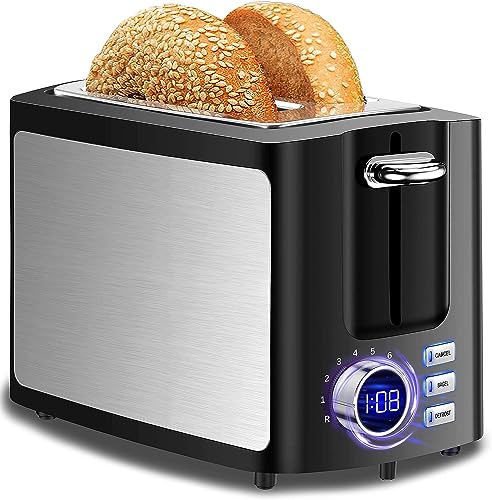
- Hommater 2-Slice Smart Toaster with LCD Digital Countdown Timer — the one verified digital pick in this pool
- Amazon Basics 2-Slice Toaster — prose-only for this lens (six browning settings and a 900W element rating, but no digital display is claimed)
Read the full guide ↓
Searches for best toasters digital trends usually come from readers who have seen trend roundups praising screens, countdown timers and smart browning controls, and who now want to know which of those ideas are real, which are marketing gloss, and which toaster actually delivers them. That is exactly the question this guide answers, and it answers it strictly. We checked every listing in the pool for confirmed digital features — a display, a countdown, electronic shade selection — rather than for vague words like modern or smart in a headline. One model passed that test cleanly. The rest are honest, capable analogue machines, and there is no shame in that: a well-made dial toaster can outlast a screen. But if your reason for searching was the digital experience itself, you deserve a guide that tells you plainly how narrow the true digital field is in this pool, instead of dressing up six conventional toasters as tech products.
The digital trend in toasting is real, and it is worth understanding before you buy anything. A countdown changes behaviour in the kitchen: instead of hovering, listening for the pop, you glance at a number and get on with coffee, eggs or a lunchbox. Finer shade steps — the digital pick here offers nine settings, more than any other model in the pool — promise repeatability, the idea that your preferred crust is a number you can return to rather than a dial position you estimate. Trend coverage tends to skip the trade-offs, so this guide will not: screens add a component that can fail, they invite fingerprints, and a countdown cannot fix uneven elements. Readers comparing the wider field may also want our notes on Best Toasters For Even Toasting, because evenness, not electronics, is what most breakfast complaints are actually about.
Key Takeaways
- Only one pick in this pool, the Hommater 2-Slice Smart Toaster, has a listing-confirmed LCD digital countdown timer; it is the sole linked pick in this guide.
- Digital control mainly buys repeatability and information — a visible countdown and nine shade settings — not automatically better browning.
- The other five picks are reviewed prose-only because their listings claim dials, levers and buttons, not displays; several are excellent conventional choices.
- If counter safety matters more than screens, the Elite Gourmet’s confirmed cool-touch body addresses the concern behind Best Toasters Don T Get Hot On Outside.
- Bagel and defrost functions exist across most of the pool, digital or not, so do not pay a trend premium for features that are already standard.
- Judge any digital toaster by what its display actually shows; a countdown timer is useful information, while a decorative screen is not.
In this guide
Quick Picks
| Pick | Badge | Control style | Why it is here | Link |
|---|---|---|---|---|
| Elite Gourmet ECT1027B Cool-Touch Toaster | Best Cool-Touch Analogue Pick | Dial and buttons, six shades | Confirmed cool-touch body, 1.25-inch extra-wide slots, cancel and bagel handling | Prose-only — no digital display claimed |
| Hamilton Beach 22634 Extra-Wide Slot Toaster | Best Analogue Browning Control | Browning control, seven shades | Auto shutoff, toast boost and a slide-out crumb tray in a cheerful blue finish | Prose-only — no digital display claimed |
| bella Fits-Anywhere Slim 4-Slice Toaster | Best for Feeding a Crowd | Conventional controls, shade count not stated | The pool’s only four-slice, extra-long-slot design in a slim footprint | Prose-only — no digital display claimed |
| BLACK+DECKER 2-Slice Toaster with Extra-Wide Slots | Best Analogue Bagel Mode | Dial, seven shade settings | Dedicated bagel mode, extra lift lever and a removable crumb tray | Prose-only — no digital display claimed |
| Hommater 2-Slice Smart Toaster with LCD Countdown | Best Digital Pick | LCD digital countdown, nine shades | The only listing-confirmed digital display in the pool, with bagel, defrost, cancel and reheat functions | Check on Amazon |
| Amazon Basics 2-Slice Toaster | Best Straightforward Value Design | Buttons and dial, six settings | Extra-wide slots, defrost, cancel and bagel buttons, cord wrap and a stated 900W rating | Prose-only — no digital display claimed |
How These Picks Were Chosen
This guide was built from the verified pick pool for the toasters group: six pop-up toasters whose listings were cross-checked against the Creators API on 2026-11-20, with product titles, images and identifiers taken from that API response rather than from memory or from other roundups. For this keyword we then applied a second, stricter filter on top of the pool. The core attribute of a digital-trends search is digital control, so a pick earned a purchase link only if its own listing explicitly confirms a digital feature. One listing does: it names an LCD digital countdown timer in plain words. The other five listings describe shade dials, browning knobs, levers and push buttons — perfectly respectable controls, but not digital ones — so those picks are covered in full as prose-only reviews, with the reason stated in the sources file that accompanies this article.
Our method is research-led, and we are honest about its limits. We did not run these toasters side by side in a test kitchen, and we make no hands-on claims. What we compared were confirmed specifications and functions from the listings themselves: slot configuration, shade range, named functions such as bagel, defrost, cancel and reheat, safety behaviours such as auto shutoff and cool-touch construction, and cleaning design such as removable or slide-out crumb trays. Where a listing is silent — on shade count, wattage or materials — we say so rather than filling the gap with a plausible guess. That discipline matters most on a trend keyword, because trend coverage is where vague language does the most damage. If you are weighing the classics against the newcomers, the long-running favourites gathered under Best Toasters Ever make a useful counterweight to any trend list, this one included.
Best Toasters Digital Trends Coverage Points To: The 6 Picks in Detail
A note on ordering before the reviews begin. The picks appear in the order they were assigned to this guide, not in a ranked countdown, and the badge on each one tells you its honest role. Read the prose-only entries as seriously as the linked one: if the digital features turn out to matter less to you than capacity, cool sides or a bagel mode, your best toaster in this pool may well be an analogue one, and the reviews below are written to help you reach that conclusion just as easily as the opposite one.
Elite Gourmet ECT1027B 2-Slice Cool-Touch Toaster
Badge: Best Cool-Touch Analogue Pick
Strengths
- Listing-confirmed cool-touch body, the only explicit cool-exterior claim in this pool
- 1.25-inch extra-wide slots sized for bagels and thick-cut bread
- Six shade settings with cancel and bagel handling covered in the listing
Trade-offs
- No digital display or countdown is claimed, so it sits outside this keyword’s core promise
- Two slices at a time, which means batches for larger households
- Six shades is the joint-narrowest range in the pool
Mini spec box
- Format: 2-slice pop-up toaster
- Exterior: cool-touch, black finish
- Slots: 1.25-inch extra-wide
- Shade settings: 6
- Named functions: cancel; bagels and thick bread handling
- Model: ECT1027B
The Elite Gourmet is the clearest example in this pool of a toaster that trend coverage overlooks and sensible buyers keep choosing. Its headline feature is not a screen but a body that is designed to stay cool to the touch, which matters in the kitchens where toasters actually live: pushed against a wall, beside a fruit bowl, within reach of a child standing on a stool to watch breakfast happen. The listing states the cool-touch design outright, and that single confirmed attribute does more daily good than most decorative electronics. Slot width is the other practical strength. At 1.25 inches and described as extra-wide, the slots take bagels and thick bread without the squeeze-and-scrape routine that narrower slots demand, and six shade settings cover the realistic range from warmed-through to deeply browned.
Why is it prose-only here? Because honesty about this keyword requires it. Nothing in its listing claims a display, a timer readout or electronic controls, so presenting it as a digital pick would be exactly the kind of trend-washing this guide exists to avoid. Treat it instead as the control group in the experiment: if, reading its review, you realise the cool sides and wide slots solve your actual breakfast problems, then the digital trend was never really your requirement. Its honest limitation, beyond the missing electronics, is throughput — two slices per cycle is fine for one or two people and slow for a family queue — and its shade range, while adequate, gives less fine-grained repeatability than the nine-step digital pick below. Readers whose mornings centre on bakery loaves should also glance at Best Toasters For Big Bread, where slot geometry gets the full treatment.
Best for: households that value cool sides and wide slots over screens / Not suited for: buyers who specifically want a countdown display
Hamilton Beach 22634 Extra-Wide Slot 2-Slice Toaster
Badge: Best Analogue Browning Control
Strengths
- Seven-shade browning control, a step finer than the six-setting models
- Auto shutoff and toast boost are both confirmed in the listing
- Slide-out crumb tray makes the weekly clean quicker
Trade-offs
- Analogue control only; no display or countdown is claimed
- Two-slice capacity, like most of this pool
- The blue Kitchen Makeover finish will not suit every kitchen
Mini spec box
- Format: 2-slice pop-up toaster, extra-wide slot design
- Shade settings: 7 browning shades
- Named functions: bagel and defrost buttons; auto shutoff; toast boost
- Crumb tray: slide-out
- Finish: Kitchen Makeover Blue
- Model: 22634
Hamilton Beach built its name on appliances that do ordinary jobs without fuss, and the 22634 reads like a checklist of the small frustrations analogue toasters usually leave behind. The browning control offers seven shades, one more step than the six-setting models in this pool, which helps when a household splits between pale-and-warm and properly bronzed. Toast boost lifts small pieces higher at the end of the cycle, a simple answer to the fingertip-versus-hot-slot problem that waffle pieces and English muffin halves create. Auto shutoff adds a quiet safety behaviour: the cycle ends itself rather than relying on a jammed lever being noticed. The slide-out crumb tray is the cleaning detail you will appreciate monthly rather than daily, but monthly is exactly when unloved trays become a burnt smell.
None of that makes it digital, and this guide will not pretend otherwise. There is no screen to read a countdown from and no electronic shade memory; you set the browning control by eye and experience, the way toaster owners have for decades. For many kitchens that is genuinely fine — arguably preferable, since there is no display to fail — but it places the model outside the linked set for a keyword built around digital trends. Its honest limitation is the familiar one: two slices, one batch at a time, and a colour that makes a statement whether you wanted one or not. If your real priority is a proper bagel cycle rather than electronics, compare it against the dedicated discussion in Best Toasters For Bagels before deciding.
Best for: analogue loyalists who want finer browning control and auto shutoff / Not suited for: anyone shopping specifically for a display
bella Fits-Anywhere Slim Toaster, 4 Slice
Badge: Best for Feeding a Crowd
Strengths
- The pool’s only four-slice capacity, in an extra-long and wide slot format
- Slim Fits-Anywhere profile designed for tight counters
- Long-slot geometry suits artisan and sourdough loaves that defeat standard slots
Trade-offs
- No digital display, shade count or named functions are stated in its listing
- A long footprint, even a slim one, still needs a long stretch of counter
- One long slot format is less flexible for two very different items at once
Mini spec box
- Format: 4-slice pop-up toaster, slim profile
- Slot: extra long and wide
- Finish: Oatmilk
- Shade settings: not stated in listing
- Named functions: not stated in listing
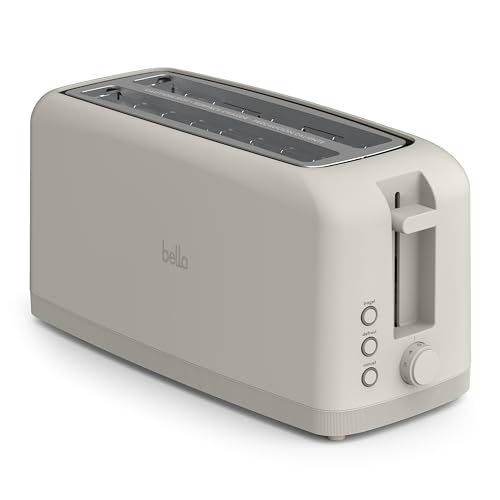
The bella is the pool’s shape-shifter. Where every other pick is a two-slice box, this is a slim four-slice machine built around an extra-long, extra-wide slot, which changes both what it toasts and where it lives. Long loaves — the bakery sourdoughs and rustic rounds that standard slots force you to cut, flip or abandon — lie down properly in a long slot, and four slices per cycle halves the queue when a family eats together. The Fits-Anywhere name points at its other trick: a narrow depth that slides into the strip of counter between a wall and a kettle where a conventional four-slice box would never fit. In small kitchens, that geometry can matter more than any electronic feature.
Its listing, however, is the quietest in the pool. It confirms the slot format, the capacity and the finish, and stops there: no shade count, no bagel or defrost function, and certainly no digital display is claimed. We review it prose-only for this keyword on two grounds — it is not digital, and we will not invent the missing control details to make it sound trendier than its own listing does. The honest limitation follows from the same silence: if precise, repeatable shade selection is your priority, a listing that does not state its shade range asks you to take more on trust than the nine-setting digital pick below. Buy the bella for its shape and capacity, which are confirmed and genuinely distinctive, rather than for any control sophistication, which is unconfirmed.
Best for: families and long-loaf lovers short on counter depth / Not suited for: buyers who want confirmed digital controls or a stated shade range
BLACK+DECKER 2-Slice Toaster with Extra-Wide Slots
Badge: Best Analogue Bagel Mode
Strengths
- Dedicated bagel mode confirmed in the listing
- Seven shade settings for finer browning steps
- Extra lift lever and removable crumb tray, two proven convenience details
Trade-offs
- Analogue controls only; no display is claimed
- Two-slice capacity
- No auto shutoff or cool-touch claim appears in its listing
Mini spec box
- Format: 2-slice pop-up toaster
- Slots: extra-wide
- Shade settings: 7
- Named functions: bagel mode
- Convenience: extra lift lever; removable crumb tray
BLACK+DECKER’s entry is the traditionalist’s toaster: extra-wide slots, a proper bagel mode, seven shade settings, an extra lift lever and a removable crumb tray. Nothing on that list is fashionable, and almost everything on it is useful. The bagel mode matters because bagels are not thick toast — the cut side wants real browning while the crust side wants warming, and a dedicated mode is the difference between a bagel that eats like a bagel and one that eats like a warm brick. The extra lift lever earns its keep with short items, raising muffins and small ends clear of the slots so retrieval is a lift, not a dig. Seven shades give the same finer-step advantage as the Hamilton Beach above.
It is prose-only in this guide for the now-familiar reason: its listing claims no digital feature of any kind. That is not a criticism of the toaster; it is a statement about the keyword. If your search began with trend coverage but your breakfasts are really about bagels done properly and toast that lifts clear, this analogue machine may serve you better than a screen would. Its honest limitations are capacity — two slices, standard for this class — and the absence of the safety extras some rivals confirm: no auto shutoff and no cool-touch claim appears in its listing, so households for whom those behaviours are decisive should weigh the Hamilton Beach and Elite Gourmet entries above more heavily.
Best for: bagel households that trust levers over screens / Not suited for: digital-feature shoppers
Hommater 2-Slice Smart Toaster with LCD Digital Countdown Timer
Badge: Best Digital Pick
Strengths
- The pool’s only listing-confirmed LCD digital countdown timer
- Nine shade settings, the widest browning range in this pool
- Full function set confirmed: bagel, defrost, cancel and reheat
Trade-offs
- Two-slice, wide-slot format only; no long-slot or four-slice option
- A display is one more component to keep clean and one more thing that can fail
- Countdown information does not by itself guarantee even browning
Mini spec box
- Format: 2-slice pop-up toaster, wide slot
- Display: LCD digital countdown timer
- Shade settings: 9
- Named functions: bagel, defrost, cancel, reheat
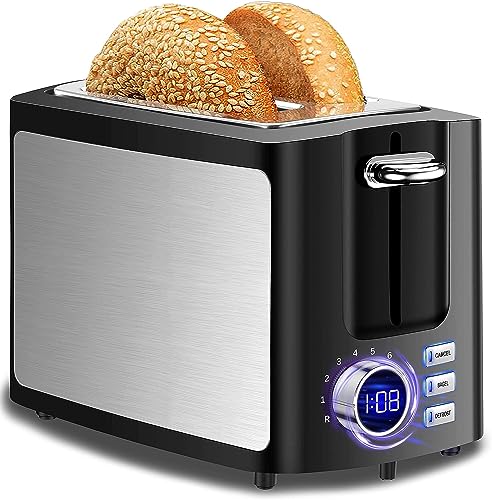
Here is the toaster this keyword is actually about. The Hommater’s listing confirms, in plain language, the features trend roundups describe: an LCD digital countdown timer, a smart display presentation, and nine shade settings — three more steps than the six-setting models and two more than the seven-setting ones. The countdown is the feature you will feel daily. Toasting stops being an event you supervise and becomes a number you can glance at while the kettle boils; if the eggs need another minute, you know whether the toast does too. The nine-step shade range serves the repeatability promise of digital control: the difference between your setting and your partner’s setting can be a single remembered step rather than a negotiation with a dial, and the reheat function — confirmed here and absent from several rivals’ listings — rescues the slice that popped while you were answering the door, warming it without restarting the browning from scratch.
The full function set rounds it out: bagel and defrost cover the freezer-to-table routine, and cancel is the basic control every toaster should confirm. Wide slots handle thick slices, though the listing does not claim the extra-wide or long geometry of the bella or the measured 1.25-inch width of the Elite Gourmet, so artisan-loaf households should temper expectations. The honest limitations are the digital ones. A screen invites fingerprints and adds a failure point a dial never has, and no countdown can compensate if elements brown unevenly — electronics inform a cycle, they do not heat the bread. Buy this model because the display genuinely fits how you cook, and check the current listing details before ordering, because feature presentation is exactly where trend products change fastest.
Best for: cooks who want a visible countdown and fine, repeatable shade steps / Not suited for: four-slice households or long-loaf specialists
Amazon Basics 2-Slice Toaster
Badge: Best Straightforward Value Design
Strengths
- Extra-wide slots explicitly described as suited to bagels
- Defrost, cancel and bagel buttons all confirmed
- The pool’s only stated wattage, 900W, plus a cord wrap for tidy storage
Trade-offs
- No digital display is claimed; controls are conventional
- Six browning settings, the joint-narrowest range here
- Removable crumb tray, but no lift-boost or auto shutoff is claimed
Mini spec box
- Format: 2-slice pop-up toaster
- Slots: extra wide, for bagels
- Browning settings: 6
- Power: 900W
- Named functions: defrost, cancel and bagel buttons
- Convenience: removable crumb tray; cord wrap
- Finish: black and silver
The Amazon Basics toaster is the pool’s plain-spoken option, and its listing is admirably complete: extra-wide slots for bagels, six browning settings, defrost, cancel and bagel buttons, a removable crumb tray, a cord wrap, and the only wattage figure stated anywhere in this pool, 900W. That completeness is worth praising on a trend keyword, because it shows what good analogue specification looks like — every claim checkable, nothing dressed up. The cord wrap is a small feature with outsized value in small kitchens and rental flats where the toaster lives in a cupboard between uses, and button-based functions are unambiguous in a way some dials are not: a bagel button is either pressed or it is not.
It remains, firmly, an analogue toaster. Six settings is enough for most households but offers the least granular repeatability here, and there is no countdown to glance at. We include it prose-only, like the other conventional picks, because its listing claims no digital feature. Its honest limitation is that it is a competent generalist in a guide about a specialism: nothing it does is digital, and nothing about it is best-in-pool except specification transparency and storage tidiness. For a second kitchen, a student flat or a buyer who has read this whole guide and decided the trend is not for them, it is a perfectly rational endpoint — and the heritage-minded comparisons under Best Toasters Ever Made will feel like familiar territory.
Best for: straightforward households and cupboard-stored second toasters / Not suited for: anyone who came for a screen
Comparison Table
| Pick | Digital display | Capacity and slots | Shade settings | Standout confirmed feature | Link |
|---|---|---|---|---|---|
| Elite Gourmet ECT1027B | Not claimed | 2-slice, 1.25-inch extra-wide | 6 | Cool-touch body | Prose-only |
| Hamilton Beach 22634 | Not claimed | 2-slice, extra-wide | 7 | Auto shutoff and toast boost | Prose-only |
| bella Fits-Anywhere Slim | Not claimed | 4-slice, extra long and wide | Not stated | Slim four-slice long slot | Prose-only |
| BLACK+DECKER 2-Slice | Not claimed | 2-slice, extra-wide | 7 | Bagel mode and extra lift lever | Prose-only |
| Hommater 2-Slice Smart | LCD countdown confirmed | 2-slice, wide | 9 | Digital countdown with reheat | Check on Amazon |
| Amazon Basics 2-Slice | Not claimed | 2-slice, extra wide | 6 | 900W stated; cord wrap | Prose-only |
How to Choose a Digital Toaster Without Buying a Gimmick
Start by defining digital honestly. A digital toaster, for buying purposes, is one whose controls are electronic and whose feedback is visible: a display that shows time remaining or shade selected, and settings chosen as discrete steps rather than as a dial position. By that definition most toasters sold with tech-flavoured language are not digital at all, and the first buying skill is reading a listing the way this guide read its pool — hunting for the words display, countdown or timer readout, and discounting smart, modern and advanced when they appear without a concrete feature attached. If a listing cannot tell you what its screen shows, assume the screen shows little.
Next, decide what the display must do for you. A countdown timer is the genuinely useful headline feature because it converts waiting into information; you can sequence eggs, coffee and toast instead of hovering. Shade steps matter second: more steps only help if you actually use the middle of the range, so be honest about whether your household argues over browning. Two people with strong, different preferences benefit from nine remembered steps; a household that toasts everything medium does not. Then check the unglamorous fundamentals that electronics cannot replace: slot width for the bread you actually buy, a bagel function if bagels are weekly, defrost if your bread lives in the freezer, cancel within reach, and a crumb tray you will actually empty. Capacity is the final filter — every digital advantage evaporates if a two-slice machine makes a four-person breakfast a relay race, in which case the four-slice analogue above, or patience, is the real answer.
Tier thinking helps with value. In qualitative terms, conventional toasters occupy the lower-cost tier and compete on slots, shades and cleaning; digital models sit a tier up and must justify the step with information and repeatability, not with vocabulary. A sensible rule: pay the digital premium only when you can name the morning moment it improves. If you cannot, the analogue pool — cool-touch bodies, bagel modes, long slots — will serve you as well for less complexity.
How to Use and Care for a Toaster, Digital or Not
Set up on a clear, heat-safe stretch of counter with room above the slots; toasters vent serious heat upward, so keep the space under low cupboards in mind and never drape a towel over a machine that has just cycled. For the first use, run an empty cycle at a medium setting to clear manufacturing dust, and expect a brief new-appliance smell that should not recur. For daily toasting, centre each slice in its slot, choose your shade step, and let the cycle finish rather than cancelling early and restarting, which double-heats one side of the routine. On the digital pick, use the countdown as a kitchen timer for the rest of breakfast; on any model, use bagel mode with the cut side facing as the manufacturer directs, and defrost for frozen bread instead of simply adding a shade step, because defrost cycles are timed to thaw first and brown second.
Cleaning is weekly and simple. Unplug, let the machine cool fully, slide or lift out the crumb tray, empty it, and wipe the exterior with a slightly damp cloth — on a display model, that cloth matters doubly, since a smeared screen is hard to read in morning light. Never shake a toaster upside down over the sink as your main cleaning method, never fish with metal utensils, and never immerse any part of it. Troubleshooting follows a short pattern. Problem: toast browns darker through a morning’s batches → the elements and cavity are heat-soaked, so step the shade down one notch for later batches. Problem: one side of a slice is pale → the slice was likely off-centre or a bagel was loaded facing the wrong way; centre the next slice and check bagel orientation. Problem: the lever or cycle will not stay engaged → check the plug and outlet first, empty the crumb tray, and stop using the machine if the fault repeats, because a toaster that will not latch is a toaster to retire, not to hold down by hand.
What the Digital Trend Gets Right — and Where It Overpromises
The trend coverage is right about one big thing: information reduces kitchen friction. A countdown display turns toasting from an interruption into a background process, and step-based shade selection turns preference into something repeatable and shareable — genuinely helpful in households where one person’s perfect is another person’s burnt. Trend roundups are also right that controls are the current frontier of toaster design, because the heating side of the product matured long ago; slots, elements and levers have been good for years, so differentiation has moved to interfaces.
Where the trend overpromises is in implying that electronics improve the toast itself. Browning is done by hot elements and bread position, and a display changes neither. A digital toaster with mediocre elements will produce precisely timed, beautifully counted, uneven toast. That is why this guide weighted confirmed fundamentals — slot geometry, function set, safety behaviours — alongside the one confirmed display, and why it refused to link analogue models under a digital banner: the trend is a control story, not a quality guarantee. Shoppers who enjoy this kind of clear-eyed sorting will find the same approach in our roundup of Best Toasters For Home Use, where interface fashion is weighed against daily practicality.
Reading Any Trend List Like an Editor
Because this keyword exists — people literally search for a trend publication’s take — it is worth leaving you with the skill of reading any such list critically, including ours. First, separate the publication’s headline from the manufacturer’s listing: headlines compress, listings commit, and only the listing’s confirmed words should drive a purchase. Second, watch for recycled picks; trend lists are often refreshed annually with the same models and new adjectives, so check whether the features described this year were described identically last year. Third, count the functions that matter to your kitchen and ignore the rest of the spec sheet; a reheat function you will use weekly outweighs three modes you will never touch. Fourth, treat the absence of a claim as information. When a listing does not state a shade count, a wattage or a material, the manufacturer has chosen not to promise it, and your decision should price that silence in. Those four habits will protect you in every small-appliance category, not just this one.
Digital Controls Versus Dials: Living With Each Interface
Because five of this pool’s six toasters are dial-and-button machines, it is worth spelling out what daily life with each interface actually feels like, since the difference is ergonomic rather than culinary. A dial toaster asks you to learn a position. The first week involves a little charred experimentation, after which your hand finds your setting by feel, half asleep, without looking. That tactility is a genuine virtue: no menus, no boot-up, nothing to read. The cost is precision drift — dials get knocked in cleaning, housemates nudge them, and the difference between your setting and the next mark is a judgement call you remake every time the dial moves. A digital control replaces position with number. Your setting survives a cleaning knock, a curious toddler’s button press is easier to spot because the displayed step looks wrong, and a second cook can reproduce your result by copying a digit rather than interpreting a dial angle. The cost is a small cognitive tax — you interact with the machine rather than simply using it — plus the long-term question every screen raises about spare parts and longevity.
Countdown displays change the social life of breakfast in one more subtle way: they make the toaster’s progress public. Anyone in the kitchen can see whose toast is nearly ready, which quietly ends the pop-guessing and the premature lever-checking that cools a cycle. Against that, analogue machines hold one trump card that trend lists rarely mention — repairability and simplicity compound over years. A lever, a dial and elements are about as close to a finished technology as appliances get. Neither interface browns better. Choose the one that matches how your household actually cooks: choreographed mornings with several dishes landing together reward the countdown; simple toast-and-go routines are served perfectly well by a dial that your hand already knows.
What to Verify In Store or On the Listing Page
Whether you shop in person or online, run the same five checks before committing. First, find the display claim in writing and note exactly what it displays — remaining time is the useful datum; a screen that only shows a shade number is a smaller benefit. Second, count the shade steps and ask whether your household will use the extremes; steps you never touch add no value. Third, measure your usual loaf against the slot description: wide, extra-wide and long are different geometries solving different bread problems, and only one of them is yours. Fourth, confirm the unglamorous functions by name — bagel, defrost, cancel, reheat — because assumptions are where returns begin. Fifth, look at the crumb tray and the exterior finish and ask whether you will keep them clean; a display you cannot read through toast-smears and a tray you never empty will quietly undo every other advantage. A toaster that passes those five checks, digital or not, is a toaster you will still be pleased with when the trend cycle has moved on to something else.
Common Buying Mistakes
- Believing the adjective instead of the listing. Smart, modern and digital are only meaningful when a display, countdown or electronic control is explicitly confirmed.
- Paying for a screen and ignoring the slots. If your bread does not fit the slot, no interface will save breakfast.
- Assuming more shade steps means better toast. Steps give repeatability; element quality and centring give evenness.
- Forgetting capacity. A two-slice digital pick still queues a family; count slices per cycle against mouths per morning.
- Skipping the safety basics. Cancel within reach, a crumb tray you will empty, and sensible placement matter more than any trend feature.
- Treating trend lists as permanent. Models and listings change; re-check the confirmed features on the current listing before you order.
Final Recommendation
If you came for the digital experience, the recommendation is unusually clean: the Hommater 2-Slice Smart Toaster is the only pick in this pool whose listing confirms it, with its LCD countdown, nine shade settings and full bagel, defrost, cancel and reheat set — check the latest price on Amazon and confirm the display details on the current listing before ordering. If reading the analogue reviews changed your mind, choose by your real constraint instead: the Elite Gourmet for cool sides, the bella for four slices and long loaves, the BLACK+DECKER for bagel mode, the Hamilton Beach for auto shutoff and finer analogue browning, or the Amazon Basics for plain, fully specified simplicity. A trend is only worth following when it points at the toaster your kitchen actually needs.
Frequently Asked Questions
What makes a toaster genuinely digital?
Electronic controls with visible feedback: a display showing a countdown or a selected shade step, and settings chosen as discrete electronic steps. A dial with numbers printed beside it is an analogue control, however modern the styling looks.
Is a countdown timer actually useful, or is it a gimmick?
Useful, for a specific reason: it lets you sequence the rest of breakfast instead of hovering by the toaster. It does not improve browning, so judge it as an information feature, not a cooking feature.
Do more shade settings mean more even toast?
No. Shade steps control how long and how hot the cycle runs, which sets the depth of browning. Evenness depends on element design and on centring the slice in the slot. The two qualities are often confused in trend coverage.
Why are five of the six picks in this guide not linked?
Because their listings do not claim any digital display or electronic control, and this keyword is specifically about digital models. They are reviewed in full as prose-only entries so you can still choose them with open eyes if analogue suits you better.
Can a digital toaster handle bagels and frozen bread?
The digital pick here confirms bagel and defrost functions, so yes for this model. Always check the function list on the listing rather than assuming a display model includes them; several analogue picks in this pool confirm the same functions.
Are digital toasters harder to clean or maintain?
Only slightly, and mainly at the surface. The crumb tray routine is identical — slide it out, empty it weekly, and never immerse the machine. The extra task is the display itself: wipe it with a soft, slightly damp cloth rather than a scouring pad, and avoid spraying cleaner directly onto the control area. Buttons and touch surfaces also collect kitchen grease faster than a simple dial, so a weekly wipe keeps the controls responsive and the countdown readable. There are no filters, descaling cycles or software chores involved; a digital toaster is still a toaster, and its maintenance is measured in seconds.
Will a digital toaster last as long as a simple dial model?
Nobody can promise a lifespan for a specific unit, and any guide that does is guessing. What can be said honestly is structural: a dial model has fewer distinct components, so it has fewer distinct ways to fail, while a display model adds electronics whose longevity depends on build quality and on keeping heat and moisture away from the control area. If decade-long service is your top priority, that structural simplicity is a real argument for the analogue picks in this pool. If the countdown and repeatable steps will improve hundreds of breakfasts in the meantime, many households reasonably judge the trade worthwhile.
What should I check on the listing before ordering a trend-listed toaster?
Confirm the display type and what it shows, the shade step count, slot dimensions against your usual loaf, the named functions, and the crumb tray design. If any of those is missing from the listing, treat it as unconfirmed rather than assuming it is included.