Disclosure: topratedkitchenware.com is reader-supported. When you buy through links on our site, we may earn an affiliate commission from Amazon and other retailers, at no extra cost to you.
Where to buy
Every linked pot in this guide is a genuine alternative to the famous French brand — enameled cast iron, working sizes, lids built for braising. The benchmark itself appears once, prose-only with no purchase link, so you can see feature-by-feature what the alternatives are matching. Start with the links below or read the matching analysis first.
- Overmont Enameled Cast Iron Dutch Oven, 7 QT — Best Feature Match — Capacity. Check on Amazon for the current listing.
- Amazon Basics Enameled Cast Iron Dutch Oven, 6 Quart, Blue — Best Feature Match — Simplicity. Check on Amazon for the current listing.
- Mueller DuraCast Enameled Cast Iron Dutch Oven, 6 Quart, Emerald — Best Feature Match — Specifications. Check on Amazon for the current listing.
- Lodge Essential Enameled Cast Iron Dutch Oven, 6 Quart, Island Spice Red — Best Feature Match — the Braise. Check on Amazon for the current listing.
- Le Creuset Enameled Cast Iron Round Dutch Oven, 5.5 qt, Cerise — The Benchmark — Reference Only. Prose-only in this guide (see the review below for why); no purchase link is provided for this pick.
- Umite Chef Enameled Cast Iron Dutch Oven, 7 QT, Emerald — Best Feature Match — Color and Kit. Check on Amazon for the current listing.
Read the full guide ↓ for the detailed reviews, the buying guide, and the how-to section.
The best dutch ovens that aren t le creuset succeed by matching features, not by imitating a logo. Strip the famous pot down to what a cook actually uses — a 5.5 quart enameled cast iron body, a tight lid, stove-to-oven range, a non-reactive surface — and the question becomes precise: which alternatives deliver each of those features, and where does each one choose a different trade? This guide answers feature by feature, with five linked alternatives and the benchmark shown once, prose-only, as the specification everyone is matching.
That prose-only treatment is deliberate and worth stating plainly: a guide answering ‘not that brand’ does not link that brand. The benchmark’s review here exists so the matching is honest — you deserve to see the target. Everything else in this guide is a buyable alternative, verified from its manufacturer listing. Readers who arrived via the common misspelling will find the same pool organized by search intent in Best Dutch Ovens Not Le Crueset; this version is organized by features.
Key Takeaways
- Match features, not logos: capacity, lid, enamel, and stated ratings are the benchmark’s real specification.
- Overmont’s 5.5-class sizing and 7 QT range bracket the benchmark’s role; Lodge matches its braise performance via the sealing lid.
- Mueller out-specifies the benchmark on paper: a stated 500°F rating and explicit induction support.
- The benchmark appears prose-only by design — this guide does not link the brand it is the alternative to.
- Bundled potholders and cookbooks are features too: the alternatives include what the premium sells separately.
- What no alternative matches is the color library and heirloom culture — decide if those are features you use.
In this guide
Quick Picks
| Pick | Badge | Why it stands out | Listing |
|---|---|---|---|
| Overmont Enameled Cast Iron Dutch Oven, 7 QT | Best Feature Match — Capacity | Overmont 7 QT with enclosed lid knob, cookbook and potholders — matches and exceeds the benchmark’s working volume. | Check on Amazon |
| Amazon Basics Enameled Cast Iron Dutch Oven, 6 Quart, Blue | Best Feature Match — Simplicity | Amazon Basics 6 quart blue — matches the core format (enameled iron, round, dual handles) with nothing extraneous. | Check on Amazon |
| Mueller DuraCast Enameled Cast Iron Dutch Oven, 6 Quart, Emerald | Best Feature Match — Specifications | Mueller 6 quart emerald — stated 500°F rating and induction support out-document the benchmark’s listing style. | Check on Amazon |
| Lodge Essential Enameled Cast Iron Dutch Oven, 6 Quart, Island Spice Red | Best Feature Match — the Braise | Lodge Essential 6 quart island spice red — the moisture-sealing lid matches the benchmark’s core cooking job. | Check on Amazon |
| Le Creuset Enameled Cast Iron Round Dutch Oven, 5.5 qt, Cerise | The Benchmark — Reference Only | The 5.5 qt cerise original: the specification the five linked pots are matched against, shown without a purchase link. | Prose-only — no link |
| Umite Chef Enameled Cast Iron Dutch Oven, 7 QT, Emerald | Best Feature Match — Color and Kit | Umite Chef 7 QT emerald with potholders — a distinctive finish and included kit at batch capacity. | Check on Amazon |
How These Picks Were Chosen
The pool was filtered by the keyword’s single hard rule — the pot must not be the famous brand — then by feature completeness: enameled cast iron, 5.5 to 7 quart capacities, braising lids, and listing data detailed enough to match against the benchmark honestly. Five alternatives qualified. The sixth pool product is the benchmark itself; it is reviewed prose-only, without link or image, as the reference specification, and labeled as such wherever it appears.
All specifications come from manufacturer listing data verified for this guide; the evaluation is research-led and feature-based, not a hands-on test. Where an alternative exceeds the benchmark’s published clarity — Mueller’s stated ratings are the example — we say so; where the benchmark retains genuine advantages — finish refinement and color range — we say that too. The value-tier framing of the same decision is developed in Best Dutch Ovens On Sale for shoppers timing the purchase.
The Best Dutch Ovens That Aren’t Le Creuset, Matched Feature by Feature

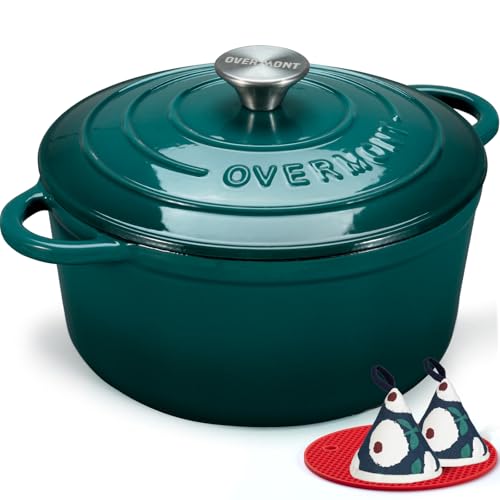
Overmont Enameled Cast Iron Dutch Oven, 7 QT
Badge: Best Feature Match — Capacity
Strengths
- 7 QT capacity swallows double batches, big boules and holiday braises
- Enclosed lid-knob design avoids the separate replacement-knob question for high-heat baking
- Cookbook and potholders included despite the larger size
Trade-offs
- A full 7 QT enameled pot is genuinely heavy — test your lift before committing
- Needs real storage space; measure the cabinet and oven before ordering
- Oversized for everyday two-person cooking, where food spreads thin
Key specs (from the manufacturer listing)
- Material: enameled cast iron
- Capacity: 7 QT — largest in this pool
- Included: lid, cookbook and cotton potholders
- Design: enclosed lid-knob
- Oven safe (per listing)
- Named uses: sourdough baking, braising, stews, roasting
The Overmont 7 QT is the big pot of this pool: enameled cast iron, a cookbook and cotton potholders in the box, and an enclosed lid-knob design that sidesteps the classic sourdough problem of knobs with lower heat limits. Seven quarts changes the cooking math — double batches of soup for the freezer, a braise for eight, a large-format boule, a whole duck. If you batch-cook on Sundays or feed a crowd at holidays, this is the size that stops you splitting recipes across two pots.
Respect the physics: enameled cast iron at 7 QT, loaded, is a two-handed, clear-the-counter lift. Check that it fits your oven with the lid on and that your storage shelf can take it. Cooks who clear those bars get the pool’s most capable braiser and baker.
Feature match: capacity and completeness. The benchmark’s working sizes top out where this Overmont begins its argument — 7 QT for batch cooking — and the enclosed lid-knob design matches the high-heat baking requirement that makes owners of premium pots buy replacement knobs. Add the bundled cookbook and potholders and the feature ledger tilts: this alternative includes, as standard, items the premium line treats as accessories.
Best for: batch cooks, large families and sourdough bakers who want maximum capacity / Not suited for: anyone with limited storage, smaller ovens, or difficulty lifting heavy cookware

Amazon Basics Enameled Cast Iron Dutch Oven, 6 Quart, Blue
Badge: Best Feature Match — Simplicity
Strengths
- Amazon’s own label — straightforward returns and a no-drama buying experience
- Classic 6 quart round format with dual handles fits standard recipes and ovens
- Blue enamel hides everyday staining better than white finishes
Trade-offs
- No included accessories — no potholders or extras in the box
- House-brand enamel lines tend to offer fewer color and size siblings for building a set
- Listing data is spare, so fine details are thinner than the brand-name rivals here
Key specs (from the manufacturer listing)
- Material: enameled cast iron
- Capacity: 6 quart
- Shape: round
- Color: blue
- Handles: dual handles
- Oven safe (per listing)
- Named uses: stews, roasting, baking
The Amazon Basics 6 quart enameled cast iron Dutch oven is the pool’s utility pick: round, blue, dual-handled, oven safe, and aimed squarely at stews, roasting and baking. House brands compete on removing friction rather than adding features, and that is the honest pitch here — a standard-format enameled pot in the most useful size, sold through the simplest possible channel. The blue finish is a practical middle ground, darker than the whites in this pool and better at hiding the patina of regular use.
For cooks who know the format and just need a sound 6 quart pot — a second pot for holidays, a cabin kitchen, a first enameled piece without ceremony — this covers the fundamentals. Pair it with your own potholders and it does the same sear-braise-bake work as everything else on this page.
Feature match: the core format, honestly stripped. Enameled cast iron? Yes. Round 6 quart body? Yes. Dual handles, oven-safe, braise-ready lid? Yes, yes, yes. What is absent is everything beyond the format — heritage narrative, color library, bundled extras — and for cooks who use features rather than admire them, that absence is the match that matters.
Best for: pragmatic buyers who want a standard 6 quart enameled pot with the simplest purchase and returns path / Not suited for: gift buyers or anyone wanting included extras and a wider color story

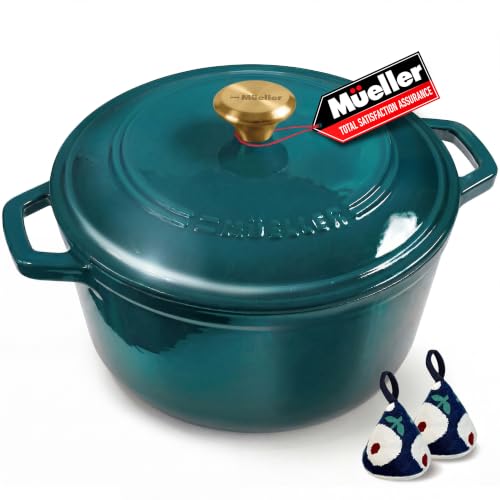
Mueller DuraCast Enameled Cast Iron Dutch Oven, 6 Quart, Emerald
Badge: Best Feature Match — Specifications
Strengths
- The most explicit spec sheet in this pool — 500°F oven rating and all-cooktop induction compatibility stated outright
- PFOA-free callout answers the first question chemically-conscious buyers ask
- 6 quart emerald pot covers family cooking in a distinctive color
Trade-offs
- 500°F ceiling is fine for bread but worth noting if you broil aggressively
- Emerald is a love-it-or-not color with fewer matching pieces
- Spec-forward listing still leaves long-term enamel questions to the brand’s track record
Key specs (from the manufacturer listing)
- Material: enameled cast iron (DuraCast)
- Capacity: 6 quart
- Color: emerald
- Oven safe: to 500°F (per listing)
- Cooktops: all cooktops including induction (per listing)
- Surface note: PFOA-free (per listing)
- Named uses: sourdough bread baking, braising, slow cooking
Mueller’s DuraCast 6 quart enameled cast iron Dutch oven in emerald is the pool’s spec-sheet champion: it states a 500°F oven-safe rating, compatibility with all cooktops including induction, and a PFOA-free surface right in its name. Induction owners should pay attention — enameled cast iron is usually induction-friendly, but a listing that says so explicitly removes the guesswork, and 500°F covers sourdough baking, braising and slow cooking with room to spare. The emerald finish is the boldest color in this group.
For bread bakers the numbers line up: 6 quart volume for a standard boule, a stated oven rating that covers preheating the empty pot, and enamel that will not react with long acidic braises on rest days. If your decision process starts with verified specifications rather than brand romance, this is your pot.
Feature match: documented capability. The benchmark’s reputation asks to be trusted; the Mueller’s listing states numbers — 500°F oven rating, all-cooktop induction compatibility, a PFOA-free surface note. For an induction household, that explicit support is a feature the premium line’s marketing rarely states as plainly. Specification for specification, this is the alternative that wins its comparison on paper and cooks the same physics in practice.
Best for: induction cooktop owners and spec-driven buyers who want stated ratings, plus anyone who loves the emerald finish / Not suited for: cooks who need an oven rating above 500°F, or who prefer a heritage brand name

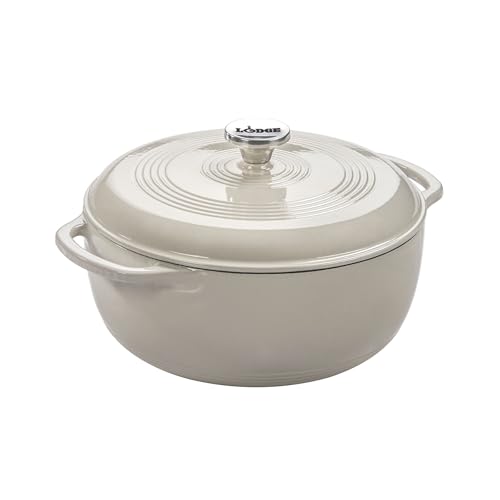
Lodge Essential Enameled Cast Iron Dutch Oven, 6 Quart, Island Spice Red
Badge: Best Feature Match — the Braise
Strengths
- Same moisture-sealing lid and 6 quart format as the oyster white Lodge, in a stain-forgiving red
- Lodge’s brand depth means lids, parts and support are easy to find years later
- Red is the classic serving color — straight from oven to table
Trade-offs
- Red enamel darkens the view of fond compared with pale interiors
- No accessories included
- If you already own red cookware from other brands, shades rarely match exactly
Key specs (from the manufacturer listing)
- Material: enameled cast iron
- Capacity: 6 quart
- Color: island spice red
- Lid: moisture-sealing design
- Handles: dual handles
- Named uses: bread baking, braising, marinating, slow cooking
This is Lodge’s Essential 6 quart enameled Dutch oven in island spice red — the same moisture-sealing lid, dual handles and bread-baking, braising, marinating and slow-cooking brief as the oyster white version, in the finish that hides a lifetime of chili and ragù. Red is the pragmatic enthusiast’s choice: it looks festive on the table, forgives staining, and pairs with the pot’s role as a serving piece. Lodge’s long retail presence also means this is the pool’s easiest pot to see in person before buying.
Pick red over oyster white if your cooking leans tomato, paprika, turmeric and wine — the foods that write their history on pale enamel. Pick it, too, if the pot will live on the stovetop as a semi-permanent fixture; red earns its place visually.
Feature match: the braise itself. A Dutch oven’s defining job is the low, humid, hours-long cook, and that job is lid work. Lodge names its lid’s moisture-sealing design outright — the same functional promise the benchmark’s reputation rests on — in a 6 quart format with America’s own cast iron heritage behind it. If you match one feature, match this one.
Best for: Lodge loyalists and heavy braise cooks who want the sealing lid in a forgiving red finish / Not suited for: cooks who judge browning by eye and prefer a pale interior
Le Creuset Enameled Cast Iron Round Dutch Oven, 5.5 qt, Cerise
Badge: The Benchmark — Reference Only
Strengths
- The benchmark premium pot — the reference point every alternative in this pool is measured against
- 5.5 qt round format is the size a generation of recipes was written for
- Cerise is the signature color of the line
Trade-offs
- Sits in the premium tier that the alternatives in this guide exist to undercut
- Its presence here is as the reference standard, not as a value pick
- Premium enamel still chips if abused — the price buys refinement, not invincibility
Key specs (from the manufacturer listing)
- Material: enameled cast iron
- Capacity: 5.5 qt
- Shape: round
- Color: cerise
Le Creuset’s 5.5 qt round enameled cast iron Dutch oven in cerise is the product that defines this category: the French-made benchmark whose size, shape and enamel quality every other pot in this pool is implicitly compared with. A generation of cookbook recipes assumes its dimensions, and its resale and hand-me-down culture is unmatched in cookware. None of that makes it the right buy for everyone — it anchors the premium tier — but no honest guide to this category can pretend it is not the reference point.
Understand what the premium buys: tight lid fit, refined enamel, deep color range and a century-deep brand. Understand also what it does not buy: immunity from chips, lighter weight, or better-tasting stew by default. Every alternative in this guide should be judged on how much of that benchmark experience it delivers for its tier.
Read this entry as the target specification: 5.5 quart round enameled cast iron, the size a recipe generation assumes, in the signature color. Its genuine unmatched features are refinement of finish and depth of palette. It carries no link and no image in this guide, by the guide’s own premise — the five pots around it are the answer to your search; this one is the question, stated fairly.
Best for: buyers who want the category benchmark itself and cook in the classic 5.5 qt format / Not suited for: value-focused shoppers — the rest of this pool exists for them
Prose-only pick: no Amazon link and no product image are shown for this item in this guide, for the reason explained above.

Umite Chef Enameled Cast Iron Dutch Oven, 7 QT, Emerald
Badge: Best Feature Match — Color and Kit
Strengths
- 7 QT capacity with potholders included — big-pot cooking without extra purchases
- Emerald finish stands apart from the usual red-and-white crowd
- Marinating is named among its uses, and enamel handles acidic marinades without reacting
Trade-offs
- Full and hot, this is one of the heaviest lifts in the pool
- Emerald is a distinctive color that will not match most existing sets
- Too much pot for small households’ daily cooking
Key specs (from the manufacturer listing)
- Material: enameled cast iron
- Capacity: 7 QT
- Color: emerald
- Included: lid and cotton potholders
- Named uses: bread baking, braising, stews, marinating
Umite Chef’s 7 QT enameled cast iron Dutch oven in emerald is the brand’s big-format entry: full batch capacity, cotton potholders in the box, and a color that reads more jewel tone than farmhouse. Seven quarts suits the cooks who actually use it — freezer-batch soup makers, holiday hosts, bakers of large loaves — and the included potholders matter even more at this size, because a loaded 7 QT pot demands a confident two-handed grip. Marinating appears in its named uses, a nod to enamel’s non-reactive surface for long acidic soaks.
Between this and the Overmont 7 QT, the choice is accessories and details: both include potholders, the Overmont adds a cookbook and an enclosed lid-knob design, this Umite counters with the emerald finish. Size, enamel and role are otherwise matched.
Feature match: presence. The benchmark’s color story is its most-loved feature, and the honest alternative answer is not imitation but distinction — this Umite’s emerald is its own statement at 7 QT, potholders included, marinating among its named uses. Kitchens are visual places; a pot that earns its stovetop residence in a color you chose beats a pot apologizing for not being another brand’s red.
Best for: batch cooks who want 7 QT capacity in a distinctive emerald finish, potholders included / Not suited for: small households or anyone who finds a full 7 QT pot hard to lift
Comparison Table
| Pick | Badge | Key attribute | Listing |
|---|---|---|---|
| Overmont Enameled Cast Iron Dutch Oven, 7 QT | Best Feature Match — Capacity | 7 QT, enclosed lid knob, extras included | Check on Amazon |
| Amazon Basics Enameled Cast Iron Dutch Oven, 6 Quart, Blue | Best Feature Match — Simplicity | 6 quart, round, blue, oven safe | Check on Amazon |
| Mueller DuraCast Enameled Cast Iron Dutch Oven, 6 Quart, Emerald | Best Feature Match — Specifications | 6 quart, 500°F stated, PFOA-free note | Check on Amazon |
| Lodge Essential Enameled Cast Iron Dutch Oven, 6 Quart, Island Spice Red | Best Feature Match — the Braise | 6 quart, moisture-sealing lid, red | Check on Amazon |
| Le Creuset Enameled Cast Iron Round Dutch Oven, 5.5 qt, Cerise | The Benchmark — Reference Only | 5.5 qt, cerise — reference only | Prose-only — no link |
| Umite Chef Enameled Cast Iron Dutch Oven, 7 QT, Emerald | Best Feature Match — Color and Kit | 7 QT, emerald, potholders included | Check on Amazon |
How to Choose the Best Dutch Ovens That Aren t Le Creuset by Matching the Benchmark’s Features
Start with capacity, because it is the one decision you cannot undo later. A 5 QT pot serves two to four people for most braises and bakes a medium loaf. A 5.5 to 6 quart pot is the family standard: a whole chicken, a Sunday sauce, a standard sourdough boule, soup for six. A 7 QT pot is batch-cooking territory — double recipes for the freezer, holiday meals, large-format bread. Buy for the largest meal you cook monthly, not the largest you can imagine, because an oversized pot spreads a small braise thin and a heavy pot you dread lifting is a pot you stop using.
Next, think about what enameled cast iron actually does. The iron core stores heat and releases it slowly, which is why braises cook evenly and bread crusts set so well. The enamel layer makes that iron non-reactive and easy to clean — acidic tomatoes, wine and vinegar are all safe — at the cost of a surface that can chip if struck with metal or shocked from freezer to flame. Every pot in this guide shares that basic physics; the differences are size, lid fit, included extras and finish.
Lid fit deserves more attention than it gets. A lid that seals well keeps braising liquid in the pot over a three-hour cook, which is the difference between meat that bastes itself and meat that dries at the edges. When a listing calls out a moisture-sealing lid, that is a functional claim worth weighting. Weight is the other honest factor: enameled cast iron is heavy by nature, and a full 7 QT pot is a serious lift. If anyone in your household has grip or wrist limitations, a 5 QT pot they can move confidently is the safer and better tool.
Finally, judge the whole package: whether potholders are included, whether the knob design suits high-heat bread baking, whether the color will live happily on your stove, and whether the size fits your oven and your storage. None of the pots here needs seasoning, special soap or ceremony — warm water, a soft sponge and prompt drying of the rim are the whole routine.
Use the benchmark as a checklist, not a destination: capacity in the 5.5–6 quart working band, a lid that seals, enamel for non-reactive cooking, ratings you can verify. Every linked pot in this guide checks those boxes; the remaining choice is which extra — size, bundle, color, heritage — fits your kitchen. The community’s long-term verdict on that matching exercise is collected at Best Dutch Ovens Reddit.
How to Bake Bread and Braise in a Dutch Oven, Step by Step
- For bread, preheat the pot with its lid inside the oven as the oven comes to temperature. A thoroughly hot pot is the home baker’s steam chamber: the lid traps the dough’s own moisture for the first part of the bake, which is what produces a glossy, crackling crust.
- Lower the dough in on its parchment sheet. The parchment is both a sling and insurance — it keeps the loaf from sticking and your hands away from the iron. Score the top, lid on, and bake covered for the first portion so the loaf can spring.
- Remove the lid to finish. The second half of the bake, uncovered, is where color develops. Judge doneness by a deep golden-brown crust and a hollow sound when the base is tapped.
- For braises, the same pot works at the opposite tempo: a patient stovetop sear, aromatics, a deglaze, then hours at a low oven temperature with the lid sealed. One pot, two personalities — violent heat for crust, gentle humidity for tenderness.
- Rotate roles through the week and the pot earns its storage space: soup on Monday, a roast chicken midweek, bread on Saturday. Versatility, not novelty, is what makes a Dutch oven a daily tool.
- After baking, let the pot cool before washing. Flour dust brushes out; stuck dough softens in warm water. Never soak a screaming-hot enameled pot in cold water.
Problem: Problem: bread crust is pale and soft → the pot was not fully preheated or the lid came off too late. Preheat longer, and give the loaf enough uncovered time to color.
Problem: Problem: the base of the loaf scorches → your oven runs hot from below. A sheet pan on the rack under the pot diffuses the heat.
Problem: Problem: braised meat is tender but the sauce is thin → lift the lid for the final stretch, or reduce the strained sauce on the stovetop while the meat rests.
The Feature Ledger: What Matches, What Doesn’t
Matches, across the linked five: the material system (enameled cast iron), the working capacities (5.5-class through 7 QT), the stove-to-oven workflow, non-reactive cooking for acidic foods, bread baking in the standard formats, and — in Lodge’s case — a lid explicitly designed around moisture sealing. In other words, the entire cooking specification matches. A braise cannot tell these pots apart, because physics does not read logos.
Exceeds, in places: stated documentation (Mueller’s printed ratings), included kit (Overmont’s and Umite’s potholders, Overmont’s cookbook), and top-end capacity at accessible tiers (two 7 QT options). Does not match: the depth of the color library, the cosmetic refinement standard of the enamel finish, the global boutique ecosystem, and the heirloom resale culture. That is the whole ledger. Price the right-hand column against your actual life — a cook who uses two colors and cooks weekly will find the ledger lopsided in the alternatives’ favor; a collector will not, and both are reasoning correctly.
Sizing the Alternative to the Benchmark’s Recipe World
One underappreciated feature of the benchmark is invisible: the recipe ecosystem written around its 5.5 quart dimensions. Thousands of published braises, breads and soups assume that pot. The good news for alternative buyers is that capacity is forgiving — a 6 quart pot runs a 5.5 quart recipe without adjustment, and the Overmont’s 5.5-class sizing matches it outright. Only at the extremes does the ecosystem pinch: a 7 QT pot spreads a small braise thin, and a 5 QT pot crowds a big one.
So the sizing rule for alternative shoppers is simple: buy the benchmark’s size class unless your cooking argues otherwise — batch production argues up to 7 QT, a two-person household argues down to 5. Then let the feature ledger, not habit, pick the brand. The eco-longevity case for buying one such pot for decades is made at Best Eco Friendly Dutch Ovens, and it applies to every name in this guide.
A word on shape: every pot in this pool is round, and round is the right default. It fits burners evenly, stirs without corners trapping food, and matches the shape of the boules and chickens it cooks most often. Oval pots have their fans for whole fish and long roasts, but a first Dutch oven should be round.
Storage is the unglamorous deciding factor for many buyers. Measure your deepest cabinet or accept that the pot will live on the stovetop — most do. A pot that lives in view gets used; a pot buried in a low cupboard behind other pans quietly becomes a special-occasion object, which wastes its best quality.
Think about who else will lift the pot. A Dutch oven is often a shared household tool, and the heaviest version in this pool, filled with stew, can challenge smaller cooks. The right size is the one every cook in the house can move from oven to counter with confidence, potholders on, every time.
Enamel color is partly practical. Pale interiors let you watch fond and caramelization change color, which teaches timing better than any timer. Dark and saturated exteriors forgive the stains of tomato, wine and spice cooking. Many experienced cooks own one of each and reach for them by dish, not by mood.
Secondhand shoppers should know that enameled cast iron is one of the most durable things in a kitchen: chips on the rim are cosmetic, a smooth interior without crazing is what matters, and a well-kept pot from any brand in this guide can serve a second owner for decades. Check the lid fit and the cooking surface, and ignore the rest.
If you cook on a schedule, note how these pots change weeknight math. A Dutch oven braise is mostly unattended time; the pot asks for twenty active minutes and returns dinner plus leftovers. That ratio — little attention, large yield — is why the format survives every kitchen trend cycle.
Do not overlook the lid as a tool in itself. A heavy, well-fitting lid is what turns the pot into a small oven; it is also, flipped in some kitchens, an emergency trivet or a rest for a spoon. Judge a Dutch oven by its lid and you will rarely judge wrong.
Consider the stovetop-to-oven handoff, the movement that defines this cookware. A Dutch oven sears on the burner, then finishes in the oven without a transfer — which means one less pan to wash, one less temperature loss, and flavors that stay in the same vessel from fond to finish. When you evaluate any pot in this guide, imagine that handoff with a full load: handles you can grip with mitts, a lid you can lift without drama, a weight you can move with confidence. The pots that make that movement easy are the pots that get used on weeknights, not just Sundays.
A note on lids and evaporation for cooks who like precision: a tight lid keeps a braise’s liquid nearly constant over hours, which makes recipes repeatable. A loose lid reduces as it cooks, concentrating flavor but demanding attention. Neither is wrong — sauces have been built both ways for centuries — but consistency favors the tight lid, and it is why lid language in a listing deserves the weight this guide gives it. If you braise the same dish monthly, a sealing lid turns it into a reliable ritual rather than a fresh experiment each time.
Think, too, about what a Dutch oven does to a household’s cooking confidence. Beginners succeed with it because the format is forgiving: heavy iron smooths out burner unevenness, the lid forgives timing, and enamel forgives acidic ingredients that would punish bare metal. Many cooks trace their first great braise, their first real loaf, to the season a pot like these entered the kitchen. Buying the right size is therefore not just a capacity decision — it is an invitation to cook more ambitiously, extended daily.
Oven fit deserves one more practical word. Measure diagonally as well as straight across: a round pot’s handles make its true footprint wider than its body diameter, and oven interiors taper. Check the height with the lid on and the rack in its lowest useful position. The 7 QT pots in this guide are magnificent batch tools, but only in ovens that welcome them; a pot that must be wrestled past the rack rails will quietly discourage the very cooking it was bought for.
There is also the question of a second pot, which many households reach within a few years: a smaller one for sides and bread while the main pot braises, or a larger one for holidays while the everyday pot handles Tuesdays. The pairs in this guide — the two Lodge finishes, the Umite twins, the Overmont sizes — hint at how naturally these pots form a working set across sizes and finishes. Buy the first one for your most common meal; the second, when it comes, will choose itself.
Finally, a word about patience as a cooking technique, because Dutch ovens reward it disproportionately. Preheat patiently and the sear improves. Braise patiently and connective tissue surrenders. Let the pot cool patiently before washing and the enamel lasts decades. Almost every disappointment attributed to this cookware traces to hurry — a ripping burner under a cold pot, a lid lifted every ten minutes, a sauce rushed at a boil. The pot’s whole design argues for slowness; cooks who accept the argument eat better.
If you are furnishing a kitchen from zero, sequence the purchase early. A Dutch oven covers the work of a stockpot, a braiser, a bread cloche and a serving dish, which makes it the highest-leverage first serious pot a kitchen can own. Several households in every cook’s acquaintance run their entire winter menu — soups, stews, roasts, breads — out of one enameled pot and a sheet pan. The guides in this series differ in angle, but on that point they are unanimous.
And when the pot finally shows its years — a stained interior, a rim chip from an honest accident — remember that none of it reduces what the pot does. Enameled cast iron ages the way good tools age: visibly, and without apology. The cooks who love these objects most tend to love the used-looking ones best, because every mark is a meal. Choose well, and in twenty years your pot will have the same biography.
One more sizing nuance belongs in every buyer’s notebook: stated capacity is brim capacity, and nobody cooks at the brim. A braise wants headroom for bubbling, a soup wants headroom for stirring, and bread wants headroom for spring. Treat roughly three-quarters of the stated figure as the working capacity and every size in this guide becomes clearer — the 5 QT pots are honest four-serving tools, the 6 quart pots are six-serving tools, and the 7 QT pots are the double-batch and holiday tools.
Do not forget the human factors on the day the pot arrives: fill it with water, lift it, carry it the distance from your oven to your counter, and set it down. That thirty-second rehearsal tells you more about whether you bought the right pot than any review can, and it is far better done inside the returns window than discovered at Thanksgiving. Every maker in this guide sells through channels that make that rehearsal risk-free — use it.
Common Buying Mistakes
- Matching the benchmark’s color instead of its features — the cooking lives in the iron, lid and size.
- Assuming alternatives must be the cheapest option; the feature-complete ones here are mid-tier tools with bundles.
- Overlooking stated ratings when the benchmark’s reputation made you stop asking for numbers.
- Buying outside the 5.5–6 quart class without a cooking reason, then fighting the recipe ecosystem.
- Treating the prose-only benchmark entry as a hidden recommendation — it is the reference, deliberately unlinked.
- Forgetting the arrival inspection: feature matching ends with your lid-fit check at home.
Final Recommendation
Match by your lead feature: capacity and completeness — the Overmont 7 QT; documented specifications — the Mueller; the braise itself — the Lodge in red; the unadorned format — the Amazon Basics; color and kit at batch size — the Umite emerald. Each is a complete answer to the benchmark’s specification, and the benchmark itself, reviewed above without a link, remains the fairly-stated target. Buy the feature set you will use weekly and the logo question dissolves on its own. Cooks who want the performance-criteria version of this same comparison should read Best Dutch Ovens Tested By Cooks next.
Start with one of these three:
- Overmont Enameled Cast Iron Dutch Oven, 7 QT — Check on Amazon.
- Mueller DuraCast Enameled Cast Iron Dutch Oven, 6 Quart, Emerald — Check on Amazon.
- Lodge Essential Enameled Cast Iron Dutch Oven, 6 Quart, Island Spice Red — Check on Amazon.
Frequently Asked Questions
What features of Le Creuset do the alternatives actually match?
The cooking specification: enameled cast iron construction, working capacities in the same size classes, tight braising lids, stove-to-oven versatility and non-reactive surfaces for acidic foods. Lodge matches the braise with its moisture-sealing lid; Mueller exceeds the documentation with stated ratings; Overmont and Umite Chef exceed the kit with included potholders and a cookbook.
Why is the Le Creuset pot shown without a link?
Because this guide answers a search for pots that are not that brand. It is included once, prose-only, as the fairly stated reference specification — with no purchase link and no product image — so the feature matching is honest rather than rhetorical.
Which alternative is closest to the classic 5.5 quart size?
The 6 quart models — Lodge, Mueller and Amazon Basics — are the nearest working equivalents, and recipes written for the classic size run in them unmodified. The Overmont and Umite 7 QT pots are the deliberate step up for batch cooking.
Do the alternatives work for sourdough and high-heat baking?
Yes, with the usual attention to stated ratings. The Overmont 7 QT’s enclosed lid-knob design suits high-heat preheating, and the Mueller states a 500°F oven rating outright. Where a listing gives no number, treat the ceiling conservatively.
What does the benchmark still do better?
Finish refinement, the deepest color library in the category, and a global brand ecosystem with heirloom resale culture. Those are real features — they are simply features many cooks never use, which is why the alternatives in this guide satisfy so many kitchens completely.
Are these alternatives good for induction cooktops?
Enameled cast iron is magnetic and generally induction-compatible; the Mueller states all-cooktop induction support explicitly in its listing, which is the certainty induction owners should look for in any brand’s documentation.