Disclosure: topratedkitchenware.com is reader-supported. When you buy through links on our site, we may earn an affiliate commission from Amazon and other retailers, at no extra cost to you.
Where to buy
Reliability is the one faucet claim that marketing can make for free and only evidence can support. This guide to the best most reliable kitchen faucets therefore ranks six pull-down faucets by a strict standard: what their verified listings actually state about construction — stainless grades, ceramic cartridges, lead-free certifications, braided supply hoses — and by the serviceability that stands behind them. Where a listing states nothing, the review says nothing, and treats the silence itself as the finding. Every pick is linked; the evidence for each is laid out in its review.
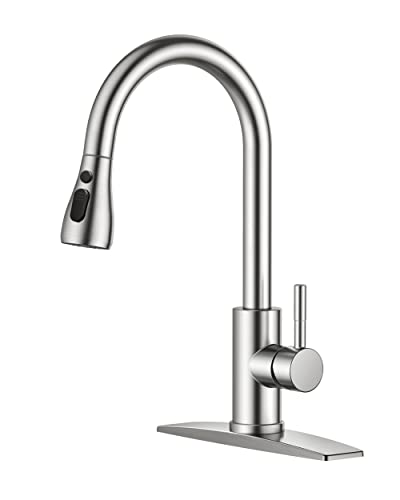
- VFAUOSIT Kitchen Faucet with Pull Down Sprayer — Best Certified Reliability. Check on Amazon
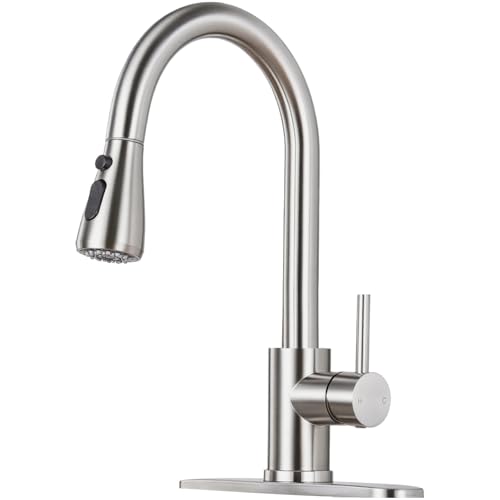
- WEWE High-Arc Pull-Down Kitchen Faucet — Best Documented Durability
- FORIOUS Kitchen Faucet with Pull Down Sprayer — Best Mechanical Simplicity
- Moen Essie Pulldown Kitchen Faucet — Best Serviceability
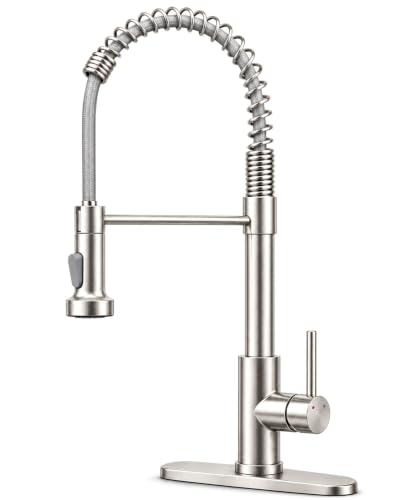
- OWOFAN Kitchen Faucet with Pull Down Sprayer — Best Certified Spring Design
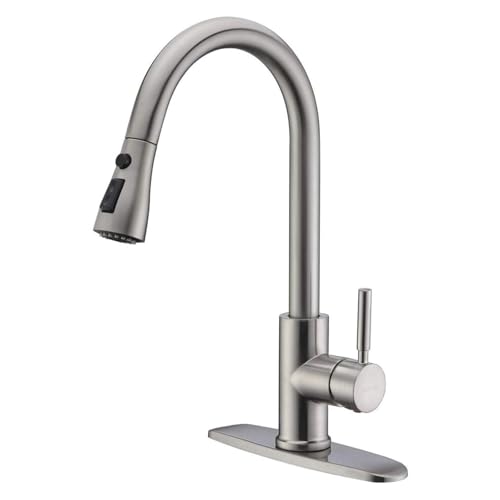
- WEWE Pull-Down Kitchen Faucet, High Arc — Most Complete Specification
Read the full guide ↓
Every faucet fails the same few ways. Cartridges wear and begin to drip. Hoses chafe, kink, or lose their fight with the cabinet until the sprayer will not dock. Sprayer faces crust with mineral scale until the stream wanders. Finishes pit where water sits. A reliability guide earns its title by asking, for each pick, what evidence exists that those specific failures have been designed against — and the evidence available to a buyer is the listing itself. A named stainless grade is evidence. A ceramic cartridge is evidence. A lead-free certification with a named standard is evidence about the water path’s construction. Braided stainless supply hoses are evidence. A famous name, a confident adjective, or a beautiful photograph is not evidence, and this guide does not grade it as any.
Applied strictly, that standard produces the ranking below — and one deliberate honesty: the six picks do not carry equal evidence. Two WEWE models and the VFAUOSIT document their durability in detail; the OWOFAN certifies its construction; the FORIOUS states materials and mounting but leaves its valve undocumented; and the Moen Essie’s title states almost nothing at all, its reliability case resting instead on the most serviceable parts ecosystem in the category. Each review grades only what its listing supports, invents no failure rates, quotes no lifespan figures, and tells you exactly which questions remain open for the product page. Readers whose reliability concern centers on a single failure mode can go straight to the leak-focused research in Best No Leak Kitchen Faucets after this guide’s broader evidence tour.
Key Takeaways
- Evidence leader: the VFAUOSIT pairs lead-free construction with two named standard families — NSF 61/372 and cUPC — the strongest certification evidence in this pool.
- The WEWE High-Arc is the durability documentarian: SUS 304 body, ceramic cartridge, 20-inch reach, and nozzles designed to be cleaned rather than replaced.
- Ceramic cartridges are the drip story. Three picks state one; where a listing is silent about its valve, this guide counts the silence against it.
- Serviceability is reliability’s second half. The Moen Essie’s sparse title is offset by the deepest parts network here — a faucet that can be repaired is reliable in a way a sealed bargain is not.
- Simplicity is a legitimate strategy. The manual, single-handle FORIOUS has fewer failure modes than any sensor design — though its undocumented valve caps its grade.
- No lifespan numbers appear in this guide, because no listing states any. Reliability here means stated construction plus serviceable design — claims you can verify yourself.
In this guide
Quick Picks
| Pick | Badge | Reliability evidence (as listed) | Listing |
|---|---|---|---|
| VFAUOSIT Pull-Down | Best Certified Reliability | Lead-free; NSF 61/372 and cUPC named; cold-start safety. | Check on Amazon |
| WEWE High-Arc Pull-Down | Best Documented Durability | SUS 304, ceramic cartridge, rub-clean nozzles, 20-inch reach. | Check on Amazon |
| FORIOUS Pull-Down | Best Mechanical Simplicity | Stainless steel construction, single handle, deck plate included; valve unstated. | Check on Amazon |
| Moen Essie Pulldown | Best Serviceability | Established brand parts ecosystem, exact model 87014SRS; construction unstated in title. | Check on Amazon |
| OWOFAN Spring Pull-Down | Best Certified Spring Design | Lead-free, NSF certified stainless steel; spring format. | Check on Amazon |
| WEWE Pull-Down, High Arc | Most Complete Specification | SUS 304, ceramic cartridge, braided 304 supply hoses, tool-free install. | Check on Amazon |
How These Picks Were Chosen
The evidence standard was fixed before the picks were ranked. Reliability credit is given only for facts a verified listing states: body material by grade (SUS 304 earns more than an unqualified metal claim), valve type (a stated ceramic cartridge is the strongest drip-resistance evidence a title can offer), water-path certification (lead-free with named standards — NSF 61/372, NSF372, NSF61, cUPC — outranks an unqualified safety adjective), connection hardware (braided stainless supply hoses are a stated durability fact), and maintainability features (nozzles designed to be rubbed clean address the most predictable degradation in the category). Serviceability — the availability of exact replacement parts under an exact model identity — is credited separately and labeled as a different kind of reliability, so a reader can see when a pick’s case is construction and when it is ecosystem.
What earns no credit is equally explicit: brand fame by itself, review sentiment, price tier as a proxy, and any statistic this guide cannot source. No failure rates, leak percentages, or service-life figures are stated anywhere in these pages, because none appear in the verified listings and inventing them would corrupt the guide’s only asset. Where a listing omits a core item — the FORIOUS’s valve, the Moen’s entire construction — the omission is reported in the review and reflected in the badge. This is a research-led guide without hands-on testing, and its reliability claims are framed accordingly: as an audit of stated evidence, which is the strongest claim an honest desk review can make.
The 6 Best Most Reliable Kitchen Faucets in Detail
Reviews follow assignment-pool order. All six picks are linked; each review separates stated evidence from open questions.

VFAUOSIT Kitchen Faucet with Pull Down Sprayer
Badge: Best Certified Reliability
Strengths
- Lead-free construction with NSF 61/372 and cUPC named — verifiable water-path evidence
- Cold-start safety removes a whole class of accidental hot-water events
- Tool-free install claim reduces installation-error risk, a real reliability factor
Trade-offs
- Listing states no body material grade and no cartridge type — two core items open
- Bar scale limits it to compact and secondary sinks
- Finish and hole fit unstated; verify before ordering
Key specs from the verified listing
- Pull-down sprayer; modern bar sink faucet
- Lead-free; NSF 61/372 and cUPC as listed
- 3 spray modes
- 23-inch retractable hose
- Cold-start safety
- Tool-free install, stated at 10 minutes
The VFAUOSIT leads a reliability guide on the strength of the most checkable sentence in the pool: lead-free, with NSF 61/372 and cUPC named. Certifications matter to reliability in two ways. Directly, they attest that the water path’s materials meet published standards — the part of a faucet whose failure modes are invisible until they are not. Indirectly, a maker who certifies is a maker whose construction has survived third-party scrutiny, which is a stronger signal than any adjective. Add cold-start safety — a design that makes the lever’s rest position cold, eliminating accidental hot draws — and a stated tool-free install, which matters because a large share of early faucet failures are installation errors rather than product defects, and the VFAUOSIT’s evidence portfolio is genuinely distinctive.
The audit must also record what the listing withholds: no stainless grade for the body, and no cartridge type for the valve — the two items this guide weights most heavily after certification. A reliability-first buyer should confirm both on the product page; if the answers are a stainless body and a ceramic cartridge, this pick’s case becomes the pool’s most complete. If they are not, its certification still stands, but the ranking argument narrows. Either way, the guide’s method is visible in miniature: credit what is stated, flag what is not, and never let a strong line item launder a missing one.
Best for: compact and secondary sinks where certified water-path construction leads the decision. / Not suited for: large primary sinks, or buyers unwilling to verify body and valve details.
WEWE High-Arc Pull-Down Kitchen Faucet
Badge: Best Documented Durability
Strengths
- SUS 304 body and a ceramic cartridge — the two core durability facts, both stated
- Rub-clean silicone nozzles design against the most predictable degradation
- 20-inch reach and full swivel reduce hose strain across big sinks
Trade-offs
- No lead-free certification named in the listing
- High arc suits deeper bowls; shallow bowls will splash
- Manual design — reliability through simplicity, not features
Key specs from the verified listing
- High-arc pull-down design
- Brushed nickel finish
- 3-mode sprayer; soft silicone nozzles, rub clean
- 360-degree swivel
- 20-inch pull-down reach
- SUS 304 stainless steel
- 1- or 3-hole fit; ceramic cartridge
This is the pick a reliability auditor would design. Body: a named stainless grade, resistant to the corrosion that undermines faucet bodies at their threads and fittings. Valve: a ceramic cartridge, the wear-resistant standard whose discs outlast the washer-based designs that taught older generations to expect drips. Degradation: answered in advance by silicone nozzles that clear mineral crust with a fingertip, converting the category’s most predictable decline into a two-second habit. Even the geometry contributes — a 20-inch reach and full swivel mean the hose works within its travel rather than straining at its limits, and hoses fail at their limits.
Its one evidence gap is certification: the listing names no lead-free standard, so the water-path paperwork belongs to other picks in this guide. Buyers for whom that line is decisive should weigh the VFAUOSIT or the OWOFAN; buyers whose reliability definition centers on the mechanical core — body, valve, hose behavior, maintainability — will find no more completely documented faucet in the pool. It is also, not coincidentally, the pick whose design assumes its owner will maintain it, which is the correct assumption: reliability in this category is a partnership between construction and care, and this faucet holds up its side in writing.
Best for: primary family sinks where documented mechanical durability leads. / Not suited for: buyers who require named lead-free certification above all.
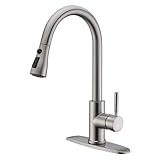

FORIOUS Kitchen Faucet with Pull Down Sprayer
Badge: Best Mechanical Simplicity
Strengths
- Stainless steel construction with a single-handle, manual design — few failure modes
- Deck plate included, removing a separate component and its fit risk
- Standard-fittings generalist listed across many sink settings
Trade-offs
- No cartridge type stated — the core drip question is undocumented
- No spray modes or hose reach stated
- No certification named in the listing
Key specs from the verified listing
- Pull-down sprayer; classic high arc
- Stainless steel, brushed nickel finish
- Single handle
- Deck plate for 1 or 3 hole installation
- Listed uses: farmhouse, camper, laundry, RV, bar
The FORIOUS argues reliability the old way: there is less here to break. A manual single-handle faucet in stainless steel, with its deck plate included and its format proven across farmhouse, camper, laundry, RV, and bar listings, presents a short failure-mode list — no electronics, no sensor, no dispenser pump, nothing powered or delicate between the water and the work. In outbuildings, rentals, and utility sinks, where a faucet’s environment is rougher and its service calls are slower to happen, that simplicity is a genuine reliability strategy, and this guide credits it as one.
The audit’s reservation is specific and important: the listing never states its valve. The cartridge is where drips are born, and a reliability guide cannot certify what a listing does not document — so the FORIOUS’s badge is capped at its strategy (simplicity) rather than its construction (unverified at the core). A buyer drawn to it should ask the product page one question — what cartridge does it use — and let the answer decide whether this is the pool’s quiet value or merely its quiet unknown. That single question, asked of every sparse listing, is the most portable skill in this guide.
Best for: utility, rental, and secondary sinks where mechanical simplicity is the strategy. / Not suited for: buyers who need the valve documented before purchase.
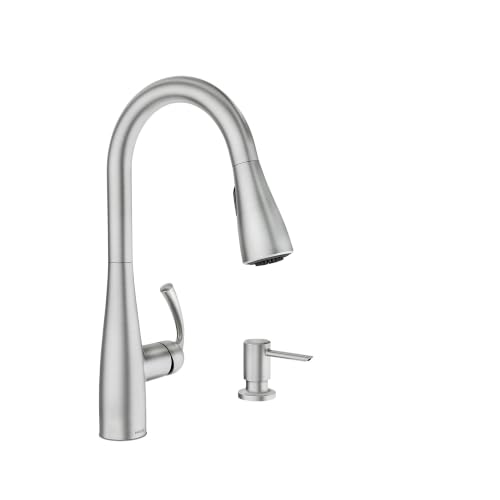
Moen Essie Pulldown Kitchen Faucet
Badge: Best Serviceability
Strengths
- Exact model identity — 87014SRS — makes every future part an exact order
- The deepest parts and support ecosystem in this pool
- Spot Resist Stainless finish resists the daily smudge-and-spot cycle
Trade-offs
- Title states no material, cartridge, or certification — construction evidence is absent, not negative
- No hole fit or sprayer details stated; verify on the listing
- Its reliability case is repairability, which only pays out when something wears
Key specs from the verified listing
- Pulldown kitchen faucet
- Spot Resist Stainless finish
- Model 87014SRS
The Essie forces this guide to define its terms, which is why its review may be the most useful one here. Its verified title offers no construction evidence whatsoever — no material grade, no cartridge, no certification — and under a construction-only audit it would rank last. But reliability has a second meaning that ownership teaches: a faucet is reliable not only when it resists failure, but when failure, arriving on schedule years later, is cheap, fast, and certain to fix. By that measure the Essie is formidable. Its model number identifies it exactly; its maker operates the widest parts distribution in the category; its cartridges and hoses are the kind of parts a hardware store stocks rather than orders. A drip in year seven is, for this faucet, an errand. For an unbranded faucet with an undocumented valve, the same drip can be a replacement.
This guide therefore grades the Essie on serviceability, labeled as such, and refuses to smuggle construction claims into its file. Buyers should hold both truths at once: the alternatives document their durability better, and this faucet will very likely be repairable longer. Which truth dominates depends on the household — its water, its handiness, its horizon — and the buying guide below turns that into an explicit decision rather than a vibe. One more consideration belongs to the record: the spot-resistant finish is a reliability feature of the cosmetic kind, resisting the fingerprint-and-spot cycle that makes owners perceive a faucet as tired before it is.
Best for: long-horizon homeowners who define reliability as always-repairable. / Not suited for: buyers who require construction evidence stated in the listing.

OWOFAN Kitchen Faucet with Pull Down Sprayer
Badge: Best Certified Spring Design
Strengths
- Lead-free, NSF certified stainless steel — certified construction, stated plainly
- Spring format keeps the sprayer mechanism exposed and inspectable
- 1 or 3-hole deck plate fit; single-handle simplicity
Trade-offs
- No cartridge type stated
- Spring coils collect kitchen grime and need wiping that a smooth spout does not
- No spray-mode count stated
Key specs from the verified listing
- Pull-down sprayer; spring design
- Brushed nickel finish
- Lead-free, NSF certified
- Stainless steel construction
- 1 handle; 1 or 3-hole deck plate
- Listed uses: farmhouse, RV, bar, laundry room
The OWOFAN brings certification to the one format where buyers often assume style has replaced substance. Its listing states lead-free, NSF certified stainless steel — the water-path evidence this guide credits most — wrapped in a spring design whose mechanics have an underappreciated reliability virtue: exposure. A spring sprayer’s working parts are visible and reachable; a coil that tires, a head that crusts, a connection that weeps announces itself to the eye instead of hiding inside a spout until the failure is advanced. For owners who actually look at their fixtures — the maintenance-minded households reliability guides are written for — that inspectability is a real property, not a consolation.
Its open items mirror the FORIOUS’s: no cartridge type is stated, so the drip question is undocumented, and the spring format adds a housekeeping duty of its own, since coils near a stove’s splatter zone need regular wiping to stay clean. Neither fact displaces its certification, which remains the strongest single line in its file. In the pool’s evidence table it sits exactly where its listing puts it: construction certified, valve unknown, format inspectable — a mid-pool reliability case stated with unusual clarity.
Best for: buyers who want certified construction in a spring format they can inspect and maintain. / Not suited for: buyers who need the cartridge documented up front.

WEWE Pull-Down Kitchen Faucet, High Arc
Badge: Most Complete Specification
Strengths
- SUS 304 body and ceramic cartridge — the core pair, stated
- 304 braided supply hoses: connection hardware specified to a grade
- Easy-clean nozzles and a tool-free install reduce degradation and install error
Trade-offs
- 1-hole fit only — the narrowest mounting in the pool
- No lead-free certification named in the listing
- High-arc profile is the standard silhouette, not a distinctive one
Key specs from the verified listing
- Pull-down faucet; high arc
- Brushed nickel finish
- 3-mode sprayer
- 360-degree swivel
- SUS 304 stainless steel
- 1-hole fit
- Ceramic cartridge; easy-clean nozzles
- Tool-free install; 304 braided supply hoses
The second WEWE in this pool is the specification completist, and one line of its title deserves a paragraph of its own: 304 braided supply hoses. Supply connections are where faucets meet the house’s plumbing, and they are a classic quiet failure point — the leak that starts under the sink, inside the cabinet, discovered by the damage rather than by the drip. A listing that specifies its supply hoses’ construction to a stainless grade is a listing that has thought about the failure modes its buyer cannot see, and this guide weights that signal heavily, because makers reveal their reliability culture in the components they bother to specify.
Around that detail, the familiar core is complete: stainless grade stated, ceramic cartridge stated, nozzles designed for cleaning, and a tool-free install that reduces the installation-error share of early failures. The constraints are mounting and paperwork — a 1-hole fit that excludes the legacy decks several rivals serve, and no named lead-free certification where the VFAUOSIT and OWOFAN offer one. A single-hole household that weights mechanical completeness over certification will find this the pool’s most persuasive file; it is the audit’s co-leader, separated from the top badge only by the certification column. Shoppers comparing its old-fashioned virtues against the category’s newer directions can place it in context with Best Old Style Kitchen Faucets, where simplicity is judged as a style as well as a strategy.
Best for: single-hole decks wanting the most completely specified mechanical package. / Not suited for: three-hole decks or certification-first buyers.
Comparison Table
| Pick | Material (as listed) | Cartridge (as listed) | Certification (as listed) | Reliability thesis | Listing |
|---|---|---|---|---|---|
| VFAUOSIT Pull-Down | Not stated | Not stated | Lead-free; NSF 61/372, cUPC | Certified water path | Check on Amazon |
| WEWE High-Arc | SUS 304 stainless | Ceramic | None named | Documented mechanical core | Check on Amazon |
| FORIOUS Pull-Down | Stainless steel | Not stated | None named | Mechanical simplicity | Check on Amazon |
| Moen Essie | Not stated | Not stated | None named | Serviceability and parts | Check on Amazon |
| OWOFAN Spring | Stainless steel | Not stated | Lead-free, NSF certified | Certified, inspectable format | Check on Amazon |
| WEWE High Arc, 1-Hole | SUS 304 stainless | Ceramic | None named | Complete specification incl. hoses | Check on Amazon |
How to Choose a Reliable Kitchen Faucet
Grade the listing, not the adjectives. Use the audit this guide applied: body material by grade, valve by type, water path by named certification, connections by construction, maintenance by design. Five columns, each either stated or not. A faucet with four stated columns is a documented appliance; a faucet with one is a photograph with plumbing attached. The table above is the worked example — keep it open while shopping anywhere, including the wider market’s sensor-led corner in Best Motion Activated Kitchen Faucets, where the same audit separates durable electronics from decorative ones.
Decide which reliability you are buying. Resistance — construction that delays failure — and repairability — an ecosystem that cheapens failure — are different goods, and this pool contains champions of each. Households with hard water, heavy use, and a long horizon should weight resistance first, because their failure clock runs fast. Households that are handy, patient, and parts-literate can weight repairability, because their repair cost is mostly time. Households that are neither should weight resistance and simplicity together, and avoid formats whose failures they cannot diagnose.
Count failure modes before features. Every added system — sensor, dispenser, spring mechanism — is a capability and a failure mode in the same object. That is not an argument against features; the touchless sets in this program’s research earn their complexity for the right kitchens. It is an argument for buying complexity on purpose, with its maintenance accepted in advance, rather than discovering at the first malfunction that you owned a system you never chose.
Ask the cartridge question of every sparse listing. When a title omits the valve — three picks here do — the product page’s specifications are the next stop, and if the answer cannot be found, treat that as the answer. In a category where the cartridge is the most common wear item, a maker who will not name it has told you how the ownership conversation will go.
Plan the maintenance you will actually do. The most reliable faucet is the one whose care routine matches its household: rub-clean nozzles for the wiper, an exposed spring for the inspector, a sealed simple design for the household that will do nothing at all — in which case the FORIOUS’s simplicity strategy and the Essie’s service network are the honest finalists, for opposite reasons.
How to Install and Maintain for Maximum Service Life
- Shut off, remove, and clean the deck fully. A base sealed over debris rocks, and a rocking faucet fatigues its own connections — installation quality is the first reliability feature.
- Flush the supply lines before connecting the new faucet, with the sprayer head removed as the manual directs, so legacy grit never reaches a new cartridge.
- Set the hose weight exactly at its marked point and clear the hose’s cabinet path; chafing against stored items is a leading owner-caused hose failure.
- Torque connections snugly, not brutally. Over-tightened fittings crack and weep; under-tightened ones announce themselves at the first pressure cycle. Leak-check at full pressure with dry hands.
- Record the model and documentation — for every pick, not just the brand-name one. Future you, holding a dripping cartridge, will be grateful for present you’s two minutes.
One installation decision deserves its own emphasis because it silently governs years of behavior: the condition of the shutoff stops and supply connections you inherit. A new faucet mounted on corroded stops and tired lines has imported the old installation’s failure modes into its own ledger, and no construction grade in any listing can compensate. If the stops weep, resist, or predate your ownership of the house, replacing them during the faucet swap is the highest-value reliability purchase available at any price tier — it converts the under-sink system, not just the fixture, to a known state, and it makes every future service event in this guide’s troubleshooting list a closed-valve procedure instead of a whole-house shutdown.
The maintenance calendar is short and is the whole game: wipe the base dry regularly so water does not sit against the finish and deck seal; rub nozzles clean before the spray pattern wanders, not after; rinse the sprayer screen each season; exercise the shutoff stops once a year so they close when needed; and glance at the under-sink connections whenever you retrieve something from the cabinet. Reliability, in practice, is mostly this list, done.
Troubleshooting.
- Problem: a slow drip from the spout → the cartridge is wearing; on a documented model this is a defined part and a defined job — the moment the serviceability picks in this guide were bought for.
- Problem: spray pattern sprays sideways → mineral crust on the nozzle face; rub clean or soak the head before pricing parts.
- Problem: moisture under the sink with no visible drip → check supply connections and the hose along its travel with a dry tissue at full pressure; connection weeps hide exactly there, and early detection is the difference between a fitting and a cabinet floor.
The Failure Modes, Honestly Ranked by How Owners Meet Them
Without inventing a single statistic, the category’s failures can still be ranked by how owners actually encounter them, because the sequence is structural. First comes degradation you can see: spray patterns wandering as mineral scale builds — universal in hard-water homes, trivially reversible on nozzles designed for cleaning, and the reason maintainability earned its own column in this guide’s audit. Second comes degradation you can hear: the drip, almost always the cartridge, arriving on a schedule set by water quality and use. Third comes degradation you discover: the under-sink weep at a connection or along a chafed hose, found late because it lives in the dark — which is why this guide weighted stated supply-hose construction and teaches a tissue test instead of a glance.
Last, and rarest in a well-bought faucet, comes structural failure of the body itself — the failure that named stainless grades exist to postpone beyond the household’s planning horizon. Read the six reviews again against that sequence and the badges explain themselves: the leaders each fortify the early, common failures with stated evidence; the serviceability pick accepts the sequence and guarantees its remedy; the simplicity pick shortens the list of things that can join it. A buyer who understands the sequence stops asking which faucet never fails — none — and starts asking which failures they are equipped to meet. That is the most reliable question in this entire category, and it is answered by the household, not the listing. Readers who want the newest entrants audited by the same sequence will find them gathered in Best New Kitchen Faucets, where fresh listings meet this guide’s five columns without sentimentality.
Hard Water: The Reliability Variable No Listing Controls
Every reliability audit in this guide grades the faucet; the water grades it back. Hard water is the single largest environmental variable in faucet life, and it does not appear in any listing because it is not a property of the product — it is a property of your house. Its mechanisms are the ones this guide has tracked throughout: scale builds fastest where water evaporates (nozzle faces, aerator screens, the base’s edge), it stiffens cartridges and valves as it accumulates in their clearances, and it spots finishes in a daily cycle that owners misread as finish failure. Two households can buy the same pick from this guide and report different decades, and the difference will be dissolved minerals more often than manufacturing.
The practical responses divide into product choices and household choices. Among product choices, this pool’s evidence points the same way the audit did: nozzles designed to be rubbed clean (both WEWE models state them) convert hard water’s most visible attack into a habit; ceramic cartridges tolerate the environment better than the washer designs they replaced; and finishes in the brushed family hide the spotting cycle that a polished or specialty finish — the kind surveyed in Best Oil Rubbed Bronze Kitchen Faucets — displays more honestly and demands more wiping to defend. Among household choices: a softener, where the whole house justifies one, rewrites every faucet’s future at once; a point habit of drying the base after the last wash slows the deck-edge cycle; and a seasonal screen rinse keeps the first symptom — a wandering stream — from being misdiagnosed as a dying faucet.
The audit’s final lesson is therefore humility in both directions. Do not credit a faucet for surviving soft water, and do not condemn one for struggling in hard water without checking the maintenance it was offered. Reliability, as this guide has defined it from the first page, is stated construction meeting stated care — and hard water is where the care half of that equation is priced.
Reliability When the Faucet Has a Brain: A Note on Sensor Models
This pool’s six picks are all manual, which makes this guide an incomplete map of the reliability landscape until one section addresses the electronic frontier honestly. Sensor faucets — the category mapped in the motion-first research, including the terminology buyers meet in Best Motion Sense Kitchen Faucets — add a control box, a power source, and a sensing element to the failure-mode list, and a reliability audit must grade them by additions, not by prejudice. Their stated-evidence columns work identically: materials, cartridge, and certifications mean the same things on a sensor body as on a manual one. What changes is the tail of the list — power arrangements that need dry, accessible mounting; sensors whose placement decides whether the faucet feels psychic or haunted; and an override behavior the household must learn.
The balanced verdict this guide offers is that sensor reliability is installation reliability. A touchless faucet mounted with its electronics clear of the hose’s travel, its power reachable, and its sensor tested against the sink’s reflections during the first day’s cooking tends to disappear into the household’s routine; the same faucet installed carelessly generates the stories that give the format its reputation. Manual picks, including all six here, simply have a shorter version of that same truth — which is why this guide’s installation section is written with the same seriousness for a lever as for a sensor. Complexity is not the enemy of reliability. Unconsidered complexity is, and the audit’s five columns, applied without sentimentality to any format, remain the buyer’s best instrument for considering it.
Common Buying Mistakes
- Treating brand fame as construction evidence. A famous name with an unstated interior is a serviceability purchase — valuable, but a different purchase than buyers think they made.
- Ignoring the cartridge column. The most common wear item in the category is the one most often left unstated; ask, every time.
- Skipping the install flush. Grit from old lines is a new cartridge’s first enemy, and the flush costs four minutes.
- Letting the hose live in a junk drawer. Cabinet clutter chafes hoses and blocks docking; owners manufacture this failure themselves.
- Buying complexity by accident. Sensors and dispensers are systems with maintenance; choose them for their benefits, not as decorative upgrades.
- Waiting for symptoms to maintain. Nozzles, screens, and connections reward a calendar, not a crisis.
Final Recommendation
On stated evidence, the reliability summit is shared: the VFAUOSIT for certified water-path construction in compact sinks, and the two WEWE models for documented mechanical cores in full-size ones — the High-Arc for flexible decks, its 1-hole sibling for the most complete specification including braided hoses. Take the OWOFAN when certified construction must come in a spring format, the FORIOUS when simplicity is the strategy and its cartridge checks out, and the Moen Essie when your definition of reliable is that whatever wears will always be replaceable. No pick here was credited with a lifespan, a failure rate, or a claim its listing did not make — which is exactly why the recommendations can be trusted as far as they go.
Frequently Asked Questions
What is the most reliable type of kitchen faucet?
On the evidence standard this guide applies, the strongest profile is a manually operated pull-down with a named stainless body, a ceramic cartridge, and maintainable nozzles — few systems, documented core, degradation designed against. Sensor and spring formats can serve reliably too, and two picks here certify their construction, but each adds a system whose maintenance the owner must accept. The type matters less than the documentation: a fully stated listing of any format outranks a vague listing of the ideal one.
Why does this guide print no reliability ratings or lifespans?
Because no verified listing states any, and inventing them would be fabrication. Reliability is graded here from stated evidence — materials by grade, cartridge type, named certifications, connection hardware, maintainability — plus, separately labeled, the serviceability of the maker’s parts ecosystem. Those are claims a reader can verify from the same listings, which is the only basis on which a research-led guide should ask to be believed.
Is a ceramic cartridge really more reliable?
It is the strongest valve evidence a listing can state. Ceramic disc cartridges replaced washer-based designs as the category’s durability standard because the discs themselves are extremely wear-resistant, and the drip that ends most faucets’ quiet years is a valve-wear symptom. Three picks in this guide state one; where a listing is silent about its valve, this guide counts the silence — not as proof of a poor cartridge, but as the absence of the proof a reliability buyer is paying to see.
How much does installation affect reliability?
Enormously, and it is the variable buyers control completely. A base sealed over debris rocks and fatigues its connections; unflushed lines feed grit to a new cartridge; a hose routed through cabinet clutter chafes and docks poorly; over-tightened fittings weep. The installation section of this guide is written as reliability policy, not as a formality — a careful hour at install is worth more than any single specification in any listing here.
Are brand-name faucets more reliable than value brands?
They are differently reliable. This pool’s value picks document their construction more completely than its brand-name pick does — stainless grades, cartridges, certifications in plain title text. The brand-name pick answers with serviceability: exact model identity and the deepest parts network, so that wear, when it comes, is cheap to reverse. For a household, the better definition depends on its water, its handiness, and its horizon, and this guide grades both definitions openly rather than collapsing them into one score.
Should I choose a faucet with fewer spray modes for reliability?
Mode count by itself is a weak reliability variable — the mode mechanism lives in the sprayer head, a replaceable component, rather than in the faucet’s core — but it is not a meaningless one. Each additional mode is a small mechanism and a small seal set, and a household that will genuinely use only a stream and a spray gains nothing from carrying the rest. The stronger version of the same instinct is the one this guide has applied throughout: prefer the faucet whose core — body, valve, connections — is documented, and let the head’s complexity be a preference rather than a proxy. If the head ever becomes the problem, on any pick here it is the cheapest major component to renew.
Does a pull-down hose hurt reliability?
It adds the category’s most owner-influenced component, which is not the same as hurting reliability. A hose lives a harder life than any other part — flexed thousands of times, dragged through a cabinet, asked to retract against a weight — and its lifespan is set jointly by its construction and by its environment: a clear cabinet path, a correctly placed weight, and no stored chemicals leaning on it. The picks here mitigate by design where they can (stated reach that avoids straining at limits, braided supply hardware on one model), and the rest is the household’s contribution. A fixed-spout faucet removes the hose question entirely, at the cost of the rinsing freedom that made pull-downs the default — a trade this guide regards as legitimate for utility sinks and unnecessary for most kitchens.
What maintenance actually extends a faucet’s life?
A short calendar, consistently kept: wipe the base dry so water does not sit on the finish and seal; rub nozzles clean before scale distorts the spray; rinse the sprayer screen each season; keep the hose’s cabinet path clear; exercise the shutoff valves yearly; and glance at under-sink connections whenever you are in the cabinet anyway. None of it requires skill or tools beyond a cloth and attention — which is precisely why it, and not any purchase, is the largest reliability variable most households control.