Disclosure: topratedkitchenware.com is reader-supported. When you buy through links on our site, we may earn an affiliate commission from Amazon and other retailers, at no extra cost to you.
Where to buy
A faucet that does not leak is not a special product category — it is a faucet whose sealing points were engineered and installed properly. The six models below were chosen because their published specifications contain the evidence that matters for staying dry: ceramic cartridges where stated, certified materials, braided supply connections and installation systems designed to remove guesswork. Read the cartridge and installation notes in each review, then use the links to check current availability on Amazon.
- Lufeidra Kitchen Faucet With Pull-Down Sprayer, Classic Pot Filler Faucet
- FEELSO Kitchen Faucets with Pull Down Sprayer, Brushed Nickel
- WEWE Touchless Kitchen Faucet with Soap Dispenser Set, Brushed Nickel
- GIMILI Matte Black Touchless Kitchen Faucet with Spring Pull Down Sprayer
- VFAUOSIT Kitchen Faucet with Pull Down Sprayer, Modern Bar Sink Faucet
- WEWE High-Arc Pull-Down Kitchen Faucet, Brushed Nickel, 3-Mode Sprayer
Read the full guide ↓
Nobody searches for the best no leak kitchen faucets because they enjoy plumbing theory. They search because there is a puddle in the cabinet, a drip that ticks at night, or a green crust forming at the base of a faucet that is only a few years old. A leaking faucet wastes water, but the quieter damage is worse: slow seeps rot cabinet floors, feed mold, and swell the particleboard that most sink cabinets are built from, often for months before anyone notices. Choosing a faucet that resists leaking — and installing it so it stays that way — is one of the highest-value decisions in a kitchen, and it is mostly decided by evidence you can read before you buy.
That evidence lives in a short list of specifications. The single most important one is the cartridge: the valve inside the handle that starts, stops and mixes the water. Older faucets sealed that valve with rubber washers that compressed, hardened and eventually let water creep past — the classic handle drip. The modern replacement is the ceramic disc cartridge, in which two polished ceramic plates slide across each other and seal by their flatness rather than by squashing a soft material. Ceramic discs tolerate the sand and mineral grit in household water that shreds rubber, which is why a stated ceramic cartridge is the strongest title-level evidence a faucet will stay drip-free. Three of the six picks below state a ceramic cartridge outright. The others earn their places through the other places leaks actually start: supply connections, installation accuracy, hose quality and how often the handle is worked at all.
This guide is deliberately honest about the limits of specification reading. No title can prove a faucet will never leak — a cross-threaded supply nut or a pinched O-ring during installation can defeat the best cartridge ever made. So alongside the rankings you will find a full section on where leaks begin, how installation choices prevent them, and how to diagnose the drip you already have. Readers comparing mounting patterns as part of a leak-proof install may also want Best One Hole Kitchen Faucets, since every extra deck penetration is one more place water can travel.
Key Takeaways
- The cartridge is the faucet’s main leak defense. A stated ceramic disc cartridge — found on the Lufeidra, the WEWE touchless set and the WEWE high-arc model here — is the strongest published evidence of long-term drip resistance.
- Most real-world leaks start at connections, not inside the faucet: supply-line nuts, the pull-down hose joint and the base seal. Installation quality decides as much as product choice.
- Touchless models work their handles far less, which reduces wear cycles on the manual valve path — a secondary, genuine leak-resistance advantage.
- Tool-free and quick-install systems, like the VFAUOSIT’s, reduce the under-tightened and cross-threaded fittings behind many early leaks.
- Certifications such as NSF 61/372 and cUPC speak to materials and code compliance; they support, but do not replace, cartridge evidence.
- Any drip should be fixed at first sight: a slow seep damages cabinets long before it shows on a water bill.
In this guide
Quick Picks
| Pick | Badge | Leak-resistance evidence | Link |
|---|---|---|---|
| Lufeidra Pull-Down Pot Filler Style Faucet | Best Overall | Ceramic cartridge stated; SUS304 stainless body; fits 1- or 3-hole | Check on Amazon |
| FEELSO Pull Down Sprayer Faucet | Best Certified Materials | Lead-free, NSF certified; single handle; stainless steel body | Check on Amazon |
| WEWE Touchless Faucet with Soap Dispenser Set | Best Cartridge Plus Touchless | Ceramic cartridge stated; sensor use cuts handle wear cycles | Check on Amazon |
| GIMILI Matte Black Touchless Spring Faucet | Best Fewer-Touch Design | Motion sensor does daily on/off work; single-hole mounting means one deck penetration | Check on Amazon |
| VFAUOSIT Pull Down Sprayer Faucet | Best Install-Accuracy Pick | Tool-free install positioning reduces fitting errors; NSF 61/372 and cUPC stated | Check on Amazon |
| WEWE High-Arc Pull-Down Faucet | Best Serviceable Classic | Ceramic cartridge stated; silicone nozzles rub clean; 20-inch pull-down reach | Check on Amazon |
How These Picks Were Chosen
This is a research-led guide built from verified product data cross-checked on 2026-11-20, not a hands-on leak test — no faucet here was run on a test bench, and no leak-rate figures are claimed for any model, because none were measured. Instead, each pick was evaluated on the published evidence that predicts leak resistance. First and most heavily weighted: a ceramic cartridge stated in the product’s own specification. Second: body material and certifications, since corrosion inside a faucet body eventually compromises every seal it holds. Third: installation design, because field data from plumbers consistently blames fitting errors for early leaks. Fourth: duty cycle — how the design distributes wear across its moving seals.
Just as important is what this guide does not do. It does not credit a faucet with a ceramic cartridge its listing does not state; where a pick’s cartridge type is unpublished, the review says so and rests the case on other evidence. It does not treat a finish or a brand name as leak protection. And it does not repeat the common claim that any faucet is “leak-proof” — the honest goal is a faucet whose design gives leaks the fewest possible places to start, installed in a way that keeps it that way. Shoppers whose leak worries center on an aging two-handle unit may also find the configuration comparison in Best One Handle Kitchen Faucets relevant, since a single cartridge is one valve to maintain instead of two.
The 6 Best No Leak Kitchen Faucets

Lufeidra Kitchen Faucet With Pull-Down Sprayer, Classic Pot Filler Faucet
Badge: Best Overall
Strengths
- Ceramic cartridge stated in the specification — the single strongest published predictor of a drip-free handle.
- SUS304 stainless steel body resists the internal corrosion that eventually undermines seals.
- Fits 1- or 3-hole decks, so the base seal sits correctly on either sink pattern.
Trade-offs
- Brushed nickel finish will show a base waterline if spills are left to dry at the deck — wipe the base dry as a habit.
- Newer brand, so long-term cartridge availability is less proven than a legacy maker’s.
- Classic pot filler styling will not suit every kitchen, though that has nothing to do with its sealing.
Mini spec box
- Cartridge: Ceramic (stated)
- Material: SUS304 stainless steel
- Finish: Brushed nickel
- Sprayer: Pull-down
- Mounting: Fits 1- or 3-hole
- Also positioned for: Laundry, RV and bar sinks
The Lufeidra leads this list because its specification contains the exact evidence a leak-conscious buyer should hunt for. The ceramic cartridge does the daily sealing work: two hard ceramic discs, lapped flat, that open and close the water path by sliding rather than by compressing a perishable washer. Grit that would score a rubber seal and start a slow handle drip largely passes a ceramic pair without damaging the sealing faces, and the handle feel stays consistent instead of gradually loosening the way washer valves do as their seats wear.
The body around that cartridge supports the same goal. SUS304 stainless steel does not suffer the dezincification that eats some alloy faucet bodies from the inside in aggressive water; a body that keeps its internal dimensions keeps its O-rings and cartridge seats properly loaded, which is what “not leaking in year six” is actually made of. The flexible 1- or 3-hole mounting matters for a subtler reason: a faucet whose base gasket sits flat and fully supported on the deck keeps sink-top water out of the cabinet, while a forced fit on the wrong pattern leaves a gap that funnels splashes downward. Fit the pattern your sink actually has.
The honest limitation is paperwork depth beyond the cartridge: the listing does not publish a certification set, and the brand is young, so keep the model number and cartridge details somewhere safe in case a replacement is ever needed. None of that changes the central fact — of the six faucets here, this one’s published specification makes the most direct case for staying dry, and its classic styling is a bonus for traditional kitchens rather than a compromise.
Best for: buyers who want stated ceramic-cartridge evidence in a traditionally styled faucet / Not suited for: buyers who want a legacy brand’s parts network behind the cartridge

FEELSO Kitchen Faucets with Pull Down Sprayer, Brushed Nickel
Badge: Best Certified Materials
Strengths
- Lead-free and NSF certified — documented materials compliance for everything the water touches.
- Stainless steel body and single-handle layout: one valve assembly to maintain, not two.
- High-arc spout keeps the spray head and hose working above the sink’s splash zone.
Trade-offs
- The listing does not state the cartridge type — the central drip-defense detail must be confirmed on the product page.
- No spray-mode count is published either, so the sprayer’s versatility is less documented than rivals’.
- Brushed nickel needs the base wiped dry to prevent a mineral waterline at the deck seal.
Mini spec box
- Material: Stainless steel
- Finish: Brushed nickel
- Handle: Single handle
- Spout: High arc, pull-down sprayer
- Mounting: 1 or 3 hole
- Certification stated: Lead-free, NSF certified
- Cartridge type: Not stated in listing
The FEELSO’s case rests on materials discipline. A faucet is a small plumbing system: body, cartridge seats, O-rings and hose liners all age in the same water, and leaks often begin where an inferior internal material corrodes or sheds debris that then scores a seal. A lead-free, NSF-certified build documents that the wetted materials passed standardized checks, which correlates with the manufacturing consistency that keeps tolerances — and therefore seals — where they were designed to be. That is indirect evidence compared with a stated ceramic cartridge, and this review will not pretend otherwise, but it is real evidence, and many faucets at this tier offer none at all.
The single-handle layout adds a structural advantage: one cartridge controls both temperature and flow, so there is exactly one valve assembly that can develop a handle drip, instead of the two independent valves of a widespread faucet — each with its own seat, stem seals and failure timeline. The high-arc shape also helps in a small way: the spout holds the spray head up and away from standing sink water, so the head and its connection are not sitting in the splash zone being worked by every rinse.
What keeps the FEELSO from the top spot is a missing line in its own specification: the cartridge type is not stated. Before ordering, check the product page or the maker’s documentation for it, because that single detail is the difference between this being a well-documented faucet and a fully documented one. Everything else about the package — steel body, certification, simple layout, flexible mounting — is the profile of a faucet that should stay dry with a careful install.
Best for: buyers who weight certified materials and a simple single-valve layout / Not suited for: buyers who want the cartridge type confirmed in the listing before purchase
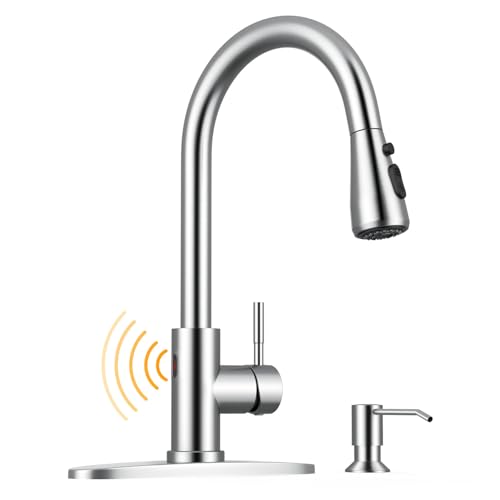
WEWE Touchless Kitchen Faucet with Soap Dispenser Set, Brushed Nickel
Badge: Best Cartridge Plus Touchless
Strengths
- Ceramic cartridge stated — the manual valve path uses the wear-resistant sealing technology.
- Touchless daily operation means the handle, and its cartridge, cycle far less often than in a manual-only faucet.
- Easy-clean nozzles and a 360° swivel keep spray performance even without tools.
Trade-offs
- The sensor system adds an electronic control box under the sink — one more component to keep dry.
- Battery changes become a recurring maintenance task a manual faucet never asks for.
- The included soap dispenser needs a spare deck hole; its own pump seal is another (minor) fitting to seat correctly.
Mini spec box
- Cartridge: Ceramic (stated)
- Activation: Touchless sensor, with manual handle
- Material: SUS 304 stainless steel
- Finish: Brushed nickel
- Sprayer: 3-mode, pull-down hose
- Swivel: 360°
- Mounting: 1- or 3-hole fit
- Included: Soap dispenser set
- Nozzles: Easy-clean
This WEWE set attacks handle drips from two directions at once. The first is the stated ceramic cartridge: when you do use the handle, the valve sealing the water is the hard-disc design that resists grit wear. The second is subtler and unique to touchless faucets — in daily life, most on-off cycles go through the sensor, not the handle. Every valve wears in proportion to how often it cycles, so a cartridge that is actuated a fraction as often accumulates wear a fraction as fast. The sensor itself is an electronic valve with no washer to compress, which removes the classic wear path from the majority of daily use entirely.
The rest of the specification supports the theme: SUS 304 stainless construction, a 3-mode pull-down sprayer whose nozzles rub clean so mineral crust does not distort the spray into splashing the deck (a surprising share of “leaks” owners report are actually spray deflection wetting the base), and 1-or-3-hole mounting flexibility. The soap dispenser set is relevant here too — a matched dispenser installed in the same session means one careful plumbing visit seats every deck fitting at once, rather than a later add-on disturbing the faucet’s base seal. Readers weighing that bundled configuration specifically can compare it in Best One Handle Kitchen Faucets With Soap Dispenser.
The counterweight is complexity. A sensor faucet has an under-sink control unit and a power source; mount the box where drips from above cannot reach it, route cables with a drip loop, and treat battery swaps as scheduled maintenance. Complexity managed well is fine — but a household that will ignore a dead sensor for a year should buy the manual Lufeidra or WEWE high-arc instead and get the same cartridge benefit with nothing to power.
Best for: busy kitchens that want cartridge evidence plus reduced handle wear from touchless use / Not suited for: households that will not maintain batteries or keep electronics dry under the sink
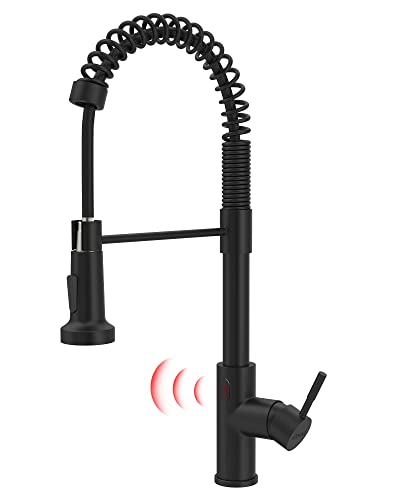
GIMILI Matte Black Touchless Kitchen Faucet with Spring Pull Down Sprayer
Badge: Best Fewer-Touch Design
Strengths
- Motion-sensor activation takes over daily on/off duty, minimizing cycles on the manual valve.
- Single-hole installation means exactly one deck penetration — the fewest possible paths for sink-top water to reach the cabinet.
- Spring pull-down head docks positively into its holder rather than hanging from hose tension.
Trade-offs
- The listing does not state a cartridge type, so the manual path’s sealing technology is undocumented.
- Matte black shows dried mineral spots clearly, which can mask the early signs of a weeping base if the faucet is not wiped down.
- Sensor power and control hardware under the sink must be kept dry, like any touchless model.
Mini spec box
- Activation: Motion sensor, hands-free smart control
- Finish: Matte black
- Sprayer: Spring pull-down
- Handle: Single handle
- Mounting: Single-hole installation
- Cartridge type: Not stated in listing
- Style stated: Modern farmhouse
The GIMILI’s leak story is about subtraction. Start with the deck: a single-hole installation has one penetration through the sink or counter, sealed by one base gasket. Multi-hole setups add covered holes, a deck plate with its own perimeter, and more edges where standing water can creep. Fewer paths down is a genuinely simpler waterproofing problem, and it is the same logic that makes single-hole layouts popular in the installations surveyed in Best Oil Rubbed Bronze Kitchen Faucets finish discussions — the deck hardware you do not install cannot leak.
Then subtract handle cycles. Like the WEWE set, the GIMILI’s motion sensor absorbs the dozens of daily on-off events — hand rinses, pot fills, produce washes — that otherwise grind through the manual cartridge. The spring sprayer contributes too: an exposed-spring head seats into a defined holder, so the hose connection at the head is not left dangling at an angle, quietly stressing its joint, the way a poorly docking pull-down can. Docking discipline sounds cosmetic; at the joint, it is mechanical sympathy.
The gaps are documentation gaps. The listing does not state the cartridge type behind its single handle, so a buyer who wants the ceramic-disc evidence in writing should choose the Lufeidra or one of the WEWE models instead. And matte black demands a wipe-down habit — not for the finish’s sake alone, but because a clean, dry base is how you spot the first bead of a weeping seal while it is still a five-minute fix. Owners who keep that habit will find this a sound, low-cycle design.
Best for: single-hole sinks and cooks who want sensor operation to spare the manual valve / Not suited for: buyers who require a stated ceramic cartridge, or anyone who never wipes the sink base

VFAUOSIT Kitchen Faucet with Pull Down Sprayer, Modern Bar Sink Faucet
Badge: Best Install-Accuracy Pick
Strengths
- Tool-free install positioning (stated as a 10-minute tool-free install) is designed to remove the fitting errors behind many early leaks.
- Documented compliance: lead-free, NSF 61/372 and cUPC listings are all stated.
- A 23-inch retractable hose gives the spray head reach without straining its connection at full extension.
Trade-offs
- Cartridge type is not stated in the listing, so the core valve evidence is missing on paper.
- Cold-start safety design means the handle’s rest position delivers cold water — a behavior change some households notice.
- Positioned as a modern bar sink faucet; confirm dimensions against a full-size kitchen sink before ordering.
Mini spec box
- Certifications stated: Lead-free, NSF 61/372, cUPC
- Sprayer: Pull-down, 3 spray modes
- Hose: 23-inch retractable
- Installation: Tool-free install positioning
- Feature: Cold-start safety
- Cartridge type: Not stated in listing
- Style: Modern bar sink design
Ask plumbers what causes most leaks in the first year of a faucet’s life and few will blame the faucet. They will blame the installation: the supply nut left a quarter-turn shy, the one cross-threaded by feel in a dark cabinet, the base gasket pinched because the mounting hardware fought back. The VFAUOSIT is built around that reality. Its stated tool-free installation system is designed so the mounting seats squarely and the connections land where they should without a wrench ballet under the sink — and a fitting that starts life correctly torqued and unstressed is a fitting that stays dry.
The supporting specifications are respectable: lead-free construction with NSF 61/372 and cUPC listings covers the materials-and-code side, three spray modes handle the daily range, and the 23-inch retractable hose deserves a leak-specific mention. Hose-end joints fail when they are repeatedly yanked to their limit; a longer hose that reaches the corners of the sink without tension treats its own connections gently. The cold-start feature — the handle’s neutral position runs cold rather than mixed — also trims unnecessary hot-water cycling through the cartridge for quick rinses, a small reduction in thermal stress on seals over thousands of uses.
Balance that against the missing line: no cartridge type is published, so on the central drip question this faucet asks for trust its rivals document. It is also sized and styled as a modern bar faucet, so measure a large kitchen sink against it. Choose it when installation confidence is your main worry — for a DIYer replacing a faucet in an awkward cabinet, that may honestly be the worry that matters most.
Best for: DIY installers who want the fitting process itself engineered to be hard to get wrong / Not suited for: buyers who want stated cartridge evidence, or very large double sinks without a size check
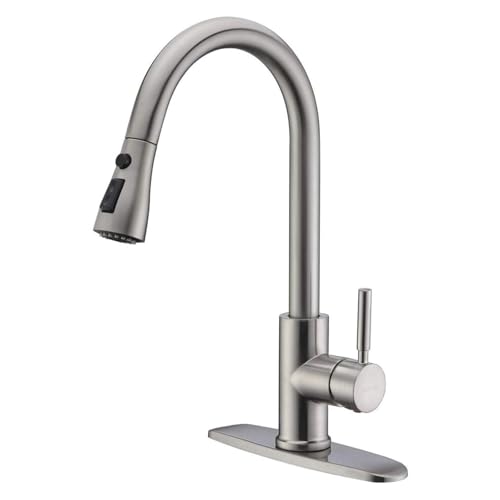
WEWE High-Arc Pull-Down Kitchen Faucet, Brushed Nickel, 3-Mode Sprayer
Badge: Best Serviceable Classic
Strengths
- Ceramic cartridge stated — documented drip resistance at the valve.
- Soft silicone nozzles rub clean by hand, so scale never builds into a spray-deflecting crust.
- A 20-inch pull-down reach and 360° swivel cover big sinks while keeping hose joints unstressed.
Trade-offs
- Brushed nickel shows water spots; the base needs the same wipe-dry habit as any nickel finish.
- A long-running value model rather than a feature flagship — no sensor or dispenser options.
- High-arc profile needs cabinet clearance above the sink; measure before ordering for tight spaces.
Mini spec box
- Cartridge: Ceramic (stated)
- Material: SUS 304 stainless steel
- Finish: Brushed nickel
- Sprayer: 3-mode, 20-inch pull-down reach
- Nozzles: Soft silicone, rub clean
- Swivel: 360°
- Mounting: 1- or 3-hole fit
The second WEWE on this list is the traditionalist’s answer: no sensor, no bundle, just the proven leak defenses executed completely. The ceramic cartridge is stated, the body is SUS 304 stainless, and the mounting fits one or three holes. What elevates it for a leak-focused list is serviceability. Its soft silicone nozzles are designed to be cleared of mineral buildup by rubbing them with a finger. That matters beyond spray quality: a scaled-up spray face deflects water sideways onto the deck and base, and owners routinely misread that wet base as a leaking seal, sometimes disassembling a healthy faucet. A spray face you can keep clean in five seconds keeps both the sink and your diagnosis dry.
The dimensions work in the same direction. Twenty inches of pull-down reach means the head reaches a large sink’s corners without the hose being hauled to its stop, and the full-circle swivel lets the spout park out of the way instead of being left twisted — small mechanical kindnesses that keep the head joint and hose from living under constant strain. Joints that are not strained do not weep; that sentence summarizes half of practical leak prevention.
If there is a caveat, it is that this is a mature, widely sold design rather than a novelty — buyers browsing Best New Kitchen Faucets for the latest features will find it plain. But plain, documented and serviceable is a strong combination for the specific job of not leaking, and for many households it is the right final answer on this list.
Best for: buyers who want stated cartridge evidence in a simple, maintainable manual faucet / Not suited for: buyers who want touchless operation or bundled accessories
Comparison Table
| Pick | Cartridge evidence | Other leak-relevant evidence | Mounting | Link |
|---|---|---|---|---|
| Lufeidra Pot Filler Style | Ceramic, stated | SUS304 stainless body | 1- or 3-hole | Check on Amazon |
| FEELSO Pull Down | Not stated | Lead-free, NSF certified; single valve layout | 1 or 3 hole | Check on Amazon |
| WEWE Touchless Set | Ceramic, stated | Sensor absorbs daily cycles; SUS 304 body | 1- or 3-hole | Check on Amazon |
| GIMILI Touchless Spring | Not stated | Sensor operation; single deck penetration | Single hole | Check on Amazon |
| VFAUOSIT Pull Down | Not stated | Tool-free install design; NSF 61/372, cUPC; 23-inch hose | See product page | Check on Amazon |
| WEWE High-Arc | Ceramic, stated | Rub-clean silicone nozzles; 20-inch reach | 1- or 3-hole | Check on Amazon |
How to Choose a Kitchen Faucet That Will Not Leak
Read listings in a fixed order. First, the cartridge: “ceramic disc” or “ceramic cartridge” in the specification is the headline evidence, because the cartridge is where handle drips are born. Second, the body material: stainless steel grades such as SUS 304 resist the internal corrosion that eventually distorts sealing surfaces. Third, the connections: integrated or braided supply lines and a well-designed hose joint reduce the number of field-made seals. Fourth, the installation system: anything that helps the mounting seat squarely and the fittings torque correctly — quick-install nuts, tool-free positioning — is leak prevention disguised as convenience.
Be skeptical of the word “leak-proof” wherever it appears in marketing. No responsible reading of a specification can promise zero leaks forever, because seals age, water chemistry varies and installation quality varies more. What you are buying is margin: harder sealing faces, better materials, fewer joints, and a design whose wear parts can be serviced. A faucet with a replaceable, identifiable cartridge can be returned to drip-free service with one part; a faucet with a mystery valve often gets replaced whole.
Match the faucet to your water, too. Hard water attacks in two directions: mineral grit wears valve seals, and scale crusts spray faces until they deflect water everywhere. In hard-water homes, prioritize a stated ceramic cartridge and rub-clean silicone nozzles — the Lufeidra and WEWE high-arc cover both — and consider a whole-home or under-sink softening step if scale is severe. In homes with older galvanized pipe, grit is the enemy, and the same cartridge advice applies with extra force.
Finally, budget a few minutes of the purchase decision for the cabinet, not the faucet. Check that your shutoff valves actually close fully and are not themselves weeping — replacing a faucet onto failing angle stops is how a “new faucet leak” is born. Confirm the sink’s hole pattern so the base gasket will sit as designed. The driest faucet in this guide can be defeated by a ten-dollar valve under the sink; the inspection is free.
How to Install a Faucet So It Stays Leak-Free
- Before removing anything, close the shutoff valves and open the old faucet to confirm the water truly stops. If it does not, replace the valves first — they are the foundation of a dry install.
- Clean the deck surface completely. Old putty ridges or grit under a new base gasket create channels for water; the gasket can only seal against a flat, clean surface.
- Seat the faucet and tighten mounting hardware evenly, snug rather than forced. Over-torquing can distort a base gasket and create the very gap it exists to close.
- Connect supply lines hand-tight, then a modest additional turn with a wrench as the instructions direct. If a fitting weeps at first pressurization, tighten slightly more rather than disassembling and restarting with a stressed seal.
- Route the pull-down hose in a smooth loop with its weight positioned as marked, clear of supply lines and stored items, so the head joint is never tugged sideways.
- For touchless models, mount the control box high and dry in the cabinet, with cables looped downward so any stray droplet runs away from the electronics, not into them.
- Pressurize slowly, then inspect every joint with a dry hand and a flashlight. Leave a dry paper towel under the cabinet overnight; a faint damp spot in the morning locates a seep while it is still trivial to fix.
Troubleshooting Common Drips
Problem: a drip from the spout minutes after shutoff → water is creeping past the cartridge; on a ceramic model, first flush the cartridge by running the handle through its range, since a grit grain on a disc face is a common and fixable cause, before assuming the cartridge has failed.
Problem: moisture at the base of the faucet after washing up → often sink-top water migrating under a poorly seated base gasket rather than a plumbing leak; dry the area, run water in the sink without splashing the deck, and see whether the moisture returns before opening the cabinet.
Problem: a damp cabinet floor with a dry faucet above → suspect the supply connections or the sink’s own drain and trap joints; wrap each suspect joint in dry tissue, wait, and the wet tissue names the culprit.
Where Kitchen Faucet Leaks Actually Start
There are five usual origins, and knowing them turns leak prevention from luck into a checklist. The cartridge is first: it is the only seal that moves thousands of times a year, which is why its material dominates this guide. Second are the supply connections, static seals whose fate is sealed — literally — at installation. Third is the pull-down hose and its head joint, the only pressurized flexible line in the system, vulnerable to strain and cabinet clutter. Fourth is the base gasket, which does not hold back pressurized water at all but decides whether sink-top splashes end up in the cabinet. Fifth, in touchless models, is the solenoid valve in the control unit — generally reliable, but dependent on staying dry.
Notice what is not on that list: the spout body itself and the finish. Faucets almost never leak “through” their metal. When an owner says a faucet leaks, one of the five origins above is responsible nearly every time, and each maps to a choice you control — cartridge evidence at purchase, care at installation, hose routing in the cabinet, gasket seating on the deck, and dryness around electronics. That is genuinely good news: staying leak-free is a process, not a lottery.
Maintaining a Drip-Free Faucet Year After Year
Maintenance is short and mostly observational. Once a month, run a dry hand around the supply connections and the base while the faucet runs — ten seconds that catch seeps years before they rot anything. Keep the spray face clean; on rub-clean silicone nozzles that is a fingertip’s work, and on any model a vinegar soak dissolves scale before it distorts the spray. Exercise the shutoff valves under the sink twice a year by closing and reopening them, so they work on the day you truly need them. If your faucet is touchless, put battery replacement on the same calendar as smoke-alarm batteries. And keep the cabinet under the sink uncluttered enough that the hose loop hangs freely and a leak, if one ever starts, is visible rather than absorbed by stored clutter. A shallow waterproof tray or mat under the plumbing costs very little, contains the first hours of any seep, and turns a hidden drip into an obvious puddle you will notice the next time you reach for the detergent — cheap insurance for the cabinet floor you cannot see. Households planning a broader refresh alongside the faucet may find the layout notes in Best Old Style Kitchen Faucets helpful for matching new hardware to an older sink’s character.
How to Read a Faucet Listing Like a Plumber
Plumbers read faucet listings differently from most shoppers: they skip the lifestyle photographs entirely and interrogate four lines of text. Learning that reading order will protect you in any future faucet purchase, including models not on this list. The first line is the cartridge, and it is non-negotiable at the top of the order because it is the only component whose failure mode is a guaranteed drip rather than a cosmetic decline. “Ceramic disc” or “ceramic cartridge” ends the inquiry on the spot; “washerless” is an older term that usually points to a similar sealed design and is worth a follow-up look at the manufacturer’s documentation; silence on the subject means the maker either uses a basic cartridge or does not consider it a selling point, and either way you are being asked to buy the most important part of the faucet blind.
The second line is the body and waterway material. Stainless grades, solid brass waterways and documented lead-free compliance all point the same direction: internal surfaces that will look the same in ten years as they do today, holding their seals in the positions the designer intended. Finishes, by contrast, tell you nothing about longevity of sealing — a beautiful oil-rubbed or matte coating over a mediocre body is still a mediocre body, which is why this guide treats finish discussions, including those in Best One Handle Kitchen Faucets With A Side Soap Dispenser, as styling questions rather than durability evidence.
The third line is the hose and connection story: braided lines, integrated supplies, a stated hose length, a docking method. Each describes how the one flexible, pressurized part of the system will live. The fourth line is the installation system, because the plumber knows the warranty statistics: early leaks are installation stories far more often than manufacturing stories. A maker who engineers the mounting to be hard to get wrong is telling you they understand where leaks come from. When all four lines read well — cartridge, materials, hose, installation — you are looking at a faucet designed by people who have answered warranty calls. When the listing offers only adjectives, keep scrolling; the six models ranked above were chosen precisely because their listings answer at least most of these four questions in writing.
Common Buying Mistakes
- Trusting the words “leak-proof” instead of the cartridge line. Marketing adjectives are not evidence; a stated ceramic cartridge is.
- Blaming the faucet for an installation leak. A quarter-turn on a supply nut fixes more “defective” faucets than any warranty department.
- Reusing old supply lines and valves without inspection. New seals against corroded valve threads are a false economy.
- Ignoring a slow drip. The water wasted is trivial next to the cabinet floor it is quietly destroying.
- Letting the pull-down hose fight the cabinet contents. A snagged, strained hose joint is a future weep; route it clear.
- Assuming certification means leak resistance. NSF and cUPC listings speak to materials and code — valuable, but the cartridge specification is the drip evidence.
Final Recommendation
Start with the Lufeidra if you want the clearest documented case: a stated ceramic cartridge in a SUS304 stainless body, mounted flexibly and styled to outlast trends. The FEELSO is the pick when certified materials and a simple single-valve layout matter most, and the WEWE Touchless Set adds sensor operation on top of a stated ceramic cartridge for households that will keep up with batteries. Whichever you choose, spend as much care on the installation as on the selection — the combination of a well-evidenced faucet and a careful, inspected install is what “no leak” actually looks like in practice.
Frequently Asked Questions
What faucet feature prevents leaks the most?
The cartridge. A ceramic disc cartridge seals with hard, flat ceramic faces that resist the grit and wear that make washer-based valves drip. It is the first specification to look for, and three picks on this list state one directly.
Can a new faucet leak even if it is a good model?
Yes — installation is the other half of the outcome. Under-tightened or cross-threaded supply fittings, a pinched base gasket, or a strained pull-down hose can make any faucet weep. A slow pressurization and an overnight paper-towel check under the cabinet catch nearly all of these on day one.
Are touchless faucets more or less likely to leak?
They shift the wear rather than simply adding risk. The sensor path absorbs most daily on-off cycles, sparing the manual cartridge, but the system adds an electronic control unit that must stay dry under the sink. Installed and maintained sensibly, either type can stay drip-free for years.
How do I tell a cartridge drip from a base leak?
A cartridge drip appears at the spout or handle after the faucet is off, with the deck dry. Base moisture appears after sink use involving splashing, while the spout stays dry. The distinction matters because one needs a cartridge service and the other needs the base gasket reseated.
Does hard water make faucets leak sooner?
It accelerates the two main wear mechanisms: mineral grit scores valve seals, and scale buildup distorts spray faces. In hard-water homes, prioritize a stated ceramic cartridge and rub-clean silicone nozzles, and descale the spray face regularly.
Should I replace supply lines when I replace the faucet?
Inspect them honestly. If the lines or shutoff valves show corrosion, stiffness or any weeping, replace them during the same job — it is far cheaper than a second cabinet-opening later, and new faucet seals deserve sound threads to mate with.
What should I do at the first sign of a drip?
Act the same week. Identify the origin using the dry-tissue method, tighten or reseat the fitting if it is a connection, and flush or service the cartridge if the drip is at the spout. Early drips are small repairs; ignored drips become cabinet replacements.