Disclosure: topratedkitchenware.com is reader-supported. When you buy through links on our site, we may earn an affiliate commission from Amazon and other retailers, at no extra cost to you.
Where to buy
Old style is the easiest faucet category to shop badly, because “vintage look” marketing covers everything from a faithful bridge faucet to a modern pull-down with a slightly curved spout. The list below is therefore split honestly: two models whose own specifications state a classic or farmhouse design language carry purchase links, while four contemporary models are reviewed in prose as the near misses and modern alternatives they are — useful comparisons, clearly labeled, with no pretense that they are period pieces.
- VFAUOSIT Kitchen Faucet with Pull Down Sprayer, Modern Bar Sink Faucet — prose-only (explicitly modern design; see review)
- WEWE High-Arc Pull-Down Kitchen Faucet, Brushed Nickel, 3-Mode Sprayer — prose-only (high arc alone is a spout shape, not a stated retro design; see review)
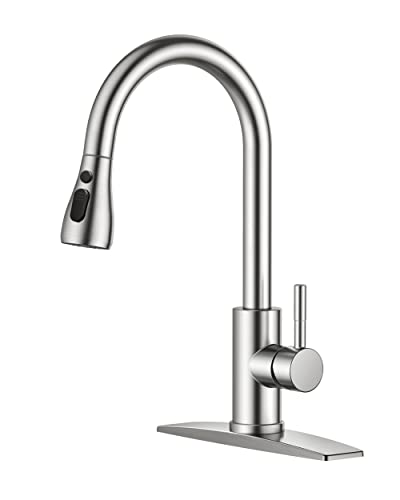
- FORIOUS Kitchen Faucets Pull Down Sprayer, Stainless Steel, Brushed Nickel — Classic High Arc
- Moen Essie Pulldown Kitchen Faucet, Spot Resist Stainless, 87014SRS — prose-only (contemporary design, no classic cue stated; see review)
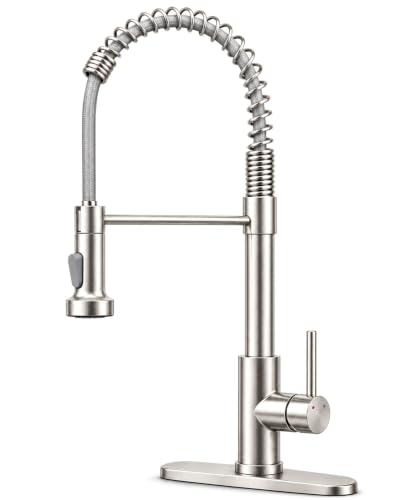
- OWOFAN Kitchen Faucet with Pull Down Sprayer, Brushed Nickel — Farmhouse Spring Design
- WEWE Pull-Down Kitchen Faucet, 3-Mode Sprayer, Brushed Nickel, High Arc — prose-only (contemporary design, no classic cue stated; see review)
Read the full guide ↓
The search for the best old style kitchen faucets usually starts with a kitchen, not a faucet: a farmhouse renovation that finally reached the sink, a craftsman home whose previous owners installed a chrome builder faucet that looks wrong every single day, or a period house where every other fixture — the lighting, the hardware, the range — speaks a traditional language the faucet refuses to join. Old style, done properly, is not nostalgia decoration. It is proportion, silhouette and detail: a tall gooseneck arc instead of a low modern sweep, visible mechanical character instead of hidden minimalism, and shapes — bridge bodies, spring arms, pot-filler joints — that come from how faucets were built when they were assembled from pipes and castings rather than molded as single sculptural objects.
Here is the uncomfortable truth this guide is built around: the current verified market for faucets is dominated by contemporary pull-down designs, and genuinely traditional forms — two-handle bridge faucets with cross handles, wall-mounted pot fillers, unlacquered brass that patinas — are a niche within it. Of the six models in the pool assigned to this keyword, exactly two state a traditional design language in their own specifications: the FORIOUS, which describes itself as a classic high arc design, and the OWOFAN, a farmhouse spring faucet. The other four are honestly modern products. Rather than dress them up as something they are not, this guide reviews all six transparently: the two true old-style picks with full purchase links, and the four modern models in prose, explaining exactly where each one falls short of the old-style brief and what kind of buyer should consider it anyway.
That honesty turns out to be useful, because the most common old-style buying error is paying for a label. A faucet does not become traditional because a listing calls it “vintage inspired” in the marketing copy while its specification describes a standard contemporary pull-down. Throughout this guide, style judgments are tied to what each product actually states and shows: classic, farmhouse, spring, high arc — or, in the prose-only cases, modern. If your renovation also involves the handle layout, Best One Handle Kitchen Faucets covers how single-lever control can still work inside a traditional scheme when the silhouette is right.
Key Takeaways
- True old-style design cues are specific: classic high-arc silhouettes, farmhouse and spring-faucet forms, bridge bodies and cross or lever handles. Only two picks here state such cues — the FORIOUS (classic high arc) and the OWOFAN (farmhouse spring).
- Four pool models are contemporary designs and are reviewed prose-only, clearly labeled: high arc by itself is a spout shape shared by modern faucets, not proof of a retro design.
- Modern internals are not the enemy of old style: both linked picks pair traditional silhouettes with current pull-down sprayers and single-handle control.
- Finish supports the illusion but cannot create it: brushed nickel flatters traditional shapes, while the silhouette does the real period work.
- If your heart is set on a bridge faucet or cross handles, treat this list as a starting point and shop dedicated traditional lines — no pick here is a bridge design, and the guide says so plainly.
- Buy the silhouette first, the finish second, and the feature list third; in an old-style kitchen the shape is what you will see every day.
In this guide
Quick Picks
| Pick | Badge | Old-style verdict | Link |
|---|---|---|---|
| VFAUOSIT Pull Down Sprayer Faucet | Modern Contrast Pick | Prose-only — its own specification says “Modern”; included to show the contrast | See review |
| WEWE High-Arc Pull-Down Faucet | High-Arc Near Miss | Prose-only — graceful gooseneck shape, but no classic or retro design stated | See review |
| FORIOUS Pull Down Sprayer Faucet | Best Overall Classic | Linked — “Classic High Arc” stated in its own specification, single handle, farmhouse-ready | Check on Amazon |
| Moen Essie Pulldown, 87014SRS | Contemporary Alternative | Prose-only — a modern big-brand pulldown with no traditional design cue stated | See review |
| OWOFAN Spring Kitchen Faucet | Best Farmhouse Style | Linked — farmhouse spring-faucet form stated; the exposed spring is a pre-war commercial-kitchen silhouette | Check on Amazon |
| WEWE Pull-Down Faucet, High Arc | Modern Simplicity Pick | Prose-only — clean contemporary pull-down; traditional only in the loosest sense | See review |
How These Picks Were Chosen
This guide applies a stricter evidence rule than most style roundups, because style is where faucet marketing stretches furthest. A pick could be linked — presented as a purchasable old-style recommendation — only if its own verified specification states a traditional design language: words like classic, farmhouse, spring, bridge, cross handle, or a traditional form evident in the stated design. That rule is the same title-evidence standard used across this research program for core attributes, and it is why the linked list here is short. Two models meet it. Four do not, and those four are still reviewed in full prose, because a reader deserves to see the near misses judged openly rather than silently dropped or dishonestly relabeled.
Two judgment calls deserve daylight. First, the WEWE high-arc model: a tall gooseneck arc is historically the traditional kitchen silhouette, and in a looser guide it would be linked on shape alone. But high arc is also the default shape of thoroughly modern pull-downs, and this model’s specification states no classic, retro or traditional design intent, so it is prose-only — shape noted, claim withheld. Second, the OWOFAN: “farmhouse” can be a loose marketing word, but paired with an exposed-spring spout — a form that descends directly from early commercial and farmhouse kitchen hardware — the design language is stated and visible, so it is linked as the farmhouse pick. Readers who disagree with either call have the full reasoning in the reviews to weigh for themselves. The research is specification-led, not hands-on; no model was installed or tested for this guide, and the check date for the underlying product data is 2026-11-20.
The 6 Best Old Style Kitchen Faucets
VFAUOSIT Kitchen Faucet with Pull Down Sprayer, Modern Bar Sink Faucet
Badge: Modern Contrast Pick
Strengths
- Documented compliance: lead-free with NSF 61/372 and cUPC listings stated.
- Three spray modes and a generous 23-inch retractable hose.
- Tool-free install positioning and a cold-start safety feature show thoughtful current engineering.
Trade-offs
- Its own specification calls it a “Modern Bar Sink Faucet” — the opposite of this keyword’s brief.
- Clean contemporary lines will fight a traditional kitchen’s other fixtures rather than joining them.
- Sized and styled for bar sinks; a period kitchen’s large farmhouse sink deserves a larger presence.
Mini spec box
- Style stated: Modern
- Certifications stated: Lead-free, NSF 61/372, cUPC
- Sprayer: Pull-down, 3 spray modes
- Hose: 23-inch retractable
- Installation: Tool-free install positioning
- Status: Prose-only — no Amazon link, because the design contradicts the keyword’s core attribute
The VFAUOSIT opens this list as the control specimen: a perfectly respectable current faucet that is, by its own description, a modern bar sink faucet. Including it — clearly labeled, without a purchase link — serves a purpose. It shows exactly what old style is not. Its lines are the clean, minimized geometry of contemporary design; nothing in its silhouette references the mechanical, assembled-from-parts character of traditional hardware. In a period kitchen it would be the one object in the room speaking the wrong decade, no matter how well it washes dishes.
Judged on its own terms rather than this keyword’s, the specification is genuinely good: full certification listings, three spray modes, an unusually long retractable hose and an installation system designed to be hard to get wrong. If your kitchen is modern and you landed on this page by accident, the VFAUOSIT deserves a look through a modern lens — the kind of assessment given in Best New Kitchen Faucets. But honesty in a buying guide means refusing to relabel it, and so it stands here as the contrast that defines the category: everything the two linked picks below are trying not to be.
Best for: modern bar sinks and contemporary kitchens (outside this keyword’s brief) / Not suited for: any kitchen pursuing a traditional, farmhouse or period look
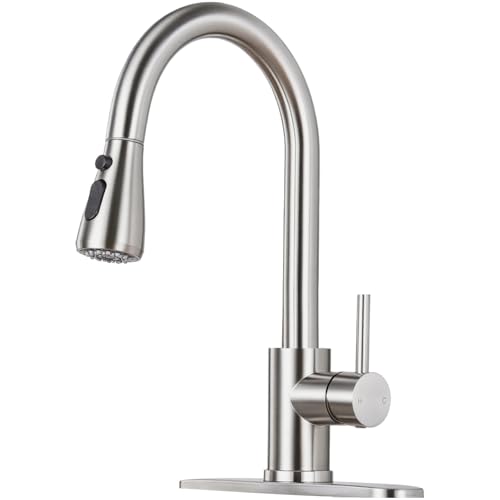
WEWE High-Arc Pull-Down Kitchen Faucet, Brushed Nickel, 3-Mode Sprayer
Badge: High-Arc Near Miss
Strengths
- The tall gooseneck arc is the closest silhouette to a traditional kitchen faucet among the prose-only models.
- Documented internals: ceramic cartridge stated, SUS 304 stainless body.
- Rub-clean silicone nozzles, 20-inch pull-down reach and 360° swivel — thoroughly serviceable hardware.
Trade-offs
- No classic, retro or traditional design is stated anywhere in its specification — the arc is its only period-adjacent trait.
- The pull-down head and contemporary handle keep the overall impression modern at conversational distance.
- Brushed nickel is period-friendly, but finish alone cannot carry a traditional scheme.
Mini spec box
- Cartridge: Ceramic (stated)
- Material: SUS 304 stainless steel
- Finish: Brushed nickel
- Sprayer: 3-mode, 20-inch pull-down reach
- Swivel: 360°
- Mounting: 1- or 3-hole fit
- Status: Prose-only — high arc noted as a shape, not accepted as a stated retro design
This is the hardest call on the list, and the review will argue it openly. The WEWE high-arc’s spout is a gooseneck — the tall, curved profile that kitchen faucets wore for most of the twentieth century, long before the low, angular sweeps of contemporary design. Stand it in a traditional kitchen and, from across the room, its outline will not offend the way the VFAUOSIT’s would. Its internals are also the best documented among the prose-only picks: a stated ceramic cartridge, a SUS 304 stainless body, silicone nozzles you clear with a fingertip, and a 20-inch pull-down reach that makes it a pleasure at a deep farmhouse sink.
Why, then, prose-only? Because the rule of this guide is that a style claim must be stated, not inferred from one shared trait. High-arc goosenecks are also the standard shape of entirely modern faucets — including another pick in this very pool — and nothing in this model’s specification claims a classic or traditional design. The honest summary is “period-compatible shape, modern product,” and a buyer whose traditional scheme is loose and eclectic may reasonably decide that is enough. A buyer restoring a period kitchen with intent should hold out for the stated classics below — or for the dedicated bridge and cross-handle designs discussed in the buying guide section, which this pool does not contain at all.
Best for: eclectic traditional kitchens where a graceful arc is enough, judged with open eyes / Not suited for: strict period restorations that need a stated traditional design

FORIOUS Kitchen Faucets Pull Down Sprayer, Stainless Steel, Brushed Nickel
Badge: Best Overall Classic
Strengths
- “Classic High Arc” is stated in its own specification — the traditional silhouette is the product’s declared design, not a reviewer’s inference.
- Single-handle control delivers modern convenience without disturbing the period outline.
- Deck plate for 1 or 3 hole mounting suits the older, multi-hole sinks common in traditional homes.
Trade-offs
- Classic here means a traditional gooseneck profile — it is not a bridge faucet and has no cross handles, so purists should calibrate expectations.
- Brushed nickel needs regular wiping to keep its soft period tone free of water spots.
- Also positioned for campers, RVs and laundry sinks, so it is a versatile classic rather than a specialist reproduction.
Mini spec box
- Style stated: Classic high arc
- Material: Stainless steel
- Finish: Brushed nickel
- Handle: Single handle
- Sprayer: Pull-down
- Mounting: Deck plate for 1 or 3 hole
- Also positioned for: Farmhouse, camper, laundry, RV and bar sinks
The FORIOUS earns the top linked spot by the simplest route: it calls itself classic, and its form backs the word up. The classic high arc is the silhouette that defined the twentieth-century kitchen — a tall, rounded gooseneck that clears stockpots, gives the sink a sense of ceremony, and pairs naturally with apron-front sinks, beadboard, shaker cabinetry and the other elements of a traditional scheme. Where the prose-only WEWE shares that arc incidentally, the FORIOUS builds its identity on it, and the difference shows in the details of proportion: this is a faucet designed to be looked at as a period object, not merely to fit under a cabinet.
Crucially, choosing it does not mean choosing period plumbing. The single handle gives one-motion temperature control — the modern convenience traditional two-handle owners secretly envy every time they balance hot and cold with wet hands — and the pull-down sprayer handles the sink work a fixed vintage spout never could. The included deck plate deserves a traditional-home mention of its own: older sinks and counters are very often drilled for three holes, and a plate that covers them gracefully, in a matching finish, saves the patchwork look that ruins many well-meant restorations. Shoppers comparing that mounting flexibility across patterns will find Best One Hole Kitchen Faucets a useful companion on what each configuration demands.
Calibrate on one point: “classic” in this specification means the classic gooseneck form, not a bridge faucet with exposed pipework and porcelain cross handles. If your restoration brief demands those specific artifacts, this pool does not contain your faucet, and the buying-guide section below maps where to look instead. For the far larger group of traditional kitchens that need the right silhouette with modern manners, the FORIOUS is the coherent answer.
Best for: traditional, shaker and farmhouse kitchens wanting a stated classic silhouette with modern control / Not suited for: purist restorations requiring a bridge body or cross handles
Moen Essie Pulldown Kitchen Faucet, Spot Resist Stainless, 87014SRS
Badge: Contemporary Alternative
Strengths
- Spot Resist Stainless finish hides the fingerprints and water spots that daily use leaves.
- Backed by a major brand’s parts and support network — a real consideration in an older home’s long renovation arc.
- Restrained pulldown form is inoffensive in transitional kitchens that mix old architecture with new appliances.
Trade-offs
- No traditional design cue is stated; this is a contemporary faucet by any honest reading.
- The listing is terse — spray modes, cartridge and mounting details need confirmation on the product page.
- Its stainless tone reads cooler than the warm metals most period schemes are built around.
Mini spec box
- Brand line: Moen Essie
- Model: 87014SRS
- Finish: Spot Resist Stainless
- Sprayer: Pulldown
- Status: Prose-only — contemporary design with no classic cue stated
The Essie is here for the transitional kitchen — the very common real-world case where the house is old, the appliances are new, and the faucet brief is “do not fight with either.” Moen’s design is a clean contemporary pulldown, and this review will not pretend otherwise: no classic arc language, no farmhouse claim, no traditional detail appears in its specification. What it offers instead is neutrality with support behind it. In a kitchen where a stainless range and refrigerator already set a modern note, a restrained faucet in a spot-resistant stainless finish can be the peacemaker, and Moen’s depth of parts availability matters in homes where a renovation is a ten-year project rather than a single season.
That said, within this keyword’s purpose the Essie is an alternative, not an answer. If the goal is a faucet that actively contributes to an old-style scheme — that a guest would read as belonging to the house’s era — the Essie’s smooth contemporary form will always read as the new object in the room. Buy it knowingly, as many transitional-kitchen owners happily do, or choose the FORIOUS above for the same money spent in the period direction. What this guide will not do is sell it to you as traditional; the distinction between “does not clash” and “belongs” is the whole subject of old-style shopping.
Best for: transitional kitchens mixing period architecture with modern appliances, bought with open eyes / Not suited for: any scheme where the faucet itself must read as a period piece

OWOFAN Kitchen Faucet with Pull Down Sprayer, Brushed Nickel
Badge: Best Farmhouse Style
Strengths
- The exposed-spring spout is a direct descendant of early commercial and farmhouse kitchen hardware — the most mechanically honest silhouette in traditional design.
- Farmhouse use is stated in its own specification, alongside a 1-handle layout and a 1 or 3-hole deck plate.
- Lead-free and NSF certified stainless construction brings current materials documentation to the period form.
Trade-offs
- The spring silhouette is tall and industrial; in a delicate, formal traditional kitchen it can read as utilitarian rather than elegant.
- Brushed nickel is a cooler period tone than the brass or bronze a strict restoration might demand.
- Spring arms invite a clearance check — measure the space between sink and upper cabinets before ordering.
Mini spec box
- Style stated: Farmhouse, spring faucet
- Material: Stainless steel, lead-free, NSF certified
- Finish: Brushed nickel
- Handle: 1 handle
- Sprayer: Pull-down
- Mounting: 1 or 3-hole deck plate
- Also positioned for: RV, bar and laundry room sinks
If the FORIOUS is old style as elegance, the OWOFAN is old style as work. The exposed spring faucet descends from the hardware of farmhouse sculleries, diners and commercial kitchens of the early twentieth century, where the coil was not decoration but engineering: it let a heavy spray head travel anywhere in a deep sink and snapped it home again, thousands of times, in rooms that had no patience for fragile objects. That heritage gives the spring form a claim on “old style” that no amount of curved-spout marketing can match — it is a silhouette with a job history, and in a farmhouse kitchen with an apron sink, open shelving and a big range, it looks less like a reproduction than like the original equipment.
The OWOFAN’s specification supports the story with modern substance: stainless, lead-free, NSF certified construction, a single handle for one-motion control, and a deck plate covering one- or three-hole decks — the flexibility older sinks demand. The pull-down head keeps the spring’s working reach while adding the rinsing precision a fixed commercial head lacked. It is also positioned for laundry and bar sinks, and in a hard-working laundry room the spring form is arguably even more at home than in the kitchen.
Two cautions complete the picture. The spring tower is tall — verify your cabinet clearance, especially in kitchens where a window or shelf sits close above the sink. And its industrial character is a specific flavor of old style: in a formal traditional kitchen built around ornate woodwork, the FORIOUS’s graceful arc will harmonize better. Choose between them by deciding which ancestor your kitchen actually had — the farmhouse workhorse or the classic gooseneck — and the decision makes itself. For more farmhouse-adjacent configurations, Best Performing Kitchen Faucets compares how these hard-working forms handle daily demands.
Best for: farmhouse, apron-sink and working kitchens that want the spring form’s genuine heritage / Not suited for: formal traditional kitchens, or tight sink-to-cabinet clearances
WEWE Pull-Down Kitchen Faucet, 3-Mode Sprayer, Brushed Nickel, High Arc
Badge: Modern Simplicity Pick
Strengths
- Well-documented internals: ceramic cartridge, SUS 304 body, braided supply hoses and tool-free install are all stated.
- Three spray modes, a full 360° swivel and easy-clean nozzles make it an easy faucet to live with.
- One-hole fit keeps the deck clean and uncluttered.
Trade-offs
- A contemporary pull-down in every stated respect; “high arc” in its title describes clearance, not a design era.
- Nothing in its form — handle, head or body — references traditional hardware.
- Choosing it for an old-style kitchen means choosing modern convenience and abandoning the period brief.
Mini spec box
- Cartridge: Ceramic (stated)
- Material: SUS 304 stainless steel
- Finish: Brushed nickel
- Sprayer: 3-mode pull-down
- Swivel: 360°
- Mounting: 1-hole fit
- Status: Prose-only — contemporary design, no traditional cue stated
The second WEWE in this pool closes the list as the mirror image of the first. Where the high-arc WEWE at position two at least shares the traditional gooseneck outline, this model is a straightforward contemporary pull-down whose “high arc” phrase promises pot clearance rather than period character. Its specification is, on modern terms, excellent — ceramic cartridge, 304 stainless, braided hoses, tool-free installation, three spray modes — and in a modern kitchen it would likely outrank half this list. None of that is in dispute here.
What is in dispute is only the label, and labels are this guide’s whole point. A buyer assembling an old-style kitchen who orders this faucet on the strength of the words “high arc” will receive a good faucet that quietly modernizes their sink — the thin end of the wedge that turns a period renovation into a merely pleasant kitchen. It is included, in prose and without a link, so that the contrast is visible on the page: this is what the current market mostly sells, it is genuinely good at its job, and it is not old style. If, having seen the two honest period options above, you decide modern performance matters more to you than period form, buy this kind of faucet with clear eyes through a modern roundup rather than a traditional one.
Best for: modern kitchens (outside this keyword’s brief) wanting documented internals and simple installation / Not suited for: traditional, farmhouse or period schemes of any strictness
Comparison Table
| Pick | Style stated in specification | Old-style status | Mounting | Link |
|---|---|---|---|---|
| VFAUOSIT Pull Down | Modern | Prose-only — contradicts the brief | See product page | See review |
| WEWE High-Arc | None stated (gooseneck shape) | Prose-only — shape only | 1- or 3-hole | See review |
| FORIOUS Classic High Arc | Classic high arc | Linked — Best Overall Classic | Deck plate, 1 or 3 hole | Check on Amazon |
| Moen Essie | None stated (contemporary) | Prose-only — transitional alternative | See product page | See review |
| OWOFAN Spring | Farmhouse spring | Linked — Best Farmhouse Style | 1 or 3-hole deck plate | Check on Amazon |
| WEWE Pull-Down High Arc | None stated (contemporary) | Prose-only — modern simplicity | 1-hole fit | See review |
How to Choose an Old Style Kitchen Faucet
Begin by naming the specific tradition your kitchen belongs to, because “old style” contains multitudes that do not mix. The farmhouse tradition is utilitarian: apron sinks, spring or gooseneck faucets, visible hardware, nothing precious. The classic traditional kitchen is more formal: a graceful high arc, lever handles with some shaping, finishes with warmth. The industrial-heritage look borrows from commercial kitchens — spring arms, substantial bodies, function worn proudly. And true period restoration aims at a documented era, where bridge faucets, cross handles and period-correct finishes are researched rather than approximated. The two linked picks here serve the first two traditions well; the fourth requires dedicated reproduction lines that this pool does not include.
Next, learn the vocabulary of traditional forms so listings cannot bluff you. A bridge faucet mounts through two holes with the mixing body exposed above the deck as a horizontal pipe — the most unmistakably period form there is. Cross handles are the four-spoke wheels of early plumbing; lever handles with porcelain or shaped grips are their later cousins. A spring faucet carries its spray head on an exposed coil. A gooseneck or high arc is the tall curved spout shared by nearly every era — which is precisely why it proves nothing by itself. When a listing says “vintage” but its specification describes none of these forms, you are reading marketing, not design.
Then reconcile style with internals, because the happiest old-style purchases refuse the false choice between them. A ceramic cartridge, a stainless or brass body and a pull-down sprayer are invisible from across the room and invaluable across a decade; the linked FORIOUS and OWOFAN both hide current internals inside period silhouettes, which is exactly the combination to seek in any traditional faucet. What you should not accept is the reverse bargain — a beautiful period shape wrapped around an undocumented valve — because drips are not charming on any era’s cabinetry. The evidence-first reading method in Best Outdoor Kitchen Faucets applies the same discipline to a different harsh-environment brief.
Finally, treat finish as the supporting actor. Warm, soft finishes — brushed nickel among the options here — flatter traditional shapes and forgive the water spots that busy sinks produce. Dark bronze tones and unlacquered brass belong to stricter period schemes, but a finish cannot rescue a modern silhouette, and a modern finish cannot ruin a true traditional form as quickly as the wrong shape can. Silhouette, then internals, then finish: shopping in that order is the whole secret of this category.
How to Install and Live With a Traditional Faucet
- Photograph your sink’s hole pattern before ordering anything. Traditional homes often hide surprises — wide-spread drillings, a separate sprayer hole, an old soap hole — and the deck plate question must be settled before the faucet arrives.
- For a deck-plate install, center the plate carefully and seat its gasket evenly; on an older, slightly uneven cast-iron or fireclay sink, a patient seating matters more than torque.
- Align a spring faucet’s tower dead vertical before tightening. A spring arm amplifies small tilts visually — a degree off at the base reads as a lean at the top.
- Set the pull-down hose weight so the head docks without snapping; traditional silhouettes look wrong with a head left dangling, and the joint lasts longer when it parks properly.
- Flush the lines before fitting the spray head, as with any faucet, to keep construction grit out of the new cartridge.
- After a week of use, re-check the base and connections once. Older plumbing settles; a single early inspection is the cheapest leak insurance there is.
Troubleshooting
Problem: the new traditional faucet looks “too new” against aged fixtures → finishes mellow with use and gentle cleaning; avoid abrasive polishes, which keep a finish showroom-bright and deepen the contrast you are trying to soften.
Problem: the spring head sways or fails to stay parked → check that the hose weight is positioned as marked and the hose loop is not snagged on under-sink plumbing, which pulls the head off its seat.
Problem: deck plate rocks slightly on an old sink → the deck surface is uneven; reseat with the gasket fully compressed by even tightening, and fill any visible gap with a neat bead of kitchen-safe sealant at the plate’s edge.
The Design Language of Old Style, Explained
Traditional faucets look the way they do because they were once assembled, visibly, from parts: a body cast and machined, handles that turned stems, spouts bent from tube. Modern design hides that assembly inside a single sculpted shell, which is why contemporary faucets read as objects and traditional ones read as mechanisms. When you shop, look for the visible-mechanism quality — separate elements, honest joints, forms that show how they work. The OWOFAN’s exposed spring is the extreme case; the FORIOUS’s classic arc is the gentle one. Both speak the language. A faucet that hides everything may be beautiful, but it is speaking modern, whatever its listing claims.
Proportion is the second language. Traditional kitchens were built around human-scaled, slightly generous forms: taller spouts, longer handles, bodies with presence. A low-profile modern faucet in a farmhouse sink does not merely clash in style — it looks undersized, and undersized reads as wrong even to guests who could not name why. When in doubt between two traditional options, choose the one with more stature; period rooms forgive bold hardware and punish timid hardware. This is also why measuring spout height against your sink and cabinets, a step emphasized again in Best One Handle Kitchen Faucets With Soap Dispenser for deck layouts, matters doubly in traditional schemes.
Pairing an Old Style Faucet With the Rest of the Kitchen
A faucet does not perform its era alone. Cabinet hardware is the first ally: cup pulls and latches in a compatible tone make a traditional faucet look inevitable, while sleek bar pulls make the same faucet look stranded. Lighting is the second: a faucet’s silhouette is seen against whatever hangs above the sink, and a period lantern or schoolhouse pendant completes the sentence the faucet starts. The sink itself is the third — an apron-front or a heavy fireclay basin is the natural partner for both linked picks here, and either will make a modern faucet look more out of place than any photograph suggests.
Care of the finish deserves one sentence of its own in traditional schemes: soft finishes like brushed nickel age gracefully when they are cleaned with water, a soft cloth and nothing abrasive, because traditional rooms read gentle wear as patina and harsh polishing as damage. A faucet that is allowed to mellow slightly will blend with genuinely old objects faster than one kept in showroom condition, which is a rare case of less maintenance producing the better result.
None of this requires a museum. The most livable traditional kitchens mix eras with intent: a classic-arc faucet, modern appliances chosen in quiet finishes, one or two genuinely old objects for soul. The rule is that the mixing should be a decision, not an accident — which is, in the end, all this guide has asked of its product rankings too.
If You Truly Need a Bridge Faucet or Cross Handles
Some readers will finish the reviews above with a fair objection: neither linked pick is the faucet in their reference photograph. If your kitchen brief names a bridge faucet — the exposed horizontal body spanning two deck holes — or cross handles with porcelain indices, or a wall-mounted pot filler over the range, then say so plainly and shop accordingly, because those are specialist products with their own rules. Bridge faucets mount on wider, fixed centers, so the sink or counter drilling must match exactly; there is no deck plate rescue for a mismatched spread. Cross-handle models are two-valve faucets, which means two cartridges to maintain and a mixing ritual — hot and cold balanced by hand — that households either find charming or tiresome, usually discovering which within the first week. Wall-mounted pot fillers are a separate purchase from the sink faucet entirely, with their own shutoff discipline, since a leak at a range-side filler has no sink beneath it to catch the evidence.
None of that makes those choices wrong; it makes them deliberate. The shoppers who love their bridge faucets chose the ritual along with the silhouette. What this guide’s pool offers instead is the middle path that most traditional kitchens actually end up choosing: the classic arc and the farmhouse spring, each with one handle, a pull-down sprayer and a cartridge you never think about. If you go the specialist route, carry this guide’s two tests with you — is the traditional form stated and real, and is the valve behind it documented? A reproduction that passes both tests is a treasure. One that passes only the first is a photograph waiting to drip.
One more practical note for the strict-restoration path: period homes often pair their faucets with equally period sinks, and those sinks were not always drilled to modern centers. Before falling for any specialist traditional faucet, template your actual hole spacing with cardboard and a tape measure, in daylight, twice. More traditional-faucet projects have been delayed by a half-inch of assumption than by any shortage of beautiful hardware, and the older the house, the less standard anything in it turns out to be.
Common Buying Mistakes
- Believing the word “vintage” in a title. Demand a stated traditional form — classic, farmhouse, spring, bridge, cross handle — before believing a style claim.
- Confusing high arc with old style. The gooseneck is every era’s spout; by itself it certifies clearance, not character.
- Sacrificing internals for silhouette. A period shape around an undocumented cartridge is a drip with good posture; insist on both.
- Forgetting the hole pattern of an older sink. Traditional homes hide multi-hole decks; a deck plate plan prevents the patchwork look.
- Ignoring spring-faucet clearance. Spring towers are tall — measure cabinet and window clearance before the box arrives.
- Mixing traditions accidentally. Farmhouse, formal classic and industrial heritage are different languages; pick one and let the faucet speak it consistently.
Final Recommendation
For most traditional kitchens, the answer is the FORIOUS Classic High Arc: a stated classic silhouette, single-handle convenience and deck-plate flexibility for the multi-hole sinks traditional homes so often have. If your kitchen’s tradition is the working farmhouse — apron sink, big range, nothing precious — the OWOFAN spring faucet is the more characterful and equally honest choice. And if neither silhouette is traditional enough for a strict restoration, take this guide’s method with you to the dedicated reproduction lines: demand the form in writing, check the cartridge behind it, and never let a listing’s adjectives substitute for either.
Frequently Asked Questions
What makes a kitchen faucet “old style”?
A stated traditional design language: classic high-arc silhouettes, farmhouse and spring forms, bridge bodies, or cross and shaped lever handles — forms descended from how faucets were built before contemporary minimalism. A modern pull-down with a curved spout does not qualify on shape alone, which is why four picks here are prose-only.
Are bridge faucets better than classic high-arc faucets for a period kitchen?
For strict period restoration, a bridge faucet is the more authentic form. For most traditional kitchens, a classic high-arc single-handle faucet like the FORIOUS delivers the right silhouette with simpler installation and modern one-hand control. No bridge model appears in this guide’s verified pool, and the guide does not pretend otherwise.
Can an old style faucet have modern features like a pull-down sprayer?
Yes, and the best ones do. Both linked picks pair period silhouettes with pull-down sprayers and current construction. The sprayer lives inside the traditional form rather than replacing it — that combination is the sweet spot for a kitchen that is lived in, not exhibited.
Which finish suits an old style kitchen best?
Warm, soft finishes flatter traditional shapes; brushed nickel, as on both linked picks, is the versatile choice and hides water spots reasonably well. Darker bronze tones and brass belong to stricter schemes. Finish supports the silhouette — it cannot substitute for it.
Will a traditional faucet fit my older sink’s holes?
Often, with the right model. Both linked picks mount on one hole or cover three holes with a deck plate, which handles the most common older patterns. Measure your exact spread before ordering, especially for wide-spread vintage drillings that may need a true bridge or widespread model instead.
Is a spring faucet practical for everyday family use?
Yes — the spring form was designed for punishing commercial use, and its reach and positive docking suit big farmhouse sinks especially well. Verify the tower’s height against your cabinets, and expect its industrial character to be a strong visual statement.
Why are some faucets in this guide not linked?
Because their own specifications describe modern designs, and presenting them as purchasable old-style recommendations would mislead. They are reviewed in full prose so you can see the near misses and judge the boundary for yourself.