Disclosure: topratedkitchenware.com is reader-supported. When you buy through links on our site, we may earn an affiliate commission from Amazon and other retailers, at no extra cost to you.
Where to buy
A one-hole faucet makes a promise about your sink deck: a single, clean penetration, with the whole faucet — body, control and spout — rising from one opening. Five models in this pool state a 1-hole fit or single-hole installation in their own specifications and carry the purchase links below. One model, the VFAUOSIT, states no mounting pattern at all; it is reviewed in prose so its otherwise interesting specification is not mistaken for a confirmed one-hole fit.
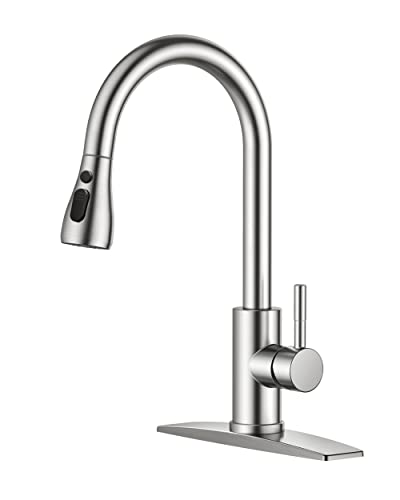
- Lufeidra Kitchen Faucet With Pull-Down Sprayer, Classic Pot Filler Faucet — fits 1- or 3-hole
- FEELSO Kitchen Faucets with Pull Down Sprayer, Brushed Nickel — 1 or 3 hole
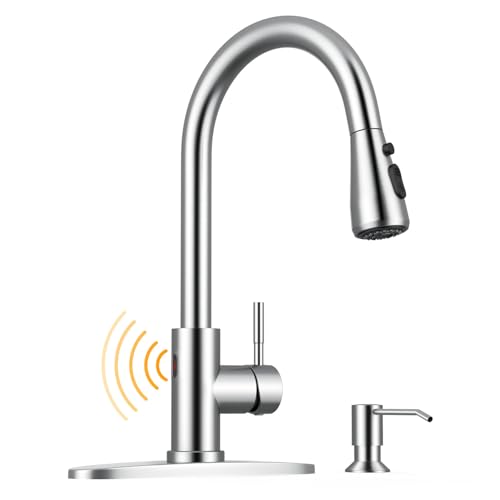
- WEWE Touchless Kitchen Faucet with Soap Dispenser Set, Brushed Nickel — 1- or 3-hole fit
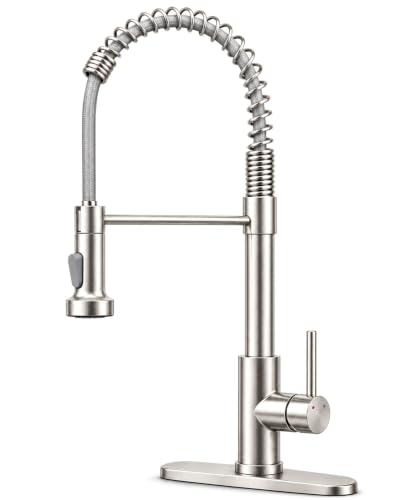
- GIMILI Matte Black Touchless Kitchen Faucet with Spring Pull Down Sprayer — single hole installation
- VFAUOSIT Kitchen Faucet with Pull Down Sprayer, Modern Bar Sink Faucet — prose-only (mounting pattern not stated; see review)
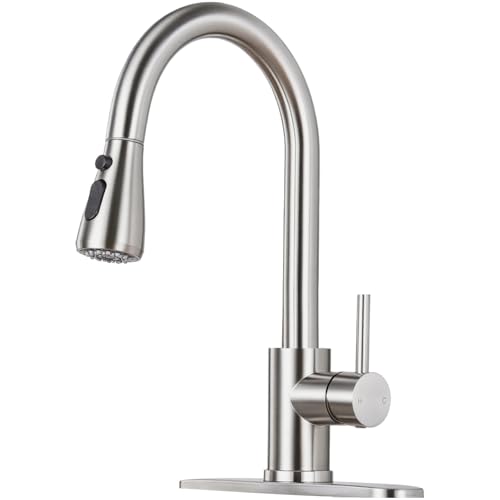
- WEWE High-Arc Pull-Down Kitchen Faucet, Brushed Nickel, 3-Mode Sprayer — 1- or 3-hole fit
Read the full guide ↓
The appeal of the best one hole kitchen faucets is visible from across the room: a sink deck with exactly one thing on it. No deck plate bridging a trio of holes, no orphaned sprayer, no leftover cap where a second handle used to live — just the faucet, rising clean from a single opening in the stone or steel. That minimalism is why one-hole drilling has become the default for new countertops and modern sinks, and it carries practical dividends beyond looks: one penetration means one base gasket to seal, one mounting point to service, and the easiest deck in the kitchen to wipe clean. A one-hole faucet is also the most future-proof choice, because any single-hole model can later move to another one-hole deck, and most can cover a three-hole sink with a plate if your housing situation changes.
This guide applies the same evidence discipline as its sibling research: a pick is linked only when its own verified specification states the mounting — “fits 1- or 3-hole,” “1 or 3 hole,” “1- or 3-hole fit,” or, in the GIMILI’s case, an explicit “Single Hole Installation.” Five picks pass, and they are usefully different: a classically styled ceramic-cartridge model, a certified value design, a touchless set with a dispenser, a matte-black single-hole-only spring faucet, and a serviceable high-arc classic. The sixth, the VFAUOSIT, publishes certifications and an installation method but never a hole count — so it is reviewed in prose, with the gap named, rather than waved into a category its paperwork does not claim.
One clarification matters before the rankings, because it confuses more buyers than any other in this category: most “one-hole” faucets are really “one-hole native, three-hole compatible.” Mounted on a single hole they show their clean intended form; mounted on a three-hole deck they use a plate to cover the outer holes. Both installations are legitimate, and this guide notes which form each pick takes. The exception is a true single-hole-only design like the GIMILI, whose specification names single-hole installation without a plate option — the purest form of the category, and the one that demands the most certainty about your deck before ordering. Readers arriving from a multi-hole world may also want the configuration background in Best Plumbing Kitchen Faucets 4 Hole, which explains what those wider drillings were designed for.
Key Takeaways
- Five picks state their one-hole credentials in writing: the Lufeidra, FEELSO, WEWE touchless set and WEWE high-arc all fit 1- or 3-hole decks, while the GIMILI specifies single-hole installation outright.
- The VFAUOSIT states no mounting pattern in its specification and is prose-only — a hole count is never inferred from a photograph or a product class.
- “One-hole native, three-hole compatible” is the flexible majority: clean on a single hole today, plate-covered on a three-hole deck tomorrow.
- One penetration means one base seal — the simplest waterproofing and the easiest deck to keep clean in the kitchen.
- The GIMILI is the purist’s pick and the planner’s warning: single-hole only means your deck must be right before the box arrives.
- Measure your existing hole’s diameter and position, and count everything else claiming deck space — dispenser, filter tap, air gap — before choosing.
In this guide
Quick Picks
| Pick | Badge | One-hole evidence | Link |
|---|---|---|---|
| Lufeidra Pull-Down Pot Filler Style Faucet | Best Overall | Linked — “Fits 1- or 3-Hole” stated; ceramic cartridge; SUS304 body | Check on Amazon |
| FEELSO Pull Down Sprayer Faucet | Best Certified Value | Linked — “1 or 3 Hole” stated; lead-free, NSF certified; single handle | Check on Amazon |
| WEWE Touchless Faucet with Soap Dispenser Set | Best Touchless One-Hole | Linked — “1- or 3-Hole Fit” stated; sensor activation; dispenser set included | Check on Amazon |
| GIMILI Matte Black Touchless Spring Faucet | Best True Single-Hole | Linked — “Single Hole Installation” stated; motion sensor; matte black | Check on Amazon |
| VFAUOSIT Pull Down Sprayer Faucet | Install-Friendly Alternative | Prose-only — mounting pattern not stated anywhere in its specification | See review |
| WEWE High-Arc Pull-Down Faucet | Best Serviceable Classic | Linked — “1- or 3-Hole Fit” stated; ceramic cartridge; rub-clean nozzles | Check on Amazon |
How These Picks Were Chosen
Every pick comes from a verified product pool cross-checked on 2026-11-20, and the selection test for this keyword was a single question asked of each specification: does it state the mounting pattern? Statements that qualify include an explicit one-hole fit, a one-or-three-hole range, or a named single-hole installation. Statements that do not qualify include everything else — bar-sink positioning, tool-free installation claims, compact styling — because a faucet can be all of those things and still arrive drilled for a configuration your sink does not have. The VFAUOSIT’s prose-only status is that test applied without favorites: its specification is detailed about certifications and silent about holes, so it is treated as unconfirmed for this keyword’s core attribute.
Among the five confirmed picks, ranking weighed the completeness of the whole specification — cartridge evidence, materials, certifications, sprayer design — since a one-hole faucet is a long-term fixture and the hole is only its footprint. This is specification-led research rather than hands-on testing; no model was installed for this guide, and where a detail such as an exact hole diameter is not published, the reviews direct you to confirm it on the product page rather than guessing. That restraint is deliberate: mounting is the one specification where a guess becomes a return shipment.
The 6 Best One Hole Kitchen Faucets

Lufeidra Kitchen Faucet With Pull-Down Sprayer, Classic Pot Filler Faucet
Badge: Best Overall
Strengths
- “Fits 1- or 3-Hole” is stated — one-hole native today, plate-compatible if your next sink differs.
- Ceramic cartridge stated, in a SUS304 stainless body: the durability file matches the mounting flexibility.
- Classic pot filler styling gives a single-hole deck a traditional presence modern minimalism cannot.
Trade-offs
- Brushed nickel needs a wipe-down habit to stay spot-free.
- A newer brand, so long-term parts support is less proven than a legacy maker’s.
- The classic styling is a deliberate look; stark modern kitchens may prefer the GIMILI or WEWE below.
Mini spec box
- Mounting: Fits 1- or 3-hole (stated)
- Cartridge: Ceramic (stated)
- Material: SUS304 stainless steel
- Finish: Brushed nickel
- Style: Classic pot filler design
- Sprayer: Pull-down
- Also positioned for: Laundry, RV and bar sinks
The Lufeidra leads because it treats the one-hole brief as a beginning rather than the whole story. The mounting statement is exactly what this category wants — a stated fit for one hole, with three-hole compatibility behind a plate — and everything behind the footprint is documented with equal care: a ceramic cartridge doing the sealing, a 304 stainless body resisting internal corrosion, and a classic pot filler silhouette that proves a single-hole deck does not have to read as minimal-modern. In a traditional kitchen with a modern one-hole countertop — a combination renovation creates constantly — this is the faucet that reconciles the two facts gracefully.
Daily life with it is the standard modern pull-down repertoire, delivered through a period form: the sprayer reaches where a fixed spout cannot, the single base seals against one clean gasket line, and the deck around it stays empty enough to wipe in one pass. That last point is the one-hole dividend owners mention most after a year: not the look, but the thirty seconds of cleaning that never happens because there is no plate edge, no second fixture base, no cap collecting grime at the sink’s edge.
Its caveats are the familiar pair — a young brand’s unproven decade, and a finish that rewards a cloth. Neither touches the mounting promise, which is stated, flexible and central. For a one-hole buyer who wants documentation and character in the same box, this is the complete pick.
Best for: one-hole decks in traditional or transitional kitchens that want stated mounting plus cartridge evidence / Not suited for: buyers who want a legacy brand’s parts network above documentation

FEELSO Kitchen Faucets with Pull Down Sprayer, Brushed Nickel
Badge: Best Certified Value
Strengths
- “1 or 3 Hole” mounting is stated, and the single handle keeps the one-hole form factor honest — one opening, one control.
- Lead-free and NSF certified: the materials paperwork leads its specification.
- High-arc spout gives a single-hole installation the clearance tall pots need.
Trade-offs
- Cartridge type and spray-mode count are not stated — its file is thinner than the Lufeidra’s.
- Brushed nickel can clash in tone with cooler stainless appliances if not checked.
- Positioned broadly across kitchen, farmhouse, laundry, RV and bar use rather than tuned to one setting.
Mini spec box
- Mounting: 1 or 3 hole (stated)
- Material: Stainless steel
- Finish: Brushed nickel
- Handle: Single handle
- Spout: High arc, pull-down sprayer
- Certification stated: Lead-free, NSF certified
- Cartridge type: Not stated in listing
The FEELSO is the value expression of the one-hole idea: a single stated opening, a single stated handle, and a certification line — lead-free, NSF certified — that many pricier listings omit. There is a coherence to the package for a buyer furnishing a clean modern deck on a budget: everything about it is singular and simple, from the one penetration in the counter to the one valve in the body, and simplicity at a sink compounds — fewer seals, fewer edges, fewer decisions at installation.
The high arc deserves its sentence, because on a one-hole deck the spout’s height does visual work: a tall, clean arc gives the lone fixture enough presence to hold the sink’s composition, where a low, timid spout can leave a one-hole installation looking accidental rather than minimal. The FEELSO’s arc clears stockpots and fills the vertical space properly. Its farmhouse and laundry positioning also makes sense of the design — rooms that value a certified, simple, single-hole fixture are exactly the rooms it names.
What it asks in return is tolerance for a thinner file: no cartridge type, no mode count. Buyers who need those lines in writing should step up to the Lufeidra or the WEWE high-arc. Buyers whose priorities are a stated one-hole fit and certified materials at a value tier will find the FEELSO’s omissions an acceptable trade — the two facts this keyword and a health-conscious household care most about are both in writing.
Best for: budget-conscious one-hole installs that put certification first / Not suited for: spec-sheet completists who want cartridge and modes documented
WEWE Touchless Kitchen Faucet with Soap Dispenser Set, Brushed Nickel
Badge: Best Touchless One-Hole
Strengths
- “1- or 3-Hole Fit” is stated, and the faucet body itself occupies a single hole — the dispenser is the only additional deck claim.
- Touchless activation plus a stated ceramic cartridge: the most complete documentation in this pool.
- The included soap dispenser set is finished to match, solving the second-fixture problem in the same box.
Trade-offs
- Total deck arithmetic still applies: faucet hole plus dispenser hole, so a strict one-hole-only deck cannot host the full set.
- The sensor needs under-sink power and periodic battery attention.
- Brushed nickel shows spots without a wipe-down habit.
Mini spec box
- Mounting: 1- or 3-hole fit (stated)
- Activation: Touchless sensor, with manual handle
- Cartridge: Ceramic (stated)
- Material: SUS 304 stainless steel
- Finish: Brushed nickel
- Sprayer: 3-mode, pull-down hose
- Swivel: 360°
- Included: Soap dispenser set
- Nozzles: Easy-clean
The WEWE set is the maximalist answer to a minimalist category, and the tension is productive. Its faucet body honors the one-hole brief exactly — a stated 1-hole fit, one base, one seal — while the set acknowledges the truth that most one-hole decks eventually host a second fixture anyway: the soap dispenser. By including that dispenser, finished in the same brushed nickel, WEWE turns the inevitable second hole from a mismatched afterthought into a designed pair. If your deck has exactly two holes, or two holes’ worth of plan, this is arguably the most considered package in the pool — a point developed from the dispenser’s side in Best One Handle Kitchen Faucets With Soap Dispenser.
The faucet’s own file remains the pool’s most complete: touchless activation over a stated ceramic cartridge, 304 stainless construction, three spray modes, full swivel and rub-clean nozzles. On a one-hole stone counter, that specification reads as permanence — the sense that the single object on the deck was chosen to deserve its solitude. The sensor’s under-sink hardware is the one hidden complexity, and it stays hidden only if the cabinet is kept dry and the batteries are maintained.
Be precise about your deck before ordering: a counter drilled with literally one hole and no more can host the faucet but not its dispenser, and drilling stone later is a professional errand. With two openings or a three-hole deck to cover, the set’s arithmetic closes beautifully. Count first; this pick rewards counters who count.
Best for: one-hole faucet plans that already include a dispenser hole, and buyers who want the fullest documentation / Not suited for: a strict single-opening deck with no possibility of a second hole
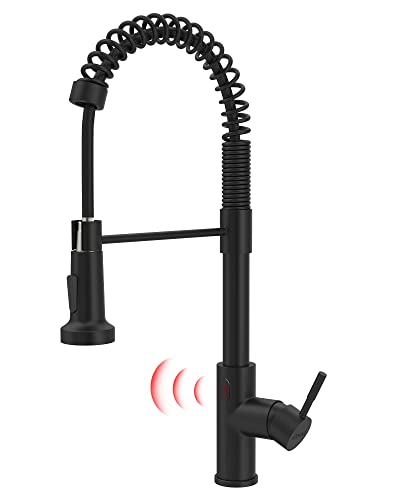
GIMILI Matte Black Touchless Kitchen Faucet with Spring Pull Down Sprayer
Badge: Best True Single-Hole
Strengths
- “Single Hole Installation” is stated outright — the only pick whose specification commits to the pure form, with no plate ambiguity.
- Motion-sensor, hands-free operation in a matte black spring silhouette: the boldest one-hole statement available here.
- One penetration is also the simplest sealing problem and the cleanest deck in the category.
Trade-offs
- Single-hole means single-hole: a three-hole deck has no stated covering solution with this model.
- Matte black shows mineral spotting in hard-water homes unless wiped down.
- The spring tower is tall; verify clearance above the sink before committing.
Mini spec box
- Mounting: Single-hole installation (stated)
- Activation: Motion sensor, hands-free smart control
- Finish: Matte black
- Sprayer: Spring pull-down
- Handle: Single handle
- Style stated: Modern farmhouse
Every other linked pick in this guide hedges its one-hole identity with a three-hole escape route. The GIMILI does not hedge: its specification says “Single Hole Installation,” full stop, and that commitment is its identity. For the buyer with a genuinely single-hole deck — a drilled stone counter, a modern single-hole sink — that purity is the point. No plate, no covered holes, no compromise geometry: one opening, one gasket, one matte-black spring tower rising from the stone like it was drawn there.
The rest of the design leans into the same confidence. Motion-sensor activation keeps the single control nearly untouched in daily use, the spring head travels the sink and docks home, and the modern farmhouse styling gives the minimal deck a maximal object. There is a real argument that this is the most beautiful configuration in the pool — the fewest possible elements, each one deliberate. It is also, not coincidentally, the configuration with the least forgiveness: the deck must already be right, the clearance above must fit the tower, and hard water will autograph the matte finish if the household does not wipe down.
Choose it as you would choose any uncompromising design: because your kitchen matches its terms. If your deck is three-hole, your water is hard and your habits are relaxed, the flexible WEWE models above will make you happier. If your deck is one hole, your style is bold and your cloth is handy, the GIMILI is the category’s purest expression — and its outdoor-adjacent durability questions are worth comparing against the harsher brief in Best Outdoor Kitchen Faucets.
Best for: true single-hole decks in modern farmhouse or industrial kitchens that want a statement piece / Not suited for: three-hole decks, low clearances, or hard-water households that never wipe down
VFAUOSIT Kitchen Faucet with Pull Down Sprayer, Modern Bar Sink Faucet
Badge: Install-Friendly Alternative
Strengths
- Tool-free install positioning is stated — a mounting experience designed to be simple, whatever the pattern proves to be.
- Full compliance file: lead-free with NSF 61/372 and cUPC listings stated.
- Three spray modes, a 23-inch retractable hose and a cold-start safety feature round out a thoughtful specification.
Trade-offs
- No mounting pattern or hole count is stated anywhere in its specification — this keyword’s core attribute is undocumented.
- It is positioned as a modern bar sink faucet, so its dimensions need checking against a full-size one-hole kitchen deck.
- Cartridge type is also unstated, compounding the documentation gap.
Mini spec box
- Certifications stated: Lead-free, NSF 61/372, cUPC
- Sprayer: Pull-down, 3 spray modes
- Hose: 23-inch retractable
- Installation: Tool-free install positioning
- Feature: Cold-start safety
- Mounting pattern: Not stated in specification
- Status: Prose-only — no Amazon link, one-hole fit unconfirmed
The VFAUOSIT is this guide’s demonstration that a specification can be detailed and still miss the point. It tells you about its certifications, its hose length to the inch, its installation method and even its cold-start behavior — a fuller file than several linked picks offer. What it never says is how many holes it mounts through. For most keywords that omission would be a footnote; for this keyword it is the entire subject. A one-hole buyer who orders on the strength of the VFAUOSIT’s other virtues is gambling the installation on an unstated fact, and gambles of exactly that kind are what this research program’s evidence rules exist to retire.
None of this makes it a bad faucet. Its tool-free installation positioning suggests a compact single-shank design, its compliance file is genuinely complete, and as a bar-sink faucet it may be excellent. If you verify the mounting on its product page and it states a one-hole fit, the rest of this assessment applies in its favor and it becomes a legitimate contender. Until that verification, it stands here honestly: an interesting, well-certified alternative whose candidacy for this specific list its own paperwork does not establish. The thirty seconds the check takes is the cheapest insurance in the whole purchase — a habit worth carrying to every faucet listing you ever read, including the channel comparisons in Best Place To Order New Kitchen Faucets.
Best for: bar-sink buyers, and one-hole shoppers willing to confirm the mounting at the listing / Not suited for: anyone who needs the hole count certified within the guide itself
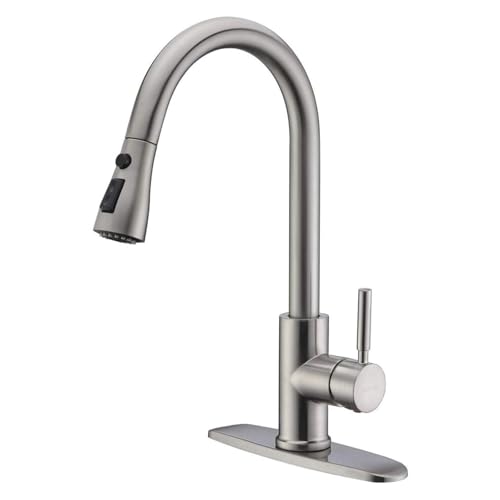
WEWE High-Arc Pull-Down Kitchen Faucet, Brushed Nickel, 3-Mode Sprayer
Badge: Best Serviceable Classic
Strengths
- “1- or 3-Hole Fit” is stated — the flexible mounting, in writing.
- Ceramic cartridge stated, SUS 304 body, and rub-clean silicone nozzles: the serviceability trifecta.
- A 20-inch pull-down reach and 360° swivel make the single deck hole serve a large sink completely.
Trade-offs
- A mature, plain design — no sensor, no bundle, no statement finish.
- Brushed nickel shows water spots without regular wiping.
- High-arc profile needs the usual clearance check above the sink.
Mini spec box
- Mounting: 1- or 3-hole fit (stated)
- Cartridge: Ceramic (stated)
- Material: SUS 304 stainless steel
- Finish: Brushed nickel
- Sprayer: 3-mode, 20-inch pull-down reach
- Nozzles: Soft silicone, rub clean
- Swivel: 360°
The WEWE high-arc closes the linked list as the conservative craftsman’s choice: the mounting stated, the cartridge stated, the body material stated, and a spray face designed to be maintained with a fingertip. On a one-hole deck, that serviceability matters more than it might elsewhere, because the whole point of the single-fixture deck is a sink station that stays clean and calm — and a faucet whose nozzles crust with scale until the spray wanders is neither. Rub-clean silicone keeps the spray honest in hard water with five seconds of attention, which is the maintenance philosophy of this entire category in miniature.
Its dimensions suit the format, too. Twenty inches of pull-down reach means the one hole you drilled can serve a big sink’s every corner, and the full swivel parks the spout wherever the work is not. Nothing about the design shouts; everything about it is documented. In a guide full of statements — classic, touchless, matte black — there is a place for the faucet that simply files its paperwork correctly and gets on with the decade, and this is that place.
Best for: one-hole buyers who value stated everything and easy maintenance over novelty / Not suited for: buyers who want touchless operation or a bold finish
Comparison Table
| Pick | Mounting stated | Cartridge | Standout | Link |
|---|---|---|---|---|
| Lufeidra Pot Filler Style | Fits 1- or 3-hole | Ceramic, stated | Classic styling, SUS304 body | Check on Amazon |
| FEELSO Pull Down | 1 or 3 hole | Not stated | Lead-free, NSF certified | Check on Amazon |
| WEWE Touchless Set | 1- or 3-hole fit | Ceramic, stated | Sensor plus included dispenser | Check on Amazon |
| GIMILI Touchless Spring | Single hole installation | Not stated | Matte black spring, motion sensor | Check on Amazon |
| VFAUOSIT Pull Down | Not stated | Not stated | Tool-free install, NSF 61/372, cUPC | See review |
| WEWE High-Arc | 1- or 3-hole fit | Ceramic, stated | Rub-clean nozzles, 20-inch reach | Check on Amazon |
How to Choose a One Hole Kitchen Faucet
Start by deciding which species of one-hole buyer you are. The flexible majority — four of the five linked picks — mount natively on one hole and cover three holes with a plate when needed; they suit anyone whose housing or sink might change, and anyone whose current deck is three-hole but whose taste is one-hole. The purist species, represented by the GIMILI, is single-hole only; it suits a deck that is already drilled once and a buyer who values the uncompromised form. Choosing your species first prevents the category’s classic error: falling for a single-hole-only design while owning a three-hole sink.
Next, audit the deck as a whole, not just the faucet’s footprint. List everything that wants an opening: the faucet, a soap dispenser if planned, a filtered-water tap, a dishwasher air gap, a disposal switch. A one-hole counter with a dispenser plan is really a two-hole counter, and discovering that after the stone is drilled is an expensive education. If you are specifying a new countertop, drill for the full list now — capped spare holes are cheap during fabrication and precious later. The wider plumbing context for these decisions is laid out in Best Plumbing Kitchen Faucets.
Then weigh what stands on the hole. A single fixture carries the whole visual and functional load of the sink, so its documentation matters proportionally more: a stated ceramic cartridge (Lufeidra, both WEWE models) and a stated body material are the lines to prefer. Finally, measure the hole you have — its diameter and its distance from the backsplash — against the product page for your finalist, because “one hole” describes a count, not a universal size, and a lever’s swing needs room behind the faucet that a tight backsplash can steal.
How to Install a One Hole Faucet
- Close the shutoff valves, remove the old faucet, and clean the deck until the single hole’s rim is bare — the new base gasket seals against this surface alone.
- Test-fit the faucet dry. Check the lever’s full swing against the backsplash and confirm the body sits centered before any hardware is tightened.
- If a deck plate is being used on a three-hole sink, center it over the outer holes and seat its gasket evenly; if the install is truly one-hole, omit the plate for the clean intended form.
- Feed the hoses and shank through the hole, position the faucet, and secure the mounting nut from below — snug and even, since the single mounting point carries the whole fixture.
- Connect the supply lines, fit the pull-down hose weight as marked, and route the loop clear of anything stored under the sink.
- For touchless models, mount the control box dry and high in the cabinet and confirm the sensor’s behavior before closing up.
- Flush the lines with the spray head removed, pressurize slowly, and inspect the single base and both supply joints with a dry hand.
Troubleshooting
Problem: the faucet rocks slightly on its single mounting → the deck surface is uneven or the mounting nut needs an even re-snug; a rocking base will fret its gasket, so correct it now rather than monitoring it.
Problem: the lever taps the backsplash at full travel → the faucet was seated rotated a few degrees off center; loosen the mounting, rotate the body slightly forward, and re-secure.
Problem: water appears at the base after washing up → splash water is crossing the base gasket line; dry everything, run water without splashing the deck, and confirm whether the moisture returns before suspecting a supply joint.
One Hole, Three Holes and the Life of a Kitchen
Decks outlive faucets, and kitchens change their minds. The household that drills one hole today may want a dispenser next year, a filter tap in five years, and a different faucet in ten. The flexible picks in this guide are built for that reality: native on one hole, graceful over three. The purist pick is built for a different reality — a finished design, confidently final. Neither philosophy is wrong, but they should be chosen knowingly, and the cheapest moment to choose is before the counter is drilled. If your kitchen is still on paper, the highest-value sentence in this guide is the dullest: drill for the fixtures you might plausibly add, and cap what you do not use yet. Future you, standing at a finished stone counter with a dispenser in hand, will be grateful. Shoppers comparing raw capability across mounting types can cross-check the finalists against Best Performing Kitchen Faucets.
Caring for a Single-Fixture Deck
The one-hole deck’s great pleasure is its upkeep: one base to wipe around, no plate edge to trap grime, no orphaned caps to clean under. Protect that simplicity with two habits. Keep the base gasket’s line dry — a quick pass with the dish cloth after washing up prevents the mineral tide-mark that single fixtures otherwise wear like a collar. And once a season, reach under the sink and confirm the single mounting nut is still snug; a one-point mounting that loosens announces itself as a faint rock long before it becomes a leak, and the correction takes a minute. The faucet on a one-hole deck is the sink’s only ornament and only machine — a moment of attention per season is a fair price for both roles. Add the spray face to that seasonal minute: on rub-clean models a fingertip clears the nozzles, and on any model a brief vinegar soak keeps the spray true, so the single fixture keeps performing like the single, deliberate choice it was.
Stone, Steel and Fireclay: How the Deck Material Changes the Job
The same one-hole faucet lives three different lives depending on what it is bolted to, and the differences are worth knowing before the counter is cut or the sink is chosen. On a stone or quartz countertop, the hole is drilled by the fabricator, its edges are clean and hard, and the faucet’s base sits on a surface that will never flex — the most forgiving foundation in the category, provided the drilling position was planned with the backsplash clearance and the dispenser’s future hole in mind, because stone forgives nothing after the fact. A faucet mounted through stone also inherits the counter’s thickness: check that the mounting shank and hardware suit a thick slab, a detail the finalist’s product page will state and this guide deliberately does not guess.
On a stainless steel sink deck, the physics invert. The hole is usually pre-punched by the sink maker — which settles the diameter question for you — but thin steel flexes under a tall faucet’s leverage, and a high-arc or spring model can develop a faint wobble that is a property of the deck, not a defect in the faucet. The cures are a stiffening support under the deck where the sink’s design allows one, and a mounting snugged evenly rather than heroically. Fireclay and cast-iron sinks sit between the two: rigid and handsome, with holes that are sometimes slightly less regular than machined stone, which is why the installation section insists on seating the single base gasket patiently and evenly — on a one-hole deck, that one gasket line is the whole waterproofing story, and it deserves the extra minute.
What One Hole Cannot Do: Knowing the Format’s Limits
Honesty about a format’s limits is what separates a guide from a brochure, and the one-hole format has three. The first is separation: a one-hole faucet integrates its control on the body, so the widespread-faucet luxury of placing handles apart from the spout — or a sprayer on its own station — is off the table unless additional holes are drilled for separate fixtures. The second is service access: everything threads through one opening and one mounting point, which concentrates the installation into a small working space under the sink; it is simpler than a three-hole install, but it is not roomier. The third is visual: a single fixture must carry the sink’s whole composition, and a small, low faucet on a large double-bowl sink can look lost in a way the same faucet never would on a compact deck. Spout height and presence — the Lufeidra’s classic stature, the GIMILI’s tower, the FEELSO’s arc — are therefore not vanity metrics in this category; they are how the lone fixture earns its place.
None of these limits argues against the format for the kitchens it suits. They argue for choosing it with the same deliberateness the format itself expresses: one hole, chosen on purpose, with the deck’s whole future — dispenser, filter, replacements — thought through at the one moment when changing your mind is still free. Kitchens planned that way tend to stay satisfying for a very long time, and the faucet at their center tends to be the one object nobody ever proposes replacing.
Template Before You Order: A Ten-Minute Deck Audit
The cheapest tool in this entire category is a piece of cardboard. Before ordering any finalist, cut a template of your sink’s rear deck — or trace the existing hole pattern onto paper — and mark four things: the faucet hole’s center and diameter, its distance to the backsplash, the positions of every other fixture or cap, and the swing the new faucet’s lever will need. Stand the template on the deck, sight along it from the room’s doorway, and you will see your future sink station more honestly than any product photograph can show it. This audit is where the single-hole-only GIMILI gets validated or vetoed, where a planned dispenser finds out whether it truly has a home, and where a lever-versus-backsplash conflict is discovered on paper instead of porcelain.
Take the same template under the sink. The space below a one-hole deck is usually tidier than below a three-hole one, but the pull-down hose loop needs a clear vertical path, the touchless models need a dry shelf for their control box, and stored cleaning supplies have a lifelong habit of migrating into the hose’s way. Ten minutes with a template and a flashlight, before any box arrives, converts the installation from a discovery exercise into a confirmation exercise — and in a category whose entire aesthetic is calm, beginning calmly is exactly right, for the installer and for the kitchen alike.
Common Buying Mistakes
- Assuming “one hole” from a photograph. If the specification does not state the mounting, it is unconfirmed — the VFAUOSIT’s prose-only status is the standing example.
- Buying single-hole-only for a three-hole deck. The GIMILI’s purity has no plate rescue; match the species to the sink you own.
- Forgetting the dispenser’s hole. A one-hole faucet plus a dispenser is a two-hole plan. Count the whole station, not the headline fixture.
- Skipping the diameter and backsplash measurements. One hole is a count, not a size, and a lever needs swing room behind the body.
- Over-tightening the single mounting. One mounting point tempts force; even and snug seals better than strained.
- Drilling a new counter for today only. A capped spare hole during fabrication is the cheapest future option in the whole kitchen.
Final Recommendation
For most one-hole buyers, start with the Lufeidra: stated 1-or-3-hole mounting, a stated ceramic cartridge and a classic form that flatters the format. The FEELSO is the certified value route, and the WEWE Touchless Set is the fullest package when a dispenser hole is part of the plan. Choose the GIMILI when your deck is truly single-hole and your style is bold, and the WEWE high-arc when stated-everything serviceability is the priority. Whichever you land on, you will have bought the mounting in writing — which is the whole discipline of this category, and the reason every linked pick above can be ordered without a tape-measure prayer.
Frequently Asked Questions
What does “fits 1- or 3-hole” actually mean?
The faucet mounts natively through a single hole. On a three-hole sink, a deck plate covers the two outer holes so the same faucet can be used. Four of the five linked picks here offer that flexibility; the GIMILI specifies single-hole installation only.
Can I install a one-hole faucet on my three-hole sink?
Yes, if the model includes or supports a deck plate — the Lufeidra, FEELSO and both WEWE picks state 1-or-3-hole mounting. A single-hole-only model like the GIMILI should not be bought for a three-hole deck.
Why is one faucet in this guide not linked?
The VFAUOSIT’s specification states no mounting pattern or hole count, and this keyword’s core attribute is the mounting. It is reviewed in full prose with the gap named; confirming the fit on its product page is a quick check the buyer can make directly.
Is a one-hole faucet more likely to leak than a three-hole?
No — if anything the reverse at the deck, since there is one base gasket line instead of a longer plate perimeter to seal. The single mounting point does carry the whole fixture, so keeping its nut snug at a seasonal check is the one discipline the format asks for.
How big is a standard single faucet hole?
Most kitchen faucets are designed around a common single-hole diameter, but “one hole” in a listing is a count rather than a dimension. Measure your deck’s hole and compare it with the finalist’s product-page specification before ordering, especially on stone counters.
Can I add a soap dispenser to a one-hole setup later?
Only if a second opening exists or can be added. The WEWE set plans for this by including a matched dispenser from the start. If your counter is not yet drilled, having a capped spare hole made during fabrication is the inexpensive way to keep the option open.
Are one-hole faucets a passing trend?
The format has become the default for new countertops because it is simpler to drill, seal, clean and design around — and because a single, well-chosen fixture ages more gracefully than a cluster of fixtures bought at different times, in different finishes, by different reasoning. The flexible 1-or-3-hole models in this guide also hedge the bet: they will fit the next sink, whatever its drilling, which is the practical definition of future-proof.