Disclosure: topratedkitchenware.com is reader-supported. When you buy through links on our site, we may earn an affiliate commission from Amazon and other retailers, at no extra cost to you.
Where to buy
Every faucet in this guide to the best pull down kitchen faucets yale appliances was verified against Amazon catalogue data on 2026-11-20. Use the links below to check the latest price on Amazon for each pick, or read the full guide ↓ for the detailed reviews, comparison table and buying advice.
- LUFG Brushed Nickel Kitchen Faucet with Pull Down Sprayer — Check on Amazon
- Moen Adler Pulldown Kitchen Faucet 87233SRS
- Lufeidra Kitchen Faucet with Pull-Down Sprayer
- FEELSO Kitchen Faucet with Pull Down Sprayer
- WEWE Touchless Kitchen Faucet with Soap Dispenser Set
- GIMILI Matte Black Touchless Kitchen Faucet
Shoppers searching for the best pull down kitchen faucets yale appliances are usually doing something sensible: using a well-known appliance retailer name as a reference point while they compare models. This guide is written in exactly that spirit, as a benchmark. The six faucets below are Amazon listings, presented so you can compare model names, stated specifications and configurations side by side before you buy anywhere. Nothing in this guide claims that any retailer stocks, distributes or prices these particular models; retailer assortments change constantly, and the honest use of a benchmark is comparison, not a claim about any store shelf.
Used that way, a benchmark guide is genuinely useful. Appliance retailers organize faucets by brand, finish and configuration, and the same discipline helps here. The six picks span a documented-certification leader from LUFG, a mainstream Moen model, a classic-profile Lufeidra, a high-arc FEELSO, and two touchless designs from WEWE and GIMILI that show where the category is heading. Reading them together tells you what the current pull-down market looks like at several tiers, whichever channel you ultimately buy through.
One definition matters before the comparisons begin. Every pick here is a true pull-down: the spray head docks in a raised spout and pulls down into the bowl. That is a different mechanism from a pull-out head, which slides out of a low spout body. If your benchmark list mixes the two, separate them first, because deck fit, clearance and sink pairing all follow from the mechanism. Our companion research on Best Pull Out Kitchen Faucets covers the pull-out side of the category for exactly that comparison.
A final note on method: every specification quoted below comes from the verified Amazon listing title for that model. Where a listing is brief, most notably the Moen, this guide says so and treats the missing figures as questions to resolve on the product page, not as gaps to fill with guesses. A benchmark is only worth reading if its data stays clean.
Key Takeaways
- This is a benchmark guide: the picks are Amazon listings used to compare models and stated specs, with no claim about any retailer stocking or pricing them.
- All six are true pull-down designs; separate them from pull-out models before comparing, because the mechanisms fit different sinks.
- The LUFG states the fullest documentation: NSF372, NSF61 and cUPC on an SUS 304 body.
- Two picks are touchless (WEWE with a soap dispenser set, GIMILI in matte black), showing the sensor tier of the current market.
- Deck fit ranges from single-hole-only (GIMILI) to flexible 1- or 3-hole fits on most other picks.
- The Moen Adler listing is the briefest here, so its spray and deck details need confirming on the product page.
In this guide
Quick Picks
The table below benchmarks the six models at a glance. Badges mark the role each model plays in the comparison, and the same badges follow each faucet into its detailed review.
| Badge | Pick | Why it earns the spot |
|---|---|---|
| Best Overall | LUFG Brushed Nickel Kitchen Faucet with Pull Down Sprayer | NSF372, NSF61 and cUPC stated, SUS 304 body, 3 modes, deck plate included. |
| Best for Brand Support | Moen Adler Pulldown Kitchen Faucet 87233SRS | Spot Resist Stainless mainstream model 87233SRS with a strong parts trail. |
| Most Versatile Fit | Lufeidra Kitchen Faucet with Pull-Down Sprayer | SUS304 and ceramic cartridge, fits 1- or 3-hole, classic profile. |
| Best High-Arc Value | FEELSO Kitchen Faucet with Pull Down Sprayer | Lead-free NSF certified high arc, single handle, 1 or 3 hole fit. |
| Best Touchless Pick | WEWE Touchless Kitchen Faucet with Soap Dispenser Set | Touchless with soap dispenser set, 3 modes, 360-degree swivel, SUS 304. |
| Best Statement Finish | GIMILI Matte Black Touchless Kitchen Faucet | Matte black touchless spring design, motion sensor, single hole install. |
How These Picks Were Chosen
The pool for this guide was the verified kitchen faucet catalogue set, and the selection was made to represent the pull-down market a benchmark shopper actually faces: value-oriented specification leaders, one mainstream brand anchor, and the touchless tier. Each model was included because its listing states something concrete worth comparing, whether that is a certification set, a finish technology, a sensor system or a deck configuration. Models whose titles stated nothing distinctive were not useful benchmarks and were left out.
Verification was title-based and strict. A faucet is described here only with attributes its own listing states: the LUFG is credited with NSF372, NSF61 and cUPC because its title prints them; the GIMILI is described as single-hole because its title says so; the FEELSO is called high arc because its title claims that profile. This discipline matters doubly in a benchmark guide, because readers will carry these comparisons to other retailers and product pages, where inflated claims would quickly unravel.
This is research, not hands-on testing, and it makes no claim about any retailer. We do not assert that Yale Appliance or any other store carries these models, matches these configurations or offers any particular terms. What we can do is give you a clean, model-level comparison, including the questions each listing leaves open, so that wherever you shop, including alongside guides like Best Pulldown Faucets Kitchen, you are comparing verified facts rather than brochure language.
One more selection note deserves recording. The pool contained additional pull-down models whose listings restated combinations already represented here, and a benchmark gains nothing from near-duplicates: six distinct positions teach more than ten overlapping ones. The six chosen positions, documentation leader, mainstream anchor, classic profile, certified value, mainstream sensor and statement sensor, are the positions a shopper will actually encounter in the wild, which is the test a benchmark has to pass.
The 6 Best Options for Best pull down kitchen faucets yale appliances Shoppers
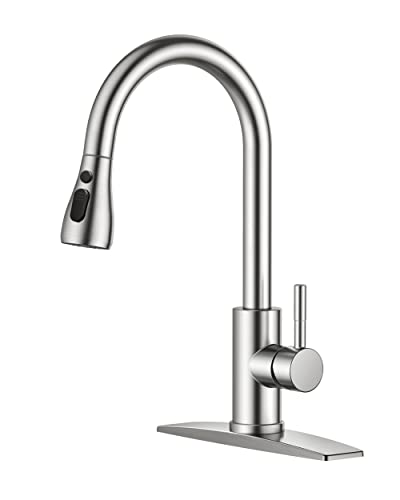
LUFG Brushed Nickel Kitchen Faucet with Pull Down Sprayer
Badge: Best Overall
Strengths
- The fullest certification set in this group is printed right in the listing title
- Three spray modes plus a full 360-degree swivel make it easy to work a wide sink
- Deck plate included, which simplifies fitting older multi-hole sinks
Trade-offs
- Brushed nickel only in this listing, limiting finish matching
- Single-handle control means temperature and flow share one lever, which takes adjustment
- The certification-heavy listing gives fewer styling details than some rivals
Key specs from the verified listing: Finish: Brushed Nickel; Mechanism: Pull down sprayer, deck plate included; Body: SUS 304 stainless steel; Handle: Single handle; Spray: 3 spray modes; Swivel: 360-degree swivel spout; Certifications stated: NSF372, NSF61, cUPC; Stated settings: RV, laundry, bar sink.
As a benchmark, the LUFG is the model that sets the documentation standard. Its listing states NSF372, NSF61 and cUPC together, on an SUS 304 stainless steel body, with three spray modes, a 360-degree swivel spout, a single handle and an included deck plate. When you compare other faucets, retailer listings included, this is the checklist to hold them against: are the certifications printed, is the steel grade named, is the deck plate in the box?
The working specification supports the paperwork. Three modes cover filling, rinsing and heavier cleaning, the full swivel lets the spout serve a wide or double bowl, and the deck plate makes the faucet a realistic fit for older multi-hole sinks as well as single-hole counters. The listing also names RV, laundry and bar sink settings, a reminder that this is a standard-fitting design rather than a proprietary system.
Its limitation as a benchmark is styling information. The listing concentrates on certifications and core mechanics and says little about finish alternatives or hose details. If your comparison includes appearance beyond brushed nickel, note that as an open question for the product page rather than assuming options exist.
Best for: benchmark shoppers who want certifications and core specs printed in the listing / Not suited for: buyers choosing mainly on styling range or finish options

Moen Adler Pulldown Kitchen Faucet 87233SRS
Badge: Best for Brand Support
Strengths
- Spot Resist finish is designed to show fewer fingerprints and water spots
- A long-running mainstream model line, so replacement parts and documentation are easy to find
- Understated profile suits kitchens that do not want a commercial spring look
Trade-offs
- The listing title is brief, so spray modes and hose details must be confirmed on the product page
- Spot Resist Stainless is a coated tone, not a match for every stainless appliance
- No deck or hole configuration is stated in the title itself
Key specs from the verified listing: Finish: Spot Resist Stainless; Mechanism: Pulldown sprayer; Model: Adler 87233SRS; Brand: Moen.
The Moen Adler anchors the mainstream end of this benchmark. It is the model most likely to be cross-shopped against big-brand assortments anywhere, and its listing gives you the two identifiers that make cross-shopping possible: the Adler name and the model number 87233SRS, in a Spot Resist Stainless finish. With a model number in hand, specification sheets, parts diagrams and cartridge references can be checked precisely, which is more than many value listings allow.
The Spot Resist finish is the substantive feature. It is designed to show fewer fingerprints and water spots, a practical benefit in family kitchens where the faucet is wiped down at the end of the day rather than after every use. The pulldown head itself covers the standard filling and rinsing repertoire expected of the category.
As a benchmark entry, its weakness is the brevity of the listing. Spray modes, swivel range, deck configuration and certifications are not stated in the title. Treat those as a verification list: a careful shopper confirms each on the product page or the manufacturer specification sheet before treating this model as equivalent to the fully documented picks around it. The same caution applies when comparing against the one-word category variant covered in Best Pull Pout Kitchen Faucets research.
Best for: shoppers who value a mainstream model number, parts trail and spot-resistant finish / Not suited for: buyers who need every specification stated before they will shortlist a model


Lufeidra Kitchen Faucet with Pull-Down Sprayer
Badge: Most Versatile Fit
Strengths
- SUS304 body and ceramic cartridge cover the two parts that decide service life
- Flexible 1- or 3-hole fit makes it one of the easier swaps for older sinks
- Classic styling reads more traditional than the spring and touchless designs here
Trade-offs
- No spray-mode count is stated in the title, so check the listing before assuming three modes
- Pot filler styling is a look, not a second articulated filler arm
- Brushed nickel is the only finish named in this listing
Key specs from the verified listing: Finish: Brushed Nickel; Mechanism: Pull-down sprayer, classic pot filler styling; Body: SUS304 stainless steel; Deck fit: Fits 1- or 3-hole; Cartridge: Ceramic cartridge; Stated settings: Kitchen sink, laundry, RV, bar.
The Lufeidra benchmarks the traditional end of the pull-down market. Its listing pairs an SUS304 stainless body with a ceramic cartridge and a 1- or 3-hole fit, wrapped in classic styling that the listing describes with pot filler language. In benchmark terms, it demonstrates that a conventional appearance does not require giving up the modern core specification: the steel grade and the cartridge type are both stated, which is more than many classic-styled faucets manage.
The clarification worth repeating is that the pot filler phrasing describes a styling direction. This is a single deck-mounted faucet with a pull-down sprayer, not a separate articulated filler. Judged correctly, it suits kitchens where spring and touchless designs would look out of place, and its listing also names laundry, RV and bar settings, underlining its standard-fit versatility.
The open question is spray functionality. No mode count is stated in the title, so a shopper benchmarking spray features should confirm the head functions on the product page before ranking it against the stated three-mode picks in this guide.
Best for: traditional kitchens wanting a stated SUS304 body and ceramic cartridge / Not suited for: shoppers benchmarking spray modes, which this title does not state

FEELSO Kitchen Faucet with Pull Down Sprayer
Badge: Best High-Arc Value
Strengths
- Lead-free NSF certified construction is stated up front
- High arc clearance suits stockpots and deep pans
- Single-handle layout keeps the deck uncluttered on 1-hole installs
Trade-offs
- No spray-mode or swivel figures are stated in the title
- Stainless steel grade is not specified in the title the way SUS 304 listings specify it
- High arc shape needs the same shallow-sink splash caution as any tall spout
Key specs from the verified listing: Finish: Brushed Nickel; Certification: Lead-free, NSF certified; Profile: High arc; Body: Stainless steel; Handle: Single handle; Deck fit: 1 or 3 hole; Stated settings: Farmhouse, laundry, RV, bar.
The FEELSO benchmarks high-arc value. Its listing states lead-free, NSF certified stainless steel construction, a high arc profile, a single handle and a 1 or 3 hole fit, with farmhouse, laundry, RV and bar settings named. In comparison terms, it covers the two attributes a benchmark shopper should never trade away, certified water-contact materials and flexible deck fit, while adding the tall clearance that makes stockpots and deep pans easy to fill.
The high arc is also its main pairing consideration. A tall stream needs a reasonably deep bowl to land in, or rinsing at full flow will splash. That is not a defect in the faucet; it is geometry, and it is exactly the kind of detail a benchmark should surface, because the same model can be ideal over a deep farmhouse bowl and merely adequate over a shallow double bowl.
What the listing does not state is a spray-mode count, a swivel figure or a specific steel grade. Those omissions place it mid-pack on documentation, behind the LUFG and the WEWE designs, and they are worth noting if your comparison weights stated specifications heavily.
Best for: value comparisons centered on certified materials, high arc clearance and flexible fit / Not suited for: spec-sheet maximalists who want modes, swivel and steel grade all stated
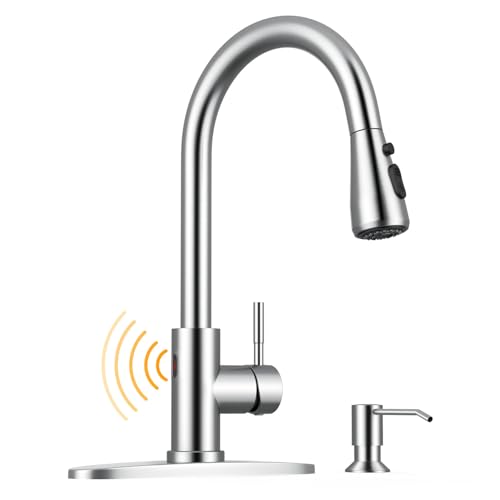
WEWE Touchless Kitchen Faucet with Soap Dispenser Set
Badge: Best Touchless Pick
Strengths
- Touchless operation keeps raw-food residue off the handle during prep
- Bundled soap dispenser fills an extra deck hole neatly on 3-hole sinks
- Still a full pull-down underneath, with 3 modes and a 360-degree swivel
Trade-offs
- Sensor operation adds a power source to maintain that manual faucets do not need
- The dispenser occupies deck space some kitchens would rather keep clear
- Touchless hardware is a premium-tier step up from the manual picks here
Key specs from the verified listing: Finish: Brushed Nickel; Operation: Touchless, with soap dispenser set included; Sprayer: 3-mode sprayer on a pull-down hose; Swivel: 360 degrees; Body: SUS 304 stainless steel; Deck fit: 1- or 3-hole fit; Cartridge: Ceramic cartridge; Extras: Easy-clean nozzles.
The WEWE touchless model benchmarks the sensor tier. Its listing combines touchless operation with a bundled soap dispenser set, a three-mode sprayer on a pull-down hose, a 360-degree swivel, an SUS 304 body, a ceramic cartridge and easy-clean nozzles, fitting 1- or 3-hole decks. That is a complete specification, and it shows what the touchless premium buys beyond the sensor itself: in this case, a full-featured pull-down with the dispenser solving the spare-hole question on 3-hole sinks.
In use-case terms, touchless activation earns its keep during raw food preparation, baking and any work where hands are coated and the handle would otherwise need washing afterward. The manual pull-down underneath remains the primary tool; the sensor simply decides when water flows.
The benchmark caveats are complexity and upkeep. A sensor system introduces a power source to maintain and electronics that manual faucets do not carry, and the dispenser occupies deck space. Shoppers comparing across channels, including those reading Best Pull Out Kitchen Faucets For Portable Dishwasher material for utility setups, should weigh that complexity against how often hands-free flow will genuinely be used.
Best for: cooks who will genuinely use touchless flow and want a dispenser included / Not suited for: minimalists who prefer manual hardware with nothing electronic to maintain
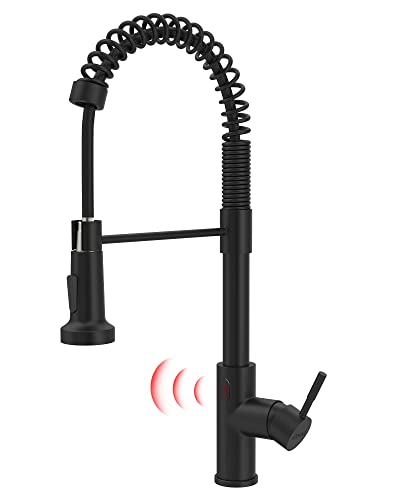
GIMILI Matte Black Touchless Kitchen Faucet
Badge: Best Statement Finish
Strengths
- Matte black is the one genuinely different finish in this group
- Motion sensor activation suits messy prep work where hands stay occupied
- Exposed spring gives the sprayer a wide, commercial-style working range
Trade-offs
- Single hole installation only, so multi-hole decks need a plate solution confirmed first
- Sensor and spring hardware together make this the most complex install here
- Matte finishes show light-colored mineral deposits more readily than brushed ones
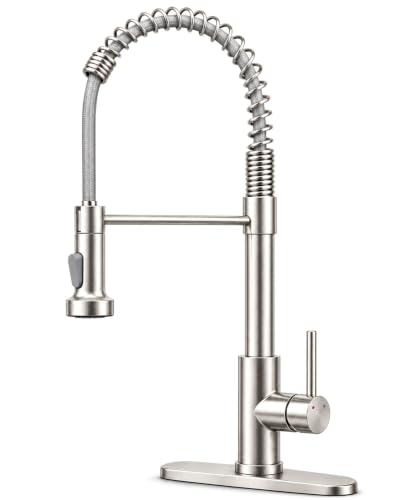
Key specs from the verified listing: Finish: Matte Black; Operation: Touchless, motion sensor activated, hands free smart control; Mechanism: Spring pull down sprayer; Handle: Single handle; Deck fit: Single hole installation; Stated setting: Modern farmhouse kitchen sink use.
The GIMILI benchmarks the statement end of the market: a matte black, touchless, spring pull-down faucet with motion sensor activation and hands-free smart control, in a single-handle, single-hole configuration aimed at modern farmhouse kitchens. As a comparison point it is valuable precisely because it differs. It shows the finish alternative to the brushed nickel consensus and pairs it with the most expressive silhouette in the group.
The spring profile gives the sprayer a wide working sweep, and the sensor keeps that sprayer usable with messy hands. For a kitchen designed around black hardware and fixtures, this is the only pick in the six whose finish continues that scheme rather than interrupting it.
Two benchmark cautions apply. First, installation is single-hole only, the least flexible deck fit here, so multi-hole sinks need a confirmed plate strategy. Second, matte finishes show pale mineral deposits more readily, which matters in hard-water homes and should factor into any like-for-like comparison with brushed finishes.
Best for: black-hardware kitchens with a single-hole deck wanting sensor operation / Not suited for: multi-hole decks without a plate plan, or hard-water homes avoiding matte upkeep
Comparison Table
This benchmark table lines the six models up on what their verified listings state. Use it to build the questions you would ask of any listing, on any channel, before buying.
| Pick | Badge | Standout detail from the verified listing |
|---|---|---|
| LUFG Brushed Nickel Kitchen Faucet with Pull Down Sprayer | Best Overall | NSF372, NSF61, cUPC; SUS 304; 3 modes; 360-degree swivel; deck plate |
| Moen Adler Pulldown Kitchen Faucet 87233SRS | Best for Brand Support | Spot Resist Stainless; model 87233SRS; brief listing, verify specs |
| Lufeidra Kitchen Faucet with Pull-Down Sprayer | Most Versatile Fit | SUS304; ceramic cartridge; 1- or 3-hole; classic profile |
| FEELSO Kitchen Faucet with Pull Down Sprayer | Best High-Arc Value | Lead-free NSF certified; high arc; 1 or 3 hole |
| WEWE Touchless Kitchen Faucet with Soap Dispenser Set | Best Touchless Pick | Touchless; soap dispenser set; 3 modes; SUS 304; 1- or 3-hole |
| GIMILI Matte Black Touchless Kitchen Faucet | Best Statement Finish | Matte black; touchless spring; motion sensor; single hole only |
How to Choose the Right Faucet for Confidence
Benchmark by model number, not by product name alone. Names repeat across channels with different configurations behind them. The Moen in this guide is identifiable as the Adler 87233SRS; the value picks are identifiable by their listing titles and stated certifications. When you compare a faucet here against any retailer assortment, match the model identifier and the stated configuration, deck fit, finish and included parts, before treating two offers as the same product.
Separate the mechanism before comparing anything else. Pull-down and pull-out faucets solve similar problems with different geometry. A benchmark that mixes them produces nonsense comparisons on clearance, hose behavior and sink pairing. All six models here are pull-down. If a retailer list you are comparing against includes pull-out designs, evaluate those separately, with the pull-out category research such as Best Pull Out Kitchen Sink Faucets as the reference point.
Score documentation quality. Give weight to listings that state steel grade, cartridge type and certifications in plain text. The LUFG states NSF372, NSF61 and cUPC; the WEWE touchless states SUS 304 and a ceramic cartridge alongside its sensor features; the Moen and Lufeidra titles leave more unstated. Unstated does not mean absent, but in a benchmark, verified beats assumed every time, and the burden of checking sits with the buyer.
Price the whole installation, qualitatively. Without printing prices, the tier logic is still clear. A faucet that includes its deck plate and supply hoses costs less to install than one that needs them separately; a touchless model adds a power source and electronics to the long-term picture; a single-hole-only model may add a plate or counter work on a multi-hole deck. Compare total project shape, not headline position, and remember that this guide makes no claim about what any particular retailer charges for any of these models.
Decide whether touchless is a feature or a complication for you. Two of the six benchmarks are touchless, which reflects the market rather than an editorial push. Sensors help during messy prep and in households where hygiene around raw food is a daily concern. They also add batteries or power, a sensor window to keep clean, and electronics to the under-sink environment. Manual picks like the LUFG, Lufeidra and FEELSO have none of that overhead. Neither answer is wrong; the benchmark exists so you choose deliberately.
Let your own deck eliminate before your taste ranks. In practice, most benchmark lists shrink quickly once the home measurements are applied: hole count removes the single-hole-only or the plate-dependent options for many kitchens, bowl depth argues against the tallest profiles for others, and cabinet clearance settles the spring question. What remains after those eliminations is a short list your taste can legitimately rank. Benchmarks feel long because they describe a market; purchases feel short because a kitchen is specific.
How to Cross-Check a Faucet Listing Before You Buy Anywhere
Step one: confirm the mechanism in words. Find the words pull-down or pull-out in the listing itself. Do not rely on the photograph, because a low pull-down and a tall pull-out can look similar in a thumbnail. Every model in this guide states pull-down, pull down or pulldown in its title; hold any listing you compare to the same standard.
Step two: confirm deck fit against your sink. Count your deck holes and check the stated fit: 1-hole, 1- or 3-hole, or single-hole only like the GIMILI here. Confirm whether a deck plate is included, as it is with the LUFG, or must be sourced. Then decide what occupies any remaining hole: a soap dispenser, as bundled with the WEWE touchless, or a cover.
Step three: verify the core specification. Look for a named body material or steel grade, a cartridge type, and certifications. SUS 304 and ceramic cartridges are stated on several picks here; NSF 61, NSF 372 and cUPC are stated in full on the LUFG. If a listing omits these, look for the manufacturer specification sheet by model number before assuming equivalence.
Step four: check the working details. Spray modes, swivel range and hose behavior decide daily satisfaction. Three modes and a 360-degree swivel are stated on the LUFG and WEWE touchless; where a figure is missing, as with the Moen listing here, treat it as unknown rather than average.
Troubleshooting a comparison. Problem: two listings show the same name at different tiers → compare model numbers and included parts; bundles with dispensers or plates explain most gaps. Problem: a finish name differs slightly between channels → treat brushed nickel, stainless and spot-resistant stainless as different finishes until the manufacturer confirms a match. Problem: a listing claims compatibility with everything → return to the stated deck fit and mechanism words, which are the claims that decide whether the faucet works in your kitchen at all.
What a Benchmark Can and Cannot Tell You
A benchmark like this one can tell you what the current pull-down market offers, which specifications are standard at each tier, and which questions a serious listing should answer. It can tell you that full certification printing is achievable, that touchless operation now appears at more than one tier, and that matte black remains the exception rather than the rule. Those are market facts, and they travel with you to any store or website.
What it cannot tell you is what any specific retailer stocks today, what any specific store charges, or which model a particular salesperson would recommend for your kitchen. Assortments rotate, displays change, and terms vary. Anyone who converts a comparison guide into a claim about a named retailer’s shelves is adding information the guide does not contain, and this guide deliberately does not. Use the benchmark to arrive informed; make the purchase decision on verified, current information at the point of sale.
The Touchless Tier, Benchmarked Honestly
Two of the six models here are touchless, and their differences are instructive. The WEWE pairs its sensor with a soap dispenser set, three spray modes, an SUS 304 body and a flexible 1- or 3-hole fit: a mainstream configuration with a sensor added. The GIMILI pairs its motion sensor with a spring silhouette, a matte black finish and a single-hole install: a design-led configuration where the sensor is part of a statement. Same technology category, different products, which is why benchmarking by feature checkbox alone misleads.
The honest costs of the tier are also comparable across both: a power source to maintain, a sensor to keep clean and responsive, and more components under the sink. Shoppers who cook with raw proteins daily often judge that trade worthwhile. Shoppers in hard-water homes, or anyone who has been annoyed by a sensor faucet in a public restroom, may not. The benchmark’s job is to make the trade visible, and readers exploring adjacent utility questions sometimes consult Best Pull Out Out Kitchen Faucets material as well, keeping in mind that keyword’s doubled word is a search typo, not a separate product type.
Included Parts: The Benchmark Line Most Shoppers Skip
Two faucets with identical headlines can install very differently depending on what is in the box, and this group illustrates the spread. The LUFG includes its deck plate. The WEWE touchless includes a soap dispenser set that occupies a deck hole productively. The WEWE pull-down in the wider category research includes its supply hoses; other listings leave hoses, plates or both to the buyer. None of that appears in a price headline, and all of it appears in the finished installation.
When you benchmark any listing, on any channel, add an included-parts line to your notes: plate, hoses, dispenser, mounting hardware, power arrangement for sensor models. Then ask what your installation still needs. A faucet that arrives complete is a different proposition from one that needs a plate sourced to match its finish, and retailer listings vary in how clearly they separate the two cases. The model number discipline described earlier in this guide applies here too, because included parts are configuration-specific, and configurations hide behind shared product names.
This is also where honest gaps deserve respect. A listing that does not mention a deck plate may still include one, but a benchmark records what is stated. If the part matters to your deck, and it usually does, verify it before purchase rather than discovering its absence with the old faucet already removed and the water off.
How to Read a Finish Name When Benchmarking
Finish names look like marketing and behave like specifications. Brushed nickel, the majority finish in this group, is a warm-toned, grain-textured surface that hides minor marks well. Spot Resist Stainless, on the Moen, is a cooler stainless tone with a treatment intended to show fewer fingerprints and spots. Matte black, on the GIMILI, is a light-absorbing surface that shows pale deposits readily. These are three different maintenance profiles wearing similar catalogue photographs.
The benchmarking error to avoid is treating finish as a photograph-matching exercise. Screens render tones unreliably, names vary slightly between channels for identical finishes, and identical names occasionally cover different underlying processes. The reliable method is textual: record the exact finish name from the listing, match it character for character when comparing across channels, and confirm with the manufacturer when a near-match name appears. Hardware already in your kitchen, hinges, pulls and appliance handles, should be matched the same way, by name and in person where possible, not by thumbnail.
Durability expectations follow the same logic. A finish’s resistance to spotting and marking is part of its design brief, as the Spot Resist name advertises, but no finish in this group is maintenance-free. Benchmark the care routine alongside the color: daily-wipe finishes suit some households, forgiving brushed finishes suit most, and statement finishes like matte black suit households willing to trade a little upkeep for the look.
Deck Holes and Plates: The Fit Details That Decide a Benchmark
Ask experienced installers what separates an easy faucet swap from a frustrating one and most will name the deck before the faucet. Hole count, hole spread and what covers them decide the finished look, and this benchmark group covers the realistic range: flexible 1- or 3-hole fits on the LUFG, Moen configuration to be verified, Lufeidra and FEELSO; a 1- or 3-hole fit with a functional dispenser on the WEWE touchless; and single-hole only on the GIMILI. Two kitchens with identical taste and different decks will rationally choose different models from this same list.
The deck plate deserves its benchmark line because it is both a fit part and a finish part. The LUFG includes its plate, which removes a sourcing step and guarantees a finish match. Where a plate is not stated as included, the shopper’s task is to confirm availability in the same finish before purchase, since a plate in a near-match tone is more visible, not less, for sitting directly under the faucet. The same logic governs hole covers and dispensers: every opening in the deck ends the day either used, plated or plugged, and a tidy result is planned, never improvised.
Measuring is the unglamorous core of the exercise. Count the holes with the old faucet still in place, note any separate sprayer or dispenser, and measure the spread on multi-hole decks. Carry those three facts into every comparison, and half the models in any assortment, however attractive, will correctly eliminate themselves before style is even discussed.
Common Buying Mistakes
Assuming a benchmark is a stock list. A comparison guide describes models, not any retailer’s inventory. Never travel to a store, or dismiss one, based on a guide’s contents; check current assortment directly.
Comparing across mechanisms. Ranking a pull-down against a pull-out on clearance or hose reach compares geometry, not quality. Separate the mechanisms first, as this guide does.
Matching by name instead of model. Brand line names cover multiple configurations. The model number, deck fit and included parts define the product; the name alone does not.
Treating unstated as equivalent. A brief listing is not proof of a brief specification, but it is proof that you have not verified the specification. The Moen entry here is the standing example: verify before you rank it.
Ignoring finish distinctions. Brushed nickel, plain stainless and spot-resistant stainless photograph similarly and age differently. Confirm the exact finish name when matching existing hardware.
Final Recommendation
As a benchmark, begin with the LUFG: it is the model whose listing answers the most questions without being asked, and you can check the LUFG on Amazon to see the full listing behind the summary.
From there, the comparison sorts itself. Choose the WEWE touchless if hands-free flow and the bundled dispenser fit your cooking, or the GIMILI if the matte black spring design is the look your kitchen is built around; you can check the WEWE touchless on Amazon as the mainstream sensor option. Choose the Moen if a mainstream model number and parts trail matter most, the Lufeidra for a classic profile with a stated modern core, and the FEELSO for certified high-arc value. Whichever you shortlist, carry the model number and the stated specifications with you, and verify them wherever you buy.
Frequently Asked Questions
Does this guide mean these faucets are sold by the retailer in the keyword?
No. This is a benchmark guide. The picks are Amazon listings used to compare models and stated specifications. The guide makes no claim that Yale Appliance or any other retailer stocks, distributes or prices these models. Retail assortments change, so confirm current availability directly with any retailer you plan to buy from.
How should I use a benchmark when shopping at different stores?
Carry identifiers and specifications, not impressions. Note the model name and number, the deck fit, the finish, the stated certifications and the included parts for each pick, then match those details against any listing you find. If a detail cannot be matched, treat the products as different until the manufacturer documentation proves otherwise.
What is the difference between pull-down and pull-out faucets?
A pull-down head docks in a raised spout and pulls down into the bowl, suiting deeper sinks and tall cookware. A pull-out head slides out of a lower spout body toward the user. The mechanisms pair with different sink geometries, so compare within one mechanism at a time.
Which pick has the most complete certifications stated?
The LUFG. Its listing states NSF372, NSF61 and cUPC together, alongside an SUS 304 body. Other picks state lead-free NSF certification in shorter form, and some state no certifications in the title at all, which is a verification task for the product page rather than a conclusion about the product.
Are touchless faucets worth the added complexity?
They are worth it for cooks who regularly handle raw food and want water control without touching the handle, and for households that simply enjoy the convenience. The costs are a power source to maintain and more components to keep clean and working. Both touchless picks here are also full pull-down faucets, so the comparison is about the control layer, not the sprayer.
Why is the Moen listing described as brief?
Because its title states the brand, line, finish and model number but not spray modes, deck fit or certifications. That brevity is common for mainstream brand listings, which rely on separate specification sheets. It does not indicate a lesser faucet; it indicates that a benchmark reader must verify those details before ranking it against fully documented listings.
How do I verify a model I found through this benchmark?
Take the model’s identifiers and stated specifications to the product page or the manufacturer’s documentation and match them line by line: mechanism, deck fit, finish name, certifications, included parts and working figures such as modes and swivel. Anything that cannot be matched should be treated as a different configuration until documentation proves otherwise. That ten-minute check is the entire method of this guide, applied at the point of purchase.
How current is a benchmark like this one?
It reflects the verified listings as checked on 2026-11-20, and listings do change: titles are revised, bundles are reconfigured and models are succeeded. That is precisely why this guide teaches a verification method instead of asking to be trusted forever. Re-run the checks in the how-to section against the live listing before you buy, and the benchmark’s conclusions can be refreshed in minutes.