Disclosure: topratedkitchenware.com is reader-supported. When you buy through links on our site, we may earn an affiliate commission from Amazon and other retailers, at no extra cost to you.
Where to buy
If you are shopping for best professional smokers for cooking, the short list below is the whole guide in miniature: every pick we could verify, in order, with a direct link wherever the pick genuinely matches what this keyword asks for. One honesty note belongs right here: every pick in this guide is a home machine. None of them is a commercial or competition-grade unit, and this guide will never call them that — what they offer is the control, capacity and workflow that let a home cook work in a professional manner.
- Masterbuilt 30-Inch Analog Electric Smoker (MB20070210) — Best for Simple, Serious Practice. Check on Amazon
- EAST OAK 30-Inch Electric Smoker, Matte Black — Best for Long, Timed Cooks
- EAST OAK 30-Inch Electric Smoker with Mobility Stand, Polar Night — Best Complete Home Setup
- Royal Gourmet SE2805 28-Inch Electric Smoker — Best Compact Practice Smoker
- Traeger Pro 22 Wood Pellet Grill and Smoker — Best Pellet Option for Serious Home Cooking
- Pit Boss 700 Carbon Series Wood Pellet Grill and Smoker — Best Large Pellet Option
Read the full guide ↓
Searching for the best professional smokers for cooking usually means one of two things: a caterer-grade machine, or — far more often — a home smoker that behaves with professional discipline. This guide serves the second search honestly. The verified pool behind it contains home electric cabinets and home pellet cookers, so the picks below are ranked by how well they support serious, repeatable cooking at home: stated capacity, stated control, and a workflow you can run the same way every time. If your research started with Best Propain Smokers or other fuel-specific lists, the fuel contrast in this guide will help you place those options too.
Professional, used carefully, is a standard of behaviour rather than a badge on a box. It means knowing your cooking area instead of guessing it, setting a temperature you can return to next month, monitoring the food rather than the clock alone, and cleaning and storing the machine so the next cook starts from the same baseline as the last. Every pick here states its capacity in its verified title, and most state their control method just as clearly — that is the raw material of repeatable cooking.
What this guide will not do is inflate a home cabinet into a restaurant unit. If you are cooking for paying customers at volume, you need commercial equipment, commercial clearances and a very different conversation. If you are cooking at home to a high standard — for family, for gatherings, for your own serious practice — read on, because that is exactly the job these six machines can do well.
Key Takeaways
- Every pick is a home machine; professional here means disciplined, repeatable cooking, not commercial equipment.
- Stated capacity and stated control method are the two facts that make results repeatable.
- Electric cabinets offer the calmest workflow; pellet cookers offer deeper wood flavour and grilling range.
- Probes and timers, where stated, replace guesswork with a routine.
- Choose by batch size and schedule first, features second.
In this guide
Quick Picks
The six picks below are ordered by how completely they support a disciplined home cooking routine, from the simplest practice cabinet to the largest pellet option. Badges are used identically in the detailed reviews.
| Pick | Badge | Form and fuel | Headline figure from the verified title | Link |
|---|---|---|---|---|
| Masterbuilt 30-Inch Analog Electric Smoker (MB20070210) | Best for Simple, Serious Practice | vertical electric cabinet; electric heat with wood chips | 535 cooking square inches | Check on Amazon |
| EAST OAK 30-Inch Electric Smoker, Matte Black | Best for Long, Timed Cooks | vertical electric cabinet; electric heat with wood chips | 725 square inches of cooking area | Check on Amazon |
| EAST OAK 30-Inch Electric Smoker with Mobility Stand, Polar Night | Best Complete Home Setup | vertical electric cabinet; electric heat with wood chips | 725 square inches of cooking area | Check on Amazon |
| Royal Gourmet SE2805 28-Inch Electric Smoker | Best Compact Practice Smoker | vertical electric cabinet; electric heat with wood chips | 454 square inches across 3 cooking grates | Check on Amazon |
| Traeger Pro 22 Wood Pellet Grill and Smoker | Best Pellet Option for Serious Home Cooking | horizontal barrel pellet grill and smoker; wood pellets | 572 square inches of cooking space | Check on Amazon |
| Pit Boss 700 Carbon Series Wood Pellet Grill and Smoker | Best Large Pellet Option | horizontal barrel pellet grill and smoker; wood pellets | 718 square inches of cooking space | Check on Amazon |
How These Picks Were Chosen
These picks were chosen from a verified pool for this exact keyword, using only facts stated in each product’s verified title: form, fuel, cooking area, control method, and named features such as loaders, probes, timers and hoppers. No specification was inferred from a photograph, a brand reputation or a similar model. Where a title states no cooking area, that gap is flagged in the review rather than filled with a guess.
The professional lens changed the ordering. Raw capacity alone did not lead; instead, picks were weighted by how repeatable they make a cook — digital set points over dials where both existed, probes and timers where a title stated them, and loaders that let you add smoke wood without opening the cabinet and dumping heat. Comparisons with fuel-specific guides such as Best Propane Gas Smokers and Best Propane Meat Smokers are useful context, but this guide stays inside its own verified pool.
A final honesty note on method: this is research-led guidance, not a claim of hands-on testing. The judgements here are built from verified listing facts and well-understood cooking principles — how stacked cabinets behave, how pellet cookers lay out food, how probes change a routine. That is a sound basis for choosing, and it is presented as exactly that.
The 6 Best Options: Best professional smokers for cooking, Examined One by One
Each review follows the same pattern: what the verified title states, how the layout behaves in real batches, how the workflow feels across a long cook, and one honest limitation. Read the limitation as carefully as the strengths — it is usually the deciding paragraph.
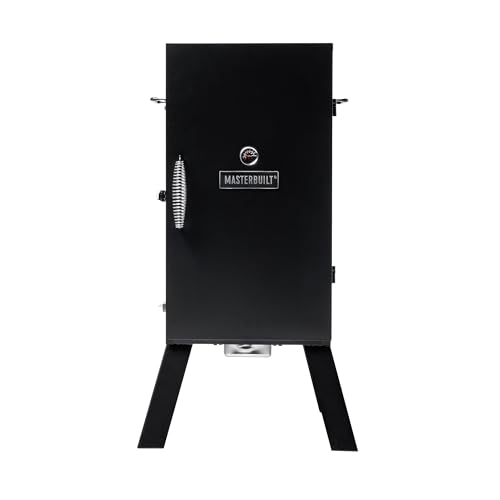
Masterbuilt 30-Inch Analog Electric Smoker (MB20070210)
Badge: Best for Simple, Serious Practice
Strengths
- Analog dial is the simplest control in this group to learn
- Smaller cabinet heats and recovers with less wasted space on small cooks
- Chrome racks and a simple layout make cleanup uncomplicated
Trade-offs
- Smallest stated cooking area in this group
- Dial control gives less precise repeatability than a digital set point
- No side loader, probe or window is stated in the title
At a glance
- Form: 30-inch vertical electric cabinet
- Cooking area: 535 square inches (stated in title)
- Controls: analog temperature control
- Racks: chrome smoking racks
- Colour: black
Start with the basics. The Masterbuilt 30-Inch Analog Electric Smoker (MB20070210) is a vertical electric cabinet that cooks with electric heat with wood chips. Its verified title states 535 cooking square inches and analog temperature control. It also brings analog dial control and chrome smoking racks in a compact black cabinet. For anyone cooking seriously at home, that combination — a stated capacity and a stated control method — is the starting point of repeatable results. Judged on the title alone — the only evidence this guide uses for specifications — it is a coherent, honestly described machine rather than a vague listing, and that clarity is part of why it appears in this line-up at all.
In practice, capacity is about layout as much as area. A vertical cabinet stacks its area across racks, which is efficient for layered batches: ribs on one level, a shoulder above, smaller items filling the gaps. The stated figure — 535 cooking square inches — rewards cooks who plan the stack, putting the slowest, thickest cuts where heat is steadiest and quick items where they can be reached first. Serious home cooking is usually about feeding people well on a schedule, and a layout you can plan around matters more than a few extra square inches. Tall cabinets also ask for rotation on long cooks, because no stacked cooker heats every level identically, and honest guides should say so.
The workflow is where this model separates itself. This model leans on analog dial control and chrome smoking racks in a compact black cabinet, and those details shape the routine: how often you open the door, how confidently you judge doneness, and how much cleaning waits afterwards. Repeatability is the real professional habit available to a home cook: the same set point, the same layout, the same checks, cook after cook. Its clearest limitation, stated in the trade-offs above, is real and should not be talked away — weigh it against your own patio, your batch sizes and how you actually cook, and this pick will either fit your life or politely rule itself out.
Best for: smaller households and anyone who prefers a simple dial / Not suited for: large batch cooking for gatherings

EAST OAK 30-Inch Electric Smoker, Matte Black
Badge: Best for Long, Timed Cooks
Strengths
- Timer support suits overnight and all-day cooks
- Wheels solve the storage problem most cabinet smokers create
- Large stated area handles bigger batches without a second cooker
Trade-offs
- No viewing window is stated in the title for this finish
- No built-in meat probe is stated in the title
- Timer is not the same as remote monitoring — there is no app control stated
At a glance
- Form: 30-inch vertical electric cabinet
- Cooking area: 725 square inches (stated in title)
- Timer: digital 12-hour timer
- Loading: side chip loader
- Mobility: easy-rolling wheels
- Colour: Matte Black
The verified listing is specific about what this model is. The EAST OAK 30-Inch Electric Smoker, Matte Black is a vertical electric cabinet that cooks with electric heat with wood chips. Its verified title states 725 square inches of cooking area and digital control with a 12-hour timer. It also brings a side chip loader described as running far longer on a single load, a digital 12-hour timer and easy-rolling wheels. For anyone cooking seriously at home, that combination — a stated capacity and a stated control method — is the starting point of repeatable results. Judged on the title alone — the only evidence this guide uses for specifications — it is a coherent, honestly described machine rather than a vague listing, and that clarity is part of why it appears in this line-up at all.
What that means at the grate is simple. A vertical cabinet stacks its area across racks, which is efficient for layered batches: ribs on one level, a shoulder above, smaller items filling the gaps. The stated figure — 725 square inches of cooking area — rewards cooks who plan the stack, putting the slowest, thickest cuts where heat is steadiest and quick items where they can be reached first. Serious home cooking is usually about feeding people well on a schedule, and a layout you can plan around matters more than a few extra square inches. Tall cabinets also ask for rotation on long cooks, because no stacked cooker heats every level identically, and honest guides should say so.
Ownership, not just cooking, deserves a paragraph. This model leans on a side chip loader described as running far longer on a single load, a digital 12-hour timer and easy-rolling wheels, and those details shape the routine: how often you open the door, how confidently you judge doneness, and how much cleaning waits afterwards. Repeatability is the real professional habit available to a home cook: the same set point, the same layout, the same checks, cook after cook. Its clearest limitation, stated in the trade-offs above, is real and should not be talked away — weigh it against your own patio, your batch sizes and how you actually cook, and this pick will either fit your life or politely rule itself out.
Best for: all-day and overnight cooks who want timer support and easy storage / Not suited for: buyers who want a built-in probe or viewing window
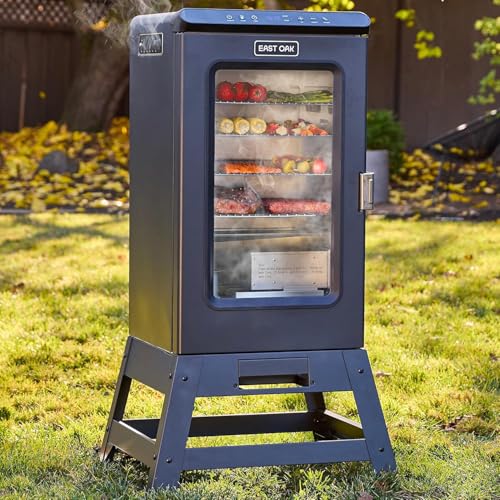
EAST OAK 30-Inch Electric Smoker with Mobility Stand, Polar Night
Badge: Best Complete Home Setup
Strengths
- Probe and stand together make this the most complete EAST OAK bundle here
- Large stated area suits batch cooking for gatherings
- Side loading protects the cook temperature when chips run low
Trade-offs
- No viewing window is stated in the title for this version
- Stand adds footprint compared with a plain cabinet
- No WiFi control is stated in the title
At a glance
- Form: 30-inch vertical electric cabinet
- Cooking area: 725 square inches (stated in title)
- Probe: built-in meat probe
- Loading: side chip loader
- Stand: mobility stand included
- Colour: Polar Night
On paper, this is a straightforward proposition. The EAST OAK 30-Inch Electric Smoker with Mobility Stand, Polar Night is a vertical electric cabinet that cooks with electric heat with wood chips. Its verified title states 725 square inches of cooking area and digital control with a built-in meat probe. It also brings a built-in meat probe, a mobility stand and a side chip loader described as running far longer uninterrupted. For anyone cooking seriously at home, that combination — a stated capacity and a stated control method — is the starting point of repeatable results. Judged on the title alone — the only evidence this guide uses for specifications — it is a coherent, honestly described machine rather than a vague listing, and that clarity is part of why it appears in this line-up at all.
Day to day, the layout matters more than the headline number. A vertical cabinet stacks its area across racks, which is efficient for layered batches: ribs on one level, a shoulder above, smaller items filling the gaps. The stated figure — 725 square inches of cooking area — rewards cooks who plan the stack, putting the slowest, thickest cuts where heat is steadiest and quick items where they can be reached first. Serious home cooking is usually about feeding people well on a schedule, and a layout you can plan around matters more than a few extra square inches. Tall cabinets also ask for rotation on long cooks, because no stacked cooker heats every level identically, and honest guides should say so.
Then there is the routine around the cook itself. This model leans on a built-in meat probe, a mobility stand and a side chip loader described as running far longer uninterrupted, and those details shape the routine: how often you open the door, how confidently you judge doneness, and how much cleaning waits afterwards. Repeatability is the real professional habit available to a home cook: the same set point, the same layout, the same checks, cook after cook. Its clearest limitation, stated in the trade-offs above, is real and should not be talked away — weigh it against your own patio, your batch sizes and how you actually cook, and this pick will either fit your life or politely rule itself out.
Best for: batch cooks who want a probe and a stand in one bundle / Not suited for: the tightest patios, where a stand footprint matters

Royal Gourmet SE2805 28-Inch Electric Smoker
Badge: Best Compact Practice Smoker
Strengths
- Only pick here whose title states its element wattage
- Compact cabinet is the easiest in this group to place and store
- Three grates still allow layered cooking for smaller households
Trade-offs
- Smallest stated cooking area in this group
- Analog control is less repeatable than a digital set point
- No loader, probe, window or wheels are stated in the title
At a glance
- Form: 28-inch vertical electric cabinet
- Cooking area: 454 square inches (stated in title)
- Power: 1350W (stated in title)
- Controls: analog, adjustable heat
- Grates: 3 cooking grates
- Colour: black
This pick earns its place for a clear reason. The Royal Gourmet SE2805 28-Inch Electric Smoker is a vertical electric cabinet that cooks with electric heat with wood chips. Its verified title states 454 square inches across 3 cooking grates and analog temperature control with adjustable heat. It also brings a stated 1350W element, three cooking grates and adjustable analog heat in the smallest cabinet in this group. For anyone cooking seriously at home, that combination — a stated capacity and a stated control method — is the starting point of repeatable results. Judged on the title alone — the only evidence this guide uses for specifications — it is a coherent, honestly described machine rather than a vague listing, and that clarity is part of why it appears in this line-up at all.
Capacity only helps if you can arrange food sensibly in it. A vertical cabinet stacks its area across racks, which is efficient for layered batches: ribs on one level, a shoulder above, smaller items filling the gaps. The stated figure — 454 square inches across 3 cooking grates — rewards cooks who plan the stack, putting the slowest, thickest cuts where heat is steadiest and quick items where they can be reached first. Serious home cooking is usually about feeding people well on a schedule, and a layout you can plan around matters more than a few extra square inches. Tall cabinets also ask for rotation on long cooks, because no stacked cooker heats every level identically, and honest guides should say so.
Consider the hours outside the cook, too. This model leans on a stated 1350W element, three cooking grates and adjustable analog heat in the smallest cabinet in this group, and those details shape the routine: how often you open the door, how confidently you judge doneness, and how much cleaning waits afterwards. Repeatability is the real professional habit available to a home cook: the same set point, the same layout, the same checks, cook after cook. Its clearest limitation, stated in the trade-offs above, is real and should not be talked away — weigh it against your own patio, your batch sizes and how you actually cook, and this pick will either fit your life or politely rule itself out.
Best for: small households with limited patio space / Not suited for: feeding a crowd from a single cabinet load

Traeger Pro 22 Wood Pellet Grill and Smoker
Badge: Best Pellet Option for Serious Home Cooking
Strengths
- Pellet fire gives a deeper wood-smoke flavour than electric elements
- One cooker covers smoking and everyday grilling
- Generous hopper supports long cooks with fewer refills
Trade-offs
- Barrel form is not a box or cabinet design — see the box discussion in this guide
- Pellet cookers need dry pellet storage and auger care
- Costs more to run than an electric cabinet, pellet by pellet
At a glance
- Form: barrel pellet grill and smoker (not a vertical cabinet)
- Cooking area: 572 square inches (stated in title)
- Hopper: 18 lb
- Probe: meat probe included
- Stated maximum temperature: 450 degrees (in title)
- Functions: grill, smoke, bake, roast, braise and BBQ
Look first at the form, because form decides the workflow. The Traeger Pro 22 Wood Pellet Grill and Smoker is a horizontal barrel pellet grill and smoker that cooks with wood pellets. Its verified title states 572 square inches of cooking space and pellet controller with a meat probe and a stated maximum of 450 degrees. It also brings 6-in-1 versatility across grilling, smoking, baking, roasting, braising and barbecue, a meat probe and an 18 lb pellet hopper. For anyone cooking seriously at home, that combination — a stated capacity and a stated control method — is the starting point of repeatable results. Judged on the title alone — the only evidence this guide uses for specifications — it is a coherent, honestly described machine rather than a vague listing, and that clarity is part of why it appears in this line-up at all.
Think of the cooking area as a floor plan, not a trophy figure. A barrel pellet cooker lays food out on a broad single level, which suits wide cuts — a full brisket, several racks of ribs laid flat, a spatchcocked bird — better than a narrow cabinet does. The stated area of 572 square inches of cooking space is therefore easy to use well, because little of it is lost to awkward corners. Serious home cooking is usually about feeding people well on a schedule, and a layout you can plan around matters more than a few extra square inches. The trade is height: you cannot hang sausage or stack tray after tray of jerky the way a tall cabinet allows, so batch style, not just batch size, should drive the choice.
A smoker is also a cleaning and storage commitment. This model leans on 6-in-1 versatility across grilling, smoking, baking, roasting, braising and barbecue, a meat probe and an 18 lb pellet hopper, and those details shape the routine: how often you open the door, how confidently you judge doneness, and how much cleaning waits afterwards. Repeatability is the real professional habit available to a home cook: the same set point, the same layout, the same checks, cook after cook. Its clearest limitation, stated in the trade-offs above, is real and should not be talked away — weigh it against your own patio, your batch sizes and how you actually cook, and this pick will either fit your life or politely rule itself out.
Best for: cooks who want one pellet cooker for smoking and grilling / Not suited for: buyers who specifically need a vertical box or cabinet form

Pit Boss 700 Carbon Series Wood Pellet Grill and Smoker
Badge: Best Large Pellet Option
Strengths
- Wide stated temperature range covers low smoking and hotter grilling
- Large single-level cooking space suits wide cuts like brisket
- Digital controller and probe support repeatable cooks
Trade-offs
- Barrel form is not a box or cabinet design — see the box discussion in this guide
- Hopper is smaller than the largest pellet pick in this group
- Pellet ash and auger maintenance are part of ownership
At a glance
- Form: barrel pellet grill and smoker (not a vertical cabinet)
- Cooking area: 718 square inches (stated in title)
- Temperature range: 180 to 500 degrees (stated in title)
- Controls: LCD digital controller
- Probe: meat probe included
- Hopper: 13.5 lb
The headline facts are easy to summarise. The Pit Boss 700 Carbon Series Wood Pellet Grill and Smoker is a horizontal barrel pellet grill and smoker that cooks with wood pellets. Its verified title states 718 square inches of cooking space and LCD digital controller with a stated range from 180 to 500 degrees and a meat probe. It also brings an LCD digital controller, a meat probe and a 13.5 lb pellet hopper. For anyone cooking seriously at home, that combination — a stated capacity and a stated control method — is the starting point of repeatable results. Judged on the title alone — the only evidence this guide uses for specifications — it is a coherent, honestly described machine rather than a vague listing, and that clarity is part of why it appears in this line-up at all.
The useful question is how a real batch fits. A barrel pellet cooker lays food out on a broad single level, which suits wide cuts — a full brisket, several racks of ribs laid flat, a spatchcocked bird — better than a narrow cabinet does. The stated area of 718 square inches of cooking space is therefore easy to use well, because little of it is lost to awkward corners. Serious home cooking is usually about feeding people well on a schedule, and a layout you can plan around matters more than a few extra square inches. The trade is height: you cannot hang sausage or stack tray after tray of jerky the way a tall cabinet allows, so batch style, not just batch size, should drive the choice.
Finally, weigh the honest limitation. This model leans on an LCD digital controller, a meat probe and a 13.5 lb pellet hopper, and those details shape the routine: how often you open the door, how confidently you judge doneness, and how much cleaning waits afterwards. Repeatability is the real professional habit available to a home cook: the same set point, the same layout, the same checks, cook after cook. Its clearest limitation, stated in the trade-offs above, is real and should not be talked away — weigh it against your own patio, your batch sizes and how you actually cook, and this pick will either fit your life or politely rule itself out.
Best for: pellet cooks who want a wide temperature range and a large single-level space / Not suited for: buyers who specifically need a vertical box or cabinet form
Comparison Table
The table below lines the six picks up on the facts that decide most purchases: form, control and the capacity figure stated in each verified title. Prose-only picks, where a guide has them, appear without a link for the reason given in their reviews.
| Pick | Badge | Form | Control | Capacity figure stated in title | Link |
|---|---|---|---|---|---|
| Masterbuilt 30-Inch Analog Electric Smoker (MB20070210) | Best for Simple, Serious Practice | vertical electric cabinet | analog temperature control | 535 cooking square inches | Check on Amazon |
| EAST OAK 30-Inch Electric Smoker, Matte Black | Best for Long, Timed Cooks | vertical electric cabinet | digital control with a 12-hour timer | 725 square inches of cooking area | Check on Amazon |
| EAST OAK 30-Inch Electric Smoker with Mobility Stand, Polar Night | Best Complete Home Setup | vertical electric cabinet | digital control with a built-in meat probe | 725 square inches of cooking area | Check on Amazon |
| Royal Gourmet SE2805 28-Inch Electric Smoker | Best Compact Practice Smoker | vertical electric cabinet | analog temperature control with adjustable heat | 454 square inches across 3 cooking grates | Check on Amazon |
| Traeger Pro 22 Wood Pellet Grill and Smoker | Best Pellet Option for Serious Home Cooking | horizontal barrel pellet grill and smoker | pellet controller with a meat probe and a stated maximum of 450 degrees | 572 square inches of cooking space | Check on Amazon |
| Pit Boss 700 Carbon Series Wood Pellet Grill and Smoker | Best Large Pellet Option | horizontal barrel pellet grill and smoker | LCD digital controller with a stated range from 180 to 500 degrees and a meat probe | 718 square inches of cooking space | Check on Amazon |
How to Choose: a Smoker for Serious Home Cooking
Start with batch size, honestly counted. Stated cooking areas in this group run from the Royal Gourmet cabinet at the compact end to the largest EAST OAK and Pit Boss figures at the top. Count what you actually cook: a household smoking one shoulder at a time gains nothing from the biggest cabinet, while anyone cooking for gatherings will feel a small cabinet’s limits on the first big weekend. Remember that vertical area is stacked area — usable, but it needs a layout plan.
Then choose your control style. Digital set points are the easiest to repeat exactly; analog dials are simpler and perfectly workable, but they ask you to learn your own machine’s habits. WiFi control, stated on one pellet pick here, suits cooks who monitor from indoors. If your shortlist research includes Best Propane 2 Door Smokers, apply the same discipline there: control method and stated capacity first, marketing language last.
Fuel is a flavour and routine decision. Electric cabinets burn wood chips for a milder, steadier smoke and the simplest routine. Pellet cookers burn real wood pellets for a deeper smoke and add grilling range, at the cost of pellet storage, ash and auger care. Neither is more professional than the other; the professional choice is the one whose routine you will actually maintain.
Finally, value monitoring features at their true worth. A built-in probe, where stated, changes a cook more than most extras, because doneness stops being a guess. Timers help long cooks fit a schedule. Loaders protect temperature. Wheels and stands decide whether the machine lives ready on the patio or buried in storage — and a smoker that is easy to reach gets used, practised on, and mastered.
How to Run a Long Smoke Like a Professional: Setup, Routine and Troubleshooting
A disciplined long cook follows the same arc whatever the machine. Work through it in order and most problems never happen.
- Prepare the cooker. Start clean: empty old ash or spent chips, wipe the racks, and check the water pan or drip trays if your model has them. A clean baseline is a repeatable baseline.
- Preheat and stabilise. Bring the smoker to your target temperature and let it settle before food goes in. Loading a cabinet that is still climbing invites overshoot and guesswork.
- Load with a plan. Place the thickest cuts where heat is steadiest, quick items where they are reachable, and leave space for smoke to circulate. Insert the probe, if your model has one, into the thickest part of the largest cut.
- Manage smoke, not just heat. Add chips or check pellets at steady intervals rather than in one large early load. Thin, steady smoke beats thick billows.
- Resist opening the door. Every opening costs heat and time. Use the probe, the window if fitted, and your cook log instead of your curiosity.
- Rest before serving. Rest large cuts wrapped and warm, slice only what you serve, and note the timings in your log for next time.
Troubleshooting. Problem: temperature swings after loading → the cabinet was opened too often or loaded while still climbing; stabilise first, open less. Problem: harsh, bitter flavour → too much smoke wood at once; use smaller, steadier additions and drier chips. Problem: one rack cooks faster than the others → rotate racks partway through long cooks and note the hot level in your log. Readers comparing routines across fuels may also find Best Propane Smokers For Sale listings useful for contrast, though the same discipline applies to every fuel.
Wood choice shapes a cabinet cook more than most settings do. Fruitwoods such as apple and cherry give a gentler smoke that suits poultry, fish and cheese, while hickory and oak push a stronger, bacon-like note that stands up to pork shoulder and beef. Mesquite burns assertive and is best used in short bursts or blended, because a full cabinet load of it can turn bitter on long cooks. Whatever you choose, dry chips smoulder more predictably than soaked ones in an electric cabinet, and a modest handful refreshed steadily beats one large load that billows thick white smoke at the start and then fades.
Resting is part of the cook, not an afterthought. A pork shoulder or brisket pulled straight to the cutting board loses juice across the board instead of back into the fibres. Tent large cuts loosely, hold them warm, and give them time — thirty minutes at the short end for ribs and chicken pieces, longer for a full shoulder. Slice only what you are serving, keep the rest wrapped, and you will notice the second plate tastes better than the first, which is the simplest quality test any home smoker can run.
Keep a simple cook log. Note the cut, its weight, the cabinet temperature you set, when you added chips or pellets, when you wrapped, and how the texture felt at the end. Two or three logged cooks teach you more about your own smoker than weeks of general advice, because every cabinet runs a little hot or cool in its own way and every patio has its own wind. The log turns a disappointing result into a specific adjustment — a rack rotation, an earlier wrap, a longer rest — instead of a vague feeling that smoking is unpredictable.
What Professional Technique Actually Looks Like at Home
Strip away the word professional and what remains is technique: temperature discipline, layout discipline and timing discipline. Temperature discipline means preheating fully, setting a point you can repeat, and verifying doneness with a probe where one is fitted rather than by colour or habit alone. Layout discipline means knowing which rack holds what and why. Timing discipline means planning backwards from the meal, with a buffer for the stall, instead of forwards from a hopeful start time.
None of that requires commercial equipment, and all of it is available with every pick in this guide. That is the honest promise behind this keyword: not a restaurant machine in a home box, but a home machine used with a professional’s habits. Guides such as Best Propane Smokers Consumer Reports approach the same standard from the fuel side; this guide approaches it from the routine side, and the routine is the part that actually transfers.
Electric Cabinets versus Pellet Cookers for Serious Practice
The electric cabinets here — Masterbuilt, EAST OAK and Royal Gourmet — offer the calmest practice environment: steady electric heat, wood chips for smoke, and in several cases side loaders that protect the cook when chips run low. Their smoke profile is milder, which suits fish, poultry, cheese and sausage particularly well, and their routine is the easiest to keep weekly.
The two pellet cookers — Traeger and Pit Boss — burn real wood for a deeper smoke and add genuine grilling range, with stated temperature spans that reach well beyond smoking territory. They reward cooks who want one machine for both low-and-slow work and everyday grilling, and who accept pellet storage and ash management as part of the deal. Serious practice is possible on either platform; choose the routine you will keep, not the one that sounds most impressive.
Common Buying Mistakes
- Believing the word professional on a listing. Judge stated capacity and control, not adjectives.
- Buying capacity you will not use. An oversized cabinet wastes heat and space on small weekly cooks.
- Opening the door to check. Use probes and windows; every opening restarts the climb.
- Loading all the smoke wood at once. Steady, modest additions taste cleaner than one billowing load.
- Skipping the rest. Slicing immediately spills the juice you spent hours keeping.
- Never logging a cook. Without notes, every cook is a first cook. Readers cross-checking fuel options in Best Propane Smokers Consumer Reports should apply the same scepticism there.
Every one of these mistakes is a habit, not an equipment failure — which is good news, because habits can be fixed for free.
Final Recommendation
For most serious home cooks, start with the Masterbuilt 30-Inch Analog Electric Smoker (MB20070210): its timer, wheels and large stated area make the disciplined routine easiest to sustain week after week. If a built-in probe and a stand matter more than a timer, the EAST OAK 30-Inch Electric Smoker, Matte Black is the equally sound alternative, and it is the most complete single bundle in this line-up.
Choose a pellet pick instead if deeper wood flavour and grilling range are central to how you cook, and choose the compact Royal Gourmet or the simple analog Masterbuilt if your batches are small and your preference is for the plainest possible routine. Cooked with discipline, any of these six will produce food you can be proud of — that, and not a badge, is the professional standard.
Frequently Asked Questions
Are any of these smokers actually commercial or professional-grade machines?
No. Every pick in this guide is a home machine, and the guide says so plainly. Professional here describes the standard of cooking — repeatable temperatures, planned layouts, probed doneness, logged results — not the equipment class. Cooking for paying customers at volume requires commercial equipment and a separate decision.
Which fuel is better for serious home smoking, electric or pellet?
Neither is universally better. Electric cabinets give the steadiest, simplest routine with a milder smoke that suits delicate foods. Pellet cookers burn real wood for deeper smoke and add grilling range, with more maintenance. Choose the routine you will maintain consistently.
How much cooking area do I really need?
Count your largest realistic batch, not your largest imaginable one. The stated areas here run from compact to very large; most households are well served in the middle, while regular cooks for gatherings should look at the largest stated figures and remember that vertical area is stacked area.
Is a built-in meat probe worth prioritising?
For long cooks, yes. A probe turns doneness from a guess into a reading, and it reduces door openings. Two EAST OAK picks and both pellet picks state a probe in their titles; the other picks ask you to supply your own thermometer routine.
Can I learn competition-style technique on a home smoker?
You can learn and practise the underlying technique — temperature steadiness, layout, wrapping, resting, logging — very well at home. What a home machine cannot replicate is competition volume or a live-fire offset workflow, and this guide does not pretend otherwise.
How do I make my results more repeatable?
Preheat fully, use the same layout, add smoke wood steadily, probe for doneness, rest properly, and keep a short log of every cook. Repeatability is a routine, and the routine matters more than any single feature.


