Disclosure: topratedkitchenware.com is reader-supported. When you buy through links on our site, we may earn an affiliate commission from Amazon and other retailers, at no extra cost to you.
Where to buy
The six models below are the verified picks for this guide to the best smaller smokers, ranked by the only definition of smaller that can be checked: the cooking area and cabinet class stated in each listing itself. Each linked name goes to its Amazon listing, where you can check the latest price on Amazon and confirm the current configuration. The largest model in the pool is covered in prose only, with no link and no photo, because a guide to smaller smokers that sold the pool’s biggest machine would be contradicting its own title — it appears instead as the boundary marker that shows where smaller ends.
- Royal Gourmet SE2805 28-Inch Electric Smoker
- Pit Boss 500 Carbon Series Wood Pellet Grill & Smoker
- Traeger Pro 22 Wood Pellet Grill & Smoker
- Pit Boss 700 Carbon Series Wood Pellet Grill & Smoker
- EAST OAK 30-Inch Outdoor Electric Smoker with Mobility Stand, Polar Night
- Pit Boss 850 Navigator Series Wood Pellet Grill & Smoker (covered in prose only — see its review below)
Read the full guide ↓ for the size ladder in full, the footprint-versus-area distinction that decides real-world smallness, a measuring method for the working space listings never print, the compact-chamber cooking habits that make smaller genuinely better for weeknight use, and the honest limits of every pick on the ladder.
Smaller is a comparative, and comparatives need a scale. The scale for the best smaller smokers, as this guide uses the word, is the verified pool itself: six models whose stated cooking areas run from the mid four hundreds of square inches to just past nine hundred, in cabinet and barrel classes from 28-inch vertical electrics to full pellet grills. Ranked on that scale, smaller is not a vibe — it is an order, and this guide prints the order and stands by it. Two honest qualifications frame everything that follows. First, nothing in this pool is a miniature or tabletop smoker; smaller here means the lower half of the mainstream market, and a reader hunting for a countertop appliance should take that sentence as the guide’s most useful one. Second, cooking area is not footprint: a vertical cabinet can post a mid-size area while standing in the least ground space of any pick here, so the guide tracks both numbers — the stated area for capacity, the format for the patio — and tells you which one should govern your decision.
Read that way, the ladder tells a satisfying story. The genuinely smaller end is electric and analog-simple at its very bottom, then pellet and versatile in its middle, then — as area climbs into the seven hundreds — a contest between a barrel that spreads its area horizontally and a cabinet that stacks it vertically, two machines with near-identical stated areas and opposite relationships to your patio. At the top sits the pool’s largest machine, reviewed without a link as the guide’s upper fence. Readers who arrived from Best Smokers Around 1000 are shopping a different axis entirely — a budget neighbourhood rather than a size — and will find some familiar names there wearing unfamiliar rankings, which is exactly what honest, lens-specific guides should produce.
Key Takeaways
- Smaller is ranked here by stated cooking area and cabinet class, in ascending order — an order you can verify from the listings themselves.
- Nothing in this pool is a true mini or tabletop smoker; these are the smaller half of mainstream designs, and the guide says so rather than inventing miniature dimensions.
- Area is not footprint: the vertical electric posts a mid-size area on the smallest ground plan, so space-pressed buyers should shop format before figures.
- The pool’s largest model, at over nine hundred square inches, is prose-only in this guide — the visible boundary of the word smaller.
- For most households, the sweet spot sits in the five hundreds: full family batches, modest patio claims, no wasted chamber, faster preheats, and cleaning that stays a five-minute habit instead of becoming a weekend project.
In this guide
Quick Picks
| Pick | Badge | Why it earns its place | Listing |
|---|---|---|---|
| Royal Gourmet SE2805 28-Inch Electric Smoker | Smallest Overall | The only 28-inch cabinet and the smallest stated area in the pool — smaller, verifiably. | Check on Amazon |
| Pit Boss 500 Carbon Series Wood Pellet Grill & Smoker | Best Small Pellet Pick | The smallest pellet cooking area here, with full grill-and-smoker range. | Check on Amazon |
| Traeger Pro 22 Wood Pellet Grill & Smoker | Best Small Versatile Pick | Six cooking methods at the smaller end of the pellet scale, with a generous hopper. | Check on Amazon |
| Pit Boss 700 Carbon Series Wood Pellet Grill & Smoker | Best Step-Up Size | The deliberate one-size-up choice for households that outgrow the five hundreds. | Check on Amazon |
| EAST OAK 30-Inch Outdoor Electric Smoker with Mobility Stand, Polar Night | Best Vertical Space-Saver | A mid-size area stacked vertically on a stand — capacity without the barrel’s patio claim. | Check on Amazon |
| Pit Boss 850 Navigator Series Wood Pellet Grill & Smoker | Beyond Smaller — Read the Caveat | The pool’s largest machine, kept as this guide’s upper boundary marker. | Prose only — no link |
Size shoppers frequently sanity-check this ladder against Best Smoke Gas Smokers for the gas format’s compact entries, and against Best Smokers Australia when regional availability reshapes the pool; both are legitimate detours, and neither changes the arithmetic below.
How These Picks Were Chosen
This guide is research-led. The six picks come from a verified pool for the smokers group, and each model is included only where its identity, brand, and listing details could be confirmed against the listing information held for this programme. Spec boxes contain only details present in the verified listing titles — cooking area above all, since area is this guide’s ranking axis, plus cabinet class, control type, and stated features. No dimension was estimated, no area was rounded into a smaller story, and no model was described as compact without its own figures supporting the word relative to this pool.
Ranking is ascending by stated cooking area, with one deliberate refinement: format is reported alongside area at every step, because the two diverge most at the top of the ladder, where a 725-square-inch vertical cabinet and a 718-square-inch pellet barrel present nearly identical capacities and radically different footprints. A pure area ranking would call them twins; an honest guide calls them opposites that happen to share a number. The prose-only treatment of the largest model follows the programme’s standing rule for lens integrity: a pick that contradicts the keyword’s core premise — here, smallness — may be reviewed for calibration but may not be sold under that premise. Its would-be links are removed, and the reduction is recorded in this article’s sources.
One more boundary deserves stating. The pool contains no charcoal, offset, or gas models at all, so smaller in this guide is a contest among electric verticals and pellet barrels only. Readers whose smaller brief extends to other fuels should treat this guide as the electric-and-pellet chapter of their research — a complete chapter, honestly labelled — rather than as the whole book.
The 6 Best Smaller Smokers, Ranked by Size

Royal Gourmet SE2805 28-Inch Electric Smoker
Badge: Smallest Overall
Strengths
- Smallest stated cooking area in the pool and the only 28-inch class cabinet — the ladder’s verifiable bottom rung.
- Three cooking grates preserve the vertical format’s layered loading at the smaller scale.
- Stated power figure in the listing gives buyers a checkable specification many rivals omit.
Trade-offs
- Analog temperature control means the cook supervises the heat — smaller, here, also means simpler and more manual.
- The area ceiling is real: this cabinet serves small households, not gatherings.
- No probe or loader is stated, so checking and refilling are hands-on.
At a glance: 28-inch electric smoker as stated in the listing title; cooking area 454 sq. in.; power 1350W; analog temperature control; three cooking grates; adjustable heat; vertical design; colour Black; model SE2805.
Every ladder needs a true bottom rung, and this Royal Gourmet is it — smaller than everything else in the pool by class and by figure alike. For the household it suits, that smallness is efficiency, not deprivation: a compact chamber that heats promptly, smoulders a modest chip load effectively, and holds a couple of layered grates of food for two to four people without wasted volume. Its three grates matter more than its area suggests, because vertical layering is how a small cabinet punches at family weight for mixed loads — proteins below, vegetables above, everything in one session.
The trade is supervision. Analog control at this end of the market means the cook is present and adjusting, which pairs naturally with the shorter, smaller cooks this cabinet is for and poorly with all-day unattended projects. Buy it as what it is — the pool’s honest minimum, ideal for small households, small patios, and first cabinets — and it will not disappoint. Buy it as a discounted substitute for a digital 30-inch cabinet and it will feel like one.
Best for: one- and two-person households and the smallest patios in this guide / Not suited for: hosts, batch cooks, or anyone who wants the machine to mind itself.

Pit Boss 500 Carbon Series Wood Pellet Grill & Smoker
Badge: Best Small Pellet Pick
Strengths
- Smallest pellet cooking area in the pool — the pellet format at its most patio-friendly.
- LCD digital controller and meat probe bring full closed-loop control to the smaller end.
- Grills as well as smokes across a wide stated range, so the small footprint replaces two appliances.
Trade-offs
- A barrel is a barrel: even the smallest here needs side and rear clearance a cabinet never asks for.
- The hopper is the pool’s smaller pellet size, so long cooks include a planned top-up.
- Pellet fuel discipline — dry storage, sensible stock — is part of the ownership.
At a glance: Cooking space 543 sq. in. as stated in the listing title; temperature range 180°F to 500°F; LCD digital controller; meat probe; pellet hopper 13.5 lb.; colour Black.
If the Royal Gourmet is the ladder’s bottom, the Pit Boss 500 is its sweet spot — the point where smaller stops meaning compromised. Its area sits in the low five hundreds, enough for a family’s ribs-and-chicken arithmetic in a single load, while its control story is the full modern one: set the temperature, let the auger work, verify with the probe. And because it grills, its modest footprint is doing double duty, which is the most legitimate form of smallness a patio can achieve — not a tiny machine, but one machine where two might have stood.
Judge it against your space with a tape, not a hope: lid arc, hopper access, and rear clearance are the three measurements that decide whether the smallest pellet is small enough for your patio. Pass them, and this is the smaller-smoker brief answered most completely in the guide. Readers comparing it with the combo arguments in Best Smokers And Grill Combo will find the same machine making the same case there — consolidation as a space strategy — from the versatility side.
Best for: households that want pellet versatility at the smallest pellet scale / Not suited for: corner placements where only a vertical cabinet’s footprint will fit.

Traeger Pro 22 Wood Pellet Grill & Smoker
Badge: Best Small Versatile Pick
Strengths
- Six stated cooking methods at a mid-five-hundreds area — the widest repertoire per square inch in this guide.
- Larger hopper than the Pit Boss 500 stretches long cooks between refills.
- Meat probe included, keeping the versatility disciplined by data.
Trade-offs
- A step up the ladder from the smallest pellet — a little more barrel, a little more patio.
- Stated maximum temperature is the pellet field’s modest ceiling here.
- Same clearance and fuel-storage duties as every barrel in the guide.
At a glance: Cooking area 572 sq. in. as stated in the listing title; 6-in-1 versatility (grill, smoke, bake, roast, braise, BBQ); maximum temperature 450°F; pellet hopper 18 lb.; meat probe included.
The Traeger Pro 22 argues that smaller should be measured against repertoire, not just area. Twenty-nine square inches above the Pit Boss 500 — a difference no patio will ever feel — it adds the pool’s broadest stated method list and its more generous small-class hopper, becoming the machine most likely to absorb an entire outdoor cooking programme into a smaller-end footprint. For households retiring a separate grill and smoker into one barrel, this is the consolidation pick of the ladder’s lower half.
Its deductions are the pellet format’s standing ones, plus a ceiling note: the stated maximum temperature, ample for smoking and most grilling, is the modest one among this guide’s pellets. Households whose grilling runs hottest should weigh the Pit Boss models’ higher stated range; households whose cooking runs widest should weigh this one’s methods. Either way, the decision happens inside a thirty-square-inch neighbourhood — a reminder that at the smaller end of this market, differences are refinements, not gulfs.
Best for: consolidators who want one smaller machine for the whole outdoor menu / Not suited for: buyers who grill at the highest heats most often.

Pit Boss 700 Carbon Series Wood Pellet Grill & Smoker
Badge: Best Step-Up Size
Strengths
- A clear, honest step up: notably more grate than the 500 with the same controller-and-probe discipline.
- Wide stated temperature range covers the full smoke-to-grill arc at the larger household scale.
- The natural graduation pick for households that have outgrown the five hundreds.
Trade-offs
- At this rung, smaller becomes a relative claim — the barrel and its clearances are a real patio commitment.
- Hopper matches the 500’s capacity, so the bigger grate inherits a mid-cook pellet check on long sessions.
- Households that never fill the 500’s grate are buying air.
At a glance: Cooking space 718 sq. in. as stated in the listing title; temperature range 180°F to 500°F; LCD digital controller; meat probe; pellet hopper 13.5 lb.; colour Black.
Ladders exist so that steps can be taken deliberately, and the Pit Boss 700 is this guide’s deliberate step: the same digital pellet formula as the 500, scaled to the low seven hundreds for households whose guest lists and batch habits have genuinely outgrown the smaller grate. Its inclusion in a smaller-smokers guide is a boundary service — it shows exactly what one step up costs in patio and buys in capacity, so the step is taken with open eyes or not taken at all.
The discipline it demands is honesty about frequency. A grate this size earns its footprint in households that fill it monthly; in households that fill it twice a year, it is a large, mostly empty monument to two evenings. If your calendar says the former, this is your pick and the smaller rungs are your past. If it says the latter, the 500 below will serve the other fifty weekends better. Size guides cannot make that judgement for you — they can only price it clearly, which this review has tried to do.
Best for: growing households and regular hosts stepping up one size / Not suited for: buyers whose real cooking still fits the five hundreds — most do.
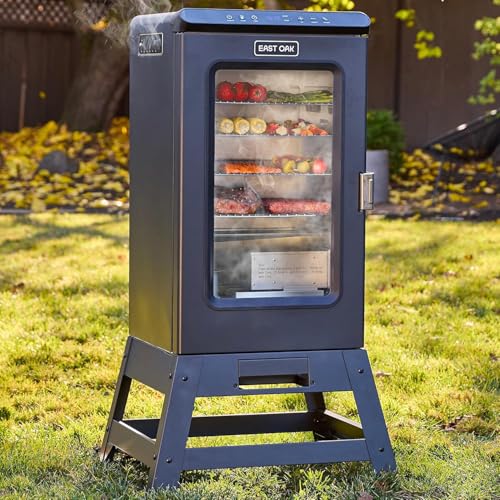
EAST OAK 30-Inch Outdoor Electric Smoker with Mobility Stand, Polar Night
Badge: Best Vertical Space-Saver
Strengths
- Its area is stacked, not spread: a seven-hundreds capacity standing on a cabinet’s ground plan — the guide’s best area-per-footprint ratio.
- Built-in meat probe and a long-interval side loader minimise disturbance on big-batch cooks.
- Mobility stand adds height and movement, suiting patios that reconfigure often.
Trade-offs
- By the area ladder alone it ranks near the top — its smallness is geometric, and buyers must understand which axis they are shopping.
- Smoker only: no grilling, at any size.
- Rack geometry suits layered loads better than one very wide cut.
At a glance: 30-inch outdoor electric smoker as stated in the listing title; cooking area 725 sq. in.; built-in meat probe; mobility stand; side chip loader; colour Polar Night.
This EAST OAK is the guide’s standing lesson in its own second qualification. By cooking area it is the largest linked pick here; by ground footprint it is among the smallest, because its capacity rises in racks inside a 30-inch-class cabinet on a stand rather than spreading across a barrel. A buyer whose constraint is patio floor — a narrow deck, a balcony-adjacent corner, a shared yard — should read this pick as effectively the smallest full-capacity option in the guide. A buyer whose constraint is batch size should read it as what its figure says. Both readings are correct; they are answers to different questions, and the guide’s job is to keep the questions separate.
As a machine, it is the long-cook electric specification in full: probe data without door openings, chip refreshes through the loader, a stand that fixes the ground cabinet’s posture problem. Households whose smaller brief is really a footprint brief will find it the most capable pick in this article, full stop. Households whose brief is genuinely about cooking less at once should climb back down the ladder to the Royal Gourmet and the small pellets, where smaller means smaller on every axis at once. The discussions under Best Smoke Generator For Vertical Smokers concern accessories for cabinets like this one — a second-season topic that does not change its standing here.
Best for: footprint-pressed buyers who still need full batch capacity / Not suited for: buyers whose smaller brief is about batch size itself.
Pit Boss 850 Navigator Series Wood Pellet Grill & Smoker
Badge: Beyond Smaller — Read the Caveat
Strengths
- The pool’s largest cooking space and hopper — event capacity, stated plainly.
- Connected controls and a flame broiler per the listing: the full modern pellet specification.
- As a large machine judged on its own terms, it is the most complete in this article.
Trade-offs
- It is not a smaller smoker by area, by footprint, or by any honest reading of the word.
- Its scale taxes every ordinary cook with the fuel and space appetite of an event machine.
- Prose only, without a link, because this guide will not sell it under a smaller premise.
At a glance: Cooking space 932 sq. in. as stated in the listing title; temperature range 180°F to 500°F; WiFi and Bluetooth connectivity; flame broiler; LCD digital controller; meat probe; pellet hopper 30 lb.
The ladder needs a top fence, and this is it. The 850 Navigator out-capacities, out-connects, and out-hoppers everything else in this article, and none of that is in dispute. What is in dispute — what this guide exists to dispute — is only the adjective. At over nine hundred square inches with the pool’s largest hopper, it belongs to the full-size pellet conversation, and a smaller-smokers guide that linked it would be spending its readers’ trust on a contradiction.
So take it as calibration. If its specification reads like your requirements, your brief was never smaller, and the honest move is to restart among full-size pellet guides with this machine on the list. If it reads like excess — as it will for most households — then the ladder below it is your territory, and its lower half, from the Royal Gourmet through the Traeger, is where smaller smokers actually live. The accessory questions in Best Smoke Generator For Small Smokers belong to that territory’s second season, not to this machine’s first.
Best for: readers who discover their brief is full-size pellet cooking / Not suited for: anyone shopping the smaller premise — the five linked picks above are the guide.
Comparison Table
| Pick | Area (as listed) | Format | Footprint character | Listing |
|---|---|---|---|---|
| Royal Gourmet SE2805 | 454 sq. in. | Electric vertical, 28-inch | Smallest on every axis | Check on Amazon |
| Pit Boss 500 Carbon Series | 543 sq. in. | Pellet barrel | Smallest barrel, full clearances | Check on Amazon |
| Traeger Pro 22 | 572 sq. in. | Pellet barrel | Small barrel, full clearances | Check on Amazon |
| Pit Boss 700 Carbon Series | 718 sq. in. | Pellet barrel | The step-up footprint | Check on Amazon |
| EAST OAK Polar Night | 725 sq. in. | Electric vertical, 30-inch | Cabinet footprint, stacked area | Check on Amazon |
| Pit Boss 850 Navigator | 932 sq. in. | Pellet barrel | Beyond the brief | Prose only — no link |
The table’s two size columns are the guide in one view: area climbs steadily down the rows, while footprint character refuses to follow it — the vertical’s stacked area breaks the pattern, and the prose-only row marks where the pattern, and the premise, end. Keep both columns in view when you check the listings, because a buyer who reads only the area column will misjudge at least two of these six machines, in opposite directions.
How to Choose the Right Smaller Smoker
Decide which smallness you mean before you shop, because this guide contains two different products wearing one adjective. If your constraint is batch size — you cook for two, you dislike leftovers at scale, you want a chamber that heats promptly for modest loads — then the area ladder is your map and its bottom half is your territory: the Royal Gourmet for the smallest honest cabinet, the two small pellets for versatility at that scale. If your constraint is ground space — the patio is narrow, the corner is fixed, the yard is shared — then format is your map, and the vertical electrics are your territory at almost any area, with the EAST OAK as the fullest expression of stacked capacity. Buyers who confuse the two maps end up with a small-area barrel that will not fit their corner, or a tall cabinet whose batches dwarf their table; both are good machines bought against the wrong definition.
One further filter separates the two maps in practice: storage. A smaller smoker is often a stored smoker — rolled into a garage, tucked under a cover in a corner, kept out of the weather and out of the way — and storage has its own geometry. Cabinets store as they stand, asking only for their square; barrels store as they stand too, but their length claims a wall. If your smaller brief includes a storage address, pace it out as carefully as the cooking address, and favour the format whose stored shape your space already has a gap for. Many a right-sized purchase has been undone by a wrong-shaped garage.
Then apply the calendar test to capacity. Count, honestly, the cooks of the last year that would have filled each rung of the ladder. Most households discover their true size two rungs below their imagined one, and the discovery is worth money and patio: a right-sized chamber heats faster, smokes cleaner at modest loads, and gets used on weeknights when an oversized one feels like an event. Reserve the step-up rungs for demonstrated patterns — monthly hosting, weekly batch cooking — rather than for aspirations. Finally, remember the standing exclusions: this pool has no miniatures and no other fuels, so a smaller brief that truly means tabletop, or truly means charcoal, must be shopped in a different pool entirely, and no ranking here should be stretched to cover it.
How to Set Up, Smoke, Clean, and Troubleshoot a Smaller Smoker
Setup rewards the smaller format. Place the cabinet or barrel level, with its working clearances — door swing or lid arc, loader or hopper access — and season the chamber per the manual before food enters it. Smaller chambers repay one extra step: a calibration cook with a forgiving load, during which you learn your particular unit’s geography — which rack runs steadiest in a vertical, which end of a small barrel runs hotter — because in a compact space those gradients are a larger share of the whole, and cooking to them deliberately is the smaller-smoker skill.
While cooking, think in densities. A smaller chamber crowded is worse than a larger one crowded, because smoke and heat have less room to circulate; space pieces generously, accept the occasional second batch, and let the probe — where fitted — arbitrate doneness. Keep doors and lids shut with the usual discipline, refresh chips through loaders where they exist, and remember that a compact chamber recovers its temperature quickly after a necessary opening, which is one of the format’s quiet pleasures. Rest everything you cook; resting is free and it finishes what the smoker started.
Cleaning scales down gratefully: fewer racks, smaller pans, a shorter wipe. Do it warm, do it briefly, do it every cook, and a smaller smoker stays the low-maintenance appliance it was bought to be. Cover it between cooks, store pellet fuel dry, and keep cords coiled and outlets sound for the electrics.
Troubleshooting for compact chambers. Problem: food at the edges cooks faster than the centre → your load is crowded for the chamber’s size; reduce density and rotate racks or positions at one planned interval. Problem: smoke turns harsh quickly → the small chamber concentrates a heavy chip load; halve the load and let the first plume clear. Problem: a pellet barrel overshoots after opening → give auger control time to settle before adjusting again; small barrels react quickly in both directions. Problem: the vertical’s top rack lags → it is the cabinet’s geography, not a fault; plan mixed loads with the longest-cooking items on the steadiest racks you found in calibration.
Smaller, Right-Sized, and the Case Against Bigger-Than-Needed
There is a philosophy under this guide’s ladder worth stating plainly, because it generalises beyond smokers. Appliances are bought at their maximum imagined use and lived with at their average actual use, and the gap between those two numbers is paid daily — in space, in fuel, in cleaning, in the reluctance to deploy a machine that feels like an occasion. Right-sized tools invert the bargain: they are deployed casually, used weekly, and mastered completely, and mastery at the right size produces better food than capacity at the wrong one. The smaller smokers in this guide are not a compromise tier for buyers who cannot reach the real thing. For the majority of households, they are the real thing — the size at which smoking becomes a habit instead of an event — and the prose-only giant at the ladder’s top is included so that the boundary of that claim is visible, priced, and impossible to mistake.
The Footprint Field Guide: Measuring What Listings Do Not Print
Listings print cooking area because it is the flattering number; they rarely print the working footprint, because it is the decisive one. Since this guide cannot invent dimensions its sources do not state, it offers instead the measuring method that produces the truth for your patio. For a vertical cabinet, measure a square: the cabinet’s own stance, plus the door’s swing in front, plus a hand’s width behind for the cord and ventilation. That square, typically not much larger than the cabinet itself, is the whole claim — which is why verticals dominate genuinely tight spaces. For a pellet barrel, measure a rectangle with annexes: the barrel’s length and depth, plus the hopper side’s access, plus the lid’s upward arc translated into rear clearance, plus a working strip in front where the cook stands with a tray. That rectangle is routinely twice the barrel’s own shadow, and it is the honest figure to compare against your patio.
Run the measurement at the worst moment, not the average one: with the patio furnished, the chairs out, the plants in summer growth, and another person trying to pass behind you carrying drinks. A smoker that fits an empty patio in March and crowds a lived-in one in July was never the right size — it was the right size for a photograph. Smaller, properly measured, is a property of your space across its whole year, and the picks in this guide were ranked with that lived-in standard in mind: the cabinet that disappears into a corner in every month, the small barrel whose rectangle a real patio can honestly spare.
Cooking at Compact Scale: Habits That Make Smaller Better
A smaller chamber is not a larger one with less room; it is a different instrument, and it rewards its own technique. Its first virtue is responsiveness: less air to heat means faster preheats, quicker recovery after an opening, and a smoke environment that establishes itself in minutes. Cook to that virtue — smaller smokers are the best weeknight smokers in this entire cluster of guides, because a tray of thighs or a side of salmon can go from decision to dinner inside an ordinary evening. Its second virtue is concentration: smoke density builds readily in a compact space, so chip and pellet discipline matters more, not less. Modest loads, clean thin smoke, and patience will produce flavour that larger chambers need longer to match.
Its disciplines are equally specific. Load in layers of time, not just of space: the longest-cooking items enter first and occupy the steadiest positions, later items join around them, and the whole load converges on a single serving moment. Use the chamber’s geography you mapped in calibration rather than fighting it. And embrace the batch as a feature — two sequential loads in a responsive small smoker often beat one crowded load in a large one, in evenness, in smoke quality, and in the cook’s temper. Mastered this way, smaller stops being the size you settled for and becomes the size you would choose again, which is the destination this guide’s ladder was built to reach.
Common Buying Mistakes
The first mistake is shopping area when your constraint was footprint, or the reverse — the two-axis confusion this guide was written to prevent, and the one most likely to put a good machine in a space where it will slowly become furniture instead of a tool. The second is assuming smaller must mean miniature, then forcing a mainstream cabinet into a tabletop role it cannot play. The third is buying two rungs up for imaginary gatherings and living with the patio cost weekly. The fourth is crowding a compact chamber and blaming its size for what density did. The fifth is treating the step-up model as the default because it seems safer, when the evidence of your own calendar points down the ladder. The sixth is ignoring the prose-only boundary — deciding that the biggest machine must be the best one, in a guide whose entire premise is that it is not.
A closing word on confidence: buyers at the smaller end of any market are often made to feel they are shopping in the shallow end, one step from the real equipment. This guide’s ladder should cure that feeling with arithmetic. The smaller picks here hold family batches, run the full modern control toolkit in their digital forms, and produce the same categories of food as the pool’s giants — at sizes matched to how households actually cook, on patios as they actually are. Smaller, chosen deliberately and measured honestly, is not the budget version of this hobby. It is, for most people, the correct version of it, and the recommendations that follow are made in that conviction.
Final Recommendation
Start at the ladder’s sweet spot: the Pit Boss 500 Carbon Series if you want pellet versatility at the smallest pellet scale, or the Royal Gourmet SE2805 if you want the smallest honest cabinet for a small household that cooks modest batches with an attentive hand on the dial. Consolidators should take the Traeger Pro 22 and its six methods. If your smallness is about ground space rather than batch size, skip the ladder’s logic entirely and take the EAST OAK Polar Night’s stacked capacity. Take the Pit Boss 700 only when your calendar proves the step up — and leave the prose-only 850 Navigator to the full-size guides, where its considerable virtues are finally on-brief.
Frequently Asked Questions
What is the smallest smoker in this guide?
The Royal Gourmet SE2805, by both measures this guide trusts: it is the only 28-inch class cabinet in the pool and it carries the smallest stated cooking area, in the mid four hundreds of square inches. It is a compact mainstream smoker, not a miniature — the pool contains no tabletop models, and this guide does not pretend otherwise.
Is a vertical smoker really smaller if its cooking area is large?
On the ground, yes; on the grate, no — and the guide keeps the two claims separate on purpose. A vertical cabinet stacks its area in racks, so a mid-size capacity can stand in the smallest footprint in this article. If your constraint is patio floor, vertical is the smaller format. If your constraint is batch size, read the area figure and climb down the ladder.
How much cooking area do most households actually use?
The low-to-mid five hundreds of square inches cover the overwhelming majority of household cooks — ribs, chickens, shoulders, mixed trays — in a single load. The seven hundreds serve regular hosts and batch cooks. Beyond that, in this pool, lies the prose-only territory of event cooking, which most households visit rarely enough that renting the capacity with a second batch is the better economics.
Why is the largest smoker in the pool not linked?
Because this is a smaller-smokers guide, and the Pit Boss 850 Navigator is the pool’s largest machine by a wide margin. It is reviewed in prose — fairly, with its strengths stated — so readers can see where smaller ends and calibrate their own brief. Linking it as a smaller recommendation would contradict the guide’s title and its readers’ trust.
Are smaller smokers worse for long cooks?
No. Long cooks are governed by control and fuel management, not by chamber size, and the smaller picks here include digital pellet control with probes and electric cabinets with loaders — the full long-cook toolkit. A compact chamber even recovers temperature faster after openings. What smaller chambers ask is load discipline: space the food, and accept an occasional second batch.
Do smaller smokers use less fuel?
Generally, yes, and for a physical reason: there is less chamber to heat and hold. Electric cabinets draw to maintain a smaller volume, pellet barrels burn to feed a smaller grate, and chip loads in a compact vertical are modest by design. The saving per cook is small; across a year of weekly smoking it becomes one of the format’s quiet dividends, alongside faster preheats and faster cleaning. The exception is a smaller smoker run constantly at its ceiling for crowds — at that point you are paying the small machine’s inefficiency at scale, and the step-up rung would have been the thriftier buy.
Can a smaller smoker handle a whole brisket or a large turkey?
It depends on geometry, and this guide answers from format rather than from figures it does not have. Vertical cabinets accept tall, layered loads and whole birds on racks more readily than their area suggests, while small barrels are bounded by grate length and lid height. For an occasional oversized cook, the honest techniques are portioning the cut, cooking in two batches, or borrowing the larger machine your calendar did not justify buying. If oversized whole cuts are your regular programme, your brief is not smaller, and the ladder’s upper rungs — or the full-size guides — are your honest territory.
Should I buy the step-up size to grow into?
Only on evidence, not on hope. If your last year of cooking shows monthly loads that fill the smaller rungs, the step up is a rational purchase and this guide ranks the model for it. If the evidence shows a handful of large cooks a year, buy your true size and batch the exceptions — you will use the right-sized smoker more, clean it faster, and master it sooner.


