Disclosure: topratedkitchenware.com is reader-supported. When you buy through links on our site, we may earn an affiliate commission from Amazon and other retailers, at no extra cost to you.
Where to buy
One clarification before anything else, because this keyword deserves it: the best smokers bbq eggs cooks can choose are gentle, steady machines — and this guide is about cooking eggs — smoked eggs, the low-and-slow kind, peeled and kissed with wood smoke until the whites turn golden and the yolks go rich and savoury. It is not a guide to kamado-style ceramic grills that carry an egg-shaped name, and no pick below is one. Every machine here is an electric cabinet or a pellet grill-smoker from the verified range, chosen because gentle, stable, low-temperature smoke is exactly what eggs ask for — and exactly what these six do well. All six are linked so you can check the latest price on Amazon.
- EAST OAK 30-inch Outdoor Electric Smoker, Polar Night — Best Overall for Smoked Eggs. A built-in probe, a long-load side chip system and a mobility stand.
- Royal Gourmet SE2805 28-inch Electric Smoker — Best for Small Batches. A compact cabinet with three grates for a dozen eggs at a time.
- Traeger Pro 22 Wood Pellet Grill and Smoker — Best for Egg-Centred Brunches. Smoke the eggs, then bake, roast and grill the rest of the spread.
- Pit Boss 700 Carbon Series Wood Pellet Grill and Smoker — Best Stated Low-End Control. A published range starting at genuinely low smoking temperatures.
- Pit Boss 500 Carbon Series Wood Pellet Grill and Smoker — Best Compact Pellet. The smaller Carbon Series machine with the same wide range.
- Pit Boss 850 Navigator Series Wood Pellet Grill and Smoker — Best for Crowds. The largest cooking space and hopper here, for eggs by the tray.
Read the full guide ↓ for the smoked-egg method itself, the wood choices that flatter eggs, and full reviews of all six machines.
So, the best smokers bbq eggs cooks can choose — with the kamado misunderstanding cleared away in the first paragraph, where it belongs. What remains is one of the quiet delights of the smoking hobby. A smoked egg is a small miracle of the low-and-slow method: an ordinary hard-cooked egg, peeled, given a gentle bath of wood smoke, and transformed into something that eats like a delicacy — smoky, golden, firm-whited, with a yolk that turns dense and deeply savoury. Devilled, they stop conversations. Sliced over salads, ramen or grain bowls, they make a weeknight plate taste planned. And they are, not coincidentally, the perfect food for judging a smoker’s low-temperature manners, because eggs forgive nothing: too hot and the whites turn to rubber bands, too smoky and the delicate flavour drowns, too long and you have made very expensive cat treats.
That is why this guide’s picks skew toward control. Three pellet machines with published low temperature ranges and digital controllers, two electric cabinets built for gentle set-and-hold cooking, and one compact cabinet for small batches — every one of them can hold the cool, steady environment eggs want, and refresh smoke without drama. The reviews judge each machine on egg-relevant virtues first: low-end stability, smoke gentleness, rack layout for trays of small round foods, and the monitoring that keeps a short, delicate cook from overrunning. Cooks whose ambitions run larger will find the same machines judged on very different virtues in our Best Smokers Do For Smoking Turkeys guide — the two pages bookend what a smoker’s range really means.
Key Takeaways
- This guide is about smoking eggs as food; it is not about kamado grills, and no pick below is a kamado.
- Eggs want low, stable temperatures and gentle smoke — control matters more than capacity or power.
- The Pit Boss models state a temperature range beginning at a genuinely low smoking heat, ideal for eggs.
- The EAST OAK Polar Night is the electric pick: probe monitoring and a side loader that keeps the door shut.
- The Royal Gourmet is the small-batch cabinet — a dozen eggs, three grates, minimal fuss.
- Short smokes, mild woods and a chilled rest are the technique secrets; the how-to section gives the full method.
In this guide
Quick Picks
Six machines judged through an egg. The badges below match the detailed reviews, and each pick’s egg-relevant virtue is named in plain terms.
| Pick | Badge | Headline fact from the listing |
|---|---|---|
| EAST OAK 30-inch, Polar Night | Best Overall for Smoked Eggs | Built-in probe, mobility stand, side loader, 725 sq in |
| Royal Gourmet SE2805 | Best for Small Batches | 28-inch vertical, 454 sq in, three cooking grates |
| Traeger Pro 22 | Best for Egg-Centred Brunches | Pellet grill and smoker, six-in-one versatility, meat probe |
| Pit Boss 700 Carbon | Best Stated Low-End Control | LCD controller, range from low smoking heat to 500°F, 718 sq in |
| Pit Boss 500 Carbon | Best Compact Pellet | LCD controller, same wide stated range, 543 sq in |
| Pit Boss 850 Navigator | Best for Crowds | WiFi and Bluetooth, 932 sq in, 30 lb hopper |
How These Picks Were Chosen
This is a research-led guide, honest about its method. Picks were matched from verified Amazon listings, and every specification used in a review — temperature range, cooking area, hopper size, probe, stand — comes from the listing title supplied through the Creators API. Where a listing states a low temperature figure, the review leans on it, because a published low end is hard evidence of egg suitability. Where a listing does not state one, the review says what can honestly be said: electric cabinets as a class are built for gentle low-and-slow cooking, and pellet controllers as a class are designed to hold low smoking temperatures — class reasoning, labelled as such, never dressed up as a per-model measurement.
The kamado question was settled before selection began, and settled in the open: the verified pool for this keyword contains no kamado cooker, so the only honest article available is the food article — eggs, smoked gently — and that is the article you are reading. Within it, selection favoured low-end control first, then smoke management (side loaders and pellet feed systems that do not require opening the cooking chamber), then rack practicality for trays of eggs, then capacity for the crowd cooks. The result spans the realistic egg-smoking market from a compact cabinet that handles a dozen to a pellet machine that handles a wedding. Readers comparing verification styles will recognise the same discipline in our Best Smokers Consumer Reports criteria-based comparisons.
The 6 Best Smokers for BBQ Eggs, in Detail
Each review follows the same pattern: verified facts, three strengths and three trade-offs read through the egg lens, who it suits, one honest limitation and a verdict.
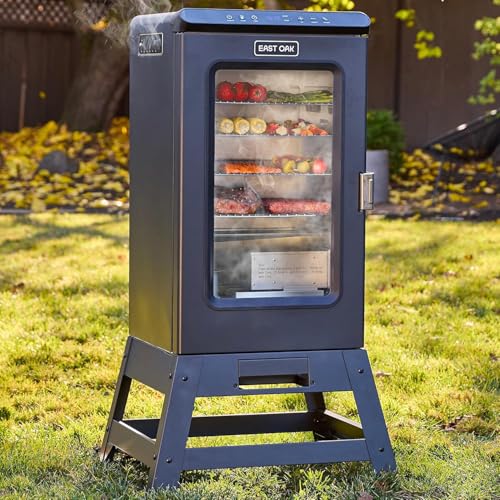
EAST OAK 30-inch Outdoor Electric Smoker, Polar Night
Badge: Best Overall for Smoked Eggs
Strengths
- The side chip loader refreshes smoke without opening the door — vital in a short, delicate cook.
- A built-in meat probe covers the same session’s other foods while the eggs smoke.
- The mobility stand lets you roll the cabinet to shade, which helps hold low temperatures on warm days.
Trade-offs
- At 725 square inches it is far more cabinet than a tray of eggs needs — you are buying range, not just eggs.
- Electric smoke is gentle by nature; cooks wanting assertive smoke must manage chip loads actively.
- No viewing window is stated for this finish, so egg colour is checked by a brief, planned peek.
Mini spec box
- Format: 30-inch outdoor electric smoker
- Cooking area: 725 square inches, as stated in the listing
- Monitoring: built-in meat probe
- Chip system: side chip loader, longer uninterrupted smoke design
- Stand: mobility stand, Polar Night finish
An egg smoke is a short cook balanced on a knife edge of temperature, and this cabinet’s design reads like it was specified by someone who understood that. The side loader is the headline: when a cook lasts well under an hour and every door opening dumps the gentle heat you have built, the ability to refresh chips from outside without breaking the chamber is not a convenience — it is the technique. Add a cabinet that holds low temperatures with electric calm, racks that take a full tray of eggs in one layer with air around each, and a stand that lets you chase shade on a bright day, and you have the most complete egg tool in this guide.
It suits the cook who will smoke everything else too — the eggs are the audition, not the whole repertoire. The honest limitation is proportion: if eggs and the occasional rack of ribs are genuinely your whole smoking life, the compact Royal Gourmet below does the job in half the footprint. Buy this one for the cook you are becoming, not just the eggs you are making this weekend.
Best for: households wanting one cabinet where eggs are the precision test / Not suited for: egg-only cooks with small spaces
Check on Amazon — confirm the Polar Night finish and mobility stand.

Royal Gourmet SE2805 28-inch Electric Smoker
Badge: Best for Small Batches
Strengths
- Three cooking grates in a compact cabinet suit a dozen eggs in a single layer per grate.
- Adjustable heat gives the cook direct, simple control for a short delicate session.
- The smallest footprint here — eggs on a balcony are a realistic proposition.
Trade-offs
- Analog-style control asks the cook to supervise rather than set and trust.
- At 454 square inches it is the smallest capacity here for everything beyond eggs.
- No probe or loader refinements are stated — the method is hands-on.
Mini spec box
- Format: 28-inch electric vertical smoker
- Cooking area: 454 square inches, as stated in the listing
- Power: 1350W, as stated in the listing
- Racks: three cooking grates
- Control: analog temperature control with adjustable heat
There is a real case that the best egg smoker is a small one. Egg cooks are short, batches are modest — a dozen for devilled eggs, two dozen for a party — and a compact cabinet comes to temperature quickly, holds its gentle heat in a small volume, and stores in a corner the rest of the week. The SE2805’s three grates are well matched to the food: eggs in a single layer, air moving around them, no stacking, no steaming in their own crowd. Adjustable analog heat suits the method too, because an egg cook is present and attentive by nature — this is not an overnight brisket, and the cook is nearby with a timer anyway.
It suits small households, balcony cooks and anyone whose smoking life is eggs, fish, cheese and other delicate small work. The honest limitation is headroom, in every sense: the household that falls for the hobby will outgrow 454 square inches, and the analog dial will eventually feel like work beside a digital set point. As a deliberate small-batch instrument, though, it is the most proportionate machine in this guide — a point our Best Smokers Canada readers, many in compact homes, will recognise.
Best for: small-batch egg smokers and small spaces / Not suited for: households planning to graduate quickly to big joints
Check on Amazon — check the latest price on Amazon for the SE2805.

Traeger Pro 22 Wood Pellet Grill and Smoker
Badge: Best for Egg-Centred Brunches
Strengths
- Six-in-one versatility lets one machine smoke eggs, then bake and roast the rest of the meal.
- An 18 lb hopper covers a full brunch session and the cooks around it without refilling.
- A meat probe is included for the meats sharing the menu with the eggs.
Trade-offs
- Pellet machines burn cleanest at higher heats; the gentlest smoke needs low settings and patience.
- Moving parts and electronics exceed what an egg-only cook strictly requires.
- Its stated maximum temperature is a grilling figure, irrelevant to eggs — judge it on low-end behaviour.
Mini spec box
- Format: wood pellet grill and smoker
- Cooking area: 572 square inches, as stated in the listing
- Temperature: maximum 450°F, as stated in the listing
- Hopper: 18 lb capacity
- Monitoring: meat probe included
The Traeger earns its egg badge by thinking past the eggs. Picture the meal this machine is for: smoked eggs as the centrepiece of a brunch, with sausages roasted alongside, potatoes baked in the same chamber, perhaps flatbreads grilled to order. A pellet grill-smoker runs that whole menu in one footprint and one fire, and its controller holds the low opening act — the eggs, smoking gently — before the temperature climbs for the rest. That arc, from delicate to hearty in a single session, is something neither a pure cabinet nor a pure grill does as naturally.
It suits entertainers and one-machine households. The honest limitation is smoke character at the low end: pellet systems produce their most delicate smoke exactly where eggs live, which suits the food, but cooks chasing a deep smoke ring on the eggs themselves should use the mild-wood, longer-rest method in the how-to section rather than expecting the machine to force it. Subtlety is the egg’s whole aesthetic; this machine respects it.
Best for: brunch hosts and one-machine households / Not suited for: cooks wanting the deepest possible smoke on eggs alone
Check on Amazon — confirm the Pro 22 model name on the listing.

Pit Boss 700 Carbon Series Wood Pellet Grill and Smoker
Badge: Best Stated Low-End Control
Strengths
- The published temperature range starts at a genuinely low smoking heat — hard evidence for egg work.
- An LCD digital controller and included meat probe make low cooks monitored and repeatable.
- The stated 718 square inches lets eggs share the chamber with the rest of a big cook.
Trade-offs
- The 13.5 lb hopper is modest for the machine’s size on very long cooks.
- A large pellet machine is a big footprint for a food measured by the dozen.
- Flame-broiler style high-heat features in the wider series are irrelevant to eggs — judge the low end.
Mini spec box
- Format: wood pellet grill and smoker
- Cooking area: 718 square inches, as stated in the listing
- Temperature range: 180°F to 500°F, as stated in the listing
- Control: LCD digital controller, meat probe included
- Hopper: 13.5 lb capacity
Evidence is a beautiful thing, and this listing provides it: a stated range that begins at a true low smoking temperature. For eggs, that single published figure does more work than any adjective, because the whole technique lives in the narrow band where smoke drifts, whites set gently and nothing scorches. The LCD controller turns that band into a set-and-hold proposition, and the wide cooking space means an egg tray can ride along at the edge of a larger cook — the economical way eggs often get smoked in real households, as passengers on a brisket day.
It suits evidence-minded buyers and big-cook households. The honest limitation is scale mismatch in the other direction: this is a lot of machine to fire for twelve eggs alone, and its owner should either batch generously — smoked eggs keep well and improve with a rest — or accept the pellet cost of small cooks as the price of range. Our Best Smokers Competition page, which judges machines by completely different pressures, reaches a similarly evidence-first view of this one’s controller.
Best for: buyers who want a published low end and big capacity / Not suited for: minimalists cooking tiny batches only
Check on Amazon — verify the 700 size in the Carbon Series listing.

Pit Boss 500 Carbon Series Wood Pellet Grill and Smoker
Badge: Best Compact Pellet
Strengths
- The same wide stated temperature range as its 700 sibling, low end included.
- A smaller footprint and cooking space better proportioned to egg-sized batches.
- LCD digital control and a meat probe are standard, not upsells.
Trade-offs
- The 13.5 lb hopper is shared with the larger model, so refills come sooner relative to appetite.
- At 543 square inches, crowd brunches will queue rather than share the grate.
- Two Carbon Series sizes make the 500 figure in the listing worth a careful check.
Mini spec box
- Format: wood pellet grill and smoker
- Cooking area: 543 square inches, as stated in the listing
- Temperature range: 180°F to 500°F, as stated in the listing
- Control: LCD digital controller, meat probe included
- Hopper: 13.5 lb capacity
If the 700 is the evidence pick, the 500 is the proportion pick: the same published low end, the same controller family and probe, in a machine sized for the households most egg cooks actually feed. A tray or two of eggs, a chicken, a modest rack of ribs — the 543 square inches covers the realistic week without heating a cavern, and smaller chambers reach and recover low temperatures with a nimbleness that flatters delicate work. For the egg cook specifically, this may be the sweet spot of the entire guide: pellet convenience and a verified low range, without buying capacity that exists to impress a tape measure.
It suits couples, small families and patio cooks. The honest limitation is the shared ceiling: when the party grows, this machine queues food rather than gathering it, and the cook becomes a scheduler. Households that regularly feed a crowd should step up to the 700 or the Navigator below and accept the footprint as the cost of the gathering.
Best for: small households wanting pellet low-end control / Not suited for: regular large gatherings
Check on Amazon — check the latest price on Amazon and the 500 size designation.

Pit Boss 850 Navigator Series Wood Pellet Grill and Smoker
Badge: Best for Crowds
Strengths
- The stated 932 square inches is the largest cooking space here — eggs by the catering tray.
- A 30 lb hopper is the biggest here, built for event-length cooking days.
- WiFi and Bluetooth monitoring suits a host who is feeding people, not watching a dial.
Trade-offs
- The largest footprint and appetite for pellets in the group, for a delicate small food.
- Connected features assume a network and a phone between the host and the cook.
- Small egg batches in a huge chamber are the least economical way to smoke them.
Mini spec box
- Format: wood pellet grill and smoker, Navigator Series
- Cooking area: 932 square inches, as stated in the listing
- Temperature range: 180°F to 500°F, as stated in the listing
- Control: LCD digital controller with WiFi and Bluetooth, meat probe included
- Hopper: 30 lb capacity
Every guide needs its maximalist, and the Navigator is a genuinely useful one. Devilled eggs are party food, and party arithmetic is unforgiving: a crowd eats them by the tray, and the cook who promises smoked devilled eggs for forty people needs grate space, hopper endurance and monitoring that survives socialising. This machine provides all three, with the same published low temperature range as its Carbon Series siblings — the egg credentials are real, merely scaled. The flame broiler and high-heat range then cover the rest of the party menu in the same footprint.
It suits hosts, big families and event cooks. The honest limitation is everyday proportionality: firing the largest chamber here for a quiet dozen eggs is like heating a hall to warm a chair, and weekday cooks will feel the pellet bill. Buy it for the gatherings and let the eggs be one of its party tricks — a very good one, as our Best Smokers Cookbook companions will happily help you exploit with recipes once the hardware lands.
Best for: hosts smoking eggs by the tray / Not suited for: small households and small everyday batches
Check on Amazon — confirm the 850 Navigator model on the listing.
Comparison Table
| Pick | Format | Stated cooking area | Egg-relevant strength | Link |
|---|---|---|---|---|
| EAST OAK Polar Night | Electric vertical | 725 sq in | Side loader keeps the door shut; probe included | Check on Amazon |
| Royal Gourmet SE2805 | Electric vertical | 454 sq in | Compact chamber, three grates, small batches | Check on Amazon |
| Traeger Pro 22 | Pellet grill and smoker | 572 sq in | Whole-brunch versatility, big hopper | Check on Amazon |
| Pit Boss 700 Carbon | Pellet grill and smoker | 718 sq in | Published low range start, LCD control | Check on Amazon |
| Pit Boss 500 Carbon | Pellet grill and smoker | 543 sq in | Published low range in a compact size | Check on Amazon |
| Pit Boss 850 Navigator | Pellet grill and smoker | 932 sq in | Crowd capacity, connected monitoring | Check on Amazon |
How to Choose the Best Smokers BBQ Eggs Demand
Judge by the low end first. Eggs live at the gentle bottom of a smoker’s range, so a published low temperature figure — stated plainly in a listing, as the Pit Boss models here provide — is the single most useful specification an egg cook can shop by. Where no figure is published, judge the class: electric cabinets are built around low, steady heat, and their gentleness is a design trait rather than a setting. Judge smoke delivery second: the cook is short, so the machine must make clean smoke quickly and refresh it without opening the chamber — side loaders and pellet feeds both pass this test, in different dialects. Judge monitoring third, because a short cook overruns in minutes, and a probe-equipped machine that watches the rest of the meal frees the cook to watch the eggs.
Size comes last, and smaller than you think. A dozen eggs occupy a modest tray; even a party’s worth fits the mid-sized machines here in a couple of batches. Buy the capacity for your whole smoking life, not for the eggs alone — but let the eggs arbitrate between finalists, because a machine that treats the most delicate food in the repertoire with control and gentleness will treat everything else well too. That is the deeper reason this keyword is worth a full guide: eggs are not a niche. They are a diagnostic. A smoker’s brochure will tell you its maximum temperature, its total area and its longest feature list, but only a tray of peeled eggs will tell you the truth about its first hour — how cleanly the smoke starts, how calmly the low temperature holds, and how gracefully the machine behaves when the food cannot defend itself. Cooks who shop by that truth rarely regret the machine they bring home.
How to Smoke Eggs: The Full Method
Start with properly hard-cooked eggs: simmered until the yolks are just set, cooled in cold water, and peeled carefully — a torn white smokes unevenly and looks it. Pat the peeled eggs dry; surface moisture is the enemy of an even golden colour. Set the smoker to its gentle low end, the cool smoking zone where the air moves and the heat is kind. Use a mild wood — fruitwoods are the classic egg partners, and anything assertive should be diluted or saved for beef — and let the smoke establish before the eggs go in, arranged in a single layer with space around each, on a tray or directly on a clean grate.
Smoke briefly. Eggs take flavour fast, and the window between delicately kissed and harshly overdone is measured in tens of minutes, not hours — check colour early and pull them when the whites reach a pale gold. Rest them chilled before serving; the smoke mellows and settles, and a devilled yolk made from a rested smoked egg is noticeably better than one made in a hurry. Three common problems cover most failures. Problem: rubbery whites → the temperature ran hot; drop to the lowest stable setting and shorten the next batch. Problem: acrid, bitter flavour → the smoke was too dense or the wood too strong; use a milder wood and a lighter hand. Problem: patchy colour → the eggs were wet or crowded; dry them, space them, and turn them once midway. A raw-in-shell variation exists — eggs smoked in the shell take a gentler, subtler smoke through the porous shell — and it is worth one experiment once the peeled method is yours.
Woods, Flavours and Serving Ideas
Eggs are a canvas with a delicate native flavour, so wood choice is seasoning, not fuel. Apple and cherry give a sweet, light smoke that flatters devilled eggs and breakfast plates. Pecan sits a step stronger, lovely for egg salads with backbone. Hickory, used briefly, suits eggs destined for hearty company — chopped over baked beans, sliced onto a brisket plate. Mesquite and other assertive woods should be treated like chilli heat: a little is character, a lot is a takeover. Beyond wood, the serving ideas multiply quickly once a batch exists: smoked devilled eggs with a paprika dusting, smoked egg salad with herbs, eggs halved over ramen or grain bowls, a smoked Scotch egg for the ambitious, or simply salted halves with drinks, which is how many batches quietly disappear before they reach a recipe at all.
A word on rhythm: because the cook is short and the eggs keep well chilled for days, the efficient household smokes eggs as passengers — a tray added to a longer cook’s gentle opening phase, or a dedicated batch on a weekend morning that stocks the fridge for the week. Both habits argue for machines whose low end you trust without hovering, which is the thread that runs through every badge in this guide.
Why This Page Is Not About Kamado Grills
It is worth one short section, plainly, because search language is ambiguous and readers deserve the map. The word in this keyword that causes the confusion names a famous egg-shaped kamado cooker, and many searchers typing it are indeed hunting that style of grill. This guide cannot serve that hunt: the verified pool behind it contains electric cabinets and pellet machines only, and presenting any of them as a kamado would be a falsehood with a price tag. What it can do — and what the keyword also legitimately asks, read as food — is cover smoking eggs themselves, thoroughly and honestly, on the machines that verifiably exist for the job. If your heart is set on a ceramic kamado, this page’s honest service is to tell you to shop that category under its own name, where the listings will match the intent. If your heart is set on a plate of golden smoked eggs, you are exactly where you should be, and the method above is the good stuff.
Batch Planning: Eggs for a Dozen or a Crowd
The arithmetic of eggs is friendlier than the arithmetic of brisket, and planning a batch is mostly a matter of layers and timing. A single layer with air around each egg is the rule that governs everything: count your tray or grate space in eggs-per-layer, and let that number, not the chamber’s headline area, set your batch size. A mid-sized machine here handles a generous household batch in one layer; the big pellet machines earn their badges when the count climbs toward party scale, where two trays in rotation — one smoking, one resting — keep a host ahead of the eaters. Work backward from serving time, remembering the chilled rest is part of the recipe rather than dead time: eggs smoked in the morning are at their best by lunch, and eggs smoked the day before a party are better still, which makes this the rare party food that rewards the organised cook instead of punishing them.
Peeling is the hidden labour, and it scales worse than the smoking does. For a crowd batch, cook the eggs a day ahead, chill them thoroughly, and peel in a dedicated session with a bowl of water and a patient playlist; slightly older eggs peel more kindly than the very freshest, a rare case of the supermarket’s timing working in the cook’s favour. Season the peeled eggs lightly before smoking if they are destined for salads, and leave them plain if devilled yolks will carry the seasoning. None of this requires equipment beyond the smoker itself — which is precisely why the machine choice on this page is about temperature manners rather than accessories. The best egg smoker is the one whose low end you trust while your attention is on the peeling bowl.
Egg Quality, Safety and Sensible Handling
Because eggs are a cooked-then-cooked food, a short section on handling belongs in any honest guide. Start with eggs well within their date, cook them fully in the first stage, cool them promptly, and peel with clean hands and clean water. The smoking stage is a flavouring stage at gentle temperatures, so treat the eggs throughout as what they are — a perishable cooked food: refrigerate them without long warm counter rests, keep the total time out of the fridge modest on serving day, and chill leftovers promptly. None of this is exotic; it is the ordinary discipline of any egg dish, applied to one with a smoky detour. Households new to smoking sometimes treat the smoker as a preservative. It is not one — it is a flavour instrument, and the fridge remains the food-safety instrument, before and after the smoke.
Quality at the start shows at the finish. Fresh, sound eggs with firm whites take an even colour and a clean peel; eggs that were difficult before smoking are difficult after it, only more golden. If a batch matters — the party, the gift jar of pickled smoked eggs, the photograph — spend the small extra on good eggs and spend the saved worry on the wood choice instead. The smoker’s job is gentleness; the cook’s job is giving it something worth being gentle with.
Beyond the Basics: Pickled, Stuffed and Twice-Smoked
Once the plain smoked egg is yours, the repertoire opens in three directions, and each makes a different demand of the machine. Pickled smoked eggs — the peeled, smoked egg rested in a spiced vinegar brine — are the keeper’s direction: the smoke mellows in the brine over days, and the result slices beautifully over salads and boards. They reward a lighter initial smoke, because the brine will carry and concentrate what is there, and they reward the big-hopper, big-grate machines when a preserving session means eggs by the many dozen. Stuffed variations are the entertainer’s direction: devilled yolks piped back into smoked whites, with the yolk itself sometimes given a whisper of extra smoke before mixing, which argues for machines whose low end is trustworthy in very short, very gentle sessions — the Pit Boss models’ published low range and the electric cabinets’ calm both shine here.
Twice-smoked eggs are the experimenter’s direction: a first gentle smoke, a chill, and a second brief pass just before serving, which layers a fresh aromatic top note over the settled base. The technique is a small masterclass in why door-shut smoke management matters — every opening between passes costs the delicacy you are layering — and it is where the EAST OAK’s side loader quietly justifies its badge all over again. None of these directions requires different hardware from the six above; they require the same virtues, applied with more intent. That is the mark of a well-chosen machine for this keyword: it does not merely survive the basic recipe, it stays interesting as the cook’s ambitions grow past it.
Common Buying Mistakes
The first mistake is the identity error this page opened with: buying from an egg-smoking guide when you wanted a kamado, or the reverse. The second is judging a smoker for eggs by its maximum temperature, a figure that tells you nothing about the gentle end where eggs live. The third is over-smoking — dense smoke and long times that bully a delicate food — and then blaming the machine. The fourth is buying crowd capacity for a dozen-egg habit, heating a cavern for a tray. The fifth is forgetting that eggs are a short cook: machines whose smoke takes an hour to establish will spend the whole session warming up, which is why quick, clean smoke delivery earned so much weight in the badges above.
Final Recommendation
For most households, the EAST OAK Polar Night is the egg pick: door-shut smoke management, probe monitoring and electric calm in a cabinet that does everything else too. Pellet households should start with the Pit Boss 500 Carbon for its published low range in a right-sized body, stepping up to the Pit Boss 700 when the batches grow. Small-batch cooks have the Royal Gourmet, brunch hosts the Traeger, and party hosts the Navigator. Whichever you choose, smoke a dozen eggs in the first week — there is no faster way to learn a new smoker’s gentle end, and no tastier tuition in the whole hobby. A machine that can hold a cool, clean smoke for a tray of peeled eggs without scorching, rubberising or overwhelming them has proved the hardest part of its character; everything else it will ever cook asks for less delicacy than that. Judge the six above by that standard, pick the one whose size and style match your household, and let the first golden dozen make the case for the second.
Frequently Asked Questions
Is this guide about kamado egg grills?
No, and it says so from the first paragraph. This guide covers smoking eggs as food, on electric cabinets and pellet grill-smokers. No pick here is a kamado or ceramic egg-style grill; if that is the product you want, shop that category under its own name so the listings match your intent.
How long do eggs take to smoke?
Briefly — the cook is measured in tens of minutes, not hours, because peeled eggs absorb smoke quickly. Judge by colour: pull them at a pale gold. Exact times vary with temperature and taste, and the how-to section’s guidance — check early, rest them chilled — matters more than any single number.
Which wood is best for smoked eggs?
Mild fruitwoods, classically apple or cherry, are the safest and most flattering choice. Pecan is a step stronger for heartier dishes. Assertive woods should be used briefly and sparingly, because egg flavour is delicate and dense smoke turns bitter on it faster than on any meat.
Do I peel the eggs before smoking?
For the classic result, yes: hard-cook, cool and peel them first, then smoke the peeled eggs so the whites take colour and flavour directly. A subtler in-shell variation exists and is worth trying once the basic method is familiar, but the peeled method is the one to learn first.
Can I smoke eggs alongside other foods?
Yes, and it is the efficient habit: a tray of eggs rides well in the gentle opening phase of a longer cook, or alongside fish and cheese in a delicate-foods session. Keep them in a single layer with air space, and remember they finish far sooner than the main event — set a separate timer for the eggs.
What is the best first batch for a new smoker?
One dozen eggs, a mild fruitwood, the machine’s gentlest stable setting and a timer you obey. Peel carefully, dry the eggs, smoke them in a single layer, and pull them at a pale gold rather than chasing depth on the first attempt. Chill them, taste one immediately and one the next day, and write down what you did — that single logged batch teaches your machine’s egg manners better than any general advice, including this page.
Can I smoke other delicate foods the same way?
Yes — the same low, gentle discipline suits cheese on a cool day, fish, nuts and salt, and the machines in this guide were partly chosen for exactly that wider delicate repertoire. Each food has its own timing, but the machine virtues transfer completely: a trustworthy low end, clean quick smoke and a door or lid that stays shut.
How long do smoked eggs keep?
Chilled promptly and kept refrigerated, smoked eggs keep like any hard-cooked egg — several days of easy lunches, salads and snacks. Keep them in a sealed container, because their smoke aroma is generous and will happily perfume the butter, the milk and anything else unprotected nearby; most households count that as a feature for the first day and a storage lesson by the third. Their flavour settles and improves after the first rest, which is why batch-smoking a dozen or two on the weekend is such a practical rhythm.


