Disclosure: topratedkitchenware.com is reader-supported. When you buy through links on our site, we may earn an affiliate commission from Amazon and other retailers, at no extra cost to you.
Where to buy
All six picks below are linked so you can check the latest price on Amazon on the day you shop; this guide prints no price for any individual model, because prices in this category change too often for a printed figure to stay honest. The shortlist mixes two electric vertical cabinets with four wood pellet grill and smoker combinations, and every feature discussed — probes, controllers, temperature ranges, cooking areas, hopper sizes — is taken from the listing title itself, so you can verify each claim on the product page in seconds.
- EAST OAK 30-inch Outdoor Electric Smoker, Polar Night — Best Overall. A built-in meat probe, a side chip loader and 725 sq in of area in a cabinet built for controlled, repeatable smokes.
- Pit Boss 850 Navigator Series Wood Pellet Grill & Smoker — Best Premium. WiFi and Bluetooth control, a flame broiler, 932 square inches and the largest hopper in this guide.
- Pit Boss 700 Carbon Series Wood Pellet Grill & Smoker — Best Temperature Range. A stated range from 180°F to 500°F with digital control and a meat probe.
- Traeger Pro 22 Wood Pellet Grill & Smoker — Most Versatile. Six cooking modes in the title and an 18 lb hopper for long, steady sessions.
- Pit Boss 500 Carbon Series Wood Pellet Grill & Smoker — Best Compact Pellet. The same stated 180°F to 500°F range in a smaller 543-square-inch footprint.
- Royal Gourmet SE2805 28-inch Electric Smoker — Best Simple Analog. A stated 1350W element and dial control for cooks who prefer manual craft to menus.
Read the full guide ↓ for badges, honest trade-offs, a comparison table, and the control features that actually separate a serious cook’s smoker from a casual one.
The best smokers for home chefs are not simply the biggest or the most expensive machines in the category. A home chef — someone who cooks seriously at home, plans menus, and cares about repeatability — asks different questions from a casual weekend smoker. Can I hold a precise low temperature for six hours without tending a fire? Can I monitor the food without opening the door and losing the heat I built? Can I move from a gentle smoke to a hard finish in the same session? Can I run two proteins at different stages without chaos? This guide ranks six verified machines against those questions, using only what their listings actually state.
That evidence discipline matters more for this keyword than most. Marketing language in this category loves words like precision and professional, but the title of a listing is where verifiable claims live: a stated temperature range, a stated probe, a stated controller type, a stated cooking area. Where a title is silent — and some below are silent on points a chef would love to know — the review says so plainly rather than filling the gap. You will find no invented specifications, no prices and no frozen ratings here; you will find the control story of each machine told accurately, including its limits.
The result is a shortlist with a genuine spread of philosophies. At one end sits an electric cabinet with a built-in probe, built for set-and-monitor smoking. At the other, a connected pellet grill with WiFi control and a flame broiler for finishing. Between them are pellet machines with wide stated ranges and one deliberately simple analog cabinet for the cook who trusts a dial and a standalone thermometer more than an app. If you are also weighing sheer bird capacity, our companion guide to the Best Smokers For Large Turkeys applies a strict size standard that complements the control-first lens used here.
Key Takeaways
- For a serious home cook, the features that matter most are a meat probe, a controller that holds a set temperature, and a stated temperature range wide enough for both low smoking and high finishing — all verifiable in a listing title.
- The EAST OAK Polar Night is the only electric cabinet here whose title states a built-in meat probe, and it pairs that with 725 sq in of area and a side chip loader.
- The three Pit Boss pellet models state an identical 180°F to 500°F range, giving the widest documented working span in this guide; they differ in area, hopper and connectivity.
- The Pit Boss 850 Navigator adds WiFi and Bluetooth control and a flame broiler — the finishing tool a home chef reaches for — plus the largest stated area and hopper here.
- Analog control, as on the Royal Gourmet, is a legitimate chef’s choice when paired with a good standalone thermometer; it trades automation for simplicity and fewer failure points.
- No pick here should be bought on adjectives. If a control feature matters to you, confirm it is stated on the listing before you order.
In this guide
Quick Picks
| Pick | Badge | Why it is here | Link |
|---|---|---|---|
| EAST OAK 30-inch Outdoor Electric Smoker, Polar Night | Best Overall | Built-in probe, side loader for uninterrupted smoke, 725 sq in — the most complete control package in a cabinet. | Check on Amazon |
| Pit Boss 850 Navigator Series | Best Premium | WiFi and Bluetooth, flame broiler, 932 sq. in. and a 30 lb hopper — monitoring and finishing power for ambitious cooks. | Check on Amazon |
| Pit Boss 700 Carbon Series | Best Temperature Range | Stated 180°F to 500°F span, LCD digital controller, probe included, 718 sq. in. of space. | Check on Amazon |
| Traeger Pro 22 | Most Versatile | Six-in-one cooking — grill, smoke, bake, roast, braise, barbecue — with probe and 18 lb hopper. | Check on Amazon |
| Pit Boss 500 Carbon Series | Best Compact Pellet | The full stated 180°F to 500°F range and a probe in a 543-sq.-in. machine for smaller kitchens and patios. | Check on Amazon |
| Royal Gourmet SE2805 | Best Simple Analog | 1350W element stated, analog adjustable heat, 3 grates — manual control without electronics. | Check on Amazon |
How These Picks Were Chosen
This is a research-led guide. The pick pool was verified against Amazon listing data before a word was written, and the sources file beside this article records each product’s ASIN, full listing title and image source with the check date. Every specification in the reviews — every temperature, area, wattage and hopper figure — appears in the corresponding listing title. Nothing was borrowed from other models in the same brand line, because manufacturers routinely vary features between sizes and generations.
Ranking for this keyword weighted control evidence first: Is a meat probe stated? What kind of controller is stated? What temperature range is stated, and does its low end reach true smoking territory while its high end allows finishing? Capacity came second, judged as stated total area with an honest note that stacked cabinet racks and single-level pellet grates use that area differently. Connectivity counted only where a title states it. Features no title mentioned — insulation, app quality, grate materials — were excluded from scoring entirely, and the reviews flag the most relevant silences.
Two standing rules also apply. Prices are never printed, because they move; linked picks invite you to check the latest price on Amazon instead. Ratings and review counts are never printed either, for the same reason. A home chef, of all readers, deserves numbers that are either verifiable and stable — the hardware facts — or clearly labelled as things to check live on the day of purchase.
The 6 best smokers for home chefs, in detail
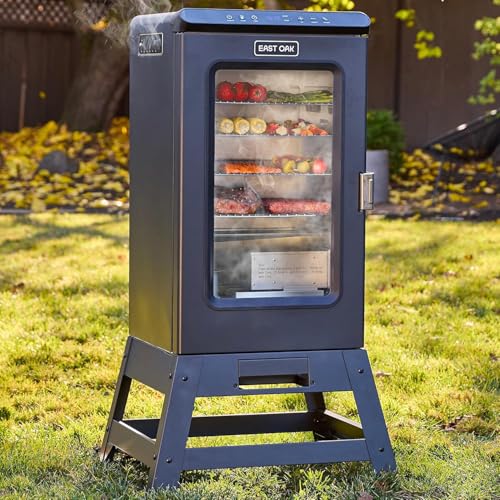
EAST OAK 30-inch Outdoor Electric Smoker, Polar Night
Badge: Best Overall
Strengths
- A built-in meat probe is stated in the title — the control feature a serious cook uses most — letting you cook to internal temperature without opening the cabinet.
- The side chip loader is designed for up to six times longer uninterrupted smoke, so smoke renewal never costs you the heat and humidity you have built.
- At 725 sq in of stated cooking area, it handles multi-rack menus — a brisket below, ribs above, vegetables finishing on top — in one session.
Trade-offs
- Its title states no temperature range, so the exact low and high ends must be confirmed on the listing before purchase — an unusual silence in an otherwise well-documented pick.
- As an electric cabinet it smokes and roasts but does not offer direct-heat finishing; searing needs a pan or a second appliance.
- The mobility stand is practical, but a tall loaded cabinet still wants two careful hands and a level route when moved.
At a glance: Fuel: electricity with wood chips. Stated cooking area: 725 sq in. Meat probe: built in. Chip system: side loader. Stand: mobility stand included. Colour: Polar Night.
A home chef’s smoking is usually part of a larger production: a main cut in the smoker, sides timed around it, guests arriving at a stated hour. The Polar Night fits that production style better than any other cabinet here because its stated features all serve monitoring and continuity. The built-in probe turns doneness into data. The side loader turns smoke management into a ten-second task that does not disturb the cabinet’s climate. The area turns a single protein into a menu. That combination is why it leads this guide despite being an electric appliance in a field of pellet machines with wider stated ranges.
The working method it rewards is worth describing. Load the cabinet, set the probe in the thickest cut, and then manage the cook by readings rather than by door openings. Chips go in through the side loader on schedule. The chef is free to work on everything else — sauces, sides, the table — which is precisely the division of labour a serious home cook wants from a smoker. Readers who entertain at scale should still sanity-check single-item fit for very large birds against the strict capacity notes in our Best Smokers For Large Turkeys guide, since total rack area and one-bird clearance are different questions.
The honest limitation is the unstated temperature range. The listing promises control features but does not print its working span in the title, so a chef planning very low or unusually high smokes must verify the figures on the product page. That is a small task, but this guide will not do the manufacturer’s paperwork for it by guessing.
Best for: organised home chefs who cook to temperature and run multi-item smokes. / Not suited for: cooks who need direct-heat searing in the same appliance.

Pit Boss 850 Navigator Series Wood Pellet Grill & Smoker
Badge: Best Premium
Strengths
- WiFi and Bluetooth control are stated in the title, so a long smoke can be monitored and adjusted from the kitchen — or the sofa — without lifting the lid.
- A flame broiler is stated, giving direct-flame finishing inside the same machine: the chef’s tool for crusting a smoked cut at the end of its cook.
- The largest stated package here — 932 sq. in. of cook space and a 30 lb hopper — supports big menus and genuinely long unattended runs.
Trade-offs
- Connectivity adds setup and an app account to your cooking; cooks who dislike managing software with their hardware will not use the feature they paid for.
- Its size is the largest footprint in this guide, which small patios and storage spaces will feel.
- A 30 lb hopper invites complacency; pellets left sitting for months in damp air still degrade, however large the bin.
At a glance: Fuel: wood pellets. Stated cook space: 932 sq. in. Stated temperature range: 180°F to 500°F. Controller: LCD digital with WiFi and Bluetooth. Meat probe: included. Hopper: 30 lb. Finishing: flame broiler.
The Navigator is the machine in this guide that most plainly thinks like a chef. Its stated range covers the full working span from low smoking to high finishing. Its connectivity acknowledges that a twelve-hour cook and a life both need attention, and that checking a graph indoors beats lifting a lid outdoors. And its flame broiler answers the oldest criticism of pellet smoking — that everything emerges with the same gentle surface — by offering direct flame for the final minutes of a cook.
Capacity completes the case. A stated 932 square inches is entertaining territory: multiple cuts at different stages, a full menu rather than a single centrepiece. The 30 lb hopper matches that ambition, holding enough fuel for the longest realistic home cook with margin. For the chef who hosts, experiments and cooks in volume, no other pick here states a comparable combination. Cooks shopping this tier on a tighter qualitative budget may want to compare the value logic in our Best Smokers For Less Than 300 guide, which examines what lower tiers keep and what they give up.
The limitation is complexity itself. Connected features are only worth their cost if you use them, and a large machine is only an asset if your space and your cooking volume justify it. Bought for a household that smokes a chicken twice a month, the Navigator is over-specification; bought for a chef who cooks weekly for a crowd, it is the right tool arriving with its evidence in order.
Best for: ambitious home chefs who entertain, monitor remotely and finish with direct flame. / Not suited for: small spaces, occasional cooks, or anyone who avoids app-managed appliances.

Pit Boss 700 Carbon Series Wood Pellet Grill & Smoker
Badge: Best Temperature Range
Strengths
- The title states the full working range — 180°F to 500°F — so both the low smoking floor and the high finishing ceiling are documented, not assumed.
- An LCD digital controller and an included meat probe give the two core instruments of controlled cooking in one purchase.
- At 718 sq. in. of stated cooking space, it is sized for family-plus cooking without the Navigator’s footprint.
Trade-offs
- The stated hopper holds 13.5 lb — adequate for most cooks, but the smallest pellet capacity in this guide, so overnight sessions need a planned top-up.
- No connectivity is stated; monitoring means walking to the machine or adding your own wireless thermometer.
- No flame broiler is stated, so direct-flame finishing is a step behind the Navigator’s offer.
At a glance: Fuel: wood pellets. Stated cooking space: 718 sq. in. Stated temperature range: 180°F to 500°F. Controller: LCD digital. Meat probe: included. Hopper: 13.5 lb.
If the Polar Night wins on cabinet craft and the Navigator on connected ambition, the 700 Carbon wins on documented range per unit of fuss. A home chef planning a menu that starts with hours of low smoke and ends with a high-heat finish — smoked-then-seared chops, a chicken finished crisp — can read the whole plan in this machine’s stated figures. The low end sits in classic smoking territory; the high end reaches genuine grilling heat; the digital controller and probe manage both ends without improvisation.
It is also the balanced physical size of the pellet group: enough stated space for a couple of large cuts or a family grill load, in a machine that does not dominate a modest patio. The compromises are fuel capacity and connectivity, both stated plainly above. For many serious cooks those are acceptable trades — a hopper check before bed is a small ritual, and a standalone wireless thermometer can be added later. What cannot be added later is temperature range, and that is the specification this pick gets right in writing.
Best for: chefs who plan smoke-then-finish menus and want the range documented. / Not suited for: cooks who want remote monitoring built in, or the longest unattended runs.

Traeger Pro 22 Wood Pellet Grill & Smoker
Badge: Most Versatile
Strengths
- Six-in-one versatility is stated in the title — grill, smoke, bake, roast, braise and barbecue — the broadest documented repertoire here, and a real asset for a cook who experiments.
- The 18 lb hopper is the second-largest stated pellet capacity in this guide, supporting long smokes with fewer refills.
- A meat probe is included, keeping temperature-guided cooking available from day one.
Trade-offs
- The title states a 450°F maximum but no minimum, so the low smoking floor is less completely documented than the Pit Boss models’ full stated ranges.
- Its stated 572 sq in of area is the second-smallest here; ambitious multi-item menus will feel the ceiling sooner.
- No connectivity or direct-flame feature is stated.
At a glance: Fuel: wood pellets. Stated cooking area: 572 sq in. Stated maximum temperature: 450°F. Meat probe: included. Hopper: 18 lb. Modes named in title: grill, smoke, bake, roast, braise, barbecue.
The Traeger Pro 22 suits the experimental home chef — the cook who wants to smoke a brisket on Saturday, bake bread outdoors on Sunday and braise short ribs in the same machine on Wednesday. Pellet heat is oven-like in its evenness, and the six modes named in the title map onto real controller settings and food arrangements rather than brochure poetry. For a household that treats its outdoor cooker as a second kitchen, that repertoire is a working advantage.
Its documentation, however, is asymmetric in a way a careful buyer should notice: a maximum temperature is stated, a minimum is not. Experienced pellet cooks know these machines smoke low, but this guide scores evidence, and the Pit Boss titles state their full ranges while this one does not. That is the difference between a strong recommendation and the top badge — a small paperwork gap with a practical consequence only for buyers who need the floor guaranteed in writing. Shoppers cross-checking models across retailers will find the same evidence-first method applied in our Best Smokers For Meat Gander Mountain benchmark guide.
Best for: experimental cooks who will use bake, roast and braise modes as well as smoking. / Not suited for: buyers who need a stated low-end temperature, or the largest cooking area.

Pit Boss 500 Carbon Series Wood Pellet Grill & Smoker
Badge: Best Compact Pellet
Strengths
- It states the same 180°F to 500°F range as its larger siblings — no control capability is surrendered for the smaller size.
- An LCD digital controller and a meat probe are both stated, keeping the full instrument set.
- At 543 sq. in. of stated cooking space, it fits smaller patios and households while remaining a genuine two-cut smoker.
Trade-offs
- The stated area is the smallest of the pellet group; entertaining at scale means batching.
- The 13.5 lb hopper matches the 700’s modest capacity, so long smokes share the same top-up ritual.
- No connectivity or flame broiler is stated.
At a glance: Fuel: wood pellets. Stated cooking space: 543 sq. in. Stated temperature range: 180°F to 500°F. Controller: LCD digital. Meat probe: included. Hopper: 13.5 lb.
The 500 Carbon is the thinking cook’s smaller machine. Many compact models in this category quietly cut the specification — a narrower range, a simpler controller, no probe — and hope the buyer will not compare titles side by side. This one’s title states the full range and both instruments, which is exactly the comparison this guide exists to make easy. A couple or small family that cooks seriously but not voluminously loses nothing in control by choosing it; they simply gain a machine proportioned to their actual menus.
Where it asks for honesty is headroom. Smoking is a hobby that grows: the first pork shoulder leads to two, the holiday bird gets larger, friends start accepting invitations faster. A buyer already cooking near this machine’s stated area should size up to the 700 instead. A buyer whose real loads are one or two cuts at a time will find the 500’s efficiency — less space to heat, less fuel to hold temperature — a genuine virtue rather than a compromise.
Best for: serious small-household chefs who want full documented control in a compact machine. / Not suited for: frequent large gatherings or fast-growing menus.

Royal Gourmet SE2805 28-inch Electric Smoker
Badge: Best Simple Analog
Strengths
- Its title states a 1350W element — the only explicit wattage in this guide — giving the comparison shopper a real figure for the heating hardware.
- Analog temperature control with adjustable heat offers direct, manual command with no menus, pairing or firmware between the cook and the fire.
- Three cooking grates in a 28-inch vertical cabinet make efficient use of a small footprint for layered small-batch smoking.
Trade-offs
- No probe and no digital controller are stated; precision depends entirely on the cook’s own thermometer and attention.
- At 454 sq. in., the stated area is the smallest in this guide — this is a small-batch machine.
- No temperature range is stated, so neither the smoking floor nor the ceiling is documented in the title.
At a glance: Fuel: electricity. Stated cooking area: 454 sq. in. Element: 1350W. Grates: 3 cooking grates. Control: analog, adjustable heat. Format: 28-inch vertical.
Every category needs its manual-transmission option, and the SE2805 is this guide’s. Some excellent home chefs actively distrust appliance automation: they keep their own thermometer, they know their cabinet’s moods, and they would rather manage a dial than debug an app during a dinner party. For that cook, the Royal Gourmet’s simplicity is not a missing feature list but a philosophy — fewer systems, fewer failures, and a stated element wattage that at least documents the heating hardware honestly.
The discipline it demands is equally clear. Without a stated probe or digital control, temperature knowledge is the cook’s job, and without a stated range, expectations must be set by the listing details beyond the title. Its small stated area confines it to small batches. Within those honest borders it is a coherent little machine; outside them, the digital picks above exist. Cooks who smoke outdoors year-round should also read the weather-planning notes in our Best Smokers For Meat When Outside Temperature guide before committing to any cabinet.
Best for: hands-on cooks who prefer manual control and cook in small batches. / Not suited for: precision-by-default cooking, large loads, or set-and-forget sessions.
Comparison Table
| Pick | Type | Stated area | Stated range | Probe | Control | Link |
|---|---|---|---|---|---|---|
| EAST OAK Polar Night | Electric cabinet | 725 sq in | Not stated | Built in | Cabinet control with side loader | Check on Amazon |
| Pit Boss 850 Navigator | Pellet grill & smoker | 932 sq. in. | 180°F to 500°F | Yes | LCD digital, WiFi and Bluetooth | Check on Amazon |
| Pit Boss 700 Carbon | Pellet grill & smoker | 718 sq. in. | 180°F to 500°F | Yes | LCD digital | Check on Amazon |
| Traeger Pro 22 | Pellet grill & smoker | 572 sq in | 450°F max stated | Yes | Pellet controller | Check on Amazon |
| Pit Boss 500 Carbon | Pellet grill & smoker | 543 sq. in. | 180°F to 500°F | Yes | LCD digital | Check on Amazon |
| Royal Gourmet SE2805 | Electric cabinet | 454 sq. in. | Not stated | Not stated | Analog, 1350W element | Check on Amazon |
How to Choose a Smoker as a Home Chef
Begin with the probe, because it changes outcomes more than any other single feature. Cooking smoked meat to internal temperature rather than elapsed time is the difference between repeatable results and hopeful ones, and a built-in or included probe removes the friction of setting up separate gear for every cook. Five of the six picks here state a probe; the one that does not asks you to supply your own, which is fine if you already own a thermometer you trust and a real cost if you do not.
Next, read the temperature range as a menu-planning document. The low end tells you whether true low-and-slow smoking is documented; the high end tells you whether finishing, roasting and grilling live in the same machine. The three Pit Boss titles state the full span in writing. The Traeger states its ceiling only. The two electric cabinets state neither end in their titles — which does not make them bad smokers, but does mean the careful buyer verifies those figures on the listing before ordering, especially when planning delicate work or cold-weather sessions of the kind discussed in our Best Smokers For Meat When Outside Temperature Is Cold notes.
Then match area to your real menus, remembering that cabinet area is stacked and pellet area is flat. A chef running a brisket with ribs above and vegetables on top uses vertical area efficiently; a chef who wants everything on one level with room to manoeuvre needs flat grate space. Finally, decide your relationship with automation honestly. Connectivity and digital control are worth paying for if you will actually monitor cooks remotely and cook long sessions often; they are dead weight for the cook who enjoys standing by the machine. Neither temperament is wrong — buying against your own temperament is the only error.
How a Home Chef Runs a Smoker: Workflow, Timing and Care
Serious smoking is a scheduling exercise before it is a cooking one. Work backwards from the serving hour: allow the cook its expected duration, add a resting period — large cuts improve with a wrapped rest — and add a buffer for the stall, the plateau where a big cut’s temperature pauses while moisture evaporates. Start earlier than feels necessary; a finished brisket holds well, while a late one cannot be hurried without cost. Preheat fully, season while the machine stabilises, and load the food cold for the best smoke uptake.
During the cook, manage by instrumentation. Keep the probe in the thickest part of the largest piece, watch trends rather than minute-by-minute numbers, and open the door or lid only for defined tasks — spritzing, wrapping, loading chips through a side loader where fitted. For pellet machines, glance at the hopper at natural breaks; for cabinets, keep chip loads on a schedule instead of waiting for the smoke to vanish. Finish by temperature and tenderness together: the probe should slide with little resistance in large cuts, whatever the exact reading.
After service, the unglamorous half of craft begins. Empty ash and chip trays, scrape grates while warm, wipe door seals, and store pellets and chips dry and sealed. Record what you did — wood, temperature, timing, result — in whatever notebook or app you will actually maintain. A home chef’s real advantage compounds over cooks, and it lives in those notes. Troubleshooting follows the same logged logic. Problem: temperatures swing during a long cook → check fuel level and quality, then door seal and wind exposure, before blaming the controller. Problem: smoke flavour is harsh → the fire is starved or the fuel damp; improve airflow and use dry wood. Problem: food finishes hours early or late → your plan ignored size and starting temperature; weigh cuts and log starting conditions next time.
The Finishing Question: Sear, Broil and Crust
Smoking produces tenderness and flavour; it does not, by itself, produce crust. The home chef’s finishing options in this pool are instructive. The Navigator states a flame broiler — direct flame inside the machine, purpose-built for the final crust. The pellet grills with stated 500°F ceilings can finish hot and fast, if short of true direct-flame char. The electric cabinets finish gently at best, sending the chef to a ripping-hot pan or a separate grill for the last two minutes. None of these is a failure; they are different kitchens. Decide before purchase whether your signature dishes — reverse-seared steaks, crisped chicken skin, a pizza night of the kind explored in our Best Smokers For Pizza guide — need the finish built in or can borrow it from the stove.
Cabinet or Pellet: Two Kitchens, Two Tempers
The electric cabinet and the pellet grill represent two genuinely different answers to the question of what a smoker is for, and a home chef should choose between them deliberately rather than by price drift. The cabinet is a single-purpose instrument: it holds gentle, smoky heat in a tall, efficient box, asks very little fuel or attention, and produces the clean, steady environment that fish, cheese-adjacent projects, sausages and long pork cooks love. Its virtues are quiet ones — low running cost, small footprint, simple cleaning — and its boundary is equally clear: no direct heat, no searing, no roasting at high temperature. The chef who owns a good stove and a cast-iron pan may never miss those functions outdoors.
The pellet grill is a generalist outdoor kitchen. It smokes at the bottom of its stated range, roasts and bakes in the middle, and grills toward the top, burning wood the whole time so everything it cooks carries some smoke character. Its costs are also generalist costs: pellets consumed by the hour, an auger and fan that need power and occasional cleaning, and a larger footprint. The chef who entertains outdoors and wants one appliance to run the entire menu will accept those costs gladly. The chef who smokes twice a month and grills on a separate beloved kettle may be buying a second kitchen to do a first kitchen’s occasional job. Neither answer is the sophisticated one; the sophisticated move is knowing which kitchen your cooking actually is.
Running a Full Menu: Sequencing a Service from One Smoker
The skill that separates a home chef from a smoker owner is sequencing — arranging a whole menu through one chamber without collisions. Start with the longest, most forgiving item: a pork shoulder or brisket that improves with rest can finish early and hold, wrapped, while faster items use the chamber. Plan the middle of the service around foods that share a temperature band, so the controller stays put while ribs, chicken pieces and sausages rotate through in waves. Reserve the final window for quick, delicate items — fish, vegetables, bread — that would be ruined by hours of accumulated heavy smoke but shine with a brief exposure at the end.
Probes and loaders earn their price precisely here. A built-in probe lets the main cut report its own progress while your hands are busy elsewhere; a side chip loader lets you refresh smoke for a new wave of food without dumping the chamber’s heat mid-service. Connectivity extends the same logic across the house: the cook can plate a starter indoors while the main course reports in. Practise the sequence once with forgiving food before performing it for guests, log the timings, and the second service will feel like a system rather than a gamble. That system — not any single specification — is what the home-chef lens in this guide has been measuring all along.
Common Buying Mistakes
- Buying area before control. A huge machine without a probe or a trustworthy controller produces large quantities of uncertain food. Instruments first, then capacity.
- Assuming features carry across a brand’s range. Sizes and generations differ. A feature on one model is not evidence for another — check the exact listing title of the exact model.
- Paying for connectivity you will not use. Remote monitoring earns its cost only across frequent long cooks. Occasional smokers should redirect that budget to capacity or a better probe setup.
- Ignoring the low end of the range. Everyone checks the maximum; chefs check the minimum, because documented low-temperature control is where smoking lives.
- Treating total area as single-item capacity. Stacked and flat areas behave differently, and one large item needs clearance, not just square inches.
- Cooking by time because the machine lacks a probe. If your pick has no stated probe, budget for a good standalone thermometer in the same purchase.
Final Recommendation
For most serious home cooks, the EAST OAK Polar Night is the first recommendation: its built-in probe, uninterrupted-smoke loader and generous area form the most complete control package in a cabinet, and it frees the chef to run the rest of the menu. Choose the Pit Boss 850 Navigator instead if your cooking is larger, more connected and finish-focused — it is the premium instrument here. And if your menus run smoke-then-sear in a mid-sized machine, the Pit Boss 700 Carbon states the range to prove it can follow the plan. Each of the remaining picks serves a defined temperament — versatility, compact control, or manual craft — and the reviews above name those readers plainly.
Accessories a Home Chef Will Actually Use
A short, honest accessory list serves a serious cook better than a drawer of gadgets. First, a backup instant-read thermometer, even when your smoker states a built-in probe: probes live in one cut at a time, and the instant-read checks everything else — plus it verifies the built-in probe itself, because instruments drift. Second, heat-resistant gloves rated for handling hot racks and wrapped cuts, which turn mid-cook rearrangements from a hazard into a routine. Third, a wide roll of butcher paper for wrapping large cuts through the stall while preserving bark better than foil alone. Fourth, a spray bottle for spritzing, which manages surface moisture and bark colour during long cooks. Fifth, a dedicated ash vacuum or at least a metal ash bucket for pellet machines, because ash management is the maintenance task that quietly decides whether a pellet fire burns clean next time. Everything beyond this list should have to argue for its shelf space against a specific recipe you actually cook.
Frequently Asked Questions
What is the single most important feature for a home chef buying a smoker?
A meat probe, because it converts smoking from timing guesswork into temperature-guided cooking. Five of the six picks here state one in their titles. If the model you favour does not, pair it with a quality standalone thermometer from the first cook.
Digital or analog control — which do serious cooks prefer?
Both, for different reasons. Digital controllers hold set temperatures with less attention and pair naturally with probes and connectivity; analog dials offer simplicity and fewer failure points for cooks who monitor with their own instruments. This guide includes both philosophies and scores each on what its listing actually states.
Why do some listings in this guide not state a temperature range?
Because manufacturers choose what to put in a title, and the two electric cabinets here emphasise probes, loaders and area instead. The absence is worth noticing: a chef who needs a documented low or high end should verify those figures on the product page before ordering, rather than assuming them.
Is WiFi control worth it for smoking?
For frequent long cooks, yes — remote monitoring protects a twelve-hour session from becoming a twelve-hour vigil, and the Navigator states WiFi and Bluetooth in its title. For occasional short smokes, the same money buys capacity or fuel. Match the feature to your actual cooking calendar.
How much cooking area does a home chef really need?
Most serious home menus — one large cut plus sides, or two cuts at once — fit comfortably in the 543 to 725 square inch band represented here. Regular entertaining pushes toward the Navigator’s stated 932 square inches. Remember that cabinet area is stacked across racks while pellet area is flat, and choose by how you actually arrange food.
How should a home chef maintain temperature accuracy over time?
Treat the controller’s display as a claim to be verified, not a fact. A few times a season, run the empty, preheated machine with an independent thermometer at grate level and compare readings; a small, consistent offset can simply be noted and cooked around, while a growing or erratic gap suggests a dirty temperature sensor, ash build-up around the fire, or a door seal that no longer closes fully. Clean the sensor gently, clear the ash, check the seal, and verify again before concluding anything expensive. Instruments stay honest when someone checks them — that habit, more than any feature, is what makes a home chef’s results repeatable.
Can these machines handle both delicate and heavy smoking work?
The pellet models with stated ranges beginning at 180°F document the low end delicate work needs, and their stated ceilings cover roasting and finishing. The cabinets specialise in the gentle end and ask for help — a pan or second appliance — when a hard finish is required. The reviews mark which is which for every pick.


