Disclosure: topratedkitchenware.com is reader-supported. When you buy through links on our site, we may earn an affiliate commission from Amazon and other retailers, at no extra cost to you.
Where to buy
Five of the six smokers below are verified with Amazon listings you can check directly; the sixth is reviewed in full as a prose-only pick, for a temperature reason explained honestly in its review. Each linked name takes you to its Amazon listing so you can check the latest price on Amazon and confirm current details before you decide. The full guide then works through what summer sausage actually demands — low heat that rises in slow, controlled stages and holds steady for hours — and judges every pick against that demand, using only the temperature and design evidence its listing states.
- EAST OAK 30″ Outdoor Electric Smoker with Side Chip Loader, Matte Black — Best Overall for Summer Sausage.
- EAST OAK 30″ Outdoor Electric Smoker with Built-in Meat Probe & Mobility Stand, Polar Night — Best for Long, Steady Cooks.
- Masterbuilt 30-inch Electric Vertical BBQ Smoker with Analog Temperature Control, Model MB20070210 — Best Traditional Cabinet.
- Royal Gourmet SE2805 28-Inch Electric Smoker — Best Compact Batch.
- Traeger Pro 22 Wood Pellet Grill & Smoker — Best Pellet Option, with a Caveat.
- Pit Boss 700 Carbon Series Wood Pellet Grill & Smoker — Prose-Only Pick (its listing states a temperature floor that conflicts with this job; see its review).
Read the full guide ↓
Choosing the best smokers for summer sausage means choosing for a cook unlike any other in the smoker’s repertoire. Summer sausage is not grilled, and it is barely even cooked in the usual sense: stuffed casings are dried, smoked, and brought up to temperature in slow stages, beginning at genuinely low heat and rising gradually over hours, because a sudden climb melts the fat inside the casing — the fault sausage makers call fat-out — and leaves the finished sausage greasy, crumbly, and pale where it should be firm, sliceable, and evenly coloured. The smoker that serves this job best is therefore the one that can sit at low heat without surging, step upward in small controlled increments, and hold each stage steadily for as long as the batch requires, with smoke available across the long middle of the process.
That requirement shapes this guide’s ranking more strictly than most, and it produces one prose-only pick that deserves explanation up front. Electric vertical cabinets dominate the list because electric heat is inherently stageable: an element and a controller can hold a low set point for hours without the fire management a fuel-burning smoker needs. Pellet grills enter with a caveat written in their own listings. The Pit Boss 700’s title states a range of 180°F to 500°F — and 180°F is the finishing neighbourhood of a summer sausage cook, not its starting point, so a machine whose stated floor sits there cannot perform the low opening stages this keyword requires; it is reviewed fully below as a prose-only pick, without a link or image, for exactly that stated reason. The Traeger Pro 22’s title states a maximum of 450°F and no minimum, so no contradiction exists in its evidence — it stays linked, with an explicit instruction to verify its low setting on the product page before relying on it for the early ramp. That is the standard applied throughout: stated figures rule, silence is flagged rather than filled, and contradiction — not absence — is what removes a link. Cooks coming to sausage from general fish or meat smoking will find the steadiness theme familiar from Best Smokers For Smoking Fish, but sausage stretches it over far longer, lower cooks.
Key Takeaways
- Summer sausage cooks in stages: low heat first, rising gradually over hours. Temperature stability at the low end is the whole buying question.
- Electric verticals lead this ranking because electric heat stages cleanly; four of the five linked picks are electric cabinets of 454–725 sq. in.
- The EAST OAK models pair the largest area here with long-run side chip loaders and, in the Polar Night, a built-in probe — the tool that verifies the sausage’s internal endpoint.
- The Pit Boss 700 is prose-only: its listing states a 180°F floor, which is this cook’s finishing zone, not its start. The Traeger stays linked because its listing states no floor — verify its low setting before buying for sausage.
- Hanging vs racking matters: casings should hang or lie without touching, so cabinet height and rack layout are sausage specifications, not details.
- The finish is procedural — a gradual ramp, an internal-temperature endpoint, and an ice bath to stop the cook — and the how-to section lays it out in full.
In this guide
Quick Picks
| Pick | Badge | Why it earns its place for summer sausage | Listing |
|---|---|---|---|
| EAST OAK 30″ Outdoor Electric Smoker, Matte Black | Best Overall for Summer Sausage | 725 sq. in. for uncrowded batches, a side chip loader listed for up to 6x longer per load, and a digital 12-hour timer built for staged, hours-long programmes. | Check on Amazon |
| EAST OAK 30″ Outdoor Electric Smoker, Polar Night | Best for Long, Steady Cooks | A built-in meat probe to verify the internal endpoint, the long-run side loader, a mobility stand for a level cabinet, and 725 sq. in. | Check on Amazon |
| Masterbuilt 30-inch Electric, Analog, MB20070210 | Best Traditional Cabinet | Analog control and 535 sq. in. of chrome-racked vertical space — the classic sausage-cabinet formula, steered by hand in small increments. | Check on Amazon |
| Royal Gourmet SE2805 28-Inch Electric Smoker | Best Compact Batch | 454 sq. in. on 3 grates with adjustable analog heat and a stated 1350W element — small batches in a small footprint. | Check on Amazon |
| Traeger Pro 22 Wood Pellet Grill & Smoker | Best Pellet Option, with a Caveat | 572 sq. in., an 18 lb. hopper and a meat probe, with 6-in-1 versatility; its listing states a 450°F maximum and no minimum, so verify the low setting before sausage work. | Check on Amazon |
| Pit Boss 700 Carbon Series Wood Pellet Grill & Smoker | Prose-Only — Stated Floor Conflicts | A capable pellet grill whose listing states 180°F to 500°F; that floor is this cook’s finishing zone, so it cannot run the low opening stages and carries no link here. | Prose-only — no link |
Badges are consistent through the detailed reviews. Note the deliberate honesty of this table: one pick is present without a link, and one linked pick carries its caveat in its badge. A summer sausage guide that hid either fact would be steering you with incomplete evidence, and this cook punishes incomplete evidence more than most.
How These Picks Were Chosen
This guide is research-led; no hands-on testing is claimed. The six picks come from a verified pool for this smoker group, and every name, ASIN, specification, and image traces to that pool’s listing data, checked on 2026-11-20. The method differed from a general smoker ranking in one respect: temperature evidence was treated as a gate, not a preference. Each title was read for what it states about temperature — a full range, a maximum only, a power figure, or nothing — and the pick’s treatment follows from that reading. A stated range whose floor contradicts the sausage ramp made the pick prose-only. A stated maximum with no floor left the pick linked with a verification instruction. Silence on temperature, common among the electric cabinets, was handled by ranking on the design evidence that does exist — control style, timer, probe, loader, area — while telling you plainly that the low-end check on the product page is part of buying for this job.
Beyond the gate, ranking weighed the sausage-specific virtues in order: control style suited to small staged increments; a timer or probe to manage and verify a long programme; smoke delivery that renews without opening the door, because a sausage cabinet opened mid-ramp loses the stage it was holding; and layout — vertical space and rack arrangement that let casings hang or lie without touching each other. General grilling versatility earned the pellet picks their places at the foot of the table rather than the head, because for this keyword versatility is a consolation, not the job. The same evidence discipline — crediting only what a listing states — governs the seasonal judgements in Best Smokers For Year Round, and readers who found that guide strict will find this one consistent with it.
The 6 Best Smokers for Summer Sausage

EAST OAK 30″ Outdoor Electric Smoker with Side Chip Loader, Matte Black
Badge: Best Overall for Summer Sausage
Strengths
- The digital 12-hour timer is built for exactly this programme: staged hours that must be kept whether or not the cook is watching.
- 725 sq. in. of vertical space lets a full batch of chubs hang or lie without touching — the layout condition good sausage texture depends on.
- The side chip loader, listed for up to 6x longer on a single load, renews smoke without opening the door and collapsing a held stage.
Trade-offs
- No built-in probe is stated in this listing, so the internal endpoint needs your own thermometer in a test chub.
- The listing states no temperature range; confirm the controller’s low settings on the product page, since the opening stages are low by design.
- Wheels make it mobile, but a staged cook wants the cabinet parked level and sheltered for its whole duration.
Mini spec box
- Type: Electric vertical smoker, 30-inch
- Cooking area: 725 sq. in.
- Smoke system: Side chip loader, listed for up to 6x longer on a single load
- Controls: Digital, 12-hour timer
- Mobility: Easy-rolling wheels
- Colour: Matte Black
Summer sausage rewards the cook who can programme a day: an hour of drying at low heat, a long smoking stage, a patient climb, a verified finish. The Matte Black EAST OAK is the cabinet in this pool that most clearly shares that temperament. The timer structures the stages; the loader keeps smoke present through the middle hours without door openings that would knock the cabinet off its stage; and the capacity is honest batch capacity, because sausage making is batch work — nobody grinds, seasons, cures, and stuffs for a single chub. It suits the home sausage maker who produces several batches a season, gifts them, and wants the smoker to be the reliable middle of a process they control at both ends. The honest limitation is endpoint evidence: with no stated probe, you will designate a sacrificial chub for your own thermometer, which is traditional practice but worth planning rather than discovering. Confirm the low end on the product page before the first batch, and this cabinet covers the job more completely than anything else here.
Best for: batch sausage makers who programme staged cooks and value a timer / Not suited for: cooks who want the machine to verify the internal endpoint
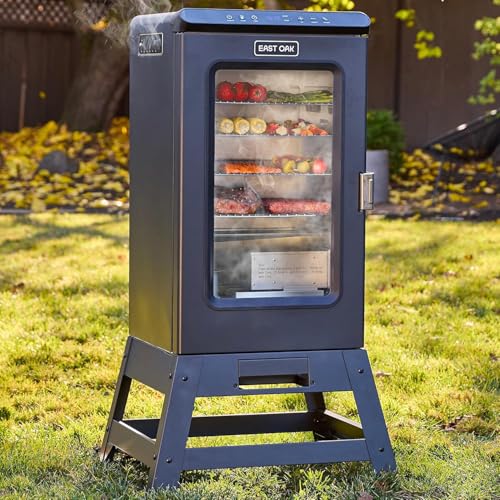
EAST OAK 30″ Outdoor Electric Smoker with Built-in Meat Probe & Mobility Stand, Polar Night
Badge: Best for Long, Steady Cooks
Strengths
- The built-in meat probe verifies the internal endpoint in a test chub — the single most important measurement in the whole process.
- The mobility stand keeps the cabinet level and settled for a cook measured in many hours; a level cabinet heats evenly around hanging casings.
- The side chip loader is listed for up to 6x longer uninterrupted smoke, matching the long middle stage of the programme.
Trade-offs
- No timer is stated in this listing, so stage-keeping is the cook’s schedule rather than the cabinet’s.
- No temperature range is stated; the low-end confirmation on the product page applies here as across the electric pool.
- No viewing window is stated, so casing colour is checked at planned openings.
Mini spec box
- Type: Electric vertical smoker, 30-inch
- Cooking area: 725 sq. in.
- Smoke system: Side chip loader, listed for up to 6x longer uninterrupted smoke
- Features: Built-in meat probe, mobility stand
- Colour: Polar Night
If the Matte Black is the programme-keeper, the Polar Night is the verifier, and sausage makers will recognise the temperament split immediately. The ramp is a means; the endpoint is the fact — the moment the centre of the chub reaches its finished temperature, the cook is over and the ice bath begins, and guessing that moment is how batches end up underdone in the middle or cooked to grease at the edges. A built-in probe in a designated test chub turns the finish from folklore into measurement. The stand’s contribution is quieter: over a cook this long, a cabinet that sits level and unmoved keeps heat distribution honest around casings that must not touch or sway into each other. It suits the precision-minded sausage maker, and anyone whose batches are large enough that a failed finish is a real loss of meat, cure, and a day’s work. The honest limitation is scheduling: with no stated timer, the stages advance when you advance them, so this is the cabinet for a cook who is present for the process — which, traditionalists will note, is how summer sausage has always been made. The retail-benchmark habits in Best Smokers From Lowes are worth borrowing here: compare this model’s number and stated kit carefully against any store listing before you buy.
Best for: precision-focused makers who verify the endpoint by probe / Not suited for: cooks who want the cabinet to run the stage schedule unattended
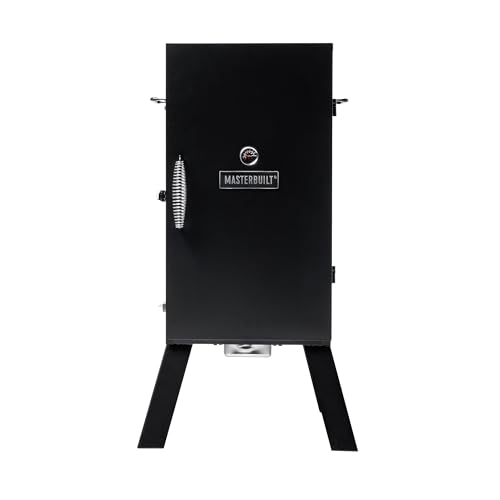
Masterbuilt 30-inch Electric Vertical BBQ Smoker with Analog Temperature Control, Model MB20070210
Badge: Best Traditional Cabinet
Strengths
- Analog control invites the small, manual increments the ramp is made of — a dial you nudge stage by stage, the way sausage has long been smoked.
- 535 sq. in. of vertical, chrome-racked space suits the modest batches most home makers actually produce.
- The simplest machine here to run and to clean after a greasy, hours-long sausage session.
Trade-offs
- Analog control is the least exact way to hold a stage; expect to verify cabinet temperature with your own thermometer and correct by hand.
- No timer, probe, or loader endurance is stated in the listing.
- Capacity suits home batches, not production for a crowd.
Mini spec box
- Type: Electric vertical smoker, 30-inch
- Cooking area: 535 sq. in.
- Racks: Chrome
- Controls: Analog temperature control
- Model: MB20070210
- Colour: Black
Before digital controllers, summer sausage was made in cabinets very much like this one, and the method co-evolved with the tool: the maker stayed nearby, read a thermometer, and turned a dial a fraction at each stage. The analog Masterbuilt remains a legitimate sausage smoker for exactly that maker. Its smaller chamber is honestly matched to home production — a batch of chubs from a single grinding session — and its simplicity means there is nothing between the cook and the process to fail, drift, or demand an app. It suits traditionalists, beginners who want to learn the ramp by hand, and anyone whose sausage making is an attentive weekend ritual rather than a programme. The honest limitation is precision, and for this food precision is not pedantry: a stage that overshoots can start fat rendering before the casing has set, and a dial gives you a neighbourhood where a digital controller gives you an address. The compensation is attention and a good thermometer, and the cook who brings both will make excellent sausage in this cabinet. The cook who wants the machine to hold the line while they do other things should buy one of the EAST OAK models above, and this guide says so without ranking the analog cabinet as a lesser product — it is a different contract between cook and machine.
Best for: traditional, attentive makers producing home-size batches / Not suited for: unattended staged cooking

Royal Gourmet SE2805 28-Inch Electric Smoker, 1350W
Badge: Best Compact Batch
Strengths
- The most compact cabinet here — 454 sq. in. across 3 grates — sized for the small batches of a first or occasional sausage maker.
- Adjustable analog heat gives direct manual control of the ramp’s small steps.
- The listing states a 1350W element, the pool’s only stated power figure — checkable information about the heat on offer in this class.
Trade-offs
- Vertical room is the tightest here; long chubs may need to lie on grates rather than hang, which demands careful spacing.
- Analog precision limits apply, as with the Masterbuilt dial model.
- No probe, timer, or loader endurance is stated in the listing.
Mini spec box
- Type: Electric vertical smoker, 28-inch
- Cooking area: 454 sq. in.
- Power: 1350W (as stated in the listing)
- Grates: 3 cooking grates
- Controls: Analog temperature control, adjustable heat
- Colour: Black
The Royal Gourmet is the entry point for the sausage-curious: a compact electric cabinet in which a first batch — a few chubs from a small grind — can be dried, smoked, and finished without dedicating patio or budget to the hobby before it has proven itself. Its three grates take chubs laid flat, which is a legitimate arrangement provided they do not touch and are turned at a stage change so all sides colour evenly; hanging is where the smaller cabinet asks its compromise, since long casings need vertical room this 28-inch class has less of. It suits apartment-adjacent patios, small households, and makers whose batches will stay small by design. The honest limitation is headroom in every sense: capacity, hanging height, and control precision are all the pool’s most modest, and a maker who catches the sausage habit seriously will outgrow it. Bought as a deliberate first instrument — with a thermometer, and with expectations set by the budget-tier discussion in Best Smokers For Under $200 — it teaches the process faithfully, and the process is the transferable skill.
Best for: first-time and small-batch makers in compact spaces / Not suited for: long hanging chubs or growing production

Traeger Pro 22 Wood Pellet Grill & Smoker
Badge: Best Pellet Option, with a Caveat
Strengths
- A meat probe is included, so the endpoint verification this cook depends on is covered.
- The 18 lb. hopper supports long sessions without refuelling, and pellet controllers hold set temperatures with little attention.
- 572 sq. in. and 6-in-1 versatility mean the machine earns its patio space across the rest of your cooking, not only on sausage days.
Trade-offs
- Its listing states a 450°F maximum and no minimum temperature — the low end, which is where sausage lives, must be verified on the product page before you rely on it for the opening stages.
- A horizontal grill layout means casings lie on the grate rather than hang; spacing and turning need care.
- Pellet smoke at very low settings can be thin, so the smoke stage may need the lowest stable setting and patience.
Mini spec box
- Type: Wood pellet grill & smoker
- Cooking area: 572 sq. in.
- Maximum temperature: 450°F (as stated in the listing); no minimum stated
- Hopper: 18 lb.
- Features: Meat probe, 6-in-1 versatility — grill, smoke, bake, roast, braise, BBQ
- Brand: Traeger
The Traeger is included as the pellet route, and its treatment in this guide is a small lesson in reading evidence. Its listing makes no false promise: it states a maximum and a probe and a hopper, and stays silent on the low end. Pellet controllers as a class are good at holding set points, and a probe-equipped machine that can genuinely hold a low setting can run a sausage ramp respectably, with the hopper removing fuel anxiety from a long day. But “can, if” is doing work in that sentence, and the if is yours to verify: before buying this grill for sausage, confirm the lowest set point on the product page and judge whether it reaches the low opening stages this cook requires. If it does, you gain the most versatile machine in the guide — a grill that also does sausage duty. If it does not, you have learned so before the meat was ground, which is the entire point of the check. It suits the household that wants one pellet grill for everything and makes sausage occasionally. Dedicated makers should take an electric cabinet from the top of this ranking, where the low game is the machine’s home ground. The mid-tier budget framing in Best Smokers For Under $1000 places this grill in its wider pellet context.
Best for: pellet-grill households making sausage occasionally, after verifying the low setting / Not suited for: buyers who need a stated, guaranteed low-temperature floor for dedicated sausage work
Pit Boss 700 Carbon Series Wood Pellet Grill & Smoker — Prose-Only Pick
Badge: Prose-Only — Stated Floor Conflicts
Strengths
- On its own terms, a well-specified pellet grill: 718 sq. in. of cooking space, an LCD digital controller, a meat probe, and a 13.5 lb. hopper.
- Its stated range of 180°F to 500°F covers ordinary low-and-slow barbecue — brisket, ribs, shoulders — comfortably.
- Pellet operation gives steady, low-attention heat for the cooks it is ranged for.
Trade-offs
- That stated floor of 180°F is the disqualifier here: summer sausage begins far below it and climbs gradually, so this machine, by its own listing, cannot run the opening stages.
- Running the whole cook at its floor would hold the sausage at finishing heat from the start — the fat-out scenario the staged ramp exists to prevent.
- It is therefore reviewed without a purchase link or image in this guide, per the rule that a pick contradicting the keyword’s core requirement stays prose-only.
Mini spec box
- Type: Wood pellet grill & smoker
- Cooking space: 718 sq. in.
- Temperature range: 180°F to 500°F (as stated in the listing)
- Hopper: 13.5 lb.
- Controls: LCD digital controller, meat probe included
- Colour: Black
- ASIN (recorded for transparency, not linked): B0FVPW6Z6F
Nothing in this review should be read as a judgement against the Pit Boss 700 as a grill — by its stated specification it is a capable, generously sized pellet machine, and for mainstream barbecue it would rank respectably in many of this site’s other guides. It is prose-only here for one narrow, provable reason: summer sausage is defined by a gradual climb from low heat, and this listing’s own stated minimum sits where that climb ends. A guide that linked it for this keyword anyway would be asking you to discover, with a batch of cured meat already stuffed, that the machine cannot go where the recipe starts. If your cooking is brisket-and-ribs barbecue with sausage as a rare experiment you are willing to finish by another method, the calculus is yours to make with the facts in front of you. For the keyword as asked — the best smokers for summer sausage — the honest answer is that this is not one of them, and it is included, unlinked, so you can see the reasoning rather than wonder at an absence.
Best for: general pellet barbecue, per its stated range / Not suited for: summer sausage, whose low opening stages fall below its stated 180°F floor
Comparison Table
| Pick | Type | Cooking area | Temperature evidence in listing | Sausage note | Listing |
|---|---|---|---|---|---|
| EAST OAK 30″ Electric, Matte Black | Electric vertical | 725 sq. in. | Not stated; digital 12-hour timer stated | Programme-keeping for staged cooks | Check on Amazon |
| EAST OAK 30″ Electric, Polar Night | Electric vertical | 725 sq. in. | Not stated; built-in probe stated | Endpoint verification by probe | Check on Amazon |
| Masterbuilt Analog MB20070210 | Electric vertical | 535 sq. in. | Not stated; analog control stated | Traditional hand-steered ramp | Check on Amazon |
| Royal Gourmet SE2805 | Electric vertical | 454 sq. in. | Not stated; 1350W element stated | Compact first batches | Check on Amazon |
| Traeger Pro 22 | Pellet grill & smoker | 572 sq. in. | 450°F maximum stated; no minimum stated | Verify the low setting before sausage use | Check on Amazon |
| Pit Boss 700 Carbon Series | Pellet grill & smoker | 718 sq. in. | 180°F to 500°F stated | Floor conflicts with the low opening stages — prose-only | Prose-only — no link |
How to Choose a Smoker for Summer Sausage
Begin with the floor — literally. Ask of any candidate: what is the lowest temperature it can hold, and is that figure stated anywhere you can check? Summer sausage’s opening stages are drying and smoking stages run at low heat, and a machine that cannot go low cannot be argued into the job by capacity or brand. That is why this guide treats one stated range as disqualifying and instructs verification wherever a listing is silent. When you check product pages, look for the controller’s full stated range rather than marketing language about low-and-slow, and remember that holding a low temperature steadily for hours is a different claim from reaching it briefly; digital control and a sheltered, level setup both serve the steadiness half of that claim.
Layout comes next. Casings should not touch each other or the cabinet walls: contact points cook unevenly, colour unevenly, and can stick and tear. Vertical cabinets earn their dominance here because they offer height to hang chubs — the ideal arrangement, with air on all sides — or stacked racks for shorter casings laid with space between them. Judge a candidate by the batch you actually make: count your chubs, picture them hanging or lying without contact, and let that picture, not the headline area figure, size your purchase. Smoke delivery follows: the smoking stage is long, so a loader that renews chips without opening the door protects the stage you are holding, and the EAST OAK models’ stated loader endurance is why they sit at the top. Finally, decide your verification method before you buy — a built-in probe, or your own thermometer in a test chub — because the finish of a sausage cook is a measurement, and a maker without a measurement plan is guessing with cured meat, which is the one protein where guessing has consequences beyond texture.
How to Smoke Summer Sausage, Step by Step
- Stuff and rest the casings. After grinding, seasoning, curing, and stuffing, rest the filled casings refrigerated so the cure distributes and the casings dry slightly. Keep the batch uniform — chubs of even diameter cook evenly, which matters more in this process than in any other.
- Dry at low heat without smoke. Hang or lay the casings in the smoker at the lowest stage, with air moving, until the casings feel dry to the touch. A dry casing takes smoke evenly and resists the sweating that mars colour.
- Smoke at low heat. Introduce smoke while holding the low stage. This is the long middle of the process — the stage the side loaders in this guide exist to sustain without door openings.
- Climb in small steps. Raise the temperature gradually, in modest increments with holding time between them, so the fat inside warms and firms progressively instead of melting. Rushing this climb is the classic cause of fat-out: greasy surfaces, crumbly texture, and fat pooled under the casing.
- Finish to a verified internal temperature. Judge the endpoint in the centre of a test chub with a probe — the Polar Night and the Traeger carry one in their listings; with the other cabinets, use your own thermometer. Appearance is not evidence; the centre temperature is.
- Ice-bath immediately, then bloom. Plunge the finished chubs into ice water to stop the cook and set the texture, then hang them at room temperature to bloom — the resting stage where colour deepens and evens — before refrigerating.
Troubleshooting. Problem: fat under the casing and a greasy bite → the ramp climbed too fast or a stage overshot; slow the steps, verify cabinet temperature independently, and never start a batch in a preheated-to-finishing-temperature cabinet. Problem: wrinkled, loose casings → the sausage was under-finished or cooled too slowly; verify the internal endpoint by probe and ice-bath promptly and thoroughly. Problem: pale, uneven colour → the casings went into smoke wet, or chubs touched during the cook; dry the casings properly in stage one and space the batch so air reaches every surface.
Why the Ramp Matters: Fat, Protein, and Patience
Summer sausage’s texture is an emulsion problem. Inside the casing, finely divided fat is held in a protein matrix; kept cool and warmed gradually, that matrix sets around the fat and the finished sausage slices cleanly, moist and firm. Heated too fast, the fat melts before the matrix sets, migrates, and pools — and no later step can put it back. This is why the process is staged, why the stages begin low, and why this guide is unusually strict about temperature evidence: for most barbecue, a smoker’s low end is a preference, but for sausage it is the mechanism of the food itself. It is also why electric cabinets, with their fine, surge-free heat, have become the home maker’s default for this work, and why an analog dial in attentive hands still outperforms a powerful machine that cannot go low. When you read any smoker listing with sausage in mind — including the wider pool surveyed in Best Smokers For Under $1500 — read the temperature line first and the capacity line second. For this one food, that order is not a style choice; it is the recipe asserting itself in the buying decision.
Casings, Cures, and Batch Planning
The smoker is the middle of the process, and the decisions made before it decide what the smoker has to work with. Casings come first: fibrous casings are the summer sausage standard, tough enough for hanging, permeable enough to take smoke and to dry evenly, and available in diameters that should be chosen with your cabinet in mind — a chub’s diameter sets both its hanging length and its cooking time, since the centre of a thick chub lags far behind a thin one. Uniformity is the quiet virtue: a batch of even chubs finishes together, while a mixed batch forces you to choose between overcooking the thin ones and undercooking the thick one, and the probe-in-a-test-chub method only works if the test chub honestly represents the batch. Natural and collagen casings serve smaller, snack-stick styles of the same family and follow the same staged logic at smaller scale.
Curing is the step that makes the low, slow process safe as well as traditional, and it deserves plain words: summer sausage recipes use a curing salt according to the recipe and the cure manufacturer’s instructions, measured accurately, because the long hours the sausage spends at low temperatures are precisely the hours the cure exists for. This guide does not publish cure ratios — they belong to your recipe and your cure’s maker, and they should be followed exactly rather than approximated — but it will insist on the surrounding discipline: accurate scales, thorough mixing, refrigerated rest, and a smoker programme that follows the recipe’s stages rather than improvising them. Batch planning ties the two halves together. Work backwards from the smoker: decide the batch size your cabinet holds without contact, grind and stuff to that size, and schedule the day so the long smoking stage falls when the cabinet can be left in peace. Sausage making punishes the over-ambitious first batch more than any other charcuterie project; a modest batch in a well-chosen cabinet, finished and bloomed properly, teaches more than a heroic one that crowds the racks and rushes the ramp.
Storing and Serving Summer Sausage
A finished batch is an asset with a keeping life, and handling decides how much of that life you get. After the bloom, refrigerate the chubs; the style was developed for keeping, and properly cured, cooked, and chilled summer sausage holds well in the fridge and freezes respectably in portions for longer storage, wrapped tightly against air. Slice as you serve rather than in advance — cut surfaces dry and oxidise, while the intact chub protects its own interior — and bring slices toward room temperature before serving so the fat reads as richness rather than waxiness. On the table it is one of the most obliging foods in the repertoire: a board with sharp cheese, mustard, pickles, and dark bread; a sandwich filling that needs nothing more than a assertive condiment; a hiker’s and hunter’s staple that travels as it was designed to. If a chub’s surface blooms with white mould of the powdery, dry kind familiar from salami, that is a traditional and generally harmless resident of cured sausage; anything fuzzy, coloured, slimy, or off-smelling is a discard, and the rule of cured meat applies without exception — when in doubt, throw it out. The keeping quality is, in the end, the point of the entire exercise: a day of grinding, stuffing, and patient staged smoking becomes weeks of ready food, which is why the makers who do it once a season tend to do it every season, and why the smoker that serves the process honestly earns a permanent place in the household’s year.
Common Buying Mistakes
- Ignoring the stated floor. A range that starts at finishing temperature cannot cook a food that starts low. The Pit Boss 700’s prose-only treatment in this guide is the standing example.
- Assuming silence means capability. Where a listing states no low figure — the Traeger’s minimum, the electrics’ ranges — the product-page check is part of the purchase, not an optional extra.
- Crowding the batch. Touching casings cook and colour unevenly. Size the cabinet to your real batch with air around every chub.
- Buying for grilling versatility first. A sausage smoker is a low-temperature instrument. Versatility is a fine second virtue and a poor first one for this keyword.
- Skipping the endpoint measurement. No probe in the listing means a thermometer in your hand — plan it, buy it, and designate the test chub before the batch goes in.
Final Recommendation
For most summer sausage makers, the EAST OAK 30″ Electric Smoker in Matte Black is the first choice: batch-sized vertical space, a long-running side loader, and a 12-hour timer that keeps a staged programme honestly. If you judge a cook by its verified finish, the EAST OAK Polar Night is the pick instead — its built-in probe measures the endpoint this food is decided by. Traditionalists will make fine sausage in the analog Masterbuilt, small-batch beginners in the compact Royal Gourmet, and pellet households in the Traeger Pro 22 once its low setting is verified on the product page. The Pit Boss 700 remains a capable general pellet grill that this guide does not link for sausage, because its own stated floor contradicts the recipe. Whichever cabinet you choose, respect the ramp: dry low, smoke low, climb slowly, verify the centre, and ice-bath without delay.
Frequently Asked Questions
Why does summer sausage need such low starting temperatures?
Because of the fat. The sausage’s texture depends on fat staying emulsified while the protein sets around it, and that only happens if the temperature climbs gradually from a low start. A hot start melts fat before the structure sets — fat-out — and the damage cannot be undone later in the cook.
Why is the Pit Boss 700 reviewed but not linked?
Because its listing states a temperature range of 180°F to 500°F, and 180°F is where a summer sausage cook finishes, not where it begins. A pick whose own stated specification contradicts the keyword’s core requirement is covered honestly as prose-only in this guide — full review, no purchase link, no image.
Can I make summer sausage in the Traeger Pro 22?
Possibly — its probe and controller are the right kind of equipment — but its listing states only a 450°F maximum and no minimum. Verify the lowest set point on the product page: if it reaches and holds the low opening stages, the machine can do the job; if its floor is high, it has the same problem as the Pit Boss, whatever its other virtues.
Do casings have to hang, or can they lie on racks?
Hanging is ideal because air and smoke reach every surface and nothing sticks. Lying on racks works well provided casings do not touch each other or the walls, and provided you turn them at a stage change so colour and cooking even out. Long chubs in short cabinets are the case where hanging room runs out — measure before you stuff.
What internal temperature finishes summer sausage?
Recipes converge on a firm internal endpoint in the fully cooked range for this style, verified in the centre of the thickest chub — follow your specific recipe and cure manufacturer’s guidance, and always verify with a probe rather than by time or appearance. The ice bath that follows is part of the finish, not an optional garnish: it stops the cook and sets the texture.
How much smoke does summer sausage need?
A sustained, moderate smoke across the long middle stage — more than a fillet of fish, less than the heaviest brisket routine. The practical requirement is continuity without door openings, which is why loader design features so heavily in this ranking: steady, renewable smoke beats intense, interrupted smoke for this food.


