Disclosure: topratedkitchenware.com is reader-supported. When you buy through links on our site, we may earn an affiliate commission from Amazon and other retailers, at no extra cost to you.
Where to buy
The best indoor barbecue grills have one job that ordinary indoor grills do not: they have to make food that tastes like a cookout — seared edges, rendered fat managed instead of pooled, and enough surface to feed the group that gathered for it. The six verified picks below were chosen for that barbecue test, from plate-swapping Korean barbecue machines to a 20-inch Ninja and a thermometer-guided Foodi, and each is linked so you can check the latest price on Amazon while you compare formats.
- NAUQUOHZ 1500W 2-in-1 Smokeless Indoor Grill — Best for Korean Barbecue at Home. A 1500-watt smokeless-design 2-in-1 with swappable plates and three cheese pans for the table.
- George Foreman 4-Serving Indoor Grill — Best Pressed Barbecue Shortcut. A 4-serving contact grill with removable plates and a grease-reducing design for fast cookout staples.
- Ninja Sizzle Pro XL 20-Inch Griddle and Grill GX101 — Largest Surface for Group Barbecue. A 20-inch griddle and grill with ceramic nonstick plates, ventilated lid and grease control.
- Ninja Foodi Smart 6-in-1 Indoor Grill and Air Fryer FG551 — Best for Thick Barbecue Cuts. A 6-in-1 grill and air fryer with built-in thermometer and Smart Cook System for doneness control.
- NAUQUOHZ 1700W 2-in-1 Smokeless Indoor Grill — Highest-Power Plate-Swap Pick. The 1700-watt version of the 2-in-1 smokeless format, with grill and griddle plates and cheese pans.
- Pukomc 2-in-1 Electric Indoor Grill — Best Portable Barbecue Format. A 1700-watt 2-in-1 with smokeless grill net, removable plate and dishwasher-safe cleanup.
Read the full guide ↓ for badges, honest trade-offs, a comparison table and the detail behind every pick.
Barbecue indoors sounds like a compromise until the format clicks: a hot ridged or flat plate, food cooked in the open where everyone can see and reach it, fat running to a tray instead of flaring, and a table that becomes the grill station. The best indoor barbecue grills are built for that scene. They are not trying to replicate a backyard smoker — no electric countertop plate produces wood smoke or a bark — and this guide will not pretend otherwise. What they produce, done well, is genuine grilled food with barbecue manners: shared, seared and eaten straight off the heat.
The six picks divide by barbecue style. Three plate-swapping machines — two NAUQUOHZ models at 1500 and 1700 watts and the Pukomc 2-in-1 — are built around the Korean barbecue format, with removable grill and griddle plates and cheese or raclette pans for the table. The Ninja Sizzle Pro XL brings the largest single surface, a 20-inch griddle and grill for feeding a group from one station. The Ninja Foodi adds thermometer-guided enclosed grilling for thick barbecue cuts. The George Foreman is the pressed outlier, included because its two-sided speed has fed more informal cookouts than any format here.
Read this guide alongside its sibling for the abbreviated search — Best Indoor Bbq Grills covers the same territory under the spelling most shoppers use — and alongside Best Indoor Chicken And Beef Grills if your barbecue menu is built on those two proteins. This page keeps the full word barbecue and the full cookout standard: surface, sear, fat management and the social table.
Key Takeaways
- Indoor barbecue is a format, not a flavor promise: open plates, shared cooking and managed fat, with no wood-smoke claims made for any pick.
- The plate-swapping 2-in-1 models are the Korean barbecue specialists, with removable grill and griddle plates and cheese pans included.
- The Ninja Sizzle Pro XL offers the largest single cooking surface at 20 inches, described as 40 percent larger, for group feeding.
- The Ninja Foodi Smart adds a built-in thermometer and Smart Cook System, the doneness tool thick barbecue cuts benefit from most.
- The NAUQUOHZ 1700W is the higher-powered plate-swap pick; the 1500W version and the Pukomc cover the same format at different feature mixes.
- The George Foreman presses barbecue food two-sided and fast, with removable plates and a grease-reducing design.
In this guide
Quick Picks
Badges follow barbecue jobs: shared-table cooking, largest surface, thick-cut doneness, highest stated power in the format, portable sessions and pressed speed. Find your cookout style in the table, then confirm the trade-offs in the full review before checking the latest price on Amazon.
| Pick | Badge | Best for | Check |
|---|---|---|---|
| NAUQUOHZ 1500W 2-in-1 Smokeless Indoor Grill | Best for Korean Barbecue at Home | Korean barbecue sessions and shared cooking | Check on Amazon |
| George Foreman 4-Serving Indoor Grill | Best Pressed Barbecue Shortcut | Burgers, chicken and pressed barbecue sandwiches, fast | Check on Amazon |
| Ninja Sizzle Pro XL 20-Inch Griddle and Grill GX101 | Largest Surface for Group Barbecue | Feeding a group from one big station | Check on Amazon |
| Ninja Foodi Smart 6-in-1 Indoor Grill and Air Fryer FG551 | Best for Thick Barbecue Cuts | Thick steaks, chops and chicken with guided doneness | Check on Amazon |
| NAUQUOHZ 1700W 2-in-1 Smokeless Indoor Grill | Highest-Power Plate-Swap Pick | Shared sessions that want the strongest stated power | Check on Amazon |
| Pukomc 2-in-1 Electric Indoor Grill | Best Portable Barbecue Format | Portable sessions and smaller tables | Check on Amazon |
How These Picks Were Chosen
Every pick was verified against the pool listings for this group, and the guide prints only what those listings state: wattages of 1500 and 1700 where stated, the 20-inch and 40-percent-larger surface language where stated, the thermometer and Smart Cook System where stated, plate and pan configurations exactly as listed. Where a listing does not state a maximum temperature — true of the plate-swapping models — the spec box works with wattage and format instead of inventing a degree figure.
This is research-led comparison, not a cook-off report. No brisket was smoked and no sauce was judged for this guide, because countertop electric grills do neither and honesty about that boundary is what makes the rest of the advice usable. What was compared is barbecue suitability as documented: cooking area for a group, plate formats for mixed menus, fat paths to trays, enclosed versus open cooking for thick cuts, and the included extras that turn a grill into a barbecue session. The apartment-specific version of this decision — smoke, footprint and building rules — is handled in Best Indoor Electric Grills For Apartments.
The 6 Best Indoor Barbecue Grills
The order runs from the shared-table specialists through the large-surface and enclosed picks to the press. Each review names the barbecue job the pick does best, one honest limitation, and the household it suits.

NAUQUOHZ 1500W 2-in-1 Smokeless Indoor Grill
Badge: Best for Korean Barbecue at Home
Strengths
- Removable grill and griddle plates cover meats, vegetables and flat-top sides in one session
- Smokeless design stated in the listing, the right starting point for table-centered cooking
- Three cheese pans included, turning the grill into a complete barbecue set
Trade-offs
- Session cooking is paced by the table, not by batch size — groups cook in waves
- More parts to wash after a full session than any fixed-plate pick
- No maximum temperature stated in the listing, so searing is judged by its 1500 watts and format
Key specs from the verified listing
- Format: 2-in-1 open grill and griddle, Korean barbecue style
- Power: 1500 watts
- Plates: Removable nonstick grill and griddle plates
- Design: Smokeless, stated in listing
- Extras: 3 cheese pans, dishwasher-safe parts
This is the barbecue-as-gathering pick. The format assumes the grill sits in the middle of the table and the cooking is the entertainment: thin meats and vegetables on the grill plate, flat items on the griddle plate, cheese pans working at the side. For households whose barbecue means people cooking together rather than one cook serving plates, the 1500W NAUQUOHZ is the most complete session kit in this guide, with the stated smokeless design addressing the obvious table concern — the diners share the air with the grill.
Performance here is continuity: 1500 watts with temperature control holding a working sear through the small, constant additions that table cooking involves, with dishwasher-safe parts closing a messy evening simply. The honest limitation is throughput in the batch sense — a cookout for eight hungry people eats in waves around a tabletop plate, and hosts who need volume first should look at the 20-inch Ninja below. As a session machine, though, nothing else in the guide combines the plates, the pans and the stated smokeless design in one listing.
Best for: households whose barbecue is a shared table session / Not suited for: hosts who need to feed a large group in a few big batches
Check on Amazon to confirm the current configuration and check the latest price on Amazon before you buy.
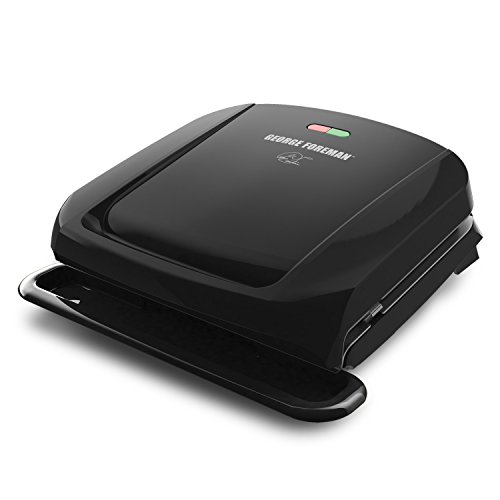
George Foreman 4-Serving Indoor Grill
Badge: Best Pressed Barbecue Shortcut
Strengths
- Two-sided contact cooking halves the clock on burgers and chicken pieces
- Grease-reducing sloped design stated in the listing, with fat moving away from the food
- Removable nonstick plates that wash properly after a greasy session
Trade-offs
- A press cannot host a shared table session or cook delicate items gently
- Four servings is the ceiling per load, so groups eat in rounds
- No open surface for eggs, loose vegetables or cheese pans
Key specs from the verified listing
- Format: Contact grill, hinged two-sided plates
- Capacity: 4 servings
- Plates: Removable nonstick plates
- Design: Grease-reducing sloped design, fast heat-up
- Controls: Simple contact-grill controls per listing
Not every barbecue is a session; some are Tuesday. The George Foreman earns its place in a barbecue guide by owning the fast end of the cookout menu: burgers with proper contact sear, chicken breasts cooked through without flipping, barbecue sandwiches pressed until the edges crisp. The sloped, grease-reducing design is the barbecue-relevant engineering — fat leaves the food while it cooks — and the removable plates answer the cleanup objection that follows any greasy menu.
The listing promises fast heat-up and grease handling, and this guide credits exactly that, without numbers attached to either. What the press cannot do defines its boundary honestly: no shared cooking, no open-plate theater, no gentle treatment for fish or soft vegetables, and a four-serving ceiling that turns a party into a queue. Within the shortcut lane it remains the reference machine — the format the contact-grill comparison in Best Indoor Contact Grills uses as its baseline — and for weeknight barbecue staples it is the quickest route in this guide from fridge to plate.
Best for: weeknight barbecue staples for up to four servings / Not suited for: hosts planning a shared tabletop barbecue session
Check on Amazon to confirm the current configuration and check the latest price on Amazon before you buy.

Ninja Sizzle Pro XL 20-Inch Griddle and Grill GX101
Badge: Largest Surface for Group Barbecue
Strengths
- 20-inch cooking surface described as 40 percent larger, the biggest area in this guide
- Ceramic nonstick plates with ProTemp IQ edge-to-edge heat for even group cooking
- Detachable ventilated lid and grease control for a working barbecue station
Trade-offs
- The largest footprint here, and the storage commitment that follows
- A premium-format machine for households that may cook for two most nights
- Open-format splatter management still falls to the cook at full loads
Key specs from the verified listing
- Format: Open griddle and grill with detachable ventilated lid
- Size: 20 inches, 40 percent larger cooking surface
- Plates: Ceramic nonstick plates
- Heat system: ProTemp IQ edge-to-edge heat
- Extras: Grease control system per listing
When the barbecue problem is volume — a family cookout, a double batch of burgers and vegetables, a brunch griddle load beside the grilled items — surface area is the whole answer, and the Sizzle Pro XL is the surface pick. Twenty inches of ceramic-nonstick plate, split between grill and griddle duties, cooks a group’s food in one layer instead of three queueing batches, and edge-to-edge heat is the listing language that matters at this size, because a big plate with cold corners is just a small plate with borders.
The ventilated lid and grease control complete the station picture: splatter partly contained, runoff managed, the cook able to work a full load without the surface drowning in its own fat. The honest limitation is domestic scale — this is the biggest appliance in the guide, and a two-person household will feel its footprint every day for the sake of occasional crowds. Buy it as the group station it is, the role the open-format guide at Best Indoor Electric Open Grills also assigns it, and it justifies itself every time the whole table eats at once.
Best for: households that barbecue for groups and need one-layer capacity / Not suited for: small kitchens cooking mainly for one or two
Check on Amazon to confirm the current configuration and check the latest price on Amazon before you buy.
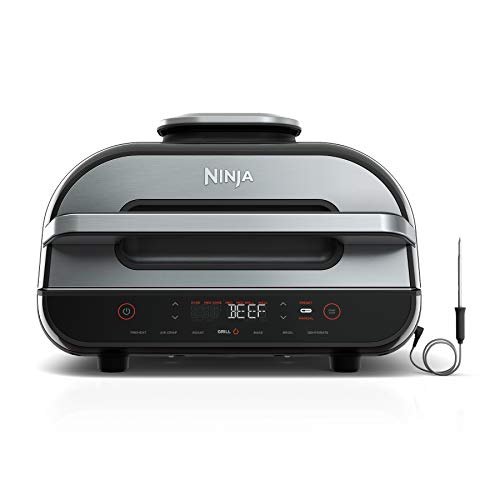
Ninja Foodi Smart 6-in-1 Indoor Grill and Air Fryer FG551
Badge: Best for Thick Barbecue Cuts
Strengths
- Built-in thermometer with Smart Cook System, the doneness tool thick cuts need
- 6-in-1 range across grilling and air frying in an XL, 4-quart format
- Enclosed lidded grilling contains splatter during fatty barbecue cooking
Trade-offs
- Enclosed cooking removes the open-table barbecue experience entirely
- A multi-cooker’s complexity and footprint for households wanting a simple plate
- Grill capacity is bounded by the enclosed cavity rather than an open surface
Key specs from the verified listing
- Format: Enclosed grill and air fryer, hinged lid
- Capacity: 4 quarts, XL capacity
- Functions: 6-in-1: grill, air fry and more
- Thermometer: Built-in, with Smart Cook System
- Doneness: Rare to well done, per listing
Thick barbecue cuts are where indoor grilling usually fails: the outside races, the center guesses. The Foodi’s answer is the built-in thermometer and Smart Cook System, which move doneness from folklore to measurement for steaks, chops and whole chicken pieces. The enclosed format suits the job — contained heat, contained splatter — and the 6-in-1 range means the same machine air fries the sides while the next batch grills, a division of labor a barbecue cook appreciates.
Judge this pick on guidance and enclosure rather than on open-plate metrics: the listing’s performance language is doneness, from rare to well done, delivered by the thermometer system, inside an XL-capacity cavity. The honest limitation is experiential — there is no shared surface, no flipping at the table, no griddle theater. Households whose barbecue is about nailing thick proteins indoors, including the beef side of Best Indoor Chicken And Beef Grills, will trade the theater gladly; session hosts should stay with the plate-swapping picks above.
Best for: cooks whose barbecue centers on thick cuts cooked to a target doneness / Not suited for: hosts who want an open shared cooking surface
Check on Amazon to confirm the current configuration and check the latest price on Amazon before you buy.

NAUQUOHZ 1700W 2-in-1 Smokeless Indoor Grill
Badge: Highest-Power Plate-Swap Pick
Strengths
- 1700 watts, the highest power stated among the plate-swapping picks
- Removable grill and griddle plates with a stated smokeless design
- Three cheese pans included for the full Korean barbecue setup
Trade-offs
- Same parts count and washing load as its 1500-watt sibling
- Power helps recovery and sear, but session pace is still set by the table
- No maximum temperature stated in the listing to compare against dial-led rivals
Key specs from the verified listing
- Format: 2-in-1 open grill and griddle, Korean barbecue style
- Power: 1700 watts
- Plates: Removable nonstick grill and griddle plates
- Design: Smokeless, stated in listing
- Extras: 3 cheese pans, dishwasher-safe parts
This is the same shared-barbecue idea as the first pick, turned up: 1700 watts behind the same removable grill and griddle plates, the same stated smokeless design, the same three cheese pans. The extra power matters in the specific rhythm of table cooking, where cold food lands on the plate constantly and recovery speed decides whether the session sizzles or steams. Households choosing between the two NAUQUOHZ models are really choosing how hard their sessions push the plate.
The listing supports a power-and-format reading and nothing more speculative: highest stated wattage in its format class here, temperature control, dishwasher-safe cleanup. The honest limitation mirrors its sibling’s — parts, pace and the absence of a stated maximum temperature — with the addition that power is not a substitute for surface area when the group is large. For energetic shared sessions on a standard table, it is the strongest plate-swap specification in the guide; for sheer area, the Ninja above it still wins.
Best for: shared-table households that cook in rapid, continuous additions / Not suited for: hosts who need maximum surface area above all
Check on Amazon to confirm the current configuration and check the latest price on Amazon before you buy.
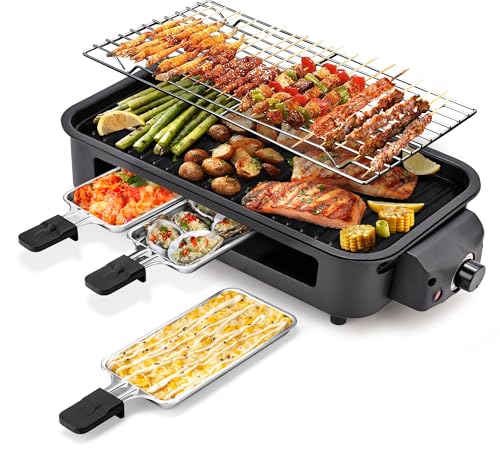
Pukomc 2-in-1 Electric Indoor Grill
Badge: Best Portable Barbecue Format
Strengths
- 1700 watts in a 2-in-1 format the listing positions for kitchen portability
- Smokeless grill net and nonstick removable plate, two cooking surfaces in the listing
- Dishwasher-safe cleanup with temperature control
Trade-offs
- A grill-net surface cooks differently from a solid plate and suits some foods better than others
- Portable scale means group sessions run in more waves
- The listing’s feature mix differs from the cheese-pan kits, so compare inclusions carefully
Key specs from the verified listing
- Format: 2-in-1 indoor grill, portable positioning
- Power: 1700 watts
- Surfaces: Smokeless grill net and nonstick removable plate
- Controls: Temperature control
- Cleaning: Dishwasher safe, per listing
The Pukomc closes the barbecue lineup as the portable expression of the 2-in-1 idea: 1700 watts, a smokeless grill net alongside a nonstick removable plate, temperature control and dishwasher-safe cleanup, in a format the listing aims at kitchen portability. For smaller homes, students of the format, and households that barbecue on a side table or a balcony-adjacent setup within their building’s rules, it delivers the session experience without the largest footprint.
The grill net is the distinctive performance fact: an open-net surface changes how heat and drippings behave compared with a solid plate, favoring foods that suit direct, open cooking and asking more care with small or delicate items that a plate would cradle. That is a genuine format difference, stated here rather than smoothed over, and it is why the comparison table separates this pick’s surfaces from the plate-swappers. As the portable, dishwasher-simple route into indoor barbecue sessions — the everyday-cooking angle is extended in Best Indoor Electric Grills For Cooking — it earns its badge honestly.
Best for: smaller households wanting a portable 2-in-1 barbecue session / Not suited for: cooks who prefer a solid plate for delicate foods
Check on Amazon to confirm the current configuration and check the latest price on Amazon before you buy.
Comparison Table
Barbecue suitability turns on four documented things: surface for the group, plate format for the menu, the fat path, and whether cooking is open, pressed or enclosed. The table keeps those facts in listing language only.
| Pick | Form | Surface and heat (from listing) | Cleaning notes (from listing) | Check |
|---|---|---|---|---|
| NAUQUOHZ 1500W 2-in-1 Smokeless Indoor Grill | 2-in-1 open grill/griddle | 1500 watts; temperature control | Removable plates; dishwasher-safe parts | Check on Amazon |
| George Foreman 4-Serving Indoor Grill | Contact press grill | 4-serving plates; fast heat-up per listing | Removable nonstick plates | Check on Amazon |
| Ninja Sizzle Pro XL 20-Inch Griddle and Grill GX101 | Open griddle/grill with ventilated lid | 20-inch surface; ProTemp IQ edge-to-edge heat | Ceramic nonstick plates; grease control | Check on Amazon |
| Ninja Foodi Smart 6-in-1 Indoor Grill and Air Fryer FG551 | Enclosed grill/air fryer | 4-quart capacity; Smart Cook System | Enclosed format; parts per listing | Check on Amazon |
| NAUQUOHZ 1700W 2-in-1 Smokeless Indoor Grill | 2-in-1 open grill/griddle | 1700 watts; temperature control | Removable plates; dishwasher-safe parts | Check on Amazon |
| Pukomc 2-in-1 Electric Indoor Grill | 2-in-1 grill with net and plate | 1700 watts; temperature control | Removable plate; dishwasher safe | Check on Amazon |
How to Choose the Best Indoor Barbecue Grills for Real Cookout Food
Decide what barbecue means at your table before comparing a single specification. If it means people cooking together, the plate-swapping 2-in-1 models are the category and the choice among them is power and inclusions. If it means feeding a group efficiently, surface area rules and the 20-inch Ninja is the honest answer. If it means thick cuts cooked precisely, the thermometer-guided Foodi is the specialist. If it means fast staples on a weeknight, the press wins. Each definition is legitimate; mixing them produces the wrong purchase.
Then audit the fat path, because barbecue food is fatty food. Removable plates that carry drippings to a wash, grease-control systems, sloped press designs — the listings name different mechanisms, and the mechanism your menu needs depends on whether you cook marinated thin cuts at a table, burgers in batches, or chops under a lid. Fat with nowhere to go becomes smoke, smell and a dirty plate, in that order.
Finally, keep the flavor boundary in view. No pick here smokes wood, builds bark or replaces a backyard pit, and sauces and rubs do more for barbecue character indoors than any appliance feature. Buy the format that fits your gathering, season generously, sear properly, and the food will taste like a cookout — which is the achievable, honest version of indoor barbecue.
- Barbecue style: Shared table, group feeding, thick-cut precision or weeknight speed — the style selects the format before any number matters.
- Surface and capacity: A 20-inch plate, a tabletop 2-in-1 surface or a 4-serving press imply different group sizes and paces. Match the listing’s format to your gathering.
- Plate system: Swappable grill and griddle plates widen the menu; a grill net changes the cooking character; a press fixes the menu to pressable foods.
- Fat management: Named trays, grease control and sloped designs are the barbecue-relevant engineering. Unnamed usually means unmanaged.
- Power and recovery: In session cooking, stated wattage — 1500 versus 1700 — predicts how the plate handles constant cold additions.
- Cleanup load: Barbecue is the messiest indoor cooking. Dishwasher-safe and removable parts decide whether the session repeats next weekend.
One planning note for hosts: a tabletop barbecue session needs the unglamorous infrastructure — a heatproof surface, an outlet the cord reaches without crossing walkways, small bowls for raw and cooked food kept separate, and tongs for more than one cook. The best grill in this guide cannot organize the table around it, and the sessions people remember are the organized ones.
How to Run an Indoor Barbecue Session, From Setup to Cleanup
A good indoor barbecue is produced by sequence more than by equipment. The routine below assumes an open plate or 2-in-1 format — the session picks — with notes where the enclosed and pressed formats differ.
- Stage the table: Set the grill on a stable, heatproof surface with raw food on one side, cooked food landing on the other, and sauces away from the hot zone. Decide the geography before the heat.
- Preheat the working plate: Bring the grill plate fully to temperature before the first item lands. Barbecue sear is a preheat story; a half-hot plate steams the first batch and sets the session’s tone badly.
- Cook in waves by thickness: Thin items and vegetables in fast waves, thicker cuts given their uninterrupted minutes. On the Foodi, let the thermometer arbitrate; on the press, respect its four-serving ceiling per load.
- Manage fat continuously: Watch the tray and the plate channels during fatty waves. A pause to empty or clear the fat path prevents the smoke that ends sessions early.
- Sauce late: Apply sweet barbecue sauces in the final minutes only. Early sauce burns on hot plates, smokes heavily and coats the surface the next wave needs.
- Close with the wash: Plates, nets, pans and trays into the sink or dishwasher while the table is being cleared. Barbecue residue left overnight is the single most common reason a session grill gets retired.
For the enclosed Foodi, the session rhythm changes rather than disappears: batches cook lid-down to the thermometer’s reading while the table handles sides and the next raw tray. Hosts often pair one enclosed batch machine with one open plate for exactly this reason, a combination the daily-cooking households in Best Indoor Electric Grills For Cooking will recognize as the two-station home setup.
Troubleshooting
Problem: the first wave steams instead of searing → what to do: The plate was not fully preheated or the first load was too wet and crowded. Dry the food, preheat completely, and open with a smaller wave.
Problem: smoke builds during fatty cuts → what to do: Empty the fat path, drop the setting a notch after the sear, and sauce later. Persistent smoke at sensible settings usually means residue from a previous session.
Problem: cheese pans scorch or stick → what to do: Lower the local heat by moving pans to the plate edge and stir as the cheese melts; the pans are small and respond fast, in both directions.
What Indoor Barbecue Cannot Do — and Why That Is Fine
Honesty first: there is no wood, no charcoal and no smoke ring anywhere in this guide, because there is no combustion anywhere in this guide. Barbecue purists are entitled to their definition, and by that definition these are grills, full stop. The counter-argument is the calendar: the households buying these machines barbecue on weeknights, in apartments, in winter, with children at the table — occasions the backyard pit never reaches. The achievable goal is grilled food with barbecue structure: sear, fat management, shared cooking and sauce at the end.
Judged on that goal, the formats here are genuinely differentiated rather than graded copies of one idea. The session machines socialize the cooking; the big Ninja industrializes it; the Foodi measures it; the press accelerates it; the Pukomc miniaturizes it. A reader who picks by their real barbecue definition will be satisfied with any of them, and a reader who picks expecting a smoker will be disappointed by all of them — which is why this section exists near the top of the decision, not buried at the bottom.
Building a Barbecue Menu Around an Indoor Plate
Menu design is the indoor barbecue skill nobody lists as a feature. Thin, marinade-friendly cuts are the session stars: sliced beef and chicken, prawns, mushrooms, peppers, onions, zucchini — foods that cook in minutes, tolerate sharing and perfume the table without overwhelming it. Thick cuts belong to the enclosed thermometer pick or to a deliberate two-stage plan: sear on the open plate, finish lid-down or resting while the table eats the thin wave.
Sides should exploit the second surface wherever the format offers one: griddle plates for flatbreads, corn and onions; cheese pans for the melted course; the air-fryer function on the Foodi for anything crisp. A menu built this way makes the appliance look versatile because it is being used the way its listing describes — and it keeps any single surface from becoming the bottleneck the whole table waits on.
- Session wave one: vegetables and flatbreads while the plate settles and guests gather.
- Session wave two: thin marinated meats, cooked in small constant batches.
- Thick cuts: thermometer-guided on the enclosed pick, or seared and rested by plan.
- Finishing: sauces and glazes in the last minutes only, cheese pans at the plate edge.
Barbecue for Two Versus Barbecue for Eight, on the Same Guide
For two, the honest picks are the press and the Pukomc: fast, small, washed in minutes, with the session scaled to a side table. The big formats still work for two, but their preheat, footprint and washing load tax a small meal, and appliances that tax small meals get skipped on small nights — which are most nights. Couples who barbecue socially twice a month and quietly twice a week should weight the quiet nights more heavily than instinct suggests.
For eight, the arithmetic reverses: surface and recovery dominate, the 20-inch Ninja becomes the station, and a second format — the Foodi batching thick cuts lid-down, or a 2-in-1 hosting the table wave — stops being a luxury and becomes the schedule. Hosts feeding eight from a single four-serving press are not being frugal; they are running a queue, and the food’s timing will say so.
Marinades, Rubs and the Indoor Plate: Where Barbecue Flavor Actually Lives
Since no machine in this guide burns wood, the barbecue flavor burden falls where it honestly belongs: on seasoning and technique. Dry rubs are the indoor cook’s best friend because they flavor without adding the liquid that steams on a hot plate; apply them early, let the surface of the meat dry in the refrigerator where time allows, and the sear — on a session plate, a big station or under the Foodi’s lid — will do the rest. Wet marinades work too, with one discipline: most of the liquid should leave the food before the food meets the plate, or the first minutes become a boil rather than a grill.
Smoke flavor, specifically, is the one note these appliances cannot supply from their own hardware, and this guide will not smuggle it in through adjectives. What a cook can do is build the surrounding flavors that make grilled food read as barbecue: char from a properly preheated plate, rendered-fat richness managed rather than feared, acidity and sweetness in a sauce applied at the end, and rest time that lets a thick cut settle. Guests tasting that combination rarely file a complaint about the absence of a pit; they ask what the rub was.
The plate-swap formats add one more flavor tool worth naming: separation. Delicate and strongly flavored items can take the griddle plate while plain cuts take the grill plate, so the menu’s loud and quiet foods do not perfume each other into sameness. Menu separation, rub discipline and sauce timing — those three habits, applied to any pick in this guide, produce more barbecue character than the difference between any two machines on the list.
Feeding a Crowd From a Countertop: a Host’s Arithmetic
Indoor barbecue hosting is an arithmetic problem before it is a cooking problem. Estimate the eating in waves: a tabletop session plate serves the table continuously but never simultaneously, a 20-inch station serves a full round at once, an enclosed machine serves batch after batch on a thermometer’s schedule, and a press serves four at a time at the fastest rate in the guide. Hosts who do this arithmetic before the guests arrive choose formats — and menus — that match; hosts who skip it discover their machine’s true capacity in front of an audience.
The menu can be engineered to forgive the format. Thin cuts, vegetables and flatbreads are wave foods that keep a session table happy indefinitely; thick cuts are batch foods that should be scheduled, rested and sliced for sharing rather than served as individual races against the clock. A host running one session machine and one batch of thick cuts through an enclosed pick is not compensating for a weakness — that two-station arrangement is how experienced indoor hosts actually work, and several households reading this guide will recognize their own best evenings in it.
Drinks, sides and seating are part of the same arithmetic: the session formats seat the cooking inside the party, while the station and enclosed formats free the host to circulate between batches. Neither social geometry is superior; they are different parties. The barbecue decision this guide keeps returning to — format first, figures second — is ultimately a decision about which party you throw.
The Two-Station Home: Pairing a Session Grill With a Batch Grill
Serious indoor barbecue households tend to converge on the same architecture, and it is worth describing for readers planning beyond a first purchase. One station socializes: a session machine at the table, cooking waves of thin cuts and vegetables while the party happens around it. The other station produces: a batch machine — the 20-inch surface, or the enclosed thermometer pick — turning out the thick cuts and the volume items on a schedule the host controls. Neither station is the backup for the other; they are halves of one system, and the six picks in this guide sort naturally into the two roles.
The pairing logic explains several otherwise puzzling buying patterns: why a household that loves its press still wants a tabletop 2-in-1, why the Foodi and a session plate coexist happily in one kitchen, why the big Ninja does not make the YOHAWJAN redundant. Each machine was answering a different half of the barbecue question. Readers choosing a first pick should therefore ask which half their household lacks — the gathering or the production — and let the answer order the badges, because a second purchase made later will almost certainly be the other half introducing itself.
Budget the unglamorous infrastructure for whichever half comes first: the heatproof surface, the outlet that reaches, the trays that separate raw from cooked, the washing route. Two-station households are not richer in equipment so much as clearer in organization, and the clarity — visible in every section of this guide’s advice — is available to a one-station household from the very first session.
Common Buying Mistakes
Expecting smoker results from an electric plate
No combustion means no wood smoke and no bark. Buy these machines for seared, shared, well-managed grilling and they deliver; buy them as pit substitutes and nothing will satisfy.
Saucing at the start
Sweet sauces burn, smoke and foul the plate for every following wave. Sauce is a finishing act indoors, always.
Ignoring the fat path until it smokes
Barbecue loads render constantly. Trays and channels need mid-session attention, not just end-of-night washing.
Buying a session format for batch hosting
A tabletop 2-in-1 feeds a gathering in waves by design. Hosts who need volume in few batches need surface — the 20-inch pick — not more session features.
Final Recommendation
Match the badge to your barbecue definition and the choice makes itself: the NAUQUOHZ 1500W 2-in-1 Smokeless Indoor Grill for Korean barbecue sessions at the table, the Ninja Sizzle Pro XL 20-Inch Griddle and Grill GX101 when one big 20-inch station must feed the group, and the George Foreman 4-Serving Indoor Grill when the cookout menu is burgers, chicken and pressed sandwiches on a weeknight clock.
The 1700W NAUQUOHZ is the energetic middle — the session format with the strongest stated power — the Foodi is the thick-cut specialist, and the Pukomc is the portable route in. Check the latest price on Amazon for your pick, confirm the included plates and pans in the current listing, and plan the table before the first session: indoor barbecue rewards the organized host.
Frequently Asked Questions
Can an indoor grill really make barbecue?
It makes grilled food with barbecue structure — sear, managed fat, shared cooking, sauce at the finish. It does not make wood-smoked barbecue, and this guide claims nothing of the kind for any pick.
Which pick is best for a Korean barbecue night?
The two NAUQUOHZ 2-in-1 models, whose listings include removable grill and griddle plates and three cheese pans for exactly that format. Choose 1700 watts for faster recovery in busy sessions, 1500 watts for the standard kit.
What is the largest cooking surface in this guide?
The Ninja Sizzle Pro XL, at 20 inches and described in its listing as a 40 percent larger cooking surface. It is the group-feeding pick for one-layer batches.
How do I stop an indoor barbecue from smoking out the room?
Preheat properly, cook in waves, empty the fat path mid-session, sauce late and ventilate. Picks whose listings state a smokeless design — both NAUQUOHZ models and the Pukomc’s grill net — are the strongest starting points.
Is a thermometer worth it for indoor barbecue?
For thick cuts, yes. The Ninja Foodi’s built-in thermometer and Smart Cook System replace guesswork on steaks, chops and chicken pieces, which is where indoor grilling most often disappoints.
Can the George Foreman really handle barbecue food?
Burgers, chicken pieces and pressed barbecue sandwiches, yes — fast and with its grease-reducing design working. It cannot host a shared session or cook delicate items gently, and the review says so plainly.


