Disclosure: topratedkitchenware.com is reader-supported. When you buy through links on our site, we may earn an affiliate commission from Amazon and other retailers, at no extra cost to you.
Where to buy
Chicken and beef make opposite demands of a grill — chicken needs even, thorough cooking without drying, beef needs a hard sear and room to rest — so the best indoor chicken and beef grills are the ones whose listings document both sides of that bargain: surface area for family loads of mixed proteins, and heat, stated as a maximum temperature or honest wattage, to sear beef while chicken cooks through. The six verified picks below are judged on exactly those listing facts, and each is linked so you can check the latest price on Amazon.
- Hamilton Beach Searing Grill with Viewing Window — Most Controlled Chicken Cooking, With Real Sear. A 118 square inch lidded grill to 450 degrees, with viewing window and PFAS-free removable surface.
- Ninja Sizzle Indoor Grill and Griddle GR101 — Hardest Sear for Beef, With a Griddle for Chicken. Heat to a stated 500 degrees on interchangeable grill and griddle plates, with a dishwasher-safe lid.
- NAUQUOHZ 1700W 2-in-1 Smokeless Indoor Grill — Best Session Power for Mixed Proteins. A 1700-watt 2-in-1 with grill and griddle plates, cooking chicken and beef in shared waves.
- Pukomc 2-in-1 Electric Indoor Grill — Most Flexible Surfaces for the Pairing. A 1700-watt 2-in-1 pairing a smokeless grill net with a nonstick plate for different proteins.
- YOHAWJAN 1500W 2-in-1 Korean BBQ Grill — Best Shared-Table Value for the Pairing. A 1500-watt Korean BBQ 2-in-1 with swappable plates and raclette pans for mixed proteins.
- Techwood 1500W Smokeless Electric Grill — Best Compact Lidded Pick for the Pairing. A 1500-watt smokeless grill with glass lid and 6-level control for contained mixed cooking.
Read the full guide ↓ for badges, honest trade-offs, a comparison table and the detail behind every pick.
A mixed grill night exposes weak appliances. The beef wants the plate at its hottest and the chicken wants time and evenness; crowd them together on a small, uneven surface and the steak steams while the chicken’s thick end lags. The best indoor chicken and beef grills solve the pairing with two documented assets: enough cooking area to give each protein its own zone, and enough heat — a stated 500 or 450 degrees where the listing gives one, or serious wattage where it gives that instead — to sear beef properly while chicken finishes safely. This guide reads all six listings through that double lens and prints only the figures the listings state.
The lineup splits by strategy. The Ninja Sizzle brings the highest stated maximum in the guide, 500 degrees, on a 14-inch interchangeable plate system. The Hamilton Beach viewing-window model brings the controlled route: 118 square inches, heat to 450 degrees and a lid that keeps chicken in even heat while its window watches the beef. The three 2-in-1 session machines — NAUQUOHZ 1700W, Pukomc and YOHAWJAN — bring area through plate systems and power at 1700 or 1500 watts, cooking mixed proteins in shared waves. The Techwood brings the compact lidded version of the bargain at 1500 watts with 6-level control.
Two disciplines govern the whole guide. Temperatures and areas appear only where a listing states them, so several spec boxes honestly compare wattage and format instead of degrees — the reader is told which is which, every time. And doneness advice stays practical: chicken is cooked through, beef is cooked to preference, and no pick is credited with a thermometer it does not list. Protein-specific depth continues in Best Indoor Electric Grills For Cooking for daily cooking, while the searing-first comparison lives in Best Indoor Electric Steak Grills.
Key Takeaways
- Chicken wants even area and contained heat; beef wants maximum sear. The right pick documents both, in its own listing terms.
- The Ninja Sizzle states the guide’s highest maximum, 500 degrees, with interchangeable grill and griddle plates.
- The Hamilton Beach pairs 118 square inches with heat to 450 degrees and a viewing-window lid for controlled mixed cooking.
- The NAUQUOHZ 1700W leads the session machines on stated power; the Pukomc matches its watts with a net-and-plate system.
- The YOHAWJAN and Techwood cover the pairing at 1500 watts, one as a shared table grill, one as a compact lidded grill.
- Where a listing states wattage instead of a maximum temperature, this guide compares wattage — it never converts or invents degrees.
In this guide
Quick Picks
Badges are protein-shaped: hardest sear, most controlled chicken cooking, strongest session power, most flexible surfaces, shared-table value and compact lidded value. The spec boxes show exactly which heat figure each listing states, so the table can be read without trusting any number twice.
| Pick | Badge | Best for | Check |
|---|---|---|---|
| Hamilton Beach Searing Grill with Viewing Window | Most Controlled Chicken Cooking, With Real Sear | Families wanting controlled, contained mixed grilling | Check on Amazon |
| Ninja Sizzle Indoor Grill and Griddle GR101 | Hardest Sear for Beef, With a Griddle for Chicken | Beef-first households that also grill chicken weekly | Check on Amazon |
| NAUQUOHZ 1700W 2-in-1 Smokeless Indoor Grill | Best Session Power for Mixed Proteins | Mixed loads cooked at a shared table | Check on Amazon |
| Pukomc 2-in-1 Electric Indoor Grill | Most Flexible Surfaces for the Pairing | Households splitting beef and chicken across two surfaces | Check on Amazon |
| YOHAWJAN 1500W 2-in-1 Korean BBQ Grill | Best Shared-Table Value for the Pairing | Couples and small households grilling the pair together | Check on Amazon |
| Techwood 1500W Smokeless Electric Grill | Best Compact Lidded Pick for the Pairing | Small kitchens cooking chicken and beef under a lid | Check on Amazon |
How These Picks Were Chosen
The audit for this keyword was a two-column read of every assigned listing: what area does it state, and what heat does it state, in what unit? The Ninja Sizzle states a 14-inch plate and 500 degrees. The Hamilton Beach states 118 square inches and 450 degrees. The NAUQUOHZ, Pukomc, YOHAWJAN and Techwood state wattages — 1700, 1700, 1500 and 1500 — with temperature or level control, and no maximum degree figure in their verified text. The guide therefore runs two honest comparison languages in parallel and never blends them: degrees where degrees are stated, watts and format where they are not.
No cooking tests are claimed and no doneness is guaranteed by any appliance; the guide compares documented capacity for the two jobs. Area decides whether chicken and beef can cook in zones or must queue. Stated heat decides the sear argument. Lids decide how evenly thick chicken finishes. Plate systems decide whether a mixed load shares one session. Those four documented factors, weighed per pick, produce the badges — and readers cross-shopping the apartment angle will find the same machines footprint-checked in Best Indoor Electric Grills For Apartments.
The 6 Best Indoor Chicken and Beef Grills
Each review treats the two proteins separately before judging the pair: how the pick handles chicken, how it handles beef, and what the combination costs. Heat figures are quoted only as their listings state them.

Hamilton Beach Searing Grill with Viewing Window
Badge: Most Controlled Chicken Cooking, With Real Sear
Strengths
- 118 square inches of area, enough to zone chicken and beef at family scale
- Adjustable control to a stated 450 degrees, the searing range both proteins use
- Viewing-window lid and PFAS-free removable surface for contained, washable cooking
Trade-offs
- 450 degrees is a strong sear, a step below the Sizzle’s stated 500-degree ceiling
- A single surface only, so the pairing shares one plate and one timing plan
- Lidded batches are sequential for large mixed loads
Key specs from the verified listing
- Format: Lidded searing grill
- Cooking surface: 118 square inches
- Maximum temperature: 450 degrees Fahrenheit
- Surface: PFAS-free removable nonstick
- Housing: Stainless steel, lid with viewing window
If the Sizzle is the beef pick, the Hamilton Beach is the chicken pick that also sears. The lid is the chicken argument: contained, even heat that finishes thick breasts and thighs through without scorching their outsides, monitored through the viewing window without dumping heat. The 118 square inches are the pairing argument: room to hold chicken in its zone while beef occupies its own, at a stated 450 degrees that browns both honestly. The PFAS-free removable surface closes the case with the wash.
The trade against the Sizzle is a single number and a format: 450 against 500 degrees at the ceiling, and a fixed lidded surface against swappable plates. For most mixed home menus, 450 degrees with a lid and area beats 500 without them, because chicken — the less forgiving protein — sets the difficulty. The honest limitation is simultaneity at scale: big mixed loads still batch. As the controlled, contained, family answer to cooking chicken and beef on one indoor grill, it closes this guide as the balanced recommendation.
Best for: families whose mixed menu is chicken-led with regular beef / Not suited for: steak purists who want the highest stated ceiling available
Check on Amazon to confirm the current configuration and check the latest price on Amazon before you buy.
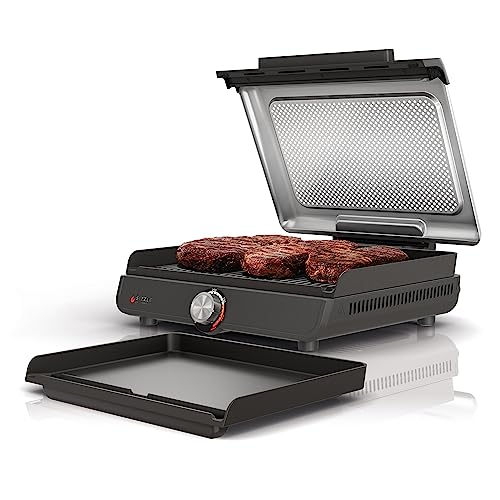
Ninja Sizzle Indoor Grill and Griddle GR101
Badge: Hardest Sear for Beef, With a Griddle for Chicken
Strengths
- Maximum temperature stated at 500 degrees, the highest in this guide
- Interchangeable grill and griddle plates divide beef searing from chicken and sides
- Edge-to-edge heat and a dishwasher-safe lid for a contained, washable routine
Trade-offs
- A 14-inch plate cooks the pairing in two zones only at modest portions
- The listing names no drip tray, so fat handling relies on plate design
- Plate swapping mid-menu means a hot-plate pause in the routine
Key specs from the verified listing
- Format: Open grill and griddle with lid
- Plate size: 14 inches
- Maximum temperature: 500 degrees Fahrenheit
- Plates: Interchangeable nonstick grill and griddle plates
- Lid: Dishwasher-safe
Beef makes the first claim on this pick: 500 degrees is the only maximum in the guide that speaks steakhouse language, and edge-to-edge heat means the sear does not depend on finding the plate’s hot spot. Chicken makes the second claim through the plate swap — the griddle surface for even, flat cooking of breasts and thighs, the grill plate when marks and drainage are wanted. For a household whose mixed menu is steak-led with chicken in regular support, the Sizzle’s documented combination is the strongest in the guide.
The performance boundary is area: 14 inches zones the pairing for two to four servings, and a full family mixed load becomes a sequence — beef seared and rested while chicken finishes, which good cooks will recognize as correct order anyway. The listing’s silence on a drip tray is noted plainly wherever this model is reviewed in this cluster, and it applies here too: fat management is plate-based. Judged on stated heat and plate intelligence, it is the beef household’s pick; judged on raw area, the Hamilton Beach beside it competes hard.
Best for: beef-first households wanting the hardest stated sear / Not suited for: large families needing maximum simultaneous area
Check on Amazon to confirm the current configuration and check the latest price on Amazon before you buy.

NAUQUOHZ 1700W 2-in-1 Smokeless Indoor Grill
Badge: Best Session Power for Mixed Proteins
Strengths
- 1700 watts, the joint-highest stated power in this guide, for recovery between protein waves
- Removable grill and griddle plates split the menu: ridged for beef, flat for chicken and sides
- Smokeless design stated in the listing for indoor mixed cooking
Trade-offs
- Heat is stated as wattage and control, not a maximum temperature, so sear comparisons stay in watts
- Session waves mean chicken and beef are sequenced, not simultaneous, at table scale
- Plates, pans and parts make the fullest wash in the session class
Key specs from the verified listing
- Format: 2-in-1 open grill and griddle, Korean barbecue style
- Power: 1700 watts
- Plates: Removable nonstick grill and griddle plates
- Design: Smokeless, stated in listing
- Extras: 3 cheese pans, dishwasher-safe parts
For households that cook chicken and beef together the social way — thin beef cuts and chicken pieces moving across a shared plate in waves — the NAUQUOHZ 1700W is the power pick. Its 1700 watts are the session statistic that matters: every cold addition of marinated chicken drops the plate temperature, and recovery speed decides whether the next beef wave sears or steams. The griddle plate earns its place in the pairing too, giving chicken skinless pieces and vegetables a flat, even surface while the grill plate handles the beef’s marks.
The listing states power, plates and a smokeless design, and the review stays inside those facts: no maximum temperature is printed for this pick because none is stated, and its sear case is made on wattage, plate format and recovery instead. The honest limitation is simultaneity — a tabletop session cooks the pairing in sequence, so a household wanting four chicken breasts and four steaks finished at the same minute should look at the large-area and lidded picks. As a mixed-protein session machine, it leads its class here.
Best for: households cooking chicken and beef together in shared waves / Not suited for: cooks who need a stated maximum temperature to make their decision
Check on Amazon to confirm the current configuration and check the latest price on Amazon before you buy.
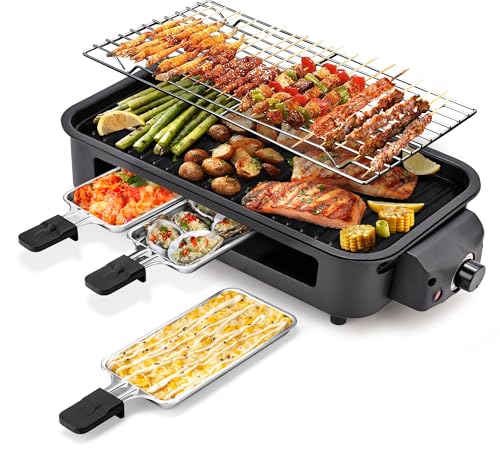
Pukomc 2-in-1 Electric Indoor Grill
Badge: Most Flexible Surfaces for the Pairing
Strengths
- Two distinct surfaces in one listing: a smokeless grill net and a nonstick removable plate
- 1700 watts matching the guide’s highest stated session power
- Dishwasher-safe cleanup after a mixed-protein session
Trade-offs
- The net suits sturdy beef cuts and vegetables; delicate chicken pieces belong on the plate
- Surface discipline is required — the wrong protein on the wrong surface underperforms
- No maximum temperature stated, so the heat story is wattage and format
Key specs from the verified listing
- Format: 2-in-1 indoor grill, portable positioning
- Power: 1700 watts
- Surfaces: Smokeless grill net and nonstick removable plate
- Controls: Temperature control
- Cleaning: Dishwasher safe, per listing
The Pukomc’s answer to the pairing is division of labor: beef and sturdy vegetables on the open grill net, where direct heat and falling drippings suit them, and chicken pieces on the solid nonstick plate, where they cook evenly without slipping or drying at the edges. At the same 1700 watts as the guide’s other power pick, it is the most surface-literate option here — the household that enjoys matching protein to surface will get more from it than from any single-plate machine.
Surface literacy is also its demand: put small chicken pieces or delicate items on the net and the format punishes the choice, a trade-off this review states rather than softens. The listing gives temperature control and dishwasher-safe cleanup to support the two-surface routine, and states no maximum temperature, so the guide compares its 1700 watts honestly against degree-led rivals. For mixed menus cooked with intent, it is the flexible pick; for set-and-forget mixed batches, the lidded Hamilton Beach in this guide is calmer.
Best for: cooks who like matching each protein to its best surface / Not suited for: households wanting one simple plate and no format decisions
Check on Amazon to confirm the current configuration and check the latest price on Amazon before you buy.

YOHAWJAN 1500W 2-in-1 Korean BBQ Grill
Badge: Best Shared-Table Value for the Pairing
Strengths
- Removable grill and griddle plates divide beef and chicken duties on one base
- Smokeless design stated in the listing for table-centered mixed cooking
- Three raclette cheese pans included, completing the shared format
Trade-offs
- 1500 watts recovers more slowly than the 1700-watt picks in heavy mixed waves
- Tabletop scale sequences a family’s chicken and beef rather than batching them
- The full kit’s wash is the session class’s usual parts count
Key specs from the verified listing
- Format: 2-in-1 Korean BBQ grill pan, portable
- Power: 1500 watts
- Plates: Nonstick removable grill and griddle plates
- Design: Smokeless, stated in listing
- Extras: 3 raclette cheese pans, temperature control
The YOHAWJAN brings the pairing to the table at the session class’s friendliest specification: 1500 watts, two removable plates and the raclette pans, in a portable format sized for couples and small households. Thin beef and chicken cooked in alternating waves is exactly the rhythm this format was built for, and the griddle plate handles the chicken-and-vegetable half of the menu while the grill plate takes the beef. For a household of two to four eating as it cooks, the pairing feels designed rather than improvised.
The power gap against the 1700-watt picks is real and bounded: it appears in long, heavy sessions as slower recovery, not in ordinary table service, and the review prices it accordingly. No maximum temperature is stated in the listing, so none is claimed; the control is temperature-based and the format is the argument. With the stated smokeless design covering the room and dishwasher-friendly parts covering the aftermath, it is the value-complete way to cook this protein pair at a table — the same conclusion the open-format analysis reaches in Best Indoor Electric Open Grills.
Best for: small households cooking the pair at the table / Not suited for: hosts running long sessions who need 1700-watt recovery
Check on Amazon to confirm the current configuration and check the latest price on Amazon before you buy.

Techwood 1500W Smokeless Electric Grill
Badge: Best Compact Lidded Pick for the Pairing
Strengths
- Tempered glass lid holds heat around chicken while beef stays visible
- 1500 watts with 6-level control, a stated range for two proteins’ needs
- Smokeless design stated in the listing, in a compact portable format
Trade-offs
- Compact area cooks the pairing in rounds rather than zones
- A single lidded surface offers no second plate for simultaneous sides
- Glass lid care is part of the ownership routine
Key specs from the verified listing
- Format: Lidded indoor grill, compact and portable
- Power: 1500 watts
- Design: Smokeless, stated in listing
- Lid: Tempered glass
- Controls: 6-level control
- Cleaning: Dishwasher safe, per listing
The Techwood cooks the pairing the contained way: chicken pieces finishing in the even, lidded heat that poultry rewards, beef searing on the same nonstick surface under a glass lid that lets the cook watch without lifting. Six control levels give the pairing its practical range — higher for the beef’s sear, settled for the chicken’s finish — and the compact, portable format with a stated smokeless design suits the small kitchens where mixed grilling for two or three is a weeknight event, not a production.
Area is the honest limit: a compact lidded surface cooks chicken and beef in rounds, and the household that needs zones should buy area instead. Within its scale, the listing’s package is coherent — power, levels, lid, smokeless design, dishwasher-safe cleanup — and the review credits it as the compact complete answer to the pairing rather than a shrunken compromise. Cooks who later want the open-table version of the same menu will find this pick’s session cousins above it in this very guide.
Best for: small households cooking the pair under a lid, in rounds / Not suited for: families needing simultaneous zones for both proteins
Check on Amazon to confirm the current configuration and check the latest price on Amazon before you buy.
Comparison Table
Read the heat column carefully: it prints degrees only where a listing states degrees, and wattage where a listing states wattage. That separation is the most useful thing in the table.
| Pick | Form | Surface and heat (from listing) | Cleaning notes (from listing) | Check |
|---|---|---|---|---|
| Hamilton Beach Searing Grill with Viewing Window | Lidded searing grill | 118 square inches, heat to 450 degrees | PFAS-free removable nonstick surface | Check on Amazon |
| Ninja Sizzle Indoor Grill and Griddle GR101 | Open grill/griddle with lid | 14-inch plate, heat to 500 degrees | Interchangeable plates; dishwasher-safe lid | Check on Amazon |
| NAUQUOHZ 1700W 2-in-1 Smokeless Indoor Grill | 2-in-1 open grill/griddle | 1700 watts; temperature control | Removable plates; dishwasher-safe parts | Check on Amazon |
| Pukomc 2-in-1 Electric Indoor Grill | 2-in-1 grill with net and plate | 1700 watts; temperature control | Removable plate; dishwasher safe | Check on Amazon |
| YOHAWJAN 1500W 2-in-1 Korean BBQ Grill | 2-in-1 Korean BBQ grill | 1500 watts; temperature control | Removable plates; pans included | Check on Amazon |
| Techwood 1500W Smokeless Electric Grill | Lidded compact grill | 1500 watts; 6-level control | Dishwasher-safe parts | Check on Amazon |
How to Choose an Indoor Grill for Both Chicken and Beef, Not a Compromise for Either
Decide which protein leads your menu, because the pairing’s picks divide on exactly that. Beef-led households should start from stated sear: the Sizzle’s 500 degrees, then the Hamilton Beach’s 450 with its lid and area. Chicken-led households should start from evenness and containment: the Hamilton Beach’s lidded 118 square inches, then the Techwood’s compact lidded version. Households that cook the pair socially, in waves, should start from the session machines and choose by stated power and surfaces.
Treat area as a timing decision. Enough area zones the proteins and finishes them together; less area sequences them, which is not a failure — beef rested while chicken finishes is sound cooking — but it must be chosen knowingly. The listings state their areas and formats in different units because the formats differ; convert them into your household’s servings and be honest about the result.
Refuse invented conversions. A listing that states 1700 watts has told you something real about recovery and pace; it has not told you a maximum temperature, and any guide that supplies one is guessing with your dinner. This guide’s spec boxes preserve each listing’s own heat language so the comparison you make is the comparison the evidence supports.
- Lead protein: Beef-led: stated maximum temperature first. Chicken-led: lid, area and evenness first. Shared-table: session format first.
- Heat language: Degrees where stated (500, 450), watts where stated (1700, 1500). Never accept a converted or implied figure.
- Area and zoning: 118 square inches zones a family pairing; 14 inches zones a smaller one; tabletop plates sequence it in waves.
- Surface system: Swappable plates, net-plus-plate, single lidded surface — each divides the two proteins’ work differently.
- Containment: Lids finish chicken evenly and contain fatty beef splatter; open plates trade containment for access and theater.
- Cleanup after mixed proteins: Chicken and beef together make the fullest wash. Removable plates and dishwasher-safe parts are decisive at week scale.
One safety habit outranks every feature in this guide: cook chicken through, rest beef as you prefer it, and keep raw poultry and its juices from the beef’s resting board and the cooked food’s side of the plate. Zone discipline on the grill — poultry in its area, beef in its own — is both a flavor and a hygiene practice, and the area-rich picks make it easiest to keep.
How to Cook Chicken and Beef Together on One Indoor Grill
The mixed grill is a scheduling problem with a delicious solution. The sequence below works on the lidded and open picks directly, and adapts to the session machines by treating each wave as a step.
- Equalize the chicken: Butterfly or pound thick breasts to even thickness before anything heats. Even chicken finishes with the beef instead of after it, and evenness is the whole timing game.
- Preheat for the beef: Bring the plate to its working high setting first. Beef sears on arrival; chicken tolerates the same start under a lid or at a settled setting once its turn comes.
- Zone the surface: Beef in the hottest area, chicken in its own zone, vegetables in the gaps. On plate-swap machines, assign the grill plate to beef and the griddle to chicken by wave.
- Sear beef, rest beef: Cook beef to just under its target and rest it, tented, while the chicken finishes. Resting is not waiting; it is the step that lets the pairing land together.
- Finish chicken through: Give chicken the final, uninterrupted minutes — lidded where the format allows — and verify thick pieces are cooked through before serving anything.
- Serve from the hot side: Plate from the grill in order: beef sliced after its rest, chicken last off and first served. Wash plates and trays promptly; mixed-protein residue is the least forgiving.
On the session machines, the same logic becomes waves: vegetables and chicken start the table, beef waves follow at full recovery heat, and the final chicken check closes the session before the cheese course. The order changes; the principles — even chicken, rested beef, verified poultry — do not.
Troubleshooting
Problem: beef steams while chicken cooks → what to do: The surface is crowded or the beef went on wet. Dry the beef, give it the hottest zone alone for its first minutes, and let the chicken’s zone be the lid’s business.
Problem: chicken finishes long after the beef → what to do: Thickness, not temperature, is the usual cause. Equalize pieces before cooking and start chicken’s thickest pieces first in the sequence.
Problem: beef is done but chicken is not, and both are cooling → what to do: Rest beef tented for the chicken’s final minutes — a proper rest is several minutes by design — and serve the chicken straight from the plate.
Degrees Versus Watts: Reading Heat Claims for Two Proteins
This keyword attracts a specific dishonesty: converting wattage into an implied temperature, or quoting a maximum temperature for a machine whose listing never states one. The six listings here divide cleanly — two state maximums in degrees, four state power in watts — and the guide preserves the divide in every spec box and comparison row. A stated 500 degrees is a sear argument. A stated 1700 watts is a recovery-and-pace argument. Both are real; neither can be traded for the other at an honest exchange rate.
For the buyer, the practical translation is menu-based. If your beef cooking is thick steaks judged by crust, the degree-stating picks give you the figure you are shopping for. If your mixed cooking is waves of marinated cuts at a table, recovery is the figure that predicts your evening, and it is denominated in watts. Choosing the right currency matters more than choosing the biggest number in the wrong one.
The Case for Two Zones, Even on One Plate
Chicken and beef differ in more than taste: poultry must be cooked through and kept apart from ready-to-eat food, while beef is served across a doneness range and benefits from rest. A single undifferentiated pile disrespects both. The area-rich picks in this guide — 118 square inches under a lid, a 14-inch two-plate system, tabletop plate pairs — all offer a version of zoning: separate areas, separate plates or separate waves, with poultry’s zone managed as the hygiene-critical one.
Zoning also solves the flavor traffic: beef fat seasoning the chicken’s corner is a pleasure in moderation and a muddle in flood, and chicken juices have no business near resting beef. Keep the zones, keep the order — chicken verified, beef rested — and a single indoor grill cooks the classic pairing the way a two-grill backyard would, at countertop scale.
- Poultry zone: even thickness, lidded finish where available, cooked through before serving.
- Beef zone: hottest area, dried surface, seared first and rested while poultry finishes.
- Shared gaps: vegetables and sides, which tolerate either zone’s timing.
- Boards and tongs: separate raw poultry handling from cooked food, on every format.
A Mixed Grill Night, Timed on Two Different Picks
On the Hamilton Beach, the night runs in one contained act: chicken pieces on first across the 118 square inches, lid down, beef added to its zone as the chicken turns, window checks instead of lid lifts, everything landing within the same few minutes and the removable surface in the sink before dessert. It is the family version of the pairing — calm, sequential, washed.
On the NAUQUOHZ 1700W, the same menu becomes a performance in waves: vegetables and chicken open the table on the griddle plate, beef waves follow on the grill plate at full recovery heat, cheese pans close the show. Nobody’s plate is filled at the same moment and nobody minds, because the cooking is the evening. Two households, two correct answers — the guide’s job is to make sure each buys the machine that matches its night.
Thickness Is the Hidden Specification
Listings state areas, watts and degrees, but the variable that decides a mixed grill night is one no listing can state: the thickness of your chicken. A two-inch breast and a one-inch breast are different dishes wearing the same name, and every timing disappointment in this category traces back to treating them as one. The equalization step in this guide’s how-to — butterfly, pound, or buy even cuts — is therefore not a tip but the foundation: it converts chicken from the schedule’s problem into its most predictable item, on every pick from the lidded Hamilton Beach to the session plates.
Beef has the mirror-image variable: cut thickness decides whether a stated maximum temperature is a searing tool or a scorching risk. Thin cuts on the Sizzle’s 500-degree ceiling need seconds of discipline; thick cuts justify the ceiling entirely, building crust while the center climbs gently. The wattage-led session picks handle thickness socially instead — thin beef is their native format, cooked in waves where thickness is measured in millimeters and timing in moments. Match the cut to the machine’s documented strength and the pairing stops being a compromise in either direction.
A household that shops for groceries with its grill in mind — even chicken, beef in the thickness its pick sears best — will outperform a household with a stronger grill and random cuts. That is the least marketable sentence in this guide and possibly the most useful one.
Marinade Traffic: Keeping Two Proteins’ Flavors Their Own
Mixed grilling mixes flavors whether you plan it or not: beef fat perfumes the chicken’s corner, chicken marinades ghost the beef’s next batch, and a sugary glaze applied early will announce itself in every following item. The zoned cooking this guide recommends is partly a flavor system — poultry in its zone, beef in its own, vegetables mediating the gaps — and the plate-swap machines literalize it, giving each protein its own surface by wave. Cooks who sequence deliberately, mild before strong and lean before fatty, taste the difference as clarity: each protein arrives tasting like itself, seasoned by the grill rather than by its neighbor.
Sauces deserve the same traffic discipline as marinades. A barbecue glaze belongs to the final minutes of whichever protein wears it, applied after the sear and away from the other protein’s zone, because burnt sugar is the loudest flavor on any plate and it does not ask permission to spread. Keep a clean brush for cooked food, keep raw marinade off finished items entirely, and the mixed grill’s flavors stay as organized as its timing — which is to say, cooked like someone meant it.
Leftovers, Reheats and the Second Life of a Mixed Grill Night
A mixed grill night should be planned with its second day in mind, because chicken and beef reheat very differently and the grill that cooked them is also the best tool for reviving them. Beef, sliced and returned briefly to a hot plate or griddle surface, recovers its seared edges in under a minute and tolerates the treatment well; chicken, reheated gently — lidded, at a settled setting, with patience — stays moist in a way that aggressive reheating destroys. The plate-swap and lidded picks in this guide quietly double as the best leftover machines in the kitchen for exactly these reasons.
Portion planning makes the second day deliberate rather than accidental: one extra chicken portion and a modest beef overage, cooked in the same zoned session, become tomorrow’s lunches without a second cooking event. Keep the proteins apart in storage as they were kept apart on the grill, sauce leftovers only when serving them, and the mixed grill’s economy compounds — one preheat, one wash, two days of meals. Households that cook the pair weekly discover this arithmetic quickly; it is a large part of why the pairing, cooked well, becomes a standing arrangement rather than an occasional event.
Two Households, Two Right Answers: a Closing Comparison
Consider the chicken-led household first: four people, poultry three nights a week, beef on Fridays, a premium on calm and cleanliness. Their guide through these six picks ends where this article’s final recommendation begins — the lidded Hamilton Beach, its window sparing the heat, its removable surface sparing the sink, its 118 square inches zoning the Friday mixed load without drama. The Sizzle tempts them with its ceiling and is respectfully declined; the session machines entertain them and are filed under someday. Their satisfaction will be high precisely because the pick matches the protein that leads their week.
Now the beef-led household: two people, steak at the center, chicken as the supporting act, crust judged severely. Their walk ends at the Sizzle’s stated 500 degrees and swappable plates, with the Hamilton Beach as the respected runner-up whose lid they will occasionally envy on chicken night. The session machines amuse them at friends’ houses and stay there. Two households, overlapping menus, opposite answers — and a guide that forced one ranking on both would have failed at least one of them. The badges in this article are protein-led because households are.
Common Buying Mistakes
Comparing a wattage pick by an invented temperature
If the listing states watts, judge watts, format and recovery. A degree figure supplied by a reviewer rather than the listing is fiction with a unit attached.
Cooking the pair in one crowded layer
Crowding steams the beef and slows the chicken simultaneously — the worst of both proteins. Zone or sequence; never pile.
Skipping the chicken equalization step
Uneven chicken is the root cause of most mixed-grill timing failures. Two minutes of pounding or butterflying before cooking saves the whole schedule.
Resting beef beside raw chicken
Rest cooked beef away from raw poultry and its juices, with clean tools. The pairing shares a grill, never a board.
Final Recommendation
For the balanced family answer, start with the Hamilton Beach Searing Grill with Viewing Window: the lidded 118 square inches, the stated 450 degrees and the viewing window cook chicken with control and beef with conviction on one removable surface. Choose the Ninja Sizzle Indoor Grill and Griddle GR101 when beef leads and the hardest stated sear — 500 degrees with swappable plates — is the priority, and the NAUQUOHZ 1700W 2-in-1 Smokeless Indoor Grill when the pair is cooked socially, in waves, at a table.
The Pukomc splits the pair across two surfaces for cooks who think in formats, the YOHAWJAN packages the table version completely, and the Techwood keeps the pairing compact and lidded. Check the latest price on Amazon for your finalist, confirm whether its listing states degrees or watts before comparing heat, and cook the first mixed night by the zoned sequence in this guide.
Frequently Asked Questions
Which pick states the highest maximum temperature?
The Ninja Sizzle, at 500 degrees Fahrenheit in its listing, on a 14-inch interchangeable plate system. The Hamilton Beach states 450 degrees; the other four listings state wattage instead, and this guide does not convert it.
Why do some spec boxes list watts instead of a temperature?
Because that is what those listings state. The NAUQUOHZ, Pukomc, YOHAWJAN and Techwood listings give power in watts with temperature or level control; inventing a maximum degree figure for them would mislead the comparison.
Can chicken and beef cook at the same time on these grills?
On the area-rich picks, yes, in zones: the Hamilton Beach’s 118 square inches is the clearest case. On session and compact picks, the pair is sequenced in waves or rounds, with beef rested while chicken finishes.
How do I keep chicken juicy on an indoor grill?
Equalize thickness, use contained or lidded heat where the format offers it, and give chicken uninterrupted finishing minutes. Dry chicken indoors is usually uneven chicken cooked on a crowded plate.
Which pick is best for steaks specifically?
The Ninja Sizzle, on its stated 500-degree ceiling and edge-to-edge heat. The Hamilton Beach at a stated 450 degrees is the controlled alternative when chicken shares the menu.
Is it safe to cook chicken and beef on the same surface?
Yes, with zone discipline: keep raw poultry and its juices separate from cooked and resting food, use clean tools for cooked items, and cook chicken through. The routine in this guide is built around those separations.


