Disclosure: topratedkitchenware.com is reader-supported. When you buy through links on our site, we may earn an affiliate commission from Amazon and other retailers, at no extra cost to you.
Where to buy
The six faucets below are the verified picks for this guide to best pull out kitchen faucets. Each linked name leads to its Amazon listing, where you can check the latest price on Amazon, confirm the current configuration and deck fit, and read the newest owner feedback before you decide. Picks shown without a link are reviewed in full below and are prose-only for the reason stated in their review.
- Moen Renzo Pullout Faucet (CA87316SRS)
- UFAUCET Kitchen Faucet with Pull Out Sprayer
- KINGO HOME Kitchen Faucet with Pull Out Sprayer
- Moen Integra Pullout Faucet (67315SRS)
- Moen Brecklyn Pull-Out Kitchen Faucet (87557W)
- Comllen Kitchen Faucet with Pull Out Sprayer
Read the full guide ↓ for the ranking logic, the honest limitations of every pick, and the checks that matter more than any headline claim.
Finding the best pull out kitchen faucets starts with a simple mechanical truth: on a pull-out faucet, the spray head is not a separate wand hanging beside the spout — it is the end of the spout itself, and it pulls toward you on a braided hose that lives under the sink. That one design decision changes how you fill pots, rinse produce, wash a sheet pan and clean the sink itself, because the water goes where your hand points it instead of where a fixed spout happens to aim.
This guide compares six verified pull-out models — three from Moen, plus UFAUCET, KINGO HOME and Comllen designs — and judges them on the things that separate a good pull-out from a frustrating one: how smoothly the wand docks back, how the hose behaves after a year of daily pulls, whether the body fits one-hole and three-hole decks, and how the finish survives a real kitchen. Every pick below is a genuine pull-out. That filter matters more than it sounds, because pull-down faucets dominate the shelves and the two styles solve different problems: a pull-down arcs over a deep sink from above, while a pull-out reaches across, into and around things at counter level.
If your sink is shallow, your cabinets sit low over the counter, or you regularly fill tall stockpots and buckets that will not fit under a high arc, the pull-out layout is usually the right answer. Readers working through the dishwasher question as well may want the companion guide to Best Pull Out Kitchen Faucets For Portable Dishwasher, which takes the same pool and examines it through an adapter-and-threads lens instead.
Key Takeaways
- All six picks are verified pull-out faucets — the spray head pulls out of the spout on a hose; no pull-down substitutes are mixed in.
- Docking and hose behaviour decide long-term satisfaction: plan a clear under-sink loop and correct counterweight placement before anything else.
- Deck pattern is the first fit filter — this shortlist spans single-hole designs and deck-plate models for 1 or 3 hole decks.
- Finish is a maintenance decision: brushed and resist-style surfaces forgive spots, chrome wipes clean, matte finishes ask for a wipe habit.
- No prices are printed in this guide because they change too often — use the check-price links on each linked pick for the live figure.
In this guide
Quick Picks
These are the six shortlisted choices for best pull out kitchen faucets, with the badge each one earns in the detailed reviews. Linked names lead to the live listing so you can check the latest price on Amazon; the comparison table further down lines the six up side by side.
| Pick | Badge | Finish (per listing) | Listing |
|---|---|---|---|
| Moen Renzo Pullout Faucet (CA87316SRS) | Best Overall | Spot Resist Stainless | Check on Amazon |
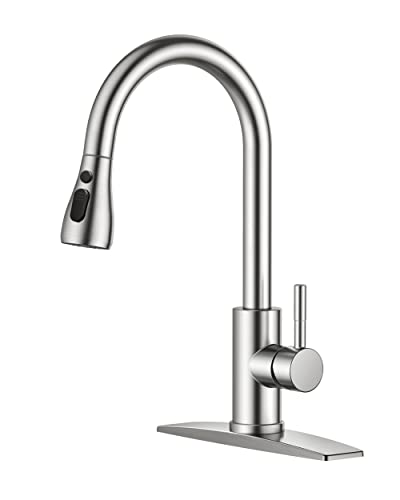
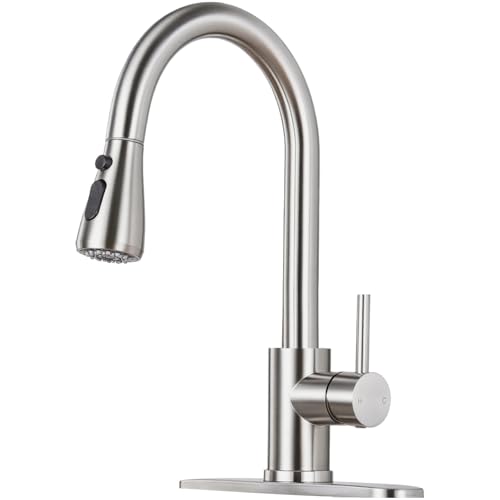
| UFAUCET Kitchen Faucet with Pull Out Sprayer | Best Certified Value | 304 stainless steel | Check on Amazon |
| KINGO HOME Kitchen Faucet with Pull Out Sprayer | Best Swivel for Small Sinks | Brushed Nickel | Check on Amazon |
| Moen Integra Pullout Faucet (67315SRS) | Best for Deck Flexibility | Spot Resist Stainless | Check on Amazon |
| Moen Brecklyn Pull-Out Kitchen Faucet (87557W) | Best White Finish | White | Check on Amazon |
| Comllen Kitchen Faucet with Pull Out Sprayer | Best for Small Sinks | Brushed Nickel stainless steel | Check on Amazon |
How These Picks Were Chosen
Every pick in this guide to best pull out kitchen faucets had to clear the same first filter: it had to be a genuine pull-out faucet, confirmed from its verified listing — spray head forming the end of the spout, pulling out on a hose. Pull-down models, however excellent, were excluded, because they solve a different problem and mixing the two is how buyers end up with the wrong geometry. Listings were then read in full for the attributes this guide is allowed to state: brand, model, finish, handle format, mounting pattern, certifications and included extras. Anything a listing did not state was left out rather than guessed, which is why some specification boxes below are shorter than others — that unevenness is the honest shape of the evidence.
The shortlist was then ranked against the work a pull-out actually does. Docking and hose behaviour came first, judged from each design’s layout: how the wand seats, how the hose must run, what can interfere with it under a typical sink. Deck flexibility came second — the pool deliberately spans single-hole designs and deck-plate models so that both common deck patterns have real options. Finish was judged third, as a maintenance decision as much as a style one, and brand support last but not least: a faucet is a ten-year appliance, and the depth of the maker’s parts and documentation network is part of the product.
A note on method and limits. This is a research-led guide: picks were verified and compared from manufacturer listings and documentation, not from a test bench in our own workshop, and no hands-on claims are made anywhere in it. Prices are deliberately absent — they move too often to print responsibly — so every linked pick carries a check-price link to its live listing instead. Where a judgement in a review goes beyond the listing, it is framed as what it is: guidance about the type of design, drawn from how pull-out faucets behave in general, ready for you to confirm against your own sink’s measurements.
The 6 Best pull out kitchen faucets, Reviewed in Detail

Moen Renzo Pullout Faucet (CA87316SRS)
Badge: Best Overall
Strengths
- Power Clean spray gives plate-clearing and pan-rinsing real force
- Spot Resist Stainless hides fingerprints and water spots between cleans
- Listed for kitchen or laundry, so one model can serve both rooms
Trade-offs
- Traditional styling will not suit a stark modern kitchen
- No deck plate is named in the listing, so check your hole pattern carefully
- White and matte-black kitchens are better served by other picks here
Key specifications (from the verified listing)
- Brand: Moen
- Model: CA87316SRS (Renzo)
- Finish: Spot Resist Stainless
- Handle: one-handle
- Spray: pullout wand with Power Clean
- Use: kitchen or laundry sink
The Renzo is the traditional pullout shape in this pool: the spray wand is the end of the spout itself, so the whole head pulls toward you on its hose. Power Clean is Moen’s name for a spray pattern built to rinse with more force than a standard aerated stream, which matters most when you are clearing plates before they go in a rack or blasting a roasting pan that sat overnight.
In daily use, judge this design by the pull-out fundamentals: the wand should draw out smoothly, the hose should follow without drama, and the head should seat home cleanly when you let it return. Its standard pullout body for kitchen or laundry use layout and single-handle (one-handle) control suit the sink types named in the verdict below; over a basin that matches them, this is a faucet that disappears into the routine, which is the highest compliment a kitchen tap can earn.
Best for: most households wanting one confident default / Not suited for: buyers whose sink, deck or finish needs contradict the trade-offs listed above

UFAUCET Kitchen Faucet with Pull Out Sprayer
Badge: Best Certified Value
Strengths
- Lead-free, NSF certified construction leads the listing — verification is easy
- 304 stainless steel throughout, a durable material choice at this tier
- Deck plate covers 1 or 3 hole decks, easing replacements
Trade-offs
- Value-brand support and parts networks are thinner than the majors’
- Low profile limits clearance under the spout for tall items at the tap
- Listing is light on spray-pattern detail beyond the pull-out function
Key specifications (from the verified listing)
- Brand: UFAUCET (Ufaucet)
- Material: 304 stainless steel
- Certification: lead-free, NSF certified (per listing title)
- Handle: single handle
- Profile: low profile
- Mounting: deck plate for 1 or 3 hole
- Use: kitchen, RV, laundry or bar sink
The UFAUCET entry is the certification-led pick in this pool: the listing title leads with lead-free NSF certification and 304 stainless steel rather than a designer finish. Its low-profile body is the reason it keeps appearing in RV, laundry and bar-sink conversations as well as ordinary kitchens.
Where this pick earns or loses its place in a shortlist for best pull out kitchen faucets is the accumulation of small behaviours: how the finish treats a day of wet hands, how the handle feels at low flow when you are filling a glass rather than a pot, and how little thought the docking asks of you. On the evidence of its listing, its strengths are the ones itemised above — and its trade-offs are stated just as plainly, because a faucet you choose with open eyes stays chosen.
Best for: buyers who weight certification and deck flexibility / Not suited for: buyers whose sink, deck or finish needs contradict the trade-offs listed above

KINGO HOME Kitchen Faucet with Pull Out Sprayer
Badge: Best Swivel for Small Sinks
Strengths
- Stated 180-degree swivel spout covers a single basin side to side
- Lead-free stainless steel with NSF certification in the listing
- Deck plate for 1 or 3 hole decks plus low profile suits tight installs
Trade-offs
- Value-brand long-term parts availability is less proven than Moen or Delta
- Low profile means tall pots fill by wand, not under the spout
- Brushed nickel shows more water evidence than resist-style finishes
Key specifications (from the verified listing)
- Brand: KINGO HOME
- Material: lead-free stainless steel
- Finish: Brushed Nickel
- Handle: single handle
- Spout: 180-degree swivel, low profile
- Certification: NSF certified (per listing title)
- Mounting: deck plate for 1 or 3 hole
- Use: kitchen, RV, laundry or bar sink
KINGO HOME pairs the same low-profile, deck-plate formula as the other compact picks with one detail worth underlining: a stated 180-degree swivel spout. On a pull-out faucet the swivel and the hose work as a team — the spout swings to one side of the basin while the wand covers the other — and a half-circle swing is what most single-basin sinks actually need.
Fit notes matter as much as features here. Confirm the deck pattern and thickness against the listing before ordering, plan the under-sink loop so the hose and counterweight travel freely, and — if your household’s water is hard — adopt the spray-face soaking habit from the start. Do those three things and this design’s listed strengths are what you will actually experience; skip them and even the best-made pull-out in this pool will feel like a compromise.
Best for: small sinks and tight clearances / Not suited for: buyers whose sink, deck or finish needs contradict the trade-offs listed above

Moen Integra Pullout Faucet (67315SRS)
Badge: Best for Deck Flexibility
Strengths
- Optional deckplate makes one faucet fit single-hole and wider decks
- Power Clean spray plus Spot Resist Stainless is the full Moen recipe
- Kitchen or laundry listing suits standardising across two rooms
Trade-offs
- Deckplate flexibility adds a part to fit and align at install
- Spot Resist finish still wants a soft cloth, not abrasives
- Traditional body lines will not flatter a minimal modern kitchen
Key specifications (from the verified listing)
- Brand: Moen
- Model: 67315SRS (Integra)
- Finish: Spot Resist Stainless
- Handle: one-handle
- Spray: pullout wand with Power Clean
- Mounting: optional deckplate
- Use: kitchen or laundry sink
The Integra sits a step above the Renzo in Moen’s pullout line-up as presented in these listings: same Spot Resist Stainless and Power Clean pairing, with an optional deckplate that lets one faucet cover a single-hole install today and a wider-spread deck later. That flexibility is its real selling point for anyone replacing an older three-hole faucet without changing the sink.
In daily use, judge this design by the pull-out fundamentals: the wand should draw out smoothly, the hose should follow without drama, and the head should seat home cleanly when you let it return. Its pullout body with optional deckplate layout and single-handle (one-handle) control suit the sink types named in the verdict below; over a basin that matches them, this is a faucet that disappears into the routine, which is the highest compliment a kitchen tap can earn.
Best for: decks that may change and two-room standardising / Not suited for: buyers whose sink, deck or finish needs contradict the trade-offs listed above

Moen Brecklyn Pull-Out Kitchen Faucet (87557W)
Badge: Best White Finish
Strengths
- The pool’s only white finish — right for farmhouse and white-sink kitchens
- Power Clean spray matches the metal Moen picks’ rinsing force
- Full pull-out wand in a finish category with very few pull-out options
Trade-offs
- White finishes ask for gentle, non-abrasive cleaning only
- No Spot Resist treatment — this is the finish-first Moen choice
- Listing gives less mounting detail than the Renzo and Integra entries
Key specifications (from the verified listing)
- Brand: Moen
- Model: 87557W (Brecklyn)
- Finish: White
- Spray: pull-out wand with Power Clean
The Brecklyn is the pool’s finish outlier: white, in a field of stainless, chrome and nickel. That is precisely why it earns a place. Farmhouse and cottage kitchens, white composite sinks and older homes with white appliances are poorly served by the all-metal look, and a white pull-out with Power Clean is a genuinely short list to shop from.
Where this pick earns or loses its place in a shortlist for best pull out kitchen faucets is the accumulation of small behaviours: how the finish treats a day of wet hands, how the handle feels at low flow when you are filling a glass rather than a pot, and how little thought the docking asks of you. On the evidence of its listing, its strengths are the ones itemised above — and its trade-offs are stated just as plainly, because a faucet you choose with open eyes stays chosen.
Best for: kitchens whose finish brief rules out plain metal / Not suited for: buyers whose sink, deck or finish needs contradict the trade-offs listed above

Comllen Kitchen Faucet with Pull Out Sprayer
Badge: Best for Small Sinks
Strengths
- Sized for small kitchen sinks — proportions match compact basins
- Low profile keeps splash down over shallow bowls
- Single hole with deck plate covers the common small-sink patterns
Trade-offs
- Too small in presence and reach for a large family basin
- Value-brand documentation is thinner than the major brands’
- Brushed nickel needs regular wiping to stay its best in hard water
Key specifications (from the verified listing)
- Brand: Comllen
- Material: stainless steel
- Finish: Brushed Nickel
- Handle: single handle
- Profile: low profile, for small kitchen sinks
- Mounting: single hole, deck plate included in listing description
Comllen aims squarely at the small-sink end of the market: the listing describes a low-profile, single-hole faucet with a deck plate, sized for small kitchen sinks. In a galley kitchen, a bar sink or a compact apartment run, that restraint is the feature — a full-size pull-out can overwhelm a small basin and splash water everywhere the moment the spray opens.
Fit notes matter as much as features here. Confirm the deck pattern and thickness against the listing before ordering, plan the under-sink loop so the hose and counterweight travel freely, and — if your household’s water is hard — adopt the spray-face soaking habit from the start. Do those three things and this design’s listed strengths are what you will actually experience; skip them and even the best-made pull-out in this pool will feel like a compromise.
Best for: compact basins and second sinks / Not suited for: buyers whose sink, deck or finish needs contradict the trade-offs listed above
Comparison Table
The six picks side by side on the attributes their listings actually state. Prices and ratings are deliberately absent — prices move, and the live listing is the only honest place for either.
| Pick | Badge | Finish | Handle | Profile / mounting notes | Listing |
|---|---|---|---|---|---|
| Moen Renzo Pullout Faucet (CA87316SRS) | Best Overall | Spot Resist Stainless | single-handle (one-handle) | standard pullout body for kitchen or laundry use | Check on Amazon |
| UFAUCET Kitchen Faucet with Pull Out Sprayer | Best Certified Value | 304 stainless steel | single handle | low profile | Check on Amazon |
| KINGO HOME Kitchen Faucet with Pull Out Sprayer | Best Swivel for Small Sinks | Brushed Nickel | single handle | low profile with 180-degree swivel spout | Check on Amazon |
| Moen Integra Pullout Faucet (67315SRS) | Best for Deck Flexibility | Spot Resist Stainless | single-handle (one-handle) | pullout body with optional deckplate | Check on Amazon |
| Moen Brecklyn Pull-Out Kitchen Faucet (87557W) | Best White Finish | White | single-handle pull-out control (per listing family) | pull-out body in a white finish | Check on Amazon |
| Comllen Kitchen Faucet with Pull Out Sprayer | Best for Small Sinks | Brushed Nickel stainless steel | single handle | low profile, sized for small kitchen sinks, single hole with deck plate | Check on Amazon |
How to Choose the Right Faucet for Best pull out kitchen faucets
Start with geometry, because it cannot be changed later. Measure your basin’s depth and width, the distance from the faucet hole to the backsplash, and the height of anything above the sink — cabinets, shelves, a window sill. A pull-out’s low-to-moderate spout suits most of these constraints, but the handle’s swing needs its arc of clear space, and the wand’s travel should cover your basin’s corners plus a pot’s width on the counter beside it. If your measurements fight every standard body, the low-profile picks in this guide exist for you.
Next, the deck. Count holes and measure their spread. A single-hole sink accepts any single-hole design directly; a three-hole sink wants a deck plate that genuinely covers the outer holes or a plan for them — a dispenser, as one pick here bundles, being the neatest. Check deck thickness against the faucet’s mounting range, especially with thick stone or a rear undermount ledge, and look under the sink before ordering: the hose loop needs a clear vertical run, and the counterweight needs travel room that a disposal, a filter housing or a pull-out bin can easily steal.
Then judge the spray as a tool, not a feature list. Most daily work is a coherent stream for filling and a rinsing spray for clearing; extra modes earn their place only if your cooking generates the work for them — heavy pan-blasting, gentle produce rinsing, or the sink-washdown habit. Force is not free: over a shallow basin, an aggressive spray is splash wearing a costume. Match the spray’s character to your basin’s depth and your household’s actual dishes, and prefer the faucet whose ordinary mode is the one you will use ninety percent of the time.
Finish deserves a colder eye than showrooms encourage. Ask how the surface treats your water and your habits. Brushed and resist-style finishes forgive spots and fingerprints; chrome stays bright and wipes clean but shows every splash until you wipe it; matte finishes are design statements that bill you in wipe-downs. None is best in the abstract — the best finish is the one your household’s real cleaning rhythm keeps handsome, in your water, at your sink.
Finally, think in years. A faucet’s moving parts — cartridge, hose, counterweight, spray face — are wear items, and the difference between brands is often simply how findable those parts and their instructions are in year five and year ten. Favour makers who publish documentation, name their models clearly and support their lines; the picks in this guide were filtered with that bias applied throughout. Buy the faucet whose tenth year you can picture maintaining, not just whose first week photographs best.
How to Install and Look After a Pull-Out Faucet
Installing a pull-out faucet follows the same rhythm as any single-handle faucet, with extra care at the hose. The outline below is the standard sequence; your model’s manual governs the details, and older plumbing that fights back is a plumber’s job, not a perseverance test.
One: clear and prepare. Empty the cabinet, lay down a towel and a tray, turn off both supply stops and open the old faucet to drain pressure. Photograph the existing connections before touching them — the photo is your reassembly map if anything surprises you. Two: remove the old faucet, clean the deck to bare, sound surface, and dry-fit the new faucet or its deck plate to confirm hole coverage before any sealant or tightening. Three: mount the body, working underneath with a basin wrench where the maker specifies, snug rather than forced — over-torqued mounting nuts crack decks and distort seals.
Four: connect supplies and the hose. Attach hot and cold lines to the correct stops, hand-tight plus the tool finish the manual specifies, then route the pull-out hose in a smooth loop with the counterweight fitted at the loop’s lowest point exactly as the manual diagrams. Keep the loop clear of the disposal, stop valves and anything stored in the cabinet — this routing is the single biggest determinant of how the faucet docks for the next decade. Five: flush and test. Remove or open the spray head as directed, run both temperatures to clear debris, check every joint dry with a fingertip, then work the wand through twenty full pulls, confirming it seats fully and unaided every time.
Care is mostly mineral management. Wipe the spray face weekly and soak it in a vinegar solution when the pattern distorts — distorted jets are scale, not failure. Keep the wand seat clean so docking stays flush. Under the sink, glance at the hose loop monthly: it should hang free, the weight unobstructed, no joint showing moisture. Use only soft cloths and gentle cleaners on finishes; abrasives void more warranties and dull more surfaces than any other household habit.
Problem: the wand retracts weakly or sits crooked → check the under-sink loop first: a snagged hose or a slipped or obstructed counterweight causes most cases; clear the loop, refit the weight at the loop’s lowest point, and retest. Problem: the spray pattern sprays sideways or sputters → mineral build-up in the spray face; soak the head in vinegar solution, rinse, and brush the nozzles gently. Problem: a slow drip at the base or a weeping connection → close the stops, dry everything, and identify the exact joint; a supply connection usually needs its specified snug finish, while a drip from the spout itself points to the cartridge, a documented, replaceable part on every major-brand pick in this guide.
Pull-Out vs Pull-Down: Getting the Geometry Right Before You Buy
The most expensive faucet mistake in this category is buying the wrong pull geometry, so it is worth settling before finishes and brands. A pull-down faucet has a tall, high-arc spout; the wand pulls down into the sink. It is excellent over deep farmhouse and workstation basins, and poor anywhere the arc does not fit — under low cabinets, in front of a window with a shallow sill, or over a shallow sink where the wand barely clears the rim before it is already pointing at the basin floor. A pull-out faucet keeps a lower, longer spout and the wand pulls out and toward you, travelling horizontally as much as vertically. Over a shallow or standard-depth sink, that horizontal reach is what lets you fill a pot sitting on the counter beside the sink, rinse the far corners of the basin, and wash a dog in a laundry tub without a separate sprayer.
Reach is the second half of the geometry. Pull-out hoses are typically longer in usable travel than pull-down hoses because the design expects the wand to leave the sink entirely. When you compare listings, treat any reach claim as a prompt to check two physical things after install: the hose loop under the sink must hang free without catching on shut-off valves or a disposal, and the counterweight must be able to slide its full travel. A pull-out that snags under the sink will feel broken within a month even if the faucet itself is well made, which is why the installation section of this guide spends as much time under the sink as above it.
Finally, consider who uses the sink. A pull-out wand is operated one-handed, at waist height, with the handle beside it — an arrangement many cooks find easier with full or wet hands than reaching up to a high-arc handle. Households washing up for someone with limited grip strength often land on pull-outs for exactly that reason. The six picks in this guide were all checked against that everyday-use lens, not just their specification sheets. Shoppers comparing phrasing variants of the same search will find the same pool examined from a sink-fit angle in the guide to Best Pull Out Kitchen Sink Faucets.
Low-Profile Bodies, Laundry Tubs and the Second-Sink Question
Three of the six picks here — the UFAUCET, KINGO HOME and Comllen models — are deliberately low-profile designs, and two of the Moen models are explicitly listed for kitchen or laundry use. That overlap points at a real pattern: the pull-out is the natural faucet for the second sink. Laundry tubs are deep, wide and used for soaking, filling buckets and rinsing things that never enter a kitchen sink, and a low pull-out body with a long hose does all of it without the tall arc that would collide with laundry-room shelving. Bar sinks, RV galleys and prep sinks follow the same logic at smaller scale.
If you are buying for a second sink, weight the decision differently than for a main kitchen. Deck flexibility matters more than finish theatre, because second sinks come in every hole pattern ever drilled. Hose behaviour matters more than spray glamour, because the wand will spend its life travelling. And a finish that hides water spots — brushed and Spot Resist style finishes over mirror chrome — saves real cleaning time in a room nobody polishes for guests. The detailed reviews below flag, for each pick, whether its strengths point at a main kitchen or a hard-working second sink.
A word about water pressure, because it quietly shapes every pull-out experience. These faucets are designed around typical household pressure, and both extremes announce themselves: very high pressure makes sprays lively to the point of splash over shallow basins, while low pressure stretches filling times and weakens rinsing. If your home sits at either extreme, a pressure check at an outside tap tells you more about your future faucet happiness than any feature list, and a regulator is a whole-house fix that no faucet choice can substitute for.
Consider the two-sink household as a planning unit. Many homes run a main kitchen sink and a secondary basin — laundry, bar, prep or utility — and the pull-out is the rare faucet type that serves both credibly. Standardising on one model or one brand across the two rooms simplifies spares, cartridges and know-how, and several picks in this guide are explicitly listed for kitchen and laundry use. Where the rooms’ decks differ, a deck-plate model is usually the bridge that lets one choice cover both.
Renters deserve a specific note. A faucet swap is one of the highest-impact reversible upgrades in a rented kitchen, provided the landlord agrees and the original faucet is stored safely for reinstatement. The winning renter profile is a deck-plate, single-handle pull-out in a forgiving finish: it fits the commonest decks, needs no drilling, and leaves no trace when removed. Keep every part of the old faucet, bagged and labelled, and photograph the under-sink arrangement before you begin.
If your kitchen has a window directly behind the sink, add one measurement to the standard list: the handle’s full swing against the sill and any blind or plant that lives there. Pull-out handles typically swing in a modest arc, which is one reason the style suits window sinks better than tall high-arc designs — but modest is not zero, and a handle that kisses the sill twice a day will mark both. The low-profile picks in this guide minimise the risk; measuring eliminates it.
Think about who else uses the sink before finalising a handle choice. Single-handle pull-outs concentrate all control in one lever worked with a wrist or the back of a hand, which suits cooks mid-recipe and anyone with limited grip. The handle’s position — atop the body or beside it — changes the wet-hand experience more than most buyers expect, and it is worth miming your usual motions at the showroom or over your current sink before deciding that any single-handle layout will do.
Hard water is the silent variable in faucet ownership. It scales spray faces, spots finishes and stiffens cartridges over years. If your water is hard, weight the forgiving finishes — chrome and brushed or resist-treated surfaces — and adopt the vinegar-soak habit for the spray head from month one rather than year three. None of the picks in this guide is immune to scale; the difference is how gracefully each finish and spray face ages under it, and the reviews note that where the evidence allows.
A pull-out faucet changes how a sink gets cleaned, and the change is worth planning around. With a wand that reaches every corner, the nightly washdown takes seconds and needs no separate sprayer bottle or cup-and-splash routine. Households that adopt the habit find the sink stays fresher with less weekly scrubbing — a small, compounding benefit that never appears in a specification table but shows up in every long-term owner’s account of why they would buy the style again.
Finally, a note on sequencing a wider kitchen refresh. If counters, sink or cabinets are also changing within a year or two, let those decisions lead: sink choice fixes hole pattern and basin depth, counters fix deck thickness, and the faucet should be chosen last, against the finished measurements. Buying the faucet first and designing around it inverts the dependency and is a reliable way to end up with a good faucet that fits nothing. This guide’s checks are written to be re-run against the final kitchen, not just the current one.
Spray modes deserve a sober paragraph of their own. Most pull-out owners live on two settings — a stream for filling and a spray for rinsing — and treat any third mode as an occasional guest. That is not a failure of curiosity; it is the shape of kitchen work. When comparing picks, weight the quality of the two everyday modes over the count of modes: a stream that runs true without sputter and a spray whose pattern matches your basin will satisfy you daily, while an exotic mode you use monthly cannot rescue a poor everyday pair.
The cartridge is the faucet’s heart and its most likely long-term service item. It is the part that mixes hot and cold and eventually, after years of mineral exposure, may stiffen or weep. Every major-brand pick in this guide sits behind a maker that documents and sells its cartridges; that documentation is part of what a brand premium buys. Before ordering, a two-minute check that your shortlisted model’s cartridge is listed and findable is the cheapest insurance in the whole purchase.
Read warranty language like an owner, not a shopper. The questions that matter are narrow: what is covered on the finish, what on the cartridge and hose, and what does claiming actually require — a receipt, a photo, a phone call? Makers differ more in claim experience than in headline terms. This guide does not print warranty terms for individual picks because they change and vary by region; the live listing and the maker’s own page are the authoritative texts, and they are worth the five minutes before a ten-year purchase.
If a garbage disposal shares your cabinet, plan the hose loop around it explicitly. The loop should hang on the opposite side from the disposal body where the cabinet allows, clear of the disposal’s power cord and the dishwasher drain line, with the counterweight’s travel crossing none of them. Disposal vibration travels through anything the loop touches, and a loop resting against the unit will buzz, wear and eventually chafe. Ten minutes of routing at install prevents the entire category of complaint.
Supply lines are the unphotographed half of every faucet install. Modern faucets commonly arrive with integrated or included supplies, but their length and end fittings must meet your stop valves where they actually are — not where the plan assumed. Measure from the faucet’s mounting point to each stop before ordering, and budget for new stops if yours are corroded or of an older pattern. A faucet install that stalls over a mismatched supply line is a rite of passage best skipped.
Deck plates look simple and are widely misunderstood. A plate covers holes; it does not move them, strengthen a weak deck, or forgive a spread wider than its footprint. Measure the outer holes centre-to-centre and compare against the plate’s stated coverage, and check what the plate’s underside will meet — raised sink rims and rear ledges can tilt a plate enough to break its seal line. Where a plate will not sit honestly, the single-hole designs in this guide, with spare holes given to a dispenser or caps, are the cleaner answer.
Common Buying Mistakes
Buying the geometry before measuring the sink. A pull-out suits most kitchens, but handle swing, spout clearance and hose travel are measurements, not hopes. Five minutes with a tape eliminates the commonest return in this category.
Ignoring the under-sink cabinet. The hose loop and counterweight need a clear run; a cabinet crammed against them manufactures docking complaints that get blamed on the faucet. Plan the cabinet as part of the install. Readers cross-checking the neighbouring shortlists will find the same warnings applied in the guide to Best Pull Out Out Kitchen Faucets.
Choosing a finish your habits cannot keep. Matte and mirror finishes are honest about their upkeep; brushed and resist finishes forgive. Mismatching finish to cleaning rhythm is how a beautiful faucet looks tired in a year.
Assuming adapters and accessories are universal. Threads, deck plates and dispenser fittings vary by model and maker. Verify the specific fitting for the specific faucet — in writing where an appliance connection is involved — rather than trusting that things generally fit. Readers cross-checking the neighbouring shortlists will find the same warnings applied in the guide to Best Pull Pout Kitchen Faucets.
Over-tightening during installation. Mounting hardware wants snug, not heroic. Forced nuts crack decks, distort seals and create the leaks owners then chase for months.
Judging by the first pull. Showroom docking is meaningless; what matters is the loop, weight and seat working together at home. Run the twenty-pull test in the first week, while adjustments are easy and returns are still possible.
Final Recommendation
If you buy one faucet from this guide, make it the first pick: the Moen Renzo Pullout Faucet (CA87316SRS). It earns the top badge — Best Overall — because it covers the widest range of sinks, decks and households in this pool with the fewest compromises, and its listing gives a buyer the most to verify with confidence.
Shortlist position 1 — the Moen Renzo Pullout Faucet (CA87316SRS) (Best Overall): Check on Amazon for the live listing and current configuration.
Shortlist position 2 — the UFAUCET Kitchen Faucet with Pull Out Sprayer (Best Certified Value): Check on Amazon for the live listing and current configuration.
Shortlist position 3 — the KINGO HOME Kitchen Faucet with Pull Out Sprayer (Best Swivel for Small Sinks): Check on Amazon for the live listing and current configuration.
Beyond the top three, choose by your constraint, not by rank: the pick whose deck pattern matches without adaptation, whose profile matches your basin, and whose finish matches your cleaning habits will serve you better than a higher-ranked faucet that fights any of the three. Every pick in this guide is a genuine pull-out with a defensible case — the final choice is about fit, and fit is measurable before you spend anything.
Frequently Asked Questions
What is the difference between a pull-out and a pull-down kitchen faucet?
On a pull-out faucet the spray head is the end of a lower, longer spout and pulls out toward you on its hose, travelling horizontally. On a pull-down faucet the wand pulls down from a tall high-arc spout into the basin. Pull-outs suit shallow sinks, low cabinets and filling pots on the counter; pull-downs suit deep basins where you work mostly inside the sink.
How long should a pull-out faucet hose be?
What matters is usable travel, not a headline number: the wand should reach every corner of your basin and a pot on the counter beside the sink, and the hose loop under the sink must hang and slide freely. If the loop catches on valves or the disposal, even a long hose feels short and docks badly.
Can one pull-out faucet fit both 1-hole and 3-hole sinks?
Often, yes. Several picks in this guide — including the UFAUCET, KINGO HOME and FORIOUS-style deck-plate designs elsewhere in the pool and Moen’s Integra with its optional deckplate — use a deck plate to cover extra holes. Check the listing for your exact hole pattern before ordering, and measure your deck thickness as well.
Why does my pull-out wand not stay docked?
The usual causes are under-sink, not in the wand: a hose loop snagged on a valve or disposal, a counterweight fitted too high or too low on the hose, or a weight that has slipped. Clear the loop, refit the weight at the lowest point of the loop as the manual describes, and docking usually recovers without parts.
Is a pull-out faucet good for a laundry tub?
It is one of the best fits. Two Moen picks in this guide are listed for kitchen or laundry use, and the low-profile certified models suit utility sinks as well. The long hose fills buckets on the floor, rinses soaking loads and washes large items that a fixed spout cannot reach.
How do I stop a pull-out spray head from splashing?
Splashing usually means the spray pattern is too aggressive for a shallow basin or the wand is held too high. Use the gentler stream for shallow work, hold the wand closer to the surface, and keep the aerator or spray face clean — mineral build-up distorts the pattern and throws stray jets sideways.