Disclosure: topratedkitchenware.com is reader-supported. When you buy through links on our site, we may earn an affiliate commission from Amazon and other retailers, at no extra cost to you.
Where to buy
This guide to best immersion blenders cooks illustrated is built around six verified picks, each documented from its own Amazon listing so you can check the latest price on Amazon and confirm the current configuration before you decide. The shortlist below reflects this guide’s angle — recipe-testing criteria in the Cook’s Illustrated tradition — again, applied openly, never borrowed as endorsement — and every name links to the listing used for this review.
- Turelar Immersion Blender 1100W 5-in-1 Set — Best Overall on Recipe-Test Criteria. Check on Amazon for the current listing details.
- MasterChef Immersion Blender 400W — Best Straightforward Pick. Check on Amazon for the current listing details.
- Ganiza Immersion Blender 5-in-1, Max 1000W — Best Accessory Kit. Check on Amazon for the current listing details.
- Vitamix 5-Speed Immersion Blender Bundle — Best Premium Pick. Check on Amazon for the current listing details.
- KitchenAid Variable Speed Hand Blender with Attachments KHBV83 — Most Versatile. Check on Amazon for the current listing details.
- Bonsenkitchen Immersion Hand Blender — Best Minimalist Pick. Check on Amazon for the current listing details.
Read the full guide ↓ for the evidence behind each badge, the honest limitations of every pick, and the checks that matter more than any headline claim.
Finding the best immersion blenders cooks illustrated is really a search for a tool that disappears into your cooking: powerful enough for the jobs you actually make, controlled enough not to redecorate the kitchen, and quick enough to clean that you reach for it without thinking. This guide compares six verified immersion blenders side by side, states plainly what each product title does and does not prove, and gives every pick a full review — strengths, trade-offs, a spec box drawn only from its listing, and a clear statement of who should skip it. If you are weighing neighbouring searches at the same time, our guide to Best Immersion Blenders For Liqued Soap Making covers the closest overlapping question.
The boundary comes first, as it should: this guide is not Cook’s Illustrated, it does not reproduce their test results, and no pick below is presented as their recommendation, their winner or their tested choice. Cook’s Illustrated built its reputation on recipe-driven equipment testing — tools judged by whether the food comes out right, batch after batch, with failures explained rather than hidden — and this guide borrows that discipline as a lens: defined recipes as the standard, texture as the verdict, and design details examined for how they change the cooking, not how they photograph.
That recipe-first lens reorders this pool in instructive ways. A stated 1100W with trigger control, like the Turelar set, gets examined for delicate sauces as carefully as for power, because recipes punish excess speed as surely as weakness. The MasterChef’s turbo boost is judged as a finishing tool for specific textures. Attachments are weighed by the recipes they unlock — a chopper for a soffritto base, a whisk for hollandaise-adjacent work — and every claim in every review traces back to a title’s stated facts, because a testing tradition that invents results is not a tradition worth borrowing.
What follows is organised the way careful shoppers actually decide: key takeaways first, then the quick picks, the method behind them, and the detailed reviews. After that come a comparison table, a full buying guide, a practical how-to layer with troubleshooting, guidance specific to this keyword’s angle, the mistakes that waste the most money, and a final recommendation with the questions buyers ask most. Nothing in this guide relies on a fixed price or a fixed rating figure, because both change; what does not change is the design evidence in each listing, and that is what the rankings rest on.
Key Takeaways
- Start with control, not wattage: for best immersion blenders cooks illustrated, the speed system decides how usable any motor feels at the pot.
- Our first-listed pick, the Turelar Immersion Blender 1100W 5-in-1 Set, earns its place on the balance of its stated evidence — 1100W, stated in the title — the highest figure in this pool.
- Where a title states no wattage, this guide says so; undocumented power is treated as unknown, never upgraded by reputation.
- Reach matters: stated 8-inch arms and shafts keep the blade guard submerged and your hand clear of steam in a full pot.
- Attachments are worth paying for only when they match your week — choppers for small prep, whisks for eggs and cream, beakers for small batches.
- Technique beats specification: submerged guard, gentle start, slow passes and short bursts will improve any pick in this guide.
In this guide
Quick Picks
All six picks at a glance. Badges are used identically here and in the detailed reviews, and each row links to the same Amazon listing documented in this guide’s sources.
| Pick | Badge | Why it stands out | Listing |
|---|---|---|---|
| Turelar Immersion Blender 1100W 5-in-1 Set | Best Overall on Recipe-Test Criteria | Trigger variable speed; 1100W motor evidence; Food processor attachment; whisk; frother; anti-scratch design | Check on Amazon |
| MasterChef Immersion Blender 400W | Best Straightforward Pick | Variable speed control with turbo boost; 400W motor evidence; Stainless steel blending stick; easy-clean design | Check on Amazon |
| Ganiza Immersion Blender 5-in-1, Max 1000W | Best Accessory Kit | 16 speed modes; Max 1000W motor evidence; 800ml mixing beaker; 600ml chopper; whisk; milk frother; stainless steel blade | Check on Amazon |
| Vitamix 5-Speed Immersion Blender Bundle | Best Premium Pick | 5-speed control; Not stated in title motor evidence; Whisk; storage case; 5-foot cord; one-handed operation; stainless blades | Check on Amazon |
| KitchenAid Variable Speed Hand Blender with Attachments KHBV83 | Most Versatile | Variable speed trigger; Not stated in title motor evidence; Blending pitcher; whisk; chopper; removable 8-inch blending arm | Check on Amazon |
| Bonsenkitchen Immersion Hand Blender | Best Minimalist Pick | 2 mixing speeds; Not stated in title motor evidence; Stainless steel blades; portable stick format | Check on Amazon |
How These Picks Were Chosen
This guide is research-led. We did not hands-on test these blenders, and no sentence in it pretends otherwise. Instead, every pick comes from a verified pool in which the product’s identity, Amazon listing and image were confirmed against the retailer’s own data, and every factual claim in the reviews — wattage, speed system, shaft or arm length, blade material, included attachments — traces to the product’s own title. When a title is silent on a spec, the review leaves the spec out rather than filling it from memory or from a different model’s listing. Readers comparing our shortlist with Best Immersion Blenders For Smoothies will find the same evidence standard applied there.
The pool was then ranked for this keyword’s specific angle: recipe-testing criteria in the Cook’s Illustrated tradition — again, applied openly, never borrowed as endorsement. That ranking is a judgement, and it is labelled as one — badges summarise the judgement, while the spec boxes and the strengths and trade-offs lists show the evidence it rests on, so a reader who weights the criteria differently can re-rank the same six tools with confidence. Picks whose titles state their wattage are credited with exactly that figure and no more; maximum figures are reported as maximums; and two otherwise strong designs in many of these line-ups state no wattage at all, which their reviews flag rather than hide.
Finally, the guide applies three standing editorial rules. No static prices appear anywhere, because prices move and a printed figure would mislead within weeks; linked picks say “check on Amazon” and prose refers only to qualitative tiers. No fixed star ratings or review counts appear, for the same reason. And no pick is described with a test result, award or endorsement it does not carry in its own listing — a discipline that matters most for the editorial-lens keywords in this series, where borrowed authority would be easy to fake and wrong to imply.
The 6 Picks for best immersion blenders cooks illustrated, Reviewed in Detail

Turelar Immersion Blender 1100W 5-in-1 Set
Badge: Best Overall on Recipe-Test Criteria
- Motor: 1100W (per title)
- Speed control: trigger variable speed
- Kit: 5-in-1 set with food processor, whisk and frother
- Design note: anti-scratch (per title)
- Stated uses: soup, puree, baby food
The Turelar 1100W set is built around one idea: one strong motor body, several jobs. The trigger variable speed is the control style experienced immersion users tend to prefer, because pressure maps directly to speed — feather it to start a mayo or a hot soup without splashing, squeeze fully when a stubborn puree needs everything the motor has. On paper the 1100W figure is the largest in this pool, and while wattage alone never blends anything, it is real headroom evidence for dense mixtures and longer runs. The food processor attachment covers the small chopping jobs that make people reach for a full-size machine, and the whisk and frother extend the same motor to eggs, cream and drinks. The cost of that range is parts: more pieces to rinse, dry and find drawer space for, every single time.
Read through a recipe-first lens, Turelar Immersion Blender 1100W 5-in-1 Set is mapped onto the four defining jobs — smooth soup, stable emulsion, fleck-free smoothie, bodied bean puree — using only its stated evidence: 1100W, stated in the title — the highest figure in this pool; trigger variable speed. No test result is claimed; the mapping shows which recipes its design is built to serve and where its stated limits will show.
Strengths
- 1100W is the highest stated wattage in this pool, useful evidence for demanding loads
- Trigger variable speed gives fine, one-hand control from first press to full power
- The 5-in-1 kit adds a food processor, whisk and frother to one motor body
Trade-offs
- A bigger kit means more parts to wash, dry and store
- Peak headline wattage still does not guarantee texture; blade and technique matter
- The anti-scratch design claim is listing language — treat it as a design note, not armour
Best for: cooks who want overall on recipe-test criteria in an immersion blender, matched to the jobs its title actually claims. / Not suited for: shoppers whose priorities contradict its stated evidence — read the trade-offs above before deciding.

MasterChef Immersion Blender 400W
Badge: Best Straightforward Pick
- Motor: 400W (per title)
- Speed control: variable speed with turbo boost
- Blending stick: stainless steel
- Design note: easy clean (per title)
- Stated uses: baby food, soup and pureeing
The MasterChef stick pairs a stated 400W motor with the control layout many cooks actually want: variable speed for the careful work and a turbo boost for the last few seconds when a soup needs one decisive pass. That split matters more than raw numbers for emulsions and purees, where starting gently protects the mixture and finishing firmly sets the texture. The stainless steel blending stick is the right material against hot soup and tomato-based sauces, and the easy-clean positioning matches how these tools really live — rinsed immediately, used again tomorrow. With no whisk or chopper in the title, this is a blender first and only, which will suit cooks who already own other tools for those jobs and want a focused, uncomplicated stick for pots, purees and baby food.
For repeatability, the telling details of MasterChef Immersion Blender 400W are its legible controls and vessels: stainless steel blending stick; easy-clean design. A cook who notes speed and vessel can reproduce a result with this kind of package, which is the standard this lens applies. Its power evidence, stated plainly, is 400W motor, stated in the title.
Strengths
- Variable speed plus a turbo boost separates gentle starts from finishing bursts
- Stainless steel stick suits hot pots and rinses clean quickly
- The 400W rating is stated, so expectations can be set honestly
Trade-offs
- No whisk or chopper attachment is listed in the title
- 400W sits below the high-watt kits for the densest loads on paper
- Turbo is a finishing tool; holding it constantly defeats its purpose
Best for: cooks who want straightforward pick in an immersion blender, matched to the jobs its title actually claims. / Not suited for: shoppers whose priorities contradict its stated evidence — read the trade-offs above before deciding.
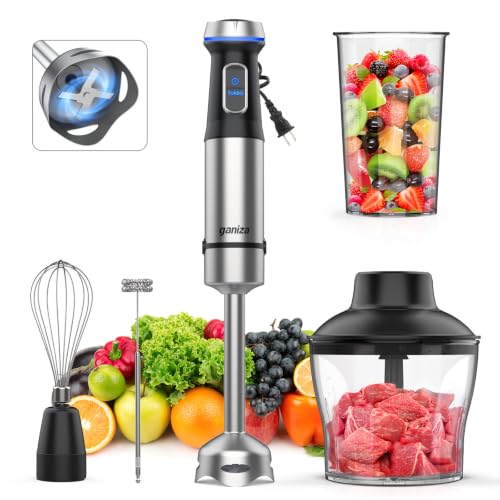
Ganiza Immersion Blender 5-in-1, Max 1000W
Badge: Best Accessory Kit
- Motor: max 1000W, described as heavy duty in the title
- Speed control: 16 speed modes
- Blade: stainless steel
- Included: 800ml mixing beaker, 600ml chopper, whisk, milk frother
- Kit format: 5-in-1
Ganiza is the pick that puts its evidence in writing: the title describes a heavy duty motor with a maximum 1000W figure, sixteen speed modes, and a full measured kit — an 800ml beaker for drinks and emulsions, a 600ml chopper for onions, nuts and herbs, plus a whisk and a milk frother. Read the wattage honestly: maximum is a peak claim, not a promise about sustained output, and this guide treats it that way throughout. What the number does support is headroom — a motor specified this way, paired with fine speed steps, is designed to be worked across thick purees and repeated batches without living at its limit. The stainless steel blade handles the hot and the fibrous, and the measured vessels remove guesswork about whether a batch fits before you start blending it.
A recipe tester examining Ganiza Immersion Blender 5-in-1, Max 1000W would ask how its 16 speed modes system behaves at the low end before asking about the top, because emulsions and gentle soup starts decide more dinners than peak power does. On title evidence, that is the question this pick has to answer — and the review above frames its strengths and trade-offs in exactly those terms.
Strengths
- The title itself carries the heavy-duty motor description and a max 1000W figure
- Sixteen speed modes give unusually fine steps between gentle and full power
- Measured attachments (800ml beaker, 600ml chopper) make batch planning concrete
Trade-offs
- The wattage is a maximum figure; the title does not state a sustained rating
- Five-in-one kits demand the most washing and storage of any pick here
- Sixteen speeds are more granularity than simple soup work will ever use
Best for: cooks who want accessory kit in an immersion blender, matched to the jobs its title actually claims. / Not suited for: shoppers whose priorities contradict its stated evidence — read the trade-offs above before deciding.

Vitamix 5-Speed Immersion Blender Bundle
Badge: Best Premium Pick
- Speed control: 5 speeds
- Operation: one-handed (per title)
- Blades: stainless steel
- Cord: 5-foot
- Included: whisk and storage case
- Design note: blends in any container (per title)
Vitamix brings its countertop reputation to a stick format with a bundle that emphasises control and keeping: five speeds, one-handed operation, stainless blades, a whisk, and a storage case, on a stated 5-foot cord. One-handed operation is a genuinely useful design goal — the other hand steadies the pot, holds a bowl at an angle, or scrapes down a beaker — and the longer cord reduces the outlet-hunting that interrupts soup work mid-pot. The title states no wattage, and this guide will not invent one; the case here rests on speed control, build positioning and the blend-in-any-container flexibility rather than a number. The storage case is a small thing that changes ownership: attachments that live together get used, while loose parts migrate to the back of drawers. This is the premium-leaning pick for cooks who blend often and keep tools for years.
Read through a recipe-first lens, Vitamix 5-Speed Immersion Blender Bundle is mapped onto the four defining jobs — smooth soup, stable emulsion, fleck-free smoothie, bodied bean puree — using only its stated evidence: No wattage is stated in the title; 5-speed control. No test result is claimed; the mapping shows which recipes its design is built to serve and where its stated limits will show.
Strengths
- Five defined speeds plus one-handed operation suit controlled, single-hand blending
- The 5-foot cord is stated in the title and gives real reach around a stove
- A storage case keeps the stick and whisk together instead of loose in a drawer
Trade-offs
- No wattage appears in the title, so power must be judged on design and brand class
- No chopper is listed, unlike several rival kits
- It sits in a premium tier qualitatively, which buys build and support rather than attachments
Best for: cooks who want premium pick in an immersion blender, matched to the jobs its title actually claims. / Not suited for: shoppers whose priorities contradict its stated evidence — read the trade-offs above before deciding.

KitchenAid Variable Speed Hand Blender with Attachments KHBV83
Badge: Most Versatile
- Speed control: variable speed trigger
- Blending arm: removable, 8 inch
- Included: blending pitcher, whisk and chopper attachments
- Finish: black matte
- Power source: corded
The KHBV83 is KitchenAid’s fuller-kit answer to the simpler KHBV53: the same removable 8-inch arm and trigger-style variable speed, extended with a blending pitcher, a whisk and a chopper. That trio maps neatly onto a real cooking week — pitcher for smoothies and dressings, whisk for eggs and cream, chopper for the onion-and-herb jobs that are too small for a food processor and too tedious for a knife. The trigger control earns its place at the soup pot, where the first press decides whether dinner stays in the pot. As with its sibling, the title states no wattage, so the honest comparison is about control, reach and kit completeness rather than a power figure. For households replacing several small appliances with one motor body, this is the KitchenAid configuration to look at first.
For repeatability, the telling details of KitchenAid Variable Speed Hand Blender with Attachments KHBV83 are its legible controls and vessels: blending pitcher; whisk; chopper; removable 8-inch blending arm. A cook who notes speed and vessel can reproduce a result with this kind of package, which is the standard this lens applies. Its power evidence, stated plainly, is No wattage is stated in the title.
Strengths
- The full attachment trio — pitcher, whisk and chopper — covers most small prep jobs
- Removable 8-inch arm gives in-pot reach and separates for washing
- Trigger variable speed maps pressure to power for splash-free starts
Trade-offs
- No wattage appears in the title, limiting headline power comparison
- Three attachments mean three things to wash after a full prep session
- Corded operation ties you to an outlet, as with every pick in this guide
Best for: cooks who want a well-matched tool in an immersion blender, matched to the jobs its title actually claims. / Not suited for: shoppers whose priorities contradict its stated evidence — read the trade-offs above before deciding.

Bonsenkitchen Immersion Hand Blender
Badge: Best Minimalist Pick
- Speed control: 2 mixing speeds
- Blades: stainless steel
- Format: electric handheld stick mixer
- Stated uses: smoothies, purees, baby food, soup, emulsions
Bonsenkitchen’s stick is the minimalist entry in this pool: an electric handheld blender with stainless steel blades and two mixing speeds, aimed squarely at smoothies, purees, baby food, soup and emulsions. There is a real virtue in that restraint. A two-speed stick has almost nothing to learn, almost nothing to store, and a rinse-under-the-tap cleanup that encourages daily use in a way a five-part kit sometimes does not. The honest limits are equally clear: the title states no wattage, so nobody should buy it expecting high-power behaviour, and two speeds give you a start gear and a finish gear rather than a dial. For small households, first apartments, and cooks whose blending is a pot of soup and a morning smoothie, that trade can be exactly right.
A recipe tester examining Bonsenkitchen Immersion Hand Blender would ask how its 2 mixing speeds system behaves at the low end before asking about the top, because emulsions and gentle soup starts decide more dinners than peak power does. On title evidence, that is the question this pick has to answer — and the review above frames its strengths and trade-offs in exactly those terms.
Strengths
- Two speeds and a stick format keep the learning curve at nearly zero
- Stainless steel blades cover the hot-soup and puree basics
- The stated use list spans smoothies, soup, baby food and emulsions honestly
Trade-offs
- No wattage appears in the title, so power expectations must stay modest and design-based
- No attachments are listed — this is a blender only
- Two speeds cannot match trigger-variable picks for delicate emulsions
Best for: cooks who want minimalist pick in an immersion blender, matched to the jobs its title actually claims. / Not suited for: shoppers whose priorities contradict its stated evidence — read the trade-offs above before deciding.
Comparison Table
The six picks on the attributes their titles actually document. “Not stated in title” is information, not an omission — it tells you exactly how much power evidence a pick offers a comparison shopper.
| Model | Motor evidence | Speed control | Included extras | Listing |
|---|---|---|---|---|
| Turelar Immersion Blender 1100W 5-in-1 Set | 1100W | Trigger variable speed | Food processor attachment; whisk; frother; anti-scratch design | Check on Amazon |
| MasterChef Immersion Blender 400W | 400W | Variable speed control with turbo boost | Stainless steel blending stick; easy-clean design | Check on Amazon |
| Ganiza Immersion Blender 5-in-1, Max 1000W | Max 1000W | 16 speed modes | 800ml mixing beaker; 600ml chopper; whisk; milk frother; stainless steel blade | Check on Amazon |
| Vitamix 5-Speed Immersion Blender Bundle | Not stated in title | 5-speed control | Whisk; storage case; 5-foot cord; one-handed operation; stainless blades | Check on Amazon |
| KitchenAid Variable Speed Hand Blender with Attachments KHBV83 | Not stated in title | Variable speed trigger | Blending pitcher; whisk; chopper; removable 8-inch blending arm | Check on Amazon |
| Bonsenkitchen Immersion Hand Blender | Not stated in title | 2 mixing speeds | Stainless steel blades; portable stick format | Check on Amazon |
How to Choose the Right Blender for Best immersion blenders cooks illustrated
Choose in the order the work demands. First decide the jobs — soup in the pot, smoothies in a beaker, emulsions, baby food, small chopping — because the job list, not the marketing, determines which specs matter. Then read speed control, reach, and stated motor evidence in that order, and only then compare kits. A shopper cross-reading Best Immersion Blenders For Soap Making will notice the same order applied there, because it reflects how these tools succeed and fail in real kitchens rather than how they are advertised.
Speed control is the daily-driver spec
Every blend begins at low speed or goes wrong immediately, so the control system is the spec you will feel most. Trigger variable designs meter power by finger pressure and excel at gentle starts. Multi-step systems — five speeds, twelve speeds, sixteen modes in this pool — give repeatable settings you can note and reproduce. Two-speed designs are honestly simple: a start gear and a finish gear, adequate for soups and purees, limiting for emulsions. Match the system to your most delicate job, not your most powerful one; top speed is easy to sell and rarely the constraint.
Motor evidence: read the figure, then read its wording
Where a title states a wattage, note both the number and its framing. A plain rating and a maximum figure are different kinds of evidence, and this guide reports them differently on purpose. Where a title states nothing, treat power as undocumented and lean on control, construction and the jobs the title claims. Remember what wattage cannot tell you: blade and guard design, container fit and your own burst technique decide how much of any motor becomes smooth food. A well-controlled mid-watt pick will out-blend a careless high-watt one in most home jobs.
Reach, blades and the pot you actually own
Measure your deepest everyday pot and compare it with the stated arm and shaft lengths — around 8 inches is the proven home standard in this pool. Stainless steel blades, stated on most picks here, suit hot, acidic and fibrous work and rinse clean without fuss. Guard design matters for your cookware: anti-scratch designs, where a title states them, are aimed at coated pots and beakers. Finally, check the vessel story: a pick with a jar, pitcher, beaker or measuring cup included gives small batches the tall, narrow container they need from day one.
Attachments: buy the week you live, not the brochure
Whisks earn their place for eggs, cream and dressings; choppers for the daily onion, herb and nut jobs too small for a food processor; frothers for drinks; beakers and pitchers for smoothies, emulsions and storage. Each attachment is also a washing commitment, so the right kit is the largest one whose every piece you will genuinely use weekly. If your blending is soup and smoothies alone, a bare stick with excellent control beats a five-piece kit that lives in a cupboard — a trade several picks in this guide are built around.
How to Use, Clean and Troubleshoot Your Immersion Blender
Adopt the recipe tester’s routine with your new blender: the first time a soup, dressing or puree comes out exactly right, write down the vessel, speed setting and burst pattern with the recipe. Repeatability is a note-taking habit, and it will teach you your specific pick’s character faster than any general guide can.
- Set up: choose a vessel with depth to spare — the pot the soup cooked in, or a tall beaker for small batches — and plug in with dry hands, cord routed clear of heat.
- Submerge first: lower the switched-off stick until the blade guard is fully covered by the mixture. Starting exposed is the splash mistake; avoid it every time.
- Start low: press the lowest speed or feather the trigger until a gentle vortex forms and the mixture begins to circulate as one body.
- Work in passes: move the stick slowly — down the centre, across the base, up the far side — in bursts of twenty to thirty seconds, repositioning between presses so corners and walls circulate through the blade.
- Finish deliberately: add power only for the final texture, taste, and adjust seasoning after blending, since pureeing changes how salt and acid read.
- Clean immediately: unplug, detach the arm if your design allows, and rinse the guard and blade under hot water at once; for a deeper clean, blend a beaker of warm soapy water for a few seconds, then rinse and dry.
Troubleshooting. Problem: the blend splashes over the pot rim → the guard is too near the surface or the start was too fast; submerge fully and restart at the lowest speed. Problem: chunks survive in the corners → the batch is too still, not too strong; slow the passes down, tilt the vessel slightly, and give the mixture time to circulate. Problem: the motor labours and smells warm on a thick mixture → stop, rest the tool, add a little liquid, and finish in smaller sections rather than one continuous run.
Recipe-First Criteria: Judging a Blender by the Food It Has to Produce
A recipe-led method starts from dishes, not devices. For an immersion blender the defining recipes are a smooth tomato or squash soup with no fibrous residue, a stable mayonnaise or vinaigrette that does not split, a fruit smoothie without leaf flecks, and a bean puree with genuine body. Each recipe interrogates a different design trait: soup tests reach and circulation, emulsions test the lowest usable speed, smoothies test blade and vortex behaviour, and bean purees test sustained torque and your burst technique. This guide’s reviews map every pick onto those four jobs using only stated evidence — speed systems, reach figures, blade materials and kit.
Notice what that method does to headline specs. Wattage becomes a supporting fact: relevant to the bean puree, nearly irrelevant to the vinaigrette, where the contest is between a trigger’s feathering, a 16-step dial’s low end, and a two-speed stick’s single low gear. A recipe-first shopper in a power-first market is exactly who this guide is written for, and the detailed reviews keep returning to the four dishes so the comparison stays culinary rather than numerical. Readers working through the neighbouring question in Best Immersion Blenders Wirecutter will find the same evidence-first approach applied to that shortlist.
Repeatability: The Cook’s Illustrated Virtue a Home Cook Can Actually Use
The deepest habit in the recipe-testing tradition is repeatability: a result counts when it can be produced again, on demand, by a cook following the same steps. Immersion blenders serve repeatability when their controls are legible — numbered speeds, a trigger whose pressure you can learn, a beaker with a stated volume like the Ganiza’s 800ml, or a blending pitcher like the KitchenAid KHBV83’s in this line-up — because a dressing that worked at “speed three in the marked beaker” can be made identically next month.
Build the habit at home: when a blend works, note the vessel, the speed and the burst pattern alongside the recipe. Within a few weeks your own notes become a miniature test kitchen file for your specific pick, tuned to your pots and your stove. That practice, more than any ranking — including this guide’s — is what turns a good immersion blender into reliably good food, and it is the most faithful way to honour the tradition this keyword invokes.
Container Choice Changes the Result More Than Another Speed Setting
The vessel you blend in is half the tool. A stick blender needs depth more than width: the guard must sit fully submerged with mixture above it, or it draws air, splashes and leaves the top layer coarse. Tall, straight-sided vessels — the blending jars, pitchers and beakers included with several picks here — suit single servings and dressings, while the soup pot itself remains the right vessel for anything hot and voluminous. Narrow bases help the vortex form; wide, shallow bowls defeat it. If a blend misbehaves, changing the container fixes it more often than changing the speed does, and experienced users keep one tall beaker reserved for exactly this reason.
Splash Control Is a Skill, and It Is Learnable in One Pot of Soup
Every immersion blender owner has one early splash story, and nearly all of them trace back to the same two errors: starting the motor before the guard is fully submerged, or lifting the stick out while it is still spinning. The full technique is simple enough to become habit in a single session. Lower the switched-off stick to the base of the pot, tilt it very slightly, press the lowest speed until the mixture begins to circulate, and only then move and add power. To stop, release the control first, wait a beat for the blade to settle, then lift. Hot liquids deserve extra respect: fill pots no more than two-thirds, and remember that a gentle start is not caution wasted — it is the difference between blending soup and wearing it.
Cleaning in the First Minute Is the Whole Secret
Immersion blenders have a reputation for easy cleaning that is entirely earned — provided the rinse happens immediately. Dried soup under a blade guard is a genuinely unpleasant job; the same guard rinsed within a minute of blending needs nothing more than hot water and a drop of soap blended in a beaker of clean water for a few seconds. Keep fingers away from the blade itself, use a bottle brush for the guard’s inner surfaces, and dry the shaft before storage so water does not sit in seams. Removable arms, like the KitchenAid designs in this pool, make the routine even shorter, but even fixed sticks clean in under a minute when the habit holds. The real maintenance rule is temporal, not technical.
Storage: Why the Drawer Beats the Counter for This Tool
A stick blender is one of the few powered kitchen tools that genuinely stores in a drawer, and that shapes how often it gets used — tools within arm’s reach get used; tools in cupboards get forgotten. Protect the blade guard with whatever case, cover or simple cloth wrap keeps it from rattling against other utensils, coil the cord loosely rather than wrapping it tightly around the body, and keep attachments together in one container if your pick has them. Bundles like the Vitamix’s, which include a storage case, solve this by design. Wherever it lives, store the stick dry and fully assembled or fully separated — never damp, and never with the guard resting under heavy pans that can bend it out of true.
Motor Heat: Reading the Tool’s Signals During Long Jobs
A handheld motor tells you how it is coping, if you know the signals. Rising warmth in the handle during thick work is normal within limits; a hot smell, a labouring change in pitch, or speed that fades under load are instructions to stop, rest the tool and thin or split the batch. Most home blending jobs never approach these limits, because soups and smoothies are minutes of intermittent work. The jobs that do — big puree batches, thick bean mixtures, back-to-back meal prep — are managed by the burst rhythm described in this guide: twenty to thirty seconds on, reposition, brief rest. Treat heat as information rather than failure and a mid-priced stick will serve for years.
Common Buying Mistakes
- Buying on wattage alone — especially treating a maximum figure as a sustained rating, or assuming an unstated motor must be powerful because the brand is famous.
- Starting every blend at full speed, then blaming the tool for splashing that the first three seconds caused.
- Choosing the biggest attachment kit for a cooking week that is soup and smoothies, and washing five pieces to do one piece’s job.
- Ignoring reach: a stick too short for your deepest pot makes in-pot blending a steam-dodging exercise no motor can fix.
- Comparing configurations by family name instead of exact model, so the whisk, chopper or jar in the review is missing from the box that arrives.
- Letting the first rinse wait: dried food under a blade guard converts a twenty-second cleanup into the worst job in the kitchen.
Final Recommendation
For most shoppers searching best immersion blenders cooks illustrated, start with the Turelar Immersion Blender 1100W 5-in-1 Set: it leads this guide because its stated evidence — 1100W, stated in the title — the highest figure in this pool; Trigger variable speed — balances the jobs this keyword is really about. If your priorities lean toward the biggest documented kit or the widest speed range, the Ganiza Immersion Blender 5-in-1, Max 1000W is the alternative this guide’s evidence supports most strongly, and shoppers who want the premium-leaning or most specialised option should examine the Bonsenkitchen Immersion Hand Blender before deciding. Whichever direction you lean, the cross-check in Best Immersion Blenders With Food Processor Attachment is worth a read before you buy, because the two shortlists overlap heavily.
Buy the pick whose trade-offs you can live with weekly, not the one whose headline is largest. Every pick here is documented to the same evidence standard, linked to the same listings used to write its review, and honest about what its title does not prove. Match it to your pots, your recipes and your washing tolerance, use the technique in the how-to layer from the first day, and the tool will repay the decision every time soup season — or smoothie season — comes around.
Frequently Asked Questions
What is the most important spec in an immersion blender?
Speed control, for most cooks. It decides whether you can start gently in a full pot, build an emulsion without splitting it, and finish a puree firmly. Stated wattage matters for thick and frozen work, reach matters for deep pots, and blade material matters for hot food — but control is the spec your hand feels in every single blend.
Can an immersion blender crush ice or frozen fruit?
It depends on the stated motor and on technique. The higher stated wattages in this pool handle frozen fruit in bursts with enough liquid to circulate; the lower stated figures will manage small amounts patiently and are better suited to cooked and soft ingredients. No stick matches a countertop blender for big frozen drinks — that remains the jar machine’s home job.
Is this guide affiliated with Cook’s Illustrated?
No. This is an independent, research-led guide that applies a recipe-first testing discipline — defined dishes, texture as the verdict, repeatability as the standard — to a verified pool of immersion blenders. It does not reproduce or claim any Cook’s Illustrated ranking, test result or recommendation, and no pick here should be described as chosen by them.
Which immersion blender traits matter most for recipe work?
Fine low-speed control for emulsions, reach that keeps the guard submerged in a soup pot, a vessel with markings or stated volume for repeatable batches, and blade design that circulates fibrous ingredients instead of flecking them. Stated wattage supports the thickest jobs, but recipes are won on control and repeatability far more often than on peak power.
How do I stop my immersion blender splashing?
Keep the blade guard fully submerged, start at the lowest speed until a vortex forms, and switch off before lifting the stick out. Fill hot pots no more than two-thirds, and prefer a tall, narrow vessel for small batches. Nearly every splash traces back to one of those four points, and all four are technique, not equipment faults.
Are attachments like whisks and choppers worth it?
When they match your week, yes. A whisk covers eggs, cream and dressings; a chopper covers the small onion, herb and nut jobs; a beaker or jar makes small batches blend properly. If none of those are weekly jobs for you, a bare stick with excellent control is the better buy — and the better wash. Readers comparing kit sizes may also find Best Immersion Hand Blenders useful.


