Disclosure: topratedkitchenware.com is reader-supported. When you buy through links on our site, we may earn an affiliate commission from Amazon and other retailers, at no extra cost to you.
Where to buy
The six grills below are this guide’s answer to the best made bbq grills, with “made” carrying the full weight of the question: which of these machines is built well enough for BBQ — not for a season of burgers, but for the long, hot, patient work that defines the craft? BBQ is construction’s sternest examiner. A grill that grills adequately can still fail at BBQ in a dozen quiet ways: dampers that will not hold a setting through a windy hour, a charcoal pan that cannot be adjusted without dismantling the cook, a lid whose fit leaks the heat a low fire can barely spare, grates that surrender their finish to the third long cook. This ranking therefore audits each pick’s construction evidence — the materials, mechanisms and systems named in its own verified listing — specifically for BBQ duty: sustained heat, fine airflow control, fire-tending access, and the durability to repeat the performance for years. The pool is mixed, four gas carts and portables beside a charcoal kettle and a charcoal offset smoker, and every pick is linked so you can check the latest price on Amazon. Gas earns no presumption here and charcoal earns no romance: the audit is the audit, and BBQ is its subject.
- Monument Grills 4-Burner Propane Gas Grill, Mesa II — Best Made Overall
- Weber Original Kettle Premium Charcoal Grill, 22-Inch — Best Made Charcoal
- Nexgrill Propane 4-Burner Gas Grill with Stainless Steel Lid — Best Documented Build
- AMERLIFE 60,000 BTU 6-Burner Propane Gas Grill — Best Big Build
- Royal Gourmet CC1830S BBQ Charcoal Grill and Offset Smoker — Best Made Smoker Combo
- Charbroil Portable 1-Burner Propane Gas Grill — Best Simple Build
Read the full guide ↓ for the reasoning, the comparisons and the buying advice before you decide.
One clarification before the audit begins, because this keyword’s family invites confusion: “made” here is not a claim about where these grills were manufactured. No pick’s listing states a country of origin, so this guide claims none, for any pick, in either direction. “Made” is a claim about how — the thickness of the evidence, literally and figuratively: which materials were chosen, which mechanisms were engineered, which systems were finished. A companion ranking in this cluster asks the same how-question for grills generally, in Best Made Grills; this page narrows it to the BBQ examination, where the hours are long and the construction has nowhere to hide.
Key Takeaways
- The Monument Mesa II leads the BBQ build audit on whole-machine evidence: a stainless steel body, an Advanced Broil Zone, foldable shelves and assembly treated as a design discipline.
- The Weber Kettle Premium is the charcoal construction benchmark: heat-control dampers, a built-in thermometer and the One-Touch cleaning system on the most proven bowl in the category.
- The Nexgrill is the most completely documented build here — stainless lid, matte finish cast iron grate, 52,000 BTU, 526 square inches, electronic ignition, thermometer, all stated.
- The AMERLIFE brings cast iron grates and a regulating valve to the largest frame in the pool — big construction with its control hardware named.
- The Royal Gourmet CC1830S is the only true smoker build: an offset chamber, an adjustable charcoal pan, a side fire door and a lid thermometer — BBQ architecture, constructed for tending.
- The Charbroil portable closes the list as the honest minimum: aluminized steel, one burner, almost nothing to fail.
In this guide
Quick Picks
| Pick | Badge | Why it stands out | Link |
|---|---|---|---|
| Monument Grills Mesa II 4-Burner | Best Made Overall | Stainless steel body, Advanced Broil Zone, foldable shelves, fast-assembly design | Check on Amazon |
| Weber Kettle Premium, 22-Inch | Best Made Charcoal | Built-in thermometer, heat-control dampers and One-Touch cleaning on the classic kettle | Check on Amazon |
| Nexgrill 4-Burner, Stainless Lid | Best Documented Build | Stainless lid, matte finish cast iron grate, electronic ignition, thermometer — everything stated | Check on Amazon |
| AMERLIFE 6-Burner Propane Grill | Best Big Build | Cast iron grates, regulating valve, warming rack across a 650 sq. in. six-burner frame | Check on Amazon |
| Royal Gourmet CC1830S Smoker Combo | Best Made Smoker Combo | Offset smoker, adjustable charcoal pan, side door, lid thermometer, 783 sq. in. | Check on Amazon |
| Charbroil Portable 1-Burner Grill | Best Simple Build | Aluminized steel portable, 11,000 BTU, the minimum-parts construction | Check on Amazon |
How These Picks Were Chosen
The audit method matches the one used across this cluster’s build rankings, with its weights re-set for BBQ. Every pick comes from a verified pool cross-checked against its manufacturer’s Amazon listing, no hands-on testing is claimed, and construction credit is given only for what a listing states: named materials, named mechanisms, named systems. For BBQ duty, the weights run as follows. First, sustained-heat integrity: the materials and constructions that survive hours at temperature without warping, flaking or fading — stainless bodies, finished cast iron, sound kettle steel. Second, control mechanisms: dampers that meter air in fine increments, pans that adjust a fire’s distance, valves that regulate gas — because BBQ is control sustained over time, and a mechanism that cannot hold a setting is a construction failure with a delay fuse. Third, tending access: the side door that feeds a fire without opening a chamber, the cleaning system that clears ash in seconds — the constructions that respect the cook’s tenth visit as much as the first. Fourth, documentation completeness: a listing that states its whole build invites trust in the parts it cannot show.
Those weights explain the ranking’s two headline judgments. The Monument leads because its evidence is whole-machine — body material, a designed heat system, assembly philosophy — and BBQ punishes whole machines, not components. The Kettle Premium stands second as the charcoal benchmark, its dampers and cleaning system being precisely the mechanisms long cooks live by. The smoker combo stands fifth despite being the pool’s only native BBQ architecture, and the review will argue that placement openly: architecture is a design virtue, while this audit scores construction evidence, and the combo’s listing states less about its materials than the leaders state about theirs. Readers who want architecture ranked first will find that ranking, argued on its own terms, in Best Made Bbq Smoker Grills. Here, the metal is the message.
The 6 Best Made BBQ Grills, Audited for the Long Cook

Monument Grills 4-Burner Propane Gas Grill, Mesa II
Badge: Best Made Overall
Strengths
- A stainless steel body — the foundation material for a machine that must hold its integrity through years of heat cycles.
- An Advanced Broil Zone: burner and firebox engineering aimed at a purpose, named as a system.
- Fast-assembly design and foldable side shelves — construction thinking from the first hour to every storage.
Trade-offs
- Grate material is not stated in the listing — the audit’s standing question for this pick.
- Gas BBQ is indirect-work BBQ; it will not produce an offset smoker’s smoke depth, however well it is made.
- A shorter public ownership record than the pool’s legacy names.
At a glance: Fuel: propane gas · Burners: 4 · Body: stainless steel · Extras: Advanced Broil Zone, foldable side shelves, fast assembly design · Model: Mesa II 410FBZ
BBQ on gas is an exercise in sustained, zoned, indirect heat — burners lit on one side, meat resting on the other, the lid closed for hours — and that duty cycle interrogates a machine’s construction in a specific way: not “can it get hot,” but “can it hold its shape, its seals and its settings while it stays warm all afternoon.” The Monument’s evidence answers that interrogation at the level of the whole machine. A stainless body does not merely resist the patio’s weather; it tolerates the thermal cycling of long cooks without the finish failures that begin at panel edges. The Broil Zone’s presence in the design means the firebox was engineered with distinct thermal territories, which is what zoned indirect cooking actually consumes. And the assembly philosophy matters more for BBQ than for grilling, because a cart that begins square and tight is a cart whose lid seals — and lid seal is the unglamorous foundation of every long, low gas cook.
It suits the gas cook whose BBQ ambitions are real — ribs and shoulders by the indirect method, all afternoon, on a machine built to be warm for a living. The honest limitations are the unstated grate material, which the product page should answer, and the fuel’s own ceiling: this is BBQ by technique on a gas platform, executed on the pool’s most completely evidenced gas construction. First place here is a construction verdict, and on construction, the stainless whole-machine case is the strongest one this pool can make.
Best for: gas cooks who run long indirect BBQ on a whole-machine build / Not suited for: smoke purists or buyers who need the grate material stated upfront

Weber Original Kettle Premium Charcoal Grill, 22-Inch
Badge: Best Made Charcoal
Strengths
- Heat-control dampers engineered for the fine, stay-put adjustments that long charcoal cooks are made of.
- A built-in thermometer in the lid — instrumentation integrated into the construction, not clipped on after.
- The One-Touch cleaning system: ash management machined into the bowl’s design, which is why kettle ash actually gets cleared.
Trade-offs
- Bowl and lid materials are not itemized in this listing; the construction case rests on mechanisms and the design’s proven geometry.
- Capacity is one 22-inch circle — BBQ in family batches.
- Charcoal’s full workload is the operating cost of its construction virtues.
At a glance: Fuel: charcoal · Size: 22-inch kettle · Extras: built-in thermometer, heat-control dampers, One-Touch cleaning system
Charcoal construction is mechanism construction. A kettle has no burners to engineer and no valves to regulate; its entire build quality expresses itself in three places — the bowl’s geometry, the dampers’ precision, and the ash system’s honesty — and the Premium’s listing names the second and third outright while the first is the most proven shape in the category. Dampers deserve the audit’s emphasis: in a long cook, temperature is airflow, and airflow is whatever the dampers permit, so a damper that moves in fine increments and stays where it is set is not a feature but the machine’s constitution. The One-Touch system is the same caliber of thinking applied to ash — the chore that, left unaided, fills a bowl until the fire suffocates — reduced to a lever’s sweep, integrated into the bowl rather than bolted beneath it. The lid thermometer completes the mechanism set: the cook reads the chamber without breaking its seal.
It suits the charcoal BBQ cook at family scale who wants the craft’s mechanisms in their most refined mainstream form. The honest limitation is the listing’s material silence — this audit does not itemize what it cannot read — and the kettle’s batch size. As a made object for BBQ, though, it is the charcoal benchmark of the pool: a machine whose every named mechanism is aimed at the long cook’s actual problems, which is the most precise definition of well-made this category offers.
Best for: charcoal BBQ cooks who live by dampers and value integrated mechanisms / Not suited for: crowd-scale smoking or push-button cooks
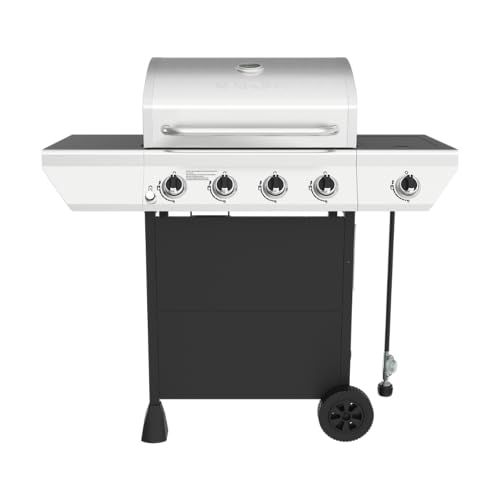
Nexgrill Propane 4-Burner Gas Grill with Stainless Steel Lid
Badge: Best Documented Build
Strengths
- A stainless steel lid over a matte finish cast iron grate — the two most-handled components, both materially specified.
- The pool’s most complete stated specification: 52,000 BTU, 526 square inches, electronic ignition, built-in thermometer.
- A side burner extends the station without compromising the main construction.
Trade-offs
- Stainless is stated for the lid only; the body’s material is not named.
- Its BBQ is the indirect gas method — sound technique on a well-documented machine, not native smoke architecture.
- The listing’s portable note sits oddly with its cart scale.
At a glance: Fuel: propane gas · Burners: 4 plus side burner · Output: 52,000 BTU · Cooking area: 526 sq. in. · Lid: stainless steel · Grate: matte finish cast iron · Extras: built-in thermometer, electronic ignition
Documentation is a construction virtue in its own right, and no listing in this pool documents like this one. Consider what the BBQ cook is told, in a single title, about the machine being trusted with a six-hour cook: the lid is stainless — the panel that will cycle heat and weather above every one of those hours; the grate is cast iron with a named matte finish — the surface the food and the fire share; the output and area are stated, so the heat system’s proportions can be judged rather than guessed; ignition is electronic and the thermometer is built in, so the two systems a long cook leans on are present by design. An audit thrives on exactly this: claims that can be checked, in the places where checking matters.
It suits the buyer who wants the BBQ build argument settled by paperwork before it is settled by experience — and who cooks BBQ by the indirect gas method, where this machine’s zoned, lidded, instrumented construction is precisely the toolkit. The honest limitation is the partial material story: stainless at the lid, silence at the body. Third place records that balance faithfully — the best-documented build in the pool, behind a whole-body stainless case and a charcoal mechanism benchmark, and ahead of everything less completely said.
Best for: documentation-first buyers running indirect gas BBQ / Not suited for: buyers who want full-body stainless or native smoking

AMERLIFE 60,000 BTU 6-Burner Propane Gas Grill with Side Burner
Badge: Best Big Build
Strengths
- Cast iron grates across a six-burner, 650-square-inch frame — substance at the pool’s largest scale.
- A regulating valve named in the listing: gas delivery treated as an engineered system, which long zoned cooks depend on.
- A warming rack and built-in thermometer complete the long-cook hardware set.
Trade-offs
- Body and lid materials unstated; the construction case is grates, valve and scale.
- Six burners is six systems to maintain across the machine’s life.
- Its BBQ is zoning at scale — generous, but still the gas method.
At a glance: Fuel: propane gas · Burners: 6 plus side burner · Output: 60,000 BTU · Cooking area: 650 sq. in. · Grates: cast iron · Extras: warming rack, built-in thermometer, regulating valve
Scale tests construction in a way small machines never face. A 650-square-inch cooking surface over six burners is a thermal and structural system: the frame must stay true while its zones run at different temperatures for hours, the gas delivery must feed near and far burners evenly through a long cook, and the grates must hold their plane under load after load of food. The AMERLIFE’s listing addresses that test with the right exhibits — cast iron grates for the working surface, a regulating valve for the delivery system, a thermometer for the cook’s information, a warming rack for the service that BBQ’s staggered finishing times demand. It is a build brief written for the hosted long cook: many pieces, finishing at different hours, held at the rack while the last zone completes its work.
It suits the host whose BBQ is a production — the big indirect cook with a crowd at the end of it. The honest limitations mirror its strengths: materials for the body go unstated, and complexity compounds maintenance across six burners’ worth of ports, valves and ignition points. Fourth place is the audit’s fair arithmetic for a machine whose stated construction is strong exactly where BBQ hosting presses hardest, and thinner where the leaders are complete. The maker-level comparison of the gas field is taken up in Best Maker Of Gas Grills.
Best for: hosts running large indirect BBQ services on gas / Not suited for: small households or body-material purists

Royal Gourmet CC1830S BBQ Charcoal Grill and Offset Smoker
Badge: Best Made Smoker Combo
Strengths
- The pool’s only offset smoker architecture — a firebox and chamber built as separate, purposeful structures.
- An adjustable charcoal pan and a side door: fire management mechanisms constructed for tending, not workarounds.
- A lid thermometer, front and side tables, and 783 square inches — the largest footprint here.
Trade-offs
- Materials are not itemized in the listing; the construction case is architectural and mechanical rather than metallurgical.
- Offset construction has the most joints, doors and seams of any pick — the most places for heat and smoke to negotiate their escape.
- The widest, heaviest footprint in the ranking.
At a glance: Fuel: charcoal · Cooking area: 783 sq. in. · Format: barrel grill with offset smoker · Extras: adjustable charcoal pan, side door, lid thermometer, front and side tables · Color: black
This is the ranking’s most interesting argument, and the guide will make it honestly in both directions. For the combo: it is the only machine here whose construction is BBQ architecture — a firebox built apart from the chamber so smoke can be managed as a medium, a charcoal pan that adjusts the fire’s distance as a designed mechanism, a side door whose entire existence is tending access, tables placed where a working pitmaster’s hands actually are. Judged as a set of decisions about how a BBQ machine should be put together, it is the most BBQ-literate build in the pool. Against a higher placement: this audit scores stated construction evidence, and the combo’s listing is eloquent about mechanisms while silent about materials — no steel is characterized, no grate is specified — and an offset’s many doors and seams are, by construction, the category’s most demanding sealing problem. Fifth place is where those two truths balance.
It suits the BBQ devotee for whom architecture is the build — who would rather tend a true offset, seams and all, than indirect-cook on a tighter gas box. Its honest limitation, for this audit’s purposes, is documentation: a buyer who shares the audit’s material-first instincts should interrogate the product page for the steel and grate facts the title omits. As the pool’s only native smoker construction, it remains irreplaceable in kind — the machine the other five are, in their different ways, approximating.
Best for: devotees who want true offset architecture with tending mechanisms built in / Not suited for: buyers who rank stated materials above architecture

Charbroil Portable Convective 1-Burner Propane Gas Grill
Badge: Best Simple Build
Strengths
- Aluminized steel body — the working equipment material, named without decoration.
- One burner, one body: the minimum-parts construction, with the minimum possible failure modes.
- A long-lineage portable model, built for transport and hard use.
Trade-offs
- Its BBQ ceiling is a small, direct cook; long low-and-slow work is beyond its design brief entirely.
- No mechanisms to audit — no dampers, pans, zones or systems are stated, because there are none to state.
- Not a construction peer of the carts and the kettle; a different, smaller idea of a grill.
At a glance: Fuel: propane gas · Burners: 1 · Output: 11,000 BTU · Body: aluminized steel · Color: black · Model: 465133010
The audit’s floor is, as in its sibling ranking, a study in subtraction. Everything BBQ construction elaborates — chambers, dampers, pans, zones — is absent here, and what remains is a body of aluminized steel wrapped around a single burner: a machine whose build quality consists of being exactly as complicated as its job. For its actual job — portable, direct, small-scale cooking at campsites and balconies — that subtraction is the correct engineering, and the material choice is the correct material: heat-tolerant, practical, unbothered by being treated as equipment. It will never smoke a shoulder, and this guide’s BBQ frame makes that limitation decisive for placement rather than incidental.
It suits the traveling cook whose BBQ is a flavor at a picnic rather than a discipline at home. Sixth place measures construction ambition for long-cook duty, and by that measure the portable is honestly last — while remaining, pound for pound, possibly the most sensibly made object in the entire pool. Rankings answer the question they were asked; this one was asked about BBQ.
Best for: portable direct cooking where simplicity is the build strategy / Not suited for: low-and-slow BBQ of any kind
Comparison Table
| Pick | Fuel / Format | Key construction evidence | BBQ-duty note | Link |
|---|---|---|---|---|
| Monument Mesa II | Propane gas cart | Stainless steel body, Advanced Broil Zone, fast assembly | Whole-machine integrity for long zoned cooks | Check on Amazon |
| Weber Kettle Premium | Charcoal kettle | Heat-control dampers, built-in thermometer, One-Touch cleaning | The charcoal mechanism benchmark | Check on Amazon |
| Nexgrill Stainless Lid | Propane gas cart | Stainless lid, matte finish cast iron grate, full stated spec | Best-documented indirect platform | Check on Amazon |
| AMERLIFE 6-Burner | Propane gas cart | Cast iron grates, regulating valve, warming rack | Big-frame hosting construction | Check on Amazon |
| Royal Gourmet CC1830S | Charcoal barrel + offset smoker | Offset architecture, adjustable pan, side door, thermometer | The only native smoker build | Check on Amazon |
| Charbroil Portable | Propane portable | Aluminized steel, minimum parts | Simple direct cooking only | Check on Amazon |
How to Choose a Well-Made BBQ Grill
Choose by the cook that will test the construction hardest — in BBQ, that is always the longest one. Begin with the heat-duration question: what must this machine hold, and for how many hours, without its settings wandering or its finishes surrendering? Gas answers with body material, lid integrity and regulated delivery; charcoal answers with damper precision and fire-management mechanisms. Score your candidates on the mechanisms of endurance as they are stated: on gas, a regulating valve, zoned burners and a thermometer; on charcoal, dampers that meter finely, a pan that adjusts, a door that tends. Then score tending access, because a long cook is a series of visits, and construction that respects the visits — side doors, one-touch ash systems, tables at hand height — is construction that understands BBQ rather than merely surviving it. Then, and only then, weigh scale: BBQ capacity is chamber and grate arranged for indirect work, and the largest number in a listing is rarely the largest usable BBQ space.
Carry the audit’s two disciplines with you. Score only what is stated, converting every silence — an unnamed grate, an uncharacterized steel — into a product-page question rather than an assumption in either direction. And separate architecture from construction in your own mind before you buy: the offset smoker here is the finest BBQ architecture in the pool and the fifth-ranked build, and both facts can be true because they answer different questions. The buyer who knows which question is theirs — “what can it do” or “how is it made” — will choose correctly between this ranking and its architecture-first sibling without regret in either direction. The propane engineering behind the gas half of this field is examined on its own in Best Made Propane Gas Grills.
How to Run a Long Cook on a Well-Made Machine
The how-to of BBQ is mostly the art of not fighting your equipment. Begin every long cook with the machine’s own systems inspected while cold: dampers swept through their range on charcoal, burner ports and ignition checked on gas, ash cleared, grates brushed and lightly oiled. Stabilize before food: a kettle or offset wants its temperature settled and boring for a full half hour before the meat arrives, and a gas cart wants its zones established with the lid closed and the thermometer calm, because food added to a still-hunting system inherits every oscillation. Cook by trend, not by instant — adjust one mechanism, wait, read again — and tend through the access the construction provides: the side door, not the chamber lid; the damper, not the fuel pile; the valve, not the lid lift. Rest the meat as deliberately as you cooked it, and let the machine cool under its own discipline before cleaning: ash out when cold, grates brushed while their memory of heat remains, everything dried before the cover.
One further discipline separates cooks who master their machines from cooks who merely own them: the log. For your first several long cooks on any pick in this ranking, note the settings that produced stability — damper positions on the kettle, burner settings on the carts, pan height and fuel rhythm on the offset — along with the weather that accompanied them. Construction quality expresses itself as repeatability, and a log is how repeatability is captured: within a handful of cooks, the notes become the machine’s personal manual, the one its manufacturer could not write because it describes your unit, your patio and your fuel. Every well-made grill rewards that attention disproportionately, because a machine built to hold a setting is a machine whose settings are worth recording.
Troubleshooting, in the pattern that covers most long-cook problems:
- Problem: temperature will not hold steady on a charcoal cook → suspect the mechanisms before the fuel: ash choking the bowl (sweep it, as the One-Touch design intends), dampers moved too far too often, or a lid seal leaking at one side, which a slow rotation of the lid sometimes cures.
- Problem: one gas zone fades over a long cook → check the tank level first, then the burner ports of the fading zone, then the regulator’s seating; long cooks expose delivery weaknesses that short grilling hides.
- Problem: smoke escapes everywhere except the stack path on an offset → work the seams’ order: door alignment, then damper settings creating proper draw, then fire size; a small hot fire draws cleaner than a large smothered one.
Gas BBQ Versus Charcoal BBQ: The Construction Divide
The fuel divide in BBQ is, at bottom, a construction divide, and this mixed pool displays it cleanly. Gas BBQ is built: its long cook is produced by engineered systems — burners, valves, regulated delivery, lidded chambers with thermometers — and its construction quality is the quality of those systems and the body that houses them. Charcoal BBQ is managed: its long cook is produced by a skilled cook operating simple, precise mechanisms — dampers, pans, doors — and its construction quality is the precision and durability of those few mechanisms. Neither is the lesser philosophy. The gas machine asks its maker for engineering and its owner for trust; the charcoal machine asks its maker for honesty in small moving parts and its owner for craft. A buyer choosing between them is really choosing where the intelligence of the system should live — in the machine, or in the cook — and the best-made answer differs accordingly, which is why this ranking can place a stainless gas cart first and a charcoal kettle a breath behind it without contradiction. Both are well-made; they are made well for different distributions of skill.
The Long Cook as a Stress Test: Where Weak Construction Confesses
Every construction weakness in a grill has a scheduled confession, and BBQ’s long cooks are when the schedule comes due. Consider the four failures that end more BBQ machines than any dramatic breakage. The first is the wandering setting: a damper whose friction fades, a valve whose detents soften, until the temperature the cook set at noon is a rumor by two o’clock — a mechanism failure that masquerades as a cooking failure, blamed on fuel and weather for a season before its true address is found. The second is the finish surrender: a grate coating or a painted panel that survives forty short grilling sessions and then, asked to hold temperature for six continuous hours, blisters and begins its slow flake into every subsequent cook — the reason this audit reads stated finishes, enamel and matte and stainless, as BBQ evidence rather than cosmetics. The third is the seal’s decline: lids and doors whose fit was approximate when new become generous after a hundred heat cycles of expansion and contraction, and a long cook on a leaking chamber is a negotiation the cook can never quite win, feeding fuel to the sky through gaps that grilling’s speed never exposed. The fourth is the ash-and-grease backlog: systems without honest cleaning access accumulate the residues of long cooks until airflow, ignition and flavor all degrade together, which is why a one-lever ash sweep and a tending door appear in this ranking as construction headlines rather than conveniences.
Read the ranking again through those four confessions and its logic sharpens. The leaders are the machines whose stated construction addresses them in advance: mechanisms named for holding settings, materials named for surviving duration, systems named for clearing what long cooks deposit. The picks below them are not accused of failing — an audit does not convict on silence — but they are unexamined on one or more of the counts, and the BBQ buyer’s wisdom is to examine them on the product page before the first shoulder does it instead. Construction, in the end, is just failure postponed by design; BBQ is simply the appointment at which the postponement is audited.
What a Decade of BBQ Does to Each Kind of Build
Project the pool forward ten years of regular long cooks and the builds diverge into recognizable biographies. The stainless-bodied gas cart ages in its systems first: burners and valves will want their renewals on schedule, while the body that housed them remains essentially itself — the correct order of mortality, since systems are replaceable and bodies are not. The kettle’s biography is the category’s most reassuring: with so few mechanisms, there is so little to retire, and a decade of Sundays mostly writes itself into patina rather than failure, provided ash never winters in the bowl. The documented Nexgrill ages component by component, its stated parts — lid, grate, ignition — each on its own clock, with the advantage that a fully specified machine is a fully serviceable one: parts can be matched because parts were named. The big six-burner ages as a fleet does, unevenly and manageably, its owner becoming gradually expert in its particular burners’ personalities. The offset ages most romantically and most demandingly: seams to watch, doors to keep true, a firebox that lives the hardest life in the pool and asks its owner to be its maintenance department — repaid, its devotees insist, in the only currency that finally matters, which is smoke. And the portable simply persists, too simple to have a biography, carried and used until its single burner or its owner retires first.
None of those futures is a reason, by itself, to choose or refuse a pick. They are, collectively, the reason this keyword exists: “made” is a question about the future tense, and BBQ — with its hours, its heat and its repetitions — is the tense in which the answer arrives soonest and most honestly.
Common Buying Mistakes
- Confusing architecture with construction. A smoker chamber is a design; steel, mechanisms and finishes are the build. This keyword asks about the build — score it.
- Judging BBQ construction by grilling performance. A machine can sear brilliantly and still leak, wander and flake across a six-hour cook. Ask the long-cook questions.
- Ignoring tending access. Side doors, ash systems and tables are BBQ construction, because a long cook is a hundred small interactions with the machine.
- Letting a stated material in one place imply materials everywhere. A stainless lid is a stainless lid. Read each component’s line separately, as this audit does.
- Assuming “made” means a place. No listing here states an origin, and this guide claims none. Judge the how, which is printed, rather than the where, which is not.
- Skipping the mechanism check on charcoal. Dampers are a charcoal grill’s constitution. Sticky, coarse or vague dampers disqualify a BBQ candidate regardless of its bowl.
Final Recommendation
Start with the Monument Mesa II if your BBQ runs on gas and your standard is whole-machine construction: stainless body, a designed broil system, and assembly treated as engineering. Choose the Weber Kettle Premium if your BBQ runs on charcoal — its dampers, thermometer and cleaning system are the mechanism set the long cook actually lives by — or the Nexgrill 4-Burner if you want the build documented line by line before you commit. The AMERLIFE scales the gas argument to hosting size, the Royal Gourmet remains the pool’s only true smoker architecture for the devotee who ranks design first, and the little Charbroil keeps the honest floor. Check the latest price on Amazon for your pick, verify its unstated materials on the product page, and buy the construction your longest cook deserves.
Frequently Asked Questions
Does “best made” mean made in a particular country?
Not in this guide. No pick’s verified listing states a country of origin, so no origin is claimed for any of them. “Made” is judged as workmanship evidence — materials, mechanisms and systems as printed — which is the only reading the evidence supports. Buyers with a specific origin requirement should verify it on the product page, where such claims properly live.
Which construction matters most for BBQ specifically?
The mechanisms of sustained control: dampers on charcoal, regulated zoned delivery on gas, and the tending access — side doors, ash systems — that lets a cook correct a long cook without dismantling it. BBQ’s hours expose weak mechanisms the way a short grilling session never can, which is why this audit weights them above raw heat or size.
Why is the only true smoker ranked fifth in a BBQ build guide?
Because this guide ranks construction evidence, and the offset combo’s listing is eloquent about architecture and mechanisms while silent about its materials — no steel or grate is characterized. Architecture-first readers are right to rank it higher for their purposes, and this cluster’s smoker guide does. Here, the metal is the message, and the combo’s metal goes unstated.
Can a gas grill really do BBQ, or only grilling?
By technique, yes: burners zoned to one side, meat on the other, lid closed, temperature governed — the indirect method, executed on a well-built, well-sealed cart, produces genuine BBQ. What gas does not produce is an offset smoker’s smoke depth. The construction question — whether the machine holds its settings and seals for hours — is exactly what separates the gas carts that can from those that merely claim to.
How do I check a damper or mechanism’s quality before buying?
From a listing, read how the mechanism is described: named systems with stated functions — heat-control dampers, an adjustable pan, a one-touch cleaning sweep — indicate engineered parts, while silence suggests hardware too ordinary to name. In person or on the product page, look for fine, stay-put adjustment and integrated design. A mechanism the manufacturer describes proudly is usually a mechanism the manufacturer built carefully.
Should I prioritize a smoker combo or a better-built plain grill?
It depends on which question brought you here, and this guide’s structure is designed to make the dependence visible. If your life is BBQ — if most of your cooks are long and smoke is the point — the combo’s architecture may outweigh its thinner material documentation, and you should buy it with the product-page material check this guide recommends. If your life is mixed grilling with occasional BBQ, the better-built plain machines above it will serve more of your year, and their construction evidence is the sounder purchase. Neither answer is the ranking being indecisive; it is the ranking refusing to let one household’s answer impersonate everyone’s.
Is a heavier grill always a better-made grill?
Weight is suggestive but not decisive, and in this pool it cannot be scored at all, because no listing states a weight — a silence this guide respected rather than filled. In the wider market, heft often does track steel thickness and grate substance, and a suspiciously light large grill deserves a question. But mechanisms outrank mass for BBQ: a lighter kettle with precise dampers will out-cook a heavier cart with vague controls across every long afternoon of its life. Use weight, where you can learn it, as one exhibit among several — never as the verdict.
What maintenance keeps a BBQ grill’s construction sound?
Ash never left sitting in a charcoal bowl, grates brushed and protected per their material, gas ports and valves checked seasonally, and fasteners re-snugged as heat cycles loosen them. Long cooks are a machine’s hardest work; the short routine after them is what lets a well-made grill stay well-made through years of them.


