Disclosure: topratedkitchenware.com is reader-supported. When you buy through links on our site, we may earn an affiliate commission from Amazon and other retailers, at no extra cost to you.
Where to buy
For readers comparing the best makers grills, here is the short version. This is the field survey: six grills from six different makers, spanning a one-burner portable to a six-burner family cart, every one linked. Each name below links to its Amazon listing so you can check the latest price on Amazon and read the full specification in the maker’s own words. No single winner is crowned on this page — the point of the plural question is the range of maker approaches, and what each approach is for.
- IdeaMaxx 3-Burner Propane Gas Grill with Cast Iron Grates — The Design-Led Maker. IdeaMaxx 3-burner: cast iron grates, 38,200 BTU, foldable side shelves. (check the latest price on Amazon)
- Weber Spirit E-425 Gas Grill — The System Maker. Weber Spirit E-425: Sear Zone with Boost Burners, Weber Works rails. (check the latest price on Amazon)
- Nexgrill 4-Burner Propane Gas Grill with Stainless Steel Lid — The Specification Maker. Nexgrill 4-burner: 52,000 BTU, 526 sq. in., thermometer, electronic ignition. (check the latest price on Amazon)
- Monument Grills Mesa II 4-Burner Propane Gas Grill 410FBZ — The Claims Maker. Monument Mesa II 410FBZ: Advanced Broil Zone, fast assembly claim, stainless. (check the latest price on Amazon)
- AMERLIFE 6-Burner Propane Gas Grill with Side Burner — The Scale Maker. AMERLIFE 6-burner: 60,000 BTU, 650 sq. in., cast iron grates, warming rack. (check the latest price on Amazon)
- Charbroil Portable 1-Burner Propane Gas Grill 465133010 — The Endurance Maker. Charbroil portable 1-burner 465133010: aluminized steel, 11,000 BTU, portable. (check the latest price on Amazon)
Read the full guide ↓ for badges, honest trade-offs, a comparison table and the reasoning behind every pick.
Put the makers side by side and the grill market’s real structure appears. The best makers grills are not six versions of the same cart at six sizes; they are six different answers to the question of what a grill maker should be. One maker in this set builds a folding 3-burner around a storage problem. One builds a system platform around a sear zone and accessory rails. One builds the same specification discipline at two sizes. One prints a testable heat-up claim. One scales to six burners and 650 square inches. And one has kept a single-burner portable in the field with a model number and a stated body material. This guide surveys the field maker by maker.
The plural framing changes the judging. Instead of asking which maker wins, this page asks what each maker’s published file demonstrates — identity, systems, specification, originality, scale, longevity of a simple design — and which households each demonstration serves. A maker can be the right answer for a small patio and the wrong answer for a big family without being a better or worse maker in any absolute sense. That matching, not a league table, is the useful output of a makers survey.
Readers who want the singular verdict should read the companion singular ranking, where the same evidence tests produce one winner. Readers comparing the products themselves, fuel by fuel, should use Best Material For Bbq Grills for the materials-first product view. This page stays at the maker level throughout, and — like its companions — uses only what the titles state: no histories, no market claims, no warranty promises appear anywhere in it.
Key Takeaways
- Six makers, six strategies: folding design, system platform, specification discipline, printed claims, maximum scale, portable simplicity.
- The field spans 11,000 BTU and one burner (Charbroil portable) to 60,000 BTU and six burners (AMERLIFE) — maker range is the story.
- Weber and Monument name systems; Nexgrill enumerates specifications; Charbroil and Monument print exact model identities.
- IdeaMaxx is the field’s originality entry: foldable shelves as a maker’s signature idea.
- AMERLIFE’s file is the scale entry: the largest area and burner count, with cast iron grates and a warming rack stated.
- Match the maker’s demonstrated strategy to your household; the survey deliberately crowns no single winner.
In this guide
Quick Picks
The badges in this survey name strategies, not ranks. Each maker is presented at its most characteristic — the grill in its range that shows the maker’s hand most clearly.
| Pick | Badge | Why it is here |
|---|---|---|
| IdeaMaxx 3-Burner Propane Gas Grill with Cast Iron Grates | The Design-Led Maker | A maker identified by one clear idea — a full-size grill that folds its shelves away. |
| Weber Spirit E-425 Gas Grill | The System Maker | The maker whose grill is a platform: line, sear system and accessory rails named together. |
| Nexgrill 4-Burner Propane Gas Grill with Stainless Steel Lid | The Specification Maker | The maker whose titles read like spec sheets — consistently, across models. |
| Monument Grills Mesa II 4-Burner Propane Gas Grill 410FBZ | The Claims Maker | The maker that prints testable promises — a broil system, an assembly claim, a heat-up figure. |
| AMERLIFE 6-Burner Propane Gas Grill with Side Burner | The Scale Maker | The field’s maximum statement: most burners, most area, fully enumerated extras. |
| Charbroil Portable 1-Burner Propane Gas Grill 465133010 | The Endurance Maker | A maker represented by its simplest product — and the discipline still shows. |
How These Picks Were Chosen
One grill per maker was chosen from the verified pool to represent that maker’s clearest published statement. The selection favors characteristic over flagship: Charbroil is represented by its portable single-burner rather than its cabinet, because a maker’s discipline shows most honestly on its simplest product, while AMERLIFE is represented by its largest cart because scale is its statement. Nexgrill’s representative is its second 4-burner model — the one that proves the first model’s discipline was a habit.
Scoring uses the cluster’s four evidence tests — identity, systems, specification, range logic — but the output is a profile, not a rank. Each review states what the maker demonstrates, what its file leaves unproven, and which household the demonstrated strategy fits. Where the wider pool contains a second model from the same maker, the review says so and uses it; where it does not, the file is described as a single statement and judged accordingly.
The honesty rules are the same as across the program. Only title-stated facts are used as specifications. Maker claims printed in titles are reported as claims. Nothing about any company’s history, size or service reputation is asserted, because none of it is in the evidence. The survey’s value is precisely that limit: everything claimed here can be re-checked by any reader against the same titles in minutes.
One structural observation completes the survey. Notice how the field divides by what each maker chose to print first. The design-led maker leads with a mechanism (folding shelves). The system maker leads with a line and model. The specification maker leads with output and area. The claims maker leads with a system and two promises. The scale maker leads with burner count. The endurance maker’s portable leads with its model number. First lines are editorial decisions, and six makers made six different ones — which means the first line of any grill title you read from now on tells you what that maker believes you care about. Checking whether you actually care about it is the whole of maker shopping, compressed into one habit.
Best makers grills — The 6 Picks in Detail

IdeaMaxx 3-Burner Propane Gas Grill with Cast Iron Grates
Badge: The Design-Led Maker
Strengths
- Foldable side shelves define the maker’s design signature
- Cast iron grates and 38,200 BTU show the idea is backed by hardware
- Patio-to-camping positioning in the title matches the folding concept
Trade-offs
- Single-model file: no range evidence to test the maker’s consistency
- No model number or monitoring hardware stated
- Folding joints are moving parts that need periodic checks
Key specs from the listing title
- Fuel: propane gas
- Burners: 3
- Output: 38,200 BTU
- Grates: cast iron
- Shelves: foldable side shelves
Every field has a maker you identify by an idea, and in this field it is IdeaMaxx. The idea — side shelves that fold — sounds small until you picture the grill’s second life: stored against a wall, rolled through a gate, fitted into the corner of a garage. Most full-size makers design the cooking footprint and abandon the stored footprint to the buyer. This maker designed both, and printed the folding shelves in the title where the idea belongs, as the headline.
The supporting file shows the idea is not a gimmick pasted onto a weak grill. Cast iron grates are a serious cooking surface with a real care contract, and 38,200 BTU across three burners is strong output for the class — the hardware of a grill meant to cook, not merely to store cleverly. The title’s own positioning, patio and camping, fits the concept: a grill that acknowledges movement in its life.
The maker judgment is therefore two-sided in the usual way. Originality: demonstrated. Range discipline, model identity and monitoring specification: unproven in a single file with no model number stated. Households whose storage problem is real should weight the demonstrated side heavily — this is the only maker in the survey solving it — while maker-first shoppers should note the unproven side and complete the file at the listing, as the product review in Best Makes Of Bbq Grills also advises.
Best for: Households whose maker priority is a design that respects storage space / Not suited for: Buyers who need a multi-model range behind their maker choice

Weber Spirit E-425 Gas Grill
Badge: The System Maker
Strengths
- Spirit line and E-425 model designate a defined platform
- Sear Zone with Boost Burners names the cooking architecture
- Weber Works rails name an accessory standard around the grill
- Porcelain-enameled cast-iron grates specified in full
Trade-offs
- Output and area unstated in the title — the platform speaks louder than the numbers
- Accessory systems reward commitment to one maker’s ecosystem
- Enameled iron grates require careful handling
Key specs from the listing title
- Fuel: propane gas
- Burners: 4
- Searing: Sear Zone with Boost Burners
- Grates: porcelain-enameled cast-iron
- Accessory system: Weber Works rails
- Model: Spirit E-425
Weber’s representative file is the survey’s clearest example of a maker selling a system rather than an appliance. The Spirit E-425 title names a line, a model, a cooking system (Sear Zone with Boost Burners), an accessory interface (Weber Works rails) and a fully specified grate (porcelain-enameled cast iron). Read together, those are not features; they are architecture — a grill designed to sit at the center of documentation, accessories and replacement parts that share its standards.
The maker lesson generalizes. When a manufacturer names its systems, it is exposing surface area to be judged: the sear system can be assessed as a design, the rails can be checked for a real accessory range, the line identity can be searched for a manual in seconds. Makers who describe only heat and size expose almost nothing. In a survey of maker approaches, that willingness to be specific is the system maker’s defining trait, and no other file here matches its density.
Balance the profile with its gap: the title states no total output and no cooking area, so the platform maker leaves the two plainest numbers to the listing. System households — cooks who like an accessory ecosystem and a defined line — will forgive that gap after one listing check. Number-first households may not, and the survey’s job is to make that fork visible rather than to decide it, a fork the companion singular ranking resolves the other way.
Best for: Cooks who want a maker organized as a documented, expandable system / Not suited for: Number-first buyers or anyone avoiding accessory ecosystems
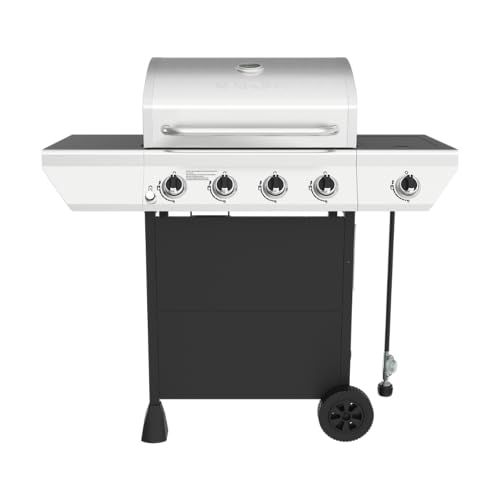
Nexgrill 4-Burner Propane Gas Grill with Stainless Steel Lid
Badge: The Specification Maker
Strengths
- Full enumeration: output, area, ignition, monitoring all stated
- Grammar repeats across the maker’s second model in the wider set
- Matte cast iron grate and stainless lid differentiate within the range
Trade-offs
- No named cooking or accessory system — discipline without platform language
- Cast iron grate carries its seasoning and rust-care contract
- This variant states no cabinet, unlike its larger sibling
Key specs from the listing title
- Fuel: propane gas
- Burners: 4 plus side burner
- Output: 52,000 BTU
- Cooking space: 526 sq. in.
- Grate: matte finish cast iron
- Lid: stainless steel
- Ignition: electronic
- Monitoring: built-in thermometer
Nexgrill’s approach is the opposite of the system maker’s: not architecture, but enumeration. This 4-burner’s title states 52,000 BTU, 526 square inches, a built-in thermometer, electronic ignition, a side burner, a stainless steel lid and a matte finish cast iron grate. Its larger sibling in the pool states the same categories in the same order at 60,000 BTU and 626 square inches with a cabinet. Two files, one grammar — the survey’s clearest demonstration that a maker’s information standard is a real, observable trait.
Enumeration serves a particular buyer beautifully: the comparison shopper. When a maker publishes every measurable column, its grills can be ranked against rivals without a single listing excavation, and its own range can be navigated by number alone. The cost of the approach is what it omits — no named sear system, no accessory standard — so the specification maker offers clarity about the object and silence about the platform around it.
As a grill, this model is a complete mid-large propane cart whose cast iron grate will please sear cooks willing to season it. As a maker profile, Nexgrill is the field’s information disciplinarian, and households that shop by spreadsheet will feel at home with it immediately. Its two-file consistency is also the strongest range evidence in this survey — the test the plural question in Best Makes Of Bbq Grills applies across fuels as well.
Best for: Comparison shoppers who want every number published, every time / Not suited for: Platform buyers who want named systems and accessories

Monument Grills Mesa II 4-Burner Propane Gas Grill 410FBZ
Badge: The Claims Maker
Strengths
- Exact model identity: Mesa II 410FBZ on the named Mesa line
- Advanced Broil Zone names the sear architecture
- Fast Assembly and a stated 500°F in 5 minutes are checkable maker claims
- Stainless body and foldable shelves complete a dense file
Trade-offs
- Heat-up figure is a claim to verify, not a result this guide measured
- Total output and cooking area are not stated in the title
- Single-model file in this set — range consistency unproven
Key specs from the listing title
- Fuel: propane gas
- Burners: 4
- Searing: Advanced Broil Zone
- Body: stainless steel
- Shelves: foldable side shelves
- Heat-up claim in title: 500°F in 5 mins
- Model: Mesa II 410FBZ
Monument’s maker personality is boldness with specifics. The Mesa II 410FBZ title names its line and model exactly, names its sear architecture (Advanced Broil Zone), and then does something no other maker in this survey does: it prints promises a buyer can test on day one — fast assembly, and a heat-up claim of 500°F in 5 minutes. Claims that specific are a form of accountability. A maker printing them expects to be measured, and a survey of makers should credit the expectation while labeling the figures as claims, which this guide does.
The rest of the file supports the personality: stainless steel body, foldable side shelves (the survey’s second folding design, on a 4-burner rather than a 3-burner), and a broil-led cooking identity. The gaps are the sizing numbers — no total output, no cooking area in the title — so the claims maker, like the system maker, sends you to the listing for the plain figures while dazzling you with the architectural ones.
Households that respond to this maker are buying a temperament as much as a grill: specific, confident, testable. The correct buyer response is to accept the invitation — assemble it with a timer in mind, run the heat-up claim yourself, and hold the maker to its own printed standard. A maker judged by its own claims is the fairest judgment in this entire survey, and the Mesa II is the grill on which to practice it.
Best for: Buyers who like makers that commit to specific, testable claims / Not suited for: Buyers who need output and area stated before anything else

AMERLIFE 6-Burner Propane Gas Grill with Side Burner
Badge: The Scale Maker
Strengths
- Six burners plus a side burner — the largest layout in the survey
- 650 sq. in. cooking area with cast iron grates stated
- Warming rack, thermometer and regulating valve all enumerated
- 60,000 BTU total matches the scale honestly across six burners
Trade-offs
- The largest ownership footprint and cleaning load in the field
- Output per burner is modest — scale here means zones, not ferocity
- No line name, model number or system name in the title
Key specs from the listing title
- Fuel: propane gas
- Burners: 6 plus side burner
- Output: 60,000 BTU
- Cooking area: 650 sq. in.
- Grates: cast iron
- Extras: warming rack, built-in thermometer, regulating valve
AMERLIFE’s statement is scale, stated completely. Six burners plus a side burner, 60,000 BTU, 650 square inches, cast iron grates, a warming rack, a built-in thermometer and a regulating valve — the title enumerates like the specification maker, but in service of the biggest object in the survey. Scale is a legitimate maker strategy: there are households for whom the binding constraint is grate area at a family gathering, and a maker that builds honestly to that brief serves them better than a refined small grill ever will.
Read the numbers with the survey’s discipline and they stay honest. Sixty thousand BTU across six burners is zone power, not sear ferocity — ten thousand per burner is a workhorse figure, and the grill’s promise is simultaneity: many foods, at several heats, at once, with a warming rack holding the finished work. The cast iron grates give that simultaneity a proper sear surface where it counts, at the usual iron care price.
The maker file’s gaps are identity and architecture: no line name, no model number, no named system. AMERLIFE here demonstrates specification and scale without demonstrating the documentation identity the survey prizes elsewhere. Big-cook households may rationally accept that trade — the product case is completed alongside its charcoal range-mates in Best Manufacterur Of Bbq Grills — but they should accept it knowingly, and keep their own purchase documentation carefully to compensate.
Best for: Large households whose binding constraint is cooking area and zones / Not suited for: Small families, or maker-first buyers who require printed model identity

Charbroil Portable 1-Burner Propane Gas Grill 465133010
Badge: The Endurance Maker
Strengths
- Exact model number (465133010) printed even on the simplest product
- Body material stated: aluminized steel
- Portable convective format with an honest 11,000 BTU single-burner spec
- One-burner simplicity is itself a durability strategy
Trade-offs
- One burner and 11,000 BTU define a small, single-zone cooking brief
- No grate material, thermometer or ignition detail in the title
- Portable scale cannot serve family-size cooks
Key specs from the listing title
- Fuel: propane gas
- Burners: 1
- Output: 11,000 BTU
- Body: aluminized steel
- Format: portable convective
- Model: 465133010
The survey closes with the smallest grill and one of its most telling maker files. Charbroil’s portable is a single-burner convective grill in aluminized steel at 11,000 BTU — and its title still prints an exact model number, 465133010, and still names its body material. Discipline that survives down to the cheapest, simplest product in a range is discipline you can believe in, because there was no marketing reason to bother. That is the endurance maker’s argument: consistency where nobody is watching.
The product itself is a lesson in simplicity as construction. One burner has almost nothing to fail; a portable convective body in aluminized steel is light, weather-tolerant and sized for the cooks it will actually do — a couple of burgers, a small pan, a tailgate or balcony session. Its title does not inflate the brief: 11,000 BTU is stated plainly, and no family-size promises are made. Makers who let their small products stay honestly small are makers whose large products can be trusted to be honestly large.
Place this file beside the same maker’s cabinet Performance in the neighboring guides and the range logic completes: compact, portable and cabinet formats under one naming-and-numbering habit. No household should buy a portable as a family grill — the survey is explicit that this pick serves small, mobile cooks — but every household can learn from its file how to recognize a maker whose standards are habits rather than headlines. That recognition is the whole skill this page exists to teach.
Best for: Small, mobile cooks — and any buyer studying what maker discipline looks like / Not suited for: Family cooking, zone cooking, or any multi-dish brief
The survey should also be honest about its own frame. One grill per maker is a portrait sitting, not a census: several of these makers build far more than the single file shown, and two of them are represented elsewhere in this cluster by second models that the reviews cite where relevant. A portrait can still be truthful — each file here is the maker’s own published statement, quoted fairly — but a household making a final decision between two makers should extend the survey’s method to a second model from each before money moves. The four tests travel well; they were designed to.
Comparison Table
Compare strategies before specifications: the table’s third column names what each maker’s title demonstrates, because that demonstration — not any single number — is this survey’s subject.
| Pick | Fuel | Headline spec from title | Link |
|---|---|---|---|
| IdeaMaxx 3-Burner Propane Gas Grill with Cast Iron Grates | propane gas | Burners: 3; Output: 38,200 BTU | Check on Amazon |
| Weber Spirit E-425 Gas Grill | propane gas | Burners: 4; Searing: Sear Zone with Boost Burners | Check on Amazon |
| Nexgrill 4-Burner Propane Gas Grill with Stainless Steel Lid | propane gas | Burners: 4 plus side burner; Output: 52,000 BTU | Check on Amazon |
| Monument Grills Mesa II 4-Burner Propane Gas Grill 410FBZ | propane gas | Burners: 4; Searing: Advanced Broil Zone | Check on Amazon |
| AMERLIFE 6-Burner Propane Gas Grill with Side Burner | propane gas | Burners: 6 plus side burner; Output: 60,000 BTU | Check on Amazon |
| Charbroil Portable 1-Burner Propane Gas Grill 465133010 | propane gas | Burners: 1; Output: 11,000 BTU | Check on Amazon |
How to Choose Among Grill Makers
Start by naming your maker priority, because the field demonstrates genuinely different virtues and no maker demonstrates all of them. If your priority is a documented platform with accessories and systems, the system maker’s file fits. If it is complete, comparable numbers across a range, the specification maker fits. If it is a design that solves your storage problem, the design-led maker fits. If it is scale for a crowd, the scale maker fits. If it is discipline on a simple product, the endurance maker’s portable is the purest evidence in the survey.
Then check identity, whichever strategy you chose. Exact model designations — E-425, 410FBZ, 465133010, and the cabinet’s 463253925 in the wider set — are the working keys to manuals and parts. A maker strategy you love, attached to a model you cannot identify precisely, will frustrate you at the first replacement part. Prefer the file where strategy and identity arrive together, and where they do not, plan to document the purchase yourself with unusual care.
Weigh single files and repeated files differently. A maker represented once can demonstrate originality, claims or scale, but cannot demonstrate consistency; a maker represented twice in the same grammar has demonstrated the habit itself. Neither automatically wins — an original single idea that solves your exact problem can outweigh a consistent range that solves none of them — but the distinction should be conscious, because you are choosing a relationship length, not just a grill.
Treat printed claims as invitations to verify, and accept the good ones. A stated heat-up figure or an assembly promise is a maker offering you a test; run the test during the return-friendly early days and keep the result with your purchase file. Makers who print testable claims and pass your tests have earned a kind of trust no survey can confer — and makers who fail their own printed claims have given you the clearest possible evidence, equally valuable, in the opposite direction.
Finally, let the product re-enter at the end. Maker strategy narrows the field; the grill still has to fit your patio, your household size and your menu. The product-level companion — Best Material For Bbq Grills for the materials view — exists to close that last step. A maker chosen on evidence and a grill chosen on fit is the complete purchase this cluster of guides is built to produce.
How to Keep a Maker File for Your Grill
Start the file at purchase, whatever maker you chose. Record the exact model designation from the title and the plate on the grill, save the manual and parts diagram under that designation, and keep the order confirmation with them. Photograph the assembled grill and the data plate. This ten-minute habit converts any maker — even one whose title printed no number — into a maker you can service by reference for the life of the grill.
Learn your grill’s wear list in the first season. Burners, grates, igniters and valves are the consumables of gas grilling; note which your model uses and confirm, once, that each is findable under your model designation. That single check, done while the grill is young and current, is the practical test of the maker evidence this survey scored — documentation and parts paths either work when you test them gently, or they were never really there.
Maintain to the maker’s stated materials. Cast iron grates get seasoning and dry storage habits; enameled iron gets gentle handling; stainless gets wipe-downs; aluminized and coated steels get chip checks. The titles in this survey name those materials precisely so that the care contract is knowable before purchase — honoring it is the owner’s half of the maker relationship, and it is where most grills are actually kept or lost.
Troubleshooting a maker problem uses the file, not frustration. Problem: a part fails and search finds nothing under the product’s marketing name → search the exact model designation; support systems are indexed by number. Problem: a named system behaves unexpectedly → re-read the maker’s own system description before concluding a defect; sear and broil zones have intended techniques. Problem: no documentation exists for your model at all → record that finding; it is maker evidence, and it belongs in your next purchase decision.
Six Strategies, One Market: What the Spread of This Field Means
Step back from the individual files and the field itself teaches something. The spread from an 11,000 BTU single-burner portable to a 60,000 BTU six-burner cart is not a quality gradient — it is a map of households. Makers survive by being the clearest answer to a particular brief: the small-space brief, the system brief, the spreadsheet brief, the crowd brief. The survey’s refusal to crown one winner is therefore not indecision; it is the accurate shape of the market these titles describe.
The common thread is that every maker in the field demonstrates at least one verifiable discipline — an identity printed, a system named, a specification completed, a claim made testable, a simple product kept honest. A field with that property is a healthy one for buyers who read evidence, because it means the comparison itself can be honest. The buyer’s skill is not finding the maker with no weaknesses; it is finding the maker whose demonstrated strengths align with the weaknesses you cannot tolerate.
The Portable Test: Why the Smallest Grill Judges the Maker
There is a reason this survey gives a one-burner portable the closing slot. Flagships receive a maker’s best efforts by definition; the discipline question is what happens at the bottom of the range, where margins are thin and attention wanders. A maker that still prints a model number and a body material on its simplest portable — as Charbroil does here — is showing you its defaults. Defaults are what most owners of most products actually experience.
Apply the portable test whenever you shop a range: find the maker’s cheapest, simplest product and read its file with the same four tests. If identity, materials and honest sizing survive at the bottom, the flagship’s polish is probably habit rather than theater. If the bottom of the range is anonymous and unspecified, discount the flagship’s file accordingly. It is the fastest maker check in this entire cluster of guides, and it costs you one extra listing read.
There is a quiet seventh strategy in this field that no badge names, because every maker here practices it to some degree: sizing honesty. The portable states 11,000 BTU without embarrassment. The 3-burners state their outputs plainly. The six-burner states a total that divides modestly across its burners rather than pretending to ferocity. In a category where inflation is easy and rarely punished, a field of titles that mostly decline to inflate is worth noticing — and worth rewarding with your attention when you compare these makers against any listing that promises everything at once.
Common Buying Mistakes
The survey’s first mistake to avoid is forcing a single winner out of a plural question. A household that crowns the system maker and then discovers it needed the folding design has not bought the best maker; it has bought the wrong strategy with great confidence. The second mistake is judging makers by their flagship alone, when the range’s bottom and middle are where discipline is proven. The third is ignoring the identity column until a part fails — the moment when a missing model number stops being a paperwork detail and becomes a dead grill.
The fourth mistake is treating maker claims as either gospel or lies. A printed heat-up figure or assembly promise is neither; it is a test the maker has offered you, and the mature response is to run it early and file the result. Buyers who test claims get makers who keep making them honestly; buyers who never test anything get marketing. The field surveyed here is good enough to deserve the testing habit.
The six strategies in this survey also map, loosely but usefully, onto the stages of a grilling life. The first stage is small and mobile — a renter’s balcony, a couple’s tailgate — and the endurance maker’s portable, with its printed number and honest single burner, is the stage’s correct instrument: cheap to keep, easy to document, impossible to misunderstand. The second stage is the family patio, where the specification maker’s enumerated carts and the design-led maker’s folding flexibility solve the twin pressures of volume and space. The third stage is the enthusiast’s plateau, where cooking becomes a practice rather than a chore, and the system maker’s platform — named sear architecture, accessory rails, a documented line — starts paying compound interest in parts, accessories and technique. The claims maker and the scale maker cut across the stages rather than sitting inside them: one serves any household that likes its promises testable, the other any household whose gatherings outgrew the second stage early. None of this mapping is a rule, and plenty of households will live happily in one stage forever. But a maker chosen with its stage in mind tends to be replaced for a happier reason — because the life changed — rather than the usual one, which is that the grill quietly stopped deserving its place on the patio.
Final Recommendation
The survey’s closing advice is a matching exercise. System households: start with the Spirit E-425’s platform file. Spreadsheet households: start with Nexgrill’s repeated grammar. Storage-pressed households: start with IdeaMaxx’s folding design. Claim-testing households: start with the Mesa II and its printed promises. Crowd households: start with AMERLIFE’s scale. And every household, whatever it chooses, should steal the endurance lesson from Charbroil’s portable — buy from makers whose discipline shows on the products nobody brags about.
All six grills are linked above for the specification and price check that completes any maker decision. Choose the strategy first, verify the model second, and the grill third, and you will have answered the plural question the way it deserves: not with a name, but with a fit.
Check on Amazon — IdeaMaxx 3-Burner Propane Gas Grill with Cast Iron Grates (The Design-Led Maker)
Check on Amazon — Weber Spirit E-425 Gas Grill (The System Maker)
Check on Amazon — Nexgrill 4-Burner Propane Gas Grill with Stainless Steel Lid (The Specification Maker)
The survey’s last word is an invitation to disagree productively. If your ranking of these six makers differs from the profiles’ emphases — if the folding idea strikes you as the field’s most important statement, or the portable’s discipline as its least relevant — the files are printed in full so your ranking can be built from the same evidence. Makers, unlike grills, cannot be returned; but they can be read, and reading them well, maker by maker and claim by claim, is the skill this page exists to hand over.
One last survey habit is worth handing over explicitly, because it converts this page from a report into a tool. When you next open any grill listing — from these makers or any other — read the title aloud and mark every noun that names a part, a material or a number, and every verb that promises an action. What remains is adjectives. Makers differ, more than in any other way, in their ratio of nouns and numbers to adjectives, and the six files in this survey sit at the honest end of that ratio almost without exception. A listing that survives the read-aloud test has earned your attention; one that dissolves into adjectives has told you, in its own words, how its maker expects to be judged — and you should believe it.
Frequently Asked Questions
Why does this survey refuse to name one best maker?
Because the plural question is about a field, and the field demonstrates different virtues: systems, specification discipline, originality, testable claims, scale and small-product honesty. Which virtue matters is a household property, not a maker property. The companion guide to the best maker of gas grills does give a singular verdict for readers who want one.
What is the most reliable sign of a good grill maker in a listing?
Consistency of evidence: an exact model identity, materials and systems named rather than implied, and — where a second model is visible — the same specification grammar repeated. Any one of these is a good sign; a maker showing several at once is showing a habit, and habits predict ownership experience.
Can a maker with only one grill in this set still be a good choice?
Yes, if its demonstrated strength solves your actual problem — the folding-shelf design is the clearest case. A single file cannot prove range consistency, so the buyer compensates with listing homework and careful purchase documentation. Originality with homework beats consistency that solves nothing you need.
How should I treat performance claims printed in titles?
As testable claims: credit the maker for specificity, label the figure a claim rather than a result, and verify it yourself in the early ownership window when remedies are easiest. This guide reports claims exactly that way — the Mesa II heat-up figure is the example — and never presents them as measured outcomes.
Does the biggest maker’s grill make it the best maker for families?
Scale serves large households, but the scale file here pairs its size with thinner identity evidence — no line or model number in the title. Large families should weigh the demonstrated capacity honestly, complete the listing check, and document the purchase carefully to offset the thinner printed identity.
Why is a tiny portable included among the best makers?
Because it is evidence about its maker, not a recommendation as a family grill. A model number and a named body material on the simplest product in a range demonstrate discipline where it is least rewarded. The portable serves small, mobile cooks as a product — and serves every reader as the survey’s discipline test.


