Disclosure: topratedkitchenware.com is reader-supported. When you buy through links on our site, we may earn an affiliate commission from Amazon and other retailers, at no extra cost to you.
Where to buy
In a hurry? These six charcoal grills are our picks for the best most versatile grills under 500 dollars as a tier — a band we use here as a qualitative shopping frame, not as a promise about what any single listing costs on a given day. The Royal Gourmet grill-and-offset-smoker listed first is the most versatile machine in the group because it grills and smokes in one footprint. The two Weber kettles are the two-zone and indirect-cooking specialists, and the smaller grills further down cover patios, tailgates and trips. Each name links to its Amazon listing, where you can check the latest price on Amazon and confirm the current specification before ordering.
- Royal Gourmet CC1830S Charcoal Grill and Offset Smoker — Check on Amazon
- Weber Original Kettle Premium Charcoal Grill, 22-Inch
- Weber Original Kettle Charcoal Grill, 22-Inch
- Cuisinart 14-Inch Portable Charcoal Grill (CCG-190RB)
- Royal Gourmet CC1830V Barrel Charcoal Grill
- NATUREPON 17.5-Inch Charcoal Kettle Grill
Read the full guide ↓
The best most versatile grills under 500 share one trait that has nothing to do with size or brand: they change jobs without changing equipment. A versatile grill sears burgers directly over the coals on a Tuesday, holds a low indirect fire for ribs on a Saturday, and still has room to smoke, roast or keep food warm when the cookout grows. In this price band that versatility almost always comes from charcoal rather than gas, because a charcoal fire can be arranged — banked to one side, spread flat, piled in a ring, or fed into an offset firebox — in ways a fixed burner layout cannot match. Every pick in this guide is a charcoal grill, and that is a deliberate result of the research, not a limitation of it: at this tier, charcoal is where the multi-role cooking lives.
That does not mean the six picks are interchangeable. Two of them are 22-inch Weber kettles, the classic shape for two-zone cooking, and they differ mainly in their fitted details. Two are Royal Gourmet barrels, one of which adds an offset smoker firebox that turns it into a genuine two-appliance machine. The last two shrink the same charcoal skills down to portable and compact sizes, for people whose versatility problem is space rather than menu. If your idea of versatile leans more toward weeknight speed across fuel types, our companion roundup of Best Multipurpose Outdoor Grills looks at the same question with gas models in the mix.
A note on the band itself before we start. Grill prices move with seasons, promotions and retailer stock, so this guide never prints a fixed figure for any pick. Treat under $500 as the tier these grills were selected for — the mainstream backyard tier below the premium built-in and ceramic class — and use the Amazon links to see live pricing when you are ready to buy. What we can judge from verified specifications is capability: cooking area, fire control, cooking modes and the hardware that supports them. That is what the rankings below are built on.
Key Takeaways
- Versatility in this tier means multiple fire layouts — direct, indirect, two-zone and smoking — not the longest feature list.
- The Royal Gourmet CC1830S is the most versatile pick overall: a 783 square inch barrel grill with an offset smoker, an adjustable charcoal pan and a side door for tending the fire.
- The two 22-inch Weber kettles are the strongest pure grilling all-rounders, with damper control and the One-Touch cleaning system; the Premium adds a built-in lid thermometer.
- Size is a versatility trade, not a ladder: the 14-inch Cuisinart and 17.5-inch NATUREPON give up capacity but gain portability and small-patio fit.
- Every pick here burns charcoal. If push-button gas convenience matters more than fire flexibility, shop the gas categories linked in this guide instead.
- Confirm live pricing on Amazon before buying — this guide deliberately lists no static prices, because grill prices change too often to print honestly.
In this guide
Quick Picks
| Pick | Badge | Why it is versatile | Listing |
|---|---|---|---|
| Royal Gourmet CC1830S Charcoal Grill and Offset Smoker | Most Versatile Overall | Grills in the barrel and smokes in the offset firebox; adjustable charcoal pan changes fire height without moving food | Check on Amazon |
| Weber Original Kettle Premium Charcoal Grill, 22-Inch | Best for Two-Zone and Indirect Cooking | Heat control dampers and a built-in thermometer make banked-fire cooking easy to repeat | Check on Amazon |
| Weber Original Kettle Charcoal Grill, 22-Inch | Best Classic Kettle | The original kettle formula — precise dampers and One-Touch ash cleaning — with nothing extra to learn | Check on Amazon |
| Cuisinart 14-Inch Portable Charcoal Grill (CCG-190RB) | Best Portable | 196 square inches, dual vents and three lid locks so the whole grill travels to the cooking instead of the reverse | Check on Amazon |
| Royal Gourmet CC1830V Barrel Charcoal Grill | Best for Big Batches | 627 square inches of cooking space plus front and side tables for staging trays at party scale | Check on Amazon |
| NATUREPON 17.5-Inch Charcoal Kettle Grill | Best Compact Kettle | A 302 square inch kettle on wheels with a bottom shelf — real two-zone technique in a small footprint | Check on Amazon |
How These Picks Were Chosen
We built this list by comparing verified product listings rather than marketing claims. For each candidate grill we recorded only what the manufacturer’s Amazon listing itself states: fuel type, cooking area in square inches, fire-control hardware such as dampers, adjustable charcoal pans and vents, temperature feedback such as a lid thermometer, and work surfaces such as side and front tables. Versatility was scored against four concrete cooking jobs — direct grilling, indirect roasting, two-zone cooking with a hot and a cooler side, and low-and-slow smoking — and a grill earned its place by covering more of those jobs credibly, not by having the longest bullet list of minor features.
Two filters shaped the final six. First, the tier filter: candidates had to sit in the mainstream backyard band framed by the keyword, which in practice excluded premium ceramic cookers and large built-in units and left charcoal as the dominant fuel — a result we kept rather than corrected, because charcoal’s arrangeable fire is genuinely the most flexible heat source at this level. Second, the honesty filter: any specification we could not confirm from the listing was left out of this guide entirely. Where two picks look similar on paper — the two Weber kettles are the obvious pair — we kept both only because their confirmed differences, the Premium’s built-in thermometer being the clearest, change how a cook works day to day.
This is a research-led guide. We did not cook on these six grills side by side, and we will not pretend otherwise; what we can do is read specifications carefully, weigh them against how charcoal cooking actually works, and be explicit about each pick’s limitations as well as its strengths. Readers who are also weighing fuel-flexible machines that pair a gas side with a charcoal side will find the closest relatives of this list in our guide to Best Natural Gas And Charcoal Combo Grills, which applies the same verified-spec method to combo units.
The 6 Best Most Versatile Grills Under 500, Reviewed in Detail

Royal Gourmet CC1830S Charcoal Grill and Offset Smoker
Badge: Most Versatile Overall
Strengths
- Two appliances in one footprint: a barrel grill for direct cooking and an offset firebox for genuine low-and-slow smoking.
- Adjustable charcoal pan raises or lowers the fire, which changes searing intensity without moving the food or waiting for coals to fade.
- A side door lets you add charcoal or wood mid-cook, and the lid thermometer keeps the main chamber’s temperature visible.
Trade-offs
- The largest footprint in this guide once the firebox and tables are counted — measure your patio before ordering.
- Offset smoking is a skill: heat leaks and fire management on a barrel smoker take practice to hold steady.
- More seams, doors and surfaces to clean than a simple kettle after a long cook.
Mini spec box: Fuel: charcoal. Cooking area: 783 square inches (barrel). Format: barrel grill with offset smoker. Fire control: adjustable charcoal pan, side access door. Extras: front and side tables, lid thermometer. Color: black.
Most grills in this tier are versatile in the way a kettle is versatile — one fire, arranged cleverly. The CC1830S is versatile in a stronger sense: it contains two distinct cooking systems. The main barrel works as a conventional charcoal grill with a wide grate for burgers, chops and vegetables, while the offset firebox burns a separate small fire whose heat and smoke are drawn across the main chamber. That second system is what unlocks the menu the other picks can only approximate — brisket, pork shoulder and ribs cooked for hours in moving smoke rather than parked beside a banked pile of coals.
The adjustable charcoal pan is the feature you will use most often, including on nights when you never touch the smoker. Raising the pan brings the coals close for a hard sear; dropping it softens the heat for chicken pieces or thicker cuts that need time. Combined with the side door — which lets you feed the fire without lifting the grate and dumping heat — the CC1830S gives a cook more mid-cook control than any other pick here. The front and side tables matter more than they sound, too: offset smoking generates trays, tongs, spray bottles and thermometers, and having staging space at the grill rather than on the ground keeps long cooks organized.
The honest limitation is that this versatility is not free. A barrel with an offset box is a big, multi-part object that takes longer to assemble, longer to clean, and more patio than a kettle, and offset smoking on thin barrel steel rewards attention — expect to check the fire regularly rather than set it and walk away for hours. Buy it because you will actually use both systems, not because two systems sound better than one.
Best for: cooks who want one machine that grills on weeknights and smokes on weekends / Not suited for: small balconies or anyone who wants the simplest possible charcoal grill

Weber Original Kettle Premium Charcoal Grill, 22-Inch
Badge: Best for Two-Zone and Indirect Cooking
Strengths
- The kettle shape is the natural home of two-zone cooking: bank coals to one side and you have a sear zone and a gentle zone in one bowl.
- Built-in lid thermometer gives constant temperature feedback, which is what makes indirect roasting repeatable.
- Heat control dampers plus the One-Touch cleaning system make both fire control and ash removal part of one simple routine.
Trade-offs
- No offset firebox, so smoking is done with banked coals and wood chunks rather than a separate fire — capable, but less hands-off.
- The round grate is less convenient than a rectangular barrel for long items laid out in rows.
- No fitted side table in the confirmed specification, so plan a separate staging surface.
Mini spec box: Fuel: charcoal. Size: 22-inch kettle. Fire control: heat control dampers. Temperature feedback: built-in lid thermometer. Cleaning: One-Touch cleaning system. Color: black.
If the CC1830S wins on breadth of systems, the Kettle Premium wins on depth of technique in a single system. The 22-inch kettle is the grill that two-zone cooking was effectively built around: light a chimney of charcoal, tip it against one wall of the bowl, and the grate divides into a ripping-hot direct half and a calm indirect half. Steaks sear on the hot side and finish on the cool side; a whole chicken roasts indirectly with the lid down; sausages move back and forth as they flare. Almost every charcoal technique book ever written assumes this shape, which means recipes, timing guidance and troubleshooting advice map onto this grill directly.
The Premium trim earns its place over the standard kettle on one confirmed detail: the built-in thermometer. Indirect cooking is temperature cooking, and guessing the bowl temperature from damper positions alone is the main reason beginners undercook chicken and overcook roasts. A lid thermometer turns that guess into a reading you can steer with the dampers — open them to climb, close them partway to settle. The One-Touch cleaning system completes the routine by sweeping ash into a catcher with a lever, so the ten-minute cleanup that keeps airflow healthy is easy enough to actually happen after every cook.
Its limitation is the mirror of the Royal Gourmet’s strength: there is no separate firebox, so long smoking sessions mean managing a banked fire inside the same bowl your food sits in. It works — kettles have smoked ribs for decades — but it asks more attention than an offset, and capacity for large cuts is bounded by how much grate the coal pile leaves you. As a pure grilling all-rounder, though, nothing else in this guide is as proven.
Best for: cooks who want one grill that teaches and rewards real charcoal technique / Not suited for: anyone planning frequent long offset-smoker sessions
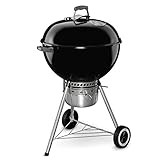

Weber Original Kettle Charcoal Grill, 22-Inch
Badge: Best Classic Kettle
Strengths
- The same 22-inch kettle geometry as the Premium, so every two-zone, indirect and lid-down technique applies unchanged.
- Precise temperature control dampers and the One-Touch cleaning system cover the two jobs that matter most: steering the fire and clearing ash.
- The simplest ownership experience in this guide — few parts, a shape with decades of accessories and advice behind it.
Trade-offs
- No built-in thermometer in the confirmed specification, so indirect cooking relies on damper feel or a separate probe thermometer.
- Shares the kettle family’s limits: no offset firebox and a round grate.
- Fewer fitted extras than the barrel picks — no tables or adjustable charcoal pan.
Mini spec box: Fuel: charcoal. Size: 22-inch kettle. Fire control: precise temperature control dampers. Cleaning: One-Touch cleaning system. Color: black.
The standard Original Kettle is the control group of charcoal grilling: the design against which versatility claims are measured. Everything said about two-zone cooking above applies here in full, because versatility in a kettle comes from the bowl, the dampers and the lid — all present — rather than from trim. Bank the coals for indirect roasts, spread them flat for a full-grate burger cook, or pile them in the center for a fierce sear; the dampers meter the oxygen that decides how hard any of those fires burn, and the One-Touch system keeps yesterday’s ash from choking today’s airflow.
Choosing between this kettle and the Premium is really choosing how you want temperature information. The standard model asks you to read the fire the older way — damper positions, hand height over the grate, cook times you learn by repetition — or to add an inexpensive probe thermometer of your own, which many experienced kettle cooks prefer anyway because a probe at grate level reads where the food actually is. If you like that hands-on relationship with the fire, this is not a lesser grill; it is the same grill with the instrumentation left to you.
The honest limitation is shared with its sibling and worth stating plainly: a kettle’s versatility is technique-driven, not hardware-driven. There is no second chamber, no height-adjustable pan and no work table in the confirmed specification, so the range of what it can do depends on the cook learning fire layouts rather than switching modes. For many households that is exactly the right bargain — one durable shape, mastered deeply — and it is why this design has stayed in production, in essence, for generations of backyard cooks.
Best for: value-minded cooks who want the classic kettle and are happy to read the fire themselves / Not suited for: cooks who want a built-in thermometer and fitted extras from day one

Cuisinart 14-Inch Portable Charcoal Grill (CCG-190RB)
Badge: Best Portable
Strengths
- Three lid locks and a carry-friendly format mean the grill travels closed and secure — versatility measured in places, not just recipes.
- Dual air vent system gives real fire control at a size where many portable grills offer none.
- 196 square inches is honestly sized for two to four people: burgers, dogs and a vegetable basket without crowding.
Trade-offs
- No indirect capacity to speak of — a 14-inch grate cannot hold a coal pile and a chicken at the same time.
- Chrome-plated grate needs gentler cleaning than heavier grate materials to keep its finish.
- Strictly a small-batch grill; a family cookout means cooking in relays.
Mini spec box: Fuel: charcoal. Size: 14-inch portable. Cooking area: 196 square inches. Fire control: dual air vent system. Portability: 3 lid locks for one-handed carrying. Grate: chrome-plated.
Versatility has a second meaning that the big grills cannot serve: cooking in more places. The Cuisinart CCG-190RB is a 14-inch charcoal grill built around three lid locks that clamp the lid, grate and fire bowl into one carryable unit, so the same grill that lives on a small apartment patio can go to a campsite, a tailgate or a beach picnic without a separate case or a trunk full of loose parts. For renters, campers and anyone whose outdoor space is borrowed rather than owned, that mobility is not a compromise feature — it is the entire point.
What keeps it in a versatility guide rather than a novelty list is the dual air vent system. Cheap portable grills often give you a fixed fire: light it, wait, cook at whatever temperature results. Two vents — intake and exhaust working together — let you run this small grill hot for a fast sear or choked down for slower cooking of thicker items, the same damper logic as the full-size kettles at miniature scale. The 196 square inch grate is sized for real meals for a couple or a small group, and the chrome-plated surface releases food well when it is preheated and oiled before cooking.
The limitation is physics. Indirect cooking needs lateral room — coals on one side, food on the other — and a 14-inch circle does not have a spare side. Treat this as a superb direct griller and a travel companion, not a tiny smoker, and it will not disappoint. Owners of a full-size grill at home often keep one of these as the second grill for trips, which is a fair summary of its role in this lineup: the specialist in location versatility.
Best for: campers, tailgaters, apartment dwellers and anyone cooking for two to four away from a big patio / Not suited for: indirect roasting, smoking or feeding a crowd in one batch


Royal Gourmet CC1830V Barrel Charcoal Grill
Badge: Best for Big Batches
Strengths
- 627 square inches of cooking space in a long barrel format that suits rows of burgers, wings and kebabs better than a round grate.
- Front and side tables — the side finished with a wood-painted surface — give staging room for trays, sauces and tools at party scale.
- The barrel shape creates natural hot and cool ends, so two-zone cooking happens along the length of the grate.
Trade-offs
- No offset firebox, so its smoking ceiling is lower than the CC1830S despite the similar barrel shape.
- A wide barrel wants a generous amount of charcoal to heat evenly for small meals — it is not the economical choice for two burgers.
- Large footprint and more assembly than a kettle.
Mini spec box: Fuel: charcoal. Format: barrel grill. Cooking area: 627 square inches. Work surfaces: front and side tables, wood-painted table finish. Use case from listing: backyard, patio and parties. Color: black.
The CC1830V is the batch-cooking member of this family. Its 627 square inches are arranged as a long rectangle rather than a circle, and that shape changes what a cook can do: rows of chicken wings edge to edge, kebabs laid parallel without ends hanging over the coals, two sheet-pan-sized batches of vegetables with room to turn them. Where a kettle’s versatility is about fire geometry, the barrel’s is about layout — and for the classic American cookout menu, layout is what runs out first.
Two-zone cooking works differently here and, for some cooks, more intuitively. Load charcoal toward one end of the barrel and the grate develops a gradient from hot to gentle along its length, so food migrates sideways as it cooks rather than across a circle. The front and side tables complete the party workflow: raw trays land on one side, finished food rests on the other, and the cook is not balancing platters on a railing. That workflow support is a real form of versatility — the grill accommodates the way people actually feed ten guests, not just the way a single steak cooks.
Its limitation sits next to its sibling in this guide: unlike the CC1830S, there is no offset firebox in the confirmed specification, so low-and-slow work means banked coals and patience inside the main barrel, and its width makes it an extravagant way to cook a small weeknight meal. Choose it when your typical cook is a crowd and your menu is wide rather than smoked.
Best for: hosts who cook for groups and want rectangular layout room plus real work surfaces / Not suited for: small households cooking a few items at a time

NATUREPON 17.5-Inch Charcoal Kettle Grill
Badge: Best Compact Kettle
Strengths
- A genuine kettle — porcelain-coated steel bowl, lid and grid — at 17.5 inches, so two-zone technique survives the downsizing.
- 302 square inches of grate is a real family-of-four cooking surface, not a token one.
- Rear wheels and a bottom shelf make it a proper patio resident: movable for storage, with somewhere to put the charcoal bag.
Trade-offs
- Adjustable dampers are present, but the smaller bowl gives a narrower margin between sear zone and safe zone than a 22-inch kettle.
- No thermometer or cleaning system is stated in the confirmed specification.
- Less cooking area than the barrels — big parties mean batch cooking.
Mini spec box: Fuel: charcoal. Size: 17.5-inch kettle. Grate: 302 square inches. Construction: porcelain-coated steel bowl, lid and grid. Fire control: adjustable air dampers. Mobility/storage: rear wheels, bottom shelf.
The NATUREPON kettle answers the most common small-space question in grilling: how much of the full kettle experience survives at a smaller size? More than you might expect. At 17.5 inches with 302 square inches of grate, it holds a family meal in one batch, and because it is a true kettle — deep porcelain-coated bowl, domed lid, adjustable dampers top and bottom — the core techniques transfer: bank coals for indirect, spread them for direct, work the dampers to hold a temperature. Porcelain coating on the bowl, lid and grid is a durability point as well as a cleaning one, since it is the finish that resists the heat cycling and weather that age a patio grill.
The details around the bowl are chosen for real patio life. Rear wheels let one person tilt and roll the grill into a garage corner or out of the wind, and the bottom shelf holds the charcoal bag and chimney starter where they belong instead of on the ground. For a balcony-adjacent patio, a townhouse yard or a first home with a small slab, this is the pick that behaves like a resident grill rather than a camping accessory — the middle ground between the Weber kettles and the fully portable Cuisinart.
The trade-off is margin. Two-zone cooking in a 17.5-inch bowl works, but the cool zone is a narrow strip, so large indirect items — a big whole chicken, a full rack laid flat — crowd the fire in a way they do not on a 22-inch kettle. And with no thermometer or ash system in the confirmed specification, fire reading and cleanup are manual. It is the right grill when space is the constraint and technique is still the goal.
Best for: small patios and first-time kettle owners who still want real two-zone cooking / Not suited for: large indirect cooks or party-scale batches
Comparison Table
| Grill | Format | Cooking area / size | Fire control | Standout versatility | Listing |
|---|---|---|---|---|---|
| Royal Gourmet CC1830S | Barrel + offset smoker | 783 sq. in. | Adjustable charcoal pan, side door | Grilling plus true offset smoking | Check on Amazon |
| Weber Kettle Premium 22-Inch | Kettle | 22-inch | Dampers, built-in thermometer | Two-zone and indirect precision | Check on Amazon |
| Weber Kettle 22-Inch | Kettle | 22-inch | Precise dampers | Classic technique, simplest ownership | Check on Amazon |
| Cuisinart CCG-190RB | Portable | 196 sq. in., 14-inch | Dual air vents | Cooks anywhere; locking lid for travel | Check on Amazon |
| Royal Gourmet CC1830V | Barrel | 627 sq. in. | Barrel-end heat gradient | Big rectangular batches plus work tables | Check on Amazon |
| NATUREPON Kettle | Kettle | 302 sq. in., 17.5-inch | Adjustable dampers | Full kettle technique, small footprint | Check on Amazon |
How to Choose the Best Most Versatile Grills Under 500 for Your Cooking
Start by naming the jobs, not the grill. Write down the four or five things you actually cook outdoors in a season — weeknight burgers, weekend chicken, one holiday brisket, vegetables through the summer — and notice which cooking modes they need. Direct grilling covers most weeknight food. Indirect roasting covers whole birds, roasts and anything thick. Smoking covers a short, specific list of low-and-slow cuts. A versatile grill is simply the one whose modes match your list with the least improvisation, which is why the offset-equipped CC1830S tops this guide for mixed menus while a household that never smokes is honestly better served by a kettle.
Size the grate with simple math. A burger patty with breathing room takes roughly twenty square inches once you leave space to turn food, so a 300 square inch grate handles about a dozen burgers in a well-packed batch, a 600-plus square inch barrel handles a party, and a sub-200 square inch portable is a two-to-four-person tool no matter how it is marketed. Match the grill to your largest regular cook, not your largest imaginable one — oversizing has a running cost, because a wide barrel or a big kettle burns a wide bed of charcoal even for four sausages. Cooks who regularly host in a larger built-in format, including the 36-inch class surveyed in our guide to Best Napoleon Grills 36, accept that fuel cost as the price of capacity; below that scale, buy for the Saturdays you actually have.
Then judge fire control, the feature that separates a versatile grill from a big one. Look for three things: dampers or vents you can adjust in small steps, a way to change the distance between food and fire — an adjustable charcoal pan like the Royal Gourmet’s, or disciplined coal banking in a kettle — and some form of temperature feedback, whether a built-in lid thermometer or a probe you add yourself. A grill with all three can hold a gentle roasting temperature and still sear hard an hour later. A grill with none of them is a one-temperature tool whatever its size.
Finally, weigh the ownership layer. Ash management decides whether you grill twice a week or twice a month: systems like Weber’s One-Touch exist because sweeping ash in ten seconds keeps a grill in service. Work surfaces decide whether cooking feels organized or chaotic at party scale. And brand depth matters for the long term — kettle owners shopping the wider brand landscape, including the models in our guide to Best Napoleon Grills, are really comparing parts availability and accessory ecosystems as much as the grill itself. At this tier, none of these grills is a lifetime heirloom, but the one whose parts, covers and grates stay easy to find will stay versatile longest.
How to Cook in Zones: The Technique That Makes Charcoal Versatile
Every pick in this guide becomes more versatile the moment you stop spreading charcoal evenly. Two-zone cooking is the core skill, and it takes one chimney of charcoal and five minutes to set up. Light the coals until they are ashed over, then bank them against one side of the bowl or one end of the barrel, leaving the other side empty. Put the lid on with the vent over the food side, so heat and smoke are drawn across the food before escaping. You now have two appliances: a fierce direct zone for searing and a gentle indirect zone, heated by convection, for everything that needs time.
Work a typical mixed menu through the zones to see why this matters. Start thick items — chicken pieces, a pork loin, corn in husks — on the indirect side with the lid down. Move sausages and burgers over the coals as guests arrive. Sear steaks last, directly over the fire, then rest them on the cool side while vegetables char. When flare-ups threaten fatty food, the cool zone is your refuge: slide the food sideways instead of lifting it off and losing heat. For a low-and-slow session on a kettle, bank the coals in a tight pile, add a wood chunk, set the dampers mostly closed and let the indirect side cruise; on the CC1830S, light the fire in the offset box instead and keep the main chamber for food alone.
Three common problems and their fixes:
- Problem: the fire runs too hot and thick food burns outside before it cooks inside → move the food fully to the indirect side, close the intake damper halfway, and give the grill five minutes to settle before judging again.
- Problem: the fire fades mid-cook and temperatures sag → ash is usually choking the intake; stir the coals gently, open the dampers, and add a small handful of lit coals rather than a large cold load.
- Problem: constant flare-ups over the direct zone → trim excess fat before cooking, keep a spray-free cool zone ready to receive food, and never press burgers flat, which squeezes fat straight onto the coals.
Charcoal Versus Gas: An Honest Word Before You Commit
This guide’s all-charcoal result deserves a direct explanation, because many shoppers arrive expecting a gas winner. Gas grills are more convenient: they light in seconds, hold a dialed temperature and shut off cleanly, and for pure weeknight speed they beat charcoal fairly. Readers whose priority is that convenience, plumbed to a house line so there is never a tank to refill, should look at our guide to Best Nat Gas Grills rather than forcing a charcoal pick to be something it is not. Where charcoal wins — and why it swept this particular list — is flexibility of the fire itself. A charcoal bed can be banked, ringed, piled or moved to a separate firebox; it can idle low for hours or run hot enough to blister flatbreads; and it flavors food with wood smoke when you add chunks. In a band where the budget will not stretch to large multi-burner gas systems with sear stations and rotisseries, charcoal simply offers more cooking modes per machine.
The cost of that flexibility is time and mess: twenty minutes to light, ash to dispose of, and a learning curve measured in a few cooks rather than a few minutes. The picks above were chosen partly to soften those costs — ash systems, thermometers, adjustable pans — but they cannot remove them. Choose charcoal for range, gas for routine, and be suspicious of any guide that tells you one fuel wins at everything.
Keeping a Charcoal Grill Versatile for Years
A versatile grill stays versatile only if its fire control keeps working, and fire control is mostly a maintenance story. After each cook, close the dampers to snuff the fire, then clear ash once the grill is cold — ash left in a bowl absorbs moisture, turns corrosive and blocks the intake vents that your next fire depends on. Brush the grate while it is still warm from the following cook’s preheat rather than scrubbing it cold, and oil it lightly before food goes on to protect the surface and reduce sticking. On chrome-plated grates like the Cuisinart’s, use a soft brush; aggressive wire scrubbing strips the finish that keeps food releasing cleanly.
Once a season, go deeper: empty and wipe the bowl, check that dampers still swing freely, tighten leg and handle hardware, and look for rust starting at scratches in porcelain or paint, where a dab of high-heat touch-up paint stops a small spot becoming a hole. Store charcoal dry — damp charcoal is the hidden cause of many weak fires blamed on grills — and cover the grill if it lives outside, mostly to keep rain out of the vents and ash pan. None of this is glamorous, but a five-year-old kettle with clean vents cooks exactly as versatile as it did new, while a neglected one loses its low end first and its top end soon after.
Common Buying Mistakes
- Buying capacity you use twice a year. The biggest barrel feels like the most versatile choice until you are heating 700 square inches to cook four burgers every Tuesday. Size for your regular cook; batch-cook on the rare big day.
- Confusing features with modes. A side table is useful, but it is not a cooking mode. Count what the fire can do — direct, indirect, two-zone, smoke — before counting accessories.
- Ignoring fire control. A grill without adjustable dampers or vents cannot hold a low temperature, which quietly removes roasting and smoking from its menu no matter what the box promises.
- Assuming a price band is a price. This tier’s prices shift with season and stock. A listing that sits above the band during peak season may return to it later — check live pricing rather than treating any printed figure, including ours, as permanent.
- Skipping the ash plan. If emptying ash means tipping a bowl into a trash bag, you will grill less. Ash handling is a versatility feature because it decides how often the grill gets used.
- Buying a smoker for a grilling menu. Offset capacity only pays if brisket, ribs and shoulders are genuinely on your calendar. Otherwise the same money in a kettle buys better everyday grilling.
Final Recommendation
For most households, start with the Royal Gourmet CC1830S if your menu truly spans grilling and smoking — it is the only pick here that does both as separate, purpose-built systems, and its adjustable charcoal pan and side door make the grilling half better controlled than most barrels. If your cooking is grilling-first with occasional roasts, the Weber Original Kettle Premium is the smarter first choice: smaller, simpler, and the best teacher of the two-zone technique that makes any charcoal grill versatile. Choose the standard Kettle if you prefer to read the fire yourself, the CC1830V if your Saturdays mean feeding a crowd in batches, the NATUREPON if your patio is small but your ambitions are not, and the little Cuisinart if your grill needs to go where you go. Any of the six will out-cook a one-mode grill; the right one is the one whose modes match your calendar.
Frequently Asked Questions
What makes a grill versatile, exactly?
Modes, not gadgets. A versatile grill can cook directly over high heat, indirectly at roasting temperatures, in two zones at once, and ideally low and slow with smoke. Each mode unlocks a category of food the others handle badly, so a grill that covers three or four modes genuinely replaces several single-purpose tools. Dampers, an adjustable fire and temperature feedback are the hardware that make those modes repeatable rather than accidental.
Is charcoal really more versatile than gas in this price band?
For cooking range, yes; for convenience, no. A charcoal fire can be rearranged into layouts no fixed burner can imitate, and it accepts wood for smoke. Gas answers with instant starts and dialed temperatures. Shoppers who decide the convenience side matters more should browse dedicated gas categories such as Best Natural Gas Barbecue Grills instead of this charcoal-led list.
How much cooking area do I actually need?
Work backward from your biggest regular cook. Around 300 square inches comfortably handles a family meal of burgers, chicken pieces or mixed vegetables. The 600-plus square inch barrels earn their size when you regularly cook for eight or more. Below 200 square inches, as with the portable Cuisinart, plan on small groups or cooking in relays — which is a fine trade when portability is the point.
Can a kettle grill really smoke ribs and brisket?
Yes, with a banked fire, a wood chunk and damper discipline. The kettle’s indirect zone can hold a low temperature for hours if you add small amounts of charcoal as needed. What a kettle cannot do is match an offset smoker’s separation between fire and food, so long smokes need more checking. If smoking becomes your main event rather than an occasional project, that is the moment the CC1830S-style offset layout justifies itself.
Why are there no prices printed in this guide?
Because grill prices move too often for a printed figure to stay honest — seasonal promotions and stock changes can shift a listing within days. The under $500 band in the keyword is used as the tier these picks were selected for, and each Amazon link shows the live price at the moment you look. That is less tidy than a printed number and considerably more truthful.
Which pick is best for a beginner?
The Weber Original Kettle Premium, because its built-in thermometer removes the biggest beginner unknown — what temperature the grill is actually running — while the kettle shape teaches transferable technique. A beginner who starts on a kettle can cook on almost any charcoal grill afterward. Start with forgiving foods (sausages, chicken thighs, vegetables) before attempting a long indirect cook.
What should I buy alongside the grill?
A chimney starter before anything else: it lights charcoal evenly without lighter fluid and doubles as your measure for how much fuel a cook needs. After that, a pair of long tongs, a wide spatula, a probe thermometer for thick cuts, and a cover if the grill lives outdoors. Those few tools extend every pick in this guide more than any single accessory upgrade.


