Disclosure: topratedkitchenware.com is reader-supported. When you buy through links on our site, we may earn an affiliate commission from Amazon and other retailers, at no extra cost to you.
Where to buy
All six picks below are genuine 12 volt batteries verified for this guide, and all six are linked. They span the full range that shoppers choosing the best batteries for 12 volt solar panels actually pair with panels: a compact 10Ah two-pack for a single small panel and light loads, the standard 100Ah deep-cycle class in four variations — including the pool’s one AGM unit — and a 300Ah self-heating battery for panel setups that have grown into real systems. Each review argues its pick’s panel pairing from the specifications its own title states.
- VEMDIA 12V 100Ah LiFePO4 Battery, Group 31 with Smart BMS — check the latest price on Amazon
- Renogy 12 Volt 100Ah Deep Cycle AGM Battery — check the latest price on Amazon
- SUPER EMPOWER 12V 100Ah LiFePO4 Battery, Group 24, 2 Pack — check the latest price on Amazon
- VATRER POWER 12V 300Ah LiFePO4 Battery, Self-Heating — check the latest price on Amazon
- SUPER EMPOWER 12.8V 100Ah LiFePO4 Battery, Group 31 — check the latest price on Amazon
- Nermak 2 Pack 12V 10Ah LiFePO4 Battery — check the latest price on Amazon
Read the full guide ↓
Most 12 volt solar stories begin with a single panel. It goes on a cabin roof, an RV, a boat’s stern rail, a fence line feeding a gate — and within a week its owner is asking the question this guide answers: which battery belongs behind it? The best batteries for 12 volt solar panels are not simply the best 12 volt batteries, because a panel is a particular kind of charger: intermittent, weather-bound, generous at noon and silent at night, and often modest in wattage compared with the battery it feeds. A good panel battery accepts charge eagerly whenever the sun offers it, tolerates the partial-charge days that cloudy weeks impose, protects itself when nobody is watching, and matches its capacity to the panel’s realistic harvest rather than to a fantasy of endless noon. The six verified picks here were chosen and ranked on exactly those panel-specific virtues, from the little Nermak pair that lives happily behind one small panel to the VATRER, which asks — honestly — for a great many panels indeed.
A note on the phrase “12 volt solar panels” themselves: panels marketed for 12 volt systems are nominal-voltage products whose real output swings with light and temperature, and the charge controller between panel and battery is what turns that swing into a disciplined charge. Every pick in this guide assumes that controller exists and is set to the battery’s chemistry — the cheapest component in the system and the one whose settings decide whether any of these batteries live up to their titles. Readers speccing a larger multi-panel installation will find the array-scale treatment in Best Batteries For 12 Volt Solar Panel Array; this page keeps its feet on the single-panel and small-setup ground where most 12 volt solar actually happens.
Key Takeaways
- All six picks are native 12 volt batteries and all six are linked; five are LiFePO4 and one is AGM.
- Panel pairing is a matching exercise: the battery’s capacity should suit what the panel can harvest in a day of the season you care about.
- Lithium’s eager charge acceptance suits small and intermittent panels; AGM’s slow taper needs longer, stronger sun.
- The Nermak 10Ah pair is the one pick sized for a single small panel and electronics-class loads.
- Low-temperature protection or self-heating decides whether a panel can charge the battery on cold mornings.
- The charge controller’s chemistry profile matters as much as the battery choice itself.
In this guide
Quick Picks
| Pick | Badge | Voltage | Capacity (from title) | Chemistry | Link |
|---|---|---|---|---|---|
| VEMDIA Group 31 Smart BMS 100Ah | Best Overall Panel Partner | 12V | 100Ah / 1280Wh | LiFePO4 | Check on Amazon |
| Renogy 100Ah AGM | Best AGM Panel Partner | 12 Volt | 100Ah | AGM lead-acid | Check on Amazon |
| SUPER EMPOWER Group 24 2 Pack | Best for Growing Setups | 12V | 100Ah per unit | LiFePO4 | Check on Amazon |
| VATRER POWER 300Ah | Best for Many Panels | 12V | 300Ah | LiFePO4 | Check on Amazon |
| SUPER EMPOWER 12.8V Group 31 | Best Expansion-Ready Unit | 12.8V | 100Ah / 1280Wh | LiFePO4 | Check on Amazon |
| Nermak 10Ah 2 Pack | Best for a Single Small Panel | 12V | 10Ah per unit | LiFePO4 | Check on Amazon |
Read the table from the bottom up and it tells the category’s story: panel systems grow. A small panel and a small battery become a bigger panel and a standard battery, then a bank, then a system — and the picks are arranged so that each stage of that growth has an honest answer that does not waste the previous stage’s purchase.
How These Picks Were Chosen
This guide is research-led. Its pool was verified through the Amazon Creators API, and every specification below comes from the API-returned title of that exact product; titles that omit a figure — and a few do — are reported as omitting it. No hands-on testing is claimed, and no panel was wired to any of these batteries for this article; pairing guidance is planning arithmetic from title-stated capacities.
Eligibility was clean: the keyword names 12 volt and no chemistry, every assigned pick is a native 12 volt battery — including the 12.8V nominal lithium unit, which is the 12 volt class by architecture — so all six link. Ranking then weighed panel-specific evidence: solar named in the title, cycle class for daily panel duty, low-temperature behavior for morning charging, charge-acceptance character by chemistry, and the capacity-to-harvest match across the range from one small panel to a wall of them. The AGM pick links on equal footing with the lithium five, with its taper discussed as the panel-relevant trade it is; owners building toward an AGM bank specifically can continue in Best Agm 12 Volt Solar Battery.
Detailed Reviews: The best batteries for 12 volt solar panels, From One Panel to Many

VEMDIA 12V 100Ah LiFePO4 Battery, Group 31 with Smart BMS
Badge: Best Overall Panel Partner
Strengths
- Stated 15000+ cycle class matches the daily rhythm of panel charging better than any figure in this guide.
- Low-temperature protection is stated — panels produce on cold bright mornings, and this battery can accept the charge safely once conditions allow.
- Stated 1280Wh capacity is the class-standard reservoir a mid-sized panel setup can genuinely refill.
Trade-offs
- Group 31 case suits fixed installs, not portable panel kits.
- Expansion configuration is not stated in the title.
- Protection waits out the coldest charging hours rather than heating through them.
Mini spec box
- Voltage: 12V
- Capacity: 100Ah / 1280Wh (from title)
- Chemistry: LiFePO4 (lithium iron phosphate)
- Case: Group 31
- BMS: built-in 100A Smart BMS
- Protection: low-temperature protection stated
- Cycle class stated: 15000+ deep cycles
- Stated uses: RV, marine trolling motor, solar, home, off-grid
The standard panel setup — a few panels, a controller, one battery, a cabin or RV or workshop behind it — cycles its battery every single day the sun shines, and no specification predicts that life like cycle class. The VEMDIA states the strongest one in this guide and pairs it with the two traits panel owners ask about next: a full stated energy figure for sizing, and low-temperature protection for the bright cold mornings when panels are at their most productive and unprotected lithium is at its most vulnerable. Its title names solar among a mobile-duty application list, and its Smart BMS stands the unattended guard that panel systems, which charge while their owners are elsewhere, genuinely need.
Choose it as the default with confidence, and note its two boundaries honestly: the case is a fixed-installation size, and the title does not describe expansion support, so owners planning a multi-battery bank from day one should weigh the SUPER EMPOWER units below, whose titles state their configuration support outright.
Best for: standard fixed panel systems at cabins, homes, and RVs / Not suited for: portable kits or Group 24 spaces

Renogy 12 Volt 100Ah Deep Cycle AGM Battery
Badge: Best AGM Panel Partner
Strengths
- Titled a solar battery in its own words, with a stated 3 percent self-discharge for seasonal panel setups.
- Pairs with the simplest controllers — including the basic units bundled with countless panel kits.
- Stated 1100A maximum discharge serves inverter loads panels commonly support.
Trade-offs
- Absorption taper is the panel mismatch to respect: short or weak sun days may never finish its charge.
- Plan on roughly half the nameplate as the sustainable daily reservoir.
- Heaviest path per usable amp-hour in this guide.
Mini spec box
- Voltage: 12 Volt
- Capacity: 100Ah
- Chemistry: AGM lead-acid
- Self-discharge stated: 3 percent
- Maximum discharge current stated: 1100A
- BMS: none (lead-acid)
- Stated uses: RV, camper, cabin, home appliances, marine, off-grid
The Renogy is the battery that half the panel kits in the world were implicitly designed around: a sealed lead-acid unit that asks the controller for nothing exotic, forgives the crude charging of budget equipment, and sits through the off-season losing little of its charge. For a sunny site with generous panels — where the taper has hours of strong sun to complete in — its simplicity is a complete argument, and its surge headroom serves the pump and tool loads that panel systems at cabins and workshops so often feed.
The panel-specific warning bears repeating in this guide’s own words: AGM finishes its charge slowly, and a panel is a charger with a deadline. Northern winters, shaded sites, and modest panels all shorten the effective day, and an AGM battery that ends most days nearly full is aging in the partial-charge state its chemistry hates. Pair the Renogy with sun and it will serve for years; pair it with a marginal panel in a dark climate and the lithium picks exist to solve exactly your problem.
Best for: sunny sites, kit controllers, and surge loads / Not suited for: small panels in short-day climates

SUPER EMPOWER 12V 100Ah LiFePO4 Battery, Group 24, 2 Pack
Badge: Best for Growing Setups
Strengths
- Two matched units: the bank a growing panel setup needs, without a matching gamble.
- Solar is named in the title, and each unit states low-temperature cutoff.
- Stated 4P4S support means the pair is a stage, not a ceiling.
Trade-offs
- A single small panel will take days to refill the pair after a deep draw — panel growth should keep pace.
- Parallel wiring adds installation care.
- Overkill for electronics-class loads, which the Nermak serves better.
Mini spec box
- Voltage: 12V
- Capacity: 100Ah per unit / 1280Wh per unit (from title)
- Configuration: 2 pack
- Chemistry: LiFePO4
- Case: Group 24
- BMS: 100A per unit, low-temperature cutoff
- Expansion: supports 4P4S, up to 20.48kWh stated
Panel setups have a life cycle: the first panel proves the concept, the second arrives within a year, and suddenly the single battery is the system’s bottleneck — full by noon, empty by midnight, cycling at its extremes. The 2-pack is the storage half of that growth spurt, bought correctly: two identical units, wired in parallel, presenting the panels with a 200Ah reservoir whose lithium depth makes most of it working capacity. Because the units match by construction, the pair avoids the imbalance that haunts banks assembled from strangers, and the stated expansion ceiling leaves the next stage open.
Its condition is reciprocity: panels must grow with it. A bank this size behind one modest panel spends its life in the shallow end, which lithium tolerates but owners overpaid for. Buy the pair when the panel count justifies it — or is firmly planned — and it is the most future-proof purchase in this guide.
Best for: setups adding panels and loads in stages / Not suited for: single-small-panel systems

VATRER POWER 12V 300Ah LiFePO4 Battery, Self-Heating with App Monitoring
Badge: Best for Many Panels
Strengths
- 300Ah reservoir swallows the harvest of a large panel installation without sitting at its ceiling.
- Self-heating keeps panel charging alive through freezing mornings — unique in this guide.
- 200A BMS and app monitoring suit a system managed as infrastructure.
Trade-offs
- Behind a small panel setup it is a reservoir waiting for a river; proportion is everything.
- Cycle class is not stated in the title.
- Single large case: plan the lift and the location.
Mini spec box
- Voltage: 12V
- Capacity: 300Ah
- Energy: not stated in title
- Chemistry: LiFePO4
- BMS: built-in 200A
- Features stated: self-heating, app monitoring, low/high temperature cutoff
At some point a “panel setup” becomes a power plant, and its battery should too. The VATRER’s 300Ah case exists for installations where panels cover a roof or a ground mount in earnest, inverters run real appliances, and autonomy is measured in days. Its panel-specific crown jewel is self-heating: winter panels are enthusiastic producers on cold bright days, and this is the one battery in the guide that can warm itself to accept their charge instead of waiting for the weather to relent. App monitoring completes the infrastructure picture for owners who check their system the way they check the weather.
Proportion is its whole caveat. The guide’s smallest pick stores a thirtieth of this battery’s capacity, and both are correct — for systems thirty times apart in scale. Buy the VATRER when the panel count, not the ambition, says so.
Best for: large panel installations and off-grid homes / Not suited for: starter or portable setups
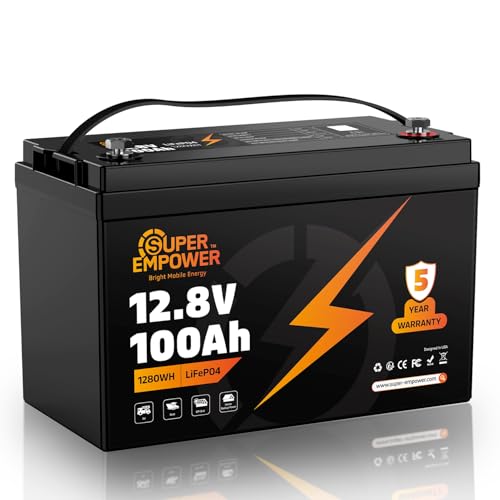
SUPER EMPOWER 12.8V 100Ah LiFePO4 Battery, Group 31
Badge: Best Expansion-Ready Unit
Strengths
- Stated 4P4S expansion support with a 20.48kWh system ceiling — the clearest growth path among single units here.
- Stated 1280Wh capacity and low-temperature cutoff cover the sizing and winter questions.
- Solar appears in its stated application list alongside RV and trolling duty.
Trade-offs
- Cycle class is not stated in the title, unlike the VEMDIA picks.
- Group 31 case only.
- The 12.8V nominal in the title occasionally confuses shoppers; it is the standard 12 volt lithium class, as the buying guide explains.
Mini spec box
- Voltage: 12.8V (12 volt class)
- Capacity: 100Ah / 1280Wh (from title)
- Chemistry: LiFePO4
- Case: Group 31
- BMS: 100A, low-temperature cutoff
- Expansion: supports 4P4S, up to 20.48kWh stated
- Stated uses: RVs, trolling motors, marine, solar
Some buyers know their panel setup will grow and want the battery purchase to be the first chapter of a bank rather than a standalone decision. This SUPER EMPOWER is that purchase: a full-size 100Ah unit whose title states formal support for series and parallel configurations up to a system ceiling far beyond any single-panel beginning. Start with one unit behind today’s panels, add its twins as the array grows, and the bank’s architecture never has to be rethought — the property that separates a system from a succession of purchases. Its low-temperature cutoff covers the unattended winter charging that panel systems do by default.
Against the VEMDIA at the top of this guide, the trade is explicitness: this unit states its expansion where the VEMDIA states its cycle class. Daily-cycling certainty favors the VEMDIA; growth-path certainty favors this one. Both are defensible defaults, and the guide’s final recommendation splits them by exactly that question.
Best for: panel systems planned to grow into banks / Not suited for: buyers who want a stated cycle class above all
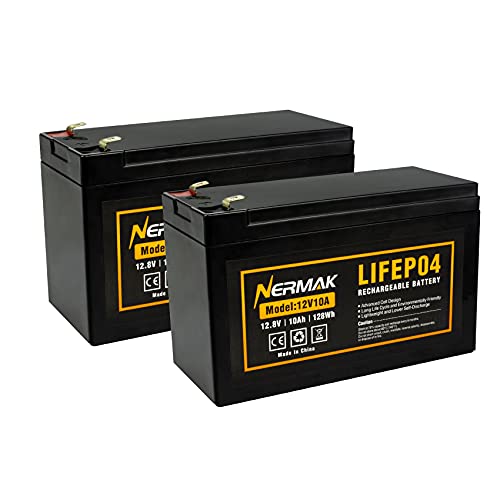
Nermak 2 Pack 12V 10Ah LiFePO4 Battery
Badge: Best for a Single Small Panel
Strengths
- Sized for reality at the small end: one modest panel refills 10Ah in a day without heroics.
- Title names solar and wind charging directly, with a stated 2000+ cycle class.
- Two units serve two separate small loads — a fish finder at the dock, lights at the shed.
Trade-offs
- 10Ah per unit is electronics territory; motors and fridges need the classes above.
- 10A BMS per unit caps loads accordingly.
- No low-temperature protection is stated in the title.
Mini spec box
- Voltage: 12V
- Capacity: 10Ah per unit
- Configuration: 2 pack
- Chemistry: LiFePO4 (lithium ion LiFePO4 per title)
- BMS: built-in 10A
- Cycle class stated: 2000+ cycles
- Stated uses: solar/wind power, scooters, lighting, Power Wheels, fish finder
Every guide needs its sense of scale restored, and the Nermak pair restores this one’s. Enormous numbers of real 12 volt solar systems are exactly this size: one small panel keeping a fish finder, a lighting circuit, a gate opener, or a remote sensor alive, indefinitely, for years. For that duty the Nermak is not a compromise but the correct engineering — its capacity matches a small panel’s daily harvest, its stated cycle class shrugs at the daily rhythm, and the two-pack format maps onto the way small loads actually scatter around a property. Its title’s application list is a census of its rightful jobs.
The boundary is appetite. The moment a load list includes a fridge, a motor of consequence, or an inverter, this battery’s class is exited and the 100Ah picks take over — a transition the buying guide’s arithmetic makes precise. Small is not a lesser category in solar; it is the category most systems honestly live in, a truth the cabin-scale examples in Best Batteries 12 Volt For Small Hunting Cabins keep confirming.
Best for: single-panel electronics, lighting, fish finders, and sensors / Not suited for: fridges, motors, or inverters
Comparison Table
| Pick | Voltage | Capacity | Chemistry | Panel pairing | Link |
|---|---|---|---|---|---|
| VEMDIA G31 Smart | 12V | 100Ah | LiFePO4 | Standard setups, daily cycling | Check on Amazon |
| Renogy AGM | 12 Volt | 100Ah | AGM | Sunny sites, kit controllers | Check on Amazon |
| SUPER EMPOWER 2 Pack | 12V | 100Ah × 2 | LiFePO4 | Growing panel counts | Check on Amazon |
| VATRER 300Ah | 12V | 300Ah | LiFePO4 | Large installations | Check on Amazon |
| SUPER EMPOWER 12.8V G31 | 12.8V | 100Ah | LiFePO4 | Expandable banks | Check on Amazon |
| Nermak 10Ah 2 Pack | 12V | 10Ah × 2 | LiFePO4 | One small panel, light loads | Check on Amazon |
How to Choose: Matching Battery Capacity to Panel Harvest
The matching rule is a single comparison: what the loads withdraw daily versus what the panels return daily, with the battery sized to bridge the two across your chosen autonomy. Estimate harvest conservatively — a panel’s rated watts multiplied by your site’s effective sun hours, discounted for season, angle, and weather honesty — and estimate loads by the audit method this program’s guides repeat: watts times hours, summed. If the daily draw is a few amp-hours of electronics, the Nermak’s class is the honest answer and anything larger is ballast. If the draw is a cabin’s or RV’s daily life, the 100Ah class is the center of the market for a reason. If the draw is a household’s, the pair or the VATRER enters — and the panel count must be audited with the same honesty, because no battery in this guide can store sunshine that was never harvested. Vehicle-adjacent panel setups, like a cart shed’s rooftop trickle system, follow the same arithmetic as Best Batteries For 12 Volt Club Car applies to strings.
Chemistry enters through charge acceptance. A panel is an impatient charger with a curfew; lithium takes in energy at full appetite until it is nearly full, which means small panels and short days are used completely. AGM’s taper spends the day’s last hours sipping, so the same panel delivers less of its potential into lead-acid across a short day. Over a long sunny season the difference narrows; over a northern winter it decides systems. Add the depth rule — lithium’s reservoir is most of its label, AGM’s sustainable reservoir is roughly half — and the panel owner has the complete comparison: for a given panel, lithium stores more of the day and returns more of the store.
How to Connect a Panel, Controller, and Battery — and Keep Them Healthy
The wiring order protects everything: battery to controller first, so the controller learns the system voltage; panel to controller second; loads last. Fuse the battery’s output, keep the controller-to-battery cables short and adequately sized, and set the controller’s profile to the battery’s chemistry before the first sunrise — a lithium battery on a lead-acid profile will undercharge politely for years while its owner blames the panel. Mount the panel where the site’s real shadows have been watched for a full day, not guessed from a morning visit, and tilt for the season you care about most rather than the season of installation.
Health is a monthly glance: the battery’s resting state after a normal day, the controller’s harvest total against the season’s expectation, terminals clean and tight. Portable setups — the folding panel on the RV, the suitcase kit at camp — add one ritual: connectors inspected for the grit and corrosion that mobile life guarantees, since a resistive connection is a silent tax on every harvest.
Problem: the battery is emptier every morning despite sunny days → audit for a parasitic load and check the controller’s profile before suspecting the panel. Problem: charging stops on cold bright mornings → lithium low-temperature protection is doing its job; shelter the battery or step to the self-heating pick. Problem: the system worked in summer and fails in autumn → the harvest shrank with the days; the honest fixes are more panel, fewer loads, or a battery whose acceptance wastes less of a short day.
Portable Panels and the Moving System
A large share of 12 volt panel life is mobile: RV roofs, boat rails, folding kits that follow a campsite’s sun. Mobility changes the battery brief in two ways. First, vibration and handling argue for the sealed, BMS-guarded lithium units in this guide over any design that minds being moved — all six picks are sealed, and the lithium five carry their protection internally. Second, harvest becomes opportunistic: the panel points where the vehicle parks, not where an engineer would aim it, and daily yields swing wildly. Opportunistic harvest rewards eager charge acceptance and a reservoir sized for feast-and-famine — full after the perfect day, patient through the shaded one. The 100Ah class is the mobile sweet spot for exactly this reason, with the 2-pack serving the full-timers whose famine days are somebody else’s problem to schedule around.
What “12 Volt Panel” Really Means
The label deserves one clear paragraph, because it confuses more buyers than any other in the category. A panel sold for 12 volt systems is a nominal product: its actual output voltage floats above the battery’s voltage in good light — which is what allows charging at all — and collapses toward it in poor light. The charge controller exists to manage that float, either by direct connection in simple PWM designs or by conversion in MPPT designs that can also harvest from higher-voltage strings. Two consequences follow for battery shoppers. First, the battery’s job is defined by the controller’s output, so controller compatibility — especially the chemistry profile — is part of the battery purchase. Second, the 12.8V in one pick’s title is not a different system: it is the nominal architecture of four lithium cells, recognized by every 12 volt controller as its own class. Buyers who internalize those two points stop being confused by listings and start reading them the way this guide does — voltage class first, chemistry second, capacity third.
A Day in the Life of a Panel and Its Battery
Follow one ordinary day to see why the pairing virtues in this guide matter. Dawn finds the battery at its lowest, carrying the night behind it. The panel wakes before the household does, producing a trickle the controller passes to a battery whose appetite — if it is lithium — is already full: every early watt-hour lands. Mid-morning brings real harvest; by noon the system is either approaching full, in a well-matched setup, or still climbing with the afternoon to help it, in an ambitious one. The afternoon tests the match from the other side, as loads wake up while the panel is still producing — the graceful systems serve loads directly from the sun and let the battery finish filling; the strained ones borrow from the battery at noon and repay at dusk. Evening is the battery’s solo shift, and the depth it reaches by bedtime is the day’s final grade. Owners who watch this cycle for a week know their system’s truth more completely than any specification sheet can state it, which is why this guide keeps prescribing observation alongside arithmetic: the arithmetic chooses the battery, and the week confirms the choice.
Upgrading From the Battery That Came With the Kit
Many panel systems begin with a bundled or inherited battery — often a modest lead-acid unit — and the upgrade moment arrives when its limits become the system’s limits. The upgrade audit has three questions. First, the controller: does it offer a lithium profile, or does the battery upgrade become a controller upgrade too? Second, the wiring: were the cables sized for the old battery’s gentler currents, and do the fuses match the new bank’s abilities? Third, the expectation: a lithium replacement of the same nameplate roughly doubles the working reservoir, which changes daily rhythms — loads previously rationed become casual, and the panel’s curtailment pattern shifts — so the first weeks deserve the monitoring habit rather than assumptions carried over from the old chemistry. Owners who treat the upgrade as a small system project, rather than a like-for-like swap, consistently report that the new battery feels larger than its label; owners who swap blindly sometimes conclude, wrongly, that nothing improved. The hardware is rarely the difference. The audit is.
Safety and Fusing in Small Solar Systems
Small systems forgive many things, but a battery is an energy reservoir at any scale, and its basic protections are not optional garnish. A fuse or breaker on the battery’s main output, sized to the wiring, is the difference between a fault and a fire story. Terminals should be covered or booted where tools and weather wander. The battery itself should be secured — in a boat or RV, against motion; in a cabin, against the curiosity of animals and the damp of floors. Lithium’s internal BMS protects the cells from electrical abuse, and the AGM’s sealed case removes the acid-handling chapter entirely, but neither replaces the owner’s part: correct polarity, tight connections, and a disconnect that makes the system safe to service. Panel wiring deserves the same respect at the other end — connectors fully seated, cables protected from edges and ultraviolet where they run outdoors. None of this is advanced practice; all of it is the difference between a system that ages and a system that surprises.
Storage Between Seasons: The Panel System at Rest
Seasonal panel systems — the cabin that closes in November, the RV that winters in storage, the boat on its trailer — ask their batteries to do the hardest thing in this category: nothing, for months, without harm. The chemistries rest differently. Lithium wants a partial state of charge, a disconnect thrown, and a cool dry place; left so, it wakes in spring nearly as it slept, and its low self-discharge makes the pattern forgiving of imperfect calendars. AGM wants the opposite state — stored full, with its stated 3 percent self-discharge topped up across the season — because a lead-acid battery stored discharged is quietly dismantling itself. The panel’s role in storage is a genuine choice: a connected panel with a correctly profiled controller can maintain either chemistry through winter where snow and shade allow, while a disconnected system trades that maintenance for absolute simplicity. Either is defensible; the indefensible pattern is the unconsidered one, where the system’s storage state was decided by whoever happened to close the cabin door. Write the storage state on a tag, tie it to the disconnect, and spring becomes a recommissioning instead of an investigation.
Reading a Battery Title Like an Engineer
This guide has quoted six titles forensically, and the habit is transferable to every listing a panel shopper will ever meet. Read a battery title in a fixed order. Voltage first — the class must match the system, with 12.8V recognized as lithium’s 12 volt dialect. Chemistry second — LiFePO4 and AGM are different ownership contracts wearing similar cases. Capacity third, converted mentally to watt-hours when comparing across any boundary. Then the working figures: the BMS current that caps discharge and, in parallel banks, scales with units; the cycle class that predicts daily-duty lifespan; the protection lines that decide winter behavior; and the configuration language that states whether the unit may grow into a bank. Whatever the title omits — and the omissions in this guide’s six titles are catalogued in every review — is a question to ask the listing, never a gap to fill with hope. A shopper who reads titles this way needs roundups less and trusts them more, which is a fair description of what this program’s guides are for.
When the Answer Is More Panel, Not More Battery
A guide about batteries should say plainly when the battery is not the purchase to make. The symptom is a bank that ends every day lower than it began despite healthy equipment: loads within the battery’s class, connections sound, profile correct — and a harvest that simply does not cover the day. Owners meet this moment most often in autumn, when a system balanced for summer tips into deficit, and the temptation is to buy capacity, because capacity is this guide’s subject. Resist it. A bigger battery in a deficit system is a bigger bucket under the same thin tap: it empties more slowly and refills never. The correct purchase is harvest — another panel, a better angle, a shadow removed — after which the original battery often proves to have been right all along. The mirror-image symptom, a battery full by noon daily while loads go begging at night, is the one genuine call for more storage, and this guide’s pair and big-case picks answer it. Telling the two apart takes one week of honest observation, and it is the highest-value week in solar ownership.
The Second Life of a Panel Battery
One quiet virtue unites this guide’s lithium picks: a battery retired from a growing solar system is rarely finished. The 100Ah unit displaced by a 2-pack becomes the shed’s lighting battery, the dock’s fish-finder reservoir, the emergency light-and-radio reserve in the house — duties at exactly the depth and tempo an experienced battery handles gracefully. Planning for that cascade changes purchase logic slightly: a unit with stated expansion support and a common case size redeploys more easily than an orphan format, and a battery whose history is known — its cycles, its winters, its treatment — is a trustworthy hand-me-down in a way a stranger’s used battery never is. Owners who keep a one-line log per battery, purchase date and role, own the information that makes cascades safe. It is a fitting closing note for a guide about matching: the best battery for a panel is often, years later, the best battery for the next smaller job too.
Common Buying Mistakes
- Pairing a huge battery with a tiny panel. The reservoir never fills, the owner concludes solar does not work, and the actual fault was proportion.
- Pairing a tiny battery with real loads. The Nermak’s class is honorable and bounded; fridges and inverters live in the 100Ah class.
- Skipping the controller’s chemistry profile. The most common silent failure in the entire category.
- Judging a site by its morning. Shadows are a full-day phenomenon; watch before mounting.
- Ignoring the taper in winter. AGM plus short days plus a small panel is the classic partial-charge trap.
- Assuming 12.8V is a different system. It is the lithium 12 volt class, as the section above explains.
Final Recommendation
For the standard panel setup, start with the VEMDIA Smart BMS 100Ah: the strongest stated cycle class for daily panel duty, cold protection for bright winter mornings, and the class-standard reservoir. If your system is planned to grow panel by panel, take the SUPER EMPOWER 12.8V Group 31 instead for its explicitly stated expansion path — or its Group 24 2-pack sibling when the growth has already happened. The Renogy AGM serves sunny sites and simple controllers honorably, the VATRER crowns the large installation, and the Nermak pair remains the right answer for the single small panel and the light load — which is where, if we are all honest, most solar stories begin.
Related guides
Frequently Asked Questions
What size battery do I need for one solar panel?
It depends on the panel’s wattage and your loads, but the matching principle is simple: the battery should store roughly what the panel harvests across one to two days, and serve loads no larger than that harvest sustains. A single small panel with electronics-class loads pairs with the Nermak class; a larger single panel feeding cabin or RV loads pairs with the 100Ah class. The audit, not the panel count alone, gives the final number.
Can I connect a solar panel directly to a battery without a controller?
Do not. Without a controller, the panel’s floating voltage can overcharge the battery in strong sun and the battery can drain back through the panel at night. The controller is the cheapest component in the system and the one that makes every battery in this guide behave as its title promises — including the correct chemistry profile, which no direct connection can provide.
Why does my panel charge my lithium battery slowly in winter?
Two effects compound: winter harvest is smaller and later, and lithium low-temperature protection may refuse charging until the battery warms — visible on exactly the bright cold mornings when panels produce best. Sheltering the battery helps; the self-heating VATRER in this guide is the pick designed to remove the second effect entirely.
Is a 12.8V battery compatible with my 12 volt panels and controller?
Yes. 12.8 volts is the nominal voltage of a four-cell lithium iron phosphate battery, and 12 volt controllers and systems treat it as their own class — the SUPER EMPOWER pick in this guide is a 12 volt system battery in every practical sense. Set the controller to its lithium profile and the pairing is standard.
AGM or lithium behind an RV’s roof panels?
Lithium suits the RV pattern — opportunistic harvest, deep evening loads, weight sensitivity — and its charge acceptance wastes less of a parked-in-shade day. AGM remains reasonable where the RV’s existing controller and wiring are lead-acid throughout and the site pattern is sunny and stationary. The conversion question is a charger question first, as the club car guide in this program also concludes.
Can I use two different batteries from this guide together?
Not in one bank. Parallel and series banks require identical units — same model, capacity, chemistry, and age — so that charge and discharge are shared evenly. The correct pairings in this guide are twins: two of the same SUPER EMPOWER unit (sold as the 2-pack), two Renogy units for an AGM bank, and so on. Different loads around a property can absolutely use different picks on separate systems — the Nermak at the dock and a 100Ah unit at the cabin is a sensible property, as long as each system is internally matched.
Do these batteries work with folding or portable panels?
Yes — the battery cannot tell whether its controller is fed by a roof array or a folding kit, and the pairing logic is unchanged: match capacity to realistic harvest, set the controller’s chemistry profile, and respect the cold rules. Portable duty does favor the sealed lithium picks for their handling tolerance, and the 100Ah class is the usual sweet spot for kits that move between campsites.
How long will a 100Ah battery take to recharge from panels?
It depends on the array’s real harvest: replacing 60 amp-hours takes most of a good day behind a modest panel setup and a few bright hours behind a large one. The planning figure is your site’s effective sun hours multiplied by the system’s realistic charging current — and the reason this guide insists on sizing battery and panel together rather than quoting a universal number.