Disclosure: topratedkitchenware.com is reader-supported. When you buy through links on our site, we may earn an affiliate commission from Amazon and other retailers, at no extra cost to you.
Where to buy
Here is the shortlist for anyone comparing best travel blenders for vehicles: every pick below was verified against live Amazon listing data on 2026-11-21, but read the labels carefully — some pool machines did not meet this keyword’s core requirement and are covered prose-only, with no purchase link, for the reason stated in their reviews. The linked picks are the ones this guide can honestly recommend for the job. Prices move constantly, so use the links to check the latest price on Amazon, and read the full guide ↓ before deciding.
- Magic Bullet Personal Blender, 22 oz — check the latest price on Amazon
- Hamilton Beach Portable Blender, 14 oz (Raspberry) — check the latest price on Amazon
- Cberhrik Personal Travel Portable Blender, 380 ml — check the latest price on Amazon
- Sleetop Portable Blender, 17 oz (Black) — check the latest price on Amazon
- Sleetop Portable Blender, 17 oz (White) — check the latest price on Amazon
- Vitamix Quiet One 36019, 48 oz — covered prose-only in this guide (see the detailed review for why)
Blending in a vehicle — on a road trip, at a campsite, in a work truck or a camper — is a power problem before it is a blender problem, and the best travel blenders for vehicles are the ones whose power story survives contact with a real car. The six picks here split cleanly by that story: two USB-C rechargeable portables (the Sleetop in black and white) that sip power from any vehicle USB socket, a mini portable (Cberhrik), two corded personal blenders (Magic Bullet and Hamilton Beach) that need an inverter, and one full-size commercial Vitamix that does not belong in a vehicle at all and is covered prose-only to show why.
That split is the guide’s backbone. If your vehicle has USB power — nearly every modern one does — the rechargeable picks are the native answer: blend at a rest stop, recharge while you drive. If your setup includes a proper inverter, as many camper and work-truck setups do, the corded personal blenders join the menu with stronger blending in exchange for more hardware. The reviews judge each pick by vehicle reality: power draw, stability, cup security and cleanup with limited water.
A safety frame before the detail, because it shapes every recommendation: blending happens parked, never moving; cups are secured or held, never loose on a dashboard; and the driver’s only job at a blending stop is to be parked. Within that frame, a smoothie at a scenic overlook is one of road travel’s small luxuries, and this guide is about choosing the machine that delivers it reliably. If you are comparing across the wider category while you decide, our companion guide to Best Travel Size Smoothie Blenders covers the neighbouring ground.
Key Takeaways
- USB-C rechargeable picks (both Sleetop colours) are the native vehicle answer: they charge from the car while you drive and blend while you are parked.
- Corded personal blenders (Magic Bullet, Hamilton Beach) work in vehicles only through an inverter — budget the inverter’s size and the vehicle battery’s patience.
- The Cberhrik mini is the glovebox-scale option for soft drinks and shakes at stops.
- The Vitamix Quiet One is covered prose-only: a 48 oz commercial countertop machine is not a vehicle blender, and this guide will not pretend otherwise.
- Blend parked, secure the cup, and plan cleanup around limited water — a rinse bottle is part of the kit.
In this guide
Quick Picks
Six models, six different answers to the same question. The badges below are used consistently through the detailed reviews, so the model you spot here is easy to find again further down the page.
| Pick | Badge | Best for | Link |
|---|---|---|---|
| Magic Bullet Personal Blender, 22 oz | Best with an Inverter | students, desk workers and beginners wanting the simplest personal blender routine | Check on Amazon |
| Hamilton Beach Portable Blender, 14 oz (Raspberry) | Best Corded Cup Pick | single-serve users who want the personal blender format in a brighter finish | Check on Amazon |
| Cberhrik Personal Travel Portable Blender, 380 ml | Best Mini for the Bag | gym and office users blending soft drinks and shakes away from a kitchen | Check on Amazon |
| Sleetop Portable Blender, 17 oz (Black) | Best USB-C Vehicle Pick | commuters, travellers and gym users who value cordless, charge-anywhere blending | Check on Amazon |
| Sleetop Portable Blender, 17 oz (White) | Best Colour Choice | cordless blender buyers who prefer a white finish for desk or travel kit | Check on Amazon |
| Vitamix Quiet One 36019, 48 oz | Not a Vehicle Pick (Prose-Only) | small cafés, juice bars and serious home drink stations wanting programmed consistency | Prose-only coverage |
How These Picks Were Chosen
The verified pool mixed genuine vehicle-suitable portables with corded personal blenders and one commercial countertop machine. We kept all six but applied the brief’s prose-only rule to the Vitamix: it fails the keyword’s core requirement outright, so it is reviewed without a purchase link or image, as a home-base contrast. The remaining five are judged on vehicle power reality — USB charging, inverter dependence and battery capacity — with specifications taken from the verified listings.
Our method is research-led and we are straightforward about its limits: this guide is built from verified listing data, manufacturer specifications and the accumulated pattern of owner experience, not from a test kitchen bench. That honesty cuts both ways — we will not claim to have blended a single smoothie ourselves, and in exchange every factual claim in the article can be traced to the sources file published with it, which records each product’s name, ASIN, exact listing title, image source and check date.
Three filters decided the final presentation. First, specification completeness: a model had to state its capacity, power and key features clearly enough to be compared without guesswork. Second, keyword fit: a pick that does not meet the core requirement of best travel blenders for vehicles is covered prose-only rather than linked under a false description. Third, ownership practicality — cleaning, controls and footprint — because a model that is miserable to live with is a bad recommendation at any level of blending performance. Readers working through a broader shortlist may also find our guide to Best Travel Smoothie Blenders useful alongside this one.
The 6 Best Best travel blenders for vehicles Picks, Reviewed in Detail

Magic Bullet Personal Blender, 22 oz
Badge: Best with an Inverter
Strengths
- The original personal blender format: blend in the cup, swap the lid, go
- Three to-go cups and a travel lid make the routine genuinely rotation-friendly
- Tiny base footprint suits dorms, offices and the smallest counters
Trade-offs
- 250 watts is for soft ingredients and shakes; frozen fruit needs thawing or liquid help
- Press-down operation gives less control than dial or program machines
- Cup capacity serves one, always
Key specifications
- Power: 250 watt base
- Capacity: 22 oz cup
- Included: 3 to-go cups and 1 travel lid
- Cleaning: Dishwasher safe parts
- Model: MBR-1101
- Finish: Silver
The Magic Bullet is the design that defined personal blending: a 250-watt base, a 22 oz cup, and a press-and-twist operation so simple it barely needs instructions. This set includes three to-go cups and a travel lid, which is the detail that makes the format work as a daily system rather than a novelty — there is always a clean cup. Its limits are the format’s limits: soft ingredients, single servings, and frozen fruit only with liquid and patience. Within those limits it remains the reference for dorm rooms, desks and first smoothies, decades of owners having proven the routine.
For vehicle use, judge the Magic Bullet Personal Blender, 22 oz by its 250 watt base and by the power question every car blender must answer: where does its energy come from on the road — a battery, a USB socket, or an inverter — and does that source match the vehicle you actually drive? The blending itself is the easy part; the logistics decide ownership.
Best for: students, desk workers and beginners wanting the simplest personal blender routine / Not suited for: frozen-fruit power users or anyone blending for more than one

Hamilton Beach Portable Blender, 14 oz (Raspberry)
Badge: Best Corded Cup Pick
Strengths
- Identical blend-and-go mechanics to the blue version, in a raspberry finish
- 14 oz jar doubles as the travel cup — one vessel to wash
- Compact footprint suits the smallest kitchens and office corners
Trade-offs
- Same 300-watt ceiling: soft ingredients yes, hard ice no
- Strictly single-serving capacity
- Colour is the only difference from its blue sibling — buy on looks
Key specifications
- Capacity: 14 oz travel jar
- Power: 300 watts peak power
- Jar: BPA-free jar and lid
- Blades: Stainless steel
- Model: 51131G
- Finish: Raspberry
The raspberry version of Hamilton Beach’s portable blender is mechanically identical to the blue one listed alongside it: 300 watts peak power, stainless blades and a 14 oz BPA-free travel jar that blends on the base and then goes with you. We list it separately because at this tier the finish genuinely is a buying factor — the machine lives visible on a counter or desk, and the colour you like is the one you will use daily. Performance expectations should be set exactly as for its sibling: soft-fruit smoothies, shakes and protein drinks handled happily, ice-heavy blends beyond its brief.
For vehicle use, judge the Hamilton Beach Portable Blender, 14 oz (Raspberry) by its 14 oz travel jar and by the power question every car blender must answer: where does its energy come from on the road — a battery, a USB socket, or an inverter — and does that source match the vehicle you actually drive? The blending itself is the easy part; the logistics decide ownership.
Best for: single-serve users who want the personal blender format in a brighter finish / Not suited for: anyone expecting a capability difference from the blue version

Cberhrik Personal Travel Portable Blender, 380 ml
Badge: Best Mini for the Bag
Strengths
- 380 ml mini format is genuinely pocket-of-the-gym-bag sized
- Made for fresh juice and shakes at the point of consumption
- BPA-free cup suits daily carry
Trade-offs
- 380 ml is a small serving even by personal standards
- Mini portables blend soft fruit and powders; ice and hard frozen chunks are out
- Small motors need short cycles and rests between blends
Key specifications
- Capacity: 380 ml BPA-free cup
- Type: Mini portable blender
- Use cases named in listing: Fresh juice, shakes, sports, travel, home
The Cberhrik mini is a portable blender in the strict sense: a 380 ml BPA-free cup with blending built in, aimed at fresh juice and shakes wherever the user happens to be — sports, travel or home. That capacity is a deliberate trade: it disappears into a bag in a way no corded personal blender can, and in exchange it asks for soft ingredients, modest servings and realistic expectations. For protein powder, soft fruit and juice-style drinks at the gym or the office, the format is exactly right. It is a companion appliance, not a kitchen blender replacement.
For vehicle use, judge the Cberhrik Personal Travel Portable Blender, 380 ml by its 380 ml bpa-free cup and by the power question every car blender must answer: where does its energy come from on the road — a battery, a USB socket, or an inverter — and does that source match the vehicle you actually drive? The blending itself is the easy part; the logistics decide ownership.
Best for: gym and office users blending soft drinks and shakes away from a kitchen / Not suited for: anyone wanting it to replace a real countertop or personal blender
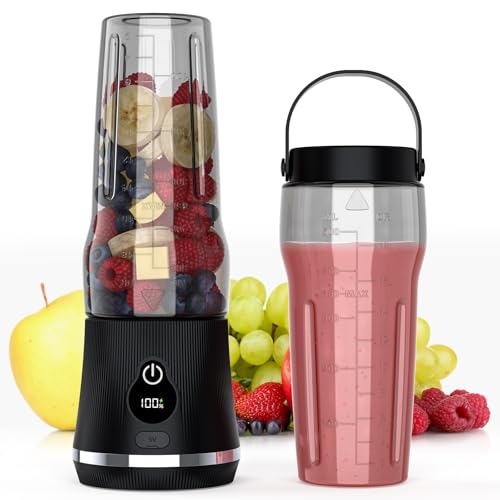
Sleetop Portable Blender, 17 oz (Black)
Badge: Best USB-C Vehicle Pick
Strengths
- USB-C rechargeable: blends anywhere a phone charger reaches, no outlet hunt
- 17 oz is a full personal serving, larger than most rechargeable rivals
- LED display and an extra lid make it feel like a designed product, not a novelty
Trade-offs
- Battery blending is gentler than corded power — frozen chunks need restraint
- Rechargeable means charge management joins the routine
- Six-blade mini systems still need liquid first for even results
Key specifications
- Capacity: 17 oz
- Power: USB-C rechargeable
- Blades: 6 stainless steel blades
- Display: LED display
- Included: Extra lid
- Finish: Black
The Sleetop in black is the modern portable formula done properly: a 17 oz cup, six stainless blades, USB-C recharging and an LED display, with an extra lid in the box. USB-C is the detail that matters — the same cable that charges a phone tops it up at a desk, in a car or from a power bank, which is what makes a portable blender actually portable in practice. Its blending brief is the portable one: protein shakes, soft-fruit smoothies and juice drinks, made fresh where you drink them. Treat frozen ingredients as small and partly thawed, and it rewards you with a routine no corded machine can match for freedom.
For vehicle use, judge the Sleetop Portable Blender, 17 oz (Black) by its 17 oz and by the power question every car blender must answer: where does its energy come from on the road — a battery, a USB socket, or an inverter — and does that source match the vehicle you actually drive? The blending itself is the easy part; the logistics decide ownership.
Best for: commuters, travellers and gym users who value cordless, charge-anywhere blending / Not suited for: ice-heavy frozen drinks or high-volume daily blending

Sleetop Portable Blender, 17 oz (White)
Badge: Best Colour Choice
Strengths
- Same USB-C cordless system as the black version, in a white finish
- 17 oz capacity and six blades cover the realistic portable repertoire
- Extra lid included for blend-now, drink-later flexibility
Trade-offs
- Identical capability to the black version — the decision is cosmetic
- Battery power sets the same frozen-ingredient limits
- White shows smoothie stains more readily; rinse promptly
Key specifications
- Capacity: 17 oz
- Power: USB-C rechargeable
- Blades: 6 stainless steel blades
- Display: LED display
- Included: Extra lid
- Finish: White
The white Sleetop is the same portable system as its black sibling — 17 oz, six stainless blades, USB-C recharging, LED display and a spare lid — in the finish that suits lighter bags, desks and kitchens. We list it separately so the comparison is honest: there is no performance difference to hunt for, and the right way to choose is by which one you would rather look at and carry daily. Its working brief matches the black model exactly: fresh shakes and soft smoothies anywhere, frozen ingredients in moderation, and a charging habit borrowed from your phone.
For vehicle use, judge the Sleetop Portable Blender, 17 oz (White) by its 17 oz and by the power question every car blender must answer: where does its energy come from on the road — a battery, a USB socket, or an inverter — and does that source match the vehicle you actually drive? The blending itself is the easy part; the logistics decide ownership.
Best for: cordless blender buyers who prefer a white finish for desk or travel kit / Not suited for: anyone expecting different performance from the black version
Vitamix Quiet One 36019, 48 oz
Badge: Not a Vehicle Pick (Prose-Only)
Coverage note: this pick is reviewed prose-only, with no purchase link and no image, because it does not meet this keyword’s core requirement. This is a full-size 48 oz commercial countertop bar blender. It cannot run from a vehicle power system in any practical sense and cannot honestly be recommended for vehicle use, so it is covered prose-only — no purchase link, no image — as a home-base contrast only.
Strengths
- Six program buttons give drink service one-touch repeatability
- Commercial bar design built for continuous, all-day drink production
- Polycarbonate 48 oz container is the café-standard format
Trade-offs
- Commercial bar priorities: home recipe versatility is secondary
- A 48 oz drinks jar is not a family soup solution
- Professional tier and footprint for a specialised role
Key specifications
- Capacity: 48 oz polycarbonate container
- Programs: 6 program buttons
- Type: Commercial bar blender
- Finish: Black
The 36019 Quiet One is the commercial original of the Quiet One concept: a 48 oz polycarbonate container, six program buttons for repeatable drink cycles, and a build intended for cafés where the blender runs all day. The program buttons are the working detail — in drink service, consistency across a hundred blends matters more than improvisation, and one-touch cycles deliver it. In a home it suits the serious drinks household or the small business owner blending at home volumes with commercial expectations. Everyone else is buying capacity for a job they do not have.
For vehicle use, judge the Vitamix Quiet One 36019, 48 oz by its 48 oz polycarbonate container and by the power question every car blender must answer: where does its energy come from on the road — a battery, a USB socket, or an inverter — and does that source match the vehicle you actually drive? The blending itself is the easy part; the logistics decide ownership.
Best for: small cafés, juice bars and serious home drink stations wanting programmed consistency / Not suited for: general home cooks who need one versatile family blender
Comparison Table
| Model | Badge | Standout specification | Key feature | Link |
|---|---|---|---|---|
| Magic Bullet Personal Blender, 22 oz | Best with an Inverter | Power: 250 watt base | 22 oz cup | Check on Amazon |
| Hamilton Beach Portable Blender, 14 oz (Raspberry) | Best Corded Cup Pick | Capacity: 14 oz travel jar | 300 watts peak power | Check on Amazon |
| Cberhrik Personal Travel Portable Blender, 380 ml | Best Mini for the Bag | Capacity: 380 ml BPA-free cup | Mini portable blender | Check on Amazon |
| Sleetop Portable Blender, 17 oz (Black) | Best USB-C Vehicle Pick | Capacity: 17 oz | USB-C rechargeable | Check on Amazon |
| Sleetop Portable Blender, 17 oz (White) | Best Colour Choice | Capacity: 17 oz | USB-C rechargeable | Check on Amazon |
| Vitamix Quiet One 36019, 48 oz | Not a Vehicle Pick (Prose-Only) | Capacity: 48 oz polycarbonate container | 6 program buttons | Prose-only |
Read the table as a map, not a ranking shortcut: the standout specification column shows what each maker chose to compete on, and the right choice is the model whose chosen strength matches the job your kitchen actually has.
How to Choose: Best travel blenders for vehicles
Start with the batch you actually blend. Capacity claims only matter translated into your servings: how many smoothies, of what size, how many mornings a week? A jar or cup matched to that number blends better than an oversized one — small loads in big jars splash and stall — and costs less counter and cupboard. Buy for the routine batch, with modest headroom, not for the largest party you can imagine.
Match power to your hardest regular ingredient. Soft fruit and protein powder ask little of any motor in this guide. Frozen fruit asks more; ice as a main ingredient and daily repetition ask the most, and they are the jobs that separate formats honestly. Read power figures carefully — peak watts and sustained working power are different claims — and weight the format’s track record with your hardest ingredient over any headline number.
Judge the routine, not just the result. Every blender in this guide can produce a good smoothie on its best day. The one you will love is the one whose full routine — set up, blend, rinse, store — fits your mornings. Blend-in-cup systems minimise washing; self-cleaning countertop models automate it; stick blenders rinse in seconds but need a vessel. Our guide to Best Prices On Ninja Blenders explores the neighbouring options if your shortlist is still growing.
Measure the home before the machine. Counter height under cabinets, cupboard shelf depth, drawer space for a stick blender, bag dimensions for a travel pick — these measurements eliminate more bad purchases than any specification. A blender is furniture as much as appliance: the one that fits your space’s daily life will be used, and the one that must be excavated will not, whatever its listing promises.
How to Use a Blender Well, Step by Step
- Load in order. Liquids and soft ingredients first, powders next, frozen and hard ingredients last, so the vortex forms at the blades and pulls the heavy items down gradually.
- Start slow, then build. A few seconds at low speed settles the mixture and prevents the air pocket that makes blenders spin without cutting; then raise the speed to working level.
- Blend to texture, not to time. Watch and listen: the mixture should turn over evenly and the motor note should steady. That steady point, not the clock, is doneness.
- Use the tamper or pause and stir where the design provides for it. Thick mixtures need help circulating; forcing a stalled blend only heats the motor.
- Taste and adjust before serving. A spoonful now can be fixed with citrus, sweetness or a pinch of salt; a served smoothie cannot.
- Rinse immediately. Empty, rinse, and where the design allows, blend warm water with a drop of washing-up liquid for a few seconds, then rinse again and leave to dry open.
Two habits separate consistent results from lucky ones. First, keep quantities honest: every format has a fill range in which its vortex works, and both underfilling and overfilling defeat it — the max line is a blending specification, not a serving suggestion. Second, manage temperature: frozen ingredients go in frozen for smoothies, but a motor worked hard on dense loads deserves short rests between cycles. Readers setting up a first machine may also want the setup notes in our guide to Best Prices On Ninja Or Vitamin Blenders.
Troubleshooting. Problem: the mixture spins but nothing blends → an air pocket has formed around the blades; stop, stir or tamp the mixture down, add a spoonful of liquid if it is very dry, and restart slowly. Problem: the motor strains and the smell turns warm → the load is too dense or too long; rest the machine, split the batch, and add frozen ingredients in stages next time. Problem: the result is grainy when it should be smooth → the blend was stopped early or the speed never reached working level; give it a shorter additional burst at full speed rather than a long slow one.
Powering a Blender in a Vehicle: Batteries, USB and Inverters
Three power paths exist, in ascending order of hassle. First, the rechargeable blender’s own battery: charge it from the vehicle’s USB socket or a 12V USB adapter while driving, and it blends independently at the stop. This is why the Sleetop format dominates vehicle recommendations — the car becomes a charging station without any additional hardware, and the blending itself draws nothing from the vehicle at all.
Second, USB power banks: a bank charged at home or from the car extends any rechargeable blender’s range across a weekend. Third, the inverter path for corded blenders: an inverter converts the vehicle’s 12V supply to mains power, and it must be sized honestly for the blender’s draw and the vehicle battery’s health. Run corded blending with the engine on where the setup allows, keep sessions short, and never discover your battery’s limits at a remote trailhead.
Whichever path you choose, test it at home in the driveway before the trip. Vehicle power questions answered at home are trivia; answered three hours from town, they are the trip. The five linked picks in this guide were chosen so that at least one honest path exists for every common vehicle setup.
Road Rules: Blending Safely and Cleanly at Stops
Park first, blend second — always. A moving vehicle adds vibration, spills and distraction to a task involving blades, and no smoothie is worth any of them. Choose stops where the vehicle is level: a tilting cup in an unlevel car park blends unevenly and spills enthusiastically. Blend on a stable surface — a folded towel on a seat or the boot floor damps vibration and catches drips.
Water is the scarce resource in vehicle blending, so cleanup is a system: a rinse bottle with a sports cap, a small cloth, and the blend-water-with-a-drop-of-soap trick done immediately. Sticky residue left to dry in a hot car becomes the trip’s least welcome souvenir. Keep ingredients in a cool bag, treat dairy with the respect a warm afternoon demands, and the road smoothie stays a pleasure rather than a gamble.
Finally, secure everything for the drive. Cups travel empty and washed or full and sealed — never half-full and open — and the blender rides in the bag it arrived in. The road rewards tidy systems and punishes improvisations, in blending as in everything else. For a neighbouring angle on the same shortlist, see our guide to Best Prices On Ninja Or Vitamix Blenders.
More to Know Before You Buy
Charge discipline is the vehicle blender’s whole routine: plug the Sleetop in when the engine starts, unplug it when you stop, and the battery is simply always ready. Travellers who treat charging as part of driving — like fuel and navigation — never meet the flat-battery disappointment that gives portable blenders an unfair reputation.
Keep a small “blend kit” in the vehicle permanently: the rinse bottle, cloth, a spoon, and shelf-stable smoothie supplies like protein sachets and UHT milk portions. With the kit resident, the blender is the only thing to remember — and a routine with one thing to remember is a routine that survives real trips.
Jar and cup materials deserve one clear-eyed paragraph. BPA-free plastic vessels, as most picks in this guide use, are light, drop-tolerant and kind to arthritic wrists, at the cost of eventual clouding and a tendency to hold strong flavours like coffee and turmeric. Glass is heavier and breakable but shrugs off stains and odours. Neither is morally superior; match the material to your household’s clumsiness and your menu’s strongest flavours.
Noise is a real ownership factor that specification sheets never print. Every blender is loud at full effort; the differences are in duration and pitch. Short, powerful blends are usually more neighbour-friendly than long, weak ones, and a folded towel under the base measurably softens what reaches the counter and the flat below. Early-morning smoothie households should treat noise as a feature to manage, not a surprise to discover.
Storage decides whether a blender is an appliance or an ornament. Machines that live assembled on the counter get used; machines that must be fetched, assembled and later dried and dismantled get used on weekends. Before buying, nominate the machine’s home — the exact counter corner or cupboard shelf — and check its height and footprint against that space in writing. Half of all blender disappointment is a storage plan that never existed.
Blades and couplings wear by load, not by time. A machine asked weekly for rock-hard frozen blends ages faster than one used daily for soft smoothies, which is why matching the machine to the menu matters more than brand loyalty. If your menu is hard, buy the format built for it and let it work within its design; if your menu is gentle, a lighter machine honestly serves you better and longer.
A small notebook — or a note on the phone — transforms blender ownership within a month. Record the three blends you make most: quantities, order, speed and time. Recipes stop being approximations, guests get the same smoothie you bragged about, and troubleshooting becomes comparison against a known-good baseline instead of guesswork. Experienced owners are not more talented; they are better documented.
Water quality quietly affects blended drinks more than owners expect. Heavily chlorinated tap water can flatten delicate smoothies and coffee drinks alike; a simple filter jug, already common in tea and coffee households, improves blender output for free. It is the cheapest upgrade in this entire category, and the one nobody mentions.
Finally, buy the blender for the household’s least confident user as well as its most enthusiastic one. Appliances are shared infrastructure: a machine only one person dares operate halves its own usefulness. Simple controls, secure lids and forgiving cleaning are household features, and the picks in this guide were weighed with every user in the house in mind.
Rinse timing is the single biggest determinant of how a blender ages. Blended food rinsed within a minute leaves almost nothing behind; the same food left for an hour bonds to the jar, the gasket line and the blade assembly, and every later clean is harder than the first should have been. Build the rinse into the routine — fill, blend plain water for a few seconds where the design allows, rinse again — and the machine stays new-looking for years rather than months.
Counter space planning should include the machine’s working envelope, not just its footprint. Jars lift upward, stick blenders need a vessel and elbow room, and personal cups need a landing zone for lids and blade units. A blender that fits its shelf but cannot be operated without moving three other appliances will be operated rarely. Walk the full routine in your head, in your actual kitchen, before the box is opened.
Seasonal blending deserves a thought, because menus rotate and machines should be bought for the whole year. Summer brings frozen drinks and gazpacho; autumn brings soups; winter brings sauces and nut butters; spring brings green smoothies by the litre. A machine chosen in July for frozen drinks alone may disappoint in November. The guides in this series weight year-round versatility precisely because the purchase has to survive all four menus.
Second-hand and hand-me-down blenders are common in this category, and they can be excellent value, with two checks. First, the blade assembly and drive coupling: wear here is expensive or terminal. Second, the vessel: cracks, deep clouding and damaged threads are reasons to walk away. Everything else — a faded finish, a missing tamper, a lost manual (all manuals live online) — is negotiable. Buy the mechanics, forgive the cosmetics.
Blending for children and for older relatives is a design brief of its own. Secure, obvious lids; controls that cannot be started accidentally mid-assembly; cups with lids that genuinely seal in a school bag; and results smooth enough for suspicious palates — these are the features that decide whether a household machine serves the whole household. When you read the detailed reviews, spare a thought for the least experienced pair of hands that will use the machine.
A blender’s second life is worth planning: the machine outgrown by a household’s batch size becomes a student’s first appliance, a caravan’s blender, or the dedicated coffee-drink station. Formats with standard cups and parts hand down better than exotic ones, because the next owner can still find lids and blades. Longevity is not just durability — it is the ecosystem of parts and knowledge that follows a popular model.
Temperature discipline protects both results and machines. Ice-cold ingredients into a jar that has just blended hot soup can stress materials; a few minutes’ rest between extremes is cheap insurance. Equally, letting a motor cool between back-to-back heavy cycles — while guests’ glasses are filled and the next batch is loaded — extends its life more than any single specification. Powerful machines invite impatience; the patient owner’s machine outlasts the impatient one.
Presentation is the last blending skill and the one guests actually judge. A smoothie poured immediately holds its body and colour; the same smoothie ten minutes later has separated, oxidised at the surface and lost its argument. Blend close to serving, pour in one motion, and wipe the rim. It sounds like fussiness until you compare the two glasses side by side — then it sounds like the whole difference.
If you blend for fitness, treat the blender as part of the training system: ingredients staged the night before, the cup or jar ready by the machine, and the recipe written where you can see it half-awake. Adherence research in every domain says the same thing — the routine that survives is the one with the fewest decisions at the moment of action. A good blender removes blending friction; your staging removes the rest.
And a final calibration for every reader: no blender in this guide, or any guide, will make ingredients you dislike taste like ingredients you love. Machines deliver texture, temperature and consistency. The menu remains yours. Buy the machine that fits your kitchen and your hardest regular ingredient, stock it with food you actually enjoy, and the appliance will earn its counter space the honest way — by being used.
Lids and seals are the quiet failure point of hard-working blenders. A lid that no longer seals throws a fine mist of smoothie across the kitchen at exactly the moment the blend reaches full speed, and a perished gasket flavours new drinks with old ones. Rinse lids separately, dry seals fully before storage, and treat a replacement lid or gasket as routine maintenance rather than a defeat — they are the cheapest parts on the machine and the ones that work hardest.
Common Buying Mistakes
- Buying the headline number. Wattage, capacity and piece counts all reward the biggest figure rather than the best fit. Translate every claim into your servings, your ingredients and your storage before it impresses you.
- Ignoring the keyword’s core requirement. A superb machine of the wrong type — a full-size jar bought for travel, a personal cup bought for family batches — is a bad purchase wearing a good brand. Fit first, badge second.
- Skipping the tape measure. Footprint, cabinet clearance and bag dimensions are the leading causes of returns in this category, and all of them take five minutes before ordering.
- Underestimating the cleaning design. Self-cleaning programs, dishwasher-safe parts and simple blade assemblies decide whether the machine is still pleasant in month six. Owners forgive modest specifications; they do not forgive a miserable cleanup.
- Treating any single number — price, rating or rank — as the decision. Each is one signal with known failure modes. The households that buy well combine the signals, weight fit highest, and check the live details on the product page at the moment of purchase.
Final Recommendation
Start with the first pick that matches your household profile in the detailed reviews — for most readers that will be one of Magic Bullet Personal Blender, 22 oz, Hamilton Beach Portable Blender, 14 oz (Raspberry), Cberhrik Personal Travel Portable Blender, 380 ml. Each earned its place on a complete, verified specification and a clear statement of who it suits. Check on Amazon Check on Amazon Check on Amazon
Whichever route you take, buy for the blending life you actually lead: the servings in your real week, the ingredients you actually buy, and the cleaning routine you will actually keep. A machine matched that honestly will be used daily and praised often — which is the only outcome any guide, including our companion piece on Best Prices On Vitamix Blenders, is really trying to produce.
Frequently Asked Questions
What is the best blender for use in a car?
A USB-C rechargeable like the Sleetop: it charges from the car’s USB while you drive and blends independently when parked, with no inverter and no drain on the vehicle battery. It is the only format designed, in effect, for exactly this job.
Can I run a corded blender from my car?
Yes, through a correctly sized inverter, ideally with the engine running and for short sessions. The Magic Bullet and Hamilton Beach picks in this guide are the realistic corded candidates. Check the inverter sizing against the blender’s draw before the trip, not at the destination.
Why is a full-size Vitamix in this guide?
It was in the verified pool. It is covered prose-only — no link, no image — with an explicit note that a 48 oz commercial countertop blender is not a vehicle appliance. It stands as the contrast that defines what vehicle-suitable actually means.
Will blending drain my car battery?
Rechargeable blenders draw very little through USB charging and nothing while blending. The risk sits with inverter-run corded blending on a stopped engine: keep it short, or run the engine. When in doubt, charge while driving and blend on battery at the stop.
What can I actually make at a rest stop?
Protein shakes, soft-fruit smoothies, juice drinks and milkshakes — the portable repertoire. Frozen-fruit smoothies need the fruit partly thawed or the corded picks and an inverter. Set the menu by the power path you chose.
How do I clean up with almost no water?
Rinse immediately with a sports-cap bottle, blend a cup of water with a drop of soap for a few seconds, rinse again and dry with a cloth. Done at once, it takes under a cup of water; left for later, no amount of water makes it pleasant.


