Disclosure: topratedkitchenware.com is reader-supported. When you buy through links on our site, we may earn an affiliate commission from Amazon and other retailers, at no extra cost to you.
Where to buy
These are the documented picks for best usb blenders. Linked picks can be checked on Amazon, where the listing confirms the current specification and availability of the exact model. Any pick covered prose-only is listed without a link, and its review explains why honestly. Read the full guide ↓
- Sleetop Portable Blender USB-C, 17 oz, Black — Best Overall USB. Check the current listing on Amazon.
- Sleetop Portable Blender USB-C, 17 oz, White — Best USB in White. Check the current listing on Amazon.
- Vitamix Quiet One 48 oz Blender — Prose-Only Contrast: Quiet Bar Power (prose-only coverage; its review explains why).
- Vitamix 5200 Blender, 64 oz, Black — Prose-Only Contrast: Classic Power (prose-only coverage; its review explains why).
- Vitamix Quiet One On-Counter 48 oz Blender — Prose-Only Contrast: Bar Format (prose-only coverage; its review explains why).
- Vitamix Propel Series 510, 48 oz — Prose-Only Contrast: Home Programs (prose-only coverage; its review explains why).
The best usb blenders are defined by one component: a battery charged over USB, almost always USB-C, that frees the blender from the wall socket. That definition sounds obvious, yet the market blurs it constantly, surrounding two genuine USB machines with powerful countertop blenders that have nothing USB about them. This guide keeps the line bright. It reviews two verified USB-C portable blenders as its linked picks, and it covers four mains-powered Vitamix machines prose-only — no links, no images — as honest contrasts showing what you give up and what you gain at each end of the portability spectrum.
A USB blender is a specific tool: roughly one serving, blended in the cup you drink from, charged from the same cable as your phone, at your desk, in a vehicle, at the gym or in a hotel room. Its limits are equally specific — battery power is gentler than mains power, and 17 oz is a serving, not a batch. Judged inside that brief, the format is genuinely useful. Judged as a kitchen blender replacement, it will always disappoint, and most negative experiences with the category are exactly that category error.
Read the two linked reviews for the USB decision itself, and the prose-only contrasts for the boundary of the category. The wider portable field is also touched by Best Pro Blenders readers less often than it should be — portability is a professional need too, for events and mobile bars.
Key Takeaways
- Only two picks in this guide are true USB blenders — the Sleetop USB-C portables — and only they are linked.
- Four mains-powered Vitamix machines are covered prose-only as contrasts; none charges by USB or runs on a battery.
- USB blending means one serving in its own cup, charged like a phone, blended anywhere.
- Battery power handles fresh and soft-frozen smoothies; hard ice-heavy mixes are the format’s limit.
- Choose USB for freedom of place, mains for power and batch size — they are different tools.
In this guide
Quick Picks
| Pick | Badge | Format | Standout point |
|---|---|---|---|
| Sleetop Portable Blender USB-C, 17 oz, Black | Best Overall USB | 17 oz personal blender | USB-C charging works from laptops, power banks and car ports |
| Sleetop Portable Blender USB-C, 17 oz, White | Best USB in White | 17 oz personal blender | Same USB-C, blend-in-cup routine in a lighter finish |
| Vitamix Quiet One 48 oz Blender | Prose-Only Contrast: Quiet Bar Power | 48 oz polycarbonate | Built for bar and cafe duty cycles rather than occasional home use |
| Vitamix 5200 Blender, 64 oz, Black | Prose-Only Contrast: Classic Power | 64 oz | Variable speed dial gives true manual control from chop to puree |
| Vitamix Quiet One On-Counter 48 oz Blender | Prose-Only Contrast: Bar Format | 48 oz | Bar-type layout is proven in daily commercial service |
| Vitamix Propel Series 510, 48 oz | Prose-Only Contrast: Home Programs | 48 oz | Three programs automate the common jobs without hiding manual control |
How These Picks Were Chosen
The research pool was verified against Amazon’s catalogue data before writing, and then screened against this keyword’s core criterion: USB charging with battery operation. Two machines pass it — the Sleetop portable in black and in white, both USB-C rechargeable with an LED display and a 17 oz cup. Four machines fail it outright: the Vitamix Quiet One in two formats, the 5200 and the Propel 510 are mains-powered countertop blenders with no USB anything, so they are covered prose-only under the brief’s honesty rule.
That split is not a defect of the guide; it is the guide’s most useful finding. Search results for USB blenders routinely mix categories, and a buyer who does not check the charging specification can end up with a superb kitchen machine that cannot blend in a car, at a desk or anywhere else the USB promise mattered. The prose-only reviews describe the contrasts accurately so the boundary is visible in both directions.
This is a research-led guide with no hands-on claims and no invented battery figures: where a listing does not state a number of blends per charge, this guide does not invent one. The same verification standard runs through Best Professional Blenders For Soups And Smoothies and the rest of the site’s blender coverage.
Detailed Reviews: best usb blenders
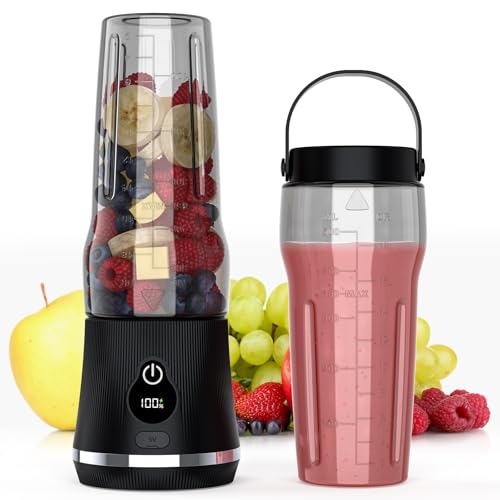
Sleetop Portable Blender USB-C, 17 oz, Black
Badge: Best Overall USB
The Sleetop is a 17 oz personal blender with six stainless steel blades, USB-C recharging, an LED display and an extra lid in the box, in black. It is built around the blend-and-go routine: charge it like a phone, blend in the cup, swap the lid and leave.
Against the USB brief, the Sleetop Portable Blender USB-C, 17 oz, Black is defined by 17 oz personal blender. Hold that against the daily pattern this category serves. A true USB machine lives where the blending happens: charged overnight from a phone charger, thrown in a bag, blended at the destination and rinsed in any sink. Its review below therefore weighs charge convenience, cup practicality and single-serving honesty more than raw power. A mains contrast, covered prose-only, lives at the opposite pole: fixed to a counter, unlimited by battery, sized for batches and built for years of daily cycles. Neither pole is a failed version of the other. The mistake this guide exists to prevent is buying one pole while dreaming of the other — the traveller who buys a countertop machine for its power, or the family cook who buys a 17 oz cup for Saturday smoothies. Read each review with your own most common blending location in mind, because location, unusually, is the specification that decides this entire category.
In the USB routine, the Sleetop Portable Blender USB-C, 17 oz, Black is best judged by a Tuesday test rather than a specification test. It is charged, it is where you need it, the drink is one serving, and the whole episode — blend, drink, rinse — fits inside a break. Machines in this category do not compete on the drama of their hardest job; they compete on the absence of friction in their easiest one, repeated daily. Weigh the Sleetop design on exactly that: the charging connector you already own, the cup you actually drink from, the display that tells you the state at a glance, and the lid that survives the bag. Those details, repeated two hundred mornings a year, are the product. The specification box records them plainly, and in this category the plain details are the ones that compound.
Strengths
- USB-C charging works from laptops, power banks and car ports
- Blend in the same 17 oz cup you drink from
- LED display removes guesswork about state and cycles
Trade-offs
- 17 oz is one serving, not a family batch
- Battery blending is gentler than mains power on ice-heavy mixes
- Needs recharging discipline to be ready when you are
| Specification | Detail |
|---|---|
| Capacity | 17 oz personal blender |
| Blades | 6 stainless steel blades |
| Charging | USB-C rechargeable |
| Display | LED display |
| Extras | extra lid included; compact travel format |
Best for: commuters, students and desk workers who blend one serving anywhere / Not suited for: family batches

Sleetop Portable Blender USB-C, 17 oz, White
Badge: Best USB in White
This is the Sleetop portable in white: the same 17 oz cup, six stainless blades, USB-C charging, LED display and spare lid as the black version. The choice between them is purely about finish and how honestly it shows smoothie stains.
Against the USB brief, the Sleetop Portable Blender USB-C, 17 oz, White is defined by 17 oz personal blender. Hold that against the daily pattern this category serves. A true USB machine lives where the blending happens: charged overnight from a phone charger, thrown in a bag, blended at the destination and rinsed in any sink. Its review below therefore weighs charge convenience, cup practicality and single-serving honesty more than raw power. A mains contrast, covered prose-only, lives at the opposite pole: fixed to a counter, unlimited by battery, sized for batches and built for years of daily cycles. Neither pole is a failed version of the other. The mistake this guide exists to prevent is buying one pole while dreaming of the other — the traveller who buys a countertop machine for its power, or the family cook who buys a 17 oz cup for Saturday smoothies. Read each review with your own most common blending location in mind, because location, unusually, is the specification that decides this entire category.
In the USB routine, the Sleetop Portable Blender USB-C, 17 oz, White is best judged by a Tuesday test rather than a specification test. It is charged, it is where you need it, the drink is one serving, and the whole episode — blend, drink, rinse — fits inside a break. Machines in this category do not compete on the drama of their hardest job; they compete on the absence of friction in their easiest one, repeated daily. Weigh the Sleetop design on exactly that: the charging connector you already own, the cup you actually drink from, the display that tells you the state at a glance, and the lid that survives the bag. Those details, repeated two hundred mornings a year, are the product. The specification box records them plainly, and in this category the plain details are the ones that compound.
Strengths
- Same USB-C, blend-in-cup routine in a lighter finish
- Extra lid turns the blending cup into a travel cup
- Compact body fits gym bags and desk drawers
Trade-offs
- White shows berry and turmeric colour sooner
- Single-serving capacity only
- Battery power has limits with hard frozen mixes
| Specification | Detail |
|---|---|
| Capacity | 17 oz personal blender |
| Blades | 6 stainless steel blades |
| Charging | USB-C rechargeable |
| Display | LED display |
| Extras | extra lid included; compact travel format |
| Colour | white |
Best for: the same USB routine in a lighter finish / Not suited for: multi-serving households
Vitamix Quiet One 48 oz Blender
Badge: Prose-Only Contrast: Quiet Bar Power
The Quiet One is Vitamix’s on-counter bar blender: a 48 oz polycarbonate container, six program buttons and a design centred on keeping noise down in working cafes and bars. It is a commercial machine that happens to fit a home counter, which shapes everything about how it behaves.
Against the USB brief, the Vitamix Quiet One 48 oz Blender is defined by 48 oz polycarbonate. Hold that against the daily pattern this category serves. A true USB machine lives where the blending happens: charged overnight from a phone charger, thrown in a bag, blended at the destination and rinsed in any sink. Its review below therefore weighs charge convenience, cup practicality and single-serving honesty more than raw power. A mains contrast, covered prose-only, lives at the opposite pole: fixed to a counter, unlimited by battery, sized for batches and built for years of daily cycles. Neither pole is a failed version of the other. The mistake this guide exists to prevent is buying one pole while dreaming of the other — the traveller who buys a countertop machine for its power, or the family cook who buys a 17 oz cup for Saturday smoothies. Read each review with your own most common blending location in mind, because location, unusually, is the specification that decides this entire category.
In the USB routine, the Vitamix Quiet One 48 oz Blender is best judged by a Tuesday test rather than a specification test. It is charged, it is where you need it, the drink is one serving, and the whole episode — blend, drink, rinse — fits inside a break. Machines in this category do not compete on the drama of their hardest job; they compete on the absence of friction in their easiest one, repeated daily. Weigh the Vitamix design on exactly that: the charging connector you already own, the cup you actually drink from, the display that tells you the state at a glance, and the lid that survives the bag. Those details, repeated two hundred mornings a year, are the product. The specification box records them plainly, and in this category the plain details are the ones that compound.
Strengths
- Built for bar and cafe duty cycles rather than occasional home use
- Six programs give repeatable one-touch results
- The quiet-focused design suits open-plan and early-morning blending
Trade-offs
- Commercial format is larger than a typical home blender footprint
- 48 oz jar is mid-sized for family batches
- Program-led controls offer less manual tinkering than a dial
| Specification | Detail |
|---|---|
| Container | 48 oz polycarbonate |
| Controls | 6 program buttons |
| Format | on-counter bar blender with sound-dampening design |
| Colour | black |
Best for: understanding what a mains bar machine does that USB cannot / Not suited for: travel or battery use — it needs a mains socket
Covered prose-only in this guide: Not a USB blender: this is a mains-powered countertop machine with no USB charging and no battery, so it fails this keyword’s core USB criterion and is covered prose-only as a home-base contrast, with no link and no image.
Vitamix 5200 Blender, 64 oz, Black
Badge: Prose-Only Contrast: Classic Power
The 5200 is the classic Vitamix formula: a 64 oz container, a variable speed dial with a separate high-speed switch, stainless blades and a self-cleaning cycle. There are no programs to hide behind; the dial puts texture decisions in the cook’s hand, which is exactly why the model has such a long following.
Against the USB brief, the Vitamix 5200 Blender, 64 oz, Black is defined by 64 oz. Hold that against the daily pattern this category serves. A true USB machine lives where the blending happens: charged overnight from a phone charger, thrown in a bag, blended at the destination and rinsed in any sink. Its review below therefore weighs charge convenience, cup practicality and single-serving honesty more than raw power. A mains contrast, covered prose-only, lives at the opposite pole: fixed to a counter, unlimited by battery, sized for batches and built for years of daily cycles. Neither pole is a failed version of the other. The mistake this guide exists to prevent is buying one pole while dreaming of the other — the traveller who buys a countertop machine for its power, or the family cook who buys a 17 oz cup for Saturday smoothies. Read each review with your own most common blending location in mind, because location, unusually, is the specification that decides this entire category.
In the USB routine, the Vitamix 5200 Blender, 64 oz, Black is best judged by a Tuesday test rather than a specification test. It is charged, it is where you need it, the drink is one serving, and the whole episode — blend, drink, rinse — fits inside a break. Machines in this category do not compete on the drama of their hardest job; they compete on the absence of friction in their easiest one, repeated daily. Weigh the Vitamix design on exactly that: the charging connector you already own, the cup you actually drink from, the display that tells you the state at a glance, and the lid that survives the bag. Those details, repeated two hundred mornings a year, are the product. The specification box records them plainly, and in this category the plain details are the ones that compound.
Strengths
- Variable speed dial gives true manual control from chop to puree
- 64 oz container handles family soups and smoothies in one batch
- Self-cleaning cycle makes daily use realistic
Trade-offs
- Tall classic profile needs cabinet clearance to store
- No one-touch programs; results depend on the operator
- Loud at full speed, like most high-performance blenders
| Specification | Detail |
|---|---|
| Container | 64 oz |
| Controls | variable speed dial with high-speed switch |
| Blades | stainless steel |
| Features | self-cleaning cycle |
| Colour | black |
Best for: home batch blending, as a contrast to portable USB limits / Not suited for: anywhere without mains power
Covered prose-only in this guide: Not a USB blender: this is a mains-powered countertop machine with no USB charging and no battery, so it fails this keyword’s core USB criterion and is covered prose-only as a home-base contrast, with no link and no image.
Vitamix Quiet One On-Counter 48 oz Blender
Badge: Prose-Only Contrast: Bar Format
This Quiet One variant is the on-counter bar-type build: 48 oz container, black and clear finish, and a layout intended to sit in a serving area blending drinks to order all day. Its priorities are uptime, repeatability and lower noise rather than home-kitchen styling.
Against the USB brief, the Vitamix Quiet One On-Counter 48 oz Blender is defined by 48 oz. Hold that against the daily pattern this category serves. A true USB machine lives where the blending happens: charged overnight from a phone charger, thrown in a bag, blended at the destination and rinsed in any sink. Its review below therefore weighs charge convenience, cup practicality and single-serving honesty more than raw power. A mains contrast, covered prose-only, lives at the opposite pole: fixed to a counter, unlimited by battery, sized for batches and built for years of daily cycles. Neither pole is a failed version of the other. The mistake this guide exists to prevent is buying one pole while dreaming of the other — the traveller who buys a countertop machine for its power, or the family cook who buys a 17 oz cup for Saturday smoothies. Read each review with your own most common blending location in mind, because location, unusually, is the specification that decides this entire category.
In the USB routine, the Vitamix Quiet One On-Counter 48 oz Blender is best judged by a Tuesday test rather than a specification test. It is charged, it is where you need it, the drink is one serving, and the whole episode — blend, drink, rinse — fits inside a break. Machines in this category do not compete on the drama of their hardest job; they compete on the absence of friction in their easiest one, repeated daily. Weigh the Vitamix design on exactly that: the charging connector you already own, the cup you actually drink from, the display that tells you the state at a glance, and the lid that survives the bag. Those details, repeated two hundred mornings a year, are the product. The specification box records them plainly, and in this category the plain details are the ones that compound.
Strengths
- Bar-type layout is proven in daily commercial service
- Noise-conscious design suits serving areas and open kitchens
- 48 oz container suits drinks made to order
Trade-offs
- Commercial sizing and format exceed many home needs
- Mid-size jar limits very large batches
- Fewer home-oriented extras than domestic models
| Specification | Detail |
|---|---|
| Container | 48 oz |
| Format | on-counter, bar type |
| Colour | black with clear container |
| Design focus | reduced operating noise for front-of-house use |
Best for: cafes and front-of-house drinks, as a contrast / Not suited for: vehicles, desks or travel
Covered prose-only in this guide: Not a USB blender: this is a mains-powered countertop machine with no USB charging and no battery, so it fails this keyword’s core USB criterion and is covered prose-only as a home-base contrast, with no link and no image.
Vitamix Propel Series 510, 48 oz
Badge: Prose-Only Contrast: Home Programs
The Propel 510 is Vitamix’s streamlined domestic formula: a 48 oz container, three programs, pulse and variable speed, plus a self-cleaning program. It keeps the brand’s blending hardware while trimming the control set to what most households actually use week to week.
Against the USB brief, the Vitamix Propel Series 510, 48 oz is defined by 48 oz. Hold that against the daily pattern this category serves. A true USB machine lives where the blending happens: charged overnight from a phone charger, thrown in a bag, blended at the destination and rinsed in any sink. Its review below therefore weighs charge convenience, cup practicality and single-serving honesty more than raw power. A mains contrast, covered prose-only, lives at the opposite pole: fixed to a counter, unlimited by battery, sized for batches and built for years of daily cycles. Neither pole is a failed version of the other. The mistake this guide exists to prevent is buying one pole while dreaming of the other — the traveller who buys a countertop machine for its power, or the family cook who buys a 17 oz cup for Saturday smoothies. Read each review with your own most common blending location in mind, because location, unusually, is the specification that decides this entire category.
In the USB routine, the Vitamix Propel Series 510, 48 oz is best judged by a Tuesday test rather than a specification test. It is charged, it is where you need it, the drink is one serving, and the whole episode — blend, drink, rinse — fits inside a break. Machines in this category do not compete on the drama of their hardest job; they compete on the absence of friction in their easiest one, repeated daily. Weigh the Vitamix design on exactly that: the charging connector you already own, the cup you actually drink from, the display that tells you the state at a glance, and the lid that survives the bag. Those details, repeated two hundred mornings a year, are the product. The specification box records them plainly, and in this category the plain details are the ones that compound.
Strengths
- Three programs automate the common jobs without hiding manual control
- 48 oz size suits couples and small families
- Self-cleaning program lowers the daily-use barrier
Trade-offs
- Smaller jar than the 64 oz classics for big batches
- Three programs is a short list next to the Ascent line
- Still a full-power machine with full-power noise
| Specification | Detail |
|---|---|
| Container | 48 oz |
| Programs | 3, plus pulse |
| Controls | variable speed with self-cleaning program |
| Colour | black |
Best for: home program blending, as a contrast / Not suited for: portability of any kind
Covered prose-only in this guide: Not a USB blender: this is a mains-powered countertop machine with no USB charging and no battery, so it fails this keyword’s core USB criterion and is covered prose-only as a home-base contrast, with no link and no image.
Comparison Table
| Model | Badge | Key specification | Second strength | Link |
|---|---|---|---|---|
| Sleetop Portable Blender USB-C, 17 oz, Black | Best Overall USB | Blades: 6 stainless steel blades | Blend in the same 17 oz cup you drink from | Check on Amazon |
| Sleetop Portable Blender USB-C, 17 oz, White | Best USB in White | Blades: 6 stainless steel blades | Extra lid turns the blending cup into a travel cup | Check on Amazon |
| Vitamix Quiet One 48 oz Blender | Prose-Only Contrast: Quiet Bar Power | Controls: 6 program buttons | Six programs give repeatable one-touch results | Prose-only |
| Vitamix 5200 Blender, 64 oz, Black | Prose-Only Contrast: Classic Power | Controls: variable speed dial with high-speed switch | 64 oz container handles family soups and smoothies in one batch | Prose-only |
| Vitamix Quiet One On-Counter 48 oz Blender | Prose-Only Contrast: Bar Format | Format: on-counter, bar type | Noise-conscious design suits serving areas and open kitchens | Prose-only |
| Vitamix Propel Series 510, 48 oz | Prose-Only Contrast: Home Programs | Programs: 3, plus pulse | 48 oz size suits couples and small families | Prose-only |
How to Choose: a USB Blender (and Knowing When Not To)
Start with location, the USB category’s deciding question. List where your smoothies and shakes actually get made and drunk: desk, gym, vehicle, site cabin, hotel, kitchen. If most answers are away from a kitchen counter, USB is your format. If most answers are ‘at home, for several people’, a mains machine serves you better and the prose-only contrasts in this guide show the class to shop in instead.
Next, serving size. A 17 oz cup is one generous serving. Solo drinkers are perfectly served; couples blend in relays, which some people enjoy as a routine and others abandon within a month. Be honest about which person you are, because capacity dissatisfaction is the most common reason portable blenders end up in drawers.
Then, mixture difficulty. Battery blenders handle protein shakes, fresh fruit, yoghurt drinks and soft frozen fruit well. Dense, ice-heavy, fibrous mixtures are where mains power earns its keep. If your signature drink is a thick frozen blend, either temper the ingredients — softer frozen fruit, a splash more liquid — or accept that the USB machine is your travel tool and a mains machine is your home tool.
Finally, charging discipline. USB-C is the right standard because the cable is already in your life: phone chargers, laptops, power banks and vehicle ports all feed it. A USB blender only delivers its promise if it is charged when you reach for it, so the buying decision includes a habit decision — a fixed charging spot, treated like the phone’s. The broader power-versus-portability trade is explored from the other side in Best Pro Style Blenders.
How to Get the Best From a USB Blender
Technique matters more in battery blending than in mains blending, because the power budget is smaller. Load liquids first, add powders and soft ingredients next, and put frozen fruit last in small pieces rather than a single frozen block. Fill to the line, not above it: the vortex needs headroom, and an overfilled cup blends unevenly and strains the motor. Run the cycle, shake the cup gently if the listing’s design allows it, and run a second cycle for fibrous ingredients rather than forcing one long one.
Charging is the second half of the technique. Recharge after use rather than before the next use, keep the USB-C port dry before plugging in, and treat the LED display as your fuel gauge. A USB blender that lives charged is a convenience; one that lives flat is a paperweight with blades.
Build the charging station once and the category works forever: one USB-C cable at the place you blend most — desk drawer, kitchen counter corner, vehicle console — plus the habit of plugging in while you drink or immediately after rinsing. Travellers should pack the blender the way they pack a phone, cable included, and treat a power bank as the range extender it is. The routine is the accessory; everything else is hardware.
- Charge fully after each use and store the blender where the cable lives.
- Load liquids first, then soft ingredients, then small frozen pieces last.
- Fill only to the cup’s line so the vortex has room to form.
- Run one full cycle; shake gently and repeat for fibrous mixtures.
- Add a splash of liquid rather than forcing a stalled blend.
- Rinse the cup immediately and dry the charging port before recharging.
Problem: the blender stalls on frozen fruit → what to do: stop, add liquid, break the frozen mass into smaller pieces and run shorter cycles; battery power rewards patience over force
Problem: the cup leaks in a bag → what to do: check the lid seal is seated and use the spare travel lid for transport; blend with the blade lid, travel with the drinking lid
Problem: the battery is flat when you need it → what to do: move charging to immediately after use and keep a cable at the place you blend most — desk or vehicle — not only at home
Where USB Blenders Genuinely Earn Their Place
The USB blender’s home turf is the routine that happens away from the kitchen. The desk worker blending a protein shake at lunch, the student in a hall of residence with no kitchen access, the driver or tradesperson whose lunch break is a vehicle, the traveller in a hotel room, the gym-goer who wants the shake fresh rather than transported — for these patterns, a mains blender is not a better tool, it is an absent one. The best blender is the one that is there.
There is also a quieter home use: the single serving in a household of one, or the early-morning shake that should not wake the house with a full-size machine’s roar through a thin wall — though even a small blender is not silent, its shorter cycle and smaller motor are easier on sleeping ears at close quarters.
Notice what these patterns share: one serving, moderate ingredients, premium on place and convenience. That is the format’s design centre, and the two Sleetop reviews above are judged exactly there.
The Honest Limits: Power, Ice and Batch Size
Battery blending trades force for freedom, and the trade shows in three places. Ice: small blades and battery motors crush modest ice but labour on the hard, dense cubes a mains machine pulverises. Fibre: stringy ingredients need time and liquid that a single short cycle may not give. Volume: 17 oz is a serving, and no technique turns it into a family batch.
None of these limits is hidden by honest sellers, yet buyers discover them as disappointments because the category is marketed with kitchen-blender imagery. The correct mental model is a personal drinks tool, closer to a very capable shaker bottle than to a small Vitamix. Inside that model, the format delights; outside it, nothing can save it.
The prose-only contrasts in this guide exist to mark this boundary from the other side. If your reading of the limits section sounds like your daily life, shop the mains class instead — the guide’s honesty about those machines’ total lack of USB is the same honesty, pointed the other way.
USB-C and the Charging Ecosystem
The shift to USB-C is what made this category practical. Earlier portable blenders used proprietary or slow charging that kept them tethered to one cable at home. USB-C means the blender drinks from the same ecosystem as a phone: laptop ports at a desk, power banks in a bag, vehicle USB sockets, hotel bedside chargers. The blender’s range is suddenly the range of the cable you already carry.
That ecosystem also sets the care routine. Keep the port dry, charge after use, and avoid leaving the battery flat for weeks, which is unkind to any rechargeable cell. The LED display on the Sleetop models earns its place here: state of charge and cycle status at a glance are what turn charging from guesswork into a glanceable habit.
When comparing USB models, the charging details — connector type, display, spare lids — are worth more than marginal blade claims, because they decide whether the machine is charged, sealed and ready on the ordinary Tuesday when the routine actually happens.
USB Blenders at Work, at the Gym and on the Road
The desk is the USB blender’s most honest workplace. A protein shake or a fruit smoothie blended fresh at lunch replaces the transported bottle that sat warming since morning, and the rinse takes a sink and thirty seconds. The etiquette is real — a short cycle is a brief noise, best timed away from calls — but the format’s small motor and single cycle are far easier on an office than a full-size machine would be, and the cup returning to the desk is the same one that blended.
The gym use is about timing: nutrients within the window after training, without carrying a pre-mixed shake through a workout. Blend in the changing room or the car, drink immediately, rinse when home. The vehicle use extends the same logic to drivers, site workers and road trips, where the USB socket is already there and the alternative is a service-station purchase nobody chose on merit.
Travel ties the patterns together. In a hotel room, a USB blender turns supermarket fruit and yoghurt into breakfast at a fraction of room-service logic, and it packs like a water bottle. Across all three settings the constant is not power but presence: the machine is simply there, charged, in the bag — which is the entire design brief of the category, fulfilled.
Battery Care and Daily Upkeep for USB Blenders
Battery care decides a USB blender’s lifespan more than blade care does. Recharge after use rather than storing the machine flat, avoid leaving it discharged for weeks, and keep the charging port dry before every plug-in — water and charging contacts are poor companions. If the machine will sit unused for a long stretch, store it with a partial charge in a cool drawer rather than empty or brim-full, the kindest state for a rechargeable cell.
The blending hardware wants the usual discipline in miniature: rinse the cup and blade base immediately, keep smoothie residue out of the seal groove, dry the lid parts before reassembly, and never run the cycle with the cup empty or wildly overfilled. Small machines forgive much, but dried residue in a seal and a battery left flat account for most of the category’s early deaths — both are habits, not defects, and both are entirely within your control.
Common Buying Mistakes
- Buying a mains countertop blender from a USB search result without checking how it is powered.
- Expecting a 17 oz battery cup to serve a family’s smoothie round.
- Forcing ice-heavy mixtures until the motor stalls, instead of adding liquid and cycling twice.
- Letting the battery live flat; a USB blender’s convenience is a charging habit, not just a product.
- Overfilling past the cup line and blaming the blades for uneven blending.
Final Recommendation
Choose the Sleetop in black or white — the finish is the only difference — if your blending life happens at desks, in vehicles, at the gym or on the road, and your drinks are single servings of shakes and smoothies. It is the honest centre of the USB category: USB-C charging, a 17 oz blend-and-go cup, an LED display and a spare lid for the journey.
Choose the other direction just as deliberately if the limits section described your life: family batches, ice-heavy drinks and soup work belong to the mains class represented by the prose-only contrasts. Many households end up owning one of each, which is not indecision but correct tool selection — and the mains end of that pairing is compared in depth in Best Prices On Vitamix Blenders.
Start with the Sleetop Portable Blender USB-C, 17 oz, Black if you want the shortest route to a good decision, and check its current Amazon listing to confirm the exact configuration. A second look at the same listing page is also the fastest way to compare the accessories included in the box before you commit.
Frequently Asked Questions
What makes a blender a USB blender?
A rechargeable battery charged over USB — now almost always USB-C — that powers the motor without a wall socket. Mains-powered machines, however small, are not USB blenders. In this guide only the two Sleetop portables meet the definition, which is why the Vitamix models are prose-only contrasts.
Can a USB blender crush ice?
Modest amounts, in small pieces, with enough liquid — yes. A full load of hard freezer cubes is beyond the format’s power budget and will stall it. Temper frozen ingredients slightly and cycle twice for the most reliable results.
How many blends does a USB blender do per charge?
It varies by model and mixture, and this guide does not invent figures the listings do not state. The practical approach is to charge after every use, which keeps the question from mattering in daily routines.
Is a USB blender a replacement for a kitchen blender?
For a solo drinker with moderate mixtures, it can be the only blender they use. For families, batch cooking, soups or heavy frozen work, it is a companion to a mains machine, not a replacement — the prose-only reviews in this guide show the other half of that pairing.
Can I charge a USB blender in a car?
Yes — that is one of the format’s main advantages. Any USB-C source works: vehicle ports, power banks, laptops and phone chargers. Keep the port dry and the cable rated for charging, and the car becomes a blending station.
Why are some picks in this guide not linked?
Because they are not USB blenders. The four Vitamix machines are mains-powered countertop models included as accurately described contrasts. Linking them as USB picks would mislead exactly the shoppers this guide exists to help.


