Disclosure: topratedkitchenware.com is reader-supported. When you buy through links on our site, we may earn an affiliate commission from Amazon and other retailers, at no extra cost to you.
Where to buy
Here is the shortlist for anyone comparing best single serve coffee makers with no pods: every pick below was verified against live Amazon listing data on 2026-11-21, but read the labels carefully — some pool machines did not meet this keyword’s core requirement and are covered prose-only, with no purchase link, for the reason stated in their reviews. The linked picks are the ones this guide can honestly recommend for the job. Prices move constantly, so use the links to check the latest price on Amazon, and read the full guide ↓ before deciding.
- Hamilton Beach FlexBrew Advanced 5-in-1 — check the latest price on Amazon
- Elite Gourmet Single-Serve Coffee Maker EHC111A — check the latest price on Amazon
- Keurig K-Mini Mate, Black — covered prose-only in this guide (see the detailed review for why)
- Tastyle Mini Single Serve Coffee Maker K310IC — check the latest price on Amazon
- Hamilton Beach FlexBrew Advanced 4-in-1 — check the latest price on Amazon
- Keurig K-Elite, Brushed Silver — covered prose-only in this guide (see the detailed review for why)
Looking for the best single serve coffee makers with no pods usually means one of three things: you are tired of buying pods, tired of binning pods, or convinced — often correctly — that fresh grounds taste better. This guide takes the requirement literally. Four of the six pool machines can brew a cup with no pod anywhere in the process and are linked; two famous pod machines cannot, and they are covered prose-only with the reason stated, so nobody buys a pod machine by mistake in a no-pods guide.
The honest surprise in the pool is how much of the no-pods capability hides inside dual-format machines. The two Hamilton Beach FlexBrew models and the Tastyle all accept pods — and all three brew grounds just as natively, which means pod-free brewing with a reservoir and a proper size menu. Beside them sits the Elite Gourmet, the pool’s one purpose-built grounds brewer, which never touches a pod at all. The reviews judge each machine on its grounds path first, because that is the path you are buying.
One clarification before the picks: brewing with no pods means the coffee travels from bag to cup as loose grounds, through a reusable filter or basket. It does not mean weaker coffee, slower coffee or more mess by necessity — it means the consumable is coffee itself, and the machine’s job is to handle grounds well. If you are comparing across the wider category while you decide, our companion guide to Best Single Serve Coffee Makers Compatable With Kcups covers the neighbouring ground.
Key Takeaways
- Four picks brew with no pods and are linked; the K-Mini Mate and K-Elite are pod-only on their listings and are covered prose-only.
- The Elite Gourmet is the only purpose-built no-pods machine here: grounds and a reusable filter, nothing else.
- The FlexBrew 5-in-1 and 4-in-1 and the Tastyle brew grounds natively beside their pod modes — use the grounds mode and no pod is involved.
- Pod-free brewing swaps pod shopping for a grounds routine: measure, brew, empty the filter, rinse.
- Reservoir choice still matters without pods: 45 to 60 oz on the linked Hamilton Beach models, fill-per-cup on the Elite Gourmet.
In this guide
Quick Picks
Six models, six different answers to the same question. The badges below are used consistently through the detailed reviews, so the model you spot here is easy to find again further down the page.
| Pick | Badge | Best for | Link |
|---|---|---|---|
| Hamilton Beach FlexBrew Advanced 5-in-1 | Best Overall for Pod-Free Brewing | households that genuinely brew both full pots and single cups every week | Check on Amazon |
| Elite Gourmet Single-Serve Coffee Maker EHC111A | Best True Pod-Free Design | grounds drinkers who want the simplest possible one-cup routine with no pods | Check on Amazon |
| Keurig K-Mini Mate, Black | Compact Pod Pick (Prose-Only) | students, desk workers and solo drinkers in small spaces who value compact simplicity | Prose-only coverage |
| Tastyle Mini Single Serve Coffee Maker K310IC | Best Dual-Format in Grounds Mode | solo users in homes, dorms, RVs and offices who want pods, grounds, hot and iced in one mini machine | Check on Amazon |
| Hamilton Beach FlexBrew Advanced 4-in-1 | Best Reservoir Pick for Grounds Brewing | households that switch between pods and grounds, and between hot and iced coffee | Check on Amazon |
| Keurig K-Elite, Brushed Silver | Premium Pod Pick (Prose-Only) | Keurig loyalists who want the premium-line machine and a brushed silver finish | Prose-only coverage |
How These Picks Were Chosen
For this keyword a pick is linked only if its verified listing supports brewing with loose grounds — natively, or as a stated mode of a dual-format machine. Four pass: the Elite Gourmet (reusable filter for grounds), the Tastyle (K Cup and ground), and both FlexBrew models (pods and grounds / pod packs and grounds). The K-Mini Mate and the K-Elite are presented in their listings as K-Cup pod machines with no grounds mode stated, so both are prose-only: reviewed fully, linked never.
Our method is research-led and we are straightforward about its limits: this guide is built from verified listing data, manufacturer specifications and the accumulated pattern of owner experience, not from a test kitchen bench. That honesty cuts both ways — we will not claim to have brewed a single cup ourselves for this guide, and in exchange every factual claim in the article can be traced to the sources file published with it, which records each product’s name, ASIN, exact listing title, image source and check date.
Three filters decided the final presentation. First, specification completeness: a model had to state its format, sizes and reservoir clearly enough to be compared without guesswork — and where a listing is terse, the review says so rather than filling the gap. Second, keyword fit: a pick that does not meet the core requirement of best single serve coffee makers with no pods is covered prose-only rather than linked under a false description. Third, ownership practicality — cleaning, controls and footprint — because a machine that is miserable to live with is a bad recommendation at any level of brewing performance. Readers working through a broader shortlist may also find our guide to Best Single Serve Coffee Makers Environmental useful alongside this one.
The 6 Best Best single serve coffee makers with no pods Picks, Reviewed in Detail
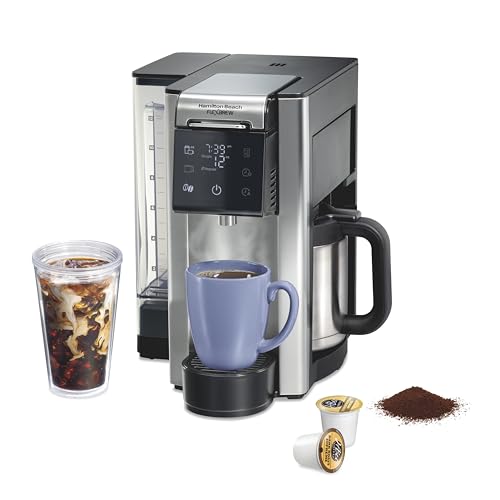
Hamilton Beach FlexBrew Advanced 5-in-1
Badge: Best Overall for Pod-Free Brewing
Strengths
- A genuine two-format machine: 12 cup programmable drip on one side, single serve on the other
- Single-serve side takes both pods and grounds, hot or iced
- The thermal carafe keeps batch coffee hot without a warming plate cooking it
Trade-offs
- The largest footprint in this pool by a wide margin — it replaces two machines and looks it
- Two brewing systems mean two cleaning routines to keep up with
- Households that never brew a pot are paying for a whole second machine
Key specifications
- Configuration: 5-in-1 drip and single serve
- Carafe side: 12 cup thermal programmable drip
- Single-serve inputs: Pods and grounds
- Drinks: Hot and iced coffee
- Reservoir: Removable 60 oz reservoir
- Finish: Black
The FlexBrew Advanced 5-in-1 is the pool’s true combination appliance: a 12 cup thermal programmable drip brewer sharing a body and a removable 60 oz reservoir with a single-serve side that accepts pods and grounds and brews hot or iced. The thermal carafe matters — batch coffee held in insulated steel rather than on a hot plate keeps its character far longer, which is the difference between a second cup that tastes brewed and one that tastes stored. For households split between a weekday pot and weekend single cups, or hosts who brew a carafe for guests and a pod for themselves, this is the one-machine answer, provided the counter can honestly hold it.
Used the pod-free way, the Hamilton Beach FlexBrew Advanced 5-in-1 is judged on its grounds path: how honestly its 5-in-1 drip and single serve supports brewing without a pod in the machine, how the reusable or grounds loading works cup after cup, and how much cleaning the no-pod routine really adds to a morning.
Best for: households that genuinely brew both full pots and single cups every week / Not suited for: small counters or strictly one-cup households

Elite Gourmet Single-Serve Coffee Maker EHC111A
Badge: Best True Pod-Free Design
Strengths
- Brews from grounds through a reusable filter — no pods to buy or bin
- One-touch, 600W fast brewing with auto shut-off is as simple as the format gets
- Dishwasher-safe parts and a compact body suit dorms, desks and travel mugs
Trade-offs
- Grounds-only as listed: no pod compatibility is claimed in the verified listing
- 14 oz is the ceiling — one generous mug, never two cups
- A basic feature set: no reservoir, no size menu, no strength control
Key specifications
- Capacity: 14 oz single serve
- Power: 600W
- Controls: One-touch operation
- Filter: Reusable filter for grounds and loose-leaf tea
- Safety: Auto shut-off
- Cleaning: Dishwasher-safe parts
- Model: EHC111A
The Elite Gourmet EHC111A is the pool’s back-to-basics brewer: a compact 600W machine that makes a 14 oz cup from loose grounds in a reusable filter, with one-touch operation, auto shut-off and dishwasher-safe parts. It also brews loose-leaf tea through the same filter, which makes it a small hot-drinks station rather than a coffee-only gadget. Its honesty is its charm — there is no reservoir to descale, no pod supply to manage, and almost nothing to learn. What it asks in return is the grounds ritual: measure, brew, empty the filter. For dorms, desks, spare rooms and second homes, that trade is often exactly right, and its tier within the single-serve class reflects the simplicity.
Used the pod-free way, the Elite Gourmet Single-Serve Coffee Maker EHC111A is judged on its grounds path: how honestly its 14 oz single serve supports brewing without a pod in the machine, how the reusable or grounds loading works cup after cup, and how much cleaning the no-pod routine really adds to a morning.
Best for: grounds drinkers who want the simplest possible one-cup routine with no pods / Not suited for: pod users or anyone brewing for more than one person at a time
Keurig K-Mini Mate, Black
Badge: Compact Pod Pick (Prose-Only)
Coverage note: this pick is reviewed prose-only, with no purchase link and no image, because it does not meet this keyword’s core requirement. Its verified listing is a K-Cup pod machine with no grounds or reusable-filter mode stated, so it cannot brew with no pods. It is covered prose-only so readers can see exactly what they would be giving up — and what they would be stuck with.
Strengths
- The compact, portable format is made for dorms, offices and small counters
- Brews any size up to 12 oz — you add the water for the cup you want
- No reservoir means almost nothing to clean, descale or leave stale
Trade-offs
- Fill-for-every-cup: there is no reservoir to carry a busy morning
- Pod-only format with no grounds mode in the listing
- One cup at a time, always — guests queue politely
Key specifications
- Brew size: Brews up to a 12 oz cup
- Type: Single serve K-Cup pod maker
- Design: Compact and portable
- Named for: Small spaces, dorms and offices
- Finish: Black
The K-Mini Mate is Keurig reduced to its essence: a compact, portable K-Cup machine that brews up to a 12 oz cup from water you add for that cup. The reservoir-free design is a deliberate philosophy — the machine is small enough for a dorm desk or an office corner, there is no tank of standing water to think about, and the whole appliance can travel or store in a way reservoir machines cannot. The cost is paid in ritual: every cup starts with a fill. For a one-person routine that ritual is seconds and the simplicity is worth more than automation; for a household queue at 7 a.m. it is the wrong tool, and this guide says so plainly.
Used the pod-free way, the Keurig K-Mini Mate, Black is judged on its grounds path: how honestly its brews up to a 12 oz cup supports brewing without a pod in the machine, how the reusable or grounds loading works cup after cup, and how much cleaning the no-pod routine really adds to a morning.
Best for: students, desk workers and solo drinkers in small spaces who value compact simplicity / Not suited for: multi-cup households that want a reservoir to carry the morning
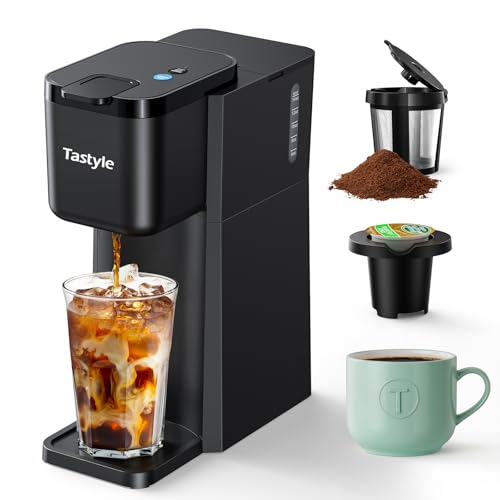
Tastyle Mini Single Serve Coffee Maker K310IC
Badge: Best Dual-Format in Grounds Mode
Strengths
- Takes K-Cup pods and ground coffee — both formats in a mini footprint
- Brews hot and iced coffee across a 6 to 14 oz size range
- Positioned for home, travel, RV, office and dorm use, with a recipe book included
Trade-offs
- A mini machine’s reservoir story is modest next to the 42-56 oz models here
- Lesser-known brand next to Keurig and Hamilton Beach in this pool
- Iced brewing at mini scale means one glass at a time, by definition
Key specifications
- Inputs: K-Cup pods and ground coffee
- Brew sizes: 6 to 14 oz brew sizes
- Drinks: Hot and iced coffee
- Included: Recipe book
- Power: 120V
- Model: K310IC, version 2.0
- Finish: Classic Black
The Tastyle K310IC packs an unusual amount of format freedom into a mini body: K-Cup pods or ground coffee, hot or iced drinks, and brew sizes from 6 to 14 oz, sold for home, travel, RV, office and dorm life with a recipe book in the box. That breadth is why it keeps appearing across this series of guides — it is the small machine that refuses to make its owner choose a camp. The honest cautions are scale and brand: it is a mini, so reservoirs and throughput are mini too, and Tastyle does not carry the decades of household familiarity the Keurig name does. For a single user who wants every option in the smallest box, it is a compelling answer.
Used the pod-free way, the Tastyle Mini Single Serve Coffee Maker K310IC is judged on its grounds path: how honestly its k-cup pods and ground coffee supports brewing without a pod in the machine, how the reusable or grounds loading works cup after cup, and how much cleaning the no-pod routine really adds to a morning.
Best for: solo users in homes, dorms, RVs and offices who want pods, grounds, hot and iced in one mini machine / Not suited for: households brewing back-to-back cups for several people

Hamilton Beach FlexBrew Advanced 4-in-1
Badge: Best Reservoir Pick for Grounds Brewing
Strengths
- Takes pod packs and grounds in one single-serve machine — the format argument settled
- Brews hot and iced coffee, covering the two daily drink families
- 45 oz removable reservoir keeps refills occasional without a giant footprint
Trade-offs
- Single-serve only: no carafe side for guests or batch mornings
- Two input types mean two loading routines to learn
- Mid-size reservoir still needs a weekly rinse-and-refill habit
Key specifications
- Configuration: 4-in-1 single serve
- Drinks: Hot and iced coffee
- Reservoir: Removable 45 oz reservoir
- Inputs: Pod packs and grounds
- Speed: Fast brewing
- Finish: Black
The FlexBrew Advanced 4-in-1 builds its whole case on flexibility inside a single-serve footprint: pod packs when speed matters, loose grounds when taste or thrift matters, hot coffee in winter and iced coffee in summer, all fed by a removable 45 oz reservoir. That reservoir size is the quiet sweet spot of this pool — large enough that filling stops being a daily chore, small enough that the machine stays a single-serve appliance rather than a countertop installation. Fast brewing is the listed promise, and the format supports it: whichever input you choose, the path from decision to cup is short. It is the natural recommendation for households whose coffee habits genuinely change by day and by season.
Used the pod-free way, the Hamilton Beach FlexBrew Advanced 4-in-1 is judged on its grounds path: how honestly its 4-in-1 single serve supports brewing without a pod in the machine, how the reusable or grounds loading works cup after cup, and how much cleaning the no-pod routine really adds to a morning.
Best for: households that switch between pods and grounds, and between hot and iced coffee / Not suited for: full-pot brewers or pod-only loyalists who will never use the grounds side
Keurig K-Elite, Brushed Silver
Badge: Premium Pod Pick (Prose-Only)
Coverage note: this pick is reviewed prose-only, with no purchase link and no image, because it does not meet this keyword’s core requirement. Its verified listing presents a K-Cup pod machine and states no grounds or reusable-filter brewing mode, so it cannot meet a no-pods requirement. Covered prose-only for completeness, with no link or image.
Strengths
- The K-Elite is Keurig’s premium single-serve line, finished in brushed silver
- A statement countertop presence compared with the plastic compacts in this pool
- K-Cup format gives access to the full pod catalogue
Trade-offs
- The verified listing is unusually terse: it states no brew sizes, reservoir or feature list to compare
- Pod-only format, as the listing presents it
- Premium-line positioning means a premium tier within the Keurig range
Key specifications
- Type: Single serve K-Cup pod coffee maker
- Finish: Brushed Silver
- Brand line: Keurig K-Elite series
The K-Elite occupies the premium step of Keurig’s single-serve ladder, and its brushed silver finish announces that on the counter. We are candid about the evidence here: the verified listing for this model is the shortest in the pool, naming the machine, the K-Cup format and the finish without the detailed size and reservoir specification its siblings publish. What can be said honestly is positional — this is the Keurig for buyers who want the brand’s upper-tier machine and a metal-look finish, and who are comfortable confirming the fine specification on the product page at purchase time. Buyers who prefer every number in writing before they commit will find the K-Express listings in this pool more forthcoming.
Used the pod-free way, the Keurig K-Elite, Brushed Silver is judged on its grounds path: how honestly its single serve k-cup pod coffee maker supports brewing without a pod in the machine, how the reusable or grounds loading works cup after cup, and how much cleaning the no-pod routine really adds to a morning.
Best for: Keurig loyalists who want the premium-line machine and a brushed silver finish / Not suited for: spec-first buyers who want every size and capacity stated in the listing
Comparison Table
| Model | Badge | Standout specification | Key feature | Link |
|---|---|---|---|---|
| Hamilton Beach FlexBrew Advanced 5-in-1 | Best Overall for Pod-Free Brewing | Configuration: 5-in-1 drip and single serve | 12 cup thermal programmable drip | Check on Amazon |
| Elite Gourmet Single-Serve Coffee Maker EHC111A | Best True Pod-Free Design | Capacity: 14 oz single serve | 600W | Check on Amazon |
| Keurig K-Mini Mate, Black | Compact Pod Pick (Prose-Only) | Brew size: Brews up to a 12 oz cup | Single serve K-Cup pod maker | Prose-only |
| Tastyle Mini Single Serve Coffee Maker K310IC | Best Dual-Format in Grounds Mode | Inputs: K-Cup pods and ground coffee | 6 to 14 oz brew sizes | Check on Amazon |
| Hamilton Beach FlexBrew Advanced 4-in-1 | Best Reservoir Pick for Grounds Brewing | Configuration: 4-in-1 single serve | Hot and iced coffee | Check on Amazon |
| Keurig K-Elite, Brushed Silver | Premium Pod Pick (Prose-Only) | Type: Single serve K-Cup pod coffee maker | Brushed Silver | Prose-only |
Read the table as a map, not a ranking shortcut: the standout specification column shows what each maker chose to compete on, and the right choice is the model whose chosen strength matches the job your kitchen actually has.
How to Choose: Best single serve coffee makers with no pods
Start with the input you will actually feed it. Pods buy zero-measure convenience and per-cup variety; grounds buy freshness, dose control and the lower ongoing fuss of a coffee bag. Dual-format machines exist for households that genuinely split. Decide the input first, honestly, from last week’s cups — every later specification is refinement of that one decision.
Translate reservoir size into your rhythm. A 42 to 60 oz reservoir is several days of water for a light drinker and a single morning for a busy household; a reservoir-free machine is a fill with every cup and nothing stale ever sitting in a tank. Neither is better in the abstract. Count your cups per day, divide, and buy the refill rhythm you will not resent.
Match sizes to your real cups. List the vessels you actually drink from — the weekday mug, the travel tumbler, the iced glass — and check the machine’s stated sizes and clearance against them. The most common single-serve disappointment is a favourite cup the machine cannot fill or cannot fit. Our guide to Best Single Serve Coffee Makers For Small Office explores the neighbouring options if your shortlist is still growing.
Weigh the routine, not just the cup. Every machine in this guide can make a good cup on its best day. The one you will love is the one whose full routine — load, brew, empty, rinse, refill — fits your mornings and your counter. Measure the space with the lid open and the reservoir out before you order; a coffee maker is furniture as much as appliance.
How to Brew Single-Serve Coffee Well, Step by Step
- Start with fresh water. Fill the reservoir or the cup-measure with fresh water; water that has sat in a warm tank for days brews flat coffee from good beans.
- Warm the cup. A rinse of hot water in the mug while the machine heats keeps the finished cup at drinking temperature to the last sip.
- Load consistently. Seat the pod fully, or measure grounds the same way every time — consistency of dose is what makes a machine’s results repeatable.
- Choose the size your coffee was dosed for. Brew the size that matches the pod or the dose rather than the largest the machine offers; oversizing is dilution.
- Use strength and style controls deliberately. Strong modes and smaller sizes are the honest levers for a bolder cup — change one at a time so you learn what each does.
- Empty and rinse now, not later. Eject the used pod or empty the filter while it is fresh, rinse what rinses, and leave the machine ready for its next cup.
Two habits separate consistent cups from lucky ones. First, change one variable at a time: size, strength, coffee — a week of single changes teaches you your machine, while a morning of three changes teaches you nothing. Second, keep the water path clean: reservoirs rinsed weekly and descaling on the maker’s rhythm are what keep an automatic machine tasting automatic in year two. Readers setting up a first machine may also want the setup notes in our guide to Best Single Serve Coffee Makers Hot Cold.
Troubleshooting. Problem: the cup tastes weak → the brew size is too large for the dose; drop one size, use the strong mode if your machine offers one, or raise the grounds dose. Problem: the brew runs slow or the cup is lukewarm → mineral scale is the usual cause; descale on the maker’s method before suspecting the machine. Problem: coffee tastes stale despite fresh pods or beans → audit the water and the cup: old reservoir water and a mug carrying yesterday’s film will defeat any brewer in this guide.
How Pod-Free Brewing Works on Each Linked Design
On the Elite Gourmet the pod-free path is the only path: grounds go into the reusable filter, the machine brews 14 oz through them, and the filter empties into the bin or compost and rinses clean. There is no pod holder to remove and no mode to select, which is why owners who want the ritual identical every day often prefer a dedicated design over a dual-format one.
On the dual-format machines the grounds path is a mode rather than the whole machine. The Tastyle loads ground coffee in place of a K-Cup; the FlexBrew models load grounds in place of a pod pack. Used daily in grounds mode, these machines are no-pods brewers in every way that matters to the cup — the pod hardware simply sits unused, available for a guest who brings their own pods or a week when convenience wins. Buyers should be honest about that temptation in both directions: the unused mode costs nothing, and the used one defines the machine.
What all four share is the filter routine: grounds must be measured with some consistency, spent grounds must leave the machine promptly, and the reusable filter rewards a rinse-now habit. None of that is difficult, and all of it together is the entire price of leaving pods behind.
Taste, Waste and Cost: The Honest Pod-Free Ledger
Taste first, because it is the strongest argument. Loose grounds let you buy coffee as beans or ground coffee from any roaster, grind or buy it fresh in small quantities, and dose it to your own strength. Pod coffee has improved enormously, but it is pre-ground and sealed weeks or months before brewing. Drinkers who make the switch for flavour rarely switch back, and the machines in this guide — especially the dual-format ones with real size menus — give grounds a fair stage.
Waste second. A pod household discards a small plastic-and-foil capsule with every cup; a grounds household discards coffee, which composts, and washes a filter. The dual-format machines complicate the purity of the claim only if you use both modes; run in grounds mode, their waste story is identical to the Elite Gourmet’s.
Cost last, stated qualitatively because prices move: per cup, loose coffee is the lower-cost input in this category by a wide and durable margin, while pods price their convenience into every serving. A household brewing several cups a day feels that difference monthly, which is why the reservoir-equipped FlexBrew models — built for several cups a day — may be the most consequential pod-free picks in the guide despite their dual-format labels. For a neighbouring angle on the same shortlist, see our guide to Best Single Serve Coffee Makers Without Pods.
More to Know Before You Buy
Dose consistency is the whole craft of pod-free brewing. Use the same scoop or spoon, filled the same way, for a week before adjusting anything; most “this machine makes weak coffee” verdicts are really “my dose wandered” verdicts, and they evaporate once the scoop stops wandering.
Buy coffee in quantities your household finishes while it is fresh rather than in bulk that ages in a cupboard. Pod-free brewing’s flavour advantage is freshness, and freshness is a purchasing habit before it is a machine feature.
The drip tray is the most honest part of any single-serve machine: it records every overflow, every removed-mug drip and every overfilled travel cup. Empty and rinse it when you refill or descale, and it stays a record of nothing. Neglect it, and it becomes the one part of the machine guests notice. Small machines ask small maintenance; the tray is where that bargain is kept.
Brew size discipline protects flavour more than any strength feature. A pod or a measured dose contains a fixed amount of coffee, and every extra ounce of water is dilution wearing the clothes of value. Choose the size your cup and your coffee were meant for, and use strength controls or dose — not restraint with the size button — when you want a bolder cup.
Noise belongs in the ownership calculation for early risers and shared walls. Single-serve pumps are brief but not silent, and a machine on a hollow counter amplifies itself. A folded mat under the base, a solid counter position and a closed kitchen door are the whole acoustics programme — plan them once, and the 6 a.m. cup stops being a household negotiation.
Finally, buy the machine for the drinker you are on your worst morning, not your best. Features that delight on a slow Sunday — extra modes, extra rituals — must also survive a rushed Tuesday. The picks in this guide were weighed on their Tuesday behaviour, because Tuesdays are most of the year.
Water is the ingredient nobody lists and everybody tastes. Single-serve machines brew with whatever the reservoir holds, and water that has sat warm in a tank for a week brews like it. The habit that protects every machine in this guide is boring and total: fill with fresh water, empty and rinse the reservoir weekly, and never top up indefinitely. Fresh water is the cheapest upgrade in coffee, and it compounds with every other good decision.
Descaling is the maintenance that decides how long a single-serve machine tastes like itself. Mineral scale insulates the heater, slows the pump and cools the brew by degrees too small to notice weekly and too large to ignore yearly. Follow the rhythm your machine’s manual sets, use the descaling method it names, and treat a slow or lukewarm cup as a symptom to descale, not a machine to replace.
Cup temperature is the invisible half of serving temperature. A cold ceramic mug pulls real heat from a fresh brew in the first minute; a warmed mug — rinsed with hot water while the machine heats — keeps the cup at drinking temperature to the last sip. It costs twenty seconds and no equipment, and it is the difference between coffee that tastes brewed and coffee that tastes stored.
Pod and grounds storage share one rule: coffee hates air, light, heat and time, in roughly that order. Sealed containers, cool cupboards and quantities matched to your household’s pace will do more for the cup than any single feature compared in this guide. Buy coffee the way you drink it — steadily — and let freshness be a purchasing habit rather than a machine specification.
Coffee temperature at the cup is a chain: machine, mug and room. Machines in this guide handle the first link; the warmed-mug habit handles the second; drinking the coffee when it is brewed handles the third. Complaints about lukewarm cups are usually a broken second or third link blaming the first.
If you drink decaf in the evening, give it a dedicated place in the routine — a labelled pod section or a separate grounds tin. Cross-contamination of the caffeinated and decaf supplies is the most common single-serve household error, and it is always discovered at the worst possible hour.
Travel with a mini machine is a packing discipline: pods or grounds measured into a sealed container, the machine dry, and a mug that fits both the machine and the destination. The Tastyle and K-Mini formats in this pool were designed with that suitcase in mind; treat the first trip as a rehearsal and note what the routine actually needed.
And the standing calibration for every reader of this guide: no machine redeems coffee you do not like. Machines deliver temperature, consistency and convenience. The beans, pods and blends remain your choice — choose ones you enjoy, in quantities you finish fresh, and the right machine will make them taste like themselves every day.
A spare reusable filter or a second pod holder, where a design uses one, is the cheapest insurance in this category: the morning a filter is forgotten in the dishwasher stops being a coffee emergency. Small parts, stored with the machine, keep single-serve routines single-motion.
Measure your counter the way the machine will actually live: height under cabinets with the lid open, depth with the reservoir removed for filling, and clearance for the tallest mug you own. Machines are returned for geometry more often than for coffee, and every one of those returns was preventable with a tape measure and five honest minutes.
Seasonal drinking is a real specification. Iced coffee households should weight the designed iced modes in this pool; winter households should weight reservoir size and mug clearance for the big hot cups of the cold months. Buy for your whole year, not for the month you happen to be shopping in.
Second machines follow their own logic. A main brewer plus a small single-serve for odd hours, decaf or a desk is a common and sensible end-state, and several picks in this guide — the minis especially — are priced and sized by their makers for exactly that supporting role.
Guests reveal a machine’s teaching cost. If a visitor cannot make a cup unaided after one demonstration, the machine is a hobby, not an appliance. Keep the instructions you wish you had been given — size, strength, where the water goes — on a card by the machine, and hospitality stops depending on the host being awake.
Keep the box and the manual for the first month. Box, because returns and exchanges are painless inside it; manual, because descaling sequences, size tables and error lights are model-specific knowledge that memory will not retain from a single reading on delivery day.
Lid, seal and pod-holder hygiene is the flavour detail nobody photographs. Coffee oils collect exactly where the brew exits, and they stale in days. A weekly wipe of the brew head area and a rinse of removable holders keeps last week’s coffee out of this week’s cup — a two-minute habit with a taste payoff out of all proportion to its effort.
Treat the first month as calibration, not verdict. Every household’s water, cups and coffee differ, and a machine’s best size and strength settings are discovered, not shipped. Keep notes for the first dozen cups — size, setting, coffee, result — and the settings that emerge will serve you unchanged for years.
Counter placement affects temperature more than owners expect. A machine backed against a cold exterior wall or under an air-conditioning vent starts every brew colder than the same machine in a sheltered corner. If cups run lukewarm despite descaling, move the machine before you replace it.
Single-serve machines are unusually honest about neglect: they slow, cool and thin their output gradually rather than failing suddenly. Read those changes as a maintenance dashboard — slow means scale, cool means scale or water, thin means dose or size — and almost every decline is reversible with the habits in this guide.
Keep a simple descaling and cleaning rhythm on the calendar rather than in memory: reservoir rinse weekly, brew-path wipe weekly, descale on the maker’s schedule. Calendar habits survive busy months; remembered habits do not, and machines age in the months nobody was watching.
The used-pod and spent-grounds step deserves a designed home: a small caddy or bin within one step of the machine. Every extra step between brewer and bin is paid in drips on the counter, and counters, not cups, are where single-serve ownership is judged by the rest of the household.
If two people share one machine, agree the default settings and write them down. Most shared-machine friction is not about coffee quality but about finding the reservoir empty, the strength changed or the decaf brewed by mistake. A one-line house rule by the machine ends all three arguments permanently.
Buy accessories last, not first. A new machine’s genuine needs — a fitting mug, a storage drawer, a spare filter — reveal themselves within a fortnight of real use. Accessories bought speculatively on delivery day mostly become cupboard archaeology; accessories bought from experience get used daily.
Common Buying Mistakes
- Buying the format label instead of the format. Pod, grounds and combo claims live in the listing’s details, not its headline. Read what the machine actually accepts before you picture it on your counter.
- Ignoring the keyword’s core requirement. A superb machine of the wrong type — a pod-only brewer bought for a pod-free household — is a bad purchase wearing a good brand. Fit first, badge second.
- Skipping the tape measure. Counter height with the lid open, mug clearance and reservoir removal space are leading causes of returns in this category, and all take five minutes before ordering.
- Oversizing every cup. The largest brew size through a fixed pod or a light dose is dilution, not generosity. Buy sizes that match your cups and your coffee, not the biggest number on the box.
- Treating any single number — price, rating or rank — as the decision. Each is one signal with known failure modes. The households that buy well combine the signals, weight fit highest, and check the live details on the product page at the moment of purchase.
Final Recommendation
Start with the first pick that matches your household profile in the detailed reviews — for most readers that will be one of Hamilton Beach FlexBrew Advanced 5-in-1, Elite Gourmet Single-Serve Coffee Maker EHC111A, Tastyle Mini Single Serve Coffee Maker K310IC. Each earned its place on a complete, verified specification and a clear statement of who it suits. Check on Amazon Check on Amazon Check on Amazon
Whichever route you take, buy for the coffee life you actually lead: the cups in your real week, the input you actually enjoy feeding a machine, and the cleaning routine you will actually keep. A machine matched that honestly will be used daily and praised often — which is the only outcome any guide, including our companion piece on Best Single Serve And Carafe Coffee Makers, is really trying to produce.
Frequently Asked Questions
Can a dual-format machine really count as a no-pods coffee maker?
In grounds mode, yes in every way that reaches the cup: loose grounds, a reusable path, no pod involved. The pod hardware sits unused. This guide links the dual-format machines for their stated grounds capability and says plainly that the capability is a mode.
Which pick never uses pods at all?
The Elite Gourmet EHC111A. Its listing is grounds and loose-leaf tea through a reusable filter — there is no pod mode to fall back on, which some buyers count as a feature.
Why are the K-Mini Mate and K-Elite prose-only here?
Their verified listings present K-Cup pod machines with no grounds or reusable-filter mode stated. A no-pods guide cannot link a pod-only machine, so both are reviewed without links or images, with the reason stated.
Is pod-free coffee weaker?
No — strength is dose and water, not packaging. Loose grounds let you dose more coffee per cup than a fixed pod holds, so pod-free brewing can run stronger, not weaker, when you want it to.
How much cleaning does pod-free brewing add?
Emptying and rinsing the reusable filter or grounds basket after each brew, plus the machine’s normal descaling rhythm. It is a minute-scale habit, and the how-to section walks through it.
Can I compost the grounds?
Yes — spent coffee grounds are compostable, which is part of the waste case for switching. Filters here are reusable, so nothing else needs discarding.


