Disclosure: topratedkitchenware.com is reader-supported. When you buy through links on our site, we may earn an affiliate commission from Amazon and other retailers, at no extra cost to you.
Where to buy
Here is the shortlist for anyone comparing best single serve full automatic coffee makers: all six picks below were verified against live Amazon listing data on 2026-11-21. Prices move constantly, so each link goes to the product page where you can check the latest price on Amazon for the exact configuration. If you are still deciding, read the full guide ↓ — the detailed reviews explain who each model suits and who should skip it.
- Keurig K-Express, Warm Stone — check the latest price on Amazon
- Elite Gourmet Single-Serve Coffee Maker EHC111A — check the latest price on Amazon
- Keurig K-Mini Mate, Black — check the latest price on Amazon
- Tastyle Mini Single Serve Coffee Maker K310IC — check the latest price on Amazon
- Keurig K-Express, Evergreen — check the latest price on Amazon
- Keurig K-Express, Mint — check the latest price on Amazon
The appeal of the best single serve full automatic coffee makers is a morning with no craft in it: fill once in a while, press once per cup, and let the machine own everything between. This guide examines how automatic each pick really is, because the word covers a spectrum — from the Elite Gourmet’s one-touch grounds brewing with auto shut-off to reservoir machines that hold days of water and ask only for a pod and a button. All six pool machines are automatic brewers in the single-serve sense, and all six are linked.
One honesty note belongs at the top. In espresso language, fully automatic can mean a super-automatic machine that grinds, tamps and brews bean-to-cup; no machine in this pool is that, and none claims to be. In the single-serve category the term means the brewing cycle itself is fully automated — measured water, heated and pumped by the machine, with no kettle, no pour and no timing from you. Judged on that category-correct definition, the pool is genuinely competitive, and the reviews grade the automation that is actually on offer.
The practical differences are about how often the machine asks for you. Reservoir size sets the refill rhythm, pod versus grounds sets the loading ritual, and auto shut-off decides whether the machine ever needs switching off. Read the reviews as an audit of requests: the most automatic machine for your life is the one whose requests land when you do not mind answering them. If you are comparing across the wider category while you decide, our companion guide to Best Single Serve Coffee Makers Nespresso And Coffe covers the neighbouring ground.
Key Takeaways
- All six picks automate the brew cycle itself; they differ in how often they ask for refills, loading and attention.
- Reservoir machines (42 oz K-Express line) automate the water supply for days; the K-Mini Mate automates everything except the per-cup fill.
- The Elite Gourmet adds auto shut-off to one-touch grounds brewing — the set-and-forget pick.
- No pick here is a bean-to-cup super-automatic espresso machine; full automatic in this guide means the single-serve category’s automated brew cycle.
- The Tastyle automates the widest routine: pods or grounds, hot or iced, across 6 to 14 oz sizes.
In this guide
Quick Picks
Six models, six different answers to the same question. The badges below are used consistently through the detailed reviews, so the model you spot here is easy to find again further down the page.
| Pick | Badge | Best for | Link |
|---|---|---|---|
| Keurig K-Express, Warm Stone | Best Overall | shared households wanting the K-Express in a go-with-anything finish | Check on Amazon |
| Elite Gourmet Single-Serve Coffee Maker EHC111A | Best Set-and-Forget Grounds Pick | grounds drinkers who want the simplest possible one-cup routine with no pods | Check on Amazon |
| Keurig K-Mini Mate, Black | Best Compact Automatic | students, desk workers and solo drinkers in small spaces who value compact simplicity | Check on Amazon |
| Tastyle Mini Single Serve Coffee Maker K310IC | Most Versatile Automatic | solo users in homes, dorms, RVs and offices who want pods, grounds, hot and iced in one mini machine | Check on Amazon |
| Keurig K-Express, Evergreen | Best Everyday Reservoir Pick | buyers who want the full K-Express package in a deep green finish | Check on Amazon |
| Keurig K-Express, Mint | Best Colour-Led Pick | everyday pod drinkers who want reservoir convenience and a strength option | Check on Amazon |
How These Picks Were Chosen
For this keyword the pool was screened for automated brewing: every pick heats, measures and pumps its own water through an automatic cycle, which is the single-serve meaning of full automatic, and the introduction states plainly how that differs from espresso super-automatics. All six pass and are linked. Within the guide they are ranked by the completeness of the automation around the cycle — reservoir capacity, loading ritual, strength and size automation, and details like the Elite Gourmet’s auto shut-off.
Our method is research-led and we are straightforward about its limits: this guide is built from verified listing data, manufacturer specifications and the accumulated pattern of owner experience, not from a test kitchen bench. That honesty cuts both ways — we will not claim to have brewed a single cup ourselves for this guide, and in exchange every factual claim in the article can be traced to the sources file published with it, which records each product’s name, ASIN, exact listing title, image source and check date.
Three filters decided the final presentation. First, specification completeness: a model had to state its format, sizes and reservoir clearly enough to be compared without guesswork — and where a listing is terse, the review says so rather than filling the gap. Second, keyword fit: a pick that does not meet the core requirement of best single serve full automatic coffee makers is covered prose-only rather than linked under a false description. Third, ownership practicality — cleaning, controls and footprint — because a machine that is miserable to live with is a bad recommendation at any level of brewing performance. Readers working through a broader shortlist may also find our guide to Best Single Serve And Full Pot Coffee Makers useful alongside this one.
The 6 Best Best single serve full automatic coffee makers Picks, Reviewed in Detail
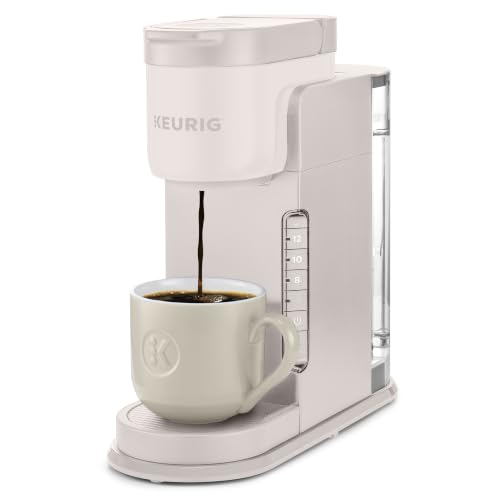
Keurig K-Express, Warm Stone
Badge: Best Overall
Strengths
- The neutral warm stone finish suits the widest range of kitchens
- Three sizes, Strong Brew and a 42 oz reservoir: the complete everyday set
- Travel mug friendly for direct-to-mug commuter brewing
Trade-offs
- Identical mechanics to the mint and evergreen K-Express versions
- Pod-only: no grounds or reusable-filter mode in the listing
- Reservoir convenience costs counter depth compared with the mini formats
Key specifications
- Brew sizes: 3 brew sizes
- Reservoir: 42 oz removable reservoir
- Strength control: Strong Brew button
- Cup fit: Travel mug friendly
- Pods: Works with all K-Cup pods
- Finish: Warm Stone
The warm stone K-Express is the same complete single-serve machine as its mint and evergreen siblings — three brew sizes, Strong Brew button, 42 oz removable reservoir, travel mug clearance, all K-Cup pods — in the finish most likely to disappear quietly into any kitchen. That neutrality is its selling point: it is the version to buy when the machine is a shared household appliance rather than a personal style statement, and the one least likely to clash with a future kitchen refresh. Everything else in this review mirrors the K-Express verdict across the pool: a well-judged everyday pod brewer whose real competition is its own colour chart.
Automation is the Keurig K-Express, Warm Stone’s whole pitch: from its stated starting point — 3 brew sizes — the question is how much of the brewing sequence the machine truly owns, and how much remains a manual ritual wearing automatic clothes.
Best for: shared households wanting the K-Express in a go-with-anything finish / Not suited for: buyers hunting for extra features beyond the standard K-Express set

Elite Gourmet Single-Serve Coffee Maker EHC111A
Badge: Best Set-and-Forget Grounds Pick
Strengths
- Brews from grounds through a reusable filter — no pods to buy or bin
- One-touch, 600W fast brewing with auto shut-off is as simple as the format gets
- Dishwasher-safe parts and a compact body suit dorms, desks and travel mugs
Trade-offs
- Grounds-only as listed: no pod compatibility is claimed in the verified listing
- 14 oz is the ceiling — one generous mug, never two cups
- A basic feature set: no reservoir, no size menu, no strength control
Key specifications
- Capacity: 14 oz single serve
- Power: 600W
- Controls: One-touch operation
- Filter: Reusable filter for grounds and loose-leaf tea
- Safety: Auto shut-off
- Cleaning: Dishwasher-safe parts
- Model: EHC111A
The Elite Gourmet EHC111A is the pool’s back-to-basics brewer: a compact 600W machine that makes a 14 oz cup from loose grounds in a reusable filter, with one-touch operation, auto shut-off and dishwasher-safe parts. It also brews loose-leaf tea through the same filter, which makes it a small hot-drinks station rather than a coffee-only gadget. Its honesty is its charm — there is no reservoir to descale, no pod supply to manage, and almost nothing to learn. What it asks in return is the grounds ritual: measure, brew, empty the filter. For dorms, desks, spare rooms and second homes, that trade is often exactly right, and its tier within the single-serve class reflects the simplicity.
Automation is the Elite Gourmet Single-Serve Coffee Maker EHC111A’s whole pitch: from its stated starting point — 14 oz single serve — the question is how much of the brewing sequence the machine truly owns, and how much remains a manual ritual wearing automatic clothes.
Best for: grounds drinkers who want the simplest possible one-cup routine with no pods / Not suited for: pod users or anyone brewing for more than one person at a time
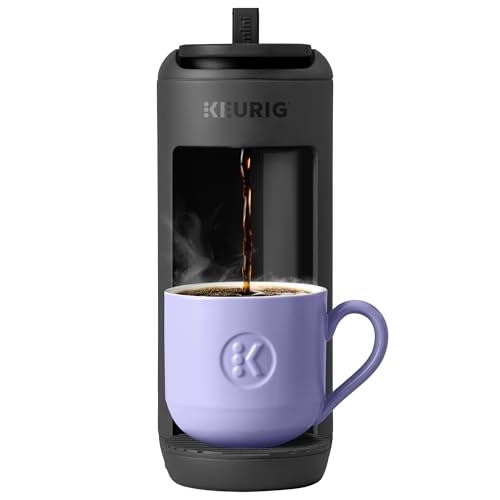
Keurig K-Mini Mate, Black
Badge: Best Compact Automatic
Strengths
- The compact, portable format is made for dorms, offices and small counters
- Brews any size up to 12 oz — you add the water for the cup you want
- No reservoir means almost nothing to clean, descale or leave stale
Trade-offs
- Fill-for-every-cup: there is no reservoir to carry a busy morning
- Pod-only format with no grounds mode in the listing
- One cup at a time, always — guests queue politely
Key specifications
- Brew size: Brews up to a 12 oz cup
- Type: Single serve K-Cup pod maker
- Design: Compact and portable
- Named for: Small spaces, dorms and offices
- Finish: Black
The K-Mini Mate is Keurig reduced to its essence: a compact, portable K-Cup machine that brews up to a 12 oz cup from water you add for that cup. The reservoir-free design is a deliberate philosophy — the machine is small enough for a dorm desk or an office corner, there is no tank of standing water to think about, and the whole appliance can travel or store in a way reservoir machines cannot. The cost is paid in ritual: every cup starts with a fill. For a one-person routine that ritual is seconds and the simplicity is worth more than automation; for a household queue at 7 a.m. it is the wrong tool, and this guide says so plainly.
Automation is the Keurig K-Mini Mate, Black’s whole pitch: from its stated starting point — brews up to a 12 oz cup — the question is how much of the brewing sequence the machine truly owns, and how much remains a manual ritual wearing automatic clothes.
Best for: students, desk workers and solo drinkers in small spaces who value compact simplicity / Not suited for: multi-cup households that want a reservoir to carry the morning
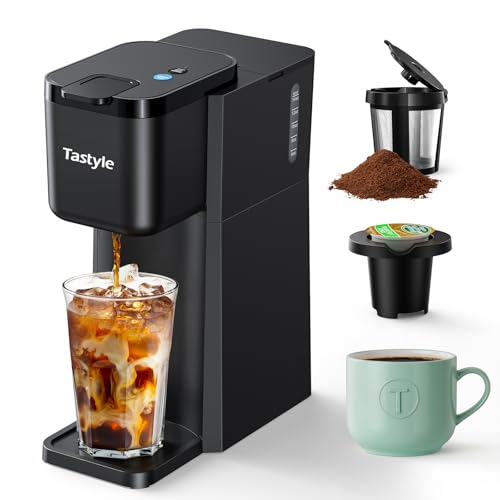
Tastyle Mini Single Serve Coffee Maker K310IC
Badge: Most Versatile Automatic
Strengths
- Takes K-Cup pods and ground coffee — both formats in a mini footprint
- Brews hot and iced coffee across a 6 to 14 oz size range
- Positioned for home, travel, RV, office and dorm use, with a recipe book included
Trade-offs
- A mini machine’s reservoir story is modest next to the 42-56 oz models here
- Lesser-known brand next to Keurig and Hamilton Beach in this pool
- Iced brewing at mini scale means one glass at a time, by definition
Key specifications
- Inputs: K-Cup pods and ground coffee
- Brew sizes: 6 to 14 oz brew sizes
- Drinks: Hot and iced coffee
- Included: Recipe book
- Power: 120V
- Model: K310IC, version 2.0
- Finish: Classic Black
The Tastyle K310IC packs an unusual amount of format freedom into a mini body: K-Cup pods or ground coffee, hot or iced drinks, and brew sizes from 6 to 14 oz, sold for home, travel, RV, office and dorm life with a recipe book in the box. That breadth is why it keeps appearing across this series of guides — it is the small machine that refuses to make its owner choose a camp. The honest cautions are scale and brand: it is a mini, so reservoirs and throughput are mini too, and Tastyle does not carry the decades of household familiarity the Keurig name does. For a single user who wants every option in the smallest box, it is a compelling answer.
Automation is the Tastyle Mini Single Serve Coffee Maker K310IC’s whole pitch: from its stated starting point — k-cup pods and ground coffee — the question is how much of the brewing sequence the machine truly owns, and how much remains a manual ritual wearing automatic clothes.
Best for: solo users in homes, dorms, RVs and offices who want pods, grounds, hot and iced in one mini machine / Not suited for: households brewing back-to-back cups for several people

Keurig K-Express, Evergreen
Badge: Best Everyday Reservoir Pick
Strengths
- Same complete K-Express specification as its colour siblings
- Strong Brew button adds a bolder extraction without changing pods
- 42 oz removable reservoir keeps a multi-cup household moving
Trade-offs
- Colour is the only difference from the mint and warm stone versions
- Pod-only brewing, with the ongoing pod supply that implies
- Mid-size footprint: measure the under-cabinet space it will live in
Key specifications
- Brew sizes: 3 brew sizes
- Reservoir: 42 oz removable reservoir
- Strength control: Strong Brew button
- Cup fit: Travel mug friendly
- Pods: Works with all K-Cup pods
- Finish: Evergreen
In evergreen, the K-Express brings the same formula as the other colours in this pool: three brew sizes, the Strong Brew button, a 42 oz removable reservoir and travel mug clearance, working with all K-Cup pods. We list the colours separately because a coffee maker is permanent counter furniture, and the finish you enjoy looking at at 7 a.m. is a legitimate part of the purchase. Performance, capacity and controls are identical across the trio, so this review makes no attempt to invent a difference: choose evergreen because your kitchen runs green, or because it is the finish on the listing you prefer, and expect exactly the K-Express experience described for its siblings.
Automation is the Keurig K-Express, Evergreen’s whole pitch: from its stated starting point — 3 brew sizes — the question is how much of the brewing sequence the machine truly owns, and how much remains a manual ritual wearing automatic clothes.
Best for: buyers who want the full K-Express package in a deep green finish / Not suited for: anyone expecting a capability difference from the other K-Express colours

Keurig K-Express, Mint
Badge: Best Colour-Led Pick
Strengths
- Three brew sizes plus a Strong Brew button cover the realistic single-serve range
- The 42 oz removable reservoir means refills every few days, not every cup
- Travel mug friendly, so the morning commute cup brews straight into its mug
Trade-offs
- Pod-only format: no grounds mode is offered in the listing
- Functionally identical to the other K-Express colours — the finish is the difference
- A reservoir machine is larger than the reservoir-free compacts in this pool
Key specifications
- Brew sizes: 3 brew sizes
- Reservoir: 42 oz removable reservoir
- Strength control: Strong Brew button
- Cup fit: Travel mug friendly
- Pods: Works with all K-Cup pods
- Finish: Mint
The K-Express is Keurig’s mainstream single-serve answer: three brew sizes, a Strong Brew button for a bolder cup from the same pod, and a 42 oz removable reservoir that removes the fill-every-time chore of the smallest machines. Travel mug clearance means the drip tray story is simple — taller mugs fit, which matters more in daily life than almost any other single specification. In mint it is also the colour-led choice of the K-Express trio in this pool: the mechanics are shared, so the honest way to choose between them is by the kitchen the machine will live in. As an everyday pod brewer it is complete, uncomplicated and sized for real households rather than occasional use.
Automation is the Keurig K-Express, Mint’s whole pitch: from its stated starting point — 3 brew sizes — the question is how much of the brewing sequence the machine truly owns, and how much remains a manual ritual wearing automatic clothes.
Best for: everyday pod drinkers who want reservoir convenience and a strength option / Not suited for: grounds brewers or anyone wanting a pod-free routine
Comparison Table
| Model | Badge | Standout specification | Key feature | Link |
|---|---|---|---|---|
| Keurig K-Express, Warm Stone | Best Overall | Brew sizes: 3 brew sizes | 42 oz removable reservoir | Check on Amazon |
| Elite Gourmet Single-Serve Coffee Maker EHC111A | Best Set-and-Forget Grounds Pick | Capacity: 14 oz single serve | 600W | Check on Amazon |
| Keurig K-Mini Mate, Black | Best Compact Automatic | Brew size: Brews up to a 12 oz cup | Single serve K-Cup pod maker | Check on Amazon |
| Tastyle Mini Single Serve Coffee Maker K310IC | Most Versatile Automatic | Inputs: K-Cup pods and ground coffee | 6 to 14 oz brew sizes | Check on Amazon |
| Keurig K-Express, Evergreen | Best Everyday Reservoir Pick | Brew sizes: 3 brew sizes | 42 oz removable reservoir | Check on Amazon |
| Keurig K-Express, Mint | Best Colour-Led Pick | Brew sizes: 3 brew sizes | 42 oz removable reservoir | Check on Amazon |
Read the table as a map, not a ranking shortcut: the standout specification column shows what each maker chose to compete on, and the right choice is the model whose chosen strength matches the job your kitchen actually has.
How to Choose: Best single serve full automatic coffee makers
Start with the input you will actually feed it. Pods buy zero-measure convenience and per-cup variety; grounds buy freshness, dose control and the lower ongoing fuss of a coffee bag. Dual-format machines exist for households that genuinely split. Decide the input first, honestly, from last week’s cups — every later specification is refinement of that one decision.
Translate reservoir size into your rhythm. A 42 to 60 oz reservoir is several days of water for a light drinker and a single morning for a busy household; a reservoir-free machine is a fill with every cup and nothing stale ever sitting in a tank. Neither is better in the abstract. Count your cups per day, divide, and buy the refill rhythm you will not resent.
Match sizes to your real cups. List the vessels you actually drink from — the weekday mug, the travel tumbler, the iced glass — and check the machine’s stated sizes and clearance against them. The most common single-serve disappointment is a favourite cup the machine cannot fill or cannot fit. Our guide to Best Single Serve And Carafe Coffee Makers explores the neighbouring options if your shortlist is still growing.
Weigh the routine, not just the cup. Every machine in this guide can make a good cup on its best day. The one you will love is the one whose full routine — load, brew, empty, rinse, refill — fits your mornings and your counter. Measure the space with the lid open and the reservoir out before you order; a coffee maker is furniture as much as appliance.
How to Brew Single-Serve Coffee Well, Step by Step
- Start with fresh water. Fill the reservoir or the cup-measure with fresh water; water that has sat in a warm tank for days brews flat coffee from good beans.
- Warm the cup. A rinse of hot water in the mug while the machine heats keeps the finished cup at drinking temperature to the last sip.
- Load consistently. Seat the pod fully, or measure grounds the same way every time — consistency of dose is what makes a machine’s results repeatable.
- Choose the size your coffee was dosed for. Brew the size that matches the pod or the dose rather than the largest the machine offers; oversizing is dilution.
- Use strength and style controls deliberately. Strong modes and smaller sizes are the honest levers for a bolder cup — change one at a time so you learn what each does.
- Empty and rinse now, not later. Eject the used pod or empty the filter while it is fresh, rinse what rinses, and leave the machine ready for its next cup.
Two habits separate consistent cups from lucky ones. First, change one variable at a time: size, strength, coffee — a week of single changes teaches you your machine, while a morning of three changes teaches you nothing. Second, keep the water path clean: reservoirs rinsed weekly and descaling on the maker’s rhythm are what keep an automatic machine tasting automatic in year two. Readers setting up a first machine may also want the setup notes in our guide to Best Single Serve And Pod Coffee Makers.
Troubleshooting. Problem: the cup tastes weak → the brew size is too large for the dose; drop one size, use the strong mode if your machine offers one, or raise the grounds dose. Problem: the brew runs slow or the cup is lukewarm → mineral scale is the usual cause; descale on the maker’s method before suspecting the machine. Problem: coffee tastes stale despite fresh pods or beans → audit the water and the cup: old reservoir water and a mug carrying yesterday’s film will defeat any brewer in this guide.
The Automation Spectrum: What the Machine Owns, What You Own
Break any of these machines’ mornings into steps and the spectrum appears. You always own choosing the drink and providing the cup. The machine owns heating, measuring and brewing on every pick here. The contested steps are water supply and coffee loading. Reservoir machines own the water for days at a time; the K-Mini Mate hands it back to you per cup in exchange for its size. Pod machines reduce loading to a single placement; grounds machines ask for a measure and a filter, and repay it with freshness and dose control.
Auto shut-off, stated on the Elite Gourmet’s listing, is the tail end of automation: a machine that turns itself off never waits on your memory, which matters in offices, dorms and holiday lets where the last user is never the next user. It is a small feature with an outsized effect on how automatic a machine feels after a month.
The buying conclusion is personal: list the steps you resent. If refilling annoys you, the reservoir machines win regardless of any other feature. If measuring grounds is the resentment, pods win. Full automatic is not a specification a listing can settle — it is the match between a machine’s requests and your patience, and this guide’s reviews are organised to expose exactly that match.
Automatic Brewing and Coffee Quality
Automation’s gift to quality is consistency. A machine that heats and pumps the same way every cycle removes the two variables that ruin home coffee most often: water temperature wandering and contact time wandering. Pod machines add a third consistency — the dose itself is sealed and identical — which is why a mid-range pod brewer often out-tastes a careless manual routine while losing to a careful one.
The honest limit is adaptability. An automatic cycle cannot notice that today’s beans are fresher, darker or ground finer than yesterday’s, and adjust. The controls that do exist in this pool — the K-Express Strong Brew button, the Tastyle’s size range, the dual-format machines’ choice of inputs — are the levers automation leaves you, and the reviews note which picks leave you the most.
For most households the trade is emphatically worth it: coffee that is very good every day beats coffee that is occasionally superb and frequently botched, especially before 8 a.m. The connoisseur’s counter-argument belongs to other formats; within single-serve, automation is not the enemy of quality but its floor. For a neighbouring angle on the same shortlist, see our guide to Best Single Serve Coffee Makers Compatable With Kcups.
More to Know Before You Buy
Automatic machines reward a full reservoir and punish an empty one at the worst moment, so make the refill a background habit — top up when you empty the drip tray or rinse the filter, and the machine’s automation will never be interrupted by its one manual dependency.
Keep the first cup of a new machine’s life unjudged. Seals seat, paths rinse through, and your own size and strength choices calibrate over the first several brews. Automatic consistency is real, but it converges over the first week rather than arriving in the first cup.
Finally, buy the machine for the drinker you are on your worst morning, not your best. Features that delight on a slow Sunday — extra modes, extra rituals — must also survive a rushed Tuesday. The picks in this guide were weighed on their Tuesday behaviour, because Tuesdays are most of the year.
Water is the ingredient nobody lists and everybody tastes. Single-serve machines brew with whatever the reservoir holds, and water that has sat warm in a tank for a week brews like it. The habit that protects every machine in this guide is boring and total: fill with fresh water, empty and rinse the reservoir weekly, and never top up indefinitely. Fresh water is the cheapest upgrade in coffee, and it compounds with every other good decision.
Descaling is the maintenance that decides how long a single-serve machine tastes like itself. Mineral scale insulates the heater, slows the pump and cools the brew by degrees too small to notice weekly and too large to ignore yearly. Follow the rhythm your machine’s manual sets, use the descaling method it names, and treat a slow or lukewarm cup as a symptom to descale, not a machine to replace.
Cup temperature is the invisible half of serving temperature. A cold ceramic mug pulls real heat from a fresh brew in the first minute; a warmed mug — rinsed with hot water while the machine heats — keeps the cup at drinking temperature to the last sip. It costs twenty seconds and no equipment, and it is the difference between coffee that tastes brewed and coffee that tastes stored.
Pod and grounds storage share one rule: coffee hates air, light, heat and time, in roughly that order. Sealed containers, cool cupboards and quantities matched to your household’s pace will do more for the cup than any single feature compared in this guide. Buy coffee the way you drink it — steadily — and let freshness be a purchasing habit rather than a machine specification.
The drip tray is the most honest part of any single-serve machine: it records every overflow, every removed-mug drip and every overfilled travel cup. Empty and rinse it when you refill or descale, and it stays a record of nothing. Neglect it, and it becomes the one part of the machine guests notice. Small machines ask small maintenance; the tray is where that bargain is kept.
Brew size discipline protects flavour more than any strength feature. A pod or a measured dose contains a fixed amount of coffee, and every extra ounce of water is dilution wearing the clothes of value. Choose the size your cup and your coffee were meant for, and use strength controls or dose — not restraint with the size button — when you want a bolder cup.
Noise belongs in the ownership calculation for early risers and shared walls. Single-serve pumps are brief but not silent, and a machine on a hollow counter amplifies itself. A folded mat under the base, a solid counter position and a closed kitchen door are the whole acoustics programme — plan them once, and the 6 a.m. cup stops being a household negotiation.
Keep the box and the manual for the first month. Box, because returns and exchanges are painless inside it; manual, because descaling sequences, size tables and error lights are model-specific knowledge that memory will not retain from a single reading on delivery day.
Coffee temperature at the cup is a chain: machine, mug and room. Machines in this guide handle the first link; the warmed-mug habit handles the second; drinking the coffee when it is brewed handles the third. Complaints about lukewarm cups are usually a broken second or third link blaming the first.
If you drink decaf in the evening, give it a dedicated place in the routine — a labelled pod section or a separate grounds tin. Cross-contamination of the caffeinated and decaf supplies is the most common single-serve household error, and it is always discovered at the worst possible hour.
Travel with a mini machine is a packing discipline: pods or grounds measured into a sealed container, the machine dry, and a mug that fits both the machine and the destination. The Tastyle and K-Mini formats in this pool were designed with that suitcase in mind; treat the first trip as a rehearsal and note what the routine actually needed.
And the standing calibration for every reader of this guide: no machine redeems coffee you do not like. Machines deliver temperature, consistency and convenience. The beans, pods and blends remain your choice — choose ones you enjoy, in quantities you finish fresh, and the right machine will make them taste like themselves every day.
A spare reusable filter or a second pod holder, where a design uses one, is the cheapest insurance in this category: the morning a filter is forgotten in the dishwasher stops being a coffee emergency. Small parts, stored with the machine, keep single-serve routines single-motion.
Measure your counter the way the machine will actually live: height under cabinets with the lid open, depth with the reservoir removed for filling, and clearance for the tallest mug you own. Machines are returned for geometry more often than for coffee, and every one of those returns was preventable with a tape measure and five honest minutes.
Seasonal drinking is a real specification. Iced coffee households should weight the designed iced modes in this pool; winter households should weight reservoir size and mug clearance for the big hot cups of the cold months. Buy for your whole year, not for the month you happen to be shopping in.
Second machines follow their own logic. A main brewer plus a small single-serve for odd hours, decaf or a desk is a common and sensible end-state, and several picks in this guide — the minis especially — are priced and sized by their makers for exactly that supporting role.
Guests reveal a machine’s teaching cost. If a visitor cannot make a cup unaided after one demonstration, the machine is a hobby, not an appliance. Keep the instructions you wish you had been given — size, strength, where the water goes — on a card by the machine, and hospitality stops depending on the host being awake.
The used-pod and spent-grounds step deserves a designed home: a small caddy or bin within one step of the machine. Every extra step between brewer and bin is paid in drips on the counter, and counters, not cups, are where single-serve ownership is judged by the rest of the household.
If two people share one machine, agree the default settings and write them down. Most shared-machine friction is not about coffee quality but about finding the reservoir empty, the strength changed or the decaf brewed by mistake. A one-line house rule by the machine ends all three arguments permanently.
Buy accessories last, not first. A new machine’s genuine needs — a fitting mug, a storage drawer, a spare filter — reveal themselves within a fortnight of real use. Accessories bought speculatively on delivery day mostly become cupboard archaeology; accessories bought from experience get used daily.
Energy habits are simple in this category: machines with auto shut-off should be allowed to use it, and reservoir machines should not be left heating water nobody will drink through long absences. The savings per cup are small and the habit costs nothing, which is exactly the profile of a habit worth keeping.
And when a machine finally ages out, judge its replacement by the routine you actually built around the old one — the sizes you used, the format you fed it, the reservoir rhythm you kept. Your own history is the most accurate buying guide ever written for your kitchen, and it is free.
Lid, seal and pod-holder hygiene is the flavour detail nobody photographs. Coffee oils collect exactly where the brew exits, and they stale in days. A weekly wipe of the brew head area and a rinse of removable holders keeps last week’s coffee out of this week’s cup — a two-minute habit with a taste payoff out of all proportion to its effort.
Treat the first month as calibration, not verdict. Every household’s water, cups and coffee differ, and a machine’s best size and strength settings are discovered, not shipped. Keep notes for the first dozen cups — size, setting, coffee, result — and the settings that emerge will serve you unchanged for years.
Counter placement affects temperature more than owners expect. A machine backed against a cold exterior wall or under an air-conditioning vent starts every brew colder than the same machine in a sheltered corner. If cups run lukewarm despite descaling, move the machine before you replace it.
Single-serve machines are unusually honest about neglect: they slow, cool and thin their output gradually rather than failing suddenly. Read those changes as a maintenance dashboard — slow means scale, cool means scale or water, thin means dose or size — and almost every decline is reversible with the habits in this guide.
Keep a simple descaling and cleaning rhythm on the calendar rather than in memory: reservoir rinse weekly, brew-path wipe weekly, descale on the maker’s schedule. Calendar habits survive busy months; remembered habits do not, and machines age in the months nobody was watching.
Common Buying Mistakes
- Buying the format label instead of the format. Pod, grounds and combo claims live in the listing’s details, not its headline. Read what the machine actually accepts before you picture it on your counter.
- Ignoring the keyword’s core requirement. A superb machine of the wrong type — a pod-only brewer bought for a pod-free household — is a bad purchase wearing a good brand. Fit first, badge second.
- Skipping the tape measure. Counter height with the lid open, mug clearance and reservoir removal space are leading causes of returns in this category, and all take five minutes before ordering.
- Oversizing every cup. The largest brew size through a fixed pod or a light dose is dilution, not generosity. Buy sizes that match your cups and your coffee, not the biggest number on the box.
- Treating any single number — price, rating or rank — as the decision. Each is one signal with known failure modes. The households that buy well combine the signals, weight fit highest, and check the live details on the product page at the moment of purchase.
Final Recommendation
Start with the first pick that matches your household profile in the detailed reviews — for most readers that will be one of Keurig K-Express, Warm Stone, Elite Gourmet Single-Serve Coffee Maker EHC111A, Keurig K-Mini Mate, Black. Each earned its place on a complete, verified specification and a clear statement of who it suits. Check on Amazon Check on Amazon Check on Amazon
Whichever route you take, buy for the coffee life you actually lead: the cups in your real week, the input you actually enjoy feeding a machine, and the cleaning routine you will actually keep. A machine matched that honestly will be used daily and praised often — which is the only outcome any guide, including our companion piece on Best Single Serve Coffee Makers Environmental, is really trying to produce.
Related guides
Frequently Asked Questions
What does full automatic mean for a single serve coffee maker?
That the machine runs the whole brew cycle itself — heating, measuring and pumping the water — from one button press. In this category it does not mean bean-to-cup espresso automation, and this guide says so in its introduction.
Which pick is the most set-and-forget?
For grounds drinkers, the Elite Gourmet: one-touch brewing and auto shut-off. For pod drinkers, a K-Express: a 42 oz reservoir means days between refills.
Does the K-Mini Mate count as automatic if I add water each time?
Its brew cycle is fully automatic; only the water supply is manual, which is the deliberate trade for its compact, portable size. The guide weighs it as such rather than pretending the step away.
Can an automatic machine make strong coffee?
Yes — the K-Express Strong Brew button exists for exactly that, and choosing a smaller brew size concentrates any pod. Grounds machines let you raise the dose itself.
Do automatic machines need descaling?
Yes, all of them. Automation moves water through heated paths, and mineral scale is the tax; the how-to section covers the rhythm. Skipping it is how automatic machines slowly stop tasting automatic.
Which pick automates the widest range of drinks?
The Tastyle: pods or grounds, hot or iced, 6 to 14 oz — the broadest automated routine in the pool.


