Disclosure: topratedkitchenware.com is reader-supported. When you buy through links on our site, we may earn an affiliate commission from Amazon and other retailers, at no extra cost to you.
Where to buy
This guide to best sterl camping coffee makers applies a strict fit rule: only picks that genuinely match the keyword carry Amazon links, where you can check the latest price on Amazon and confirm the exact variant before ordering. Picks that miss the keyword’s core requirement are reviewed prose-only, without links or images, and are marked as such in the list below and in the detailed reviews.
- Best Steel Camping Press: Stainless Steel French Press Coffee Maker (12 oz) — Check on Amazon
- Utopia Kitchen French Press Coffee Maker (34 oz) — Check on Amazon
- Veken French Press Coffee Maker (34 oz) — Check on Amazon
- Keurig K-Express Single Serve Coffee Maker, Black — prose-only in this guide (no shopping link; see the review below for why)
- Keurig K-Express Single Serve Coffee Maker, Warm Stone — prose-only in this guide (no shopping link; see the review below for why)
- Elite Gourmet Single-Serve Coffee Maker (EHC111A) — Check on Amazon
Read the full guide ↓
Camping coffee is a genre of its own, and the best sterl camping coffee makers — read here as the sturdy, camp-ready brewers this pool actually contains — share one defining trait: they make real coffee where there is no kitchen. Three of this guide’s six picks are French presses that need nothing but hot water from a stove or fire; one is a compact electric brewer for powered pitches and RVs; and two are countertop pod machines that appear prose-only, because a machine that needs a wall socket and a pod supply is not a camping brewer in any honest sense.
The camping test used throughout is practical, not romantic. Can it survive the journey? Can it brew with the heat source a campsite actually has? Can it be cleaned with a kettle of water and a wipe? And does it serve the number of people actually sitting around the fire? Every review below answers those four questions for its pick, in those terms.
If your camping is a backpack and a bivvy, weight and breakability will drive you to the small steel press. If it is a family tent or a campervan, capacity and convenience argue differently. The guide covers both honestly — and explains, in the prose-only reviews, why two perfectly good home machines did not make the camping cut.
Camping readers comparing the wider single-serve field should see Best Simple Coffee Makers for the simplest machines that travel to powered pitches.
Key Takeaways
- French presses dominate camping for a reason: no power, no paper, any heat source, and coffee for the whole tent from one vessel.
- Steel beats glass when the press travels rough; glass earns its place at car camps and cabins where it can be packed with care.
- The two Keurig K-Express machines are reviewed prose-only — mains power and pod supplies fail the camping test.
- The Elite Gourmet is the linked pick for powered pitches and RVs, where a socket exists and a travel mug is the routine.
- Brew for the group size you actually camp with: the 12 oz press serves one, the 34 oz presses serve the circle.
In this guide
Quick Picks
Six picks, six different reasons to buy. Scan the badges for the short answer, then read the detailed reviews for the honest trade-offs — every pick here has at least one.
| Pick | Badge | Standout points | Check it |
|---|---|---|---|
| Stainless Steel French Press Coffee Maker (12 oz) | Best Steel Camping Press | Capacity: 12 oz (350 ml), 1-2 cups; Material: full stainless steel body | Check on Amazon |
| Utopia Kitchen French Press Coffee Maker (34 oz) | Best Group Camping Press | Capacity: 34 oz; Body: borosilicate glass, heat-resistant listed | Check on Amazon |
| Veken French Press Coffee Maker (34 oz) | Best Brew-Path Camping Press | Capacity: 34 oz (1 litre); Body: thickened glass with stainless steel brewer parts listed | Check on Amazon |
| Keurig K-Express Single Serve Coffee Maker, Black | Best Basecamp Pod Machine (Prose-Only) | Brew sizes: 3 sizes listed; Reservoir: 42 oz removable reservoir | Prose-only — see review |
| Keurig K-Express Single Serve Coffee Maker, Warm Stone | Best in Warm Stone (Prose-Only) | Brew sizes: 3 sizes listed; Reservoir: 42 oz removable reservoir | Prose-only — see review |
| Elite Gourmet Single-Serve Coffee Maker (EHC111A) | Best Powered-Site Camping Pick | Capacity: 14 oz single serve; Power: 600W | Check on Amazon |
How These Picks Were Chosen
The verified pool was judged against the campsite, not the kitchen: portability, power independence, durability and group capacity. Three French presses passed outright, spanning solo steel to group glass. One compact electric brewer passed for the powered-pitch and RV case, where its small body and travel-mug format genuinely travel. Two countertop pod machines failed the power and supply test and are reviewed prose-only under the guide’s fit rule, with no links and no images.
This is a research-led guide built on verified listing data — capacities, materials and stated use contexts — rather than claimed field testing. Where a listing itself names travel or camping use, that is noted; where the camping case rests on the format’s well-known behaviour, the review says that instead.
Our guide to Best Sing Serve Coffee Makers covers the single-cup formats in their home context.
The Picks: best sterl camping coffee makers in detail

Stainless Steel French Press Coffee Maker (12 oz)
Badge: Best Steel Camping Press
Strengths
- A full stainless steel body survives drops, packs and campsite tables that would end a glass press
- The 12 oz size brews one generous mug with no wasted coffee left going stale
- No power, no pods and no paper filters — just hot water from any kettle or stove
Trade-offs
- French press coffee carries more sediment and body than filtered drip, which not everyone prefers
- One small batch at a time means refills for a second large mug
- Steel holds heat on the outside too, so handle placement matters when pouring
Key specs (from the verified listing)
- Capacity: 12 oz (350 ml), 1-2 cups
- Material: full stainless steel body
- Use: coffee press and teapot
- Context: kitchen and travel use listed
This small press is built around a single idea: one person, one mug, zero fragility. The full stainless steel construction is the headline, because the classic failure of French presses is a cracked glass beaker, and steel removes that failure mode entirely — it can ride in a camp box, a work bag or a crowded sink without drama. At 12 oz it is sized honestly for one to two small cups, which keeps coffee fresh instead of leaving a large batch to sit and turn bitter on its grounds. The method is the familiar press routine: coarse grounds, hot water, a few minutes of steeping, a slow plunge. The resulting cup is full-bodied, with the oils and fine particles that paper filters remove, which press drinkers count as flavour and drip drinkers count as sediment — know which camp you are in before buying. It doubles as a small teapot for loose leaves, and because it needs no electricity it works anywhere hot water exists.
The small steel press is the camper’s camper: full stainless construction that can be dropped, packed and knocked without consequence, sized for one generous mug at the tent door. For backpacking and solo trips it is not just the best pick here — it is close to the ideal form of camping coffee.
Best for: solo drinkers, travellers and campers who want an unbreakable one-mug press / Not suited for: households brewing for a crowd, or drinkers who want a sediment-free cup

Utopia Kitchen French Press Coffee Maker (34 oz)
Badge: Best Group Camping Press
Strengths
- The 34 oz size brews for two to four people, unlike one-mug mini presses
- Glass lets you watch the steep and judge strength by colour
- No power needed — any kettle, stove or camp fire water source works
Trade-offs
- Borosilicate glass is heat-tough but still breakable on stone or concrete
- Press coffee carries sediment and body that filtered-coffee drinkers may not want
- A larger press is a bulkier pack item than the mini steel press
Key specs (from the verified listing)
- Capacity: 34 oz
- Body: borosilicate glass, heat-resistant listed
- Use: coffee press and tea maker
- Context: travel and camping listed
- Finish: black
The Utopia Kitchen press is the group-sized, glass-bodied take on the French press idea: 34 oz of capacity, enough for a couple’s full morning or a small group’s round, in a heat-resistant borosilicate beaker that lets you watch the brew darken and judge the steep visually. At a campsite or cabin it needs nothing but hot water — from a kettle, a stove or a fire — and it doubles as a tea maker for loose leaves, which earns its pack space on mixed trips. The glass is the honest compromise: borosilicate handles heat shock well, and the view is genuinely useful, but a press that travels should travel padded, because campsite tables and tailgates are unforgiving surfaces. The coffee itself is classic press coffee — rich, full-bodied, with fine sediment in the last sip — which its fans consider the point. For car camping, cabins and home use where a group drinks together, this is the generous-format press; solo and rough-terrain travellers should take the small steel press instead.
The Utopia press trades the steel press’s invincibility for group capacity and a visible steep. At a car camp or cabin, serving two to four people from one 34 oz press beats three rounds of a mini — pack it padded and it earns its place.
Best for: couples and small groups brewing at camp or at home without power / Not suited for: rough backpacking where glass is a liability, or sediment-free coffee fans
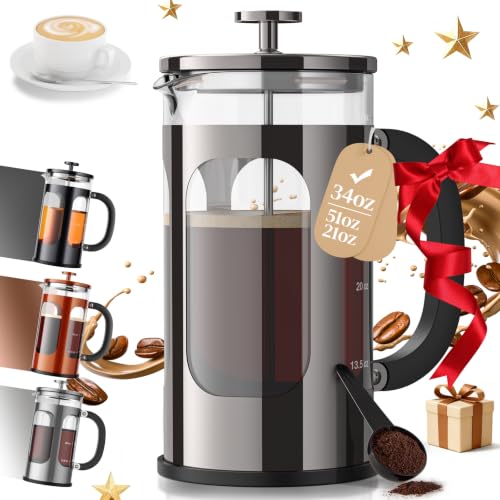
Veken French Press Coffee Maker (34 oz)
Badge: Best Brew-Path Camping Press
Strengths
- The no-plastic-contact brew path appeals to drinkers avoiding plastic in hot drinks
- Thickened glass plus stainless parts make a sturdier-feeling press than basic models
- 34 oz serves a small group, and the design looks presentable at a table
Trade-offs
- Glass remains glass — thickened helps with knocks, not drops onto rock
- A 1-litre press is a substantial item to pack for solo trips
- Press sediment is part of the cup, as with every French press
Key specs (from the verified listing)
- Capacity: 34 oz (1 litre)
- Body: thickened glass with stainless steel brewer parts listed
- Design: no plastic touching the coffee listed
- Use: kitchen, travel and camping listed
- Finish: Dark Pewter
The Veken press sells a specific reassurance: the coffee touches glass and stainless steel, not plastic, from steep to pour. For drinkers who have moved away from plastic in hot-food contact, that brew path is the deciding feature, and the thickened glass body plus stainless brewer parts give the press a more substantial feel than entry-level models. At 34 oz it is a share-sized press — a full round for a small group at a campsite, cabin or breakfast table — and the Dark Pewter finish makes it presentable enough to serve from rather than hide. The camping case is the usual press case, with the usual caveat: no power is needed and any hot water works, but glass should be packed with protection and kept off rock and concrete edges. Flavour is full-bodied press coffee with its characteristic sediment. Buyers who prioritise brew-path materials and group capacity will find this the most considered press in the guide; weight-watchers and the glass-averse have better options above.
The Veken adds the brew-path argument to the group format: coffee touching glass and steel rather than plastic, in a thickened body that feels built for travel. For quality-minded campers with a group to serve, it is the considered choice.
Best for: groups and quality-minded drinkers who want a plastic-free brew path at camp or home / Not suited for: ultralight backpackers, or anyone who wants filtered, sediment-free coffee
Keurig K-Express Single Serve Coffee Maker, Black
Badge: Best Basecamp Pod Machine (Prose-Only)
Strengths
- The 42 oz removable reservoir covers several cups between refills, unlike fill-every-time mini brewers
- The Strong Brew button gives a real strength lever for drinkers who find standard pods weak
- Three brew sizes plus travel-mug clearance cover a desk mug and a commute cup with one machine
Trade-offs
- A reservoir machine is wider and deeper than the smallest one-cup brewers
- Pod brewing locks you into pod buying and pod waste unless you add a reusable filter
- No grounds basket is listed, so loose coffee is not the native format here
Key specs (from the verified listing)
- Brew sizes: 3 sizes listed
- Reservoir: 42 oz removable reservoir
- Feature: Strong Brew button
- Cups: travel mug friendly
- Pods: works with all K-Cup pods
- Finish: black
The K-Express in black is the balanced version of the Keurig single-serve idea: big enough reservoir to feel convenient, small enough body to stay a counter appliance rather than a counter occupation. The 42 oz removable tank is the practical centre of the design — it lifts out for filling at the sink, and its capacity means a two-coffee morning for two people does not start with a refill. The Strong Brew button is the other meaningful feature, slowing the brew to extract more from the same pod, which matters because the most common complaint about pod coffee is thinness. Three brew sizes handle the range from a small strong cup to a travel mug, and the removable drip tray creates the clearance tall mugs need. As a black appliance it disappears into most kitchens and offices, which is precisely why this finish is the default recommendation for shared spaces where a colour would be one person’s taste imposed on everyone.
The black K-Express is a fine home and office machine, and that is where its story ends: it needs mains power, a reservoir of water and a stock of pods, none of which a tent provides. It is reviewed prose-only so that nobody packs it on this guide’s say-so.
Best for: everyday pod drinkers who want fewer refills and a strength option in a mainstream finish / Not suited for: minimalists chasing the absolute smallest footprint, or grounds-only brewers
Prose-only pick: no Amazon link and no image, for the reason given in this guide’s sources note.
Keurig K-Express Single Serve Coffee Maker, Warm Stone
Badge: Best in Warm Stone (Prose-Only)
Strengths
- Identical K-Express convenience — 42 oz reservoir and Strong Brew — in a softer, kitchen-friendly finish
- The light Warm Stone tone shows splashes and dust less starkly than gloss black
- Three brew sizes and travel-mug clearance cover the full daily range
Trade-offs
- Functionally identical to the other K-Express finishes, so the choice is purely cosmetic
- A light finish shows coffee drips more visibly until wiped
- Still a reservoir machine, so it is compact rather than truly mini
Key specs (from the verified listing)
- Brew sizes: 3 sizes listed
- Reservoir: 42 oz removable reservoir
- Feature: Strong Brew button
- Cups: travel mug friendly
- Pods: works with all K-Cup pods
- Finish: Warm Stone
Everything said about the K-Express platform applies here — the 42 oz removable reservoir, the three brew sizes, the Strong Brew button, the travel-mug-friendly tray — and the Warm Stone finish is the entire difference. That is not a criticism: finish is a legitimate buying factor for an appliance that sits on display every day, and a warm off-white body suits the pale woods, white tiles and stone counters of many current kitchens better than black plastic does. It also changes the cleaning psychology slightly, because coffee splashes show sooner on a light surface, which tends to mean the machine actually gets wiped more often and stays fresher. Performance, pod compatibility and footprint are the platform’s, so the honest way to choose between the K-Express finishes in this guide is simple: pick the colour you want to look at, because the coffee will be the same. Buyers splitting the difference between two finishes should remember the reservoir size and Strong Brew matter daily; the colour matters when you notice it.
The Warm Stone K-Express fails the camping test for the identical reasons as its black sibling — the finish is the only difference, and a finish has never heated water at a campsite. Prose-only, for the avoidance of all doubt.
Best for: buyers who want K-Express convenience in a light, warm finish that suits pale kitchens / Not suited for: buyers who need the smallest possible machine, or who prefer dark appliances
Prose-only pick: no Amazon link and no image, for the reason given in this guide’s sources note.

Elite Gourmet Single-Serve Coffee Maker (EHC111A)
Badge: Best Powered-Site Camping Pick
Strengths
- The reusable filter brews your own grounds or loose-leaf tea, so there are no pods to buy at all
- One-touch operation and auto shut-off make it genuinely set-and-forget for a single mug
- A 14 oz brew fills a travel mug in one cycle, and the compact body travels well
Trade-offs
- One mug at a time, with a refill of water for every brew
- 600W is gentle power, so it is not the fastest brewer in this guide
- Grounds brewing means a filter to empty and rinse after every cup
Key specs (from the verified listing)
- Capacity: 14 oz single serve
- Power: 600W
- Operation: one-touch brewing
- Filter: reusable filter for grounds and loose-leaf tea
- Safety: auto shut-off listed
- Care: dishwasher-safe parts listed
- Model: EHC111A
The Elite Gourmet EHC111A is the traditionalist in this line-up: a small one-touch brewer that works with loose grounds in a reusable filter instead of pods. That single choice changes the economics and the waste profile of every cup — any bag of ground coffee works, loose-leaf tea works, and nothing single-use goes in the bin. The 14 oz capacity is aimed squarely at the travel-mug routine: brew straight into the mug, let the auto shut-off handle the machine, and leave. At 600W it heats modestly rather than rapidly, which is the honest trade for its size and simplicity, and the brew is a straightforward drip-style cup rather than a pressurised pod extraction. Dishwasher-safe parts keep the weekly clean easy, though the filter itself wants a rinse after each use so old grounds never flavour the next cup. For a dorm desk, a bedside table, an RV shelf or a one-person office, this is the format that asks the least: little space, little money per cup, little to learn.
The Elite Gourmet is the electric exception that proves the rule: at a powered pitch or in an RV, its compact body, one-touch brew and travel-mug format make genuine camping sense, and its reusable filter means no pod supply to pack. It is linked for that defined, powered version of camping — not for the backcountry.
Best for: solo drinkers who want grounds-based coffee with no pod cost and the smallest simple footprint / Not suited for: multi-cup households, or pod drinkers who want zero cleanup per cup
Comparison Table
The table below puts the six best sterl camping coffee makers picks side by side on the attributes that decide daily satisfaction. It deliberately carries no prices and no ratings — both change too often to print honestly; use the links to check the current listing.
| Pick | Badge | Format | Key detail | Check it |
|---|---|---|---|---|
| Stainless Steel French Press Coffee Maker (12 oz) | Best Steel Camping Press | Capacity: 12 oz (350 ml), 1-2 cups | Material: full stainless steel body | Check on Amazon |
| Utopia Kitchen French Press Coffee Maker (34 oz) | Best Group Camping Press | Capacity: 34 oz | Body: borosilicate glass, heat-resistant listed | Check on Amazon |
| Veken French Press Coffee Maker (34 oz) | Best Brew-Path Camping Press | Capacity: 34 oz (1 litre) | Body: thickened glass with stainless steel brewer parts listed | Check on Amazon |
| Keurig K-Express Single Serve Coffee Maker, Black | Best Basecamp Pod Machine (Prose-Only) | Brew sizes: 3 sizes listed | Reservoir: 42 oz removable reservoir | Prose-only |
| Keurig K-Express Single Serve Coffee Maker, Warm Stone | Best in Warm Stone (Prose-Only) | Brew sizes: 3 sizes listed | Reservoir: 42 oz removable reservoir | Prose-only |
| Elite Gourmet Single-Serve Coffee Maker (EHC111A) | Best Powered-Site Camping Pick | Capacity: 14 oz single serve | Power: 600W | Check on Amazon |
How to Choose the Right Option for Best sterl camping coffee makers
Start with the water question, because it quietly decides more than any feature list. Machines split into reservoir designs, which hold several cups of water ready to brew, and fill-per-brew designs, which take exactly one cup of water at a time. Reservoir machines win on speed and rhythm — the morning becomes pod in, button pressed, coffee out — while fill-per-brew machines win on freshness and size, since water never sits inside the machine and there is no tank dictating the footprint. Neither is better in the abstract; the right answer is the one that matches how many cups you brew in a row and how much counter you can honestly give up.
Next, settle the format question: pods, grounds, or both. Pods buy consistency and zero cleanup at the price of ongoing pod cost and single-use waste. Grounds buy choice — any coffee, any roast, ground your way — at the price of a filter to empty and rinse. Dual-format machines end the argument in mixed households but add size and parts. Be honest about which cost you will still be happy paying in six months, because the machine will ask for it every single day, and a format you resent is a machine you stop using.
Then size the machine to the mug, not the marketing. Check the largest cup or travel mug you actually use, and confirm the machine brews that volume in one cycle and physically fits the mug under the spout with the drip tray in place or removed. A brewer that needs two cycles to fill your commute mug will annoy you twice a day. Capacity math works the same way for reservoirs: divide the tank size by your usual brew size to get real cups between refills, and decide whether that number fits your household’s morning.
Finally, weigh the ownership costs nobody lists on the box. Pod machines need descaling and a pod supply chain in your cupboard. Grounds machines need filters emptied and baskets washed. Grinders need periodic cleaning or their flavour slowly muddies. Cold brew jars need fridge space and planning. The best machine in this guide is not the one with the longest feature list; it is the one whose daily and weekly chores fit the time and space you actually have, because coffee equipment succeeds or fails on routine, not on specifications.
For the drip branch of simple machines, see Best Simple Drip Coffee Makers.
How to Set Up and Brew Your First Week of Coffee
A good first week with a new coffee maker is mostly about removing variables, so the routine becomes automatic before you start experimenting. Work through the setup once, carefully, and the machine will reward you every morning after.
- Run a plain water cycle first: fill the machine with fresh water and brew a full cycle with no coffee, discarding the result, to rinse the internal paths before your first real cup.
- For pod machines, seat the pod firmly and close the lid fully before brewing; for grounds machines, use a level, even bed of grounds in the filter so water passes through uniformly instead of channelling.
- Match the water to the cup: brew the size you will actually drink, because a small brew diluted in a large mug tastes weaker than a correctly sized brew every time.
- If your machine offers a strong or bold setting, try the same coffee with and without it on consecutive days — that single comparison teaches you more than any description of the feature.
- For cold brew jars, fill the filter with coarse grounds, add cold water slowly, seal the jar, and steep in the fridge; remove the filter before serving so the brew stops extracting and stays smooth.
- Empty grounds and pods the same day you brew, rinse the parts that touched coffee, and leave lids open to dry — most off flavours in week two are simply residue from week one.
- At the end of the week, descale or deep-clean if your water is hard and the machine signals it, and note the settings that produced your favourite cup so the routine is repeatable.
Troubleshooting
Problem: Coffee tastes weak and watery → what to do: use a smaller brew size for the same pod or grounds dose, engage the strong setting if fitted, and check that the water is fully hot before judging the result
Problem: Coffee tastes bitter or harsh → what to do: shorten the steep for presses and cold brew, avoid the strong setting with dark roasts, and make sure old grounds residue is not flavouring the new cup
Problem: The machine brews slowly or splutters → what to do: mineral scale is the usual cause — run a descaling cycle, rinse the pod holder or filter basket, and refill with fresh water
Heat Sources at Camp and What They Mean for Coffee
Every camping coffee method is secretly a hot-water method, so the real purchase is often the stove, not the brewer. Presses and pour-over formats ask only for water just off the boil, which any camp stove, Kelly-style kettle or careful fire provides. That is why the press dominates this guide: it converts whatever heat you already carry into coffee with no second fuel, no socket and no generator hum at dawn.
Powered pitches change the maths and justify the one electric pick here: where a hookup exists, a compact brewer with a travel-mug format reproduces the home routine exactly. The honest division is between camps that have power by design — sites, RVs, cabins with services — and camps that carry their energy with them. Buy for the camp you actually pitch, because the two equipment lists share almost nothing.
Pod-based simplicity is shortlisted at Best Simple Coffee Makers With Pods — for home and office, not the tent.
Packing Coffee Kit That Survives the Trip
Camping coffee kit fails in transit more often than in use. Glass presses should travel in their box or wrapped in the towel that will dry them, stored upright in the middle of the load rather than against the vehicle’s wall. Steel presses can go anywhere, which is their entire argument. Coffee itself travels best as whole beans with a small hand grinder for short trips, or as grounds in a sealed tin for long ones — pre-ground coffee stales, but a week of camping is well inside the window where convenience beats ceremony.
The forgotten item in most camp coffee kits is the cleaning plan: a small brush and the discipline to rinse the press while the grounds are still wet, rather than discovering them dried at the next pitch. Press coffee’s only real campsite cost is its sediment, and a press emptied and rinsed promptly never lets that cost compound.
Hot Coffee, Iced Coffee and the Machines That Do Both
Iced coffee exposes the weakness of ordinary hot brewing: hot coffee poured over ice melts it, diluting the drink at exactly the moment it should taste strongest. Machines with a dedicated iced function answer by brewing a smaller, more concentrated hot coffee designed to land on ice and finish at drinking strength — a genuinely different brew, not a marketing label. Cold brew answers the same desire from the opposite direction, extracting slowly in cold water for a smooth, naturally mellow concentrate that dilutes to taste and keeps for days in the fridge.
Choosing between them is choosing a rhythm. Iced-mode machines make one glass on demand, in minutes, with no planning. Cold brew jars make a pitcher with a day of foresight and serve from it all week. Households that drink iced coffee daily in summer often end up with both rhythms available — a jar in the fridge for the everyday glass and a hot brewer for mornings — while occasional iced drinkers are better served by a single machine with an iced setting than by dedicating fridge space to a pitcher.
What Changes When a Second Coffee Drinker Arrives
Many of the machines in this guide are bought by one person and inherited by a household, and the friction points are predictable. Fill-per-brew minis turn into a queue when two people need coffee in the same ten minutes. A single favourite pod becomes a negotiation. Reservoir size, unimportant for one, suddenly decides whether the second person starts their morning refilling someone else’s machine. None of this is a reason to overbuy at the start — it is a reason to notice which specification you would upgrade first, because that is the honest signal of what your household actually values.
The graceful upgrades are usually format flexibility and reservoir capacity, in that order. A dual-format machine ends the pods-versus-grounds negotiation permanently, and a larger reservoir ends the refill queue. Batch machines re-enter the conversation when the household drinks together at the same time, because one pot beats four sequential single cups on any busy morning. Buying for the household you have, while knowing the upgrade path if it grows, is the balanced way through a category where every design is a deliberate trade.
Water, Ratios and Why Your Coffee Tastes Different at Home
The most common reason home coffee disappoints is not the machine but the ratio — the balance of coffee to water. Pod machines fix that ratio inside the pod, which is their hidden virtue: the dose is consistent, so the main lever left to you is brew size, and choosing a smaller size for the same pod is the reliable way to get a stronger cup. Grounds machines hand the ratio back to you, which is freedom and responsibility at once; a heaped, uneven scoop one day and a level scoop the next will produce two different coffees from the same bag.
Water itself is the second variable. Very hard water scales machines and can mute flavour; very soft or distilled water under-extracts and tastes flat. Ordinary filtered tap water is the practical sweet spot for most homes, and it slows scale at the same time. Temperature is the third variable, and it is the one you control least — which is why letting a machine heat fully before judging a cup matters, and why pre-warming a cold mug in winter genuinely changes the drink in the cup.
The Honest Guide to Pod Waste and Grounds Waste
Every format in this guide creates a different kind of waste, and pretending otherwise helps nobody. Single-use pods are the visible problem: one small container per cup, convenient and consistent, but a steady stream of material that most local recycling streams handle poorly. Reusable pod filters cut that stream sharply for drinkers willing to fill and rinse them, at the cost of the zero-effort routine that made pods attractive. Grounds brewing produces no packaging per cup beyond the coffee bag, and spent grounds compost readily, but it asks for a filter routine — reusable filters avoid paper waste entirely, while paper filters add a small, compostable cost per cup.
Cold brew and French press sit at the low-waste end: a reusable steel filter, grounds that compost, and nothing else per batch. The fair conclusion is not that one format is virtuous and another is not; it is that waste is a real, recurring cost of a daily habit, and it deserves the same honest line in your decision as money and counter space. Choose the waste profile you can sustain without resentment, because a routine you abandon in month two wastes the whole machine.
Building a Coffee Corner That Actually Works
A coffee corner fails in predictable ways: the machine fits but the mug does not, the pods live in another room, the water jug is across the kitchen, and every cup becomes a small obstacle course. The fix is to arrange the corner around the sequence of making one cup — water, coffee, machine, mug, bin — within arm’s reach and in that order. Measure the space with the machine’s lid fully open, not closed, because pod and filter access happens upward, and cabinets that clear the closed machine may still block the open one.
Power and water deserve the same forethought. A corner near a sink shortens every refill and rinse; a corner far from one turns maintenance into a chore that gets skipped. Leave a small landing zone beside the machine for the mug you are filling and the one you just finished, and store a week’s coffee supply in the corner itself rather than restocking daily from a distant cupboard. Corners arranged this way get used daily and cleaned willingly; corners arranged around appearance alone quietly migrate back to the kettle.
Care, Cleaning and Making It Last
Coffee makers age through two enemies: mineral scale and old coffee oil. Scale builds inside heaters and lines wherever water is hard, gradually slowing brews and lowering temperature until coffee tastes thin no matter what you change. Descaling on the maker’s schedule — or monthly in very hard water areas — prevents almost all of it, and it is far easier than rescuing a heavily scaled machine. Coffee oil is the quieter enemy: it coats baskets, carafes, filters and press screens, and old oil turns rancid and flavours fresh coffee from the first sip. A weekly wash of everything the coffee touched, with hot soapy water and a full rinse, keeps the flavour honest.
Storage habits matter as much as washing. Keep beans and grounds away from heat and light, keep pods in a dry cupboard rather than above the steaming machine, and never leave brewed coffee sitting on a warming plate or in a press on its grounds for hours — both continue extracting and stewing long after the good flavours are out. Machines left unused for weeks should be emptied, rinsed and stored dry with lids open. None of this is elaborate; it is a few minutes a week, and it is the entire difference between a machine that still makes coffee you look forward to in year three and one that mysteriously disappoints by month six.
Storage for the home coffee corner is surveyed in Best Sideboards For Coffee Makers.
Common Buying Mistakes
- Packing a mains machine for a tent. If the pitch has no socket, the machine is luggage. The two prose-only picks in this guide exist to make that mistake unnecessary.
- Taking glass where it will be dropped. Glass presses are for car camps and cabins with padded packing. Rough and solo travel belongs to the steel press.
- Brewing solo portions for a group. Three rounds of a 12 oz press while four people wait is a morning gone. Match press capacity to the circle.
- Forgetting the water plan. Presses need hot water from somewhere. If the stove is an afterthought, the coffee is too.
- Leaving grounds in the press. At camp as at home, a press left on its grounds over-extracts and dries into tomorrow’s chore. Plunge, pour, rinse.
At a Glance: Who Each Pick Suits
If you have read this far and want the whole guide compressed into one screen, this map matches each pick to the buyer it serves and the buyer it would frustrate. It repeats the verdicts from the detailed reviews in shorthand — use it to confirm a choice, not to skip the trade-offs entirely.
- Best Steel Camping Press — Stainless Steel French Press Coffee Maker (12 oz): best for solo drinkers, travellers and campers who want an unbreakable one-mug press; not suited for households brewing for a crowd, or drinkers who want a sediment-free cup.
- Best Group Camping Press — Utopia Kitchen French Press Coffee Maker (34 oz): best for couples and small groups brewing at camp or at home without power; not suited for rough backpacking where glass is a liability, or sediment-free coffee fans.
- Best Brew-Path Camping Press — Veken French Press Coffee Maker (34 oz): best for groups and quality-minded drinkers who want a plastic-free brew path at camp or home; not suited for ultralight backpackers, or anyone who wants filtered, sediment-free coffee.
- Best Basecamp Pod Machine (Prose-Only) — Keurig K-Express Single Serve Coffee Maker, Black: best for everyday pod drinkers who want fewer refills and a strength option in a mainstream finish; not suited for minimalists chasing the absolute smallest footprint, or grounds-only brewers.
- Best in Warm Stone (Prose-Only) — Keurig K-Express Single Serve Coffee Maker, Warm Stone: best for buyers who want K-Express convenience in a light, warm finish that suits pale kitchens; not suited for buyers who need the smallest possible machine, or who prefer dark appliances.
- Best Powered-Site Camping Pick — Elite Gourmet Single-Serve Coffee Maker (EHC111A): best for solo drinkers who want grounds-based coffee with no pod cost and the smallest simple footprint; not suited for multi-cup households, or pod drinkers who want zero cleanup per cup.
Final Recommendation
For most campers, start with the format, not the brand: the 12 oz steel press for solo and rough travel, where its unbreakable build and one-mug size are exactly right; the 34 oz Utopia or Veken presses for groups at car camps and cabins, with the Veken ahead when the brew path matters to you.
Take the Elite Gourmet when your camping comes with a power hookup and a travel mug, and leave the two K-Express machines at home where they belong — good machines, wrong expedition. Camping coffee rewards the kit that matches the trip, and this guide’s linked four cover every honest version of the trip.
To revisit the top of the list: Stainless Steel French Press Coffee Maker (12 oz) and Utopia Kitchen French Press Coffee Maker (34 oz) — confirm the exact model and variant on the listing before ordering.
And plumbed single-serve options appear in Best Sigle Brew Coffee Makers With Water Line Hookup.
Frequently Asked Questions
What is the best coffee maker for backpacking?
A small stainless steel French press, like the 12 oz pick leading this guide: it cannot shatter, needs no power or filters, and brews a full mug with any hot water. Weight-watchers sometimes choose pour-over cones instead, but for durability and simplicity in one object, the steel press is the benchmark.
Can I use a pod machine for camping?
Only where mains power is guaranteed — a powered pitch or an RV with a suitable supply — and even then a compact grounds brewer usually travels better, with no pod stock to pack. The two pod machines in this guide are reviewed prose-only precisely because ordinary camping provides neither the socket nor the supply chain they need.
Glass or steel French press for camping?
Steel for anything rough, solo or packed tight; glass for car camping and cabins where it can travel padded and its larger capacities serve a group. The material choice is really a journey choice: decide how the press will travel, and the material decides itself.
How much coffee does a camping press make?
The presses here span 12 oz — one generous mug — to 34 oz, which serves two to four campers depending on mug size. Match the press to the number of people who will actually be waiting for coffee, because a second round at a cold campsite is a longer wait than it sounds.
What about coffee for a powered pitch or RV?
That is the one electric case this guide links: a compact one-touch brewer with a reusable filter and travel-mug format, like the Elite Gourmet here. It reproduces the home routine from a hookup, with no pods to stock and a body small enough for a van shelf.
How do I clean a French press at a campsite?
Empty the grounds into your waste bag while they are still wet, rinse the press and screen with hot water, and wipe dry. Grounds left to dry in the press are the only genuinely unpleasant cleaning job in camping coffee, and the prompt rinse avoids it entirely.


