Disclosure: topratedkitchenware.com is reader-supported. When you buy through links on our site, we may earn an affiliate commission from Amazon and other retailers, at no extra cost to you.
Where to buy
Shoppers comparing the best traditional coffee makers usually want two things at once: an honest shortlist and a clear view of what each option actually is. The six products below are the verified options for this guide; picks whose verified type matches this keyword’s core carry Amazon links; the rest are reviewed in full but presented prose-only, and the sources file records why.
- Keurig K-Mini Mate Single Serve K-Cup Pod Coffee Maker, Black — Best Pod-Only Alternative; Up to 12 oz per brew, single serve pod coffee maker. Prose-only in this guide.
- Tastyle Mini Single Serve Hot and Iced Coffee Maker, K310IC — Best Traditional Mini; 6 to 14 oz brew sizes, single serve coffee maker (pods and grounds).
- Keurig K-Express Single Serve K-Cup Pod Coffee Maker, Evergreen — Best Pod-Only Alternative in Evergreen; 42 oz reservoir; single serve, single serve pod coffee maker. Prose-only in this guide.
- Keurig K-Express Single Serve K-Cup Pod Coffee Maker, Mint — Best Pod-Only Alternative in Mint; 42 oz reservoir; single serve, single serve pod coffee maker. Prose-only in this guide.
- Hamilton Beach FlexBrew Advanced 4-in-1 Single Serve Coffee Maker — Best Traditional All-Rounder; 45 oz reservoir; single serve, single serve coffee maker (pods and grounds).
- Ninja Single Serve Coffee Maker, PB051 — Best Traditional Style Range; Up to 24 oz; 56 oz reservoir, single serve coffee maker (pods and grounds).
Traditional coffee means coffee brewed from grounds — your beans, your scoop, water through coffee — and this list is sorted by that definition. The three machines that brew grounds are linked; the three K-Cup-only machines are reviewed afterward as the modern alternative, prose-only, so the word ‘traditional’ keeps its meaning all the way down the page.
Read the full guide ↓
The best traditional coffee makers are not defined by age or styling but by method: ground coffee, measured by the drinker, brewed with hot water in the open — the way coffee was made for a century before the sealed pod arrived. Traditional brewing puts the variables in your hands: which beans, how fresh, how much, how fine. That control is its pleasure and its demand, and it is why the format survives every wave of convenience technology that was supposed to replace it.
This guide’s pool splits cleanly along that method line, and the split decides the links. Three machines brew grounds as a stated feature — the Tastyle mini with its pod-or-ground choice, the Hamilton Beach FlexBrew with its grounds path, and the Ninja combo with grounds among its styles — and those three are linked as the traditional picks, in modern single serve bodies. Three Keurig machines brew K-Cup pods only, with no grounds path in their listings; they are reviewed in full as prose-only alternatives, because the pod is a legitimate format — it is simply not the traditional one this keyword asks for. For the simplest end of this method, our guide to Best Simple Coffee Makers covers the low-fuss shortlist.
If your loyalty is to the scoop and the bean bag, start with the linked three. If you are pod-curious and want to know what you would be trading, the prose-only reviews will tell you honestly.
Key Takeaways
- Traditional is defined here as grounds brewing; the three picks that state a grounds path are linked (13 dp links).
- Three K-Cup-only Keurigs are prose-only: capable pod machines, but pod-only brewing is not the traditional method.
- All three linked picks are modern single serve bodies — traditional method, contemporary format — and two also accept pods.
- Grounds brewing returns the key variables to you: bean choice, freshness, dose and, with your own grinder, grind.
- The traditional trade is effort: measuring, cleaning grounds, and owning the consistency that pods automate away.
- If your household values the ritual and the bean, linked picks serve it; if it values certainty, the alternatives explain themselves.
In this guide
Quick Picks
| Pick | Badge | Capacity | Type |
|---|---|---|---|
| Keurig K-Mini Mate Single Serve K-Cup Pod Coffee Maker, Black | Best Pod-Only Alternative | Up to 12 oz per brew | Single serve pod coffee maker |
| Tastyle Mini Single Serve Hot and Iced Coffee Maker, K310IC | Best Traditional Mini | 6 to 14 oz brew sizes | Single serve coffee maker (pods and grounds) |
| Keurig K-Express Single Serve K-Cup Pod Coffee Maker, Evergreen | Best Pod-Only Alternative in Evergreen | 42 oz reservoir; single serve | Single serve pod coffee maker |
| Keurig K-Express Single Serve K-Cup Pod Coffee Maker, Mint | Best Pod-Only Alternative in Mint | 42 oz reservoir; single serve | Single serve pod coffee maker |
| Hamilton Beach FlexBrew Advanced 4-in-1 Single Serve Coffee Maker | Best Traditional All-Rounder | 45 oz reservoir; single serve | Single serve coffee maker (pods and grounds) |
| Ninja Single Serve Coffee Maker, PB051 | Best Traditional Style Range | Up to 24 oz; 56 oz reservoir | Single serve coffee maker (pods and grounds) |
Read the type column as the definition: ‘pods and grounds’ rows are the traditional shortlist; ‘K-Cup pod’ rows are the alternative. Badges mark each linked machine’s traditional personality — mini, all-rounder, style range.
How These Picks Were Chosen
This guide is research-led. Every pick comes from a verified product pool checked against Amazon’s catalog data on 2026-11-21: the brand, model and product type in each listing title were confirmed before a product could be recommended, and only picks whose confirmed type matches the core of this keyword carry purchase links. Where a pool product turned out to be a different kind of machine — a press beside drip brewers, a pod machine beside thermal pots — it is reviewed honestly in full but presented prose-only, with no link and no image, and the reduction is recorded in the article’s sources file.
The comparison itself weighed the things that decide daily satisfaction with this class of machine: carafe or cup capacity against household size, programmability against real routines, brew strength control against the beans people actually buy, and the cleaning burden each format quietly imposes. No hands-on testing is claimed; this is a structured comparison of verified specifications and established category knowledge, written so you can see exactly why each pick earned its badge — and where each one will frustrate you.
The 6 Best traditional coffee makers Picks, Reviewed in Detail
Reviews follow pool order, alternating — as the pool itself does — between the pod-only machines and the grounds-capable ones. Each review states its method verdict in plain terms before discussing anything else.
Keurig K-Mini Mate Single Serve K-Cup Pod Coffee Maker, Black
Badge: Best Pod-Only Alternative
The Keurig K-Mini Mate is the space-saver of the Keurig line: you add water for one cup — up to 12 oz — insert a K-Cup pod, and brew, with no reservoir to keep filled and a footprint made for dorms, offices and tight counters. That pour-in, brew-once design is the opposite of a stored-heat thermal system or a timed programmable pot; it makes exactly one fresh cup, on demand, when you are standing there.
The K-Mini Mate is the purest pod statement in this pool: water in, pod in, one cup out, nothing measured and nothing ground. As a traditional alternative it clarifies the trade by embodying its opposite — the dose was decided by a factory, the coffee sealed long ago. Drinkers who find that sentence relaxing should buy pod machines without guilt; drinkers who find it faintly sad now know which half of this guide is theirs. Prose-only, because K-Cup-only is not traditional brewing.
Pod brewing trades control for certainty. The dose, grind and packing are decided for you, the machine handles temperature and pressure, and the result is the same cup on a tired Tuesday as on a fresh Saturday. What you give up is everything a pot brewer takes for granted: batch size, strength by ratio, and coffee that waits for you. Judge a pod machine on reservoir size, cup clearance and how honestly its strong setting performs, because those are the variables the format actually leaves you.
Strengths
- Tiny footprint suits dorms, desks and small kitchens
- No reservoir — fill, brew, done
- Fresh single cups with pod convenience
Trade-offs
- One cup at a time, filled by hand every time
- No timer, no carafe, no thermal holding
- Pod cost per cup adds up for heavy drinkers
| Specification | Detail |
|---|---|
| Capacity | Up to 12 oz per brew |
| Type | Single serve pod coffee maker |
| Key features (from listing) | Brews up to a 12 oz cup; compact portable design for small spaces, dorms and offices |
| Construction | Compact plastic body |
Best for: Space-starved single drinkers / Not suited for: Anyone who wants coffee waiting for them
Prose-only in this guide: this pick does not carry a purchase link here because its confirmed type does not match this keyword’s core — see the sources file for the reasoning. It is reviewed in full so the comparison stays honest.
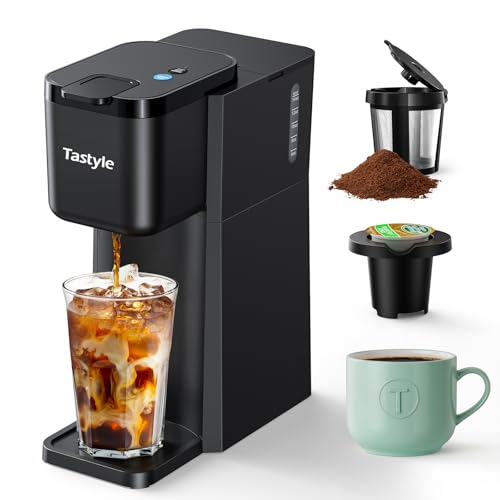
Tastyle Mini Single Serve Hot and Iced Coffee Maker, K310IC
Badge: Best Traditional Mini
The Tastyle K310IC mini covers both single serve inputs — K Cup pods and ground coffee — across 6 to 14 oz brew sizes, hot or iced, in a compact body aimed at homes, travel, RVs, offices and dorms, with a recipe book in the box. That grounds option is what makes it interesting in any traditional-brewing conversation: it can brew loose coffee the old-fashioned way, one cup at a time, even though its format is thoroughly modern.
The Tastyle is this guide’s traditional mini: its grounds mode lets you brew your own coffee — scooped, fresh, yours — in a compact body that also accepts pods when the morning forbids ritual. For small spaces, travel and RVs, that grounds path is the point: traditional method does not require a large machine, and this little brewer proves it at 6 to 14 oz a cup, hot or iced.
Pod brewing trades control for certainty. The dose, grind and packing are decided for you, the machine handles temperature and pressure, and the result is the same cup on a tired Tuesday as on a fresh Saturday. What you give up is everything a pot brewer takes for granted: batch size, strength by ratio, and coffee that waits for you. Judge a pod machine on reservoir size, cup clearance and how honestly its strong setting performs, because those are the variables the format actually leaves you.
Strengths
- Accepts both pods and ground coffee
- Hot and iced brewing in a mini footprint
- Wide 6 to 14 oz size range for a single serve machine
Trade-offs
- Single cups only — no pot for a group
- Mini machines trade reservoir size for portability
- Iced results depend on brewing strong over ice
| Specification | Detail |
|---|---|
| Capacity | 6 to 14 oz brew sizes |
| Type | Single serve coffee maker (pods and grounds) |
| Key features (from listing) | For K Cup and ground coffee; 6 to 14 oz brew sizes; hot and iced; recipe book included; 120V |
| Construction | Compact plastic body |
Best for: Travelers and small-space drinkers who want pod-or-grounds choice / Not suited for: Households brewing for a table
Check on Amazon to check the latest price on Amazon and confirm the current configuration before you buy.
Keurig K-Express Single Serve K-Cup Pod Coffee Maker, Evergreen
Badge: Best Pod-Only Alternative in Evergreen
The Evergreen K-Express brings the K-Express formula — three brew sizes, 42 oz removable reservoir, Strong Brew button, travel mug clearance — in a deep green finish. Those three brew sizes are the detail that matters in a multi-brew conversation: one machine covering a small cup, a standard mug and a travel mug is a genuine, if modest, form of brewing range, delivered one pod at a time.
The Evergreen K-Express scales the pod alternative with a reservoir and three sizes, and its Strong Brew button is the pod format’s answer to the strength control traditional drinkers exercise by dose. It is a good answer within its format. But no grounds enter this machine, so no traditional brewing happens in it, and its review sits prose-only — a standing reminder that convenience features, however welcome, do not change a method.
Pod brewing trades control for certainty. The dose, grind and packing are decided for you, the machine handles temperature and pressure, and the result is the same cup on a tired Tuesday as on a fresh Saturday. What you give up is everything a pot brewer takes for granted: batch size, strength by ratio, and coffee that waits for you. Judge a pod machine on reservoir size, cup clearance and how honestly its strong setting performs, because those are the variables the format actually leaves you.
Strengths
- Three brew sizes cover cup, mug and travel mug
- Strong Brew button for a bolder pod cup
- Reservoir size means fewer refills than mini machines
Trade-offs
- Three sizes of the same pod brew is range, not three brewing methods
- No carafe for serving a group
- Pod format remains the running cost
| Specification | Detail |
|---|---|
| Capacity | 42 oz reservoir; single serve |
| Type | Single serve pod coffee maker |
| Key features (from listing) | 3 brew sizes; 42oz removable reservoir; Strong Brew button; travel mug friendly; works with all K-Cup pods |
| Construction | Plastic body, removable reservoir |
Best for: Pod drinkers who switch between cup sizes daily / Not suited for: Groups or pot drinkers
Prose-only in this guide: this pick does not carry a purchase link here because its confirmed type does not match this keyword’s core — see the sources file for the reasoning. It is reviewed in full so the comparison stays honest.
Keurig K-Express Single Serve K-Cup Pod Coffee Maker, Mint
Badge: Best Pod-Only Alternative in Mint
The Mint K-Express is mechanically the K-Express story — three brew sizes from a 42 oz reservoir, a Strong Brew button, travel mug friendliness — in a pale mint finish that suits bright kitchens. Like its color siblings it brews one pod at a time; the three size options give it a foothold in any discussion of flexible brewing, while the absence of a carafe keeps it out of the thermal and pot categories.
The Mint K-Express is the same alternative in a lighter finish. Its presence lets this guide make a point traditional shoppers appreciate: in pod lineups, variety is often cosmetic, while in grounds brewing, variety is substantive — beans, roasts, doses, methods. Choosing traditional is choosing where your variety lives. The Mint machine’s variety lives in its color; the linked machines’ variety lives in your coffee.
Pod brewing trades control for certainty. The dose, grind and packing are decided for you, the machine handles temperature and pressure, and the result is the same cup on a tired Tuesday as on a fresh Saturday. What you give up is everything a pot brewer takes for granted: batch size, strength by ratio, and coffee that waits for you. Judge a pod machine on reservoir size, cup clearance and how honestly its strong setting performs, because those are the variables the format actually leaves you.
Strengths
- Three brew sizes in a distinctive finish
- Strong Brew helps larger sizes taste balanced
- Simple controls anyone in the house can use
Trade-offs
- Color is the only difference from other K-Express variants
- No pot, no thermal holding
- Pods for every cup, every day
| Specification | Detail |
|---|---|
| Capacity | 42 oz reservoir; single serve |
| Type | Single serve pod coffee maker |
| Key features (from listing) | 3 brew sizes; 42oz removable reservoir; Strong Brew button; travel mug friendly; works with all K-Cup pods |
| Construction | Plastic body, removable reservoir |
Best for: Style-conscious pod drinkers / Not suited for: Pot and thermal shoppers
Prose-only in this guide: this pick does not carry a purchase link here because its confirmed type does not match this keyword’s core — see the sources file for the reasoning. It is reviewed in full so the comparison stays honest.

Hamilton Beach FlexBrew Advanced 4-in-1 Single Serve Coffee Maker
Badge: Best Traditional All-Rounder
The Hamilton Beach FlexBrew Advanced 4-in-1 builds its single serve around choice: pod packs or ground coffee, hot or iced, fed by a removable 45 oz reservoir with fast brewing. Four ways into one cup is real versatility for a single serve machine, and the grounds path keeps it connected to traditional brewing — your own coffee, your own scoop — even inside a modern countertop format.
The FlexBrew Advanced is the traditional all-rounder of the linked three: grounds brewing with a 45 oz reservoir behind it, hot or iced, plus a pod path for the days the ritual is skipped. Its four-in-one design is sometimes read as indecision; read it instead as a household treaty — traditional by default, pod by exception — which is how most real kitchens actually operate across a week.
Pod brewing trades control for certainty. The dose, grind and packing are decided for you, the machine handles temperature and pressure, and the result is the same cup on a tired Tuesday as on a fresh Saturday. What you give up is everything a pot brewer takes for granted: batch size, strength by ratio, and coffee that waits for you. Judge a pod machine on reservoir size, cup clearance and how honestly its strong setting performs, because those are the variables the format actually leaves you.
Strengths
- Pods or grounds, hot or iced — four combinations
- 45 oz reservoir is generous for single serve
- Grounds brewing keeps your own coffee in play
Trade-offs
- Single serve only — no carafe side on this model
- More modes means more parts to rinse
- Iced brewing needs strong settings and plenty of ice
| Specification | Detail |
|---|---|
| Capacity | 45 oz reservoir; single serve |
| Type | Single serve coffee maker (pods and grounds) |
| Key features (from listing) | 4-in-1 single serve; hot and iced; removable 45 oz reservoir; uses pod packs and grounds; fast brewing |
| Construction | Plastic body, removable reservoir |
Best for: Single drinkers who refuse to pick one format / Not suited for: Households that brew a shared pot
Check on Amazon to check the latest price on Amazon and confirm the current configuration before you buy.

Ninja Single Serve Coffee Maker, PB051
Badge: Best Traditional Style Range
The Ninja PB051 is the range specialist among single serve machines: a combo brewer for K-Cup pods and grounds with four styles of brewing and cup sizes running up to 24 oz, fed by a 56 oz removable reservoir. Four brew styles is the widest method range in this pool, and the grounds mode means traditional coffee — measured, scooped, brewed — lives inside the same machine as the pods.
The Ninja PB051 gives traditional brewing its widest modern range: grounds among its inputs, four brew styles to apply to them, and sizes up to 24 oz from a 56 oz reservoir. Style settings let a grounds drinker move between a standard cup and richer or over-ice preparations without changing equipment — the traditional variables, plus a few new ones. For the drinker who wants method and range in one body, it is the linked shortlist’s natural top step.
Pod brewing trades control for certainty. The dose, grind and packing are decided for you, the machine handles temperature and pressure, and the result is the same cup on a tired Tuesday as on a fresh Saturday. What you give up is everything a pot brewer takes for granted: batch size, strength by ratio, and coffee that waits for you. Judge a pod machine on reservoir size, cup clearance and how honestly its strong setting performs, because those are the variables the format actually leaves you.
Strengths
- Four brew styles is the broadest range here
- Pods and grounds in one machine
- Large 56 oz reservoir and up to 24 oz brews
Trade-offs
- Bigger footprint than mini single serve machines
- Style options take a little learning
- Still single serve — a group brews in turns
| Specification | Detail |
|---|---|
| Capacity | Up to 24 oz; 56 oz reservoir |
| Type | Single serve coffee maker (pods and grounds) |
| Key features (from listing) | Combo machine for K-Cup pods and grounds; 4 styles of brewing; up to 24 oz cup sizes; 56 oz removable reservoir |
| Construction | Plastic body, removable reservoir |
Best for: Drinkers who vary style and cup size constantly / Not suited for: Minimalists who want one button
Check on Amazon to check the latest price on Amazon and confirm the current configuration before you buy.
Comparison Table
| Pick | Capacity | Type | Key features |
|---|---|---|---|
| Keurig K-Mini Mate Single Serve K-Cup Pod Coffee Maker, Black — prose-only | Up to 12 oz per brew | Single serve pod coffee maker | Brews up to a 12 oz cup; compact portable design for small spaces, dorms and offices |
| Tastyle Mini Single Serve Hot and Iced Coffee Maker, K310IC — Check on Amazon | 6 to 14 oz brew sizes | Single serve coffee maker (pods and grounds) | For K Cup and ground coffee; 6 to 14 oz brew sizes; hot and iced; recipe book included; 120V |
| Keurig K-Express Single Serve K-Cup Pod Coffee Maker, Evergreen — prose-only | 42 oz reservoir; single serve | Single serve pod coffee maker | 3 brew sizes; 42oz removable reservoir; Strong Brew button; travel mug friendly; works with all K-Cup pods |
| Keurig K-Express Single Serve K-Cup Pod Coffee Maker, Mint — prose-only | 42 oz reservoir; single serve | Single serve pod coffee maker | 3 brew sizes; 42oz removable reservoir; Strong Brew button; travel mug friendly; works with all K-Cup pods |
| Hamilton Beach FlexBrew Advanced 4-in-1 Single Serve Coffee Maker — Check on Amazon | 45 oz reservoir; single serve | Single serve coffee maker (pods and grounds) | 4-in-1 single serve; hot and iced; removable 45 oz reservoir; uses pod packs and grounds; fast brewing |
| Ninja Single Serve Coffee Maker, PB051 — Check on Amazon | Up to 24 oz; 56 oz reservoir | Single serve coffee maker (pods and grounds) | Combo machine for K-Cup pods and grounds; 4 styles of brewing; up to 24 oz cup sizes; 56 oz removable reservoir |
The features column separates the guide at a glance: wherever ‘grounds’ appears, the machine is linked; wherever the listing is pods alone, it is not. Within the linked three, compare reservoir and style range; within the alternatives, compare reservoir and finish.
How to Choose a Traditional Coffee Maker
Define traditional by method, not by looks. A retro-styled pod machine is not traditional, and a modern single serve that brews grounds — as all three linked picks do — is. Shop the input: if your own ground coffee goes in, the method is traditional, whatever the decade of the casing. That single test sorted this entire guide, and it will sort any shelf you stand in front of. Drip-style traditional brewing is compared in Best Simple Drip Coffee Makers as well.
Decide how much of the ritual you want. Traditional brewing is a spectrum of involvement. At minimum, you scoop pre-ground coffee into a filter — the Tastyle and FlexBrew pattern. With your own grinder added, you control freshness and grind as well. Be honest about the morning version of yourself: the right traditional machine is the one whose ritual you will still enjoy in February, not the one that photographs best in the listing.
Value the hybrid honestly. Two of the three linked picks also accept pods, and that is not a betrayal of the category — it is how traditional households survive busy weeks. The grounds path keeps the method, the beans and the economics yours; the pod path is a pressure valve. Purists can ignore it; pragmatists will use it twice a week and brew traditionally the other five days.
Count the cleaning as part of the method. Grounds must leave the machine after every brew, filters must be rinsed, and baskets must not carry yesterday’s oils into today’s cup. Traditional brewing’s costs are measured in these small disciplines. If they sound like friction, the prose-only pod machines are your honest answer; if they sound like craft, they are the price of the cup you actually want.
How to Brew Traditional Coffee Well in a Modern Single Serve Machine
- Start with coffee you can name. Traditional brewing exposes the bean: buy coffee whose roast and origin you know, in amounts you will finish while it is fresh, rather than anonymous bulk that stales in the cupboard.
- Dose generously and consistently. Use the same scoop and the same fill each time until the cup is right, then change one variable at a time. Consistency is the traditional drinker’s substitute for the pod’s factory control.
- Use fresh water at the right fill. Single serve grounds brewing is ratio-sensitive because the volumes are small; match the water to the brew size rather than filling by habit.
- Brew iced coffee strong. On the linked machines’ iced modes, brew a stronger, smaller cup over a full glass of ice so dilution lands on balance instead of weakness.
- Empty and rinse the grounds path daily. Spent grounds left in a basket sour the next brew. Thirty seconds of rinsing is the traditional method’s entire daily tax.
Troubleshooting. Problem: grounds brews taste weak → increase the dose before changing anything else; small machines are commonly under-dosed. Problem: coffee tastes muddy or bitter → the grind may be too fine for the filter path; step coarser and clean the basket. Problem: every cup tastes different → standardize the scoop, the fill and the water amount for a week; traditional consistency is a habit, not a feature. Pod-inclusive households can cross-check Best Simple Coffee Makers With Pods before committing to a format.
What the Pod Gave Up, and What It Gave Back
Fairness to the prose-only machines requires stating the pod’s genuine achievement: it industrialized consistency. A sealed pod delivers the same dose, grind and freshness window to a expert and a beginner alike, and for households where coffee is fuel rather than craft, that is not a lesser goal. The K-Express and K-Mini reviews in this guide are respectful because the machines are good at the thing they do.
What the pod gave up is equally specific: the bean. Your roaster, your grind, your dose, the bag you bought on a trip — none of it fits in a pod. Traditional brewing, including the modern linked machines here, is the format that keeps those choices in the drinker’s hands. This keyword, at bottom, is asking where you want the decisions to live. The guide’s links answer: with you.
Traditional Method, Modern Body: Why the Linked Three Look Like This
Some readers will be surprised that a traditional shortlist contains no gleaming countertop drip tower. The reason is the pool, and the pool reflects the market: the traditional method has migrated into single serve bodies that brew grounds one cup at a time. Method and format have separated — a machine can be traditional in what it brews and modern in how much it brews at once.
That separation is liberating once seen clearly. A solo drinker no longer has to choose between the traditional method and a wasteful full pot; the Tastyle brews grounds by the cup. A varied household no longer chooses between grounds and range; the Ninja applies four styles to them. The tradition was never the pot size. It was always the coffee.
Pre-ground or grind your own? The linked machines brew grounds either way, and the choice is the traditional drinker’s main freshness lever. Pre-ground coffee is honest convenience that stales across the bag’s life; grinding beans per brew adds a minute and returns aroma that no sealed format can match. A workable middle path — grinding a few days’ worth at a time — suits many households, and the fact that the choice exists at all is the traditional method’s quiet advantage.
The Economics of the Scoop
Without printing prices — which this guide never does for products — the structural economics are still clear. Ground coffee bought by the bag spreads its cost across many cups at the drinker’s chosen quality, while pods charge for sealing, packaging and certainty in every single cup. Households that drink several cups a day feel that difference compound; households that drink one cup occasionally may never notice it. Traditional brewing’s economy rewards volume and loyalty to a bean — one more way the method suits households who know what they like.
Beans for Traditional Brewing: Buying Coffee That Rewards the Method
Traditional brewing’s freedom is only as good as the coffee it frees you to buy. Three habits make the method pay. Buy in quantities your household finishes while the coffee is still lively — freshness is the traditional drinker’s first ingredient. Prefer roasts you can identify and reorder, so your standardized scoop and fill produce a known cup rather than a lottery. And when a coffee disappoints, change the coffee before the machine: the linked brewers are transparent instruments, and most ‘machine problems’ in grounds brewing are bean problems wearing the machine’s clothes.
That transparency is the tradition’s real curriculum. A pod teaches nothing about coffee; a scoop, a bag and a month of mornings teach almost everything.
The grinder question, settled practically. Traditional households eventually ask whether to grind their own. The honest sequence: master the scoop with good pre-ground coffee first, because dose consistency teaches more than freshness at the start. Add a grinder when the cups feel limited by the bag rather than by your habits. The linked machines reward either stage — their grounds paths do not care who ground the coffee — which makes them good long-term homes for a drinker whose involvement is still growing.
Traditional does not mean fussy. A persistent myth pictures grounds brewing as ceremony: scales, timers, rituals at dawn. The machines in this guide refute it — a scoop, a fill line and a button are the whole performance on the Tastyle and FlexBrew, closer to the pod’s effort than to a laboratory’s. What traditional brewing asks is not time but ownership: your coffee, your measure, your rinse afterward. Households scared off by imagined fuss should re-read the how-to section’s five steps and count the minutes honestly.
The Traditional Cup Across a Day
Grounds brewing scales across a day in a way pods rarely match economically or rhythmically: a strong small cup at dawn from the Tastyle, an iced grounds brew in the afternoon from the FlexBrew, a large shared-style Ninja brew when a friend arrives. Same bag, same method, three moments. That continuity is the tradition’s lived texture — one coffee, known well, meeting the day in its forms — and it is why drinkers who return to grounds rarely describe it as going backward. They describe it as cooking rather than ordering, and the difference is the whole keyword.
Traditional brewing and waste, considered fairly. Grounds brewing’s waste is visible — spent coffee, a rinsed filter — while pod waste is sealed and easy to ignore, which flatters the pod in casual accounting. The traditional household’s honest ledger includes compostable grounds and no per-cup packaging, set against the water of daily rinsing. This guide takes no side in that ledger beyond noting that the traditional method at least lets you see your waste, and seeing it tends to shrink it.
Teaching someone traditional brewing takes five minutes. A household method survives only if it can be handed over — to a partner, a teenager, a guest making the morning round. The scoop-and-fill routine on the linked machines passes that test easily, which is part of their traditional authenticity: methods that require the one initiated person are hobbies, not household systems. When you choose among the linked three, imagine explaining yours to a sleepy guest; the machine you can explain in two sentences is the machine your household will still be using in five years.
When traditional is the wrong answer. This guide links the method, so it should name its limits: households of one rushed cup, offices where nobody owns cleanup, and drinkers who genuinely cannot taste the difference the method makes. For them the prose-only pod machines are not a fall from grace but a correct allocation of attention. Tradition earns its place by being chosen against real alternatives — which is why those alternatives are reviewed here with the same care as the picks themselves.
Common Buying Mistakes
Buying capacity for the household you wish you had. A 12 cup thermal pot for a one-mug drinker means stale half-pots or wasted coffee; a 14 oz single serve for a four-person house means a morning queue. Count the cups your home actually drinks on a weekday and buy for that number, not for holidays.
Ignoring what happens after brewing. Coffee quality is decided as much by holding as by brewing. A warming plate stews, a thermal carafe protects, a pod machine sidesteps the question entirely. Shoppers who compare only brew features and never holding methods are disappointed by the second cup, not the first.
Skipping the cleaning math. Every format bills you in maintenance: carafes to rinse, reservoirs to descale, press screens to scrub, pod needles to clear. The machine you will actually clean weekly beats the superior machine you will clean never.
Trusting a feature word without checking the specification. Programmable, thermal, strong and timed all mean specific things. Read the confirmed specification — capacity, carafe type, brew sizes — rather than the marketing adjective, which is exactly the discipline this guide applied when it downgraded mismatched picks to prose-only.
Final Recommendation
For the traditional drinker in a small space, the Tastyle mini is the purest linked pick: your grounds, your cup, almost no counter. For the household that wants traditional by default with a pod pressure valve, the FlexBrew Advanced is the treaty worth signing. For the drinker who wants the method plus modern range, the Ninja PB051 is the top step — grounds in, four styles out, sizes to a full travel mug and beyond. The coffee station’s furniture is covered in Best Sideboards For Coffee Makers.
And if the prose-only pod machines sounded easier in every paragraph, believe that reaction too. Traditional brewing is a preference, not a virtue — this guide links it because the keyword asks for it, and respects the alternative because your mornings are yours.
To act on this guide: start with the Tastyle Mini Single Serve Hot and Iced Coffee Maker, K310IC — each link lets you check the latest price on Amazon and confirm the current configuration.
Frequently Asked Questions
What makes a coffee maker ‘traditional’?
Its method: brewing ground coffee that the drinker measures, rather than a sealed pod. In this guide the three machines whose listings state a grounds path — Tastyle, Hamilton Beach FlexBrew and Ninja — are the traditional picks and are linked; the K-Cup-only Keurigs are not.
Can a single serve machine be a traditional coffee maker?
Yes, when it brews grounds. Format (one cup at a time) and method (grounds versus pods) are separate questions. All three linked picks are single serve machines whose traditional credential is their grounds brewing.
Why are the Keurig machines prose-only in this guide?
Their listings state K-Cup pod brewing with no grounds path. Pod-only brewing is the modern format this keyword contrasts with, so the Keurigs are reviewed in full as alternatives, without links, under the guide’s core-matching rule.
Is traditional coffee better than pod coffee?
It is different in kind: traditional brewing gives you the bean, the dose and the freshness, at the cost of effort and consistency that you must supply. Pods give you certainty and speed at the cost of those choices and a higher per-cup spend. ‘Better’ depends on which side of that trade your household lives on.
Do the linked traditional picks also take pods?
Yes — all three linked machines accept pods as well as grounds, per their listings. The guide treats that as a practical pressure valve; their traditional status comes from the grounds path, which is the method the keyword asks for.
How do I keep grounds brewing tasting consistent?
Standardize the variables you control: the same coffee, the same scoop, the same water fill, and a daily rinse of the grounds path. Traditional consistency is built from habit, and a week of sameness will teach you more than any setting.


