Disclosure: topratedkitchenware.com is reader-supported. When you buy through links on our site, we may earn an affiliate commission from Amazon and other retailers, at no extra cost to you.
Where to buy
The picks below are the verified shortlist for this guide to best simple food processors. Each linked name takes you to its Amazon listing, where you can check the latest price on Amazon, confirm the current configuration, and read the newest owner feedback before you decide.
- Cuisinart Mini Food Processor, 3-Cup — Best Overall
- Hamilton Beach Food Processor, 10-Cup (70730) — Best for Family Batches
- BLACK+DECKER Food Processor, 8-Cup, 450W — Best Mid-Size Pick
- Cuisinart Core Custom 4-Cup Mini Chopper (MCH-4) — Best Mini Upgrade
- KitchenAid 3.5 Cup Food Chopper, Empire Red (KFC3516ER) — Best for Texture Control
- BLACK+DECKER 1.5-Cup Electric Food Chopper, 150W — Best for the Smallest Jobs
Read the full guide ↓ for how each pick performs, where each one compromises, and which households each one actually suits.
The best simple food processors make a promise the rest of the category often breaks: that the machine will be used on a tired Tuesday, by a cook who does not want to read anything, assemble anything complicated, or wash a small engineering project afterwards. Simplicity is a design discipline, not a lack of features, and this guide judges the verified picks by it strictly: how fast from cupboard to chopping, how few decisions per job, how little cleanup per use.
The shortlist crowns the obvious champion early and then complicates things honestly. The BLACK+DECKER 1.5-cup one-touch chopper is simplicity distilled to a single button. The Cuisinart minis add a reversing blade without adding real complexity. The KitchenAid offers two speeds plus pulse, the upper limit of what still counts as simple. And the full-size Hamilton Beach earns its place as the simple end of family scale, because some households’ simple need is one big bowl and no batching. Readers comparing the wider class can check Best Prices Food Processors afterwards.
What this guide refuses to do is call a machine simple because its listing is short. Simplicity is measured in the kitchen, in seconds and decisions and sink time, and each review below reports those measures from the machine’s verified design: its controls, its parts count, and what its cleanup actually involves.
Key Takeaways
- Simple means few decisions, few parts and fast cleanup, not few capabilities.
- The BLACK+DECKER 1.5-cup one-touch chopper is the simplest machine in this guide by design.
- The Cuisinart minis stay simple while adding a genuinely useful second trick, the reversing grind.
- Two speeds plus pulse, as on the KitchenAid, is the most control that still feels simple.
- For family batches, the Hamilton Beach is the simple option because one load beats three batches.
In this guide
Quick Picks
- Best Overall: Cuisinart Mini Food Processor, 3-Cup — a pick defined by a compact auto-reversing mini processor that chops in one direction and grinds in the other.
- Best for Family Batches: Hamilton Beach Food Processor, 10-Cup (70730) — a pick defined by a full-size 10-cup processor with a bowl scraper that keeps food moving without stopping.
- Best Mid-Size Pick: BLACK+DECKER Food Processor, 8-Cup, 450W — a pick defined by a mid-size 450W processor that covers shred, slice, mince, grind and puree in an 8-cup bowl.
- Best Mini Upgrade: Cuisinart Core Custom 4-Cup Mini Chopper (MCH-4) — a pick defined by a 4-cup mini chopper with an auto-reversing SmartPower blade and dishwasher-safe parts.
- Best for Texture Control: KitchenAid 3.5 Cup Food Chopper, Empire Red (KFC3516ER) — a pick defined by a 3.5-cup chopper with two speeds plus pulse and a dishwasher-safe work bowl.
- Best for the Smallest Jobs: BLACK+DECKER 1.5-Cup Electric Food Chopper, 150W — a pick defined by a one-touch 1.5-cup chopper with a 150W motor and a stay-sharp blade for the smallest jobs.
How These Picks Were Chosen
The pool was verified through the Creators API, each model confirmed, and only specifications from the verified listings appear in this guide. Simplicity was scored on three axes drawn from those listings: control count, from one-touch pulse up to preset programs; parts count, from a blade and bowl to a disc library; and cleanup design, with dishwasher-safe parts treated as the simplicity feature they truly are.
The six that remained span the honest range of the word. At one pole, the one-touch BLACK+DECKER chopper and the two Cuisinart minis, whose reversing blade adds a capability without adding a decision the cook must study. In the middle, the KitchenAid’s two speeds plus pulse and the 8-cup BLACK+DECKER’s straightforward disc set. At the far pole, the Hamilton Beach, included because batching is a complexity too, and for a family it is the complexity that matters most. First-time buyers may also find Best Professional Food Processors a useful contrast in what complicated looks like.
This is a research-led guide. No hands-on testing is claimed and no scores or review counts are printed, because those figures change constantly. Simplicity claims here rest on verifiable design facts, the controls and parts each listing names, which is the evidence a simplicity shopper can actually check before the box arrives.
The 6 Best Options for Best Simple Food Processors

Cuisinart Mini Food Processor, 3-Cup
Badge: Best Overall
Strengths
- Auto-reversing SmartPower blade gives distinct chop and grind modes in one small bowl
- 24 oz. bowl is the right size for herbs, garlic, nuts and small sauce batches
- Brushed chrome finish and a footprint that lives happily on the counter
Trade-offs
- 3-cup class capacity is a hard ceiling for family-size batches
- No slicing or shredding discs, so it is a blade-only machine
- Small bowl means liquids must stay modest to avoid leaks at the lid
Key specifications (from the verified listing)
- Capacity: 3-cup / 24 oz. (from verified listing)
- Blade: auto-reversing SmartPower stainless blade, chop and grind modes
- Finish: brushed chrome
The Cuisinart Mini is the small-bowl specialist of this shortlist. Its auto-reversing blade is the clever part: run it one way and the sharp edge chops herbs, onions and nuts; reverse it and the blunt edge grinds spices, hard cheese and coffee-adjacent jobs. The 24 oz. bowl keeps it honest, this is a machine for the small, frequent jobs that make cooks reach for a knife and board out of habit, and it does those jobs in seconds with a bowl that rinses clean just as fast.
The Cuisinart Mini Food Processor, 3-Cup keeps its simplicity credentials because it is a compact auto-reversing mini processor that chops in one direction and grinds in the other. Nothing about its operation needs explaining to a guest, a teenager or a tired cook, and that is a harder design achievement than adding features, because every capability it has was made to cost no attention at all.
Simplicity is also a promise about the sink, and the Cuisinart Mini Food Processor, 3-Cup keeps it there too: the parts its listing names are the parts you wash, no more, and most of them are dishwasher safe where the design allows. A simple machine that is complicated to clean is a lie told at the counter and exposed at the sink, and this one does not tell it.
There is a final, practical test that separates a good shortlist entry from a great one, and the Cuisinart Mini Food Processor, 3-Cup passes it: the week-two test. In week one any new processor is a novelty that gets used because it is new. By week two the novelty is gone, and the machines still on the counter are the ones whose size, controls and cleanup fit the household’s actual rhythm. Everything in this pick’s verified design, its capacity class, its blade system and the way its parts wash, points toward surviving that test in the kitchens its review describes, which is ultimately the only endorsement that compounds.
Best for: daily small jobs: herbs, garlic, nuts, small sauces and grinding spices / Not suited for: family-size batches or any slicing and shredding work
Check on Amazon for the current listing, configuration and latest price.

Hamilton Beach Food Processor, 10-Cup (70730)
Badge: Best for Family Batches
Strengths
- 10-cup bowl handles family batches, doughs and big shredding jobs in one load
- Built-in bowl scraper folds food back toward the blade while it runs
- Slicing, shredding, mincing and pureeing covered by the included discs and blade
Trade-offs
- Full-size footprint needs real counter or cupboard space
- More parts to wash than any mini chopper in this guide
- Plastic bowl class build rather than a premium metal body
Key specifications (from the verified listing)
- Capacity: 10 cups (from verified listing)
- Functions: slice, shred, mince and puree
- Feature: Easy Clean bowl scraper; model 70730; stainless steel accents
The Hamilton Beach 70730 is the workhorse format most households picture when they say food processor: a 10-cup bowl, a chopping blade plus slicing and shredding discs, and enough room to make a slaw, a pie dough or a double batch of salsa without splitting it. Its signature detail is the bowl scraper, a simple arm that sweeps the bowl wall as it runs, which matters more than it sounds, because uneven bowls are the main reason processors leave a ring of unprocessed food above the blade line.
The Hamilton Beach Food Processor, 10-Cup (70730) keeps its simplicity credentials because it is a full-size 10-cup processor with a bowl scraper that keeps food moving without stopping. Nothing about its operation needs explaining to a guest, a teenager or a tired cook, and that is a harder design achievement than adding features, because every capability it has was made to cost no attention at all.
Simplicity is also a promise about the sink, and the Hamilton Beach Food Processor, 10-Cup (70730) keeps it there too: the parts its listing names are the parts you wash, no more, and most of them are dishwasher safe where the design allows. A simple machine that is complicated to clean is a lie told at the counter and exposed at the sink, and this one does not tell it.
There is a final, practical test that separates a good shortlist entry from a great one, and the Hamilton Beach Food Processor, 10-Cup (70730) passes it: the week-two test. In week one any new processor is a novelty that gets used because it is new. By week two the novelty is gone, and the machines still on the counter are the ones whose size, controls and cleanup fit the household’s actual rhythm. Everything in this pick’s verified design, its capacity class, its blade system and the way its parts wash, points toward surviving that test in the kitchens its review describes, which is ultimately the only endorsement that compounds.
Best for: family prep, slaws, doughs and big shredding or slicing sessions / Not suited for: tiny counters or cooks who only ever make single portions
Check on Amazon for the current listing, configuration and latest price.

BLACK+DECKER Food Processor, 8-Cup, 450W
Badge: Best Mid-Size Pick
Strengths
- 8-cup bowl is the sweet spot between mini choppers and full-size machines
- 450W motor with attachments to shred, slice, mince, grind and puree
- Stainless steel blade and a feed chute sized for real vegetables
Trade-offs
- Mid-size bowl still means batching for very large prep days
- Disc-based slicing gives one thickness rather than adjustable cuts
- Controls are simple rather than programmable
Key specifications (from the verified listing)
- Capacity: 8 cups (from verified listing)
- Power: 450W (from verified listing)
- Blade: stainless steel; attachments for shred, slice, mince, grind and puree
The BLACK+DECKER 8-cup sits deliberately in the middle of this guide: bigger than the minis, lighter than the 10 and 14-cup machines, and powered by a 450W motor that covers the five jobs its listing names, shredding, slicing, mincing, grinding and pureeing. For a household of two to four that preps most nights, the 8-cup bowl is usually the size that gets used rather than admired, large enough for a meal’s worth of vegetables, small enough to wash without resentment.
The BLACK+DECKER Food Processor, 8-Cup, 450W keeps its simplicity credentials because it is a mid-size 450W processor that covers shred, slice, mince, grind and puree in an 8-cup bowl. Nothing about its operation needs explaining to a guest, a teenager or a tired cook, and that is a harder design achievement than adding features, because every capability it has was made to cost no attention at all.
Simplicity is also a promise about the sink, and the BLACK+DECKER Food Processor, 8-Cup, 450W keeps it there too: the parts its listing names are the parts you wash, no more, and most of them are dishwasher safe where the design allows. A simple machine that is complicated to clean is a lie told at the counter and exposed at the sink, and this one does not tell it.
There is a final, practical test that separates a good shortlist entry from a great one, and the BLACK+DECKER Food Processor, 8-Cup, 450W passes it: the week-two test. In week one any new processor is a novelty that gets used because it is new. By week two the novelty is gone, and the machines still on the counter are the ones whose size, controls and cleanup fit the household’s actual rhythm. Everything in this pick’s verified design, its capacity class, its blade system and the way its parts wash, points toward surviving that test in the kitchens its review describes, which is ultimately the only endorsement that compounds.
Best for: households of two to four wanting one mid-size machine for nightly prep / Not suited for: very large batch days or cooks wanting programmable controls
Check on Amazon for the current listing, configuration and latest price.

Cuisinart Core Custom 4-Cup Mini Chopper (MCH-4)
Badge: Best Mini Upgrade
Strengths
- 4-cup bowl is a useful step up from 3-cup minis for dips and dressings
- Auto-reversing SmartPower blade covers chopping and grinding in one unit
- Dishwasher-safe parts make the small-job cleanup genuinely small
Trade-offs
- Blade-only machine: no slicing or shredding discs
- 4 cups still means batching for crowd-size prep
- White and stainless finish shows every splash until wiped
Key specifications (from the verified listing)
- Capacity: 4 cups (from verified listing)
- Blade: auto-reversing stainless steel SmartPower blade
- Model: MCH-4, white/stainless steel; dishwasher-safe parts
The Cuisinart Core Custom MCH-4 is the mini for cooks who found 3-cup bowls just slightly too small. The extra cup sounds trivial and is not: it is the difference between a batch of hummus that fits and one that climbs the lid. It keeps the family’s auto-reversing SmartPower blade, sharp edge to chop, blunt edge to grind, and pairs it with dishwasher-safe parts, so the machine’s whole ownership proposition is speed at both ends of the job, seconds to process, seconds to clean.
The Cuisinart Core Custom 4-Cup Mini Chopper (MCH-4) keeps its simplicity credentials because it is a 4-cup mini chopper with an auto-reversing SmartPower blade and dishwasher-safe parts. Nothing about its operation needs explaining to a guest, a teenager or a tired cook, and that is a harder design achievement than adding features, because every capability it has was made to cost no attention at all.
Simplicity is also a promise about the sink, and the Cuisinart Core Custom 4-Cup Mini Chopper (MCH-4) keeps it there too: the parts its listing names are the parts you wash, no more, and most of them are dishwasher safe where the design allows. A simple machine that is complicated to clean is a lie told at the counter and exposed at the sink, and this one does not tell it.
There is a final, practical test that separates a good shortlist entry from a great one, and the Cuisinart Core Custom 4-Cup Mini Chopper (MCH-4) passes it: the week-two test. In week one any new processor is a novelty that gets used because it is new. By week two the novelty is gone, and the machines still on the counter are the ones whose size, controls and cleanup fit the household’s actual rhythm. Everything in this pick’s verified design, its capacity class, its blade system and the way its parts wash, points toward surviving that test in the kitchens its review describes, which is ultimately the only endorsement that compounds.
Best for: dips, dressings and small batches that overflow a 3-cup mini / Not suited for: slicing, shredding or crowd-size processing
Check on Amazon for the current listing, configuration and latest price.

KitchenAid 3.5 Cup Food Chopper, Empire Red (KFC3516ER)
Badge: Best for Texture Control
Strengths
- Two speeds plus pulse give real control over texture in a mini format
- Stainless steel multi-purpose blade and dishwasher-safe bowl keep cleanup easy
- Easy cord wrap makes it a tidy drawer or counter resident
Trade-offs
- Chopper format only: no discs for slicing or shredding
- 3.5-cup bowl is for small batches by design
- Empire Red finish is a statement colour not every kitchen wants
Key specifications (from the verified listing)
- Capacity: 3.5 cups (from verified listing)
- Controls: 2 speeds plus pulse
- Model: KFC3516ER, Empire Red; stainless steel multi-purpose blade; easy cord wrap
KitchenAid’s 3.5 Cup Chopper is the control-freak mini of the group. Where most small choppers offer one button and optimism, this one offers two speeds plus pulse, and pulse is the control that decides whether onions come out diced or pureed. The stainless steel multi-purpose blade, dishwasher-safe bowl and easy cord wrap complete a design clearly meant to live within reach and be used daily, and the Empire Red finish makes it the one pick in this guide that doubles as counter decor.
The KitchenAid 3.5 Cup Food Chopper, Empire Red (KFC3516ER) keeps its simplicity credentials because it is a 3.5-cup chopper with two speeds plus pulse and a dishwasher-safe work bowl. Nothing about its operation needs explaining to a guest, a teenager or a tired cook, and that is a harder design achievement than adding features, because every capability it has was made to cost no attention at all.
Simplicity is also a promise about the sink, and the KitchenAid 3.5 Cup Food Chopper, Empire Red (KFC3516ER) keeps it there too: the parts its listing names are the parts you wash, no more, and most of them are dishwasher safe where the design allows. A simple machine that is complicated to clean is a lie told at the counter and exposed at the sink, and this one does not tell it.
There is a final, practical test that separates a good shortlist entry from a great one, and the KitchenAid 3.5 Cup Food Chopper, Empire Red (KFC3516ER) passes it: the week-two test. In week one any new processor is a novelty that gets used because it is new. By week two the novelty is gone, and the machines still on the counter are the ones whose size, controls and cleanup fit the household’s actual rhythm. Everything in this pick’s verified design, its capacity class, its blade system and the way its parts wash, points toward surviving that test in the kitchens its review describes, which is ultimately the only endorsement that compounds.
Best for: texture-sensitive small jobs where pulse control decides the result / Not suited for: disc work of any kind, or batches beyond a few cups
Check on Amazon for the current listing, configuration and latest price.
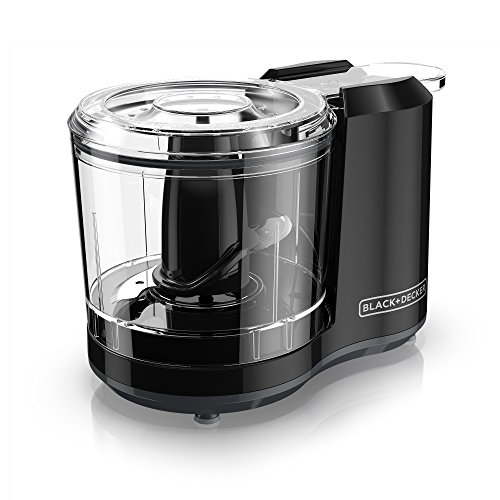
BLACK+DECKER 1.5-Cup Electric Food Chopper, 150W
Badge: Best for the Smallest Jobs
Strengths
- 1.5-cup bowl is perfectly sized for garlic, herbs, nuts and baby-food portions
- One-touch pulse operation could not be simpler to learn or teach
- Stay-sharp blade and dishwasher-safe parts keep ownership effort near zero
Trade-offs
- Smallest capacity in this guide: strictly a small-jobs machine
- 150W motor is not built for hard, dense or large loads
- One-touch pulse only, no speed settings to grow into
Key specifications (from the verified listing)
- Capacity: 1.5 cups (from verified listing)
- Power: 150W (from verified listing)
- Operation: one-touch pulse; stay-sharp blade; dishwasher safe
The BLACK+DECKER 1.5-cup chopper is the smallest machine in this guide and makes no apology for it. Its job description is the forty small tasks a week that are beneath a full-size processor and tedious by knife: a handful of garlic, a bunch of herbs, nuts for a salad, a small onion, a portion of baby food. One-touch pulse, a 150W motor, a stay-sharp blade and dishwasher-safe parts add up to a tool whose entire virtue is that using it is faster than deciding whether the job is worth a bigger machine.
The BLACK+DECKER 1.5-Cup Electric Food Chopper, 150W keeps its simplicity credentials because it is a one-touch 1.5-cup chopper with a 150W motor and a stay-sharp blade for the smallest jobs. Nothing about its operation needs explaining to a guest, a teenager or a tired cook, and that is a harder design achievement than adding features, because every capability it has was made to cost no attention at all.
Simplicity is also a promise about the sink, and the BLACK+DECKER 1.5-Cup Electric Food Chopper, 150W keeps it there too: the parts its listing names are the parts you wash, no more, and most of them are dishwasher safe where the design allows. A simple machine that is complicated to clean is a lie told at the counter and exposed at the sink, and this one does not tell it.
There is a final, practical test that separates a good shortlist entry from a great one, and the BLACK+DECKER 1.5-Cup Electric Food Chopper, 150W passes it: the week-two test. In week one any new processor is a novelty that gets used because it is new. By week two the novelty is gone, and the machines still on the counter are the ones whose size, controls and cleanup fit the household’s actual rhythm. Everything in this pick’s verified design, its capacity class, its blade system and the way its parts wash, points toward surviving that test in the kitchens its review describes, which is ultimately the only endorsement that compounds.
Best for: the smallest daily jobs: garlic, herbs, nuts, baby food, single servings / Not suited for: anything dense, large or disc-based
Check on Amazon for the current listing, configuration and latest price.
Comparison Table
Read the table by columns rather than rows: the badge column tells you the role each pick plays in this guide, the specification column keeps the comparison on verified facts from the listings, and the best-for column is the one to weigh against your own kitchen, because fit is decided there and nowhere else. Capacities and wattages are the manufacturers’ listing figures; no prices or ratings appear, for the reasons this guide has given throughout.
| Pick | Badge | Key specifications | Best for |
|---|---|---|---|
| Cuisinart Mini Food Processor, 3-Cup | Best Overall | Capacity: 3-cup / 24 oz. (from verified listing); Blade: auto-reversing SmartPower stainless blade, chop and grind modes | daily small jobs: herbs, garlic, nuts, small sauces and grinding spices |
| Hamilton Beach Food Processor, 10-Cup (70730) | Best for Family Batches | Capacity: 10 cups (from verified listing); Functions: slice, shred, mince and puree | family prep, slaws, doughs and big shredding or slicing sessions |
| BLACK+DECKER Food Processor, 8-Cup, 450W | Best Mid-Size Pick | Capacity: 8 cups (from verified listing); Power: 450W (from verified listing) | households of two to four wanting one mid-size machine for nightly prep |
| Cuisinart Core Custom 4-Cup Mini Chopper (MCH-4) | Best Mini Upgrade | Capacity: 4 cups (from verified listing); Blade: auto-reversing stainless steel SmartPower blade | dips, dressings and small batches that overflow a 3-cup mini |
| KitchenAid 3.5 Cup Food Chopper, Empire Red (KFC3516ER) | Best for Texture Control | Capacity: 3.5 cups (from verified listing); Controls: 2 speeds plus pulse | texture-sensitive small jobs where pulse control decides the result |
| BLACK+DECKER 1.5-Cup Electric Food Chopper, 150W | Best for the Smallest Jobs | Capacity: 1.5 cups (from verified listing); Power: 150W (from verified listing) | the smallest daily jobs: garlic, herbs, nuts, baby food, single servings |
How to Choose the Right Option for Best Simple Food Processors
Count the decisions, not the features
A simple machine asks few questions: press, pulse, done. Each added control, speed settings, programs, disc choices, is a decision taxed on every use. That tax is worth paying when the capability is one you use weekly, and pure friction when you do not. Read each pick’s control description in this guide as a tax schedule and be honest about which capabilities your cooking will actually redeem.
Parts count is the hidden complexity
Every part is a thing to assemble, wash, dry, store and eventually lose. A mini’s blade and bowl are a two-part life. A full disc set is a drawer ecosystem. Neither is wrong, but they are different lives, and the simple life belongs to the household that chooses its parts count deliberately. In-bowl storage and dishwasher-safe design soften the tax; they do not repeal it.
Simplicity scales differently: batches are complexity too
For a family cook, a tiny simple machine creates a complicated evening: three batches, three washes of the same small bowl, a counter of waiting vegetables. The Hamilton Beach’s presence in this guide makes that point concretely. One big, straightforward load can be the simplest path through a family dinner, and ‘simple’ that ignores scale is a slogan rather than a standard.
Learning curve is a one-time cost; friction is forever
Distinguish the two when a machine looks complex. Presets and multiple speeds take an afternoon to learn and then disappear into habit; awkward assembly, fiddly lids and trap-filled bowls tax every single use for a decade. Forgive the first kind freely when the capability earns it, and be ruthless about the second. The reviews here name both kinds where they exist.
How to Keep Food Processing Simple Every Day
Set the machine up for the life you want it to have. A simple processor should live assembled, or in two pieces, within arm’s reach of where you chop, with its cord managed and its blade stored in its bowl. Every layer of retrieval friction, the deep cupboard, the box, the separate parts drawer, is a small tax that compounds into disuse, and disuse is the only real failure mode of a simple appliance.
Work in the machine’s rhythm rather than against it. Pulse, look, pulse again; that two-second loop is the entire operating system of every pick in this guide, and it replaces all the programs and settings a new cook might fear. Cut pieces evenly, fill to the line, and let the machine’s size set the batch. Technique this plain is not a compromise; it is what the designs were built around.
Wash immediately, the simple way. Rinse the bowl and blade under the tap the moment the food is out, or load the dishwasher-safe parts and be done. Food dried onto a processor is the main way a thirty-second cleanup becomes a ten-minute soak, and the habit of the instant rinse is worth more than any feature in this guide. Dry the blade, reassemble, and tomorrow’s simple job starts from a clean, ready machine.
- Problem: the simple machine is not getting used → it is stored too far away; move it to the counter or the front of the cupboard and use returns within a week.
- Problem: results are uneven → the pieces were uneven or the bowl overfilled; simplicity rewards even pieces and honest fill lines more than any setting.
- Problem: cleanup has become a chore → food is drying on before washing; rinse immediately or use the dishwasher-safe route the design intends.
Simple Is a Feature Adults Choose on Purpose
There is a stage of kitchen ambition where every appliance must be the most capable version of itself, and a later, wiser stage where the question becomes what will actually be used at 7pm in February. This keyword belongs to the second stage. Its shoppers are not beginners by default; many are experienced cooks deliberately trading unused capability for daily ease, and the market’s mini class exists because that trade, made by millions, turned out to be the category’s centre of gravity.
That is why this guide takes simplicity seriously as engineering. A one-touch control that cannot be mis-set, a reversing blade that doubles a machine’s repertoire for zero added decisions, a bowl that goes straight in the dishwasher: these are design achievements, and the picks here were chosen because their listings demonstrate them rather than merely lacking features. Capability minimalists can compare notes with Best Prices On 8 Or 10 Cup Food Processors for the scale question.
When Simple Stops Being Enough
Honesty about the ceiling matters as much as praise for the floor. Simple machines do not slice or shred unless discs enter the picture, do not knead family dough, and do not forgive being asked. The cook whose ambitions grow into weekly slaws, bread and batch cooking will meet the ceiling of every mini in this guide, and the correct response is not disappointment but graduation: the mid and full-size picks here are the simple end of the next class, chosen to keep the graduation gentle.
Graduation also has a kind order. The mini is not discarded; it becomes the small-jobs machine beside its bigger sibling, which is the two-machine pattern this site’s guides keep arriving at from every direction. Simplicity, it turns out, is not a tier you outgrow but a quality you carry upward, demanding it of each larger machine in turn.
Simple Machines in Busy Households: Three Scenes
Scene one: a parent, home late, needs garlic and herbs for a pasta sauce in the next four minutes. The one-touch chopper is already on the counter; the job takes twenty seconds and the bowl is rinsed before the pasta water boils. Scene two: a teenager who has never been taught anything makes a salsa for friends using two speeds and a pulse button, and succeeds, because the machine’s whole language is two words long. Scene three: a grandparent, wary of appliances since a blender incident in another decade, uses the mini without anxiety, because there is nothing to program and nothing to get wrong.
No specification table captures those scenes, yet they are the product this keyword is buying. Capability lists describe what a machine can do in the hands of its most ambitious owner; simplicity describes what it will do in the hands of everyone, on the worst evening, at the lowest energy. Households are not staffed by their most ambitious member at all hours, and the machines that serve the whole cast, like the picks in this guide, quietly accumulate more use, more gratitude and more years than the brilliant ones reserved for a single expert.
The One-Button Ideal and Its Limits
The BLACK+DECKER 1.5-cup chopper is the purest expression of this keyword: one touch, one motion, no settings to learn or mis-set. Its limit is equally pure, capacity and density, and the guide states both without embarrassment because a shopper for simplicity deserves a map with the cliffs marked. Within its cliffs, for garlic, herbs, nuts and small portions, nothing in this guide beats it, because nothing in this guide asks less of its cook.
The design lesson generalises: the best simple machines are not the ones with the fewest capabilities but the ones whose capabilities are all reachable through the smallest number of gestures. Judge every future appliance by gestures-per-job and you will predict your own satisfaction more accurately than any feature list can.
Two Speeds Plus Pulse: The Complexity Sweet Spot
The KitchenAid chopper marks the point where control stops costing simplicity. Two speeds divide the world usefully, gentle for soft and small, faster for hard and dense, and pulse hands the final texture decision to the cook’s eye, which is where it belongs. There is nothing to program, nothing to menu-dive, and yet onions can be diced rather than pureed on demand, the single texture distinction home cooks actually care about.
Beyond this point, added control buys diminishing simplicity-adjusted returns for most households: presets help genuine beginners and dough makers, as the Ninja in sibling guides shows, but they ask the cook to learn the machine’s language. Neither choice is wrong; knowing which side of the line your temperament sits on is the purchase.
Cleanup: Where Simplicity Is Won or Lost
Ask owners what made a processor feel simple and the answer is rarely the controls; it is the wash. Dishwasher-safe bowls and blades, smooth interiors without traps, and bases that wipe clean are the traits repeated across this shortlist’s listings, and they deserve the prominence this guide gives them. A machine used daily and washed in seconds accumulates a different ownership story from a more capable machine whose cleanup is an event.
The habit side matters equally, and the how-to section’s instant-rinse rule is the cheapest simplicity upgrade in the category. Combined, design and habit produce the outcome this keyword is really shopping for: a machine whose total cost per use, in attention and minutes, is so low that reaching for it is never a decision at all.
Teaching the Household: Simplicity as a Social Feature
A simple processor is the one other people in the house will use: the partner who does not cook much, the teenager making a snack, the grandparent wary of appliances. One-touch and two-speed machines get borrowed by the whole household, which multiplies their value beyond the buyer’s own jobs and quietly trains everyone’s technique on the same forgiving tool.
That social dimension is a legitimate buying criterion and an underreported one. If your kitchen’s processing is shared, weight the picks whose operation can be explained in one sentence, and let the more capable, more personal machine be the second purchase, the one whose language only you need to speak.
Common Buying Mistakes
- Confusing simple with weak, and buying a mini for family batch work.
- Buying a complex machine for a household that will only ever pulse onions.
- Storing a simple machine out of reach, where its simplicity never gets used.
- Letting food dry on the bowl and concluding the machine is hard to clean.
- Counting features instead of decisions when comparing two machines.
- Forgetting that batching a too-small machine three times is the opposite of simple.
Final Recommendation
For simplicity in its purest form, the recommendation is the BLACK+DECKER 1.5-cup one-touch chopper for small jobs, and the Cuisinart Mini for households wanting the reversing grind trick at no complexity cost. The KitchenAid is the pick when you want texture control and are willing to spend exactly two speeds’ worth of attention on it.
For family scale, the Hamilton Beach 10-cup is the simple answer because one load is simpler than three batches, and the BLACK+DECKER 8-cup is its mid-size sibling. Choose by your batch reality, store the winner within reach, rinse it the moment you use it, and you will own the thing this keyword actually means: a machine that helps without ever asking to be thought about.
Ready to decide? Compare Cuisinart Mini Food Processor, 3-Cup, Hamilton Beach Food Processor, 10-Cup (70730) and BLACK+DECKER Food Processor, 8-Cup, 450W on Amazon to check the latest price on Amazon and the current configuration of each.
Readers researching the wider category will also find Best Prices On 8 Cup Food Processors and Best Prices On Breville Food Processors useful background before they decide.
Frequently Asked Questions
What makes a food processor simple to use?
Few decisions per job, few parts to assemble and wash, and cleanup that is mostly dishwasher or a quick rinse. One-touch pulse is the extreme; two speeds plus pulse is the most control that still feels simple. Parts count and cleanup design matter as much as the buttons.
Is a simple processor powerful enough for real cooking?
For the jobs it is sized for, yes. Minis handle herbs, nuts, dips and small chopping completely; the full-size simple picks handle family batches and discs. Simplicity fails only when a machine is asked beyond its class, which is a sizing mistake, not a power verdict.
Which is the simplest pick in this guide?
The BLACK+DECKER 1.5-cup electric chopper: one-touch pulse, a stay-sharp blade and dishwasher-safe parts, for the smallest daily jobs. The Cuisinart Mini is the simplest full mini processor, adding a reversing grind mode without adding real complexity.
Do simple processors have slicing discs?
The minis here do not; they are blade-only by design. The mid and full-size picks, the BLACK+DECKER 8-cup and Hamilton Beach 10-cup, include slicing and shredding in their listings while staying straightforward to run, which is why they anchor the larger end of this guide.
How do I keep a simple processor simple to own?
Store it assembled within reach, pulse rather than run, rinse or dishwasher the parts immediately after use, and keep the blade in the bowl. Those four habits preserve the low-friction ownership the design promises.
When should I graduate from a simple mini to a bigger machine?
When batching becomes your routine complaint: weekly slaws, dough, or family volumes that split into three mini loads. Graduate to the simple end of the bigger class, and keep the mini for small jobs; the pair is the classic contented kitchen.