Disclosure: topratedkitchenware.com is reader-supported. When you buy through links on our site, we may earn an affiliate commission from Amazon and other retailers, at no extra cost to you.
Where to buy
This shortlist covers the best types of grills as audited against the verified listings. A types guide should contain types, and this one does: three charcoal barrel smokers for the outdoor traditionalists, two indoor electrics for the kitchen, and one compact gas grill for the propane mainstream. All six are linked – the spread across fuels and formats is the answer to the keyword.
- Realcook Charcoal Grill with Offset Smoker (800 Sq. In.) – Best Charcoal Type
- SUNLIFER Charcoal Grill Offset Smoker – Best Large Charcoal Type
- Realcook Charcoal Grill with Offset Smoker (Barrel Combo) – Best Barrel Smoker Type
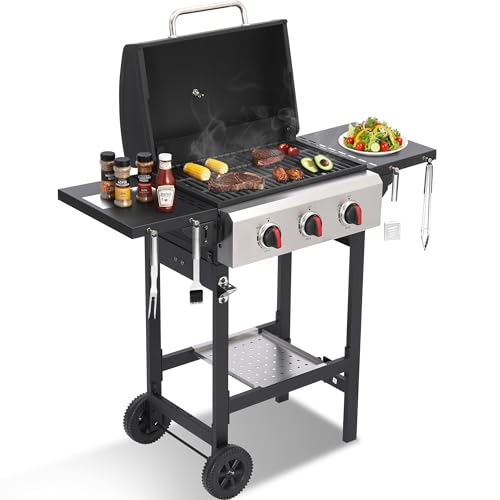
- Pukomc Electric Indoor Grill, 2 in 1 (1700W) – Best Indoor Electric Type
- YOHAWJAN Electric Indoor Grill 1500W, 2 in 1 Korean BBQ Grill Pan – Best Tabletop Electric Type
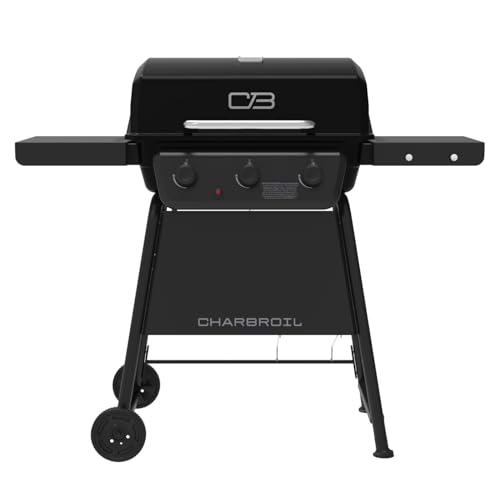
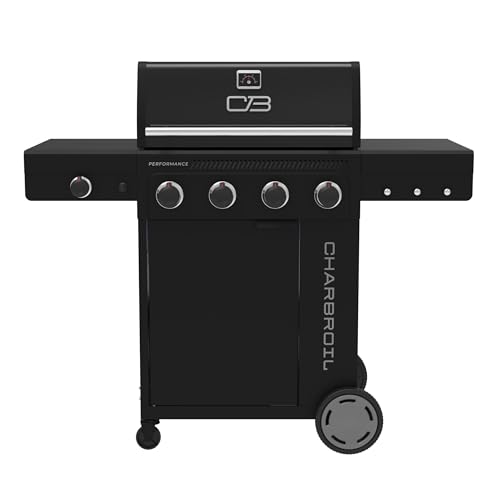
- Charbroil Classic 3-Burner Propane Gas Grill (360 Sq. In.) – Best Compact Gas Type
Read the full guide below for the research method, the detailed reviews, the comparison table, the buying guide and the care instructions.
The broadest grill question of all – the best types of grills – is really a request for a map. Before brands, before burners, a new buyer needs to know what kinds of machines exist, what each kind is for, and which kind belongs in their life. This guide draws that map from six verified grills that between them cover the territory most households actually choose among.
Three are charcoal barrels with offset smokers – two Realcook combos and a SUNLIFER – representing the oldest type in its modern party form: direct grilling over coals with a smoking chamber alongside. Two are indoor electrics: a Pukomc with a smokeless net and removable plate, and a YOHAWJAN Korean BBQ combo with griddle plate and raclette pans, representing the type that grills where no outdoor type can. One is the propane mainstream in compact form: a Charbroil Classic with three burners and porcelain-coated grates.
Pellet, kamado and flat-top griddles exist beyond this pool and are acknowledged in the type guide below; the six reviewed here are the types the verified pool can show rather than merely name. Readers who land on the smoker branch can continue into Best Types Of Pellets For Grills for the fuel side of that world.
Key Takeaways
- Grill types divide first by fuel – charcoal, gas, electric – and each fuel implies a place, a routine and a flavour.
- Charcoal barrels with offset smokers are two types in one footprint: direct grill plus indirect smoker.
- Indoor electrics are a true type, not a compromise: they grill in kitchens, in winter, where outdoor types cannot operate.
- Compact gas is the mainstream type at its most honest size: three burners, dialled heat, weeknight speed.
- The right type is chosen by where you will grill and how you will tend it, not by which cooks the single best steak.
- Many households own two types across a lifetime – the map matters more than any single destination on it.
In this guide
Quick Picks
| Pick | Badge | Why it made the list |
|---|---|---|
| Realcook Charcoal Grill with Offset Smoker (800 Sq. In.) | Best Charcoal Type | Realcook charcoal barrel with offset smoker, 800 sq in |
| SUNLIFER Charcoal Grill Offset Smoker | Best Large Charcoal Type | SUNLIFER charcoal barrel smoker combo |
| Realcook Charcoal Grill with Offset Smoker (Barrel Combo) | Best Barrel Smoker Type | Realcook barrel smoker combo for patio and parties |
| Pukomc Electric Indoor Grill, 2 in 1 (1700W) | Best Indoor Electric Type | Pukomc 1700W indoor electric with smokeless net and plate |
| YOHAWJAN Electric Indoor Grill 1500W, 2 in 1 Korean BBQ Grill Pan | Best Tabletop Electric Type | YOHAWJAN 1500W indoor Korean BBQ, griddle and raclette |
| Charbroil Classic 3-Burner Propane Gas Grill (360 Sq. In.) | Best Compact Gas Type | Charbroil Classic 3-burner gas, 30,000 BTU, 360 sq in |
How These Picks Were Chosen
The pool was read as a map, not a ranking. Each verified listing was classified by fuel, format and fire management: charcoal barrels by their offset smokers and cooking area, indoor electrics by wattage, plate systems and smoke management, and the gas grill by burner count, output and grate material as named in its listing. The classification, not a score, is what the reviews report.
Types absent from the pool – pellet grills with their hoppers and augers, ceramic kamados, flat-top griddles – are discussed in the buying guide from established practice and clearly framed as context, because a types map that pretends the territory ends at its own pool would mislead. No specifications are attached to those mentions; every specification in the reviews comes from a verified listing.
This guide is research-led and hands-on about nothing: it compares structures – what each type makes easy, hard or impossible – which research can judge honestly. Flavour verdicts are given as the types’ established characters, not as test results. Readers comparing the outdoor types against each other can continue with Best Selling Portable Grills for the travelling branch of the family.
The 6 Best types of grills Candidates, Reviewed in Detail
The reviews tour the map in pool order: the charcoal country first, then the indoor electrics, then compact gas. Each review names its type’s territory – where it lives, what it eats for fuel, what it asks of its owner.
Badges match the Quick Picks table, spec boxes quote only verified listing data, and verdict lines state the household each type belongs to, which is the whole purpose of a types guide in one line per type.

Realcook Charcoal Grill with Offset Smoker (800 Sq. In.)
Badge: Best Charcoal Type
Strengths
- 800 sq in plus an offset firebox is serious capacity for smoking and parties
- Offset design allows true indirect smoking as well as direct grilling
- A lot of cooking space for a value-positioned barrel combo
Trade-offs
- Charcoal fuel – the opposite of the electric smokeless core of its guide where noted
- A large barrel footprint needs a patio, not a balcony
- Offset smokers ask for fire management skill to hold steady temperatures
Mini spec box: Charcoal barrel grill with offset smoker; 800 sq in cooking space (per API title); Barrel-style BBQ smoker combo.
Realcook’s barrel combo pairs an 800-square-inch charcoal grill with an offset smoker firebox, which makes it a party-capacity machine: direct grilling over the main chamber and low-and-slow smoking with the fire kept off to the side. For gatherings, that dual personality is the entire appeal.
Where this pick appears in a guide whose core is something else – electric, small, boat or apartment cooking – it is covered prose-only and flagged honestly: a full-size charcoal barrel is a fine product in the wrong category for those searches, and linking it as if it fit would mislead the reader.
In daily use it is a weekend grill: charcoal to light, a fire to manage, and capacity that rewards cooking for a crowd. The honest limitation is everything about scale and fuel – startup time, ash, smoke and storage all belong to the backyard, not to small or indoor spaces.
Ownership note: offset smokers reward a small investment in a second thermometer at grate level, because barrel gauges read the lid, not the food. Season a new barrel with a low, empty burn before the first real cook to settle coatings and learn how its firebox breathes.
The big Realcook is the charcoal type at full expression: 800 square inches plus an offset firebox. If the map has a homeland for traditional barbecue, this machine’s format is it – fire, smoke and capacity in one barrel.
Best for: backyard hosts who want grilling plus offset smoking capacity / Not suited for: small-space, indoor, boat or apartment cooking of any kind
Check on Amazon for the current listing, configuration and latest price.

SUNLIFER Charcoal Grill Offset Smoker
Badge: Best Large Charcoal Type
Strengths
- Offset firebox enables genuine low-and-slow smoking
- Spacious barrel chamber suits parties and batch cooking
- Covers backyard, patio and camping-party briefs in one unit
Trade-offs
- Charcoal fuel with full smoke output – wrong for smokeless, indoor or apartment briefs
- Large footprint and fire management are part of the ownership deal
- Not a set-and-forget grill; offsets need tending
Mini spec box: Charcoal barrel grill with offset smoker; Barrel BBQ grill and smoker combo (per API title); Spacious cooking area (per API title).
SUNLIFER’s offset combo is a barrel charcoal grill with a side firebox for smoking, sold on spacious cooking area for backyard parties. The offset layout is the traditional route to smoked brisket, ribs and shoulders: heat and smoke travel across the chamber while the fire itself stays separate from the food.
In guides whose core is electric, small or apartment cooking, this pick is deliberately prose-only: it is a capable backyard smoker that simply does not answer those searches, and the review exists so readers can see what the pool contained and why it was not linked.
Day to day – realistically, weekend to weekend – it cooks for groups and smokes low and slow with attention. The honest limitation is that offset smoking is a hobbyist’s rhythm: fuel, tending and weather all matter, and none of it fits a Tuesday-night or small-space brief.
Ownership note: with any offset combo, cook order matters – long-smoke items start hours before quick-grill items, and the spacious chamber exists so both timelines can share one fire. Keep the firebox ash cleared between cooks; airflow is the offset smoker’s only real control.
The SUNLIFER repeats the barrel-and-offset pattern at a second scale, which is itself a map lesson: successful types spawn sizes, and the choice within a type is usually about capacity, not character.
Best for: backyard smokers who want an offset combo for parties / Not suited for: indoor, apartment, boat or quick weeknight grilling
Check on Amazon for the current listing, configuration and latest price.

Realcook Charcoal Grill with Offset Smoker (Barrel Combo)
Badge: Best Barrel Smoker Type
Strengths
- Offset smoker combo covers grilling and smoking in one barrel
- Party-oriented capacity for backyard gatherings
- Charcoal flavour that gas and electric cannot reproduce
Trade-offs
- A second barrel offset in the same pool – near-duplicate of its Realcook sibling
- Charcoal smoke and size rule it out of smokeless, small and apartment briefs
- Fire management skill is required for steady smoking temperatures
Mini spec box: Charcoal barrel grill with offset smoker; Barrel barbecue smoker grill combo (per API title); Positioned for backyard, patio, camping and parties (per API title).
This Realcook barrel combo is the pool’s second offset smoker from the brand: a charcoal barrel grill with an offset firebox, positioned for backyard, patio, camping and party cooking. Functionally it tells the same story as its sibling – big charcoal capacity, genuine smoking ability, and a footprint built for open outdoor space.
It is covered prose-only wherever the guide’s core is electric, small or apartment cooking, and readers cross-shopping the two Realcook barrels should compare the live listings closely, because near-duplicate pool entries differ mainly in configuration details rather than concept.
In use it is a gathering grill: light the charcoal, manage the offset fire, cook in quantity. The honest limitation mirrors its sibling’s – time, smoke, ash and space – which is precisely why it does not earn a link in small-space or smokeless guides.
Ownership note: near-duplicate listings are common in the barrel-smoker market, so compare weld quality notes, grate material and included accessories on the live listing rather than headline capacity. Either Realcook barrel will cook the same menu; the differences are in the details of configuration.
The second Realcook underlines the type’s party orientation – the listing’s own language is gatherings and weekends. Charcoal barrels are social machines, and their type suits households whose grilling is an event.
Best for: outdoor hosts who want a value barrel smoker combo / Not suited for: small patios, apartments, boats or smokeless-indoor searches
Check on Amazon for the current listing, configuration and latest price.
Pukomc Electric Indoor Grill, 2 in 1 (1700W)
Badge: Best Indoor Electric Type
Strengths
- 1700W is strong power for an indoor grill – faster preheat and better recovery
- 2-in-1 plate flexibility covers grilling and flat cooking tasks
- Removable, dishwasher safe parts keep cleanup short
Trade-offs
- Indoor electric format – no use on open decks or anywhere without an outlet
- Smokeless performance depends on keeping the plate and drip area clean
- Countertop size suits small households, not parties
Mini spec box: Electric indoor grill, 2 in 1 design; 1700W (per API title); Smokeless grill net and non-stick removable plate; Temperature control; Dishwasher safe parts (per API title).
Pukomc’s 2-in-1 indoor grill runs 1700W – genuinely strong for the class – with a smokeless grill net, a non-stick removable plate, temperature control and dishwasher safe parts. Power is the headline because indoor grills live or die on recovery heat: a strong element keeps searing instead of steaming when cold food lands.
The 2-in-1 layout lets one appliance cover ribbed grilling and flatter cooking, which is exactly the versatility small kitchens and apartments need. It links in the apartment and smokeless conversations on that basis, and stays prose-only in the boat guide, where a corded indoor appliance is not a marine grill.
Day to day it is a fast weeknight grill for two to four: quick preheat, tidy smokeless cooking, plates into the dishwasher. The honest limitation is format – it needs an outlet and a counter, and its surface is sized for households, not gatherings.
Ownership note: smokeless indoor grills stay smokeless only while their plates and drip paths are clean – fat baked onto the element area is tomorrow’s smoke. The dishwasher-safe parts make the right routine effortless, which is why this design holds up in daily apartment use.
The Pukomc is the indoor type’s modern form: a smokeless net over a removable plate, temperature control, dishwasher-safe parts. Its territory is the kitchen counter, and within that territory it is not a substitute for anything – it is the only type present.
Best for: apartment and small-kitchen cooks who want a powerful indoor 2-in-1 grill / Not suited for: outdoor, boat or off-grid grilling, or large gatherings
Check on Amazon for the current listing, configuration and latest price.

YOHAWJAN Electric Indoor Grill 1500W, 2 in 1 Korean BBQ Grill Pan
Badge: Best Tabletop Electric Type
Strengths
- Grill plus griddle plates and raclette pans make it a social, tabletop cooking centre
- 1500W gives solid indoor searing power
- Removable non-stick plates simplify cleanup after Korean BBQ sessions
Trade-offs
- Tabletop social cooking is its strength; large solo batches are not
- Raclette extras are delightful if you use them and clutter if you do not
- Indoor corded format only – no outdoor or marine role
Mini spec box: Electric indoor grill, 1500W (per API title); 2 in 1 grill and griddle plates; 3 raclette cheese pans included (per API title); Non-stick removable plates; Temperature control; portable format.
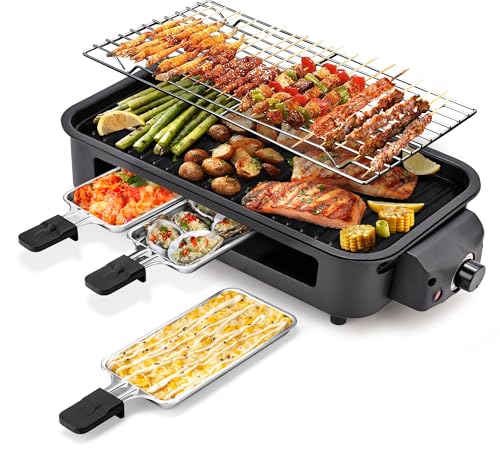
YOHAWJAN’s 1500W indoor unit is built for Korean BBQ at the table: a 2-in-1 grill and griddle plate set, non-stick removable plates, temperature control and three raclette cheese pans in the box. It is less a solitary weeknight grill and more a small dinner-party appliance, with diners cooking as they eat.
That social format is a genuine fit for apartment living, where the grill doubles as entertainment, and the guide links it on that basis. Judge the raclette pans honestly: households that host will love them; everyone else should weigh the storage they take.
Day to day it handles solo proteins on the griddle plate and becomes the centrepiece for two-to-four-person Korean BBQ nights. The honest limitation is throughput and occasion – it shines interactively and is ordinary as a plain batch grill.
Ownership note: Korean BBQ at home lives on prep – thin cuts, marinades ready, plates swapped between raw and cooked batches. The raclette pans also melt cheese and warm sauces for ordinary weeknight meals, which gives the extras a second life beyond party nights.
The YOHAWJAN stretches the indoor type toward the table itself: Korean BBQ at the centre of the meal, a griddle plate, raclette pans for the cheese course. It shows the indoor type evolving from appliance toward dining format.
Best for: apartment hosts who want tabletop Korean BBQ and raclette in one unit / Not suited for: large-batch cooking or outdoor and boat use
Check on Amazon for the current listing, configuration and latest price.

Charbroil Classic 3-Burner Propane Gas Grill (360 Sq. In.)
Badge: Best Compact Gas Type
Strengths
- 360 sq in and three burners is a genuinely compact full-grill format
- Porcelain-coated grates are low-maintenance for casual cooks
- Side shelves give prep room that true portables lack
Trade-offs
- Propane rules still apply – many apartment balconies prohibit gas grills
- 30,000 BTU is adequate, not scorching, across three burners
- Compact means family-size batches, not party-size
Mini spec box: 3-burner propane gas grill; 30,000 BTU (per API title); 360 sq in cooking area (per API title); Porcelain-coated grates; Compact design with side shelves (per API title).
Charbroil’s Classic 3-burner is a compact propane grill: 30,000 BTU, 360 square inches of cooking area, porcelain-coated grates and side shelves in a footprint the listing itself calls compact. For apartment and small-patio shoppers whose building allows gas on the balcony, this is the shape of the answer – a real grill, shrunk honestly.
The porcelain-coated grates trade a little sear drama for easy care, which suits the casual rhythm of apartment grilling. Check your lease and local rules first: the best compact gas grill is worthless where propane is prohibited, which is why the electric picks in this guide exist.
Day to day it grills a family dinner in one batch, lights instantly and cleans up without grate oiling rituals. The honest limitation is headroom – output and area both cap out when the guest list grows, and rule-restricted balconies rule it out entirely.
Ownership note: porcelain-coated grates should be cleaned with a brass or nylon brush, not steel, to protect the coating. On balconies, keep the grill’s required clearance from railings and walls – compact grills still produce full-size heat.
The Charbroil Classic is the gas type in its compact mainstream dress: three burners, 30,000 BTU, 360 square inches and porcelain-coated grates. More households grill on exactly this type than on any other in the guide.
Best for: small patios and gas-permitted balconies wanting a real 3-burner grill / Not suited for: apartments that prohibit propane, or hosts cooking for crowds
Check on Amazon for the current listing, configuration and latest price.
Comparison Table
| Pick | Badge | Headline spec (from listing) | Standout trait |
|---|---|---|---|
| Realcook Charcoal Grill with Offset Smoker (800 Sq. In.) | Best Charcoal Type | Charcoal barrel grill with offset smoker | Realcook charcoal barrel with offset smoker, 800 sq in |
| SUNLIFER Charcoal Grill Offset Smoker | Best Large Charcoal Type | Charcoal barrel grill with offset smoker | SUNLIFER charcoal barrel smoker combo |
| Realcook Charcoal Grill with Offset Smoker (Barrel Combo) | Best Barrel Smoker Type | Charcoal barrel grill with offset smoker | Realcook barrel smoker combo for patio and parties |
| Pukomc Electric Indoor Grill, 2 in 1 (1700W) | Best Indoor Electric Type | Electric indoor grill, 2 in 1 design | Pukomc 1700W indoor electric with smokeless net and plate |
| YOHAWJAN Electric Indoor Grill 1500W, 2 in 1 Korean BBQ Grill Pan | Best Tabletop Electric Type | Electric indoor grill, 1500W (per API title) | YOHAWJAN 1500W indoor Korean BBQ, griddle and raclette |
| Charbroil Classic 3-Burner Propane Gas Grill (360 Sq. In.) | Best Compact Gas Type | 3-burner propane gas grill | Charbroil Classic 3-burner gas, 30,000 BTU, 360 sq in |
The headline specs are the type signatures – cooking area and smoker format for the barrels, wattage and plate systems for the electrics, burners and BTU for the gas grill – which is why the table reads like a map legend.
How to Choose Best types of grills
Draw the map by fuel first. Charcoal burns wood-derived fuel in the open, asks for lighting time and vent craft, and returns smoke flavour and the highest peak heat. Gas burns propane from a tank through valved burners, answers a dial instantly and shuts down clean. Electric heats an element or plate from the wall, works indoors, and trades flame character for placement freedom. Every other distinction in grilling is a variation on one of those three sentences.
Then draw it by fire management. Direct types cook over the fire – all six picks here can. Indirect types cook beside it: the barrels’ offset smokers are the pool’s example, holding food in smoke at low heat for hours. Sear-focused types concentrate the fire; flat-tops spread it across a plate, a type the YOHAWJAN’s griddle plate gestures toward indoors. A buyer who knows which fire their menu needs has already chosen most of their type.
Acknowledge the types beyond the pool honestly. Pellet grills automate charcoal’s cousin – wood pellets fed by an auger under electronic control – and own the set-and-forget smoking niche. Kamados are ceramic, charcoal-fuelled eggs whose insulation makes them superb smokers and scorching searers in one small footprint. Flat-top griddles replace the grate with a plate and own breakfast, smash burgers and teppanyaki-style cooking. None is reviewed here because none is in the verified pool; all belong on a complete map, and the pellet branch is explored in the cluster around Best Selling Pellet Grills.
Place decides more types than palate does. A balcony with a no-charcoal rule, a flat with no outdoor space, a rural patio with no neighbours – each setting deletes types before flavour gets a vote. The indoor electrics in this pool exist because placement is a first-class criterion, and the barrels exist because some settings reward exactly their smoke and scale. List your setting’s hard rules before your menu’s preferences.
Routine is the second vote. Charcoal charges twenty minutes and an ash bucket; gas charges a tank and a grease tray; electric charges a sink or a dishwasher cycle. The type whose routine you will still be performing cheerfully in year three is the right type, and the wrong type – however gloriously it cooks – becomes the grill that stays under its cover. Be honest about which owner you are on a wet Tuesday.
Finally, expect the map to be walked, not settled. Households commonly begin with the type their first home allows, add the type their cooking grows toward, and keep the portable or indoor unit that covers the gaps. The six types reviewed here are best read as the stations of that walk, any of which can be the right current answer.
How to Choose Your Grill Type: A Step-by-Step Walk
This how-to converts the map into a decision, in the order the decision actually binds: setting first, then menu, then routine, then size.
Answer each step in writing if the purchase matters – the steps are cheap, and each one deletes types honestly instead of letting a showroom delete them expensively.
- List your setting’s hard rules. Outdoor space or none, building rules on charcoal or open flame, storage for a tank or bags of charcoal, and the weather your grill will live in. Delete every type the rules delete.
- Name your five most-cooked dishes. Steaks and chops point at sear-capable types; ribs and brisket at smokers; weeknight chicken and vegetables at gas or electric speed; breakfasts at plates and griddles. Let the menu rank what survives.
- Confess your routine tolerance. Lighting and tending, or dials and shutdowns, or a plate in the dishwasher. Strike any type whose routine you already know you will skip.
- Size for the ordinary cookout. Count the usual mouths, allow roughly 75 to 100 square inches each outdoors, and treat the annual party as a borrowing problem, not a sizing rule.
- Choose within the type. Only now compare models: the barrels against each other on area and fire access, the electrics on wattage and plates, the gas grills on burners and materials – the reviews above are organised for exactly this step.
- Plan the second type, loosely. Note which gap the first type leaves – travel, winter, smoking – so a future second type is a planned complement rather than a duplicated impulse.
Troubleshooting
Problem: two types survive and both feel right -> they probably are – sequence them. Buy the one your setting and menu need weekly; let the other be the planned second type rather than forcing a single machine to fail at both jobs.
Problem: the menu says charcoal, the calendar says gas -> believe the calendar. A gas grill used weekly delivers more grilled food than a charcoal grill used monthly, and the charcoal type can be added when the calendar changes.
Problem: no outdoor space, but a craving for smoke flavour -> the indoor electrics grill honestly without flame; smoked salts, liquid smoke used sparingly and a hard sear approximate the register, and a portable for park days covers the real-fire occasions.
The Charcoal Barrel: Anatomy of the Oldest Type
The barrel is charcoal’s party form: a horizontal drum whose length fits ribs and briskets, a fire that runs its width, and – in all three barrels here – an offset firebox that turns the drum into a smoker. Its virtues are capacity, smoke and price per square inch; its costs are the charcoal routine and a footprint that assumes a patio. The type has survived every fashion in grilling because its virtues are the ones gatherings are made of.
Within the type, the discriminating details are fire access and pan adjustment: a side door that feeds the fire without lifting the food, a charcoal pan that raises for searing and drops for gentler work. The listings here name the format and the areas; the in-person or specification check for doors and pans is the barrel buyer’s equivalent of the gas buyer’s grate check.
Owners who choose the type knowingly describe the routine as the pleasure, which is the type’s truest review. The guide’s only warning is for buyers who describe it as a chore in advance – believe yourselves, and choose a dial.
Indoor Electric: The Type That Changed the Map
A generation ago the types map ended at the patio door. Indoor electrics redrew it by solving the two problems that kept grilling outside: smoke and splatter. The Pukomc’s smokeless net and the YOHAWJAN’s contained plate systems are the current answers – fat managed before it smokes, temperatures dialled, parts that go to the dishwasher. What they cannot do is flame flavour; what they can do is grill in January, in a flat, at a table, which no other type in this guide can claim.
The YOHAWJAN’s Korean BBQ format shows where the type is heading: toward the meal’s centre rather than the kitchen’s corner, with diners cooking at the table and raclette pans turning the grill into a course structure. Types evolve toward their setting’s social logic, and the indoor type’s setting is the gathering itself.
Judge indoor electrics by wattage, plate area and cleaning design – the specifications their listings lead with – and the type stops looking like a compromise and starts looking like what it is: the only grills whose territory is everywhere people actually live, a point the cluster around Best Shokeless Electric Grills explores in its own spelling and depth.
Why Types Outlast Models
Models turn over yearly; types persist for decades, because types are answers to permanent questions – what fuel, what fire, what place – while models are answers to this year’s styling. A buyer who learns the types has learned the category’s permanent structure, and every future purchase becomes a within-type refinement instead of a fresh research project. That is the real product of a types guide: not six recommendations, but the map that makes the next sixty readable.
The map also explains the market’s arguments. Gas versus charcoal is a type argument and therefore eternal; this year’s burner arrangement is a model argument and therefore temporary. Knowing which argument you are in tells you how much weight to give it – type arguments deserve your calendar and your honesty about routine, model arguments deserve a specification sheet and twenty minutes.
Keep the map after the purchase. When the second type’s turn comes – the smoker, the portable, the indoor plate for winter – the decision will take an afternoon instead of a season, and it will complement the first type instead of accidentally repeating it.
One map-reading habit is worth keeping: when a new grill category is announced, ask which permanent question it answers. If none, it is a model in costume; if one, a new type may genuinely be arriving, and it deserves a place on your map.
And a note for gift buyers: a grill type is a lifestyle claim about someone else’s setting and routine. Gift within the type the household already runs, or gift the portable and indoor formats that add territory instead of arguing with it.
A map is only useful if it is redrawn as the territory changes, and grill types do change – slowly, but genuinely. The indoor electrics in this pool would have been a footnote a generation ago and are a full type now; pellet automation redrew the smoking country within a decade. The habit worth keeping from this guide is not the specific map but the surveying method: fuel, fire management, place, routine. Apply those four questions to any new arrival and you will know where it belongs before its marketing tells you.
There is a generosity in the types map, too, that model comparisons lack. A cook who chose charcoal and a cook who chose electric are not winner and loser; they are residents of different territories, each with its own excellences, and their arguments are mostly translation errors. Households that internalise the map stop arguing about grills at gatherings and start trading techniques – which are portable across types in a way verdicts never are.
End the tour where it began: with the household, not the hardware. The types in this guide will all be for sale, in evolved forms, for the rest of your cooking life. Your setting will change, your menu will change, your Tuesdays will change – and each change is a reason to re-walk the map, not a failure of the last walk. The cooks who enjoy grilling longest are the ones who treat the type decision as a subscription to renew, not a verdict to defend.
Before the walkthrough ends, one small discipline will keep the map honest in your own kitchen: revisit the type decision after the first full season, briefly and without defensiveness. Note which dishes the type served brilliantly, which it merely survived, and which it refused – in the manual, in pencil, next to the purchase date. That single page converts your second-type decision, whenever it comes, from folklore into evidence, and it is the closest thing grilling has to a laboratory notebook. The types will not have changed; your knowledge of your own cooking will have, and the map reads differently – better – through experienced eyes.
One more resident belongs on the map’s edge, named for completeness: the portable, which this pool meets only in passing through its travelling relatives in other guides. Portability is less a fuel than a format that borrows fuels – small gas, small charcoal and electric tailgate units all exist – and its territory is everywhere the other types cannot go: beaches, trailheads, balconies with strict rules and the boot of a car on a Friday afternoon. If your grilling life is mobile, the portable is not the smallest type on the map; it is the largest, measured in places rather than in square inches, and it deserves first-type status in exactly those lives.
Pin the map, finally, to one sentence you can repeat in a showroom: fuel decides the routine, fire decides the menu, place decides the shortlist, and size merely prices the answer. A buyer who can say that sentence, and mean it, will not be sold a type by a photograph again – which is the entire ambition this guide was written to serve.
Common Buying Mistakes
- Choosing a type by its best dish instead of by your setting, menu and routine.
- Treating indoor electrics as failed outdoor grills rather than as the only type that works in their territory.
- Buying a barrel smoker’s capacity for a household that grills for two on weeknights.
- Ignoring building and balcony rules until the charcoal type is already assembled.
- Expecting one type to cover travel, winter, parties and smoking equally – the map exists because none does.
- Skipping the within-type checks – fire access on barrels, wattage on electrics, grates on gas – once the type is chosen.
Final Recommendation
If you buy one type first, buy the one your setting and calendar nominate. For the mainstream household with a patio and a weeknight habit, that is gas – represented here by the Charbroil Classic in its compact, honest form. For the household whose grilling is a weekend event, it is the charcoal barrel, and the big Realcook is this pool’s fullest expression of it.
For the household without outdoor territory, the answer is not a lesser grill but a different type: the Pukomc for straightforward indoor grilling, the YOHAWJAN for the table-centred format. Neither apologises for its territory, and neither should its owner.
Whichever type you start with, keep the map. The second type – the smoker, the portable, the winter plate – is a when, not an if, for most grilling households, and choosing it as a complement rather than a replacement is the mark of a map well learned.
Start your shortlist with Realcook Charcoal Grill with Offset Smoker (800 Sq. In.), SUNLIFER Charcoal Grill Offset Smoker and Realcook Charcoal Grill with Offset Smoker (Barrel Combo) – compare their current listings, configurations and latest prices, then commit to the one that matches your space and your cooking.
Frequently Asked Questions
What are the main types of grills?
By fuel: charcoal, gas and electric, with pellet as a fourth, automated wood-fuel type. By fire management: direct grills, offset smokers, sear-focused grills and flat-top griddles. The six picks in this guide cover charcoal barrels with offset smokers, indoor electrics in two formats, and compact gas – the types most households choose among first.
Which grill type is best for beginners?
Gas, for its instant lighting and dialled temperatures, or indoor electric where there is no outdoor space. Both forgive inexperience. Charcoal rewards experience richly but asks for fire craft from the first cook, which is why it is usually a second type rather than a first.
Which type gives the most authentic barbecue flavour?
Charcoal, especially with an offset smoker cooking low and slow in wood smoke – the barrels in this guide are built for exactly that. Pellet grills deliver a gentler version of the same smoke with far less tending. Gas and electric produce excellent grilled food with a cleaner, less smoky profile.
Are indoor electric grills real grills?
By method, yes: they cook food on a hot ridged surface with direct radiant and contact heat, producing seared, marked food. They differ in fuel and setting, not in legitimacy, and they are the only type that operates in kitchens, flats and winter – which is a capability, not a caveat.
What type suits a small balcony?
Rules first: many buildings ban charcoal and some ban all open flame, which leaves electric as the automatic answer. Where gas is allowed, a compact gas grill like the three-burner Charbroil here is the mainstream choice. Always confirm the building’s rules before the type decision, not after delivery.
Should I buy two types of grill?
Eventually, many households do – typically a fast type for weeknights and a character type for weekends, or an outdoor type plus an indoor or portable for the gaps. Buy the first for your dominant use, live with it a season, and let its actual gaps nominate the second, as this guide’s how-to recommends.