Disclosure: topratedkitchenware.com is reader-supported. When you buy through links on our site, we may earn an affiliate commission from Amazon and other retailers, at no extra cost to you.
Where to buy
This guide reviews six verified listings for shoppers comparing best batteries to use for 24 volt trolling motor. Picks that pass every gate for this job are linked; picks that miss on voltage, format or duty are reviewed in full as prose-only entries, with the reason stated in their sections, because a guide that hides its near-misses is not guiding anyone. Start with the linked shortlist, then read the detailed reviews for the fit notes that decide between them.
- SUPER EMPOWER 12V 100Ah LiFePO4 Battery, Group 24 (2 Pack) — Check on Amazon
- SUPER EMPOWER 12.8V 100Ah LiFePO4 Battery, Group 31 — prose-only in this guide (see its review below for why)
- Xeanerol 24V 5Ah Lithium Battery Pack — prose-only in this guide (see its review below for why)
- yeagulch 24V 100Ah LiFePO4 Battery
- yeagulch 24V 314Ah LiFePO4 Battery
- VEMDIA 12V 100Ah LiFePO4 Battery, Group 31 — prose-only in this guide (see its review below for why)
Read the full guide ↓ for the detailed reviews, the sizing maths and the checks that separate a battery that fits your job from one that merely fits your search.
The question behind best batteries to use for 24 volt trolling motor setups is a practical one: not which battery wins a spec sheet, but which one you can live with, trip after trip, without thinking about it. This guide answers from the user’s side of the transom: how each option wires up, charges, behaves on cold mornings and long days, and what ownership actually feels like across a season.
The pool divides into three kinds of answer. There is a factory-matched pair of 12V units built to be wired in series, two true single-unit 24V batteries at very different capacities, two good 12V batteries that only become a 24V answer when bought as identical twins, and one small 24V hobby pack that demonstrates why voltage alone never qualifies a battery for propulsion. The three that work as sold are linked; the rest are reviewed in full, without links, so you can see the reasoning rather than take it on faith.
If you arrived from the companion shortlist at Best Batteries For 24 Volt Trolling Motor, this version spends its words on daily use: routines, checks and the small habits that decide whether a bank is still strong in its third season. Specifications are drawn only from verified listing data, and where a figure is a maker’s claim, we say so.
Key Takeaways
- Easiest ownership: the single-unit yeagulch 24V 100Ah — one case, one BMS, nothing to balance.
- Most flexible ownership: the SUPER EMPOWER 2-pack, a matched series pair that can split back into 12V service.
- Longest sessions: the yeagulch 24V 314Ah, built for consecutive long days.
- The two single 12V picks are prose-only: usable only as deliberately bought identical twins.
- The 24V 5Ah pack is prose-only: a project supply, not a motor battery.
In this guide
Quick Picks
| Pick | Badge | Why it is here | Amazon |
|---|---|---|---|
| SUPER EMPOWER 12V 100Ah LiFePO4 Battery, Group 24 (2 Pack) | Most Flexible in Daily Use | Living with a series pair is easier when the pair arrives matched, and that is this pack’s whole argument. | Check on Amazon |
| SUPER EMPOWER 12.8V 100Ah LiFePO4 Battery, Group 31 | Prose-Only: A Twin Away From Useful | Used as intended, on a 12V motor or in an RV, this Group 31 battery is a perfectly pleasant thing to own: 1280Wh, sensible protection, expansion support. | Prose-only |
| Xeanerol 24V 5Ah Lithium Battery Pack | Prose-Only: Bench Toy, Not a Boat Battery | In daily-use terms this pack’s story is short: it would start a 24V motor’s day and end it within minutes, assuming its light-duty design tolerated the attempt at all. | Prose-only |
| yeagulch 24V 100Ah LiFePO4 Battery | Best to Live With Overall | The daily-use case for this battery is that there is barely a case to make: you install one case, connect two cables, charge it with a 24V lithium-profile charger after each trip, and stop thinking about batteries. | Check on Amazon |
| yeagulch 24V 314Ah LiFePO4 Battery | Best for Back-to-Back Long Days | Some owners do not have a charging routine; they have a charging window, and it is short. | Check on Amazon |
| VEMDIA 12V 100Ah LiFePO4 Battery, Group 31 | Prose-Only: Pleasant 12V Battery, Half a System Here | Nothing about owning this VEMDIA would annoy you in its proper role: it is a simple Group 31 deep-cycle battery with a strong cycle-life figure and no app or account nonsense. | Prose-only |
How These Picks Were Chosen
We judged this pool the way an owner experiences it: installation effort, charging routine, protection features that work while you sleep, and the discipline each option demands across a season. The verified listing data supplied the facts (voltage, capacity, watt-hours, BMS rating, case size, certifications and named uses), and we applied two gates before linking any pick: as sold, it must be able to form a 24V bank, and it must be deep-cycle equipment designed for sustained propulsion loads. Picks that failed a gate were not discarded; they are reviewed in full as prose-only entries, because the most useful thing a guide can do with a near-miss is explain precisely where it misses. No hands-on testing is claimed; this is research-led guidance built on published data.
One further discipline applied throughout: nothing in this guide invents a specification, a price or a performance figure. Where a number appears, it comes from the verified listing data for that product, and where a judgement is ours, it is presented as a judgement, with the reasoning beside it, so you can disagree productively rather than shop blind.
The 6 Best Batteries to use for 24 volt trolling motor

SUPER EMPOWER 12V 100Ah LiFePO4 Battery, Group 24 (2 Pack)
Badge: Most Flexible in Daily Use
Strengths
- Sold as a matched 2 pack, so a series pair starts life balanced instead of mixing an old and a new battery
- 100A BMS per unit with low-temperature cutoff protects the pair on cold mornings
- Documented 4P4S expansion path lets the same units grow into a larger bank later
Trade-offs
- Each unit is still a 12V battery: the 24V result depends on correct series wiring by the owner
- Two units mean two sets of terminals and cables to inspect and keep tight
- LiFePO4 needs a lithium-compatible charger profile to fill completely
| Voltage / capacity | 12V, 100Ah per unit, sold as a 2 pack |
|---|---|
| Stored energy | 1280Wh per unit |
| Chemistry | LiFePO4 (lithium iron phosphate) |
| Protection | Built-in 100A BMS with low-temperature cutoff |
| Expansion | Supports 4P4S configuration, up to 20.48kWh |
| Named uses in listing | RV, trolling motor, marine, solar |
Living with a series pair is easier when the pair arrives matched, and that is this pack’s whole argument. Two identical 12V units, wired in series, give you the 24V bank; separated, they go back to ordinary 12V jobs, which makes this the only linked pick that hedges against a future boat or motor change. Day to day, ownership means a few extra minutes of care: two sets of terminals to keep tight, and an occasional per-unit voltage check to confirm the pair is ageing together. In exchange you get split lifting weight, documented 4P4S expansion if the system grows, and a 100A BMS with low-temperature cutoff guarding each unit.
Put the published numbers together and a character emerges: 12V, 100Ah per unit, sold as a 2 pack, with LiFePO4 (lithium iron phosphate). That combination is what the detailed judgements in this section rest on. Where the maker publishes a figure, we report it as a maker’s figure; where the listing is silent, we leave the gap visible rather than filling it with a guess, because a visible gap is information a buyer can act on.
Best for: Owners who value flexibility and split lifting weight over single-case simplicity / Not suited for: Owners who want zero balancing checks and a single battery to maintain
SUPER EMPOWER 12.8V 100Ah LiFePO4 Battery, Group 31
Badge: Prose-Only: A Twin Away From Useful
Strengths
- Group 31 case fits the larger standard marine and RV battery boxes
- 100A BMS with low-temperature cutoff is the right protection set for outdoor duty
- Documented 4P4S expansion, up to 20.48kWh, gives the bank a growth path
Trade-offs
- A single 12.8V unit: any 24V system needs a second, matched unit bought separately
- Group 31 is a large, heavy case that will not fit smaller Group 24 trays
- No self-heating function for charging in hard freezes
| Voltage / capacity | 12.8V, 100Ah |
|---|---|
| Case size | Group 31 |
| Stored energy | 1280Wh |
| Chemistry | LiFePO4 |
| Protection | Built-in 100A BMS with low-temperature cutoff |
| Expansion | Supports 4P4S configuration, up to 20.48kWh |
| Named uses in listing | RVs, trolling motors, marine, solar |
Used as intended, on a 12V motor or in an RV, this Group 31 battery is a perfectly pleasant thing to own: 1280Wh, sensible protection, expansion support. For a 24V motor it becomes useful only in duplicate, and duplicate means a second identical unit bought at the same time, not the same model bought next year. We keep it in the guide because that distinction (same model versus same battery, bought together) is the single most common series-pair mistake, and this pick is where readers most need it spelled out. If you already run one on a 12V setup and are stepping up, budget for its twin or start fresh with a linked option.
The practical reading of its data sheet runs as follows: Group 31; LiFePO4. Neither line is glamorous, and both matter more in the second year of ownership than the first, when protection behaviour and honest capacity have had time to separate the well-specified batteries from the merely well-described ones. This pick’s paperwork, taken as a whole, supports the role this guide assigns it.
Best for: 12V owners stepping up who will buy the identical twin at the same time / Not suited for: Anyone who needs a working 24V bank from this single purchase
Xeanerol 24V 5Ah Lithium Battery Pack
Badge: Prose-Only: Bench Toy, Not a Boat Battery
Strengths
- Genuinely 24 volts in a single small pack, with a charger and connector cable included
- Handy, light format for bench projects, RC builds and LED or camera power
- Simple to recharge with the bundled 2A charger
Trade-offs
- 5Ah is hobby capacity: it cannot sustain propulsion or starting loads of any size
- Li-ion chemistry and a 2A project charger are not a deep-cycle service design
- No BMS figures, cycle-life data or certifications are published in the listing
| Voltage / capacity | 24V, 5Ah |
|---|---|
| Chemistry | Li-ion (not LiFePO4) |
| In the box | 2A fast charger and cable connector included |
| Named uses in listing | 24V DIY projects, RC cars, LED light strips, CCTV cameras |
In daily-use terms this pack’s story is short: it would start a 24V motor’s day and end it within minutes, assuming its light-duty design tolerated the attempt at all. Its real daily life is on a bench or in a project box, powering RC builds, LED strips and cameras, where its included charger and connector cable make it genuinely convenient. We review it so that the boundary is unmistakable: a battery you can use for a 24V trolling motor must be sized and protected for propulsion, and this one is neither. Voltage is where the comparison starts, not where it ends.
In specification terms, the headline facts are these: 24V, 5Ah; Li-ion (not LiFePO4). Those two lines decide most of what ownership feels like, because they set the energy available each day and the protection standing guard over it. The rest of the published data fills in the supporting cast, and in this pool the listings are unusually willing to state figures that can be checked rather than slogans that cannot.
Best for: Hobby electronics and small 24V projects on the workbench / Not suited for: Propulsion of any kind, or any load measured in hours
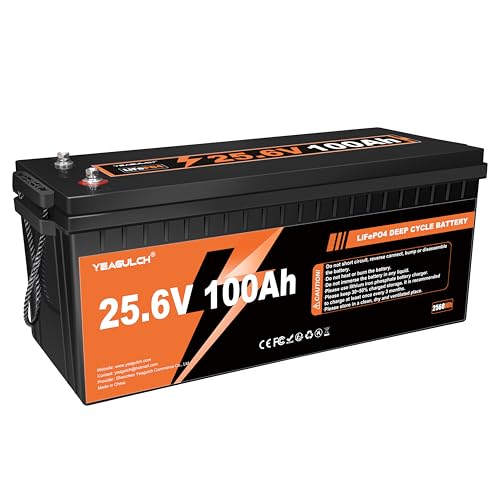
yeagulch 24V 100Ah LiFePO4 Battery
Badge: Best to Live With Overall
Strengths
- A true single-unit 24V battery: no series pair to balance, one BMS watching the whole bank
- 2560Wh is the classic full-day capacity class for 24V propulsion duty
- UN38.3 and UL1973 certifications are named in the listing, which many rivals omit
Trade-offs
- A single-purpose voltage: it cannot drop into a 12V system as a spare
- One large unit is a bigger single lift than two smaller 12V units
- The brand is a value label, so long-term support depends on the seller rather than a dealer network
| Voltage / capacity | 24V, 100Ah |
|---|---|
| Stored energy | 2560Wh |
| Chemistry | LiFePO4 |
| Protection | Built-in 100A BMS with low-temperature cutoff |
| Cycle life (maker figure) | 15000+ deep cycles |
| Certifications named | UN38.3, UL1973 |
| Named uses in listing | Trolling motors, off-grid solar, RV, marine |
The daily-use case for this battery is that there is barely a case to make: you install one case, connect two cables, charge it with a 24V lithium-profile charger after each trip, and stop thinking about batteries. No pair to balance, no interconnects to inspect, no per-unit voltage diary. The 2560Wh capacity covers the conventional full day, the 100A BMS handles sustained motor draw, low-temperature cutoff quietly guards the early-season charges you would otherwise have to police yourself, and the named UN38.3 and UL1973 certifications are the paperwork of a product built to be certified, not just sold. For most owners, this is what ‘best to use’ actually means.
Put the published numbers together and a character emerges: 24V, 100Ah, with LiFePO4. That combination is what the detailed judgements in this section rest on. Where the maker publishes a figure, we report it as a maker’s figure; where the listing is silent, we leave the gap visible rather than filling it with a guess, because a visible gap is information a buyer can act on.
Best for: Most 24V motor owners who want the bank to disappear into the background / Not suited for: Owners whose multi-day draw outgrows the 100Ah class

yeagulch 24V 314Ah LiFePO4 Battery
Badge: Best for Back-to-Back Long Days
Strengths
- Enormous 8038.4Wh capacity in one unit, the largest in this pool by a wide margin
- 200A BMS supports high continuous draw without a parallel pair
- Low-temperature protection plus named UL 1973 and UN38.3 certifications
Trade-offs
- 314Ah in one case is a serious lift and needs a tray and space planned around it
- Premium-tier capacity is wasted on small, short-session loads
- A single unit is a single point of failure compared with a split bank
| Voltage / capacity | 24V, 314Ah |
|---|---|
| Stored energy | 8038.4Wh |
| Chemistry | LiFePO4 |
| Protection | Built-in 200A BMS with low-temperature protection |
| Cycle life (maker figure) | 15000+ deep cycles |
| Certifications named | UL 1973, UN38.3 |
| Named uses in listing | Trolling motors, RV, marine, solar, backup power, off-grid |
Some owners do not have a charging routine; they have a charging window, and it is short. Guides, tournament anglers and anyone fishing consecutive long days will recognise the appeal of 8038.4Wh in a single case with a 200A BMS: you stop managing energy and start merely using it. Daily life with it is still simple (one unit, one charger routine), but installation day is not: plan the tray, the lift and the cable runs for a big unit, and accept that its capacity is surplus on short trips. Low-temperature protection and named certifications complete a specification written for people whose batteries work for a living.
The practical reading of its data sheet runs as follows: 8038.4Wh; Built-in 200A BMS with low-temperature protection. Neither line is glamorous, and both matter more in the second year of ownership than the first, when protection behaviour and honest capacity have had time to separate the well-specified batteries from the merely well-described ones. This pick’s paperwork, taken as a whole, supports the role this guide assigns it.
Best for: Guides, tournament anglers and heavy hulls fishing long consecutive days / Not suited for: Short-session anglers, and boats where the lift and footprint do not fit
VEMDIA 12V 100Ah LiFePO4 Battery, Group 31
Badge: Prose-Only: Pleasant 12V Battery, Half a System Here
Strengths
- Group 31 case suits the larger standard battery boxes and trays
- 15000-cycle maker figure signals a long-service design intent
- Straightforward 100A BMS specification with no app or account required
Trade-offs
- The listing does not name low-temperature charge protection, so cold-weather charging needs owner discipline
- Group 31 size will not fit Group 24 trays
- No app monitoring or self-heating extras
| Voltage / capacity | 12V, 100Ah |
|---|---|
| Case size | Group 31 |
| Chemistry | LiFePO4 (lithium iron phosphate cells) |
| Protection | Built-in 100A BMS |
| Cycle life (maker figure) | 15000 deep cycles |
| Named uses in listing | Solar systems, home energy, RVs, marine |
Nothing about owning this VEMDIA would annoy you in its proper role: it is a simple Group 31 deep-cycle battery with a strong cycle-life figure and no app or account nonsense. In this guide’s role it is, as sold, exactly half of a 24V system, and linking it would invite the classic error of ordering one and expecting thrust. Bought deliberately as a matched pair it would serve; bought singly for a 24V motor it cannot. We say so plainly, review its genuine merits for 12V owners, and point 24V shoppers to the linked picks that arrive complete.
In specification terms, the headline facts are these: 12V, 100Ah; Group 31. Those two lines decide most of what ownership feels like, because they set the energy available each day and the protection standing guard over it. The rest of the published data fills in the supporting cast, and in this pool the listings are unusually willing to state figures that can be checked rather than slogans that cannot.
Best for: 12V system owners, or buyers assembling a matched pair on purpose / Not suited for: 24V motor owners buying a single battery
Comparison Table
| Pick | Voltage / Capacity | Case or Format | Protection / Discharge | Best for | Amazon |
|---|---|---|---|---|---|
| SUPER EMPOWER 12V 100Ah LiFePO4 Battery, Group 24 (2 Pack) | 12V, 100Ah per unit, sold as a 2 pack | See spec box in its review | Built-in 100A BMS with low-temperature cutoff | Owners who value flexibility and split lifting weight over single-case simplicity | Check on Amazon |
| SUPER EMPOWER 12.8V 100Ah LiFePO4 Battery, Group 31 | 12.8V, 100Ah | Group 31 | Built-in 100A BMS with low-temperature cutoff | 12V owners stepping up who will buy the identical twin at the same time | Prose-only |
| Xeanerol 24V 5Ah Lithium Battery Pack | 24V, 5Ah | See spec box in its review | See spec box in its review | Hobby electronics and small 24V projects on the workbench | Prose-only |
| yeagulch 24V 100Ah LiFePO4 Battery | 24V, 100Ah | See spec box in its review | Built-in 100A BMS with low-temperature cutoff | Most 24V motor owners who want the bank to disappear into the background | Check on Amazon |
| yeagulch 24V 314Ah LiFePO4 Battery | 24V, 314Ah | See spec box in its review | Built-in 200A BMS with low-temperature protection | Guides, tournament anglers and heavy hulls fishing long consecutive days | Check on Amazon |
| VEMDIA 12V 100Ah LiFePO4 Battery, Group 31 | 12V, 100Ah | Group 31 | Built-in 100A BMS | 12V system owners, or buyers assembling a matched pair on purpose | Prose-only |
How to Choose: best batteries to use for 24 volt trolling motor, Decided Properly
Decide how much thinking you want to own
Every option in this guide works; they differ in the attention they charge you. A single 24V unit charges the least attention: install, charge, fish. A series pair charges a little more: matched units, equal cables, occasional per-unit checks. Neither fee is unreasonable, but it should be chosen, not discovered. Owners who know they will skip maintenance should buy the design that forgives skipping it.
Match the bank to your charging window
If the boat returns to a dock or garage with power every night, a 100Ah-class bank and an overnight charge is a complete system. If your trips stack days away from a charger, capacity has to cover the stack, or a generator or solar input has to join the plan. The 314Ah pick exists for the second life, not the first, and buying it for nightly-charged fishing is paying for energy you will never use.
Treat protection features as daily conveniences
Low-temperature cutoff is not a spec-sheet ornament; it is the feature that lets you plug in on a cold morning without doing freezing-point arithmetic about your own battery. Likewise a BMS with a published continuous rating is what stands between full-thrust running and an embarrassing mid-lake disconnect. When you compare picks, compare the protections you will actually rely on weekly.
Plan the physical life, not just the electrical one
Where the bank sits decides how the boat trims, how you lift the battery for winter, and whether terminals stay dry and inspectable. Split pairs distribute weight; single big units concentrate it. Measure the tray, think about the lift, and route cables so a season of vibration cannot chafe them. The best battery to use is partly the one your boat can carry gracefully.
Cycle-life figures deserve a sceptical but fair reading. Makers quote cycles under stated conditions, usually a defined depth of discharge at a moderate rate and temperature, so a headline number is a comparison tool rather than a promise about your installation. Shallow daily cycling, moderate temperatures and correct charging stretch real life toward the maker’s figure; deep daily cycling in heat pulls it down. Compare like with like across the picks, treat the figure as evidence of design intent, and put more weight on the protection features that guard the battery in your actual conditions.
Safety with any high-capacity battery is mostly about respecting stored energy. Fuse the main positive cable close to the battery, insulate terminals against dropped tools, keep metal jewellery and loose hardware away during installation, and never bypass a protection device that keeps tripping: a BMS that disconnects is reporting a condition, not malfunctioning. Ventilation still matters for lead acid under charge, eye protection is cheap insurance around any battery work, and a battery that is swollen, cracked, leaking or hot at rest leaves service immediately, whatever its age.
Terminal hardware is a small cost that protects a large one. The right lug size for the cable, stainless hardware where corrosion is a risk, anti-corrosion treatment on lead posts, and a torque check with a real wrench rather than a guess all belong in the installation budget. Heat at a terminal under load is the tell-tale of a bad joint, and it can be found with the back of a hand after a working session. Fix hot joints immediately: they waste energy, confuse voltage readings and, left alone, damage cables and battery posts.
Reading a listing critically is a skill this category rewards. Look for the figures that can be checked: capacity in amp-hours and watt-hours that agree with each other, a named BMS current, a case group size you can measure against your tray, and certifications printed in full. Be wary of listings that shout a single huge number with no supporting detail, that borrow the vocabulary of a different chemistry, or that promise compatibility with everything. The picks in this guide were chosen partly because their titles state verifiable facts that a buyer can hold the seller to.
The second-hand and take-out market tempts many buyers in this category, and it deserves a caution. A used deep-cycle battery’s remaining life is invisible from the case, resting voltage flatters tired units, and mismatched used units make poor banks. If you buy used, buy for light duty, test under load before paying, and never mix a used unit into a new bank where its weakness becomes the bank’s weakness. For the primary system your season depends on, the new picks in this guide, with known history and a warranty trail, are the defensible money.
Cable and connection quality decides how much of a battery’s capability ever reaches the equipment. Undersized cable, corroded terminals and loose lugs all add resistance, and resistance shows up as voltage sag under load, nuisance low-voltage cut-outs and heat at the connection point. Use cable sized for the highest continuous draw, keep runs as short as the layout allows, crimp and seal lugs properly, and re-check terminal tightness after the first few weeks of vibration in service. Many ‘weak battery’ complaints brought to dealers trace back to a connection, not a cell.
Parallel banks share current unevenly when they are built carelessly. Differences in cable length, terminal condition and internal resistance mean one unit works harder, ages faster and eventually drags the bank down to its level. Build parallel connections symmetrically, take the main feeds from diagonally opposite corners of the bank, keep interconnects equal, and check individual unit voltages at the first few services. A bank is a team, and the maintenance habit that keeps it one is verifying that every member is still doing its share.
Voltage sag under load is the symptom owners describe most and understand least. Every battery’s terminal voltage dips while it delivers current; the question is how far and how fast. A healthy bank of the right size dips modestly and recovers at rest, while an undersized, aged or cold bank dips hard, trips low-voltage alarms and makes equipment behave as if it were faulty. When a system misbehaves, measure voltage at the battery under the real load before blaming the equipment: the number separates a battery problem from a wiring problem from a genuinely failing device.
Warranty and support are part of the product, especially from value brands selling through marketplaces. Read what the warranty actually covers, how a claim is started, whether return shipping of a heavy battery is addressed, and whether the seller answers technical questions with specifics or slogans. Keep the order record, photograph the installed bank, and save the manual’s charging table. A slightly less glamorous specification from a seller who documents everything is often the better long-term buy than a headline number with no paperwork behind it.
Measuring your real load beats guessing it. A plug-in meter on a charger, a clamp meter on a cable, or a simple log of run-times and recharge behaviour across a week will tell you more than any forum estimate. Once you know the honest daily draw, the sizing maths in this guide becomes simple arithmetic instead of optimism, and the battery you choose will be the one the equipment actually needed. Owners who measure once rarely buy the wrong capacity twice, and they can spot a fading battery months before it strands them.
Temperature cuts both ways. Heat accelerates the ageing of every chemistry, shortening the calendar life of a battery stored in a hot shed, a sun-baked compartment or an engine bay. Cold does the opposite damage in the moment: capacity shrinks, voltage sags earlier under load, and lithium cells can be harmed by charging below freezing, which is exactly why low-temperature charge cut-offs and self-heating functions appear in the better listings in this pool. Where a battery lives is therefore a specification in its own right, and a shaded, ventilated, dry mounting spot is free performance.
Series and parallel wiring are the two levers that turn single units into systems. Wiring identical batteries in series adds their voltages while capacity in amp-hours stays the same; wiring them in parallel adds capacity while voltage stays the same. Both demand discipline: units should be the same model, the same age and at the same state of charge before they are joined, interconnecting cables should be equal in length, and the system’s main cables should draw from opposite ends of the bank so every unit shares the work evenly instead of the nearest battery doing most of it.
Disposal is the last specification. Lead acid batteries are among the most completely recycled products in commerce, and core-charge systems exist to pull them back; lithium packs go through battery recycling channels rather than household waste. Plan the exit when you buy the entrance: keep the packaging until the install is proven, note the retailer’s take-back route, and never let a retired battery sit leaking in a corner of the shed. Responsible disposal is also practical, because core value returned on an old unit offsets part of the next purchase.
Reserve thinking separates a system that copes from one that strands you. Size for the ordinary day, then ask what the bad day looks like: the overcast stretch that starves a solar input, the headwind that doubles motor consumption, the cold snap that shrinks capacity, the guest load nobody planned for. A bank with honest headroom cycles shallower, sags less and lasts longer, and the cheapest time to buy that headroom is at the first purchase, because adding a mismatched unit to an aged bank a year later rarely performs as well as a matched bank bought together.
Depth of discharge is the quiet number that decides how long any battery in this guide actually lives. Lead acid designs give their longest service when daily use takes only a modest share of the nameplate capacity, while lithium iron phosphate tolerates much deeper daily cycling because its chemistry and its battery management system guard the cells at both ends of the charge range. When you compare two batteries with the same amp-hour figure, ask how much of that capacity you are honestly allowed to use every day, because the usable figure, not the printed one, is what runs your equipment between charges.
Charging is where mismatched equipment does its slow damage. A charger built for flooded lead acid may never push a lithium battery to a full charge, and an aggressive equalisation stage can trip a lithium battery’s protection or stress an AGM unit. Before any battery in this guide earns its place, match it to a charger with the correct profile for its chemistry, confirm the charger’s voltage settings in the manual, and treat the first full charge as a supervised event: watch for heat, swelling, error lights or a protection cut-off, and only then settle into a routine.
Storage habits decide whether a battery wakes up healthy in spring. Lithium iron phosphate prefers to rest at a partial charge in a cool, dry place, checked and topped occasionally; lead acid prefers the opposite discipline, resting fully charged with a maintainer attached so self-discharge never drags it into the damage zone. Either way, disconnect parasitic loads, clean and dry the terminals, note the date and the resting voltage in a notebook or phone note, and schedule a mid-storage check. Ten minutes of routine beats a replacement purchase at the start of the season.
How to Use a 24V Bank Well, Trip After Trip
- Build the habit of charging after every trip. A bank that is recharged promptly lives longer and is always ready for an unplanned outing; a bank left sitting discharged is ageing in the corner.
- Before each trip, glance at the state of charge, check that terminals are tight and dry, and confirm the charger showed a completed cycle. Two minutes at the dock beats troubleshooting on the water.
- Run the motor one setting below maximum when conditions allow. Draw rises steeply at the top of the throttle range, and the energy saved buys disproportionate extra fishing time on any bank in this guide.
- On a series pair, measure each unit’s voltage separately once a month in season. Equal numbers mean a healthy team; a drifting unit gets an individual charge first and a question asked second.
- Keep a simple log: date, rough hours, and anything odd. Patterns in that log (shorter days, charger faults, one warm terminal) are how owners catch small problems while they are still small.
- Troubleshooting in daily use. Problem: the motor dies at full thrust and recovers at lower settings → the bank is likely hitting a current or voltage limit; check terminal tightness, then bank size against the motor’s draw. Problem: noticeably shorter days over a month → verify the charger is completing its lithium profile and check a series pair for one lagging unit. Problem: the charger refuses to start on a cold morning → that is low-temperature protection working; warm the space or wait for the day to lift, and never bypass the protection.
The Ownership Diary: Season One With Each Design
Owners of single-unit banks describe a boring season, which is the highest praise in this category: the battery is charged, the boat is fished, nothing is posted on a forum. Owners of series pairs describe a slightly more involved rhythm (a monthly two-minute voltage check, a closer eye on interconnects) repaid by flexibility when a unit is borrowed for a 12V job or the system grows. Both rhythms are respectable. The owners who struggle are those who bought one design and lived the other’s habits: pair owners who never check balance, or single-unit owners who bought capacity for a charging window they do not have. Match the design to the diary you will actually keep.
There is a wider equipment lesson here that also appears in Best Lawn And Garden 12 Volt Battery, where the same pool serves machines with seasons and storage of their own: batteries reward owners who build small routines and punish, slowly and then suddenly, owners who rely on forgetting.
Sharing Gear Between Boat, Vehicle and Shed
A 24V trolling bank rarely lives alone. The same household often runs 12V batteries in a truck, a mower and a solar shed, and the temptation to borrow units across jobs is constant. Resist it inside a series pair: a borrowed-and-returned unit breaks the matched ageing that makes the pair trustworthy. Keep the boat’s bank a closed system, and let other jobs have their own batteries; the guides at Best Prices On 12 Volt Car Batteries and Best Lithium 12 Volt Car Battery cover the vehicle side of that discipline, where starting duty adds its own rules.
What can be shared safely is knowledge and infrastructure: the same quality cables, lugs, fusing habits and charger discipline serve every system in the household, and a labelled shelf of chemistry-correct chargers prevents the one mistake (wrong profile, wrong voltage) that quietly shortens battery life everywhere it happens.
Common Buying Mistakes
- Buying a single 12V battery for a 24V motor and discovering the arithmetic at the dock.
- Pairing batteries of different models, ages or charge states in series.
- Forgetting the bank between trips: no recharge, no checks, no log.
- Running full thrust as a default and blaming the bank for short days.
- Charging on the wrong profile or the wrong voltage because the charger was ‘close enough’.
- Borrowing one unit out of a series pair for another job and returning it unbalanced.
Final Recommendation
Readers working through the neighbouring question of Best Heavy Duty 12 Volt Truck Batteries will find the same evidence standards applied there. The adjacent guide to Best Cranking Amp 12 Volt Battery covers the closest variation of this job.
For most owners, the yeagulch 24V 100Ah is the battery you will think about least, and that is the highest compliment in this category: choose it and get on with fishing. Pick the SUPER EMPOWER 2-pack if your life genuinely uses 12V flexibility and you will keep the pair’s small routines. Choose the 314Ah yeagulch when your days are long and stacked. The prose-only picks are good batteries in the wrong shape for this job; buy them for their real jobs, not this one.
Frequently Asked Questions
What is the easiest 24V battery to live with?
A single-unit 24V battery such as the yeagulch 100Ah: one case to mount, one BMS to trust, one charger routine, and no pair balancing. Series pairs are close behind if you keep their small monthly check.
Can I use two 12V batteries I already own?
Only if they are the same model, similar age and healthy, charged individually to a matched state before joining. A random pair from different jobs is how banks acquire a weak link that limits both units.
How do I charge a series pair day to day?
Either with a 24V lithium-profile charger across the whole bank, or by charging each unit separately on a 12V lithium charger. What matters is a correct lithium profile and a routine you will actually repeat after every trip.
Why did my motor cut out at full thrust?
Most often the bank reached a current or voltage limit: check for a loose or warm terminal first, then compare your motor’s draw with the BMS continuous rating, then consider whether the bank is simply small for the job.
How often should I check a series pair’s balance?
Monthly in season is a good rhythm: measure each unit separately at rest. Small differences get an individual top-up charge; a unit that keeps drifting is telling you the pair’s days are numbered.
Is the big 314Ah battery worth it for weekend fishing?
Only if your weekends stack long days away from a charger. If you recharge nightly, its extra capacity is weight and cost you carry for energy you never use; the 100Ah class is the honest fit.
Can the small 24V pack run my fish finder on the boat?
It is a 24V project pack, and most fish finders are 12V equipment, so it suits neither the motor nor the electronics on a typical boat. Its home is the workbench, powering projects it was designed for.
