Disclosure: topratedkitchenware.com is reader-supported. When you buy through links on our site, we may earn an affiliate commission from Amazon and other retailers, at no extra cost to you.
Where to buy
Here is the short version of this guide to the best kitchen gas cooktops: the picks that genuinely match the brief are linked below so you can check the latest price on Amazon, and any pick that does not match is listed without a link, with the reason explained in its full review. Read the full guide ↓
- VEVOR Gas Cooktop 30 Inch, 5 Burners — Best Overall — check the latest price on Amazon
- ThermoMate Heavy 36 Inch Gas Cooktop, 5 Sabaf Burners — Best Premium — check the latest price on Amazon
- Duxtop 1800W Portable Induction Cooktop, Gold 8100MC — Best Portable Extra Zone — unlinked in this guide (see its review for why)
- Duxtop Portable Induction Cooktop 1800W, Silver 9600LS — Best for Easy Cleaning — unlinked in this guide (see its review for why)
- AAOBOSI Portable Induction Cooktop 1800W — Best for Fine Control — unlinked in this guide (see its review for why)
- 1800W Portable Induction Cooker, Stainless Steel, 8-Inch Coil — Best Commercial-Style Portable — unlinked in this guide (see its review for why)
Shopping for the best kitchen gas cooktops usually starts with a simple wish — the instant response and visible flame that electric cooking still cannot imitate — and quickly becomes a set of practical questions about width, burner layout, fuel supply and how honestly each product matches the brief. This guide works through those questions with a verified shortlist of six cooktops, and it is upfront about a wrinkle in that pool: only two of the six are actually gas appliances. The other four are portable induction burners, useful machines in their own right, and they are reviewed fully below — but as unlinked alternatives with no purchase links, because an induction burner is not a gas cooktop no matter how the search results bundle them together.
So the shape of this guide is deliberate. The two genuine gas hobs — a 30 inch five burner VEVOR and a 36 inch five burner ThermoMate — carry the recommendations, the links and the images. The four induction units are covered honestly as a different technology that some readers will legitimately prefer for a secondary zone or a small kitchen, with the fuel difference stated plainly in every section. If your kitchen has a gas line and your heart is set on flame, read the gas reviews closely and treat the induction sections as context. If you are still deciding between fuels, the buying guide and comparison sections lay out the real trade-offs without steering you.
Key Takeaways
- Only two picks in this pool burn gas: the 30 inch VEVOR and the 36 inch ThermoMate, both five burner built-in hobs, and both are the linked recommendations.
- Both gas picks are natural gas and LPG convertible with thermocouple flame protection, so fuel flexibility and basic flame-failure safety are covered either way.
- The 36 inch ThermoMate is the premium-leaning choice, with Italy Sabaf burners and 304 stainless steel; the 30 inch VEVOR is the flexible, standard-size choice.
- The four remaining picks are portable induction burners. They are covered without a link, with no links, because they do not use gas at all.
- Width is the first decision: measure your cutout before falling for any hob, because 30 and 36 inch units are not interchangeable.
In this guide
Quick Picks
| Pick | Badge | Format | Key stated feature | Link |
|---|---|---|---|---|
| VEVOR Gas Cooktop 30 Inch, 5 Burners | Best Overall | 30 inch built-in gas cooktop | Burners: 5 | Check on Amazon |
| ThermoMate Heavy 36 Inch Gas Cooktop, 5 Sabaf Burners | Best Premium | 36 inch built-in gas cooktop | Burners: 5 Italy Sabaf power burners | Check on Amazon |
| Duxtop 1800W Portable Induction Cooktop, Gold 8100MC | Best Portable Extra Zone | portable countertop induction burner, single zone | Power: 1800W | Unlinked |
| Duxtop Portable Induction Cooktop 1800W, Silver 9600LS | Best for Easy Cleaning | portable countertop induction burner, single zone | Power: 1800W | Unlinked |
| AAOBOSI Portable Induction Cooktop 1800W | Best for Fine Control | portable countertop induction burner, single zone | Power: 1800W | Unlinked |
| 1800W Portable Induction Cooker, Stainless Steel, 8-Inch Coil | Best Commercial-Style Portable | portable induction cooker, single zone | Power: 1800W, dual IGBT power control | Unlinked |
How These Picks Were Chosen
Every pick in this guide comes from a single verified shortlist for this cooktop group: each product was checked against its listing data on 2026-11-20, and only details present in that verified data — format, burner count, fuel, materials, controls, stated power — are used in the spec boxes. Nothing about price or popularity is asserted anywhere in this guide, because those figures move and because a recommendation should rest on fit, not on a number captured on one day.
The matching rule was then applied strictly. A pick is linked only when it genuinely matches the search’s core: a kitchen gas cooktop, meaning a gas-fuelled cooking surface for a home kitchen. The two built-in gas hobs pass that test. The four portable induction burners fail it on fuel, however good they are as induction appliances, so they appear unlinked — full reviews, honest strengths and trade-offs, but no links and no images. That separation is the most useful thing this guide can do for you, because mixed-fuel roundups that hide the difference waste your measuring, plumbing and decision time.
Within the gas pair, the comparison weighed burner components, deck material, width, certification and safety features as stated in the verified data. Within the induction four, it weighed control style, timer depth, coil size and build. No hands-on testing is claimed: this is research-led guidance built from verified specifications and well-understood cooking physics, written to help you shortlist with confidence and verify final dimensions and fuel details on the product page before ordering.
The 6 Best Picks for kitchen gas cooktops
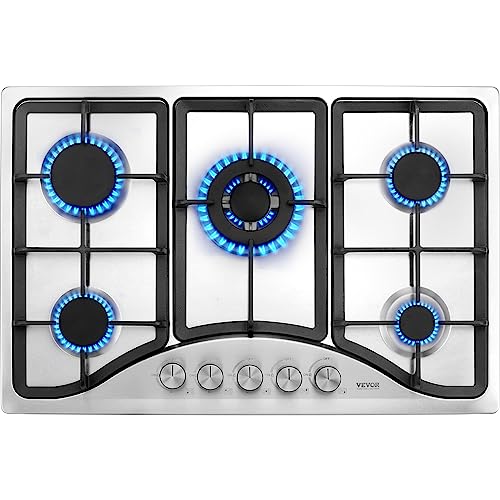
VEVOR Gas Cooktop 30 Inch, 5 Burners
Badge: Best Overall
Strengths
- Five burners on a standard 30 inch footprint, so it drops into the most common cooktop cutout size
- Runs on natural gas or LPG with conversion, which suits houses, apartments and RV galleys alike
- Thermocouple protection cuts the gas flow if a flame goes out, a meaningful safety layer
Trade-offs
- The stated output figure is modest for a five burner hob, so do not expect rangetop-style searing power
- Stainless steel shows fingerprints and cooked-on splatter more readily than enamel or glass
- A built-in unit needs a proper cutout, gas line and clearances, so it is not a casual weekend swap
Key specs (from verified listing data):
- Format: 30 inch built-in gas cooktop
- Burners: 5
- Output figure in title: 12250 BTU class
- Fuel: natural gas / LPG convertible
- Material: stainless steel
- Safety: thermocouple protection
The VEVOR is the pool’s straightforward built-in gas option: five burners across a 30 inch stainless deck, a convertible natural gas and LPG setup, and thermocouple flame protection. Its positioning in the listing is telling — camping, RVs and apartments are named alongside ordinary daily cooking — which makes it a flexible, utility-first hob rather than a design statement. In daily use that translates to a cooktop that handles a family rotation of pasta water, eggs, stir-fries and sauces without drama, and whose flat stainless surface wipes down quickly once the grates are lifted. The honest limitation is power and polish: the output figure in its title is not in power-burner territory, and the finish and control feel belong to the practical tier rather than the premium tier. Treat it as a capable, adaptable workhorse whose appeal is breadth — five burners, two fuels, a common size — rather than any single standout specification.
In daily use, the ownership story is simplicity. Five burners on a standard deck means your existing routine transfers without relearning a layout, the stainless surface forgives a hurried wipe, and the convertible fuel path means the same hob can follow you from a mains-gas house to a bottled-gas setting. Keep the caps clean and the flames will stay even and blue; let grease build around the burners and ignition will be the first thing to complain. It is not the hob for a cook who measures status in component names, but it is very much the hob for a household that measures value in years of uncomplaining service across different homes and fuels.
Setup notes for this pick: plan the cutout and gas connection before it arrives, have the fitter configure it for your supply — natural gas as delivered in most homes, or the LPG conversion for bottled gas — and commission all five burners together. In the first week, map which burner boils fastest and which simmers truest, because a five-burner deck rewards a cook who assigns roles to positions instead of lighting whichever burner is nearest. After that, its upkeep is the standard gas rhythm of clean caps, a wiped deck and an annual once-over.
For a main kitchen brief, this is one of only two picks that actually answers it: a built-in gas hob in the standard 30 inch size, equally at home in a family kitchen, an apartment or an RV galley thanks to its NG/LPG conversion and thermocouple protection.
Best for: households wanting five gas burners in a standard 30 inch opening, and RV or apartment kitchens needing NG/LPG flexibility / Not suited for: cooks chasing maximum searing output or a premium designer finish

ThermoMate Heavy 36 Inch Gas Cooktop, 5 Sabaf Burners
Badge: Best Premium
Strengths
- A wide 36 inch deck spreads five burners out, so large pans stop crowding each other
- Italy Sabaf burners and 304 stainless steel are genuinely premium-leaning components for this class
- CSA certification and thermocouple protection give it a documented safety footing
Trade-offs
- A 36 inch cutout does not fit kitchens built around a 30 inch cooktop without cabinet work
- The heavy build that makes it feel substantial also makes installation a two-person job
- Five burners on gas still means open-flame cleaning: grates, caps and a steel deck to maintain
Key specs (from verified listing data):
- Format: 36 inch built-in gas cooktop
- Burners: 5 Italy Sabaf power burners
- Fuel: natural gas / LPG convertible
- Material: 304 stainless steel
- Safety: thermocouple protection
- Certification: CSA certified
The ThermoMate is the heavyweight of this pool in every sense: a 36 inch built-in gas hob with five Italy Sabaf power burners, a 304 stainless steel body, thermocouple protection and CSA certification. Those component choices matter. Sabaf burners are the kind of part you normally find named on higher-tier European hobs, and 304-grade steel resists the dulling and staining that cheaper finishes show after a year of tomato sauces. The extra width is the real cooking upgrade — a stockpot, a wide skillet and a saucepan can genuinely coexist. Its honest limitation is commitment: it needs the larger cutout, a solid installation, and a kitchen whose cooking volume justifies the footprint. Bought for the right counter, though, it is the pick in this pool that most plausibly anchors a serious home kitchen for the long term.
Day to day, the ThermoMate’s width changes how a kitchen feels at the busiest hour. Sauces hold at the back without being jostled, the big pan gets the room it always wanted, and the deck still has a calm corner for the kettle. The heavy build shows in small ways — grates that sit with authority, a surface that shrugs off the daily wipe — and the certification gives landlords, insurers and careful buyers a documented answer. It asks more of the installation and the room than a standard hob, and it gives that investment back every time three pans share the surface without negotiation.
Setup notes for this pick: the 36 inch cutout and the unit’s weight make this a planned, two-person installation with the fitter present, and the commissioning should include a full-deck lighting test on your actual supply. Give it a hood that matches its width and landing space on both sides, because a deck this capable attracts big pans. In use, assign the burners roles — power, everyday, simmer, warming — and the width becomes a system rather than a space. Maintenance is the premium rhythm: caps soaked weekly, steel wiped along the grain, service on schedule.
For a main kitchen brief, the ThermoMate is the flagship answer: a wide, certified, component-led gas hob whose deck space and burner quality suit a kitchen that cooks seriously and often.
For a deeper look at a neighbouring question in this category, see Best 30 Inch Gas Cooktops.
Best for: larger kitchens, keen home cooks, and anyone who wants component-level quality in a five burner gas hob / Not suited for: 30 inch openings, small galley kitchens, or renters who cannot alter cabinetry
Duxtop 1800W Portable Induction Cooktop, Gold 8100MC
Badge: Best Portable Extra Zone
Strengths
- True portability: it plugs in, cooks, and stores in a cupboard when the counter is needed back
- Induction heats the pan directly, so response is fast and the surface stays comparatively cool
- A single-zone 1800W burner is a useful extra cooking zone during big meals
Trade-offs
- It is electric induction, not gas — it cannot answer a gas-specific brief on fuel grounds
- Only induction-compatible pans work; aluminium and copper without a magnetic base will not register
- One zone means one pan, so it supplements a cooktop rather than replacing one
Key specs (from verified listing data):
- Format: portable countertop induction burner, single zone
- Power: 1800W
- Model: 8100MC / BT-180G3
- Finish: gold
The Duxtop 8100MC is a long-running portable induction design: a single 1800W zone in a gold finish that sits on any counter and plugs into a standard outlet. As a piece of induction cooking it is easy to respect — quick heat, fine low-end control for sauces and chocolate, and a flat surface that wipes clean in seconds. It earns its keep as a buffet warmer, a dorm or office burner, a holiday overflow zone, or a precise simmer station next to a main hob. What it is not is a gas appliance, and this guide will not pretend otherwise: there is no flame, no grate, and no connection to a gas supply of any kind. Judge it as a portable electric specialist that happens to share this pool, useful exactly where its fuel and format fit the job.
In practice, the 8100MC’s charm is how little ceremony it needs. It comes out of the cupboard, takes a pan, boils, simmers or fries with a responsiveness that surprises gas loyalists, and goes away again leaving a wiped-clean square of counter. The gold finish divides opinion but the format does not: for renters, students, office kitchens and holiday overflow, this is cooking capacity on demand. Its ceiling is equally clear — one pan, magnetic only — and owners who accept that ceiling tend to keep these units for years.
Setup notes for this pick: there is almost no setup — a flat surface, an outlet, and a magnetic pan. Spend the saved effort on the pan audit instead, because this unit’s performance is exactly as good as the cookware you pair with it. In use, centre the pan on the marked zone, start liquids high and drop to a holding setting early, since induction overshoots less politely than gas when a pan is left at full power. Storage is part of the setup too: a drawer or cupboard slot it returns to every time is what keeps a portable portable.
For a kitchen gas brief, this Duxtop fails on fuel alone — it is a portable electric induction burner. It earns its unlinked place as a possible extra zone beside a gas hob, never as the hob itself.
Best for: a portable extra zone, small-space cooking, and precise low-heat tasks / Not suited for: anyone whose brief requires gas fuel, open flame, or multiple simultaneous pans
Duxtop Portable Induction Cooktop 1800W, Silver 9600LS
Badge: Best for Easy Cleaning
Strengths
- LCD sensor-touch controls give clear, repeatable power and temperature settings
- The flat glass surface has no grates or burners to scrub around
- Portable format works in apartments, RVs with shore power, and as a holiday overflow burner
Trade-offs
- Electric induction only — no flame, no gas connection, no use during a gas-specific installation
- Touch controls can be fussy with wet hands or when a wide pan overhangs the panel
- Requires magnetic cookware, so part of an existing pan collection may not work
Key specs (from verified listing data):
- Format: portable countertop induction burner, single zone
- Power: 1800W
- Controls: LCD sensor touch
- Model: 9600LS / BT-200DZ
- Finish: silver
The 9600LS is Duxtop’s touch-control portable induction burner: 1800W, an LCD sensor-touch panel, and a silver finish over a flat glass deck. Compared with its knob-and-button sibling in this pool, the appeal here is precision and cleanliness — settings are dialled in digitally and repeated exactly, and the sealed surface never traps grease around a burner ring. It is a strong little specialist for sauces, grains, gentle frying and single-pan meals in small kitchens. Its limitation in any gas-led comparison is absolute rather than relative: it burns no fuel at all. It also asks for induction-ready pans and a dry hand for its controls. Within an electric brief it is a front-runner; within a gas brief it is an alternative technology, presented honestly as such.
Living with the 9600LS means living with a clean counter. The sealed glass top never asks you to scrub around a burner, the digital settings repeat exactly from one session to the next, and the unit stores flat. Cooks who make the same grains, eggs and sauces on rotation particularly appreciate that repeatability. The touch panel is its personality test: cooks with dry hands and tidy habits love it, cooks mid-sauce with wet fingers sometimes wish for a knob. Either way, as a single portable zone it is a polished, proven interpretation of the idea.
Setup notes for this pick: place it where the touch panel stays clear of pan overhang and splashes, because the controls are the surface. Pair it with flat-based magnetic pans sized near the cooking zone, and learn its setting numbers for your three most-cooked dishes so the digital precision becomes muscle memory. Wipe the glass after every session — thirty seconds that keeps it looking new — and store it flat with nothing stacked on top. Used that way, it is the tidiest cooking appliance most kitchens will ever own.
For a kitchen gas brief, the same fuel verdict applies: a capable portable induction unit with tidy touch controls, reviewed for context and secondary-zone duty, but not a gas appliance in any sense.
Best for: cooks who value digital control, easy cleaning, and a storable single zone / Not suited for: gas installations, non-magnetic cookware collections, or multi-pan cooking
AAOBOSI Portable Induction Cooktop 1800W
Badge: Best for Fine Control
Strengths
- Twenty temperature and power levels give unusually fine control for a portable burner
- Four preset modes and a four-hour timer suit slow, unattended-style cooking tasks
- Compact and easy to clean, with apartments, RVs and outdoor cooking named in its listing
Trade-offs
- Electric induction, not gas — a different fuel and a different cooking feel entirely
- A single zone limits it to one pan at a time
- Preset modes still need supervision; a timer is not a substitute for watching a portable appliance
Key specs (from verified listing data):
- Format: portable countertop induction burner, single zone
- Power: 1800W
- Settings: 20 temperature and power levels
- Modes: 4 preset modes
- Timer: up to 4 hours
The AAOBOSI portable induction cooktop leans into control: twenty temperature and power levels, four preset modes and a four-hour timer on an 1800W single zone. That granularity is genuinely useful for the jobs portable burners do best — holding a gentle simmer, keeping a fondue or hotpot at a steady bubble, or running a long, low braise without babysitting a dial. The listing names apartments, RVs and outdoor cooking, and the compact, wipe-clean format fits all three. The honest caveat for this guide’s gas-led readers is the same as for every induction unit here: it is an electric appliance with no flame and no gas path, and it needs magnetic pans. As a portable electric, though, its control set is the deepest in this pool.
The AAOBOSI rewards cooks who like to set a level and trust it. Its fine-grained settings make it the unit you reach for when a recipe says ‘barely simmering’ and means it, and the timer turns long, low jobs — stocks, braises, slow sauces — into background tasks. In a small apartment it can be the difference between eating well and eating around a two-ring hob’s limitations. It remains a single zone that needs magnetic pans, but within those borders it offers the most deliberate control experience in this pool.
Setup notes for this pick: its value unlocks when you learn the level system rather than treating it like a simple dial. Spend the first sessions mapping levels to outcomes — the simmer level for your sauces, the holding level for grains, the sear level for eggs and fish — and use the presets and timer deliberately for the long, low jobs. Keep the pan centred and magnetic, the surface wiped, and the unit’s vents clear in its storage spot. It rewards methodical cooks more than any other portable here.
For a kitchen gas brief, the AAOBOSI is another electric alternative whose fine control and long timer could serve a simmer station role — no link, because the brief asks for gas and this uses none.
Best for: control-focused portable cooking, hotpot and simmer work, and small-space kitchens / Not suited for: gas cooking briefs, wok work over open flame, or cooking several pans at once
1800W Portable Induction Cooker, Stainless Steel, 8-Inch Coil
Badge: Best Commercial-Style Portable
Strengths
- Push-button controls stay usable with wet or greasy hands, unlike touch panels
- Dual IGBT power control and an 8 inch coil target even, commercial-style heating
- A ten-hour timer and stainless body suit long, workmanlike cooking sessions
Trade-offs
- Electric induction — it has no flame and no place in a gas line installation
- The commercial-grade positioning brings a utilitarian look rather than a designer finish
- Single zone, magnetic pans only, like every portable induction unit in this pool
Key specs (from verified listing data):
- Format: portable induction cooker, single zone
- Power: 1800W, dual IGBT power control
- Heating coil: 8 inch
- Settings: 18 temperature settings
- Controls: push-button
- Timer: up to 10 hours
- Body: stainless steel
This stainless portable induction cooker is the pool’s commercial-leaning electric: dual IGBT power control, an 8 inch coil, eighteen temperature settings, push-button controls and a ten-hour timer. The design choices are practical ones. Physical buttons work when your hands are wet, the steel body shrugs off knocks that would mark a glass fashion finish, and the long timer supports stock, batch and catering-style jobs. It reads as equipment rather than decor, which for many buyers is exactly the point. In a gas-focused guide it remains what it is — an electric alternative with no flame — but as a durable single-zone workhorse for heavy portable use, it makes a clear and honest case.
This cooker earns its counter space in working kitchens. The push buttons answer with gloves or wet hands, the steel body tolerates being moved, stacked against and wiped down daily, and the long timer supports the kind of batch cooking — stocks, preserves, big sauces — that domestic portables usually flinch from. It looks like equipment because it is equipment, and buyers who cook in volume, whether for a big family, a stall or a prep kitchen, will read that as a compliment. Occasional users may find it more machine than they need.
Setup notes for this pick: give it a sturdy, level surface and treat it like the equipment it is — buttons set before the pan goes on, timer set when the batch starts, vents kept clear during long sessions. Its ten-hour timer makes it the natural choice for stocks and batch sauces that run while you do other work nearby. The stainless body wants a wipe and an occasional deeper clean around the controls. Store it where its weight is not a lift you dread, and it will be used as often as it deserves.
For a kitchen gas brief, this stainless induction cooker is the heavy-duty electric outsider: commercially styled, button-controlled, and entirely flame-free, so it is covered honestly as context rather than a recommendation.
Best for: heavy-duty portable cooking, batch work, and users who prefer physical buttons / Not suited for: gas briefs, design-led kitchens, or multi-zone cooking
Comparison Table
| Pick | Format | Fuel / Power | Standout stated feature | Link |
|---|---|---|---|---|
| VEVOR Gas Cooktop 30 Inch, 5 Burners | 30 inch built-in gas cooktop | natural gas / LPG convertible | thermocouple protection | Check on Amazon |
| ThermoMate Heavy 36 Inch Gas Cooktop, 5 Sabaf Burners | 36 inch built-in gas cooktop | natural gas / LPG convertible | CSA certified | Check on Amazon |
| Duxtop 1800W Portable Induction Cooktop, Gold 8100MC | portable countertop induction burner, single zone | 1800W | gold | Unlinked |
| Duxtop Portable Induction Cooktop 1800W, Silver 9600LS | portable countertop induction burner, single zone | 1800W | silver | Unlinked |
| AAOBOSI Portable Induction Cooktop 1800W | portable countertop induction burner, single zone | 1800W | up to 4 hours | Unlinked |
| 1800W Portable Induction Cooker, Stainless Steel, 8-Inch Coil | portable induction cooker, single zone | 1800W, dual IGBT power control | stainless steel | Unlinked |
How to Choose: best kitchen gas cooktops
Start with fuel supply, because it quietly eliminates options. A home plumbed for natural gas can take either gas pick here directly; a home on bottled LPG needs a convertible hob, and both gas picks in this pool are NG/LPG convertible as stated in their verified data — but conversion is a fitter’s job involving jets and pressure checks, not a knob you turn. If your kitchen has no gas supply at all, be honest about the cost and disruption of adding one versus the induction alternative, which needs only an outlet.
Next, width and layout. Choose the largest width your cabinets genuinely fit, then look at burner arrangement rather than raw count: a strong burner placed where your biggest pan sits, smaller burners that can hold a true low simmer without a diffuser, and enough spacing that pan handles do not collide. On the gas pair here, that logic favours the ThermoMate’s spread-out 36 inch deck for multi-pan cooks and the VEVOR’s 30 inch deck for standard kitchens.
Related reading in this cluster: Best Five Burner Gas Cooktops.
Then materials and components. Deck material decides your cleaning life: stainless steel is durable and repairable but shows marks; the ThermoMate’s 304 grade and named Italy Sabaf burners are component-level signals worth weighting, because burners and valves are what age a hob. Check for thermocouple flame protection — both gas picks have it — because a flame blown out by a boil-over or a draft should shut the gas off, not keep flowing.
Finally, the unglamorous checks that prevent returns: confirm the cutout dimensions against your counter, the gas connection size and position, the ignition power requirement (most gas hobs still need an electrical point for spark ignition), and who is allowed to install gas appliances in your area. A cooktop is a decade-long fixture; an hour of verification before ordering is the cheapest upgrade in the whole project.
Using and Looking After Your Pick: best kitchen gas cooktops
Living well with a gas cooktop is mostly a handful of habits: lighting and heat judgement, a cleaning rhythm that never lets grease bake on, and knowing the few faults you can fix yourself versus the ones that belong to a gas professional.
- Season your judgement, not just your pans: for the first weeks, cook familiar dishes and learn what each burner’s low, medium and high actually look like — flame colour should be blue and steady, with the inner cone visible.
- Use pan-to-burner matching deliberately: small pans on small burners, your largest skillet on the strongest burner, and never let flames climb the sides of a pan, which wastes gas and overheats handles.
- Clean in the cool-down window: once the grates are safe to touch, lift them, wipe the deck, and wash burner caps weekly so ports stay clear and flames stay even.
- Check ignition monthly: each burner should light promptly with a clicking spark; repeated clicking without lighting is a signal to clean the electrode area gently and, if it persists, call a professional.
- Keep ventilation automatic: run the hood for every gas session, starting it a minute before ignition and letting it run a few minutes after, to clear combustion moisture and by-products.
- Test the thermocouple’s job indirectly by never defeating it: if a burner repeatedly dies at low settings, that is a service call, not a reason to hold the knob down.
Troubleshooting
Problem: one burner burns yellow or lazy → lift the cap when cold and clear the ports with a soft brush; if the flame stays yellow, stop and book a gas service, because combustion is off.
Problem: clicking continues after the flame lights → dry the electrode and cap area thoroughly; moisture after cleaning is the usual cause, and persistent clicking needs a technician.
Problem: the whole hob smells faintly of gas with everything off → do not troubleshoot this yourself; ventilate, avoid switches and flames, and call your gas emergency line.
When you are ready to compare neighbouring options, start with Best Gas Cooktops.
Gas vs Induction in a Real Kitchen: What the Fuel Choice Actually Changes
The fuel question deserves its own section because it changes daily cooking more than any single specification. Gas gives you a visible flame you judge by eye, instant heat changes when you turn a knob, and compatibility with every pan you own, including woks that need flame licking up their sides. It also gives you combustion by-products in the kitchen air, open-flame safety considerations, and a surface of grates and burner caps that takes real cleaning. Ventilation matters more with gas, and installation means a gas line, clearances and, in many areas, a permitted fitter.
Induction answers with speed and cleanliness. The pan itself becomes the heat source, water boils startlingly fast, the flat surface wipes clean, and there is no flame to blow out or ignite a tea towel. The costs are cookware compatibility — a magnet must stick to the pan base — a cooking feel some traditionalists never warm to, and dependence on electricity for every meal. Many households end up hybrid: a gas hob for the cooking they love, and a portable induction zone, like the unlinked units reviewed here, for overflow, precision simmering or summer cooking that does not heat the room. Neither fuel is objectively better; they optimise for different kitchens and different cooks.
See also Best Gas Cooktops 30 Inch for a closely related brief in this category.
Sizing a Kitchen Gas Cooktop: Cutouts, Clearances and Pan Room
Measure before you shop, in this order. First the existing cutout width and depth if you are replacing a unit, or the cabinet run available if you are starting fresh — 30 inch and 36 inch are the two standard classes in this pool, and they are not interchangeable without cabinet work. Second, the clearance above the hob to any hood or cabinet, and the ventilation path, because gas cooking deserves a hood that actually vents. Third, the space around the hob: landing room for hot pans on both sides is a safety feature, not a luxury.
Then think in pans, not burners. Five burners sound generous, but the useful question is which of your pans can run together: a 30 inch deck with five burners, like the VEVOR, fits everyday family combinations well, while the 36 inch ThermoMate spreads the same five burners so a stockpot, a wide skillet and a saucepan stop negotiating for space. If you regularly cook with two oversized pans at once, width is worth more than burner count. If your cooking is one or two pans most nights, a standard 30 inch footprint keeps the kitchen balanced and the installation simple.
Another angle on this category is covered in Best Gas Cooktops 30 Inch With 5 Burner.
Before You Order: A Kitchen Gas Cooktop Reality Check
Run this final check before any gas cooktop leaves the shortlist. Photograph your existing hob and its cutout with a tape measure in frame; write down the gas type on your meter or bottles; note the hood’s width and whether it vents outside; and confirm who will fit the appliance and what certification they hold. Those four facts eliminate nearly every failed delivery and return in this category, and they take fifteen minutes to gather.
Then sanity-check the decision against your cooking diary rather than your aspirations. If the last month held twenty weeknight meals of one or two pans and one Sunday of four, a standard 30 inch hob is your honest answer and the saved budget belongs in the hood or the fitter. If Sundays are the norm and weeknights are rehearsals, the 36 inch deck will pay you back weekly. Cooktops are bought for a decade of actual behaviour; the diary, not the dinner party, is the truth.
Ownership rhythm, in one paragraph: weekly, lift and wash the burner caps and wipe the deck; monthly, check ignition on every burner and degrease the hood filters; annually, consider a service that verifies flame picture, valve operation and flame-failure response. None of this is onerous, and all of it protects the two things you actually bought — even heat and safety. Keep the manual, note the fitter’s details in it, and record any conversion work with dates: a documented hob is easier to service, easier to insure, and easier to sell with the house.
A Week of Cooking on Each Fuel: The Honest Diary Test
Imagine the same week cooked three ways. On the gas hob, Monday’s stir-fry uses the wok you already own, Wednesday’s pasta water is a background task while you work the sauce pan beside it, and Sunday’s five-pan production feels like conducting rather than coping. The costs appear at cleaning time and in the hood’s workload, and in the knowledge that a fitter, not a screwdriver, owns any real fault. That is the gas week: maximum cooking freedom, professional infrastructure, a little more housekeeping.
Now the same week with a portable induction zone added — not replacing the hob, but relieving it. The rice minds itself on the portable while the hob runs the main event; the chocolate melts at a set temperature instead of over a bain-marie; the summer salad night cooks without heating the kitchen. This hybrid week is what the pool’s structure quietly recommends: gas as the backbone, induction as the flexible extra. Readers who came here certain they wanted only one fuel often leave planning for both, in the right roles.
Pre-purchase checklist, in one paragraph: cutout measured and recorded; gas type and supply position confirmed; fitter booked and their certification checked; hood width and venting route verified; ignition power point located; clearances to walls, tall units and combustibles checked against the manual; household briefed on the shutoff location. Seven items, one hour, and the difference between an installation day that feels routine and one that generates a return, a reschedule and a week of takeaways.
Common Buying Mistakes
- Buying on burner count alone, without checking whether your largest pans can actually share the deck at the width you chose.
- Skipping the cutout measurement and discovering at installation that a 36 inch ambition meets a 30 inch cabinet.
- Treating LPG conversion as a DIY afternoon rather than a jet-and-pressure job for a qualified fitter.
- Ignoring ventilation until the kitchen is fitted, when hood ducting is hardest to add.
- Choosing a finish for looks alone and resenting it within a month — steel, enamel and glass each have a cleaning personality.
Before you decide, it is worth a look at Best Gas Cooktops 36 Inch as well.
Final Recommendation
Start with the ThermoMate 36 inch if your cabinets fit it and you cook with several pans at once: its Sabaf burners, 304 stainless build, CSA certification and spread-out deck make it the most complete kitchen gas cooktop in this pool. Choose the VEVOR 30 inch if your opening is standard size, your fuel supply might change between natural gas and LPG, or the cooktop will serve an apartment or RV galley — it covers the gas brief completely in the common footprint.
And if reading the fuel comparison has quietly moved you toward induction for a secondary zone, the unlinked reviews above will help you choose among the portable units on their merits — control depth from the AAOBOSI, commercial build from the stainless models, proven simplicity from the Duxtops. Just buy them as what they are: excellent electric tools, not gas substitutes.
Our linked recommendations again, for convenience: VEVOR Gas Cooktop 30 Inch, 5 Burners, ThermoMate Heavy 36 Inch Gas Cooktop, 5 Sabaf Burners.
Frequently Asked Questions
Are the portable induction burners in this guide a substitute for a gas cooktop?
No. They are a different technology that needs electricity and magnetic pans. They excel as extra zones and small-space solutions, which is why they are reviewed, but they are presented unlinked because they cannot satisfy a gas brief.
What does thermocouple protection do on the two gas picks?
It senses the flame’s heat at each burner. If the flame goes out — a boil-over or a strong draft — the thermocouple cools and the gas valve closes, preventing unburned gas from flowing into the kitchen.
Can both gas cooktops run on bottled LPG as well as mains gas?
Yes, both are listed as NG/LPG convertible. The conversion itself involves different jets and pressure settings and should be done by a qualified gas fitter, who will also leak-test the installation.
Is a 36 inch cooktop always better than a 30 inch one?
Not automatically. The extra width is genuinely useful for multi-pan cooking, but only if your cabinets fit it and your cooking uses the space. A 30 inch hob in a standard kitchen is the right tool for most households.
What pans work on a gas cooktop?
Essentially all of them — gas is the most cookware-agnostic fuel. Flat, stable bases still matter for even heating, and very small pans may need a trivet or reducer ring on large burners.
Do gas cooktops need electricity at all?
Most modern ones do, for spark ignition and any electronic safety systems, even though the heat itself comes from gas. Check the product page for the exact requirement before installation day.


