Disclosure: topratedkitchenware.com is reader-supported. When you buy through links on our site, we may earn an affiliate commission from Amazon and other retailers, at no extra cost to you.
Where to buy
This guide to the best consumer reviewed coffee makers covers six verified machines, each checked against its listing on 2026-11-20 and each linked below so you can check the latest price on Amazon. No static prices are printed anywhere in this guide — the live figure on Amazon is the only one worth trusting.
- BLACK+DECKER 12-Cup Thermal Coffee Maker CM2046S — Best Value Thermal. Check on Amazon for the latest price.
- Cuisinart PerfecTemp 12-Cup Thermal DCC-3400NAS — Best for Hot, Strong Coffee.
- BLACK+DECKER CaféCraft 12-Cup Thermal Coffee Maker — Best Hot and Iced Value.
- Cuisinart 12-Cup PerfecTemp Thermal Coffee Maker (White) — Best for Small Batches.
- BUNN Speed Brew Platinum Thermal Coffee Maker CSB3T — Best for Speed.
- Hamilton Beach FlexBrew Advanced 5-in-1 Coffee Maker — Most Versatile.
Read the full guide ↓ for badges, strengths and trade-offs, a comparison table, a buying guide and a practical how-to section.
The best consumer reviewed coffee makers are not necessarily the machines with the loudest marketing — they are the ones ordinary owners keep praising after the novelty wears off, for the unglamorous reasons: coffee that is hot enough, a carafe that does not dribble, a clock that is easy to set, and a brew that tastes the same on a grey Tuesday as it did the first weekend. This guide is built around that idea. It reads the six verified machines in the pool the way experienced consumer reviewers teach you to read any category: by pattern, not by anecdote.
A note on method, because this keyword demands it: this guide invents no scores, no percentages and no counts of happy owners. Instead it explains what consumer feedback consistently focuses on for drip machines, and then maps each machine in the pool against those themes using only what its listing actually states — carafe type, capacity, programmability, brew-strength control, speed, versatility. Where a machine’s listing is silent on a feature, the review says so; silence in a listing is itself consumer information.
The pool is a well-shaped one. Five of the six are thermal-carafe machines, which consumer reviewers tend to favour because coffee held in an insulated carafe stays drinkable instead of stewing on a hot plate. The sixth, the Hamilton Beach FlexBrew, answers a different consumer complaint — households split between batch drinkers and pod users — with a 5-in-1 design. If your household is also weighing built-in grinding, the companion shortlist at Best Coffee Makers With Grinder Consumer Reports applies the same evidence-first approach to that category.
Key Takeaways
- Read consumer praise by theme — heat, carafe manners, small-batch behaviour, cleanup — not by single glowing or furious anecdotes.
- Five of these six picks use thermal carafes, the design consumer feedback consistently rewards for taste over a long morning.
- The Cuisinart PerfecTemp pair lead on brewing heat and control; the BUNN leads on speed; the FlexBrew leads on versatility.
- Small-batch settings matter more than headline capacity for one- and two-person households.
- No scores or counts are invented in this guide — every claim traces to a feature named in the machine’s own listing.
In this guide
Quick Picks
| Pick | Badge | Standout trait | Check |
|---|---|---|---|
| BLACK+DECKER 12-Cup Thermal Coffee Maker CM2046S | Best Value Thermal | Capacity: 12 cups, thermal carafe | Check on Amazon (linked) |
| Cuisinart PerfecTemp 12-Cup Thermal DCC-3400NAS | Best for Hot, Strong Coffee | Capacity: 12 cups | Check on Amazon (linked) |
| BLACK+DECKER CaféCraft 12-Cup Thermal Coffee Maker | Best Hot and Iced Value | Capacity: 12 cups, thermal | Check on Amazon (linked) |
| Cuisinart 12-Cup PerfecTemp Thermal Coffee Maker (White) | Best for Small Batches | Capacity: 12 cups, thermal carafe | Check on Amazon (linked) |
| BUNN Speed Brew Platinum Thermal Coffee Maker CSB3T | Best for Speed | Capacity: 10 cups | Check on Amazon (linked) |
| Hamilton Beach FlexBrew Advanced 5-in-1 Coffee Maker | Most Versatile | Format: 5-in-1 drip and single serve | Check on Amazon (linked) |
How These Picks Were Chosen
The pool was evaluated against the themes that dominate long-term owner feedback for drip coffee makers: brewing temperature, how the carafe pours and holds heat, whether small batches taste right, how much daily cleaning the machine demands, and whether its controls stay obvious after six months. Each machine’s listing was checked for the features that speak to those themes, and the reviews below separate what a listing proves from what it merely implies. This is a research-led guide; it does not claim hands-on testing, and it prints no ratings of any kind.
Every product below comes from the verified pick pool for this guide: brand, model and image were cross-checked against the listing data on 2026-11-20, and no product, specification or image has been invented or imported from another source. Where a listing does not state a specification, this guide leaves it unstated rather than estimating it. The result is a shorter list of claims than many guides offer — and one where every claim can be traced.
The 6 Best Consumer Reviewed Coffee Makers, in Detail
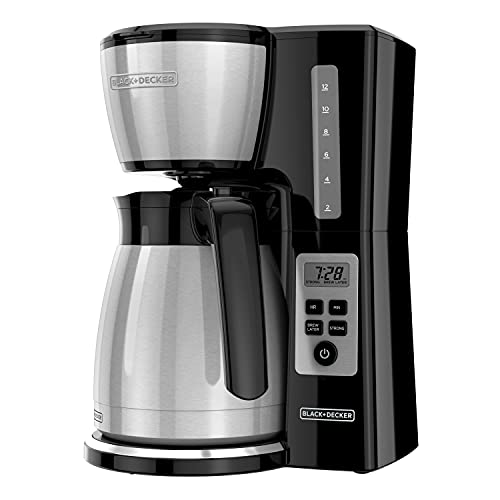
BLACK+DECKER 12-Cup Thermal Coffee Maker CM2046S
Badge: Best Value Thermal
Consumer feedback on value thermal machines tends to split on one question: does the budget show in the cup or only in the plastics? The CM2046S makes its case with two features owners actually mention — a VORTEX showerhead aimed at even extraction, and brew-strength control, which lets a household tune one machine to two palates. As a consumer-reviewed proposition it is the pool’s sensible default: thermal carafe, full programmability, and no novelty features to go wrong.
In daily use, the BLACK+DECKER CM2046S is judged at 7 a.m., not in a showroom: how fast it goes from thought to coffee, how the carafe pours at a groggy angle, how much counter theatre stands between you and the first cup. Its headline specification — capacity: 12 cups, thermal carafe — shapes that routine directly, and its other listed features fill in the rest of the morning: the setting you leave alone, the control you actually touch, the part you wash. Machines in this category earn loyalty through mornings accumulated, and this one’s design is aimed at accumulating them. Its badge (best value thermal) summarises which household’s mornings it fits best.
Strengths
- Thermal carafe keeps coffee hot without a warming plate cooking it
- VORTEX showerhead is aimed at even saturation of the grounds
- Brew strength control lets one household serve two preferences
Trade-offs
- Value-tier plastics and fit compared with the Cuisinart and BUNN models
- No iced-coffee mode is named in the listing
- Thermal carafes need a rinse discipline to avoid stale-oil flavours
Key specifications (from the listing)
- Capacity: 12 cups, thermal carafe
- Programmable, with brew strength control
- VORTEX technology showerhead (per the listing)
- Colour: black/steel
Best for: Households wanting thermal-carafe coffee on a value-tier budget / Not suited for: Buyers who prioritise premium materials and the longest feature lists
Check on Amazon — see the latest price and the full listing for the BLACK+DECKER CM2046S.

Cuisinart PerfecTemp 12-Cup Thermal DCC-3400NAS
Badge: Best for Hot, Strong Coffee
The PerfecTemp’s consumer story is heat. Lukewarm coffee is the single most common disappointment in drip machines, and this model’s listing leads with PerfecTemp hotter brewing and a double-wall stainless thermal carafe to keep that heat. Owners of hotter-brewing machines tend to praise extraction — coffee that tastes brewed rather than steeped — and the brew-strength control adds the second lever consumers ask for. It is the connoisseur’s batch brewer in this pool.
Living with the Cuisinart PerfecTemp DCC-3400NAS means its compromises become familiar furniture: you learn its carafe’s pouring angle, its reservoir’s habits, the exact moment its brew finishes relative to your alarm. Its defining specification (capacity: 12 cups) matters most on the days that test it — guests, deadlines, the second pot — while its ordinary value is the absence of friction on all the other days. That is the standard this guide applies to the whole pool: not which machine impresses a guest, but which one a household would buy again after a year of mornings. The Cuisinart PerfecTemp DCC-3400NAS’s badge (best for hot, strong coffee) is its answer to that question.
Strengths
- Hotter brewing is the spec extraction purists ask for, and it is named in the listing
- Double-wall stainless carafe holds heat through a long morning
- Brew strength control covers both delicate and assertive coffees
Trade-offs
- A taller thermal-carafe silhouette needs cabinet clearance checks
- No single-serve or pod option — it is a batch brewer, full stop
- Premium-tier positioning within this pool
Key specifications (from the listing)
- Capacity: 12 cups
- Carafe: double-wall stainless steel thermal
- PerfecTemp hotter brewing (per the listing)
- Brew strength control; finish: silver
Best for: Drinkers who find most drip coffee under-extracted and lukewarm / Not suited for: Households wanting pods, single-serve, or a small machine for one mug
Check on Amazon — see the latest price and the full listing for the Cuisinart PerfecTemp DCC-3400NAS.

BLACK+DECKER CaféCraft 12-Cup Thermal Coffee Maker
Badge: Best Hot and Iced Value
The CaféCraft answers the newest theme in consumer coffee feedback: the household that drinks hot coffee in winter and iced coffee the rest of the year. Its listing names hot and iced modes with a thermal carafe and full programmability — a combination none of the pool’s premium machines offer. Consumer-wise it is a pragmatist’s pick: one machine covering both habits, at the value end of the range, accepting simpler materials as the trade.
The BLACK+DECKER CaféCraft builds its case the way drip machines always do: one unremarkable, satisfactory morning at a time. Specifications like capacity: 12 cups, thermal set the boundaries of that satisfaction — how much it brews, how it holds heat, how it handles your household’s split preferences — while the daily experience is decided by pouring, cleaning and the controls you touch without thinking. A machine that gets those small things right disappears into the routine, which is the highest praise this category offers. Read its badge (best hot and iced value) as a claim about fit: the household described is the one for whom this machine will disappear fastest.
Strengths
- A named iced mode answers the fastest-growing home coffee habit in this pool
- Thermal carafe serves the hot side without a hot plate
- Programmability covers the weekday-morning routine end to end
Trade-offs
- Iced modes still need your ice and your ratios — the mode manages dilution, it does not abolish it
- Value-tier build next to the stainless Cuisinart models
- No brew-strength feature is named in this listing
Key specifications (from the listing)
- Capacity: 12 cups, thermal
- Hot and iced coffee modes
- Programmable
Best for: Households split between hot and iced coffee habits / Not suited for: Purists who want the hottest possible extraction and premium build
Check on Amazon — see the latest price and the full listing for the BLACK+DECKER CaféCraft.

Cuisinart 12-Cup PerfecTemp Thermal Coffee Maker (White)
Badge: Best for Small Batches
This white PerfecTemp’s distinguishing consumer feature is the 1–4 cup setting, and it matters more than it sounds. The classic owner complaint about 12-cup machines is that two-person quantities taste thin and sad; a dedicated small-batch mode is the manufacturer’s direct answer. Add Brew Pause for the impatient first cup and the same hotter brewing as its silver sibling, and this is the pool’s pick for couples in bright kitchens who occasionally brew for a crowd.
In daily use, the Cuisinart PerfecTemp 12-Cup (White) is judged at 7 a.m., not in a showroom: how fast it goes from thought to coffee, how the carafe pours at a groggy angle, how much counter theatre stands between you and the first cup. Its headline specification — capacity: 12 cups, thermal carafe — shapes that routine directly, and its other listed features fill in the rest of the morning: the setting you leave alone, the control you actually touch, the part you wash. Machines in this category earn loyalty through mornings accumulated, and this one’s design is aimed at accumulating them. Its badge (best for small batches) summarises which household’s mornings it fits best.
Strengths
- The 1–4 cup setting solves the small-batch problem most 12-cup machines handle badly
- Brew Pause lets an impatient first cup happen without drips down the carafe
- The full PerfecTemp feature set in a lighter finish for bright kitchens
Trade-offs
- White finishes show coffee splashes and demand wiping discipline
- Batch-only — no pods, no single-serve side
- Sits in the same premium tier as its silver sibling in this pool
Key specifications (from the listing)
- Capacity: 12 cups, thermal carafe
- PerfecTemp hotter brewing
- 1–4 cup setting and brew strength control
- Brew Pause; finish: white stainless
Best for: Couples and small households that sometimes host / Not suited for: Daily pod users, and anyone needing a compact footprint above all
Check on Amazon — see the latest price and the full listing for the Cuisinart PerfecTemp 12-Cup (White).

BUNN Speed Brew Platinum Thermal Coffee Maker CSB3T
Badge: Best for Speed
BUNN’s consumer reputation rests on a single word: speed. The Speed Brew line is built around a reservoir that keeps water ready, so the brew starts when you do. Owners who choose this style tend to be routine-driven — same time, same pot, no waiting — and they forgive the smaller 10-cup capacity and standby energy because the machine removes the morning’s first delay. In a consumer-reviewed roundup it is the specialist pick, and specialists poll strongly with the right households.
Living with the BUNN Speed Brew Platinum CSB3T means its compromises become familiar furniture: you learn its carafe’s pouring angle, its reservoir’s habits, the exact moment its brew finishes relative to your alarm. Its defining specification (capacity: 10 cups) matters most on the days that test it — guests, deadlines, the second pot — while its ordinary value is the absence of friction on all the other days. That is the standard this guide applies to the whole pool: not which machine impresses a guest, but which one a household would buy again after a year of mornings. The BUNN Speed Brew Platinum CSB3T’s badge (best for speed) is its answer to that question.
Strengths
- Speed is the founding idea of this line — built for households that will not wait
- BUNN’s café heritage shows in a brewer designed around an always-ready reservoir concept
- Thermal carafe, so fast coffee is not then stewed on a plate
Trade-offs
- 10 cups is the smallest batch capacity in this pool
- An always-warm reservoir design uses standby energy the others do not
- Fewer programmable conveniences are named than on the Cuisinart models
Key specifications (from the listing)
- Capacity: 10 cups
- Carafe: thermal, stainless steel
- Line: Speed Brew — BUNN’s fast-brewing home line
- Colour: black
Best for: Routine-driven households that value minutes every single morning / Not suited for: Occasional brewers, for whom an always-ready reservoir makes little sense
Check on Amazon — see the latest price and the full listing for the BUNN Speed Brew Platinum CSB3T.
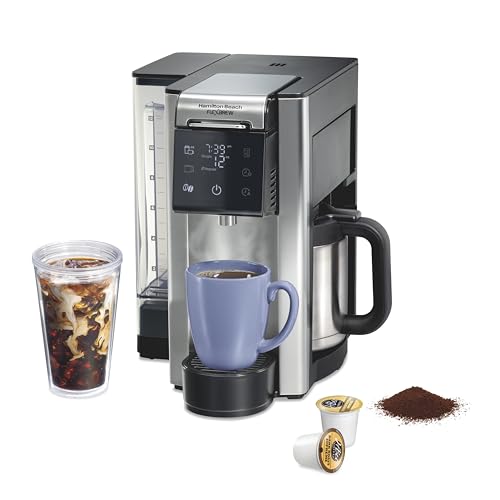
Hamilton Beach FlexBrew Advanced 5-in-1 Coffee Maker
Badge: Most Versatile
The FlexBrew Advanced is the pool’s answer to the split household, and consumer feedback on 5-in-1 machines follows a pattern: delight from households that genuinely use both sides, and mild regret from those who buy versatility they never touch. The listing is generous — 12-cup thermal drip, pods and grounds single-serve, hot and iced, a removable 60 oz reservoir. Judge it by your real week: if both formats happen weekly, few machines serve a mixed household better.
The Hamilton Beach FlexBrew Advanced builds its case the way drip machines always do: one unremarkable, satisfactory morning at a time. Specifications like format: 5-in-1 drip and single serve set the boundaries of that satisfaction — how much it brews, how it holds heat, how it handles your household’s split preferences — while the daily experience is decided by pouring, cleaning and the controls you touch without thinking. A machine that gets those small things right disappears into the routine, which is the highest praise this category offers. Read its badge (most versatile) as a claim about fit: the household described is the one for whom this machine will disappear fastest.
Strengths
- Two brewers in one footprint — batch drip for weekends, single serve for solo mornings
- Pods and grounds both work on the single-serve side, so nobody is locked in
- A removable 60 oz reservoir is the easiest fill-and-clean arrangement here
Trade-offs
- Complexity is the cost: two systems to descale, two sets of parts to keep track of
- Jack-of-all-trades machines rarely out-brew a dedicated specialist at either job
- The largest countertop commitment in this pool
Key specifications (from the listing)
- Format: 5-in-1 drip and single serve
- 12-cup thermal programmable drip side
- Pods and grounds on the single-serve side
- Reservoir: removable 60 oz; hot and iced
Best for: Mixed households of batch drinkers and pod or grounds single-serve drinkers / Not suited for: Purists who want one job done with the fewest possible parts
Check on Amazon — see the latest price and the full listing for the Hamilton Beach FlexBrew Advanced.
Comparison Table
| Pick | Badge | Headline specification | Second specification | Check |
|---|---|---|---|---|
| BLACK+DECKER 12-Cup Thermal Coffee Maker CM2046S | Best Value Thermal | Capacity: 12 cups, thermal carafe | Programmable, with brew strength control | Check on Amazon |
| Cuisinart PerfecTemp 12-Cup Thermal DCC-3400NAS | Best for Hot, Strong Coffee | Capacity: 12 cups | Carafe: double-wall stainless steel thermal | Check on Amazon |
| BLACK+DECKER CaféCraft 12-Cup Thermal Coffee Maker | Best Hot and Iced Value | Capacity: 12 cups, thermal | Hot and iced coffee modes | Check on Amazon |
| Cuisinart 12-Cup PerfecTemp Thermal Coffee Maker (White) | Best for Small Batches | Capacity: 12 cups, thermal carafe | PerfecTemp hotter brewing | Check on Amazon |
| BUNN Speed Brew Platinum Thermal Coffee Maker CSB3T | Best for Speed | Capacity: 10 cups | Carafe: thermal, stainless steel | Check on Amazon |
| Hamilton Beach FlexBrew Advanced 5-in-1 Coffee Maker | Most Versatile | Format: 5-in-1 drip and single serve | 12-cup thermal programmable drip side | Check on Amazon |
Specifications are quoted only where the listing states them; a dash or an absent line means the listing was silent, not that the feature is missing. Compare the columns that match your workload first — capacity and controls decide more days than any other pair of attributes.
How to Choose a Coffee Maker the Way Consumer Reviewers Do
Start with the carafe, not the clock. Thermal carafes dominate this pool for a reason: coffee held without a hot plate keeps its flavour through a long morning, and owner satisfaction follows that difference. Glass carafes on warmers are fine for households that drink a pot within the hour; everyone else should default to thermal and treat it as the first filter, before features.
Then match capacity to your honest batch. A 12-cup machine brewing for two needs a small-batch mode — the white Cuisinart’s 1–4 cup setting is the pool’s explicit answer — or the daily coffee will underwhelm no matter how good the machine is at full loads. Conversely, the BUNN’s 10 cups is a feature, not a flaw, for households that brew smaller and value speed. Readers comparing filter formats as part of this decision may find Best Coffee Makers With Cone Filters a useful side path.
Finally, buy the features your household will use weekly and refuse the rest. Brew-strength control earns its place in mixed-palate homes; iced modes earn theirs in warm climates and cold-coffee households; a 5-in-1 earns its complexity only when both sides truly run. Consumer wisdom, distilled, is mostly this: the best-reviewed machines are the ones whose owners use everything on them. Fresh beans matter as much as any feature — the shortlist at Best Coffee Makers With Fresh Ground explores that side of the equation.
How to Keep a Drip Coffee Maker Brewing Like New
Long-term owner satisfaction is mostly maintenance. These habits protect flavour and lifespan across all six machines in the pool.
- Rinse the thermal carafe after every pot and wash it with hot soapy water daily; coffee oils go rancid quietly and season every later brew.
- Descale on the manufacturer’s schedule for your water hardness — scale is the hidden cause of slow brews, low temperatures and gurgling.
- Use the right filter size and fold, and rinse paper filters briefly if you taste paper in delicate coffees.
- Measure coffee and water with at least rough consistency for a week before changing anything; most ‘weak coffee’ complaints are ratio problems, not machine problems.
- Wipe the showerhead area weekly — it is the part of the machine that lives in steam and old coffee vapour.
Troubleshooting
- Problem: Coffee tastes weaker than it used to → Check the ratio first, then descale. Scale lowers brew temperature, and low temperature reads on the palate as weakness.
- Problem: The carafe dribbles when pouring → Pour more slowly with the lid in its pouring position, and check the lid seal for coffee-ground grit. Most dribbles are technique or grit, not defects.
- Problem: Brewing has slowed down noticeably → That is scale until proven otherwise. Run a full descale cycle before suspecting the pump or reservoir.
How to Read Consumer Reviews Without Being Mislead
Consumer reviews are data, but noisy data. Read them the way this guide does: by theme and repetition. A complaint repeated across many owners — a dribbling carafe, a clock nobody can set — is signal. A single dramatic story, glowing or furious, is weather. Pay special attention to reviews written months after purchase, because drip machines fail slowly: seals tire, carafes lose vacuum, scale builds. Early reviews measure unboxing; late reviews measure ownership.
Also notice what reviewers praise unprompted. Across this category, the recurring praise themes are heat, speed, carafe manners and small-batch quality — which is exactly why this guide organised its badges around those axes. Community discussions add colour that formal reviews miss; the threads gathered under Best Coffee Makers With Frother Reddit show how differently households weight the same features, and the grinder-focused discussion at Best Coffee Makers With Coffee Grinders For Coffee Lovers does the same for freshness-first buyers.
Thermal Carafes: Why This Pool Leans So Heavily on Them
Five thermal carafes in a six-machine pool is not an accident of sampling; it reflects where drip coffee has gone. A warming plate holds coffee at drinking temperature by continuing to cook it, and the flavour cost compounds with every half hour. An insulated carafe simply slows cooling, so the second and third cups taste like the first. The trade-offs are real — thermal carafes pour more deliberately, cost more than glass, and hide how much coffee is left — but for households that brew once and drink over hours, consumer experience keeps landing on the same side.
If your household drinks a pot fast, this matters less, and programmability or speed may be your better axis — the BUNN’s whole design argues that case. If your household is split between drip drinkers and espresso-style drinkers, note that none of these machines makes espresso; households wanting milk drinks should treat a drip machine as one half of a two-machine answer, a split explored in the frother-focused shortlist linked earlier in this guide.
Water, Beans and the Variables You Control
A drip machine controls temperature and contact; almost everything else is yours. Fresh beans ground reasonably close to brewing, a consistent coffee-to-water ratio and water that tastes neutral will move a mid-range machine’s output further than any feature upgrade. Change one variable at a time when dialling in — ratio first, then grind, then strength settings — because changing two at once teaches you nothing. Keep a simple note of the combination your household prefers; the best-reviewed machines in owner feedback are very often just machines whose owners found their settings and stopped experimenting.
Descaling: The Maintenance That Decides Lifespan
Scale is the silent variable in every drip machine’s life. It insulates heating elements, lowers brew temperature, slows flow and eventually silences machines that were otherwise sound. How often to descale depends on your water, but the symptom list is universal: slower brews, quieter temperatures, gurgling, and coffee that tastes thinner than the same beans used to make. Descale on schedule rather than on symptoms and most machines in this pool will outlast several changes of kitchen décor. Thermal carafes need the same respect — a weekly hot soapy wash and an occasional deep clean keep yesterday’s oils out of today’s pot.
Programming the Night Before, Honestly
Wake-up programming is the drip machine’s oldest convenience and still its most used. Its one honest caveat is freshness: ground coffee stales overnight in the basket, and water sits where it sits. Households that value the alarm-clock pot accept that trade knowingly; households that value the last few percent of flavour grind in the morning and press start themselves. Neither is wrong — but knowing which household you are should steer you between the pool’s fully programmable models and its speed-first designs, which exist precisely for people who would rather brew fast on waking than schedule the night before.
Glass vs Thermal, Settled by Your Morning
The carafe question has a correct answer per household, not per category. If a pot is brewed and finished within the hour — a busy family breakfast, an office kitchen — the carafe material barely matters and pouring manners matter more. If a pot is brewed at seven and still being poured at ten, thermal wins outright, because a warming plate spends those hours slowly cooking the coffee it is keeping warm. This pool leans thermal for exactly that reason: most home pots are drunk over hours. Judge your own morning honestly; the households that choose wrong are the ones that describe the morning they wish they had.
Brew Strength Controls: What They Really Change
A strength button does not add coffee or remove it; it changes how the water meets the grounds — typically flow and contact — so the same beans and the same scoop produce a cup that drinks stronger or milder. That makes it the single most useful feature in a mixed-palate household, where one drinker’s breakfast is another’s dishwater. It is not a substitute for ratio: a household that under-doses its coffee will find the strong setting an improvement and the correct scoop a revelation. Use the control for preference, the scoop for correctness, and the two together cover almost every taste a drip machine will ever be asked for.
The First Week With a New Machine: A Dialling-In Ritual
New machines disappoint most in week one, when every variable is untested at once. Give any machine in this pool a fair first week: pick one coffee, one ratio and one setting, and brew it three mornings running before changing anything. Then adjust a single variable — grind slightly finer, or the strength setting one step — and run it again. By the end of the week you will know the machine’s real character and your household’s real preference, instead of a blur of first impressions. Owners who do this keep their machines for years; owners who judge on the first pot return good machines and repeat the experiment with the next one.
Counter Space and Cabinet Height: Measure Before the Box Arrives
Thermal-carafe machines are taller than they look in photographs, because the carafe must clear the brew basket and the lid must open upward. Measure the space under your wall cabinets with the machine’s lid-open height in mind, and check that the reservoir’s fill path works in the space you actually have — some designs want to slide out, others want a jug poured at an angle. Five minutes with a tape measure prevents the most common and most avoidable disappointment in this category: a machine that fits the counter but not the kitchen, exiled to a cupboard it must be fetched from every morning.
The Grind Question, Answered for Drip Drinkers
Drip brewing forgives many things but not stale, uneven grounds. You do not need a competition grinder to transform a drip machine’s output; you need grounds that were beans recently and a size roughly matched to the filter. Pre-ground coffee bought in small quantities and stored airtight beats ancient beans from a magnificent grinder, and fresh beans through a modest grinder beat both. If your household is deciding where the next upgrade dollar goes — machine or grinder — the honest answer for most drip drinkers is the grinder, once the machine is competent. Every machine in this pool is competent; that is what makes the grinder the better marginal purchase for their owners.
Iced Coffee From a Drip Machine, Done Properly
Iced coffee fails at dilution, not temperature: hot coffee poured over ice becomes flavoured water by the second handful of cubes. The fixes are concentration and cold management — brew stronger, chill the coffee before it meets ice where time allows, and treat any iced mode, like the one named on the CaféCraft in this pool, as a head start rather than a solution. Coffee ice cubes are the enthusiast’s answer and genuinely work. What never works is leaving the pot on a warming plate to ‘stay ready’ for iced drinks later; stewed coffee over ice is two mistakes in one glass.
One Machine, Two Palates: Running a Mixed Household
Most coffee disagreements are ratio disagreements wearing costumes. The household that argues about strength usually agrees completely once each drinker controls a variable: strength settings for the shared pot, a measured second scoop for the strong faction’s second pot, or a single-serve side — the FlexBrew’s entire reason for existing — for the drinker whose taste never matched the house blend. Machines earn their keep in mixed households by offering levers, and this pool offers several kinds: brew-strength controls, small-batch settings, and dual-format brewing. Choose the lever your household will actually pull, daily, without negotiation.
Reading a Coffee Maker Listing Without the Gloss
Coffee listings reward the same sceptical order as any appliance: carafe type first, because it decides flavour over time; capacity second, matched to your honest batch; then the specific conveniences your household will use weekly — programmability, strength control, small-batch settings, speed architecture, dual formats. Wattage and cup-size claims deserve the least attention; a ‘cup’ in this category is a small, traditional measure, not your mug, and every household should translate capacity into its own mugs before buying. This guide read its pool in that order, which is why its badges name mornings and habits rather than features in the abstract.
Why Thermal Carafes Dominate This Pool — and When to Resist
Five thermal carafes out of six is a strong editorial lean, and it deserves its counter-argument. Thermal wins when coffee is drunk over hours, loses a little on pouring grace, hides the remaining level, and costs more than glass. Households that brew small and drink immediately — or that use a machine in an office where the pot is communal and fast-moving — may rationally prefer glass and a warmer. The pool’s lean reflects the commonest home pattern, not a law. What is a law: coffee held hot for hours changes, and the only choice is whether it changes by insulation slowing down or by a hot plate speeding it up.
The Office and Second-Machine Question
Many households end up with a second coffee setup — a desk, a workshop, a spare room — and the second machine should be chosen by a different logic from the first. It will be used less, cleaned less and forgiven more, which argues for simplicity over features: fewer modes, an easy reservoir, a carafe that tolerates neglect. The value-tier machines in this pool travel well to that role, while a complex dual-format machine usually deserves the main kitchen where its versatility is used. Buying the second machine deliberately, rather than inheriting whichever old machine survived, is the difference between a pleasant backup and a dusty one.
Decaf, Half-Caf and Other Household Treaties
Shared machines serve divided households through process, not hardware. Decaf drinkers and regular drinkers sharing one brewer need a rinse discipline between pots and, ideally, a grinder routine that does not cross the streams. Half-caf — a deliberate blend — is the treaty many households actually sign, and a brew-strength control helps it land where both sides accept it. The machines in this pool support these treaties with levers rather than apps: strength settings, small-batch modes for the minority pot, and single-serve sides for the true dissenter. Peace in a coffee household is a feature; it just happens to be implemented in routine.
Travel Mugs, Thermoses and the Second Vessel
What coffee is poured into decides almost as much as what brewed it. A thermal carafe’s whole advantage can be surrendered to a cold, thin travel mug, and a great pot can taste ordinary from a vessel that carries last week’s flavours. Warm the mug, wash vessels with the same seriousness as the carafe, and treat the thermos as part of the brewing system rather than an afterthought. Households that commute with their coffee should judge machines partly on carafe-to-mug pouring manners — the unglamorous test that decides weekday satisfaction more than any specification in this guide.
When to Replace a Coffee Maker
Drip machines announce their endings politely: brews slow as scale wins, temperatures sag, carafes lose their vacuum and coffee goes lukewarm early, seals weep, clocks and buttons begin to improvise. Descale once before concluding anything — half of all ‘dead’ machines are scaled machines — and check the carafe separately, because a tired carafe on a sound brewer is a cheap fix. When temperature and speed stay wrong after descaling, the machine has given its verdict. Replace it with the lessons of its life in hand: the features you used daily are your specification, and the features you never touched are your savings.
Common Buying Mistakes
- Judging a machine by its loudest single review instead of the pattern across many owners.
- Buying a 12-cup machine for a two-cup household without checking for a small-batch setting.
- Leaving coffee on a warming plate for hours and blaming the beans for the stewed flavour.
- Never descaling — then concluding the machine ‘went weak’ when scale lowered its brew temperature.
- Paying for versatility (pods, iced modes, extra formats) your household will not use weekly.
Final Recommendation
If one machine has to be named first, it is the Cuisinart PerfecTemp DCC-3400NAS: hotter brewing and a double-wall thermal carafe answer the two complaints consumer reviewers raise most, and brew-strength control covers mixed palates. Its white sibling is the better buy for couples thanks to the 1–4 cup setting. Households that run on routine should look hard at the BUNN’s speed, and split households at the FlexBrew’s two-in-one answer.
On a value tier, the two BLACK+DECKER machines split by habit — the CM2046S for classic hot coffee with strength control, the CaféCraft where iced coffee is a year-round habit. Whichever you choose, the consumer-review lesson stands: buy for the themes owners praise after months, not the features that photograph well on day one.
Start your shortlist with the BLACK+DECKER 12-Cup Thermal Coffee Maker CM2046S and the Cuisinart PerfecTemp 12-Cup Thermal DCC-3400NAS, and let your workload — not the badge order — make the final call.
Frequently Asked Questions
What do consumer reviewers praise most in drip coffee makers?
The recurring themes are brewing heat, carafe behaviour, small-batch quality, speed and easy cleaning. This guide’s badges are organised around exactly those themes, using only features named in each listing.
Are thermal carafes really better than glass?
For coffee drunk over hours, yes — insulation preserves flavour that a warming plate slowly cooks away. For a pot finished within the hour, glass is perfectly fine and pours more freely.
Does brew-strength control actually change the coffee?
It changes how water and time meet the grounds, which drinkers experience as a stronger or milder cup from the same beans. It is the most useful single feature for households with mixed tastes.
How important is a 1–4 cup setting?
Very, if your household usually brews small amounts in a big machine. Without it, small batches in 12-cup brewers commonly taste thin because the water-to-grounds contact goes wrong.
Should a split household buy a 5-in-1 machine?
Only if both sides will genuinely run weekly. The FlexBrew’s drip-plus-single-serve design is excellent for mixed homes and unnecessary complexity for single-format ones.
Do any of these machines connect to smart assistants?
None of the six listings names smart-assistant control. Buyers who want voice control should browse a dedicated shortlist such as Best Coffee Makers With Google Assistant rather than assuming the feature is present.


