Disclosure: topratedkitchenware.com is reader-supported. When you buy through links on our site, we may earn an affiliate commission from Amazon and other retailers, at no extra cost to you.
Where to buy
Kurig is another phonetic spelling of Keurig, and the best kurig type coffee makers are single-serve machines of the Keurig type, built for K-Cup pods. The verified pool answers a type search with the type’s own machines: six genuine Keurigs, all linked below, covering the reservoir K-Express in four finishes, the desk-friendly K-Mini Mate and the premium K-Elite.
- Keurig K-Express, Black — check the latest price on Amazon
- Keurig K-Express, Warm Stone — check the latest price on Amazon
- Keurig K-Mini Mate, Black — check the latest price on Amazon
- Keurig K-Express, Evergreen — check the latest price on Amazon
- Keurig K-Express, Mint — check the latest price on Amazon
- Keurig K-Elite, Brushed Silver — check the latest price on Amazon
Read the full guide ↓
Type searches are how shoppers ask for a category without swearing allegiance to a logo, and the best kurig type coffee makers question is really about a format: one sealed pod, one fast cup, no filter papers, no carafe maths. This guide answers with six genuine Keurig machines from the verified pool, because the surest way to buy a type is to buy it from the maker that defined it, in the size and tier that fits your space.
Shared spaces are where this type quietly dominates, and they run through this guide’s thinking: the office kitchenette, the rental, the guest room, the workshop bench. A machine that asks nothing of strangers, brews each person’s own pod and cleans up in seconds is a social technology as much as a coffee one. The reviews below keep that lens on, while separating the pool’s three real formats from its four-way colour choice.
Key Takeaways
- Kurig is a misspelling of Keurig, and the type means K-Cup single-serve brewing; all six picks are genuine Keurig machines and all are linked.
- The K-Express line is the shared-space workhorse: 42oz reservoir, three brew sizes and Strong Brew, in four finishes.
- The K-Mini Mate suits desks, rentals and guest corners, brewing one filled cup at a time up to 12 oz.
- The K-Elite is the premium tier for a home base machine in brushed silver.
- In shared spaces, choose reservoir capacity and simplicity over features nobody will learn.
In this guide
Quick Picks
All six genuine machines of the type are linked. The order favours shared-space logic first: the reservoir all-rounder, its finishes, the compact satellite machine and the premium home-base model.
| Pick | Badge | Best for | Check |
|---|---|---|---|
| Keurig K-Express, Black | Best Overall | Most single-serve buyers who want a reservoir, three sizes and no learning curve | Check on Amazon |
| Keurig K-Express, Warm Stone | Best Neutral Finish | Buyers who like the K-Express formula but want a softer, warmer counter presence | Check on Amazon |
| Keurig K-Mini Mate, Black | Best for Small Spaces | Solo drinkers, dorms, offices and genuinely tight counters | Check on Amazon |
| Keurig K-Express, Evergreen | Best Statement Colour | Style-led kitchens that want the proven K-Express in a distinctive colour | Check on Amazon |
| Keurig K-Express, Mint | Best for Light Kitchens | Bright or retro kitchens that want a light finish without losing reservoir convenience | Check on Amazon |
| Keurig K-Elite, Brushed Silver | Best Premium Keurig | K-Cup loyalists who want the premium-tier Keurig and a metal-look finish | Check on Amazon |
How These Picks Were Chosen
For a type keyword, eligibility was defined by format: single-serve brewing built around K-Cup pods. The verified pool, checked on 2026-11-20, offered six machines of exactly that type, all genuine Keurig models, so every pool machine is linked and none needed to be demoted. The type’s originators were preferred over any imitator on the principle that pod compatibility is widest at the source.
Comparison focused on deployment: reservoir versus fill-per-cup for shared use, brew-size coverage for unknown mugs, footprint for borrowed counters and tier for home versus satellite machines. The work is research-led from verified listings, with no claim of hands-on testing, and specifications are quoted only from the pool data.
No prices or fixed ratings appear in this guide, per programme rules. In shared spaces especially, both are the least useful facts about a machine; capacity, simplicity and pod supply decide whether it thrives.
The Best Kurig Type Coffee Makers for Homes and Shared Spaces
The six genuine Keurig machines below carry verified images and links. Read them through the shared-space lens: how each behaves when the user is a colleague, a guest or a half-awake version of yourself. For the full single-serve picture, browse 6 Best Grind And Brew Coffee Makers Burr And Blade 2026.

Keurig K-Express, Black
Badge: Best Overall
Strengths
- Three brew sizes cover a small cup through a travel mug without changing machines
- 42oz removable reservoir means several cups between refills, unlike fill-every-time minis
- Strong Brew button gives a simple way to push a pod toward a bolder cup
Trade-offs
- No temperature or strength dial beyond the Strong Brew button
- Plastic-forward build at this tier, so counter feel is functional rather than premium
- Still a pod machine: per-cup pod cost and pod waste come with the format
Key specs (from the verified listing)
- Brew sizes: 3 brew sizes
- Reservoir: 42oz removable reservoir
- Pod type: Works with all K-Cup pods
- Extras: Strong Brew button, travel mug friendly
The K-Express in black is the straightforward centre of the Keurig single-serve line: a reservoir machine rather than a fill-each-time mini, with three brew sizes and a Strong Brew button for drinkers who find standard pod coffee a little thin. The 42oz removable tank is the practical headline. It is large enough that a household making two or three cups a morning is not refilling daily, yet the machine stays slim enough for ordinary counters.
In daily terms this is the pick for someone who wants pod coffee to disappear into the routine. You fill the tank when it runs low, keep a box of pods nearby, and the machine handles the rest. The honest limitation is control: beyond brew size and the Strong Brew button there is nothing to adjust, so drinkers who like to fine-tune extraction should look at the K-Elite in this same roundup or at a drip brewer instead.
In shared-space terms the black K-Express is the default deployment: a reservoir that covers a morning of different drinkers, in the finish that offends no setting.
Best for: Most single-serve buyers who want a reservoir, three sizes and no learning curve / Not suited for: Drinkers who want temperature control or a ground-coffee option built in
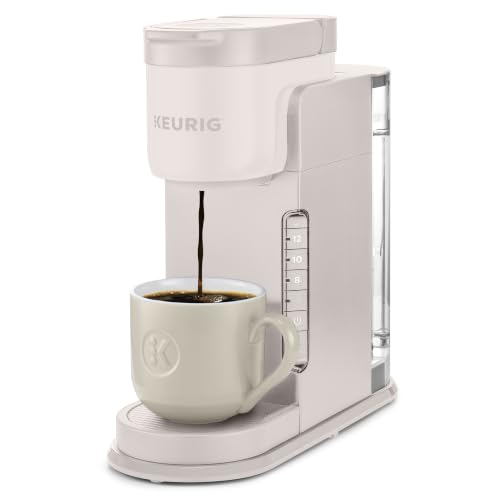
Keurig K-Express, Warm Stone
Badge: Best Neutral Finish
Strengths
- Same three brew sizes and 42oz reservoir as the black K-Express
- Warm Stone finish suits beige, wood and stone counters better than gloss black
- Strong Brew button included, so the colour choice costs no features
Trade-offs
- Internally identical to the other K-Express colours, so there is no performance upgrade here
- Light finishes can show coffee splashes more than black does
- Colour variants can be harder to find in stock than the standard black model
Key specs (from the verified listing)
- Brew sizes: 3 brew sizes
- Reservoir: 42oz removable reservoir
- Pod type: Works with all K-Cup pods
- Extras: Strong Brew button, travel mug friendly
- Finish: Warm Stone
Warm Stone is the K-Express for kitchens where a black appliance block looks out of place. Under the finish it is the same machine as the black version: three brew sizes, a 42oz removable reservoir, travel-mug clearance and the Strong Brew button. That honesty matters, because colour variants are sometimes sold as if they were different models. They are not, and this guide treats them as trim choices on one proven design.
Choose this version when the machine will live permanently on a light or warm-toned counter, or when it is a gift for someone whose kitchen style you know. Performance expectations should be set by the K-Express platform itself: fast, consistent pod coffee with minimal decisions, and the same ceiling on customisation that every K-Express shares.
Warm Stone is the finish that helps a shared machine belong in a designed space, a kitchenette or client-facing corner where gloss black looks like equipment left behind.
Best for: Buyers who like the K-Express formula but want a softer, warmer counter presence / Not suited for: Anyone expecting a feature upgrade over the black K-Express
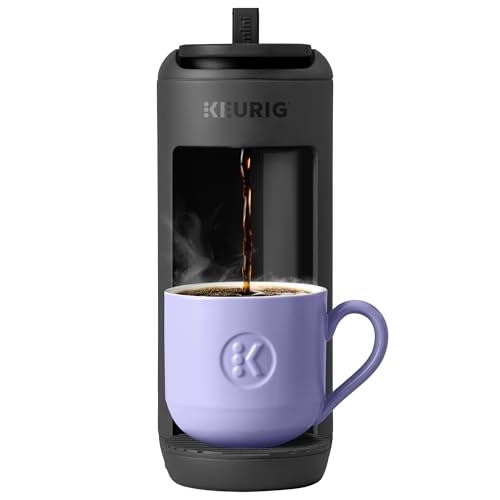
Keurig K-Mini Mate, Black
Badge: Best for Small Spaces
Strengths
- Brews up to a 12 oz cup while taking the least counter space in this roundup
- Fill-per-cup design means no stale water sitting in a tank
- Simple one-cup routine suits dorms, offices and second coffee corners
Trade-offs
- No reservoir, so every cup starts with measuring and filling water
- One cup at a time makes it slow for couples or households
- Fewer brew-size choices than the reservoir K-Express models
Key specs (from the verified listing)
- Brew size: Brews up to 12 oz cup
- Format: Single serve, fill per cup
- Pod type: K-Cup pods
- Positioning: Compact, portable, for small spaces, dorms and offices
The K-Mini Mate is the space-first answer in this lineup. Instead of a reservoir it brews one cup at a time, up to 12 oz, from water you add for that cup. That design keeps it compact enough for a dorm desk, a small office or a camper counter, and it avoids the hygiene question of water sitting in a tank for days.
The trade is built into the concept: there is no queue of ready water, so back-to-back cups for two people involve a refill and a reheat each time. For a solo drinker that rhythm is barely a burden and the tiny footprint is worth it. For a busy household it will feel like a bottleneck within a week, which is why the reservoir models sit above it for family use.
The Mini Mate is the satellite machine of the type: one per desk, room or rental, cheap in space and simple enough that no instructions need taping to it.
Best for: Solo drinkers, dorms, offices and genuinely tight counters / Not suited for: Households brewing several cups back to back every morning

Keurig K-Express, Evergreen
Badge: Best Statement Colour
Strengths
- Full K-Express feature set: three sizes, 42oz reservoir, Strong Brew
- Evergreen finish gives a small appliance a deliberate, styled look
- Removable reservoir is easy to carry to the sink and clean
Trade-offs
- Same internals as every other K-Express, so the premium is purely cosmetic
- A bold colour can date faster than black or stainless in a changing kitchen
- No ground-coffee adapter included in the box positioning
Key specs (from the verified listing)
- Brew sizes: 3 brew sizes
- Reservoir: 42oz removable reservoir
- Pod type: Works with all K-Cup pods
- Extras: Strong Brew button, travel mug friendly
- Finish: Evergreen
Evergreen brings the same K-Express formula in a deep green finish that reads as a design choice rather than an appliance default. The substance underneath is familiar: three brew sizes, a 42oz removable reservoir, travel-mug-friendly clearance and the Strong Brew button. If you already know you like the K-Express, this is simply its most expressive outfit.
Treat the decision as you would a kettle or toaster colour: pick it because your kitchen will enjoy looking at it for years, not because the listing order implies a better brew. Coffee quality will track pod choice and freshness far more than finish. The limitation, shared with its colour siblings, is that there is no extra control hiding under the paint.
Evergreen gives a shared machine a deliberate presence, useful in creative studios and home offices where the coffee corner is part of the room’s personality.
Best for: Style-led kitchens that want the proven K-Express in a distinctive colour / Not suited for: Buyers who equate a special finish with upgraded brewing hardware

Keurig K-Express, Mint
Badge: Best for Light Kitchens
Strengths
- Complete K-Express package in a pale mint finish for bright kitchens
- 42oz reservoir reduces refills compared with mini machines
- Strong Brew button helps lighter roasts taste less washed out
Trade-offs
- Identical mechanics to the black, Warm Stone and Evergreen versions
- Pale finishes show drips and pod splashes sooner between wipes
- No programmable start or auto-on in this tier
Key specs (from the verified listing)
- Brew sizes: 3 brew sizes
- Reservoir: 42oz removable reservoir
- Pod type: Works with all K-Cup pods
- Extras: Strong Brew button, travel mug friendly
- Finish: Mint
Mint is the bright-kitchen member of the K-Express family. White, pale-wood and retro-styled kitchens are exactly where a black machine can look heavy, and this finish solves that while keeping the useful parts of the platform: three brew sizes, a 42oz removable tank, travel-mug clearance and Strong Brew for a bolder cup.
As with the other colours, the buying logic is cosmetic first. There is no mint-only feature, and this guide will not pretend otherwise. What you are choosing is the version of a known machine that you will be happiest seeing every morning, with the same honest limits on adjustability that define the K-Express tier.
Mint lightens the break corner’s mood, and in shared spaces that small lift is a real, if unquantifiable, part of why people use the machine happily.
Best for: Bright or retro kitchens that want a light finish without losing reservoir convenience / Not suited for: Anyone hoping the colour signals a different or newer brew system

Keurig K-Elite, Brushed Silver
Badge: Best Premium Keurig
Strengths
- Brushed silver finish and a more feature-led position than the K-Express tier
- Single-serve K-Cup brewing for households that want the flagship-style option
- A step-up choice for gift buyers who want the present to feel substantial
Trade-offs
- Premium positioning in the Keurig line means a higher tier than the K-Express models
- Still bound by pod format: taste ceiling is set by the pods you buy
- Larger feature set means more to learn than the two-button K-Express routine
Key specs (from the verified listing)
- Format: Single serve K-Cup pod coffee maker
- Finish: Brushed Silver
- Brand line: Keurig K-Elite
The K-Elite is the step-up name in this roundup, finished in brushed silver and positioned above the K-Express family. For buyers who like the K-Cup system but want the machine to feel like the flagship of the counter rather than the budget option, this is the Keurig in the pool that answers that brief.
Its honest limitation is the one every pod machine shares: the pod decides most of what lands in the cup. A premium brewer can heat consistently, brew smoothly and look the part, but it cannot turn an old, stale pod into fresh coffee. Budget for fresh pods from roasters you like, and the Elite tier makes sense; expect the machine alone to transform mediocre pods and it will disappoint.
The K-Elite anchors the home base of a type-based setup, the machine the household’s serious pod drinker uses while minis and expresses serve the satellites.
Best for: K-Cup loyalists who want the premium-tier Keurig and a metal-look finish / Not suited for: Value-first buyers, for whom the K-Express delivers the same pod system for less fuss
Comparison Table
The comparison is organised by deployment: reservoir machines for shared counters, the mini for satellites, the premium model for the home base.
| Pick | Badge | Key attribute | Check |
|---|---|---|---|
| Keurig K-Express, Black | Best Overall | 3 brew sizes | Check on Amazon |
| Keurig K-Express, Warm Stone | Best Neutral Finish | 3 brew sizes | Check on Amazon |
| Keurig K-Mini Mate, Black | Best for Small Spaces | Brews up to 12 oz cup | Check on Amazon |
| Keurig K-Express, Evergreen | Best Statement Colour | 3 brew sizes | Check on Amazon |
| Keurig K-Express, Mint | Best for Light Kitchens | 3 brew sizes | Check on Amazon |
| Keurig K-Elite, Brushed Silver | Best Premium Keurig | Single serve K-Cup pod coffee maker | Check on Amazon |
How to Choose a Keurig-Type Machine for Your Space
Choosing within this type is an exercise in placing machines, not just picking one. Start from the space: who uses it, how many cups it owes per day, how much counter it may rent and who, if anyone, will maintain it. Shared spaces punish complexity and reward reservoirs; private spaces can afford the mini’s simplicity or the premium tier’s ceremony. Home-kitchen readers may prefer 6 Best Keurig Coffee Makers Slim Dual And Cafe Models 2026.
Then consider the pod supply as infrastructure. A type machine without pods is furniture, so the chooser in a shared space is also choosing a restocking habit: whose job, what budget rhythm, which small rotation of crowd-pleasing pods.
Reservoir capacity versus headcount
A 42oz reservoir covers a small team’s morning or a couple’s day. More heads than that means either a refill rota or accepting the queue at the sink. The Mini Mate sidesteps the question entirely by making every user bring their own water, which is why it scales so gracefully across desks and rooms.
Simplicity for untrained users
Guests and colleagues will not read a manual, so the best shared machine is the one whose correct operation is obvious: pod in, lid down, button. Every machine in this guide meets that bar, and the K-Express family meets it with the fewest variations to explain.
Footprint on borrowed counters
Shared and rented spaces lend counters grudgingly. The Mini Mate’s compact form is its qualification; reservoir models earn their larger footprint only where cup volume justifies it. Measure the actual corner, including where the mug will stand, before assigning a machine to it.
Pod rotation for mixed tastes
Keep the shared rotation short and broad: a medium roast, a dark roast, a decaf and one non-coffee option covers nearly every visitor. Deep variety in shared spaces mostly produces stale pods, because no single flavour moves fast enough.
One premium base, simple satellites
Households that love this type often end with a pattern: a K-Elite or K-Express as the kitchen base and Mini Mates where life also happens. Choosing with that end-state in mind prevents buying a premium machine for a corner that needed a mini.
How to Run a Shared-Space Pod Machine Without Drama
Shared machines fail socially before they fail mechanically: pods run out, the reservoir empties mid-queue, and nobody owns the descale. The fix is a tiny operating agreement, ideally written on a card by the machine: who restocks, where the pods live, and the one-line brewing instruction for newcomers. If your space also needs a pot sometimes, see 6 Best Kcup Coffee Makers Compact To Multibrew 2026.
Hygiene is the other shared duty, and it is light: spent pods out the same day, drips wiped by whoever made them, reservoir rinsed weekly by rota. A pod machine asks so little that a shared rota feels easy, which is precisely why the type conquered the world’s kitchenettes.
- Place pods, cups and the instruction card within one step of the machine.
- Keep the reservoir filled at the start of the day; the first user tops it up as a house rule.
- Brew by the card: pod in flat, lid closed, size matched to the cup, Strong Brew for big mugs.
- Eject your own spent pod immediately; the next user should never inherit it.
- Wipe drips and empty the drip tray when it reaches the line, whoever notices first.
- Weekly, rinse the reservoir and run a water-only cycle; descale on the rota’s schedule.
Problem: The reservoir is always empty when you arrive → there is no refill norm. Make first-user-fills a written house rule and keep a filled jug nearby.
Problem: Pods run out without warning → nobody owns restocking. Assign it, and keep a one-box buffer that triggers the reorder.
Problem: Flavours cross between cups → strongly flavoured pods are seasoning the holder. Run a water-only cycle between a flavoured pod and a plain coffee.
Why the Pod Type Won the Office Kitchenette
The office coffee problem was never really about coffee quality; it was about the pot. A shared pot is brewed by the first arrival to the first arrival’s taste, sits stewing for the last arrival, and generates a low-level politics of who cleans the carafe. The pod type dissolved every part of that: each cup is fresh, personal and somebody else’s only in the sense that the machine is shared. The reservoir K-Express models in this guide are that settlement in appliance form. Another angle on the category is 6 Best Italian Coffee Makers Moka Pots And Stovetop 2026.
The settlement has terms, and they are worth stating: pod waste is real, per-cup cost is higher than batch brewing, and a heavy-drinking office should do its sums honestly. But for the small teams, studios and home offices this guide mostly serves, the arithmetic of goodwill usually wins, and the machines above are how it is implemented.
Rentals, Guest Rooms and the Hospitality Mini
A pod machine in a rental or guest room is hospitality with almost no operating cost to the host: no instructions worth the name, no stale pot to apologise for, and a pod selection that can quietly signal care, a local roast alongside the standards, a hot chocolate for non-coffee guests. The Mini Mate’s fill-per-cup design is especially suited here, because no water stands in a tank between guests and the footprint fits a tray. You can also compare with 6 Best Iced Coffee Makers Brewers And Cold Brew Pitchers 2026.
Hosts should steal one hotel habit: the reset. Between guests, pods restocked, machine wiped, reservoir, if any, emptied and dried. It takes three minutes and it is the difference between a coffee corner that feels provided and one that feels left over. The type makes the reset easy; the host still has to do it.
The Economics of a Shared Pod Shelf
Honest shared-space planning counts the pod shelf as a running cost, not a one-off. A small team drinking pods daily will spend more per cup than a pot household, and the budget holder should hear that plainly before the machine arrives, alongside the counter-argument: no wasted half-pots, no cleaning labour and no coffee politics have value too, even if they resist the spreadsheet.
The middle path many small offices take is a hybrid the type supports well: pods for the daily personal cups, and a kettle or small pot solution for meetings. This guide’s machines cover the pod half of that settlement completely, which is the half with the moving parts.
Accessibility and the One-Button Virtue
An underappreciated virtue of this type is how little it demands of the user’s hands and attention: a pod that drops in, a lid that closes, a button that needs one press. For older users, guests with limited mobility and anyone brewing before they are fully awake, that simplicity is not a compromise; it is the feature.
When placing a machine for accessibility, keep pods and cups at the same height as the machine, leave clear counter in front for a steady two-handed set-down, and choose the reservoir models so water carrying is occasional rather than per-cup. The Mini Mate’s per-cup filling is its one accessibility cost, worth weighing for the specific user.
The Mathematics of Pod Cost, Without a Single Price Tag
Pod economics are usually argued with prices, which date instantly, so argue them with counts instead, because counts stay true. Count the cups your household brews in a week, multiply by the weeks in a year, and you have the number of pods your machine will consume annually. That number, whatever machine you choose, is the real running cost of the format, and it dwarfs the difference between machine tiers within a couple of years for daily drinkers. It is also the strongest argument for the reservoir models in this guide: a household brewing at volume should minimise friction per cup, because it performs the ritual thousands of times.
The count cuts the other way for occasional drinkers. A household brewing five pods a week will take years to spend a premium machine’s tier difference in pods, which means the machine choice itself dominates the economics and should be made on delight rather than on imagined savings. Either way, the discipline is the same: know your weekly count before you shop, because it tells you whether you are buying a workhorse or an ornament, and both are legitimate purchases when they are made knowingly.
Descaling, Decoded: What Scale Does and How to Stay Ahead of It
Scale is dissolved mineral that heat persuades out of water and onto the machine’s hottest surfaces. In a pod machine its effects arrive in a predictable order: the brew slows almost imperceptibly, the temperature sags so extraction thins, flavours dull, and only much later does anything actually fail. That order is why experienced owners descale on a calendar rather than on symptoms. By the time the cup tastes wrong, the machine has been underperforming for weeks, and the pods blamed for it were innocent.
The routine itself is undramatic: a descaling solution run through on the maker’s schedule, followed by generous fresh-water cycles so no trace survives into the next real cup. Hard-water households shorten the interval; filtered-water households can trust the standard one. Pair the descale with the weekly reservoir rinse and the two habits together cover nearly the whole of pod-machine maintenance, which is the quiet reason this format suits busy and shared households so well.
Cup Sizes, Mug Geometry and the Honest Limits of One Pod
Every pod contains a fixed dose of coffee, and every brew size is a decision about how much water to push through that dose. Small sizes concentrate the cup; large sizes stretch it. There is no setting that repeals this arithmetic, which is why the largest sizes on any machine in this guide should be reserved for pods and palates that suit a longer, milder drink, or paired with the Strong Brew function where the model offers it. Travel mugs complicate the geometry further, because a mug that fits under the spout may still be a volume the pod cannot fill with strength.
The practical method is to calibrate once, deliberately: brew your favourite pod at each size your machine offers, taste them in sequence, and note where your preference sits. Most drinkers discover a personal ceiling, a size beyond which the cup stops tasting like itself. Brew at or below that ceiling for your main cup, and let larger sizes serve milder moments, and the machine will seem noticeably better without a single part having changed.
Hosting With a Pod Machine: The Self-Service Coffee Station
A pod machine changes the host’s job from barista to stage manager, and the staging is simple: a visible pod selection arranged by type, cups and mugs within reach, water checked before guests arrive, and a small bin placed where spent pods obviously belong. Guests serve themselves without instruction because the machine’s ritual is legible, and the host stays in the conversation instead of in the kitchen. For gatherings that run across an afternoon, the reservoir models in this guide carry the load; the host’s only recurring duty is a glance at the water level.
Two details separate a good station from a great one. The first is a non-coffee option, because every gathering includes someone who wants tea or hot chocolate and would otherwise perform enthusiasm for coffee. The second is a water-only cycle run by the host between a strongly flavoured pod and the next guest’s plain coffee, a ten-second courtesy that prevents the cinnamon cup from ghosting the colombian one. Small systems, faithfully run, are what make the format feel generous.
Reusable Pods and Grounds Adapters: An Honest Assessment
Many pod households eventually ask whether they can brew their own grounds in the machine, and the honest answer is: sometimes, with compromises that should be understood before money is spent. Refillable pod capsules exist for the K-Cup format and can work well with a medium grind and a patient fill, but they reintroduce exactly the measuring, filling and washing that pods exist to eliminate, and their results vary more from cup to cup than sealed pods do. They are best understood as an occasional tool, for a special coffee that never comes in pods, rather than as a daily system.
Machines that brew grounds natively, through a proper basket, solve the same desire more completely, and readers whose hearts are truly in grounds should compare the combo machines elsewhere in this programme’s guides. Within this guide’s six machines, the pod is the native language, and the assessment to carry away is simple: buy the format you will use daily, and treat workarounds as garnish rather than as the meal.
Designing the Morning: Where the Machine Lives and Why It Matters
The best machine in this guide will underperform in a bad location, because coffee routines are choreography. The machine wants to stand where water is near, where the pod box opens without moving anything else, and where the mug’s journey from cupboard to drip tray crosses nobody’s path. In most kitchens that spot is a short run of counter near the sink, with pods in the drawer directly below and cups in the cupboard directly above, a vertical workstation that takes thirty seconds to establish and pays out every morning for years.
Light and heat deserve their small print. Pods stored in a sunlit spot or beside the oven age faster than pods in a cool drawer, and a machine tucked under a low cabinet needs its lid clearance checked before its first brew, not during it. None of these observations requires spending anything; they are the free performance that placement gives, and they apply identically to every machine in this roundup.
Water Quality: The Ingredient Nobody Lists as a Feature
Coffee is mostly water, and pod machines make that fact impossible to dodge, because there is no large brew bed to forgive tired water. Water that has sat in a reservoir for days tastes flat and faintly of the tank; water heavy with chlorine announces itself in the cup; and very hard water writes its signature twice, once in flavour and once as scale in the machine’s heating path. The simplest upgrade available to every machine in this guide is a reservoir habit: empty, rinse and refill on a weekly rhythm rather than topping up forever, so the oldest water in the system is never more than a few days old.
Filtration is the second lever, and it should be pulled with proportion. A simple jug filter used for reservoir fills softens both chlorine notes and scale formation in most municipal supplies, which lengthens the comfortable interval between descalings. What filtration cannot do is rescue a stale pod, which is why this guide keeps returning to the same hierarchy: fresh pods first, fresh water second, machine tier third. Owners who reverse that order spend the most and taste the least improvement.
When a Pod Machine Travels: Rentals, Road Trips and Borrowed Kitchens
Compact pod machines are among the few appliances that travel well, and the Mini Mate’s class exists partly for this reason. A fill-per-cup machine in a rental kitchen guarantees the traveller’s own coffee standard without trusting an unknown pot, and it packs into a small footprint with a handful of pods. The etiquette is simple: leave the borrowed counter cleaner than you found it, and never leave a spent pod in someone else’s machine.
At home, the same portability serves the guest room and the garden office. The deeper point is that the type’s simplicity is what travels; a machine with a manual, a scale and a gooseneck kettle is a hobby, and hobbies stay home. Travellers choosing from this guide should weigh the mini’s rhythm honestly against the trip’s length: two mornings forgive anything, two weeks reward the reservoir.
Reading a Pod Machine Listing Like a Skeptic
Pod machine listings are written to be skimmed, and a skeptical read takes ninety seconds longer and saves a return. Find the reservoir size in ounces rather than in cups, because cup units vary by brand imagination. Find the brew sizes as a list, and check your own mug against the largest and smallest of them. Find whether the pod format is named plainly, because a machine that cannot say which pods it takes is telling you something. Each of those facts appears in the verified data behind this guide’s picks, which is what verified data is for.
Then read for what is absent. No strength function is mentioned on a model, and none should be assumed. No reservoir is mentioned, and the machine is a fill-per-cup design whatever the photographs imply. Skepticism of this kind is not cynicism; it is the habit of letting the listing’s own words, rather than its photography, describe the machine, and it is the habit this guide’s comparisons are built on.
The Second Machine Effect: How Pod Households Grow
Pod households rarely stay at one machine, and the pattern is so regular it deserves a name. The first machine is bought for the kitchen. The second appears where life leaks out of the kitchen’s reach: a desk, a workshop, a guest room, a caravan, an elderly parent’s counter where the one-button ritual is a genuine accessibility gift. The second machine is almost always smaller than the first, because its job is presence rather than capacity, which is why compact models like the Mini Mate in this pool exist and endure.
Planning for the pattern changes the first purchase for the better. A household that expects a satellite machine someday can buy the kitchen machine purely for the kitchen, reservoir and all, without asking it to be portable or petite. And when the satellite arrives, the pod supply simply widens its route, one box serving two machines, which is the format’s quiet economies of scale working in the household’s favour.
Seasonal Drinking: Iced Pods, Hot Chocolates and the Rotating Shelf
A pod shelf that never changes is a missed opportunity, because the format’s variety is seasonal by nature. Summer wants pods brewed over ice and the discipline of a smaller, stronger cup poured over a full glass of cubes. Winter wants the hot chocolates, teas and spiced coffees that the same holder brews without a second appliance. Rotating a portion of the shelf with the calendar keeps the machine feeling new twice a year at the cost of a single box.
The rotation should be partial, not total. The household’s core favourites are the machine’s foundation and should never rotate out; it is the experimental third of the shelf that turns over. That proportion keeps mornings reliable while giving the format’s variety somewhere to live, and it prevents the January cupboard full of autumn experiments that nobody chose twice.
Common Buying Mistakes
- Putting a mini where a crowd brews. One filled cup at a time is a queue with a power cord. Match reservoir to headcount.
- Stocking twenty pod varieties in a shared space. Most will stale before they move. A short, broad rotation wins.
- Leaving maintenance to nobody. Shared machines need a named owner for descaling and restocking, or they decline politely into disuse.
- Forgetting the mug audit. Shared spaces collect odd mugs. Confirm the machine’s clearance fits the cups that actually live there.
- Choosing finishes before placement. A satellite corner needs the Mini Mate’s shape, whatever its colour. Placement first, palette second.
Final Recommendation
For a shared counter or a typical household, deploy the black K-Express and let its reservoir carry the day, choosing Warm Stone, Evergreen or Mint when the room’s design deserves a say. Scatter the K-Mini Mate across desks, rentals and guest corners where one cup at a time is the whole job, and keep the K-Elite as the premium home-base machine for the household’s committed pod drinker. Our linked shortlist to start from: Keurig K-Express, Black, Keurig K-Express, Warm Stone, Keurig K-Mini Mate, Black. Before deciding, read 6 Best Highend Coffee Makers Drip Espresso Auto 2026.
Run whichever you choose with the small shared disciplines, pods stocked, reservoir owned, spent pods ejected, and the type will do what it conquered shared spaces by doing: give everyone their own fresh cup while asking almost nothing in return.
Frequently Asked Questions
What is a kurig type coffee maker?
Kurig is a misspelling of Keurig, and the type is the single-serve K-Cup pod format: one pod, one cup, minimal steps. All six picks here are genuine Keurig machines of that type.
Which pick suits an office kitchenette?
A reservoir K-Express. The 42oz tank covers a morning of different drinkers, the three sizes fit most mugs, and the operation is obvious enough to need no training.
Which pick suits a rental or guest room?
The K-Mini Mate. It brews one filled cup at a time up to 12 oz, leaves no standing water between guests and fits on a tray or small counter.
How many finishes does the K-Express come in here?
Four in this pool: black, Warm Stone, Evergreen and Mint, all on the same machine with the same brew sizes, reservoir and Strong Brew button.
What pods should a shared space stock?
A short, broad rotation: a medium roast, a dark roast, a decaf and one non-coffee option. It covers nearly every taste and moves fast enough to stay fresh.
Is the K-Elite worth it as a home base machine?
For a committed pod household, yes: it is the premium tier of the same type in brushed silver, suited to being the main kitchen machine while simpler models serve satellite spots.


