Disclosure: topratedkitchenware.com is reader-supported. When you buy through links on our site, we may earn an affiliate commission from Amazon and other retailers, at no extra cost to you.
Where to buy
Every pick in this guide to the best nontoxic coffee makers is a stainless steel French press verified through our research pool, which means the hot water in each one touches steel and a steel filter screen rather than a plastic brew basket, a plastic reservoir, or a plastic pod. Prices and stock change, so check the latest price on Amazon for the model you like before you order.
- Secura French Press 34 oz — 34 oz insulated 304 stainless press with two spare screens included
- Utopia Kitchen French Press 34 oz — 34 oz 304 stainless press with a 4-level filtration system and spare filters
- MuellerLiving French Press 34 oz — 34 oz stainless press with 4-filter screen stack and double insulation
- AgcKuzt French Press 34 oz — 34 oz full stainless press, double-walled, pitched for kitchen and camping
- Ziruma Stainless Steel French Press 34 oz — 34 oz surgical-grade steel press marketed on a no-plastic, no-heavy-metals build
- Secura French Press 50 oz — 50 oz version of the Secura steel press for bigger households
Read the full guide ↓
Introduction: the Best Nontoxic Coffee Makers for a Cleaner Brew
If you are shopping for the best nontoxic coffee makers, the honest starting point is that “nontoxic” is not a regulated label on coffee equipment. No agency certifies a coffee maker as nontoxic, so the word only means something when you translate it into materials: what does the hot water actually touch between the kettle and your cup? In a typical automatic drip machine, that path can include a plastic reservoir, plastic tubing, a plastic brew basket, and sometimes a plastic-lined carafe. In a pod machine it includes the pod itself. In the six presses in this guide, the path is a stainless steel chamber and a stainless steel mesh screen. That is the whole argument, and it is a strong one: fewer material questions, because there are simply fewer materials in the water path.
A French press is also the rare coffee maker with no heating element, no pump, and no electronics. You heat water separately, in whatever kettle you already trust, pour it over coarse grounds, wait, press, and pour. Because the brewer itself never heats anything, there is no plastic part being repeatedly heat-cycled inside the machine, which is where most of the material-degradation worry in coffee gear actually lives. All six picks here are double-wall insulated stainless steel presses in the 34 oz class, plus one larger 50 oz model, and every one of them is built around 304-grade or surgical-grade stainless steel with multi-layer steel filtration.
This guide does not pretend a steel press makes coffee magically pure. Coffee itself, your water, and your kettle all matter, and we say so plainly in the sections below. What a steel press does is remove the brewer from the list of things you have to wonder about. If you are comparing designs more broadly, our French Press Buying Guide Size Material And Plunger Design walks through the construction choices in depth, and the roundup of Best French Presses Coffee Makers covers glass and steel options side by side.
Below you will find six verified picks, what separates them, a realistic brewing routine, and the mistakes that lead people to buy the wrong “clean” brewer. Read the detailed reviews for the differences that matter — filter layer counts, spare screens in the box, insulation, and size — because on materials alone these six are deliberately similar. That similarity is the point of the category.
Key Takeaways
- “Nontoxic” is a materials claim, not a certification: judge a brewer by what the hot water touches, not by the label on the box.
- All six picks are stainless steel French presses, so the brew path is steel chamber plus steel screen — no plastic reservoir, basket, or pod.
- Five picks are 34 oz (about four mugs); the Secura 50 oz is the pick for households that brew for a crowd.
- Multi-layer steel screens (three and four-layer systems appear in this pool) reduce sediment, the main cup-quality trade-off of press brewing.
- Double-wall insulation keeps a second cup hot without a warming plate, and it keeps the outside of the press cooler to handle.
- Your kettle and your water still matter: a steel press removes the brewer from the equation, not every variable in it.
In this guide
Quick Picks
Six steel presses, six slightly different answers to the same question. The badges below reflect what each model does best within a deliberately narrow, all-steel field.
| Pick | Badge | Best for | Key detail | Link |
|---|---|---|---|---|
| Secura French Press 34 oz | Best Overall | Most households switching to steel | 304 stainless, double-wall, 2 extra screens | Check on Amazon |
| Utopia Kitchen French Press 34 oz | Best Filtration | Drinkers who hate sediment | 4-level filtration, 2 extra filters, dishwasher safe | Check on Amazon |
| MuellerLiving French Press 34 oz | Best Value Design | A complete steel setup on a sensible budget | 4 filter screens, double insulated, dishwasher safe | Check on Amazon |
| AgcKuzt French Press 34 oz | Best for Camping and Travel | One press for home and campsite | Full stainless build, 2 extra filters, dishwasher safe | Check on Amazon |
| Ziruma Stainless Steel French Press 34 oz | Best for Material Purists | Buyers who read material specs first | Surgical-grade steel, 4-layer filter, measure marks | Check on Amazon |
| Secura French Press 50 oz | Best for Families and Groups | Households brewing for four or more drinkers | 50 oz (1.5 litre), 304 stainless, 2 extra screens | Check on Amazon |
How These Picks Were Chosen
We built this list by starting from the water path and working outward. Candidate brewers had to keep hot water and brewed coffee in contact with stainless steel (or, in designs we excluded, glass) rather than plastic, and they had to be verifiable products with confirmed listings, specifications, and images through the Amazon Creators API research pool we use for every guide on this site. Pod machines, plastic-reservoir drip machines, and aluminum stovetop brewers were set aside for this particular keyword, not because they are unusable, but because a reader searching for nontoxic coffee makers is asking a materials question first and a convenience question second.
Within the steel-press field, we compared the things that actually differ: steel grade as stated by the maker (304 food-grade in most of this pool, surgical-grade in one), filter construction (single screen versus three- and four-layer systems), whether spare screens or filters are included, insulation (all six here are double-wall), capacity, and dishwasher ratings. We also weighed brand track record in this exact product type — two of the six picks come from Secura, a brand that sells little besides steel presses, which counts for something when replacement screens and long-term parts support matter.
A note on honesty: this is research-led guidance, not a laboratory report. We did not run leaching tests, and no reviewer can. What we can do — and did — is verify what each brewer is made of, where the water flows, and how the filter is built, then be straight with you about the limits of the word “nontoxic” itself. Where a maker uses the word in its own product name, we report that as the maker’s framing, and we evaluate the underlying material claim on its merits.
The 6 Best Nontoxic Coffee Makers
All six picks brew the same way and are built from the same family of materials, so the reviews below concentrate on the genuine differences: filtration depth, included spares, capacity, and the small design choices that decide whether a press is pleasant to live with every morning.
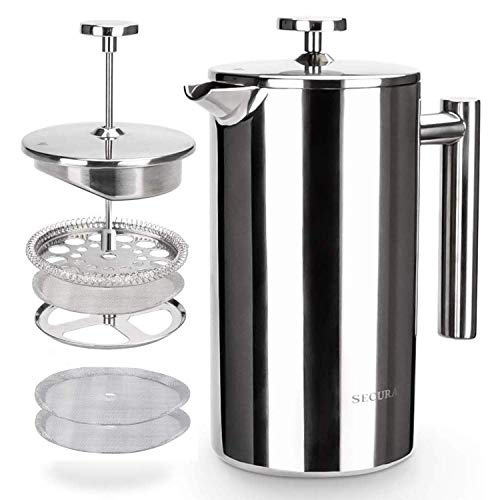
Secura French Press 34 oz
Badge: Best Overall
Strengths
- Full 304-grade stainless steel brew chamber and plunger, so the water path is steel end to end
- Two extra filter screens in the box, which extends the life of the press before you need spares
- Double-wall insulation keeps the second mug hot noticeably longer than a single-wall or glass press
Trade-offs
- 34 oz is a four-mug ceiling; big households will brew twice or want the 50 oz version
- Steel body means you cannot watch the brew level or the bloom the way you can with glass
- Like every press, it leaves some fine sediment in the last sip
At a glance
- Capacity: 34 oz (1 litre)
- Material: 304-grade stainless steel
- Insulation: Double-wall insulated
- Filtration: Steel screen, 2 extra screens included
- Finish: Silver
The Secura 34 oz is the press we would hand to someone who said “just tell me which steel press to buy.” It covers the nontoxic brief completely: a 304-grade stainless chamber, a stainless plunger and screen, and no plastic anywhere in the brew path. The double-wall body does two jobs at once — it holds heat through a slow breakfast, and it keeps the outer wall comfortable to grip when you carry the press to the table.
In daily use the details are right. The included spare screens matter more than they sound, because the screen is the one wear part on any press; when the edges of a screen eventually fray or bend, filtration gets sloppy and sediment climbs. Having two replacements in the box turns a future annoyance into a two-minute swap. Filtration on a fresh screen is clean for a press — you will still get the characteristic full-bodied cup and a little silt at the bottom, which is the honest trade of the method, not a defect of this model.
The limitation to know is capacity. Thirty-four ounces is roughly four standard mugs, and press coffee is best poured off promptly rather than left sitting on the grounds, so this is a brew-and-serve size. For one or two drinkers it is exactly right. For a house that fills a table, the same design exists in the 50 oz version reviewed below, and choosing between them is purely a headcount decision.
Best for: One-to-three coffee drinkers who want the straightforward, well-supported steel press / Not suited for: Large households, or anyone who wants to watch the coffee brew through glass
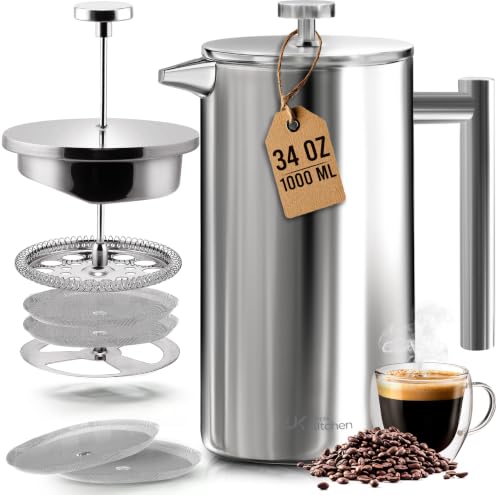
Utopia Kitchen French Press 34 oz
Badge: Best Filtration
Strengths
- 4-level filtration system is the most layered filtering in this pool, aimed squarely at reducing grit
- 304-grade stainless, double-wall insulated body keeps the water path all steel
- Rated dishwasher safe and rust-free, with two extra filters included
Trade-offs
- More filter layers means a slightly firmer press and more parts to rinse apart
- Same 34 oz ceiling as the other standard-size picks
- Layered screens need occasional separation and scrubbing to stay free-flowing
At a glance
- Capacity: 34 oz
- Material: 304-grade stainless steel
- Insulation: Double-wall insulated
- Filtration: 4-level system, 2 extra filters included
- Care: Dishwasher safe, rust-free
If your one complaint about French press coffee is the sludge in the last inch of the mug, the Utopia Kitchen press is built for you. Its headline feature is a 4-level filtration system: stacked steel screens that catch progressively finer particles as you press. In practice that means a cleaner cup than a single-screen press delivers, while keeping the heavy body and low acidity that make people choose press coffee in the first place.
The rest of the design matches the brief of this guide. The chamber is 304-grade stainless steel, double-walled for insulation, and the maker rates the whole press dishwasher safe and rust-free — worth having, because a press that is annoying to clean is a press that quietly goes back in the cupboard. Two extra filters in the box give you the same wear-part insurance as the Secura.
The trade-off is mechanical: four layers resist more than one, so the plunge takes a bit more pressure, and the screen stack deserves a proper rinse and occasional separation so old grounds do not lodge between layers. Neither is a burden, but if you want the absolute simplest press to maintain, a single-screen design asks less of you. For a fuller comparison of plunger and screen designs, see our french press buying guide.
Best for: Press drinkers who want the cleanest possible cup from a steel brewer / Not suited for: Anyone who wants the fewest possible parts to wash
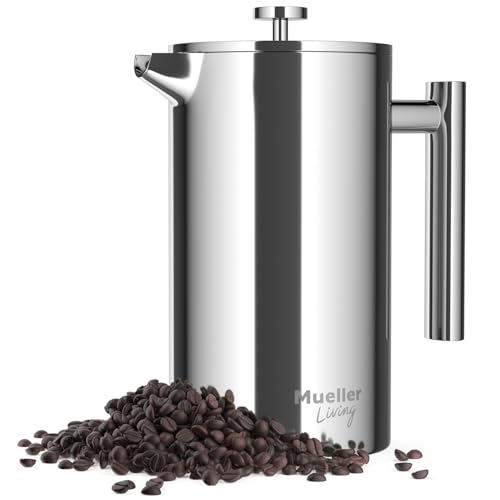
MuellerLiving French Press 34 oz
Badge: Best Value Design
Strengths
- Four-filter screen stack at a price tier that usually buys a single screen
- Double-insulated stainless body holds heat and stays comfortable to handle
- Dishwasher safe and rust-free construction keeps upkeep simple
Trade-offs
- Brand support and spare-part availability are thinner than the category leaders
- 34 oz capacity, like the rest of the standard-size field
- Steel body hides brew level, so you measure water before pouring
At a glance
- Capacity: 34 oz
- Material: Stainless steel, food grade
- Insulation: Double insulated
- Filtration: 4 filter screens
- Care: Dishwasher safe, rust-free
MuellerLiving’s press is the value play in this pool: it matches the filtration count of the premium-feeling picks — a four-filter screen stack — and pairs it with a double-insulated, food-grade stainless body, at the qualitative lower-cost end of this group. For a reader whose priority is simply “steel instead of plastic, without overpaying,” it checks every box on the materials list.
The four screens do the same work as on the Utopia: a cleaner cup with less grit than a basic press, at the cost of a slightly heavier plunge and a screen stack you should rinse apart now and then. The double insulation keeps a second cup hot through a normal morning, and the whole unit is rated dishwasher safe, which makes it a realistic daily driver rather than a weekend ritual object.
Where you feel the savings is around the edges: the brand’s long-term spare-screen ecosystem is less established than Secura’s, and the fit and finish, while perfectly functional, are a step plainer. Nothing about that affects the coffee or the materials question that brings people to this guide. It is a sensible, honest press for the money tier it sits in.
Best for: Budget-conscious buyers who still want layered filtration and full steel construction / Not suited for: Buyers who prioritize a big brand’s parts support above all

AgcKuzt French Press 34 oz
Badge: Best for Camping and Travel
Strengths
- Full stainless steel construction with nothing breakable — ideal where glass would be a liability
- Double-walled insulation keeps coffee hot outdoors where ambient air steals heat fast
- Two extra filters included, and the press is rated dishwasher safe for home use
Trade-offs
- A lesser-known brand, so long-term support is less proven than the category leaders
- 34 oz is four cups; a big camp group will re-brew
- No measurement markings highlighted, so bring your own ratio habits
At a glance
- Capacity: 34 oz (4 cups)
- Material: Full stainless steel, food grade
- Insulation: Double-walled insulated
- Filtration: Steel filter, 2 extra filters included
- Care: Dishwasher safe
Every material argument for a steel press doubles outdoors. Glass presses break in transit; plastic brewers raise the same questions at the campsite as at home, plus a few about durability. The AgcKuzt press is a full stainless steel, double-walled 34 oz press that its maker explicitly pitches for kitchen and camping, and that positioning makes sense: it can be knocked off a picnic table, rinsed in a stream-side basin, and used again the next morning.
At home it behaves like the rest of this field — steel water path, insulated body, a filter setup with two spares in the box, and a dishwasher-safe rating for easy cleanup. The double wall earns its keep outside, where a single-wall press loses heat quickly to cold air; your second cup at a campsite stays genuinely hot rather than merely warm.
The honest caveat is brand depth. AgcKuzt is not a household name in coffee gear, and if you expect to buy replacement screens in five years, the bigger brands in this guide are the safer bet. As a second press for travel, a cabin, or an RV — or a first press for someone hard on equipment — it is a rational pick. Our 6 Best French Press Coffee Makers For Home And Travel 2026 roundup looks at more travel-oriented options.
Best for: Campers, RV users, and anyone who breaks glass presses / Not suited for: Buyers who want a long-established brand behind their daily press
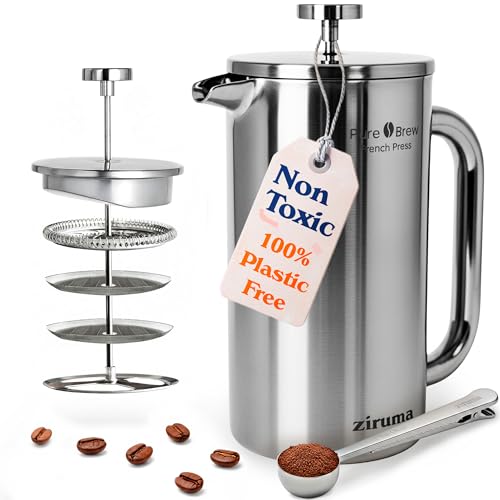
Ziruma Stainless Steel French Press 34 oz
Badge: Best for Material Purists
Strengths
- Surgical-grade stainless steel is the highest material specification in this pool
- Maker explicitly builds and markets the press around no plastic and no heavy metals in construction
- 4-layer filter plus measurement marks on the body, a combination none of the other picks lists
Trade-offs
- Surgical-grade steel is a refinement, not a transformation — 304 food-grade steel is already an excellent brew material
- 34 oz capacity, standard for the class
- Newer brand with a shorter track record than Secura or Utopia Kitchen
At a glance
- Capacity: 34 oz
- Material: Surgical-grade stainless steel
- Insulation: Double-wall insulated
- Filtration: 4-layer filter
- Extras: Measurement marks, dishwasher safe, portable
The Ziruma is the pick for the reader who opened this guide with the strictest version of the question. It is the one product in the pool that leads with the nontoxic claim in its very name, and the substance underneath is real: surgical-grade stainless steel construction, a four-layer steel filter, double-wall insulation, and an explicit no-plastic, no-heavy-metals build brief. If you want the brewer whose spec sheet works hardest to answer material concerns, this is it.
The measurement marks deserve a mention because they fix a quiet annoyance of steel presses: you cannot see the water level through the wall, so marked measures on the body help you repeat your ratio without a scale. The four-layer filter puts cup cleanliness on par with the Utopia and Mueller picks, and the press is rated dishwasher safe.
Perspective matters, though. Surgical-grade steel is a step up in corrosion resistance and finish, but 304 food-grade stainless — used by most of this pool — is already a thoroughly food-safe, non-reactive brew material with decades of use behind it. Buy the Ziruma because its total package appeals to you, not out of fear of the 304 presses. Either way, your water path is steel, which is the decision that counts.
Best for: Material-first buyers who want the highest steel specification available in a press / Not suited for: Anyone expecting a taste difference from the steel grade alone
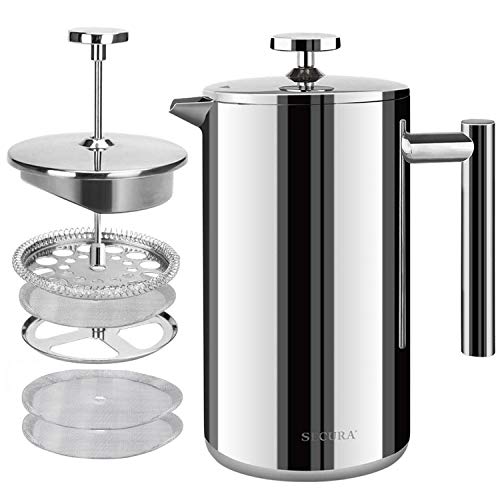
Secura French Press 50 oz
Badge: Best for Families and Groups
Strengths
- 50 oz capacity brews for a table in one press — about six mugs
- Same 304 stainless, double-wall insulated construction as the 34 oz Secura
- Two extra screens included, matching the smaller model’s wear-part insurance
Trade-offs
- A full 50 oz of press coffee should be decanted; left on the grounds it over-extracts
- Bigger and heavier, especially full — not the pick for a small kitchen or travel
- Overkill for one or two drinkers, who will waste coffee or reheat it
At a glance
- Capacity: 50 oz (1.5 litre)
- Material: 304-grade stainless steel
- Insulation: Double-wall insulated
- Filtration: Steel screen, 2 extra screens included
- Finish: Silver
The 50 oz Secura exists for the household the 34 oz models frustrate: four or more coffee drinkers, one breakfast, no second brewing shift. It is the same press as our Best Overall pick scaled up — 304-grade stainless steel, double-wall insulation, steel screen with two spares in the box — so the materials answer is identical, and the only question is whether your mornings need the volume.
Used well, the big press changes the routine slightly. Brew the full batch, press, and pour everything into mugs or a pre-warmed serving vessel right away. Press coffee left sitting on its grounds keeps extracting and turns bitter and heavy; that is true at 34 oz and more noticeable at 50, simply because a large batch tends to linger. Decanted, a big steel press is a genuinely good way to serve brunch coffee without a machine.
For one or two drinkers, this size works against you: you will either brew half batches in a vessel designed for more, or make coffee you do not finish. The smaller Secura is the same quality in the right size. But for families, shared houses, and small offices that want a plastic-free water path at volume, this is the only pick in the pool that does it in a single brew.
Best for: Families, shared houses, and small offices brewing for a group / Not suited for: Solo drinkers and couples, who are better served by the 34 oz models
Comparison Table
The six side by side. Note how narrow the field is on materials — deliberately so — and how the real differences are capacity, filtration depth, and included spares.
| Pick | Format | Capacity | Standout trait | Link |
|---|---|---|---|---|
| Secura French Press 34 oz | French press | 34 oz | Spare screens included | Check on Amazon |
| Utopia Kitchen French Press 34 oz | French press | 34 oz | 4-level filtration | Check on Amazon |
| MuellerLiving French Press 34 oz | French press | 34 oz | 4-filter stack, value tier | Check on Amazon |
| AgcKuzt French Press 34 oz | French press | 34 oz | Full steel, travel-ready | Check on Amazon |
| Ziruma Stainless Steel French Press 34 oz | French press | 34 oz | Surgical-grade steel | Check on Amazon |
| Secura French Press 50 oz | French press | 50 oz | Largest capacity in pool | Check on Amazon |
How to Choose a Nontoxic Coffee Maker
Start with the water path, because that is the entire premise of this category. List what hot water touches in any brewer you are considering: reservoir, tubing, pump parts, brew basket, filter, carafe. In the presses in this guide the list is two items long — a stainless steel chamber and a stainless steel screen. When you evaluate any other “nontoxic” brewer, hold it to the same standard and ask for the material of each part, not just the headline part. A steel carafe on a machine with a plastic reservoir and plastic brew basket is a partial answer.
Steel grade is the second factor, and it deserves calm treatment. 304-grade stainless steel — sometimes labeled 18/8 or 18/10 — is the food-industry standard for cookware and commercial kitchens; it is non-reactive, rust-resistant, and entirely appropriate for boiling-water contact. Surgical-grade steel, offered by the Ziruma in this pool, adds corrosion resistance and is a legitimate premium, but it does not change the safety picture in a meaningful way for coffee. Do not let grade anxiety push you past your budget; let it break ties instead.
Filtration decides cup quality. A French press has no paper filter, so the screen is all that stands between you and sediment. Single screens leave the most silt; the three- and four-layer stacks in this pool catch noticeably more. If you have tried press coffee and found it muddy, a multi-layer press plus a coarse, even grind will change your mind. If you truly cannot abide any sediment, no press will satisfy you — a pour-over with a steel or paper filter is the honest alternative, and our 9 Best French Presses Glass And Stainless Steel 2026 guide shows the glass side of the family too.
Capacity math is simple but easy to get wrong. Press sizes are quoted in “cups” that mean roughly 4 oz each, not mugfuls. A 34 oz press makes about four real mugs; a 50 oz press makes about six. Buy for your largest regular occasion, not your largest imaginable one, because press coffee should be served fresh rather than held. Insulation softens that rule a little — every pick here is double-walled — but it does not repeal it.
Finally, think about the wear parts and the exit costs. Screens bend and fray over years of use; a press that ships with spare screens, like the Secura, Utopia, and AgcKuzt picks here, defers that purchase and the risk that spares have been discontinued. Check that the plunger rod, knob, and cross plate are steel as well — on cheap presses those small parts are where plastic quietly re-enters the design.
One more consideration belongs in any honest version of this guide: the coffee itself and how you store it. Beans absorb odors and moisture, and a steel or glass storage canister with a tight seal keeps them better than the bag they came in. None of that changes the brewer decision, but readers pursuing a cleaner routine usually ask, and the answer is that the same material logic applies — inert, washable, and free of lingering smells from whatever was stored before.
How to Brew French Press Coffee, Step by Step
French press brewing is a skill with a short learning curve and a high ceiling. Start with the ratio: a reliable baseline is 1 part coffee to 15 parts water by weight — for a full 34 oz press (about 1 litre of water), that is roughly 65 grams of coffee, or about 8 heaped tablespoons of coarse grounds. Grind coarse and even, like raw sugar. Too fine a grind is the number one cause of muddy, bitter press coffee, and no filter stack fully compensates for it.
Heat fresh water to just off the boil — around 200°F if you use a thermometer or a temperature-controlled kettle, or simply let a boiled kettle sit for 30 to 45 seconds. Add the grounds to the empty press, pour the water over them in a steady spiral so everything is wetted, and start a timer. At the one-minute mark, break the crust that has formed on top with a spoon and skim off the foam and floating bits; this small step, borrowed from professional cupping, noticeably cleans up the cup.
Put the lid on with the plunger pulled fully up and wait until the four-minute mark. Then press slowly, with steady, gentle pressure — if you meet heavy resistance, your grind is too fine or your dose too high, and forcing it will spray hot coffee and stir sediment back into suspension. Stop the plunger just above the bed of grounds rather than compressing it hard.
Pour immediately and completely. Coffee left in the press continues to extract on the grounds and turns harsh within minutes, and the last of it carries the most sediment. If you brewed more than you are serving, decant the rest into a pre-warmed mug or thermal vessel. Rinse the press while it is still warm, knock the grounds into the compost or bin (not the sink, where they accumulate), and wash the screen stack apart once a week or so to keep it free-flowing. Our companion piece, How To Make French Press Coffee With A Clean Full Flavor, goes deeper on grind and timing, and How To Clean A French Press And Keep It Fresh Smelling covers deep-cleaning in detail.
Troubleshooting
Problem: Coffee tastes muddy and bitter → coarsen the grind, shorten the steep to four minutes, skim the crust at one minute, and decant the full brew as soon as you press.
Problem: Coffee tastes weak and thin → increase the dose toward a 1:14 ratio, use water just off the boil, and make sure the grounds are fresh — stale coffee brews flat in any method.
Problem: The plunger is very hard to push down → your grind is too fine or the dose too heavy. Never force it; lift the plunger slightly, let pressure equalize, and press again slowly with a coarser grind next time.
What “Nontoxic” Can and Cannot Mean for a Coffee Maker
It is worth being precise, because this keyword attracts vague marketing. There is no regulatory certification that stamps a coffee maker “nontoxic.” What exists are material standards: food-contact regulations that govern what may be used in equipment that touches food, and material grades with known behavior. Stainless steel’s long record in commercial kitchens and medical settings is why it anchors this guide. Glass is the other classic inert brew material, and a glass press with a steel screen is a legitimate alternative — the trade is fragility, which is why this pool leans steel.
Plastic deserves a fair sentence too. Food-contact plastics are regulated, and a modern BPA-free drip machine is not a hazard machine. The case for steel is about minimizing variables: steel does not degrade with heat cycling, does not absorb odors or coffee oils the way plastic reservoirs do over years, and does not ask you to track which polymer a part is molded from. Readers who want the fewest open questions choose steel; that is a preference we can serve honestly without fearmongering about the alternatives.
One more variable hides in plain sight: your kettle and your water. A steel press fed by a plastic kettle with a plastic water gauge has not eliminated plastic from the path — it has moved the contact point. Many steel-press owners pair the press with a stainless kettle for exactly this reason. And if your tap water tastes of chlorine, no brewer material will fix the cup; a simple carbon filter for your brewing water does more for flavor than any equipment upgrade.
It also helps to know what this guide is not claiming. We are not claiming that coffee from a plastic-part machine is proven harmful, and we are not claiming that a steel press improves the nutritional profile of coffee. The claim is narrower and stronger for being narrow: with these six brewers, the set of materials your hot water contacts is small, known, and stable over years of use. For a daily habit — and coffee is the definition of a daily habit — that kind of boring certainty is worth having.
French Press vs. the Other Low-Plastic Brewing Methods
The press is not the only route to a low-plastic brew, and for some drinkers it is not the best one. Pour-over through a steel or ceramic dripper gives a cleaner, brighter cup with no sediment, at the cost of more active technique and usually a paper filter or a fine steel mesh. A stovetop moka pot is all metal in most builds but produces a very different, concentrated coffee and demands supervision. Cold brew in a steel or glass vessel with a steel filter is the lowest-effort method of all and naturally low in acidity.
Where the press wins is the combination of zero electricity, zero consumables, full-immersion flavor, and batch size. It makes four to six mugs of rich coffee with equipment that has no parts to fail except a replaceable screen. The roundups at 6 Best French Presses Glass Steel And Insulated 2026 and 6 Best French Press Coffee Pots Glass And Stainless 2026 show how wide the press family itself is, from glass classics to fully insulated steel designs like the six here.
Common Buying Mistakes
The most common mistake is buying the marketing word instead of the material list. A brewer advertised as nontoxic can still route water through plastic tubing you never see. Ask what the reservoir, basket, and filter are made of; if a listing will not say, that is your answer.
The second mistake is forgetting the kettle. Readers replace a drip machine with a steel press, then heat water in a plastic kettle and wonder why the setup does not feel complete. It is not dangerous — but if the goal is an all-steel path, the kettle is half of it.
Third: grinding too fine. Most disappointment with press coffee is grind disappointment. A coarse, even grind — ideally from a burr grinder — transforms the cup more than any press upgrade in this guide.
Fourth: leaving coffee in the press. Serve or decant immediately after pressing. The insulated bodies in this pool keep coffee hot, which tempts people to treat the press as a serving pot; the grounds at the bottom keep extracting the whole time, and the last cup pays for it.
Finally, do not buy capacity you will not use. A 50 oz press for a solo drinker means stale second cups or wasted coffee. Match the press to your household, and let guests be the reason you brew a second batch, not the reason you bought a bigger vessel.
A sixth mistake deserves its own line: assuming “stainless steel” on a press guarantees the whole plunger assembly is steel. On the cheapest presses the knob, and occasionally the lid insert, can be plastic even when the vessel is steel. Every pick in this guide was checked for an all-steel brew path, but if you shop beyond this list, take the plunger apart in the product photos — or better, in person — before you buy. The audit takes ten seconds and it is the entire point of the category.
Final Recommendation
For most readers, the Secura 34 oz is the recommendation: a fully steel water path, double-wall insulation, spare screens in the box, and a brand that specializes in exactly this product. It is the press with the fewest asterisks. If sediment is your pet peeve, step to the Utopia Kitchen and its 4-level filtration; if material specification is your top priority, the Ziruma’s surgical-grade steel is the pool’s high-water mark; and if you brew for a table, the Secura 50 oz is the same trusted design at family scale.
Whichever you choose, you will have answered the question this keyword actually asks: the hot water in your morning coffee will touch steel, a steel screen, and nothing you have to wonder about.
Short on time? Start with the three picks our research kept circling back to: Secura French Press 34 oz, Utopia Kitchen French Press 34 oz and MuellerLiving French Press 34 oz. Each covers a different priority in this guide, and the detailed reviews above explain which one fits which kitchen.
Frequently Asked Questions
Are stainless steel French presses really nontoxic?
No brewer can be certified “nontoxic,” but a stainless steel press makes the water path as simple as it gets: steel chamber, steel screen. Stainless steel is non-reactive, does not leach flavors, and has a long record in food and medical use, which is why material-focused buyers choose it.
Is 304 stainless steel safe for boiling water?
Yes. 304-grade stainless is the standard food-contact steel used across commercial kitchens and cookware. It resists rust and does not react with coffee. Surgical-grade steel offers extra corrosion resistance, but 304 is already an excellent, proven brew material.
Does a French press make coffee with more sediment?
Yes, some fine sediment is inherent to the method because there is no paper filter. Multi-layer screens — three and four-layer systems appear in this guide — reduce it substantially, and a coarse grind, a one-minute skim, and a gentle pour reduce it further.
Can I make tea in a stainless steel French press?
Absolutely. A press is an excellent loose-leaf tea brewer: steep, press to hold the leaves down, and pour. Rinse the screen well between uses, since steel screens can hold coffee oils that will flavor a delicate tea.
How long does coffee stay hot in a double-wall press?
Meaningfully longer than in glass or single-wall steel — through a normal breakfast rather than a few minutes. That said, you should still decant after pressing, because coffee left on the grounds over-extracts even while it stays hot.
Do I need a special kettle for a French press?
Any kettle works. If your goal is an all-steel water path, a stainless steel kettle completes the setup. Temperature-wise, water just off the boil — or around 200°F — is ideal; a boiled kettle rested for half a minute gets you there.
How do I clean a steel French press?
Rinse after each use, wash the beaker and plunger with warm soapy water or in the dishwasher where the maker allows it, and separate the screen stack periodically for a thorough scrub. Coffee oils build up on screens and turn rancid, which is the main cause of stale-tasting press coffee.


