Disclosure: topratedkitchenware.com is reader-supported. When you buy through links on our site, we may earn an affiliate commission from Amazon and other retailers, at no extra cost to you.
Where to buy
The best quality drip coffee makers face a sharpened standard — add the word ‘drip’ to the quality question and the criteria become: hot water, evenly showered, through a basket, into a thermal carafe. Six drip machines meet that standard here — five programmable, one always-ready — and all six are linked.
- BLACK+DECKER 12-Cup Thermal Programmable Coffee Maker (CM2046S) — a 12-cup thermal carafe machine with brew strength control and a VORTEX showerhead; check the latest price on Amazon
- Cuisinart PerfecTemp 12-Cup Thermal Drip Coffee Maker (DCC-3400NAS) — Cuisinart’s PerfecTemp design brews hotter, into a double-wall stainless thermal carafe; check the latest price on Amazon
- BLACK+DECKER CaféCraft 12-Cup Thermal Coffee Maker — a programmable 12-cup thermal machine that brews for both hot and iced coffee; check the latest price on Amazon
- Cuisinart 12-Cup Programmable PerfecTemp Thermal Coffee Maker (White) — Cuisinart’s PerfecTemp thermal machine in white, with a dedicated 1–4 cup setting and Brew Pause; check the latest price on Amazon
- BUNN Speed Brew Platinum Thermal Coffee Maker (CSB3T) — BUNN’s Speed Brew design keeps water hot and ready, pouring a 10-cup pot with minimal wait; check the latest price on Amazon
- Hamilton Beach FlexBrew Advanced 5-in-1 Coffee Maker — a 5-in-1 system: 12-cup programmable thermal drip on one side, single-serve pods or grounds on the other; check the latest price on Amazon
Read the full guide ↓
The best quality drip coffee makers are where the quality conversation gets honest, because drip exposes everything. There is no pressure to hide behind, no pod to standardize the dose — just water temperature, water distribution, grounds, gravity, and the carafe waiting below. A drip machine that excels has mastered a short list of physical variables, and this guide’s six picks are the ones that master them in verifiably different ways.
Cuisinart’s two PerfecTemp models stake quality on temperature — hotter water, more complete extraction — with the white version adding small-batch intelligence. BLACK+DECKER’s pair stake it on distribution and range: the VORTEX showerhead’s even saturation in the CM2046S, and hot-plus-iced breadth in the CaféCraft. BUNN stakes it on commercial construction and a reservoir that makes freshness a matter of minutes. Hamilton Beach stakes it on refusing to choose, with a drip side built to full specification. Single-serve shoppers are reading a different brief; theirs is at Best Small Single Serve Coffee Makers.
Every pick brews into a thermal carafe, and that uniformity is itself a quality position: drip coffee’s second hour matters as much as its first, and no hot plate has ever improved it. The reviews that follow audit each machine against the variables above.
Key Takeaways
- Drip quality is physics: temperature, distribution, contact, and the carafe. Judge those and you have judged the machine.
- PerfecTemp’s hotter water is the strongest extraction claim in the pool; the white Cuisinart adds the 1–4 cup setting for small-batch quality.
- The VORTEX showerhead addresses drip’s other classic flaw — uneven saturation and channeled, mixed-tasting pots.
- BUNN’s Speed Brew makes quality a freshness story: a pot brewed in minutes, on demand, from a commercial-grade machine.
- Thermal carafes throughout: drip coffee that waits on a hot plate is drip quality being spent, not kept.
- The FlexBrew proves a drip side can hold full quality specification inside a dual-format machine — at the price of double maintenance.
In this guide
Quick Picks
Quality badges for a drip pool name drip virtues: temperature, batch craft, seasonality, speed, versatility. Each is tested in the detailed review beneath it.
| Pick | Badge | Why it stands out | Link |
|---|---|---|---|
| BLACK+DECKER 12-Cup Thermal Programmable Coffee Maker (CM2046S) | Best Overall | Full programmability, a thermal carafe that skips the hot plate, and even saturation from the VORTEX showerhead | Check on Amazon |
| Cuisinart PerfecTemp 12-Cup Thermal Drip Coffee Maker (DCC-3400NAS) | Best for Hotter Brewing | Hotter brewing water for fuller extraction, plus Brew Strength control and a stainless thermal carafe | Check on Amazon |
| BLACK+DECKER CaféCraft 12-Cup Thermal Coffee Maker | Best for Hot and Iced | One programmable machine covering the morning hot pot and the afternoon iced glass | Check on Amazon |
| Cuisinart 12-Cup Programmable PerfecTemp Thermal Coffee Maker (White) | Best for Small Batches | The 1–4 cup setting makes small pots taste right, and Brew Pause serves a cup mid-brew | Check on Amazon |
| BUNN Speed Brew Platinum Thermal Coffee Maker (CSB3T) | Best for Speed | The always-ready reservoir approach: the fastest route from decision to full pot in this pool | Check on Amazon |
| Hamilton Beach FlexBrew Advanced 5-in-1 Coffee Maker | Most Versatile | Full pot and single cup, pods and grounds, hot and iced — the one-machine answer for mixed households | Check on Amazon |
How These Picks Were Chosen
Admission required a verified drip specification — basket brewing with shower-style delivery — plus a documented quality mechanism: a temperature design, a distribution design, a commercial build, or a batch-compensation feature. Machines without a specific, checkable quality mechanism were not admitted, however long their feature lists ran.
The comparison is research-led, from verified specifications and the physics of drip extraction; it does not claim hands-on testing, and limitations are printed in the reviews where they belong. Programmability was treated as part of drip quality in the modern sense — a pot brewed at the right time is fresher than a pot brewed early and held — with the BUNN admitted as the always-ready alternative and labeled as such. The compact-format quality field is covered separately in Best Small Electric Coffee Makers.
The 6 Best Quality Drip Coffee Makers, Reviewed in Detail
Each review names the machine’s quality mechanism first, because in drip the mechanism is the verdict. Features that do not touch temperature, distribution, contact, or the carafe are treated as what they are: conveniences, welcome but secondary.
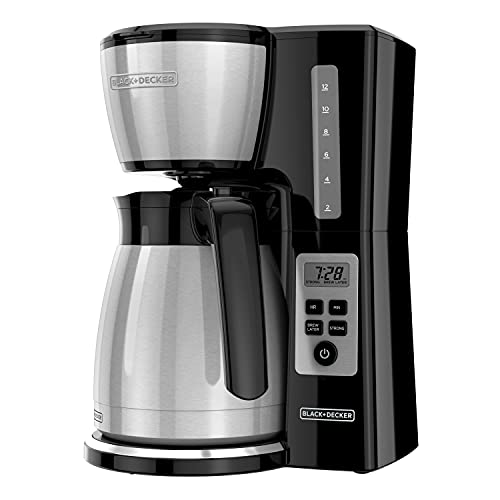
BLACK+DECKER 12-Cup Thermal Programmable Coffee Maker (CM2046S)
Badge: Best Overall
Strengths
- Programmable scheduling means coffee is brewed when you wake, not started when you stumble into the kitchen
- Thermal carafe holds heat without a warming plate, so the last cup never tastes scorched
- VORTEX showerhead is designed to saturate grounds evenly rather than channeling through the middle
Trade-offs
- A thermal carafe keeps coffee hot for hours, not all day; marathon grazers will reheat a cup eventually
- No built-in grinder, so peak freshness still depends on a separate grinder or pre-ground coffee
- The black and steel finish shows fingerprints and coffee splashes more readily than matte designs
Mini spec box
- Capacity: 12 cups
- Carafe: Thermal, Black/Steel (model CM2046S)
- Controls: Programmable, with Brew Strength control
- Showerhead: VORTEX Technology
Think of the CM2046S as the pool’s reference design for modern drip: programmable start, thermal carafe, strength control, and a showerhead built for even extraction. Each of those features addresses a specific, real failure mode of older drip machines — coffee that is not ready when you are, coffee that cooks itself bitter on a plate, one-strength-fits-nobody brewing, and water that tunnels through the grounds instead of bathing them.
In daily use the combination is greater than the list. Scheduling means the machine works while you sleep. The thermal carafe means the second and third cups hold their character. The VORTEX distribution means the pot tastes consistent from the first pour to the last, because the grounds gave up their flavor evenly. Brew Strength control is the adjustment you will actually use weekly, far more than exotic settings on fancier machines, because household tastes genuinely do change with the day and the bean.
It stops short of grinding — fresh-ground purists will pair it with a burr grinder — and its heat retention, while strong, is not an all-day thermos. Within the honest boundaries of a programmable thermal drip machine, though, this is the complete package, and it earns the Best Overall badge without needing a single exaggerated claim.
Best for: households that drink a full pot across the morning and want it brewed before they wake / Not suited for: single-cup drinkers, or anyone who wants grinding built into the same machine

Cuisinart PerfecTemp 12-Cup Thermal Drip Coffee Maker (DCC-3400NAS)
Badge: Best for Hotter Brewing
Strengths
- PerfecTemp hotter brewing targets the water temperature window where coffee extracts most completely
- Double-wall stainless thermal carafe protects flavor and shrugs off the knocks that crack glass
- Brew Strength control gives a real say in the cup without changing beans or dose
Trade-offs
- Hotter brewing is a liability with stale or very dark beans, which can tip toward harshness
- Stainless carafe hides the coffee level, so you judge the remaining pot by weight and memory
- No integrated grinder; it is a brewer only, by design
Mini spec box
- Capacity: 12 cups
- Carafe: Double-wall stainless steel thermal
- Brewing: PerfecTemp hotter brewing
- Controls: Brew Strength control
- Finish: Silver
Temperature is the invisible ingredient in drip coffee, and the PerfecTemp is the one machine here that makes it the headline. Cuisinart’s design brews hotter than standard drip machines, pushing water into the zone where extraction completes — where the sweetness and depth of the grounds actually make it into the pot instead of staying behind in the basket. For households that buy good beans and feel vaguely disappointed by their home drip, this is very often the missing variable.
The supporting cast is equally considered. The double-wall stainless thermal carafe protects the finished coffee from the slow scorching of a warming plate, so a pot brewed for an early riser still tastes honest when a late riser pours. Brew Strength control adjusts intensity for different beans and different drinkers. The silver, squared-off design reads as serious countertop equipment, which matches its intent.
The caveats: hotter water exposes stale beans without mercy, the steel carafe conceals the coffee level, and there is no grinder aboard. None of those is a flaw so much as a focus. This is a brewer built to extract well and hold heat, and it does those two things with more conviction than anything else in the pool.
Best for: drinkers who buy good beans — especially lighter roasts — and want drip that extracts them fully / Not suited for: anyone using stale or very dark beans, or who wants an all-in-one grinding machine

BLACK+DECKER CaféCraft 12-Cup Thermal Coffee Maker
Badge: Best for Hot and Iced
Strengths
- Hot and iced capability in one programmable machine covers the household’s whole day
- Thermal carafe keeps the hot pot at temperature without a flavor-cooking hot plate
- Programmable start means the hot pot can be waiting before the house wakes
Trade-offs
- Iced results depend on brewing over ice correctly; the machine cannot fix a watery technique
- Jack-of-two-temperatures design means neither mode gets the specialized depth of a dedicated machine
- Thermal carafe, as always, trades the visibility of glass for insulation
Mini spec box
- Capacity: 12 cups
- Carafe: Thermal
- Modes: Hot and iced coffee
- Controls: Programmable
Versatility is a word that gets abused in appliance marketing, so it is worth being precise about the CaféCraft: its versatility is specific and useful. It is a programmable, 12-cup, thermal-carafe drip machine — the full weekday package — that also brews for iced coffee. That second mode is not a gimmick setting; home iced coffee fails in a predictable way (dilution), and a machine that brews accounting for the ice produces a fundamentally better glass.
Around that headline, the fundamentals hold up. The programmable timer removes the morning’s first chore. The thermal carafe holds the hot pot at temperature without the slow damage of a warming plate, and it moves to the table cordlessly. Twelve cups is real household capacity — enough for guests, enough for a work-from-home day with refills, enough that nobody is brewing a second pot at ten.
Limits: no grinder, a full-size footprint, and the understanding that a dual-mode machine serves two habits well rather than one habit perfectly. Households that live in both camps — and most do, across a year — will find this the easiest pick to justify.
Best for: households that split the year between hot morning pots and iced afternoon coffee / Not suited for: single-mode purists who never drink iced coffee, or who want a dedicated specialty brewer

Cuisinart 12-Cup Programmable PerfecTemp Thermal Coffee Maker (White)
Badge: Best for Small Batches
Strengths
- The 1–4 cup setting adjusts brewing for small batches, so a half pot does not taste like an afterthought
- Brew Pause lets you pour a cup mid-cycle without the basket dripping down the carafe’s side
- PerfecTemp hotter brewing and Brew Strength control carry over from Cuisinart’s drip flagship
Trade-offs
- White finishes show coffee splashes and demand a wipe-down habit
- Thermal carafe hides the fill level, a minor daily guessing game
- Still no grinder; the small-batch setting perfects brewing, not bean freshness
Mini spec box
- Capacity: 12 cups, with 1–4 cup setting
- Carafe: Thermal
- Brewing: PerfecTemp
- Controls: Programmable, Brew Strength control, Brew Pause
- Finish: Stainless steel and white
Household math drives this Cuisinart’s design. A 12-cup capacity covers guests and gatherings, but the daily reality for many homes is two to four cups — and standard machines brew that quantity badly, rushing water through a shallow bed of grounds. The dedicated 1–4 cup setting is engineered for that reality, and it transforms the machine from a capacity purchase into a daily-quality purchase.
Around that centerpiece sits the full Cuisinart drip toolkit: PerfecTemp hotter brewing for complete extraction, Brew Strength control, programmable start for a pot that makes itself overnight, Brew Pause for the mid-cycle cup, and a thermal carafe that holds heat without a plate. The stainless-and-white finish gives bright kitchens an option that does not read as a black monolith on the counter.
Trade-offs are modest and knowable: no built-in grinding, an opaque carafe, and a white finish that asks for regular wiping. If your household brews small most days and large on weekends, this is arguably the most honestly matched machine in the roundup.
Best for: couples and small households that brew 1–4 cups daily but still host full-pot occasions / Not suited for: large households that always brew full pots, or dark kitchens where a white appliance clashes

BUNN Speed Brew Platinum Thermal Coffee Maker (CSB3T)
Badge: Best for Speed
Strengths
- Speed Brew design keeps brew water ready, so a full pot follows the decision to make one almost immediately
- BUNN’s commercial heritage shows in a simple, serviceable, no-nonsense build
- Thermal carafe protects the fast-brewed pot from hot-plate damage afterward
Trade-offs
- The always-hot reservoir uses standby energy and wants to stay plugged in and filled
- Its speed-first philosophy means no wake-up timer ritual — the machine is ready, but it does not start itself on a clock schedule
- 10 cups is the smallest capacity here; big households will brew twice
Mini spec box
- Capacity: 10 cups
- Carafe: Thermal
- Design: Speed Brew, stainless steel
- Model: 55200 CSB3T
- Finish: Black
The BUNN CSB3T answers a question the programmable machines do not ask: what if the wait itself is the problem? Its Speed Brew reservoir keeps water hot continuously, so a fresh 10-cup pot is a few minutes away at any moment of the day — no scheduling foresight required, no heat-up lag. Households with irregular hours, shift workers, and enthusiastic second-pot drinkers will recognize their lives in that design.
Build and intent are commercial. BUNN’s name is on diner counters across the country for a reason: the machines are simple, sturdy, and serviceable. The thermal carafe continues the theme, holding the pot without a plate. There are no strength algorithms or specialty modes; the levers are the timeless ones — coffee dose, grind, and fresh water — and the machine gets out of the way.
Know the trade-offs before choosing it: the hot reservoir sips power around the clock and scales faster in hard water, the capacity is the pool’s smallest at 10 cups, and if your joy is waking to a pot that brewed itself at 6:30 sharp, a programmable rival serves that ritual better. For coffee on demand, nothing else here is close.
Best for: impatient drinkers, irregular schedules, second-pot households, and small offices / Not suited for: schedule-driven drinkers who want coffee brewed before they wake, or very large households
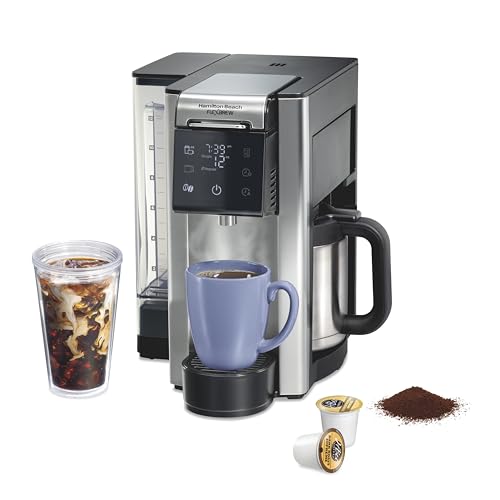
Hamilton Beach FlexBrew Advanced 5-in-1 Coffee Maker
Badge: Most Versatile
Strengths
- Drip and single-serve in one machine ends the two-appliance standoff in mixed households
- Accepts both pods and grounds on the single-serve side, so nobody is locked into one format
- The 60 oz. removable reservoir refills at the sink instead of by the jug-under-cabinet shuffle
Trade-offs
- Two brewing systems mean two sets of parts to clean and descale
- A multi-format machine rarely matches a dedicated machine’s mastery of any single format
- The larger, busier design will dominate a small counter
Mini spec box
- Capacity: 12-cup drip, plus single serve
- Carafe: Thermal, programmable drip side
- Single serve: Pods and grounds
- Reservoir: Removable, 60 oz.
- Modes: Hot and iced; 5-in-1 FlexBrew design
Versatility claims are cheap; the FlexBrew Advanced itemizes its own. Five functions — full-pot drip, single-serve pods, single-serve grounds, hot, iced — share one housing and one removable 60 oz. reservoir. The drip brewer is programmable and thermal-carafed, the specification a dedicated machine would lead with. The single-serve side accepts the two formats households actually use, which quietly resolves the pod-versus-grounds debate by refusing to pick a side.
In practice, the machine’s value compounds across a day: a programmed pot for the morning rush, a single grounds cup for the early riser who precedes it, a pod for a guest, an iced glass in the afternoon. Each use case is one another machine in this pool either cannot serve or serves by wasting a pot. The removable reservoir, filled at the sink, is the kind of unglamorous design decision that owners appreciate every single day.
The reservations are structural: two systems to clean, a large footprint, and a generalist’s ceiling in any one discipline. If your household is unanimous in its habits, a dedicated machine serves you better. If it is a coalition, this is the coalition government.
Best for: mixed households split between pot drinkers and single-cup drinkers, pods and grounds / Not suited for: single-habit households, tiny counters, or minimalists who descale reluctantly
Comparison Table
Drip’s quality columns: capacity for the pot, the carafe that receives it, the scheduling philosophy, and the mechanism each machine leads with.
| Pick | Capacity | Carafe | Scheduling approach | Standout feature | Link |
|---|---|---|---|---|---|
| BLACK+DECKER 12-Cup Thermal Programmable Coffee Maker (CM2046S) | 12 cups | Thermal carafe | Programmable + Brew Strength | VORTEX showerhead | Check on Amazon |
| Cuisinart PerfecTemp 12-Cup Thermal Drip Coffee Maker (DCC-3400NAS) | 12 cups | Stainless thermal carafe | PerfecTemp hotter brewing | Brew Strength control | Check on Amazon |
| BLACK+DECKER CaféCraft 12-Cup Thermal Coffee Maker | 12 cups | Thermal carafe | Programmable | Hot + iced modes | Check on Amazon |
| Cuisinart 12-Cup Programmable PerfecTemp Thermal Coffee Maker (White) | 12 cups (1–4 cup setting) | Thermal carafe | PerfecTemp + programmable | Brew Pause + strength control | Check on Amazon |
| BUNN Speed Brew Platinum Thermal Coffee Maker (CSB3T) | 10 cups | Thermal carafe | Speed Brew reservoir | Commercial-style build | Check on Amazon |
| Hamilton Beach FlexBrew Advanced 5-in-1 Coffee Maker | 12 cups + single serve | Thermal carafe | Pods + grounds, hot + iced | 60 oz. removable reservoir | Check on Amazon |
How to Choose the Best Quality Drip Coffee Makers
Drip rewards the shopper who thinks like an engineer for ten minutes. Four variables, in order, decide the cup; everything else decides the counter.
Temperature headroom
Extraction completes in a narrow hot window, and drip machines differ in how confidently they reach it. PerfecTemp is this pool’s explicit answer — brewing hotter by design. If your beans are fresh and your roasts light to medium, temperature headroom is the quality feature; if your beans are dark and oily, moderate your dose and let strength control do the adjusting.
Distribution honesty
A single drip stream drills a hole through the grounds bed and leaves the edges dry: sour and bitter in the same pot. A showerhead — VORTEX in the BLACK+DECKER, and shower-style delivery across the pool — wets the bed as a whole. When you read any drip specification, find the distribution sentence; if there is not one, the maker is hoping you will not ask.
Batch truth and carafe discipline
Quality must survive your smallest pot and your longest morning. Small batches need compensation (the white Cuisinart’s 1–4 cup setting) or a format change (the FlexBrew’s single side). Long mornings need a thermal carafe — universal here — and the owner’s half of the bargain: washing it daily so yesterday’s oils do not season today’s pot. Close the loop with descaling, the maintenance act on which drip temperature, and therefore drip quality, ultimately depends. The dual-format and pod corners of the quality map live at Best Small Flex Brew Coffee Makers and Best Small Pod Coffee Makers.
Consider, too, the machine’s manners at the table. A thermal carafe is a serving vessel: it pours at the table, away from cords, and keeps the pot’s temperature through a long breakfast. Drip machines whose carafes drip down their own sides or demand two hands and a prayer will be cursed daily in ways no extraction advantage repays. The pool’s carafes are mainstream designs with long production histories — an unglamorous quality signal that matters every single morning.
How to Brew Drip Coffee at Its Best, and Keep It There
Drip’s variables are few enough to master completely. This is the working method the six machines in this guide were built to serve.
The brew, step by step
- Start with fresh water and a clean machine; drip has nowhere to hide residue.
- Use a medium grind — coarse sand — and a consistent dose, roughly a tablespoon per cup, adjusted deliberately over several pots.
- Seat the filter so it cannot fold, add grounds, and level the bed. An even bed is the showerhead’s partner in even extraction.
- For scheduled brews, load in the evening and verify the program; for the BUNN, keep the reservoir topped so readiness is real.
- Serve the pot from the thermal carafe across the morning rather than reheating cups; the carafe’s whole purpose is a graceful second and third cup.
Dialing in a new machine
Change one variable per pot for the first week: dose first, then grind, then strength setting. Drip responds predictably — sour means extract more (finer, more dose, hotter machine), bitter means extract less — and a programmable machine’s repeatability turns that week into a permanent recipe. Write the winning combination down; households forget, and the machine will faithfully repeat whatever you settled.
Maintenance that protects quality
Daily carafe and basket washing; weekly spray-head and valve checks; scheduled descaling without exception. In drip, scale is not a cosmetic issue — it is a temperature cut applied to every brew, invisible until the coffee has been mediocre for a month. The always-hot reservoir design concentrates minerals fastest and should be descaled first and most faithfully.
Troubleshooting
- Problem: sour and thin → under-extraction. Finer grind, more dose, or descale to restore temperature — in that diagnostic order.
- Problem: bitter and heavy → over-extraction or stale beans. Coarsen, reduce dose, and check the roast date before blaming the machine.
- Problem: uneven, muddled flavor → distribution: clean the showerhead, level the grounds bed, and confirm the basket sits flat.
Write your household’s recipe where the machine can see it — dose, grind setting, strength setting, water line — on a card in the cupboard door. Drip quality is repeatability, and repeatability fails at the human interface more often than at the heating element. The card is the cheapest quality accessory in this entire guide.
The Case for Drip in the Quality Debate
Quality debates in coffee are usually won by the most theatrical method — pressure, steam, ritual. Drip’s case is quieter and, for households, stronger. It is the only method whose quality scales: the same machine, the same technique, and the same beans produce one mug or twelve cups with no change in the drinker’s workload. Its per-cup cost is the lowest in coffee, its waste the most benign, and its ceiling — with temperature and distribution engineered properly, as the PerfecTemp and VORTEX designs engineer them — satisfies all but the most committed hobbyists.
Programmability completes the case by fixing drip’s one structural weakness, timing. A method this economical and scalable, that also starts itself, is not a compromise format; it is the household format, and the six machines here are its quality vanguard. Readers building a second station for solo cups will find the quality criteria translated to that scale in Best Small Serve Coffee Makers.
Reading a Drip Specification Like an Engineer
A drip machine’s specification sheet contains its quality confession, if you know which lines matter. Find the carafe line: thermal, double-wall — or a glass pot and a plate, which tells you the maker spent its budget elsewhere. Find the temperature line: a named hotter-brewing design, or silence. Find the distribution line: a named showerhead, or silence. Find the batch line: a small-cup setting, or a one-size basket. Four lines, and you know the machine’s quality posture before reading a single review.
This guide’s pool was built by reading those lines across the verified market and admitting the machines whose answers were specific. That is also the skill worth taking to any future purchase, in this category or beyond it: quality is always a mechanism before it is a reputation. The pod format’s version of the same discipline — dose consistency, temperature, freshness — is examined in Best Small K Cup Coffee Makers.
Altitude, Water, and Other Honest Complications
Drip brewing’s physics assume a world that not every kitchen inhabits. Water boils cooler at altitude, which trims the top off a drip machine’s temperature range and can push extraction toward sour for mountain households; the countermeasures are the same levers this guide has taught — finer grind, fuller dose, the hottest-brewing machine in the pool — applied with the altitude in mind. The PerfecTemp’s temperature headroom, a luxury at sea level, becomes close to a necessity where water gives up its heat early.
Water chemistry cuts the other way in lowland cities: heavily mineralized supplies scale machines faster and mute the cup’s brightness, while very soft water can under-deliver the minerals extraction quietly uses. None of this changes the pool’s ranking, but it changes the owner’s manual each household should write for itself: descale intervals set by your water, not by a generic calendar, and a filter pitcher judged an ingredient, not an accessory. Quality drip is a local practice wearing a universal method.
The Long Morning: Drip’s Defining Use Case
Espresso is an event; drip is a duration. The pot is brewed once and drunk across hours — with breakfast, at the desk, in the refill that accompanies the second chapter of the news. That duration is why this guide has treated the carafe as a quality mechanism equal to temperature and distribution: a drip machine’s product is not the first cup but the morning, and every design decision should be audited against the third hour as sternly as against the first pour.
Audit the pool by that standard and its shape explains itself. Thermal carafes everywhere, because duration punishes hot plates. Programmability everywhere, because duration begins before the drinker is awake. Batch intelligence — the 1–4 cup setting, the single-serve side — because duration shrinks to one person’s two cups on the days the household scatters. Even the BUNN’s speed is a duration feature: the fresh second pot at ten o’clock, brewed in minutes, extends the morning without extending the first pot past its prime. Judge any drip machine you meet by the long morning, and you will rarely judge wrong.
Drip Coffee and the Sense of Smell
Flavor science keeps rediscovering what drip drinkers know: most of what we call taste in coffee is aroma, and aroma is perishable. A drip pot’s aromatic peak is its first minutes, which is why the smell of a brewing pot — the smell programmable machines deliver to a waking house — is so disproportionately beloved. The thermal carafe’s underappreciated virtue is that it slows the aroma’s escape: a sealed, insulated vessel loses less to the kitchen air than an open glass pot on a plate, hour by hour.
This reframes several of the guide’s positions in sensory terms. Freshness of beans is aroma inventory. Grinding late is aroma timing. The carafe is aroma storage. Even descaling is aromatic, since under-extracted coffee is precisely coffee whose aromatics stayed in the basket. A household chasing drip quality is, whether it knows it or not, managing a small, daily economy of scent — and the six machines here are its best available instruments, chosen because every one of their mechanisms pays into that economy rather than taxing it.
The Mug Matters: Serving Drip at Its Best
A guide to drip quality is allowed one indulgence, and this is it: the vessel you drink from is the last variable, and it is not nothing. A thin-walled mug sheds heat quickly, rushing the drinker and cooling the coffee into dullness; a heavy ceramic mug, pre-warmed with a splash of hot water, holds the cup’s temperature through a long read. The thermal carafe preserved the pot’s heat across the morning — it seems a shame to surrender the last of it to a cold mug in the final ten seconds of the coffee’s journey.
Pre-warming is a ten-second ritual with an outsized return, and it pairs with a second: pour decisively. Drip coffee drunk in two sittings from the same mug — half now, half after it has cooled and been microwaved — is two different beverages, the second unworthy of the first. The machines in this pool did their work at temperature, evenly, into an insulated carafe. The household’s closing duties are merely not to undo it: warm mug, full pour, drink it while it is the coffee the machine made. Quality is a relay, and the mug is the anchor leg.
Common Buying Mistakes
Buying drip by brand nostalgia
Great names have shipped mediocre drip machines, and the specification’s four lines — carafe, temperature, distribution, batch — outrank any logo. This pool contains several famous names; they earned their places on mechanisms, not fame.
Overlooking small-batch quality
A household of two drinking under-extracted four-cup pots from an uncompensated twelve-cup machine is experiencing a quality failure daily and blaming its beans. The 1–4 cup setting exists because this mistake is so common.
Reheating instead of carafe-keeping
Microwaving the morning’s third cup destroys what the thermal carafe preserved. If your pot routinely outlives its carafe’s comfortable window, brew smaller — with a machine that brews small well.
Confusing strength with quality
A stronger pot is a dosed pot, not a better-extracted one. Strength controls are for preference; temperature and distribution are for quality. Shoppers who chase strength to fix sour coffee are treating under-extraction with the wrong lever.
Deferring descaling until symptoms
In drip, scale’s first symptom is a month of quietly mediocre coffee. Descale on the calendar and the symptom never arrives.
Storing beans above the machine
The warm, steamy shelf over a working coffee maker is the worst storage in the kitchen: heat and moisture spend the beans’ aromatics daily. Quality drip begins before the basket — beans sealed, cool, and dry, in a cupboard that does not share a wall with the oven.
Letting the machine live beside the stove
Steam, grease aerosol, and heat cycles from a neighboring stove coat a coffee maker’s exterior and vents and shorten its comfortable life. Quality machines deserve a dry, cool station of their own — near water for filling, away from the stove for longevity. Counter geography is a quality decision too.
Final Recommendation
The Cuisinart PerfecTemp Check on Amazon takes the final recommendation for drip purists: its hotter brewing is the most consequential quality mechanism in the pool, and the thermal carafe completes the argument. The BLACK+DECKER CM2046S Check on Amazon stands beside it as the distribution-and-completeness pick, and the CaféCraft Check on Amazon carries drip quality into iced season.
The white Cuisinart is the small household’s quality machine; the BUNN, the freshness-through-speed machine; the FlexBrew, the household that wants drip quality and single-cup freedom under one roof. Each verdict follows from the same four variables, applied to different lives.
Buy the machine whose mechanism matches your beans and your mornings, then keep its temperature honest with descaling. Drip quality is not mysterious — it is maintained.
Related guides
Frequently Asked Questions
What separates a quality drip machine from a basic one?
Mechanisms, verifiable in the specification: hotter, controlled brew temperature; a showerhead that saturates the grounds evenly; a thermal carafe; and batch-size competence. Basic machines brew; quality machines brew at the right temperature, evenly, and protect the result. This pool was admitted on exactly those criteria.
Is programmable scheduling part of drip quality?
Indirectly, yes. A pot brewed at the moment it will be drunk is fresher than one brewed early and held, so a timer that matches brewing to drinking protects quality. The BUNN’s always-hot reservoir reaches the same freshness by the opposite route — brewing within minutes whenever asked.
Why does my drip coffee taste sour even with good beans?
Under-extraction: water too cool (often scale), grind too coarse, dose too light, or a small batch in a big uncompensated basket. Descale first, then adjust grind and dose one at a time. Machines with hotter brewing and small-batch settings — both represented here — remove the two structural causes.
Glass or thermal carafe for drip quality?
Thermal, for any pot that outlasts its first pouring. A hot plate maintains temperature by cooking, and the flavor cost compounds hourly. Every pick in this guide uses a thermal carafe for that reason; glass survives in the market on price and visibility, not on quality.
Can a dual-format machine match a dedicated drip machine?
The FlexBrew’s drip side carries the full programmable thermal specification, so the practical gap is small; the real costs are footprint and double maintenance. For households that will use both sides, it is a quality purchase. For pot-only households, the dedicated machines here are the cleaner answer.
How do I keep a drip machine brewing at full quality for years?
Wash the flavor path daily, descale on schedule, and keep the showerhead clear. Those three habits defend temperature and distribution — the whole of drip quality — against their two natural enemies, scale and oil.
Why does the last cup from the pot taste different from the first?
Two honest causes: the pot settles and cools slightly even in a thermal carafe, and the drinker’s palate changes across a morning. What should not cause it is the carafe cooking the coffee — that is the hot-plate failure every pick here avoids. If the difference in your kitchen is large and bitter, suspect a warming plate or a carafe overdue for a deep clean.
Does the order of pouring matter in a drip pot?
Slightly, and enjoyably: the pot’s strength evens out as it sits, and a gentle swirl of the carafe before serving homogenizes the first and last cups. Coffee that dripped in earliest is marginally different from the last through the basket. One swirl, and the pot is a single beverage again — a two-second ritual that costs nothing and that long-morning drinkers swear by.
How can I tell if my drip machine is losing temperature?
Brew a pot of plain water and pour it immediately into a pre-warmed mug; if you own a kitchen thermometer, the water should arrive genuinely hot, near the top of the comfortable drinking range and well above lukewarm. Without instruments, the behavioral signs suffice: brews that have crept sour over months, and a pot that no longer steams when poured. Both say descale first — temperature lost to scale is recoverable; temperature lost to a dying element is the repair conversation.


