Disclosure: topratedkitchenware.com is reader-supported. When you buy through links on our site, we may earn an affiliate commission from Amazon and other retailers, at no extra cost to you.
Where to buy
The best quality low cost coffee makers prove that quality and low cost are not enemies in drip coffee — they are allies, because drip’s quality mechanisms (hot water, even distribution, a thermal carafe) are engineering choices, not luxury materials. The six below are the pool’s proof, spanning the value-conscious end of serious drip design. All six are linked, and none asks you to pay for decoration.
- BLACK+DECKER 12-Cup Thermal Programmable Coffee Maker (CM2046S) — a 12-cup thermal carafe machine with brew strength control and a VORTEX showerhead; check the latest price on Amazon
- Cuisinart PerfecTemp 12-Cup Thermal Drip Coffee Maker (DCC-3400NAS) — Cuisinart’s PerfecTemp design brews hotter, into a double-wall stainless thermal carafe; check the latest price on Amazon
- BLACK+DECKER CaféCraft 12-Cup Thermal Coffee Maker — a programmable 12-cup thermal machine that brews for both hot and iced coffee; check the latest price on Amazon
- Cuisinart 12-Cup Programmable PerfecTemp Thermal Coffee Maker (White) — Cuisinart’s PerfecTemp thermal machine in white, with a dedicated 1–4 cup setting and Brew Pause; check the latest price on Amazon
- BUNN Speed Brew Platinum Thermal Coffee Maker (CSB3T) — BUNN’s Speed Brew design keeps water hot and ready, pouring a 10-cup pot with minimal wait; check the latest price on Amazon
- Hamilton Beach FlexBrew Advanced 5-in-1 Coffee Maker — a 5-in-1 system: 12-cup programmable thermal drip on one side, single-serve pods or grounds on the other; check the latest price on Amazon
Read the full guide ↓
The best quality low cost coffee makers answer the most practical question in home coffee: how good can the morning pot be without the purchase becoming a financial event? The answer, in drip coffee, is: genuinely good. Drip’s quality lives in water temperature, water distribution, and the carafe — mechanisms that cost engineering attention rather than exotic materials — which is why the six machines in this guide can pair real quality with low cost of ownership.
Low cost deserves a precise definition before the picks. It is not merely the sticker; it is the whole ledger — the machine, the coffee format it eats, the energy it uses, the parts that wear, and the years it serves before replacement. By that ledger, drip machines drinking bulk grounds are the cheapest serious coffee system in existence, and the pod side of the family — examined in Best Small K Cup Coffee Makers — pays a per-cup premium forever. Every pick here is a grounds machine; that is the first and largest saving.
Within the pool, the value stories differ: BLACK+DECKER builds complete specification at the accessible end, Cuisinart sells temperature engineering in two finishes, BUNN sells a decade-scale build, and Hamilton Beach sells two machines’ work in one housing. The reviews price each philosophy in words, not numbers — because the quality-per-cost argument is structural, and it holds.
Key Takeaways
- Drip is the low-cost quality format: bulk grounds cost a fraction of pods per cup, forever, and the machines themselves are simple and durable.
- Quality mechanisms — hotter brewing, even distribution, thermal carafes — appear at accessible price points throughout this pool.
- Total cost includes energy (the BUNN’s always-hot reservoir is its one running-cost caveat) and lifespan (its commercial build is the counter-argument).
- The FlexBrew’s value is consolidation: one purchase replacing a pot machine and a single-serve machine.
- The white Cuisinart’s 1–4 cup setting is a running-cost feature — no more brewing twelve cups to drink three.
- Descaling protects the investment: a descale solution costs little; a scaled-out machine costs a replacement.
In this guide
Quick Picks
Badges name each machine’s value thesis — where its quality-per-cost is strongest. The detailed reviews audit the theses, including the running costs honest value shopping must count.
| Pick | Badge | Why it stands out | Link |
|---|---|---|---|
| BLACK+DECKER 12-Cup Thermal Programmable Coffee Maker (CM2046S) | Best Overall | Full programmability, a thermal carafe that skips the hot plate, and even saturation from the VORTEX showerhead | Check on Amazon |
| Cuisinart PerfecTemp 12-Cup Thermal Drip Coffee Maker (DCC-3400NAS) | Best for Hotter Brewing | Hotter brewing water for fuller extraction, plus Brew Strength control and a stainless thermal carafe | Check on Amazon |
| BLACK+DECKER CaféCraft 12-Cup Thermal Coffee Maker | Best for Hot and Iced | One programmable machine covering the morning hot pot and the afternoon iced glass | Check on Amazon |
| Cuisinart 12-Cup Programmable PerfecTemp Thermal Coffee Maker (White) | Best for Small Batches | The 1–4 cup setting makes small pots taste right, and Brew Pause serves a cup mid-brew | Check on Amazon |
| BUNN Speed Brew Platinum Thermal Coffee Maker (CSB3T) | Best for Speed | The always-ready reservoir approach: the fastest route from decision to full pot in this pool | Check on Amazon |
| Hamilton Beach FlexBrew Advanced 5-in-1 Coffee Maker | Most Versatile | Full pot and single cup, pods and grounds, hot and iced — the one-machine answer for mixed households | Check on Amazon |
How These Picks Were Chosen
The pool was verified as usual — genuine programmable drip machines (plus the labeled always-ready exception) confirmed against specifications — and then read through a total-cost lens: format cost per cup, energy pattern, batch waste, expected service life, and the quality mechanisms present at each design’s position in the market. Machines whose low price was achieved by deleting a quality mechanism — a hot plate instead of a thermal carafe, a token showerhead — were treated as false economy and excluded from the value argument.
This is research-led guidance from verified specifications, not hands-on testing, and it invents no prices: the value claims are structural (grounds versus pods, one machine versus two, small batches versus waste) rather than numerical. Readers pricing the compact end of the same philosophy will find it in Best Small Serve Coffee Makers and Best Small Serving Coffee Makers.
The 6 Best Quality Low Cost Coffee Makers, Reviewed in Detail
Each review states the machine’s quality claim and its cost claim separately, then weighs them together — because a value machine must win both arguments at once, and several famous cheap machines win only the second.
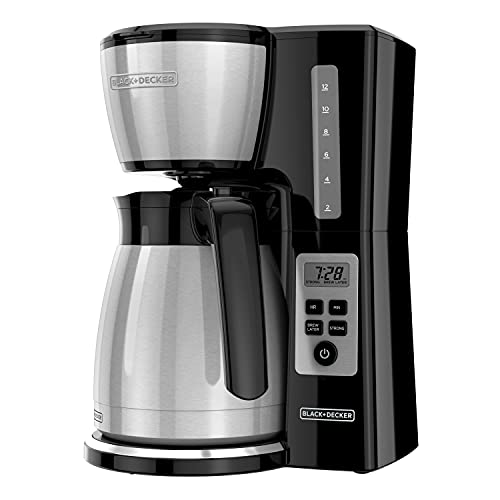
BLACK+DECKER 12-Cup Thermal Programmable Coffee Maker (CM2046S)
Badge: Best Overall
Strengths
- Programmable scheduling means coffee is brewed when you wake, not started when you stumble into the kitchen
- Thermal carafe holds heat without a warming plate, so the last cup never tastes scorched
- VORTEX showerhead is designed to saturate grounds evenly rather than channeling through the middle
Trade-offs
- A thermal carafe keeps coffee hot for hours, not all day; marathon grazers will reheat a cup eventually
- No built-in grinder, so peak freshness still depends on a separate grinder or pre-ground coffee
- The black and steel finish shows fingerprints and coffee splashes more readily than matte designs
Mini spec box
- Capacity: 12 cups
- Carafe: Thermal, Black/Steel (model CM2046S)
- Controls: Programmable, with Brew Strength control
- Showerhead: VORTEX Technology
The CM2046S is built around the two decisions that matter most in a weekday coffee maker: when it brews, and what the coffee sits in afterward. The programmable timer handles the first — set it the night before and the machine starts on schedule, so the kitchen smells like coffee before your alarm has finished being resented. The thermal carafe handles the second. Because there is no hot plate cooking the finished pot, the coffee you pour at nine tastes like the coffee that brewed at seven, just a little cooler, instead of progressively stewing into bitterness.
BLACK+DECKER’s VORTEX showerhead is the extraction story here: instead of a single stream drilling into the center of the grounds, water is distributed in a swirling pattern meant to wet the whole bed. Paired with the Brew Strength control, which adjusts how assertively the machine brews, the CM2046S covers a wide household range — a mild pot for a sensitive stomach on Monday, a stronger one for a deadline on Friday — without changing coffees. It is not a specialty instrument, and it does not pretend to be; it is a dependable, schedulable, good-tasting pot machine, which is what most kitchens actually need.
The honest limitations are the class limitations. There is no grinder on board, the carafe’s heat retention is measured in hours rather than a full workday, and the glossy black-and-steel exterior rewards a quick wipe. None of that undermines the core proposition: this is the pool’s most complete expression of set-it-tonight, drink-it-all-morning drip coffee.
Best for: households that drink a full pot across the morning and want it brewed before they wake / Not suited for: single-cup drinkers, or anyone who wants grinding built into the same machine

Cuisinart PerfecTemp 12-Cup Thermal Drip Coffee Maker (DCC-3400NAS)
Badge: Best for Hotter Brewing
Strengths
- PerfecTemp hotter brewing targets the water temperature window where coffee extracts most completely
- Double-wall stainless thermal carafe protects flavor and shrugs off the knocks that crack glass
- Brew Strength control gives a real say in the cup without changing beans or dose
Trade-offs
- Hotter brewing is a liability with stale or very dark beans, which can tip toward harshness
- Stainless carafe hides the coffee level, so you judge the remaining pot by weight and memory
- No integrated grinder; it is a brewer only, by design
Mini spec box
- Capacity: 12 cups
- Carafe: Double-wall stainless steel thermal
- Brewing: PerfecTemp hotter brewing
- Controls: Brew Strength control
- Finish: Silver
The PerfecTemp’s argument starts with a number-free fact about coffee: water that is too cool under-extracts, leaving coffee sour and thin. Cuisinart built this machine around brewing hotter — the PerfecTemp name is the promise — so the water meets the grounds in the range where sugars and aromatics actually dissolve. With fresh, decent beans the difference is not subtle: the cup tastes rounder and more complete, especially with the medium and lighter roasts that cooler machines leave tasting grassy.
The brewed coffee lands in a double-wall stainless steel thermal carafe, which is the right destination for it. There is no hot plate to keep cooking the pot, the steel takes counter knocks that would end a glass carafe’s career, and the insulation holds serving temperature through a long, interrupted morning. Brew Strength control rounds out the package, letting you push the same beans toward bold when the pot is destined for milk, or keep it regular for drinking black.
Its limits are honest ones. Hotter water is unforgiving of stale beans — it will extract their flaws as efficiently as their virtues — and the opaque carafe means you cannot see how much coffee is left. It also brews only: no grinder, no pods, no espresso. As a focused drip instrument for people who care about extraction temperature, it is the connoisseur’s pick in this pool.
Best for: drinkers who buy good beans — especially lighter roasts — and want drip that extracts them fully / Not suited for: anyone using stale or very dark beans, or who wants an all-in-one grinding machine

BLACK+DECKER CaféCraft 12-Cup Thermal Coffee Maker
Badge: Best for Hot and Iced
Strengths
- Hot and iced capability in one programmable machine covers the household’s whole day
- Thermal carafe keeps the hot pot at temperature without a flavor-cooking hot plate
- Programmable start means the hot pot can be waiting before the house wakes
Trade-offs
- Iced results depend on brewing over ice correctly; the machine cannot fix a watery technique
- Jack-of-two-temperatures design means neither mode gets the specialized depth of a dedicated machine
- Thermal carafe, as always, trades the visibility of glass for insulation
Mini spec box
- Capacity: 12 cups
- Carafe: Thermal
- Modes: Hot and iced coffee
- Controls: Programmable
The CaféCraft’s insight is about the calendar. Households that drink drip coffee rarely drink it the same way in January and July, and this machine is built for both households at once: a programmable 12-cup thermal brewer for the hot pot, with an iced-coffee mode for the months when the pot migrates into a glass over ice. One appliance, one footprint, no seasonal swap and no second machine crowding the counter.
The hot side is properly equipped. Programmability means the pot can be set the night before, and the thermal carafe means what brews stays hot and un-scorched through the morning, with no warming plate slowly concentrating bitterness. The iced side addresses the classic home-iced-coffee failure — hot coffee poured over ice and diluted into sadness — by brewing with the ice in mind, so the finished glass tastes like coffee rather than coffee-flavored water.
The compromises are the familiar ones for a dual-mode machine: it will not out-specialize a dedicated iced-coffee device or a temperature-obsessed drip brewer, and it has no grinder. But for the very common household that splits its year between hot pots and iced glasses, it is the most season-proof pick in this pool.
Best for: households that split the year between hot morning pots and iced afternoon coffee / Not suited for: single-mode purists who never drink iced coffee, or who want a dedicated specialty brewer

Cuisinart 12-Cup Programmable PerfecTemp Thermal Coffee Maker (White)
Badge: Best for Small Batches
Strengths
- The 1–4 cup setting adjusts brewing for small batches, so a half pot does not taste like an afterthought
- Brew Pause lets you pour a cup mid-cycle without the basket dripping down the carafe’s side
- PerfecTemp hotter brewing and Brew Strength control carry over from Cuisinart’s drip flagship
Trade-offs
- White finishes show coffee splashes and demand a wipe-down habit
- Thermal carafe hides the fill level, a minor daily guessing game
- Still no grinder; the small-batch setting perfects brewing, not bean freshness
Mini spec box
- Capacity: 12 cups, with 1–4 cup setting
- Carafe: Thermal
- Brewing: PerfecTemp
- Controls: Programmable, Brew Strength control, Brew Pause
- Finish: Stainless steel and white
Most 12-cup machines quietly punish small households: brew four cups in a basket designed for twelve and the water races through too little coffee, producing a thin, sour pot. This Cuisinart’s 1–4 cup setting exists to fix exactly that, adjusting the brew for small batches so a couple’s morning pot tastes like a deliberate brew rather than a diluted one. It is the single most useful feature in this pool for the way many households actually drink.
The rest of the specification is Cuisinart’s proven drip formula. PerfecTemp hotter brewing for complete extraction, Brew Strength control for adjusting intensity, full programmability for waking up to a finished pot, and a thermal carafe that holds the coffee without a hot plate stewing it. Brew Pause adds the small mercy of a mid-brew cup — pull the carafe, pour, replace — for the mornings when waiting for the full cycle is not an option anyone is willing to discuss.
In white and stainless it is also the bright-kitchen pick, a real consideration in kitchens where every other appliance is black. Its compromises: white shows every splash, the thermal carafe conceals its contents, and there is no grinder. For small households that occasionally host a full-pot crowd, it threads the needle better than anything else here.
Best for: couples and small households that brew 1–4 cups daily but still host full-pot occasions / Not suited for: large households that always brew full pots, or dark kitchens where a white appliance clashes

BUNN Speed Brew Platinum Thermal Coffee Maker (CSB3T)
Badge: Best for Speed
Strengths
- Speed Brew design keeps brew water ready, so a full pot follows the decision to make one almost immediately
- BUNN’s commercial heritage shows in a simple, serviceable, no-nonsense build
- Thermal carafe protects the fast-brewed pot from hot-plate damage afterward
Trade-offs
- The always-hot reservoir uses standby energy and wants to stay plugged in and filled
- Its speed-first philosophy means no wake-up timer ritual — the machine is ready, but it does not start itself on a clock schedule
- 10 cups is the smallest capacity here; big households will brew twice
Mini spec box
- Capacity: 10 cups
- Carafe: Thermal
- Design: Speed Brew, stainless steel
- Model: 55200 CSB3T
- Finish: Black
Every other machine in this pool starts cold. The BUNN starts ready. Its Speed Brew design keeps an internal reservoir of water at brewing temperature around the clock, so when you add fresh water, the hot water is displaced into the basket almost immediately — a full 10-cup pot in the time a conventional machine spends just heating up. For households where coffee is a decision made in the moment — a second pot at ten, an unexpected guest, a work call that demands reinforcements — that readiness is a genuinely different ownership experience.
The philosophy extends to the whole machine. BUNN builds for cafes and diners, and the CSB3T carries that DNA: stainless construction, a thermal carafe instead of a fragile glass pot on a plate, controls that do one thing. There is no wake-up scheduling ritual because the machine’s answer to scheduling is to always be ready; you trade the romance of waking to brewed coffee for the reality of coffee minutes after you ask for it, at any hour.
The costs are real: an always-hot tank draws standby power and demands descaling discipline, and 10 cups is the pool’s smallest pot. But as a speed instrument from the most commercially proven name in drip coffee, it occupies ground none of the others contest.
Best for: impatient drinkers, irregular schedules, second-pot households, and small offices / Not suited for: schedule-driven drinkers who want coffee brewed before they wake, or very large households
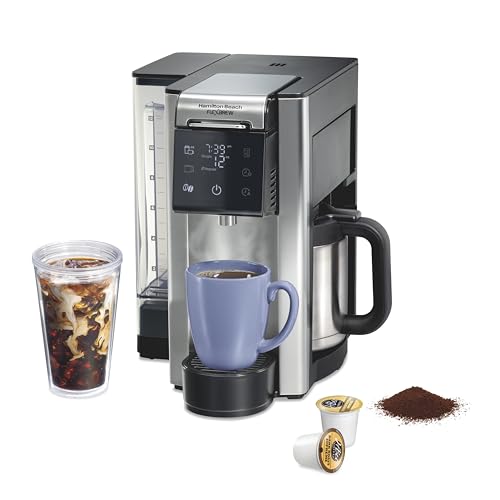
Hamilton Beach FlexBrew Advanced 5-in-1 Coffee Maker
Badge: Most Versatile
Strengths
- Drip and single-serve in one machine ends the two-appliance standoff in mixed households
- Accepts both pods and grounds on the single-serve side, so nobody is locked into one format
- The 60 oz. removable reservoir refills at the sink instead of by the jug-under-cabinet shuffle
Trade-offs
- Two brewing systems mean two sets of parts to clean and descale
- A multi-format machine rarely matches a dedicated machine’s mastery of any single format
- The larger, busier design will dominate a small counter
Mini spec box
- Capacity: 12-cup drip, plus single serve
- Carafe: Thermal, programmable drip side
- Single serve: Pods and grounds
- Reservoir: Removable, 60 oz.
- Modes: Hot and iced; 5-in-1 FlexBrew design
The FlexBrew Advanced exists because of a household argument: one person drinks pots, another drinks pods, and the counter cannot hold two machines. Its answer is a genuine 5-in-1 — a 12-cup programmable thermal drip brewer on one side, and a single-serve brewer on the other that takes both pods and loose grounds, with hot and iced capability across the system. That is not a drip machine with a novelty attachment; both sides are fully realized, which is what makes the compromise work.
The details show a designer who has watched people use coffee makers. The 60 oz. reservoir is removable, so it fills at the sink rather than via a measuring jug poured at an angle under a cabinet. The drip side is programmable with a thermal carafe, matching the dedicated machines feature for feature. The single-serve side’s grounds option matters more than it appears: it frees the pod drinker from pod prices and pod waste whenever they have two extra minutes, without buying a second device.
The honest costs: two systems to descale, a footprint that will own its corner of the counter, and the standing truth that a specialist machine usually beats a generalist at its specialty. For the mixed household, though, this is not a compromise so much as a peace treaty — one machine, every drinker served.
Best for: mixed households split between pot drinkers and single-cup drinkers, pods and grounds / Not suited for: single-habit households, tiny counters, or minimalists who descale reluctantly
Comparison Table
The value columns: capacity against waste, the carafe that protects the pot, the scheduling approach, and the design decision that carries each machine’s quality-per-cost case.
| Pick | Capacity | Carafe | Scheduling approach | Standout feature | Link |
|---|---|---|---|---|---|
| BLACK+DECKER 12-Cup Thermal Programmable Coffee Maker (CM2046S) | 12 cups | Thermal carafe | Programmable + Brew Strength | VORTEX showerhead | Check on Amazon |
| Cuisinart PerfecTemp 12-Cup Thermal Drip Coffee Maker (DCC-3400NAS) | 12 cups | Stainless thermal carafe | PerfecTemp hotter brewing | Brew Strength control | Check on Amazon |
| BLACK+DECKER CaféCraft 12-Cup Thermal Coffee Maker | 12 cups | Thermal carafe | Programmable | Hot + iced modes | Check on Amazon |
| Cuisinart 12-Cup Programmable PerfecTemp Thermal Coffee Maker (White) | 12 cups (1–4 cup setting) | Thermal carafe | PerfecTemp + programmable | Brew Pause + strength control | Check on Amazon |
| BUNN Speed Brew Platinum Thermal Coffee Maker (CSB3T) | 10 cups | Thermal carafe | Speed Brew reservoir | Commercial-style build | Check on Amazon |
| Hamilton Beach FlexBrew Advanced 5-in-1 Coffee Maker | 12 cups + single serve | Thermal carafe | Pods + grounds, hot + iced | 60 oz. removable reservoir | Check on Amazon |
How to Choose the Best Quality Low Cost Coffee Makers
Value shopping in coffee makers goes wrong in two directions: paying for decoration, and saving on mechanisms. The middle path is a short checklist of what to fund and what to skip.
Fund: the mechanisms that touch the coffee
Brew temperature (PerfecTemp’s hotter extraction), water distribution (the VORTEX showerhead’s even saturation), and a thermal carafe are the three purchases inside every machine here that actually change the cup. They are also, fortunately, inexpensive technologies — which is the entire reason quality low cost coffee is possible. A machine that funds these three and skips the touchscreen has its priorities in the drinker’s order.
Count the format, not just the machine
The largest cost in home coffee is not the appliance; it is the consumable stream. Grounds by the bag undercut pods by a wide, permanent margin, and every machine here drinks grounds (the FlexBrew additionally accepts pods for the moments that justify them). A household switching its daily habit from pods to a programmable drip pot recovers the machine’s cost in saved consumables as a matter of arithmetic, then keeps the saving. Batch discipline compounds it: the white Cuisinart’s 1–4 cup setting ends the quiet tax of dumped half-pots.
Price the years, including energy and upkeep
A machine that serves twice as long at a modest premium is the cheaper machine. That is the BUNN’s argument — commercial construction as a cost strategy — balanced against its one running cost, the standby energy of an always-hot reservoir, which scheduled households pay for nothing. Descaling is the cheapest line in the whole ledger and protects every other one. For the small-format ledger, Best Small Single Serve Coffee Makers and Best Small Size Coffee Makers run the same accounting at compact scale.
Protect the purchase with the cheapest insurance in the category: register the machine, keep the manual’s descaling page, and buy the replacement carafe’s part number into your notes while the model is current. Value is a long game, and the households that win it are the ones whose ten-dollar part is findable in year six.
How to Keep Quality High and Costs Low, Year After Year
Ownership is where the low-cost promise is kept or broken. These habits cost almost nothing and decide whether a value machine delivers a decade of quality or three years of decline.
Buy coffee like a drip drinker
- Buy whole beans or grounds in quantities your household finishes while fresh; the largest bag is only a saving if the last of it is still good coffee.
- Store coffee sealed, cool, and dry — not in the freezer’s freeze-thaw cycle and not beside the stove.
- Standardize your dose. A consistent tablespoon-per-cup habit ends the expensive experiment phase and the wasted pots it produces.
Maintain on the cheap, on schedule
Wash the carafe and basket daily — free. Descale with the manufacturer’s recommended solution on schedule — inexpensive, and it defends brew temperature, which is the quality you paid for. Keep the showerhead holes clear and the drip-stop rinsed. Treat the BUNN’s reservoir to the strictest descaling rhythm in the house; its readiness is worth pennies of prevention rather than a service call.
Spend the savings deliberately
The drip format’s running-cost advantage is real money across a year. The highest-return place to reinvest a share of it is the coffee itself: fresher beans, bought a little more often, raise the cup more than any machine upgrade at this level. That is the virtuous circle of the quality-low-cost position — the format saves, the beans improve, the pot justifies itself every morning.
Troubleshooting
- Problem: coffee quality fading over months → scale and oil before anything else. Descale and deep-wash; both fixes together cost less than a bag of beans.
- Problem: half the pot gets dumped daily → a batch-size mismatch, not a machine fault. Move to the 1–4 cup discipline or let a dual-format machine’s single side carry small days.
- Problem: standby costs nagging you → if your household drinks on a fixed schedule, a timer machine delivers readiness without the always-hot reservoir’s draw; match the philosophy to the routine.
Batch your coffee buying to the household’s real rhythm — a bag sized to two or three weeks, sealed and dated when opened. The low-cost format’s savings are largest when none of the coffee is wasted, and freshness discipline is what keeps a cheap format tasting like an expensive one.
The Arithmetic of the Pot: Why Drip Wins the Ledger
Lay the formats side by side as a household accountant would. Pods: a premium on every cup, forever, plus a machine whose low entry price is the ecosystem’s hook. Espresso at home: a serious machine, a grinder, and a learning curve, repaid in cafe visits avoided only by heavy users. Drip: a modest machine, bulk coffee at commodity prices, paper filters at nearly nothing, and a per-cup cost that approaches the price of the beans themselves. For a multi-cup household, drip is not the budget option among equals; it is the only format whose consumables do not dominate its lifetime cost.
Quality was drip’s historical concession — the pot was cheap and tasted it. The machines in this pool are the correction: temperature and distribution engineering, once specialty territory, now standard at accessible prices. The modern value position is therefore stronger than the old one: not ‘cheap, and fine’ but ‘cheap, and genuinely good, with the receipts in the specification’. The pod side’s cost story is told from its own angle in Best Small Pod Coffee Makers.
False Economies: Where Cheap Coffee Makers Charge You Later
The category’s traps are consistent enough to list. The glass-carafe hot-plate machine saves on the carafe and taxes every pot with stewed flavor, pushing households back to cafes — the most expensive outcome of all. The under-powered brewer saves on its heating element and under-extracts for years, wasting a percentage of every bag of beans you buy. The fragile machine saves on construction and collects its price at replacement time, twice.
Each pick in this guide is the refusal of one of those traps: thermal carafes throughout, named temperature and distribution mechanisms, and in the BUNN’s case a build whose entire reputation is refusing the third trap. Value, properly understood, is not the lowest number on a shelf tag; it is the absence of these deferred charges. Households applying the same suspicion to compact machines will find the exercise repeated in Best Small Size Coffee Makers.
Where the Money Goes in More Expensive Machines
Understanding what pricier machines charge for is the fastest way to stop paying it. Above this pool’s tier, money buys: industrial design and materials (beautiful, inert), interface theater (screens that brew nothing), brand margin, and occasionally a genuinely different capability — espresso pressure, integrated grinding, plumbing. For drip specifically, the extraction mechanisms plateau early: once water is hot enough, evenly distributed, and caught in a thermal carafe, additional spending improves the cup’s circumstances far more than the cup.
That plateau is the quality-low-cost shopper’s home ground, and this pool was mapped onto it deliberately. The discipline is to audit any premium claim with one question — what does it do to the water, the grounds, or the wait? Answers involving temperature, distribution, and insulation justify money. Answers involving finishes and feature counts justify only themselves. Households that internalize that audit rarely overpay twice, in this category or any other.
The Second-Hand and Hand-Me-Down Question
Value shoppers inevitably ask about used machines, and drip is the kindest category in which to ask it. The mechanisms that matter — heating, showering, insulating — either work or visibly do not; there are no pods ecosystems to be locked out of and no software to expire. A used machine from a proven line, descaled thoroughly and fitted with a fresh carafe seal, can deliver most of this pool’s quality for a fraction of its cost, and the commercially descended designs tolerate prior lives best of all.
The cautions are hygiene and scale, both curable: run descale cycles until the water runs clean and tasteless, wash or replace the carafe’s soft parts, and retire any machine whose brew temperature cannot be restored — a descale that does not revive it means the element, not the mineral, is the problem. Bought with those checks, a second-hand drip machine is not a compromise of the quality-low-cost philosophy; it is the philosophy, extended.
Teaching the Household: Value Is a Shared Skill
The low-cost quality position survives only if the household shares it. One member’s careful descaling is undone by another’s habit of leaving the carafe unwashed; one member’s right-sized batches are undone by another’s reflexive full pots. The machines in this pool are forgiving, but the ledger is kept by everyone who touches them. The households that win the value game treat the routines in this guide — wash, descale, right-size, buy fresh — as house rules rather than one person’s fussiness.
There is a pleasant side effect: a household that runs its coffee this way tends to run its other appliances the same way, and the savings compound across the kitchen. The coffee maker, used daily and maintained visibly, becomes the training ground for a general competence — read the mechanism, keep the routine, distrust the deferred charge. If a single inexpensive appliance can teach that, it may be the best-value purchase in the house in a sense no ledger captures.
Renting vs. Owning Your Coffee Habit
Step back far enough and the coffee formats are financial instruments. The cafe habit is pure rental: perfect coffee, zero assets, a bill that never ends. The pod ecosystem is a lease: a cheap machine, payments forever in consumables, nothing owned at the end but the habit. The programmable drip pot is ownership: a modest capital purchase, commodity inputs, an asset that serves for years and can be maintained with pocket change. Households do not need a finance degree to feel the difference across a year; they need only add up a month of each.
Ownership has obligations — the maintenance this guide repeats — and that is precisely why the rental and lease models find customers: they sell the absence of obligations. The honest value shopper prices the obligations truthfully (they are minutes a month) and the rentals truthfully (they are the largest number in the category), and then chooses with both eyes open. For multi-cup households the arithmetic is not close, and it never has been. The drip pot is the owned home of coffee formats, and this pool is its quality end at a working household’s price.
Common Buying Mistakes
Judging cost by the shelf price alone
The machine is the smallest part of a coffee habit’s lifetime cost. Format, energy, waste, and lifespan dominate — and on those terms the grounds-drinking drip pool beats every pod ecosystem ever sold.
Saving money on the carafe
A hot-plate glass pot is the classic false economy: the saving is once, the stewed coffee is daily, and the cafe trips it causes are the real invoice.
Over-buying capacity and dumping the difference
A 12-cup habit in a 3-cup household wastes coffee every single day. The small-batch setting is a money feature disguised as a convenience feature.
Skipping descaling to save effort
Scale cuts brew temperature, wastes beans on under-extracted pots, and shortens the machine’s life — three charges for one skipped chore. It is the most expensive saving in the category.
Upgrading the machine before the beans
At this level, fresher coffee improves the cup more than a pricier brewer does. Let the format’s savings fund the beans first; upgrade hardware when the household’s pattern, not its coffee, is the constraint.
Chasing sales on the wrong component
Households wait for a machine sale while paying pod prices weekly, or buy premium beans for a scaled machine that cannot heat them properly. The ledger’s big lines are the consumable format and the machine’s health; optimize those first and let the small sales go to other people.
Final Recommendation
The BLACK+DECKER CM2046S Check on Amazon is the value recommendation in its purest form: the complete quality specification — programmable, thermal, even extraction, strength control — from the pool’s most accessible design tradition. For most households chasing quality at low cost, the search ends there.
The Cuisinart PerfecTemp Check on Amazon is the step up for bean quality, and its white sibling adds the small-batch savings. The CaféCraft Check on Amazon consolidates hot and iced into one purchase. The BUNN is the decade play — pay for construction, save on replacement — and the FlexBrew is the two-machines-one-price play for divided households.
Whichever you choose, run the full ledger in its favor: grounds, right-sized batches, faithful descaling. Quality low cost coffee is not a machine you find; it is a system you keep.
Related guides
Frequently Asked Questions
Can a low cost coffee maker really make quality coffee?
Yes — in drip especially, because quality is produced by temperature, distribution, and carafe design, all of which are inexpensive engineering rather than luxury materials. Every machine in this guide carries those mechanisms; that is precisely why the quality low cost category exists.
What is the cheapest coffee format to run at home?
Drip with bulk grounds, by a wide and permanent margin over pods. The machine is a one-time cost; the consumable stream is forever, and grounds cost a fraction of pods per cup. The FlexBrew is the hedge — grounds daily, pods when they earn it.
Is the BUNN’s always-hot reservoir expensive to run?
It draws standby energy to keep water at brewing temperature — a real, ongoing cost that scheduled households do not need to pay. Its counter-argument is longevity: commercial construction that outlasts several lesser machines. Irregular households buy readiness; scheduled households should buy a timer.
How does a 1–4 cup setting save money?
By ending over-brewing. Households that brew twelve cups to drink three pay for twelve cups of coffee and dump nine. A small-batch setting that brews the small quantity properly removes the waste without removing the quality — a daily saving that compounds quietly.
What maintenance actually protects a budget machine’s value?
Descaling on schedule, above all: it defends brew temperature and the machine’s lifespan for the price of a cleaning solution. Daily carafe and basket washing costs nothing and defends flavor. Together they are the entire insurance policy a value machine needs.
Should I buy a cheap machine now and upgrade later?
Only if your household’s pattern is genuinely unsettled. Otherwise the two-purchase path costs more than buying the right machine once — and in this pool, ‘right’ does not mean expensive: the complete-specification value picks here are machines households keep for years.
Is it worth paying more for a coffee maker with a grinder built in?
Only if your household will use the freshness: grind-at-brew-time is a real quality gain with fresh beans, as this wave’s grind-and-brew guide details. For households content with good pre-ground coffee bought fresh and often, the grinder premium buys little, and the money serves better in the bean budget.
What is the single best habit for keeping a budget machine tasting expensive?
Descale on the calendar and wash the carafe daily — the two routines together cost almost nothing and defend the only things that separate an inexpensive machine’s cup from a costly one’s: full brew temperature and a clean flavor path. Everything else in this guide is optimization; those two are the foundation.


