Disclosure: topratedkitchenware.com is reader-supported. When you buy through links on our site, we may earn an affiliate commission from Amazon and other retailers, at no extra cost to you.
Where to buy
If you are shopping for the best quality tasting coffee makers covered in this guide, start with the six verified picks below. Each name links to its Amazon listing so you can check the latest price on Amazon and confirm the current configuration before you decide. Prices and availability change, so we never print a fixed figure here.
- BLACK+DECKER CM2046S — Best for Even Extraction. Check on Amazon for the current listing details.
- Cuisinart PerfecTemp DCC-3400NAS — Best Overall for Taste. Check on Amazon for the current listing details.
- BLACK+DECKER CaféCraft — Best for Hot and Iced Variety. Check on Amazon for the current listing details.
- Cuisinart PerfecTemp, White — Best for Small Batches. Check on Amazon for the current listing details.
- BUNN Speed Brew Platinum — Best for Fast, Fresh Pots. Check on Amazon for the current listing details.
- Hamilton Beach FlexBrew Advanced — Most Versatile. Check on Amazon for the current listing details.
Read the full guide ↓ for how each pick performs, where each one compromises, and which households each one actually suits.
Finding the best quality tasting coffee makers is really a search for control over the few variables that decide what lands in the cup: how hot the water is when it meets the grounds, how evenly it wets them, how long the coffee sits afterwards, and whether it stews on a hot plate while it waits for you. Every machine in this guide is a thermal-carafe drip brewer, and that shared format is deliberate. A thermal carafe holds coffee with insulation instead of applied heat, so the last cup is far less likely to taste cooked, thin or bitter than the first one poured an hour earlier.
Within that format, the six picks separate themselves on taste-relevant details rather than on decoration. One uses a shower-style VORTEX system intended to saturate the grounds evenly. Two are built around PerfecTemp hotter brewing, which speaks directly to extraction temperature. One is a Speed Brew design, where a fast cycle protects freshness in a busy household. One adds a proper 1-4 cup setting, because small batches are where many big machines quietly produce their weakest coffee. And one splits its talents between a full thermal pot, single servings, pods and grounds, for households whose taste changes from person to person.
This guide is honest about what a drip machine can and cannot do for flavour. No brewer rescues stale beans, a wrong grind or a careless ratio, so alongside the reviews you will find the ratio, grind and water guidance that lets these machines show what they can actually do. If you mostly drink one mug at a time, it is also worth browsing Best Small Single Serve Coffee Makers after this guide, because the best-tasting format for a solo drinker is not always a twelve-cup pot.
Key Takeaways
- Thermal carafes protect flavour after brewing: coffee held by insulation instead of a hot plate avoids the cooked, bitter taste that builds on a warming plate.
- Hotter, controlled brewing water is the single biggest machine-side taste factor, which is why the PerfecTemp models anchor this list.
- Even saturation matters as much as temperature: the VORTEX design on the BLACK+DECKER CM2046S targets the dry-pocket problem that causes sour, uneven cups.
- Small batches need a dedicated 1-4 cup setting to taste right; the white Cuisinart PerfecTemp is the only pick here that lists one.
- Speed is a taste feature too: the BUNN Speed Brew Platinum gets a full pot brewed and off the clock quickly, limiting how long brewed coffee sits before drinking.
- Beans, grind and ratio still decide more than the machine: use the starting ratios in the how-to section before blaming any brewer for a dull cup.
In this guide
Quick Picks
| Pick | Badge | Headline facts |
|---|---|---|
| BLACK+DECKER CM2046S | Best for Even Extraction | Capacity: 12 cups; Carafe: thermal |
| Cuisinart PerfecTemp DCC-3400NAS | Best Overall for Taste | Capacity: 12 cups; Carafe: double-wall stainless steel thermal |
| BLACK+DECKER CaféCraft | Best for Hot and Iced Variety | Capacity: 12 cups; Carafe: thermal |
| Cuisinart PerfecTemp, White | Best for Small Batches | Capacity: 12 cups; Carafe: PerfecTemp thermal carafe |
| BUNN Speed Brew Platinum | Best for Fast, Fresh Pots | Capacity: 10 cups; Carafe: thermal |
| Hamilton Beach FlexBrew Advanced | Most Versatile | Format: 5-in-1 drip and single serve; Modes: hot and iced coffee |
How These Picks Were Chosen
We built this shortlist from the verified pick pool for this guide and then filtered it through a taste-first lens. The first filter was format: every pick had to brew into a thermal carafe, because holding temperature without a hot plate is the most reliable machine-side protection against the stewed flavour that ruins second and third cups. The second filter was extraction control: each pick needed at least one feature that speaks directly to how coffee is extracted, whether that is hotter brewing, brew strength control, an even-saturation shower design, a small-batch setting or a genuinely fast cycle.
The third filter was honesty about range. Two of the picks are colour or trim variants within the same wider families you will see across this site, so we describe exactly what each listing is rather than pretending every model is a wholly different machine. Where two picks share a brewing platform, we say so and explain which households should prefer which version. Readers comparing compact formats as well may also find Best Small Space Coffee Makers useful, since counter space and taste goals often pull in opposite directions.
A note on method and limits: this is research-led guidance built from manufacturer specifications, listing data and the established principles of drip extraction, not a claim that we brewed side-by-side laboratory tests in your kitchen. Taste is also personal. Some drinkers prize brightness, others body, others a forgiving cup that tastes good with milk. Each review therefore names the palate a machine suits best, and the final recommendation separates a first choice for most people from the alternatives for specific tastes.
Finally, we applied the standing rules of this site throughout: no static prices, because listings change; no fixed ratings or review counts, because those change too and tell you little about flavour; and links only to the verified listings in the pool, so the machine you read about is the machine you land on when you check it.
The 6 Best Quality Tasting Coffee Makers, Reviewed in Detail
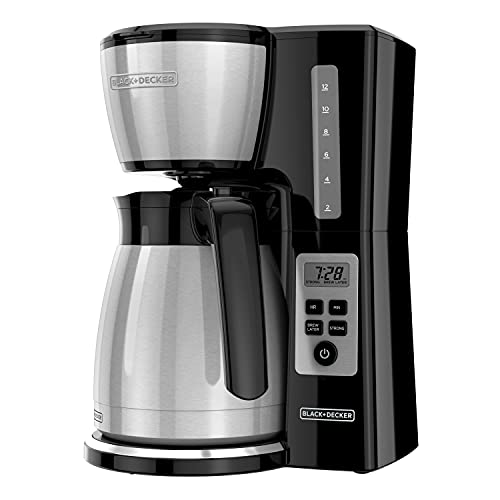
BLACK+DECKER 12-Cup Thermal Programmable Coffee Maker CM2046S
Badge: Best for Even Extraction
Strengths
- VORTEX Technology is designed to saturate the grounds bed evenly, attacking sour, under-extracted pockets
- Brew strength control lets you push a bolder extraction without changing your coffee dose
- Thermal carafe keeps the pot tasting fresh without a flavour-damaging hot plate
Trade-offs
- Even saturation helps most with medium grinds; very fine grinds can still channel
- No dedicated small-batch setting is listed, so half pots need ratio care
- Black and steel finish shows fingerprints more than matte alternatives
At a glance: Capacity: 12 cups · Carafe: thermal · Programmable: yes · Brew strength control: yes · Technology: VORTEX Technology · Colour: Black/Steel · Model: CM2046S
The CM2046S makes its taste case through water distribution. In drip brewing, the classic failure is uneven wetting: water finds one easy path through the grounds, over-extracts that channel into bitterness, and leaves the rest under-extracted and sour, and the cup tastes like both mistakes at once. A shower-style system marketed as VORTEX Technology is built to spread water across the bed instead, and for drinkers whose current machine produces cups that swing between sharp and harsh, that evenness is the most valuable upgrade on this list.
Brew strength control adds a second lever. Rather than simply adding more coffee, you can ask the machine for a bolder cycle, which suits drinkers who take milk and find standard drip a little washed out. Programmability means the pot can be ready when you are, and because it lands in a thermal carafe, a pot brewed slightly early does not punish you for it. This is a strong, sensibly priced-feeling tier of machine — a mainstream design with one genuinely taste-focused idea at its centre.
Best for: drinkers whose current coffee tastes uneven — sour one day, bitter the next / Not suited for: solo drinkers who mostly brew two cups at a time

Cuisinart PerfecTemp 12-Cup Thermal Drip Coffee Maker DCC-3400NAS
Badge: Best Overall for Taste
Strengths
- PerfecTemp hotter brewing targets the temperature range where drip extraction tastes sweetest and fullest
- Double-wall stainless steel thermal carafe holds heat and flavour without stewing
- Brew strength control gives a second extraction lever for milk drinkers and bold palates
Trade-offs
- No 1-4 cup setting is listed, so small pots are not its speciality
- Silver finish and thermal carafe add visual bulk on smaller counters
- Hotter brewing rewards fresh beans; stale coffee tastes more obviously stale, not less
At a glance: Capacity: 12 cups · Carafe: double-wall stainless steel thermal · Brewing: PerfecTemp hotter brewing · Brew strength control: yes · Colour: silver · Model: DCC-3400NAS
If one machine here deserves the taste crown, it is this Cuisinart. PerfecTemp hotter brewing addresses the most common hidden flaw in home drip coffee: water that arrives at the grounds too cool, producing flat, sour-leaning cups no matter how good the beans are. Hotter, controlled water extracts the sweet, soluble compounds more completely, and in practice that is the difference between coffee that tastes like a café drip and coffee that tastes like a compromise.
The double-wall stainless steel thermal carafe completes the argument. Coffee that brews well and then sits on a hot plate is a story with a sad ending; coffee that brews well and rests in insulation keeps its character far longer. Brew strength control rounds out a package aimed squarely at flavour rather than novelty. Readers who want this brewing approach in a smaller footprint should also look at Best Small Serve Coffee Makers for the compact end of the category. For a full-size household pot, though, this is the benchmark in the guide.
Best for: flavour-first households brewing full pots daily / Not suited for: drinkers who mainly brew one or two cups

BLACK+DECKER CaféCraft 12-Cup Thermal Coffee Maker
Badge: Best for Hot and Iced Variety
Strengths
- Brews both hot and iced coffee, so taste preferences across seasons stay in one machine
- Thermal carafe protects a morning pot from hot-plate stewing
- Programmable start suits households that want coffee ready on a schedule
Trade-offs
- The listing gives fewer extraction details than the PerfecTemp models, so its taste case rests more on format than on brewing technology
- Iced coffee mode will not suit purists who prefer a separate cold-brew method
- Twelve-cup capacity is more machine than a one-person household needs
At a glance: Capacity: 12 cups · Carafe: thermal · Modes: hot and iced coffee · Programmable: yes · Line: CaféCraft
The CaféCraft earns its place by widening what good-tasting coffee means across a year. In summer, plenty of households abandon their drip machine for café iced coffee, not because the machine brews badly but because it only brews hot. A model that handles both hot and iced coffee keeps home coffee central in every season, and brewing iced coffee directly, at a strength intended to survive dilution over ice, tastes markedly better than pouring a standard hot pot over ice cubes and hoping.
For hot coffee, the fundamentals here are sound: a twelve-cup thermal carafe and programmability, which together mean a pot brewed for a household breakfast stays pleasant through second cups. We are straightforward that its listing says less about extraction temperature or saturation than the Cuisinart and VORTEX models do, so flavour purists chasing the last degree of control may rank it below them. As an all-season family machine, though, it covers more drinking occasions than any other pick here.
Best for: households that switch between hot pots and iced coffee through the year / Not suited for: extraction purists who want named temperature technology

Cuisinart 12-Cup PerfecTemp Thermal Carafe Coffee Maker, White
Badge: Best for Small Batches
Strengths
- Dedicated 1-4 cup setting addresses the weakest case in drip brewing: the small batch
- PerfecTemp hotter brewing brings the guide’s best extraction story to half pots as well as full ones
- Brew pause lets you pour a first cup mid-cycle without waiting for the full pot
Trade-offs
- White finish will show coffee splashes and counter stains more readily than darker models
- Brew pause is a convenience, not a quality feature — cups poured early taste stronger than the finished pot
- Still a full-size twelve-cup footprint for households that may rarely fill it
At a glance: Capacity: 12 cups · Carafe: PerfecTemp thermal carafe · Small-batch setting: 1-4 cups · Brew strength control: yes · Brew pause: yes · Finish: stainless steel, white
Small batches are where big drip machines go to disappoint. Brew two cups in a twelve-cup brewer without a small-batch mode and the water often rushes through a shallow bed of grounds, under-extracting it, while the carafe loses heat faster than a full one. This white Cuisinart PerfecTemp is the only pick in the guide listing a dedicated 1-4 cup setting, and for couples and small households that single feature may matter more than anything else here.
It keeps the rest of the PerfecTemp package: hotter brewing, brew strength control and a thermal carafe, so a household that brews small on weekdays and full on weekends gets one machine that handles both honestly. Brew pause adds weekday practicality. If your household size is genuinely small every day, compare this against Best Smallest Coffee Makers as well — but if your batch size varies, this is the most flexible taste pick in the line-up.
Best for: couples and small households whose batch size changes day to day / Not suited for: buyers who want a dark finish that hides splashes

BUNN 55200 CSB3T Speed Brew Platinum Thermal Coffee Maker
Badge: Best for Fast, Fresh Pots
Strengths
- Speed Brew design gets coffee brewed and ready quickly, so pots are drank fresh rather than left sitting
- Thermal carafe in stainless steel holds the pot without a hot plate
- Ten-cup capacity suits households that finish a pot promptly rather than grazing on it for hours
Trade-offs
- No brew strength control or small-batch setting is listed, so extraction control is simpler than the Cuisinart models
- Ten cups is the smallest full-pot capacity here, which large households may outgrow
- Its taste case is freshness through speed, not adjustable extraction technology
At a glance: Capacity: 10 cups · Carafe: thermal · Material: stainless steel · Line: Speed Brew Platinum · Colour: black · Model: 55200 CSB3T
The BUNN Speed Brew Platinum argues that the freshest-tasting pot is the one brewed fast and finished young. BUNN built its name on fast brewing, and the Speed Brew line carries that identity into the home: a ten-cup thermal pot produced quickly, ready for a household that drinks together at breakfast rather than returning to a stewing carafe across a whole morning. Speed also helps flavour directly, because coffee spends less total time between grinding and drinking.
The trade-off is control. There is no listed brew strength selector or small-batch mode, so dialling in a particular palate relies on your grind and ratio rather than on machine settings. For many households that is a fair exchange: fewer decisions, a fast and fresh pot, and a stainless thermal carafe to hold it. If your mornings are a shared event with a start time, this is a compelling, unfussy way to make those mornings taste better.
Best for: households that brew one pot and drink it together, promptly / Not suited for: tinkerers who want strength and batch-size controls
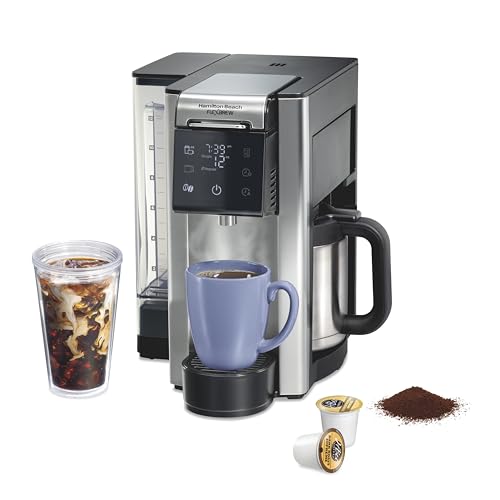
Hamilton Beach FlexBrew Advanced 5-in-1 Coffee Maker
Badge: Most Versatile
Strengths
- Five-in-one format covers a full thermal drip pot and single servings in one footprint
- Brews with pods or grounds, so each drinker can follow their own taste
- Removable 60 oz reservoir reduces refill trips in a busy household
Trade-offs
- Versatility spreads its talents: dedicated drip-only machines here offer more extraction-specific features
- Pod coffee will never match a well-made grounds brew for depth of flavour
- More modes mean more parts to clean if you use them all
At a glance: Format: 5-in-1 drip and single serve · Modes: hot and iced coffee · Drip capacity: 12 cups, thermal, programmable · Brewing options: pods and grounds · Reservoir: removable, 60 oz · Colour: black
The FlexBrew Advanced approaches taste from the household-harmony angle. In many homes the flavour problem is not extraction at all; it is that one person wants a strong pot, another wants a flavoured pod, and a third wants iced coffee, so everyone ends up with a compromise. A five-in-one machine that brews a twelve-cup thermal programmable drip pot, single servings, hot and iced coffee, and accepts both pods and grounds lets each drinker get closer to their own preference.
Judged purely as a drip machine, it lacks the named extraction technologies of the PerfecTemp and VORTEX picks, and pod brews should be chosen for convenience rather than ultimate cup quality. Judged as the machine most likely to be used happily by everyone in a mixed household, it may be the smartest buy here. Households tight on counters should weigh it against Best Small Pod Coffee Makers, but one machine replacing two is itself a space saving.
Best for: mixed households split between pots, pods and single cups / Not suited for: single-palate purists who only ever brew one way
Comparison Table
| Pick | Badge | Capacity / format | Holding / carafe | Listing |
|---|---|---|---|---|
| BLACK+DECKER CM2046S | Best for Even Extraction | Capacity: 12 cups | Carafe: thermal | Check on Amazon |
| Cuisinart PerfecTemp DCC-3400NAS | Best Overall for Taste | Capacity: 12 cups | Carafe: double-wall stainless steel thermal | Check on Amazon |
| BLACK+DECKER CaféCraft | Best for Hot and Iced Variety | Capacity: 12 cups | Carafe: thermal | Check on Amazon |
| Cuisinart PerfecTemp, White | Best for Small Batches | Capacity: 12 cups | Carafe: PerfecTemp thermal carafe | Check on Amazon |
| BUNN Speed Brew Platinum | Best for Fast, Fresh Pots | Capacity: 10 cups | Carafe: thermal | Check on Amazon |
| Hamilton Beach FlexBrew Advanced | Most Versatile | Format: 5-in-1 drip and single serve | Modes: hot and iced coffee | Check on Amazon |
How to Choose Among the Best quality tasting coffee makers
Choosing for taste means ranking the variables honestly. The machine controls water temperature, water distribution, brew time and how coffee is held afterwards. You control the beans, the grind, the ratio and how fresh everything is. A quality-tasting machine is one that removes machine-side excuses, so that the variables you control can actually shine.
Brewing temperature
Coffee extracts best in a hot, stable range. Machines that advertise hotter brewing, like the PerfecTemp models, are addressing the most common cause of sour, thin home drip. If your current coffee tastes sharp no matter which beans you buy, temperature is the first suspect.
Water distribution
A showerhead or vortex-style system that wets the whole grounds bed prevents channeling, where water drills one path and leaves the rest dry. Even extraction tastes sweet and balanced; uneven extraction tastes sour and bitter at the same time.
Thermal holding
A thermal carafe holds coffee with insulation. A glass carafe on a hot plate keeps cooking the coffee, and the flavour cost grows with every half hour. For households that drink a pot over a morning, this choice alone changes the last cup completely.
Batch-size honesty
Rate your real batch, not your aspirational one. If you brew four cups most days, a 1-4 cup setting or a smaller machine will taste better than a twelve-cup brewer run at a third of its capacity.
Strength control versus dose
Brew strength settings adjust the cycle; adding more coffee adjusts the recipe. Both work, but they are not identical. Strength control is convenient for households split between regular and bold drinkers.
Speed and freshness
A fast brewer shortens the gap between grinding and drinking and suits households that finish a pot together. Slow, programmable convenience suits households that graze. Match the machine to the rhythm, not to a spec sheet.
Budget tiers in this category buy features in a predictable order. The lower tier buys the thermal format and programmability. The middle tier adds extraction technology — hotter brewing, strength control, better water distribution. The upper tier adds build, capacity flexibility and multi-format versatility. For pure taste per tier, the middle is the sweet spot, which is why the PerfecTemp models sit at the centre of this guide. Readers whose priority is footprint over flavour can cross-check Best Space Saving Coffee Makers before deciding.
How to Brew Better-Tasting Coffee in Any of These Machines
The steps below apply to every pick in this guide and will improve your cup more than any single upgrade. Work through them in order the first week you own the machine.
- Start with fresh, whole beans and grind just before brewing if you can. Pre-ground coffee is convenient, but its flavour fades far faster; even a modest grinder beats stale pre-ground in a better machine.
- Use a medium grind for drip baskets — roughly the texture of coarse sand. Too fine and the cup turns bitter and the basket may overflow; too coarse and it tastes weak and sour.
- Measure a starting ratio of about one to two tablespoons of coffee per six ounces of water, brew, taste, and then adjust one step at a time. Write your preferred ratio on a note inside a cupboard door.
- Use fresh, cold water in the reservoir each day. Water left sitting in a warm machine tastes flat and can carry yesterday’s flavours into today’s pot.
- Let the full cycle finish before pouring, except when using a brew pause feature for a single quick cup — and know that early cup will taste stronger than the finished pot.
- Serve from the thermal carafe promptly and keep the lid closed between pours. Every opening trades heat, and heat loss flattens flavour.
- Rinse the carafe and basket after each use, wash with mild detergent regularly, and descale on the schedule your water hardness demands — mineral scale lowers brewing temperature and adds off flavours.
Troubleshooting
Problem: Coffee tastes sour and thin → what to do: Check grind first (go finer), then ratio (add coffee), then consider that your old machine brewed cool — a hotter-brewing model addresses the machine side of this fault.
Problem: Coffee tastes bitter and harsh → what to do: Go coarser, reduce the strength setting, and check whether the pot sat too long; bitterness that grows across the morning points at holding, not brewing.
Problem: The pot tastes fine at first, then dull → what to do: Heat loss or stale water is the usual cause: close the carafe lid between pours, start with fresh water, and clean the carafe, which holds onto old coffee oils.
Why Thermal Carafes Taste Better Over a Morning
The flavour of brewed coffee changes with time and heat. On a hot plate, the pot is effectively still cooking: volatile aromatics escape, bitterness compounds develop, and the cup poured at ten o’clock is a poorer relative of the cup poured at eight. Insulated holding slows that decline dramatically, which is why every pick in this guide uses a thermal carafe despite the format costing more to build than a glass jug.
Thermal holding has one discipline attached: pre-warming the carafe with hot water on cold mornings helps a full pot hold its temperature, and keeping the lid sealed between pours matters more than most owners expect. Treat the carafe as part of the brewing system rather than a storage jug and it will repay you in the last cup of every pot.
There is also a texture point. Coffee held at a steadier temperature keeps a more consistent body, while coffee that cools and is reheated — in a microwave, cup by cup — loses aroma at every cycle. If your household drinks slowly, thermal holding is not a luxury feature; it is the main event.
Temperature, Saturation and Time: The Three Levers of Drip Flavour
Every taste claim in this guide reduces to three levers. Temperature decides which compounds extract at all. Saturation decides whether they extract evenly across the whole bed of grounds. Time decides how far extraction goes before the cycle ends. A machine that manages all three — hotter controlled water, even distribution, and a cycle length matched to its capacity — gives you a balanced cup with ordinary care.
This is also why two machines with the same capacity can taste different. The PerfecTemp models pull the temperature lever, the VORTEX model pulls the saturation lever, and the BUNN pulls the time lever by brewing fast. None of these approaches is magic, and none excuses poor beans, but each addresses a real and different failure mode, which is why the right choice depends on what your current coffee gets wrong.
Diagnose before you buy. Sour and thin points at temperature or under-extraction. Mixed sour-and-bitter points at saturation. Good-then-tired points at holding. Match the machine to the diagnosis and the upgrade will feel obvious from the first pot.
Water: The Ingredient That Decides More Than the Machine
Coffee is mostly water, and yet water is the variable home brewers think about least. Water that is heavily chlorinated will carry that flavour straight into the cup no matter which machine in this guide brewed it, and water that is extremely hard not only tastes dull on its own but lays down scale inside the brewer, slowly lowering the temperature the machine can reach. If your tap water tastes good cold from the glass, it will generally brew well. If it does not, a simple filter jug used for brewing water is the cheapest taste upgrade available to any household, and it benefits every machine equally.
Temperature stability is the other half of the water story, and it is where the picks in this guide quietly separate. A machine that delivers water in the proper hot range, steadily, across the whole cycle, extracts the sweet middle of the coffee’s flavour. A machine that starts hot and fades, or pulses unevenly, extracts a mixture of the sour early compounds and little else. This is why the PerfecTemp models’ hotter-brewing design and the even saturation of the VORTEX system keep returning in our reviews: they are not marketing garnish, they are the two halves of what water is supposed to do when it meets coffee.
There is a practical test you can run at home. Brew two pots with the same beans, grind and ratio, one with your everyday tap water and one with filtered water, and taste them side by side at the same temperature. Most households can tell the difference immediately, and the exercise recalibrates expectations: if the filtered pot wins clearly, your machine was never the problem. If both pots share the same flaw — sourness, bitterness, flatness — then the flaw lives in temperature, ratio or freshness, and the sections around this one tell you which lever to pull first.
A Ratio and Grind Workshop for Every Batch Size
Ratios confuse people because recipes are usually written for one batch size and then scaled by hope. Work in ratios instead of scoops and the maths becomes portable. A sensible starting point for drip coffee is roughly one part coffee to sixteen parts water by weight, adjusted stronger toward one to fourteen for drinkers who take milk, or gentler toward one to seventeen for those who drink it black and prefer clarity. You do not need a scale to benefit, but you do need consistency: measure the same way every time, change one thing at a time, and judge a change over at least two pots, because palate and beans vary day to day.
Batch size changes the physics as well as the arithmetic. In a small batch, water passes through a shallow bed quickly, so extraction runs short; this is exactly the problem a dedicated 1-4 cup setting exists to solve, and why the white Cuisinart earns its badge in this guide. In a full batch, the deeper bed and longer cycle extract more completely, which is why a recipe that tastes perfect at twelve cups can taste thin at four in the same machine. Keep two written recipes — your small-batch recipe and your full-pot recipe — taped inside a cupboard door, and most home coffee inconsistency disappears within a week.
Grind sits underneath all of this. For the flat-bottom and cone baskets used across this category, a medium grind, similar in feel to coarse sand, is the honest starting point. If the cup is sour, thin and salty, extraction ran short: grind slightly finer or add a little coffee. If the cup is bitter, dry and harsh, extraction ran long: grind slightly coarser or ease the dose down. Make small moves. The drinkers who chase flavour in huge adjustments oscillate between the two faults forever, while the drinkers who nudge one notch at a time find their setting and keep it for years.
The First-Week Tasting Protocol: Judging a New Machine Fairly
A new coffee maker deserves a fair trial, and most never get one, because the first pot is brewed with old beans, a guessed ratio and a lifetime of habits from the previous machine. Give any pick in this guide a structured first week instead. Days one and two: brew your normal recipe and change nothing, establishing a baseline. Days three and four: adjust only the ratio, one step in the direction your palate requests. Days five and six: adjust only the grind, one notch. Day seven: brew the best combination again and decide, with a week of evidence, what the machine actually does.
Taste at drinking temperature, not at brewing temperature, and taste the first cup and a later cup from the same pot. The gap between those two cups is the thermal carafe’s report card, and in this guide it should be a small gap. Take three-word notes — sweet, thin, harsh, clean, dull — rather than scores. Notes written in words survive; numbers invented on the spot do not, and this site does not print fixed scores for exactly that reason.
If, after a fair week, a machine still disappoints, the protocol has at least told you where the disappointment lives, and whether it is the machine’s fault at all. That knowledge is worth as much as the coffee: it stops households cycling through brewers when the real culprit was stale beans, hard water or a recipe that never suited the batch size in the first place.
Beans, Storage and the Honest Limits of Any Brewer
It would be convenient if a better machine could rescue old beans, and dishonest to pretend otherwise. Coffee stales from the moment it is roasted, faster once ground, and the symptoms — flat aroma, hollow flavour, a cup that tastes like the idea of coffee — are routinely blamed on brewers that are doing their jobs perfectly well. Buy beans in quantities your household will finish while they are still lively, store them sealed away from heat and light, and grind as close to brewing as your routine allows. None of the picks in this guide can repeal that chemistry, and all of them will reward you visibly when you respect it.
Storage mistakes are quieter than freshness mistakes. Beans kept beside the stove absorb heat cycles; beans kept in the freezer and dosed daily collect condensation; beans kept in a pretty, unsealed jar on the counter are a decoration with a declining hobby. A sealed container in a cool cupboard, opened briefly and closed properly, is the whole technology required. If a pot suddenly tastes worse with no change of machine, recipe or water, the beans are the first suspect, and they are guilty often enough that experienced brewers check them before touching a single setting.
This is also the right place to set expectations for the category. These are drip machines, and great drip coffee is a different pleasure from espresso or pour-over: rounder, more forgiving, built for mugs rather than demitasses. Judged on their own terms — a sweet, balanced, generous pot that stays pleasant across a morning — the best of these machines deliver completely. Judged against a café extraction they were never designed to imitate, everything disappoints. Choose the pleasure you actually drink, and let the machine be excellent at that.
Serving Well: Temperature, Cups and the Last Pour
The final metres of the journey matter more than their length suggests. Coffee served into a cold, thick mug loses heat and aroma on contact; warming the mug with hot water on a cold morning is a ten-second ritual with an outsized effect on the first sip. Pour steadily, close the carafe lid immediately afterwards, and resist the household habit of leaving the carafe open on the counter between cups, because every open minute is flavour leaving by the only door available to it.
Taste also changes as coffee cools in the cup, and not always for the worse: many drinkers find the sweetest, clearest flavours a little below scalding, which is worth remembering before declaring a pot dull at first sip. Give a new machine’s coffee a minute in the cup before judging it. The thermal carafes in this guide hold coffee at a steady, drinkable heat rather than a punishing one, which is partly why their pots taste composed from first pour to last.
And pour the last cup with the same respect as the first. The end of a thermal pot, brewed well and held properly, should be a good cup of coffee, not an apology. If yours consistently is not, the fault lies in holding time, an unsealed lid, or a carafe that needs cleaning — all fixable, all cheaper than a new machine, and all covered in the maintenance habits elsewhere in this guide.
Common Buying Mistakes
- Buying capacity you never use: A twelve-cup machine brewed at four cups without a small-batch mode makes its weakest coffee for your most common day. Size the machine to the weekday, not the holiday.
- Judging a machine with stale beans: New brewers get blamed for old coffee constantly. Run any new machine on fresh beans for a week before forming a verdict.
- Ignoring the grinder: Grind consistency shapes extraction as much as the brewer does. Upgrading the machine while keeping a blade-chopped, dusty grind leaves half the improvement on the table.
- Leaving water in the reservoir: Yesterday’s warm, flat water makes today’s flat pot. Refill fresh every morning; it takes twenty seconds.
- Never descaling: Scale insulates the heating element, brewing temperature falls, and sour cups creep in over months. Descale before the machine tastes tired, not after.
- Pouring mid-brew every day: The first coffee through is the strongest. Habitual mid-brew pouring leaves the rest of the pot weak and unbalanced.
Final Recommendation
For most households, start with the Cuisinart PerfecTemp DCC-3400NAS: hotter controlled brewing plus a double-wall thermal carafe is the most complete taste package in this guide, and it asks nothing unusual of the drinker. You can check the Cuisinart PerfecTemp on Amazon to confirm the current listing before deciding.
Choose the BLACK+DECKER CM2046S instead if your current coffee’s problem is unevenness — sour and bitter in the same cup — because its VORTEX saturation design targets exactly that, and check the BLACK+DECKER CM2046S on Amazon if that diagnosis sounds familiar. Households that brew and drink together, fast, should look at the BUNN: check the BUNN Speed Brew Platinum on Amazon for the freshness-through-speed route.
Whichever you choose, spend the first week on the ratio and grind steps in the how-to section before judging the machine. Quality taste is a system — brewer, beans, grind, water and holding working together — and every pick here can hold up its end of that system when the rest is in place.
Frequently Asked Questions
What actually makes one coffee maker taste better than another?
Three machine-side factors dominate: brewing temperature, evenness of water distribution over the grounds, and how the coffee is held after brewing. Hotter controlled water extracts fully, even saturation prevents mixed sour-and-bitter cups, and thermal holding stops the pot from cooking on a plate. Beyond the machine, bean freshness, grind and ratio matter just as much.
Is a thermal carafe really better tasting than a glass carafe?
For any pot that is not finished immediately, yes. A glass carafe on a warming plate keeps applying heat, which steadily increases bitterness and dulls aroma. A thermal carafe simply insulates, so the flavour declines far more slowly. If you always drink a pot within minutes of brewing, the gap narrows considerably.
What does a brew strength control actually change?
It adjusts the brewing cycle — typically how water is delivered and how long extraction runs — to produce a bolder or milder cup from the same dose of coffee. It is a convenient way for households with mixed preferences to vary the pot without remeasuring, though changing your coffee-to-water ratio gives you finer control.
Why does my coffee taste sour even with good beans?
Sourness usually signals under-extraction: water too cool, grind too coarse, too little coffee, or water rushing through a small batch in a big machine. Work through those in order. A hotter-brewing machine and a small-batch setting, both represented in this guide, address the machine-side causes.
How much coffee should I use per pot?
Start near one to two tablespoons per six ounces of water, brew a pot, and adjust by taste over several days. Keep notes. Preference varies, but a measured, repeatable ratio beats guessing scoops, because it lets you change one variable at a time when a pot disappoints.
Does a faster brewer make better coffee?
Speed helps freshness: the pot is ready sooner after grinding and is usually finished younger. The BUNN in this guide builds its case on that. Speed alone does not fix temperature or saturation, so it suits households whose current coffee tastes tired rather than sour or uneven.


