Disclosure: topratedkitchenware.com is reader-supported. When you buy through links on our site, we may earn an affiliate commission from Amazon and other retailers, at no extra cost to you.
Where to buy
If you are shopping for the best quiet coffee makers covered in this guide, start with the six verified picks below. Each name links to its Amazon listing so you can check the latest price on Amazon and confirm the current configuration before you decide. Prices and availability change, so we never print a fixed figure here.
- BLACK+DECKER CM2046S — Best for Night-Before Brewing. Check on Amazon for the current listing details.
- Cuisinart PerfecTemp DCC-3400NAS — Best Overall Quiet Routine. Check on Amazon for the current listing details.
- BLACK+DECKER CaféCraft — Best for Open-Plan Homes. Check on Amazon for the current listing details.
- Cuisinart PerfecTemp, White — Best for Early Risers. Check on Amazon for the current listing details.
- BUNN Speed Brew Platinum — Best for Short Noise Windows. Check on Amazon for the current listing details.
- Hamilton Beach FlexBrew Advanced — Best for Different Wake Times. Check on Amazon for the current listing details.
Read the full guide ↓ for how each pick performs, where each one compromises, and which households each one actually suits.
The best quiet coffee makers share a secret that has nothing to do with motors: drip brewing is one of the quietest ways to make coffee at home in the first place. There is no grinder screaming at dawn, no pump driving water at pressure, no steam wand announcing itself to the whole house. Water heats, rises, and percolates through grounds at a murmur. The differences that remain — and they matter in a sleeping household — are about timing, duration, beeps, carafe design and where the machine sits. This guide works through all of them.
Every pick here is a thermal-carafe drip brewer, chosen partly for quietness itself: an insulated carafe makes no warming-plate clicks, produces no sizzling plate noises, and lets you brew once for a household that wakes in stages instead of re-starting a noisy routine for each person. Within that quiet family, the strategies differ. Programmable models can finish before the earliest riser is even awake, or be set by a night owl for the morning. The BUNN’s fast cycle compresses the noise window to a few minutes. The white Cuisinart’s brew pause avoids the clatter of a second, separate routine for the first cup. And the FlexBrew’s single-serve side makes one silent cup without running a whole pot for a house still asleep.
We are honest about the limits of the category: none of these listings publishes a decibel figure, and we will not invent one. Quiet here is judged by mechanism — what makes noise, for how long, and whether it can be scheduled away — which is the information you can actually act on. Pair this guide with good placement habits from the how-to section, and with Best Stainless Steel Thermal Coffee Makers if you want to compare thermal formats more widely.
Key Takeaways
- Drip brewing is inherently quiet: no grinder, no pressure pump, no steam — the baseline noise of every pick here is low.
- Thermal carafes remove warming-plate clicks and sizzle, and let one brew serve a house that wakes in stages.
- Programmability is the strongest quiet feature: a pot brewed before anyone wakes makes no noise anyone hears.
- The BUNN Speed Brew shortens the noise window itself — a fast cycle is simply over sooner.
- Brew pause and single-serve modes prevent the extra clatter of second routines for the first person up.
- Placement matters as much as the machine: a level counter away from bedroom walls, with the lid and carafe handled gently, keeps any pick quieter.
In this guide
Quick Picks
| Pick | Badge | Headline facts |
|---|---|---|
| BLACK+DECKER CM2046S | Best for Night-Before Brewing | Capacity: 12 cups; Carafe: thermal |
| Cuisinart PerfecTemp DCC-3400NAS | Best Overall Quiet Routine | Capacity: 12 cups; Carafe: double-wall stainless steel thermal |
| BLACK+DECKER CaféCraft | Best for Open-Plan Homes | Capacity: 12 cups; Carafe: thermal |
| Cuisinart PerfecTemp, White | Best for Early Risers | Capacity: 12 cups; Carafe: PerfecTemp thermal carafe |
| BUNN Speed Brew Platinum | Best for Short Noise Windows | Capacity: 10 cups; Carafe: thermal |
| Hamilton Beach FlexBrew Advanced | Best for Different Wake Times | Format: 5-in-1 drip and single serve; Modes: hot and iced coffee |
How These Picks Were Chosen
We built this shortlist from the verified pick pool with a mechanism-first definition of quiet. A pick had to be a drip brewer without a built-in grinder, because grinding is the loudest event in home coffee and no enclosure fully tames it. It had to use a thermal carafe, removing the warming plate’s clicking thermostat and the sizzle of coffee on hot glass. And it had to offer at least one noise-management strategy: programmability to move brewing out of sleeping hours, a fast cycle to shorten them, a small-batch or pause feature to avoid repeat routines, or a single-serve mode for one silent cup.
We also considered the household soundscape honestly. In a studio or an open-plan home, duration matters as much as volume; in a house of shift workers, scheduling matters most; for parents of a light-sleeping baby, the absence of beeps, bangs and plate clicks matters more than the brew murmur itself. Each review names the soundscape its machine suits. Readers in genuinely small spaces should also see Best Smallest Coffee Makers, since a compact machine placed well can beat a large one placed badly.
Method note: this is research-led guidance based on manufacturer specifications and the known acoustics of drip brewing. No listing in the pool publishes a decibel rating, so we make no numerical noise claims for any pick; instead we explain, for each machine, what will make sound, when, and how the household can arrange for nobody to hear it.
Site rules apply throughout: no static prices, no fixed ratings or review counts, and links only to the verified listings in the pool.
The 6 Best Quiet Coffee Makers, Reviewed in Detail
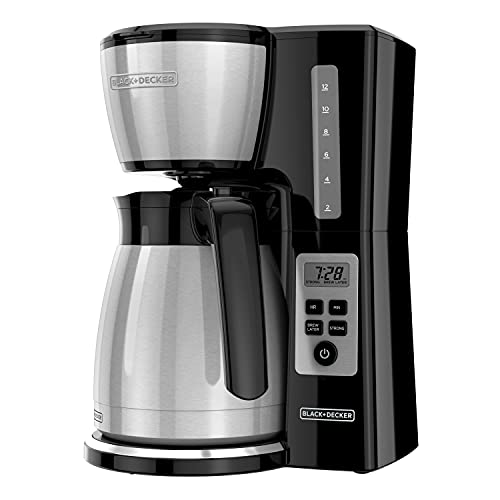
BLACK+DECKER 12-Cup Thermal Programmable Coffee Maker CM2046S
Badge: Best for Night-Before Brewing
Strengths
- Programmable brewing can finish before the house wakes, removing the noise from sleeping hours entirely
- Thermal carafe eliminates warming-plate clicks and sizzle after brewing
- VORTEX saturation is a silent process — water distribution makes no mechanical noise
Trade-offs
- If run live in the morning, its conventional cycle lasts a normal length beside other rooms
- No small-batch mode listed, so a single early cup means a full quiet cycle or waiting
- Programmability only helps households willing to stage the night before
At a glance: Capacity: 12 cups · Carafe: thermal · Programmable: yes · Brew strength control: yes · Technology: VORTEX Technology · Colour: Black/Steel · Model: CM2046S
The CM2046S is the night-before strategist of this guide. Set it in the evening and its twelve-cup thermal pot is brewed and waiting before the first alarm, which means the noisiest interpretation of quiet — no brewing sounds during sleeping hours at all — is achieved by the clock rather than by engineering. The thermal carafe then holds the pot in silence: no plate clicking on and off, no hiss, nothing to penetrate a bedroom door across the morning.
Used live, it is an ordinary, gentle drip brewer rather than a specially hushed one, and we rank it on that honest basis. Its quiet case is scheduling, and for organised households that is the strongest case there is. The VORTEX system and strength control keep the pre-brewed pot worth waking for.
Best for: organised households that can stage coffee the night before / Not suited for: spontaneous brewers in thin-walled flats who brew live at dawn

Cuisinart PerfecTemp 12-Cup Thermal Drip Coffee Maker DCC-3400NAS
Badge: Best Overall Quiet Routine
Strengths
- All-drip, grinder-free design keeps the whole process at a murmur
- Double-wall stainless thermal carafe holds coffee silently for staggered waking
- Hotter PerfecTemp brewing completes a full pot in one quiet cycle — no repeat brewing for late risers
Trade-offs
- Standard cycle length means a live brew is a normal-duration event
- No dedicated small-batch setting for a single silent early cup
- Silver finish and size make it a visible, permanent counter resident
At a glance: Capacity: 12 cups · Carafe: double-wall stainless steel thermal · Brewing: PerfecTemp hotter brewing · Brew strength control: yes · Colour: silver · Model: DCC-3400NAS
If one machine here best represents the quiet drip ideal, it is the Cuisinart DCC-3400NAS. Its virtues compound: a grinder-free drip cycle that never rises above a murmur, PerfecTemp extraction that makes one cycle sufficient for the whole house, and a double-wall stainless thermal carafe that keeps that cycle’s output ready, in silence, for everyone who wakes after the brewer has finished. In a staggered household, the quietest machine is the one nobody has to run twice.
There is no hush technology to describe, because drip brewing does not need it; what this model offers is completeness, so the quiet routine happens once and holds. Households comparing thermal formats can cross-check Best Stainless Steel Thermal Coffee Makers — this pick is very much of that family. For most homes that simply want mornings to stay calm, it is the benchmark here.
Best for: households that wake in stages and want one silent brew to cover everyone / Not suited for: buyers wanting a tiny machine for a studio shelf

BLACK+DECKER CaféCraft 12-Cup Thermal Coffee Maker
Badge: Best for Open-Plan Homes
Strengths
- Drip cycle is gentle and grinder-free, like every pick here
- Hot and iced modes avoid the blender-and-café noise of summer alternatives
- Programmable start lets brewing happen outside sleeping hours
Trade-offs
- No fast or small-batch features, so live brewing runs a full standard cycle
- Iced coffee still involves ice handling, the loudest part of its routine
- Listing offers less detail on controls and alerts than some rivals
At a glance: Capacity: 12 cups · Carafe: thermal · Modes: hot and iced coffee · Programmable: yes · Line: CaféCraft
The CaféCraft brings the quiet argument to summer. Iced coffee at home usually involves blenders, shakers or a trip out; this machine brews iced coffee directly, in the same low murmur as its hot pots, which keeps July mornings as calm as January ones. Its programmable twelve-cup thermal format covers the standard quiet strategies too: brew before waking, hold without a plate, serve in stages.
Its honest limits are duration and detail. A live full cycle is a full standard cycle, and the listing says less about its control behaviour than the Cuisinart models. Place it on the far side of the kitchen from sleeping quarters, programme it when you can, and it is a peaceable all-season resident.
Best for: open-plan homes that want quiet iced coffee as well as hot / Not suited for: shift workers needing the shortest possible live brew

Cuisinart 12-Cup PerfecTemp Thermal Carafe Coffee Maker, White
Badge: Best for Early Risers
Strengths
- 1-4 cup setting shortens the live brewing event for the first person up
- Brew pause lets an early riser pour and go without starting a second routine
- PerfecTemp thermal format holds the rest of a small pot silently for the next riser
Trade-offs
- Full-pot cycles are standard length if the household brews big
- White finish needs gentle handling to stay scuff-free in a dark, sleepy kitchen
- Brew pause pouring in the dark requires a steady hand and a familiar layout
At a glance: Capacity: 12 cups · Carafe: PerfecTemp thermal carafe · Small-batch setting: 1-4 cups · Brew strength control: yes · Brew pause: yes · Finish: stainless steel, white
The early riser is the quiet-coffee problem in person: awake at five, unwilling to wake the house, unwilling to skip coffee. The white Cuisinart is this guide’s gift to that person. Its 1-4 cup setting runs a shorter, smaller cycle — less time, less water moving, less of everything audible — and brew pause allows a first mug to be poured and carried away without a second machine, a kettle, or a cafetière clattering in a silent kitchen.
What remains can wait in the thermal carafe for the next riser, still warm, still silent. It is a full twelve-cup programmable machine as well, so the early-riser specialism is an addition, not a compromise. For couples on different clocks, this may be the most considerate pick in the guide.
Best for: early risers in households that are still asleep / Not suited for: big households that always brew the full pot live

BUNN 55200 CSB3T Speed Brew Platinum Thermal Coffee Maker
Badge: Best for Short Noise Windows
Strengths
- Fast Speed Brew cycle compresses the entire brewing noise window into a few minutes
- Thermal carafe keeps the finished pot silent, with no plate to click or sizzle
- Simple controls mean no menu beeps and settings to negotiate at dawn
Trade-offs
- No timer listed, so the fast cycle happens when someone is awake to start it
- Ten-cup live cycle is still a live cycle beside a sleeping room
- No small-batch mode for an even shorter single-serving event
At a glance: Capacity: 10 cups · Carafe: thermal · Material: stainless steel · Line: Speed Brew Platinum · Colour: black · Model: 55200 CSB3T
The BUNN Speed Brew Platinum takes the opposite strategy from the programmable picks: if a noise cannot be scheduled away, shorten it. Its fast brewing design turns out a ten-cup thermal pot in a fraction of a conventional cycle’s time, so the murmur of brewing — already gentle — is over almost as soon as it begins. For a household where someone is always awake to press the button, but a baby, a night-shift sleeper or a light-sleeping partner is behind the next door, that brevity is the whole ballgame.
The absence of a listed timer is the honest trade: this machine cannot brew before you wake, only quickly once you do. Judged on its own strategy, it executes superbly. In a house of staggered sleepers where starts are unpredictable, a short noise window beats a long quiet-ish one.
Best for: households with a sleeper to protect and someone awake to press brew / Not suited for: households wanting coffee brewed before anyone wakes
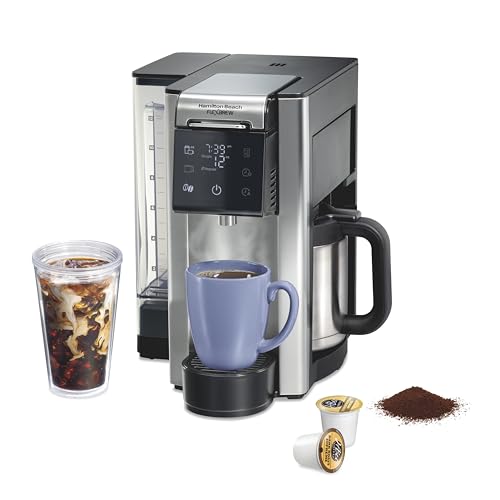
Hamilton Beach FlexBrew Advanced 5-in-1 Coffee Maker
Badge: Best for Different Wake Times
Strengths
- Single-serve mode makes one cup for one awake person, at drip-maker volume, without a full pot routine
- Twelve-cup thermal drip side covers the house when everyone is up
- Removable 60 oz reservoir means fewer clattering refill trips across the week
Trade-offs
- More formats mean more parts to handle, and dropped pod holders are their own dawn noise
- Pod brewing has its own small sounds — puncture and pump-style flow — unlike pure drip
- Using all modes in a sleepy kitchen demands an organised station
At a glance: Format: 5-in-1 drip and single serve · Modes: hot and iced coffee · Drip capacity: 12 cups, thermal, programmable · Brewing options: pods and grounds · Reservoir: removable, 60 oz · Colour: black
The FlexBrew Advanced is the diplomat of this guide: it lets each person’s coffee happen at their own volume of life. The single-serve side — pods or grounds — produces one cup for the person who is awake, in a short, contained routine, while the house sleeps on. When the house is up, the twelve-cup thermal programmable drip side takes over, hot or iced, and the removable 60 oz reservoir keeps refills — and their clatter — to a minimum.
Candour requires noting that pod brewing is not as silent as pure drip: there is a puncture and a more directed flow. It remains far quieter than grinding or steaming, and dramatically quieter than running a full pot routine for one cup. For houses on genuinely different clocks, that flexibility is worth more than any single hush feature. Space-conscious readers can compare it with Best Small Size Coffee Makers before deciding.
Best for: households on different clocks sharing one quiet machine / Not suited for: purists who want one simple, silent drip format only
Comparison Table
| Pick | Badge | Capacity / format | Holding / carafe | Listing |
|---|---|---|---|---|
| BLACK+DECKER CM2046S | Best for Night-Before Brewing | Capacity: 12 cups | Carafe: thermal | Check on Amazon |
| Cuisinart PerfecTemp DCC-3400NAS | Best Overall Quiet Routine | Capacity: 12 cups | Carafe: double-wall stainless steel thermal | Check on Amazon |
| BLACK+DECKER CaféCraft | Best for Open-Plan Homes | Capacity: 12 cups | Carafe: thermal | Check on Amazon |
| Cuisinart PerfecTemp, White | Best for Early Risers | Capacity: 12 cups | Carafe: PerfecTemp thermal carafe | Check on Amazon |
| BUNN Speed Brew Platinum | Best for Short Noise Windows | Capacity: 10 cups | Carafe: thermal | Check on Amazon |
| Hamilton Beach FlexBrew Advanced | Best for Different Wake Times | Format: 5-in-1 drip and single serve | Modes: hot and iced coffee | Check on Amazon |
How to Choose Among the Best quiet coffee makers
Choosing a quiet coffee maker means analysing your household’s soundscape, not shopping for silence in the abstract. Who sleeps, where, and until when? Who wakes first, and what do they do before coffee? The answers select between scheduling the noise away, shortening it, shrinking it to a small batch, or containing it in a single serving.
Scheduling beats silencing
A programmable machine that finishes before the first sleeper stirs is quieter in practice than any live brew, however gentle. If your household can stage at night, start here.
Duration is a volume of its own
In studios and open-plan homes, a fast cycle like the BUNN’s exposes sleepers to far less total sound than a long, soft one. Count minutes, not just loudness.
One brew or many
Thermal holding lets a single morning brew serve staggered risers. Every avoided re-brew is an avoided noise event, which is why carafe choice sits at the centre of this guide.
The first-cup problem
Brew pause and single-serve modes exist for the first person up. Without them, the earliest riser improvises with kettles and cafetières, usually louder than the machine ever is.
Alert sounds and handling
Beeps, lid snaps, carafe clunks and reservoir trips are household noises the spec sheet ignores. Simple controls, a well-kept station and a gentle hand are part of the product you actually live with.
Placement and surfaces
A machine on a hollow counter against a bedroom wall broadcasts; the same machine on a solid surface across the kitchen whispers. Leave room in the budget of attention for where the machine will live, and see Best Space Saving Coffee Makers if placement options are tight.
Money in this category buys strategy rather than silence itself. Lower tiers buy programmability — noise moved in time. Middle tiers buy completeness — one thermal brew that serves everyone. The specialist tiers buy brevity or flexibility. All six picks share the quiet drip foundation; the right one is the one whose strategy matches your household’s sleep.
How to Keep Morning Coffee Quiet: A Practical Routine
Most dawn coffee noise is habit, not hardware. These steps, used with any pick in this guide, will make mornings measurably calmer within a week.
- Stage silently at night: filter in, coffee measured into the basket, reservoir filled, carafe seated, mug waiting. Every staged item is a drawer that does not open at dawn.
- Programme the brew to finish just before the first riser needs it, so brewing sounds fall in sleeping hours only if the household accepts them, or finish before waking entirely.
- Grind the night before if you use whole beans, or choose pre-ground for weekday mornings. The grinder is the loudest appliance in coffee; schedule it like one.
- Place the machine on a solid, level surface away from bedroom walls, with clearance so the carafe slides rather than scrapes. A folded bar towel beneath can damp a hollow counter.
- Pour with the carafe lid managed deliberately — open, pour, close — rather than letting it clatter, and set the carafe down on a mat or towel, not bare stone.
- Use the small-batch, pause or single-serve features for the first cup instead of improvising with kettles and pans.
- Descale on schedule: a scaled machine labours, gurgles and spits more than a clean one, and quiet machines are, in part, maintained machines.
Troubleshooting
Problem: Brewing has started gurgling and spitting loudly → what to do: Mineral scale is the usual cause: descale the machine, and use fresh water, before assuming it is wearing out.
Problem: The pot is quiet but the kitchen is not → what to do: Audit the routine, not the brewer: drawers, grinder, kettle and mug cupboards usually out-shout any drip machine. Stage them away the night before.
Problem: Coffee is ready too early and tastes tired by the last cup → what to do: Move the programme closer to waking and keep the thermal lid closed between pours; the carafe holds well, but it is not a time machine.
Where Coffee Noise Actually Comes From
Rank the sounds of a home coffee routine honestly and the drip brewer sits near the bottom. The grinder is the loudest device in the kitchen short of a blender. A kettle at full boil roars and clicks. Espresso pumps labour at pressure, steam wands shriek, and even a cafetière involves boiling water, pouring and washing up. A drip machine heats water and lets gravity work, and gravity is quiet.
What remains is mostly peripheral: the click of a warming plate’s thermostat, the sizzle of drips on hot glass, alert beeps, carafe clunks, and the human noises of an unprepared kitchen. This guide’s thermal, grinder-free shortlist removes the first two entirely, and the how-to routine handles the rest. That is the whole science of quiet coffee, and it is refreshingly manageable.
It also means expectations should be set correctly. No drip machine is silent, and none needs to be. The goal is a routine whose loudest moment is a murmur behind a closed door — and every pick here can deliver that in a sensibly arranged kitchen.
Quiet Coffee for Shift Workers, Babies and Light Sleepers
Households with a day sleeper live by different rules: coffee must happen at hours when the house is officially asleep, and it must happen daily. For those homes, the strategies in this guide stop being preferences and become infrastructure. Programmability brews before the sleeper’s deepest hours end, thermal holding bridges the gap between shifts, and single-serve modes let the waking shift drink without a full production.
Parents of newborns recognise the same pattern in miniature: the nap is sacred, the coffee is necessary, and the two must coexist. A staged, programmed, thermal routine — mug waiting, machine murmuring in a far corner — is the difference between coffee as a risk and coffee as a rest.
If your household includes a truly light sleeper, combine strategies: the BUNN’s brevity on live mornings, a programmable thermal pot on scheduled ones, and the grinder banished to the evening. Quiet is a system, and this category rewards households that treat it as one.
Reading a Listing for Quiet: What to Look For and What to Ignore
Because almost no coffee maker publishes a meaningful noise specification, quiet shoppers have to read listings the way engineers read them: for mechanisms, not adjectives. Words like whisper and silent in marketing copy tell you nothing. The specification tells you everything, if you know the code. A built-in grinder is the single loudest component in home coffee, so its absence is the first thing to verify. A warming plate implies a clicking thermostat and sizzling drips, so a thermal carafe is the second. A pump implies pressure and vibration, so a gravity-fed drip design is the third. Every pick in this guide passes all three checks, which is the real reason the shortlist sounds the way it does.
Controls deserve a look as well. Elaborate interfaces tend to announce themselves with beeps for every press and a fanfare at the end of the cycle, and some machines let those alerts be muted while others do not. Listings rarely settle the question, so treat alert behaviour as a thing to verify in the questions and documentation for the exact model you choose, and weigh it honestly: a single soft end-of-cycle tone is a trivial event in most homes and a genuine problem in a house with a day sleeper.
Finally, ignore any decibel figure that appears without a measurement method. Distance, room and load change such numbers beyond recognition, and a figure quoted without them is decoration. Mechanism, duration and scheduling — the three lenses used throughout this guide — predict a household’s real experience far better than a laboratory number ever will.
The Night-Shift Playbook: Coffee Around a Day Sleeper
A household with a night-shift worker runs two days in one building, and coffee belongs to both of them. The returning worker wants a cup before sleeping; the waking household wants theirs without ending that sleep early. The playbook that serves both starts the night before, with the machine staged and, where the schedule allows, programmed to brew a thermal pot timed for the household’s morning rather than the worker’s return. The thermal carafe is the treaty between the two days: brewed once, poured quietly by whoever needs it, never re-heated, never re-brewed, and never announced by a warming plate.
For the returning worker’s own cup, the small-batch and single-serve strategies in this guide earn their place. A short, contained routine in a distant corner of the kitchen, with a mug that was staged the night before, produces coffee at a volume the rest of the house can sleep through. The grinder, if the household owns one, belongs to the waking hours entirely; night-shift coffee is pre-ground coffee, and no one who has slept through a grinder at the wrong hour will argue otherwise.
Rotate the playbook as the shifts rotate. The finish time that protects a sleeper in one rotation endangers one in another, and a ten-second adjustment when the roster changes is the cheapest kindness in the whole system. Quiet, in a shift household, is not a product feature. It is a roster with a coffee machine in it.
Apartments, Thin Walls and the Considerate Kitchen
Apartment living adds neighbours to the soundscape, and with them a different standard: not whether the house wakes, but whether the building does. Drip coffee is already a considerate choice — its sounds are internal to the kitchen, brief and low — but placement decides how much of it travels. A machine on a counter that shares a wall with a neighbour’s bedroom, especially on a hollow surface that acts like a drum, will be heard. The same machine moved along the counter, onto a solid section, with a mat beneath it, effectively disappears.
Timing is the second courtesy. Programmable brewing lets apartment dwellers shift the noisiest parts of the wider routine — grinding, kettle, cupboard doors — into sociable hours, leaving only the murmur for the early morning. Where a machine must run live at dawn, a fast or small cycle shortens the event, which neighbours experience as the difference between a moment and an incident.
None of this requires silence or apology; it requires the same consideration you would want through your own wall. The considerate kitchen is simply the quiet kitchen, arranged once and then forgotten, which is the best kind of arrangement there is.
Quiet Hosting: Brunches, Guests and the Sleeping House
Hosting tests a quiet routine in the opposite direction: more people, more coffee, and usually someone asleep in the spare room. The thermal format in this guide is built for the test. A full pot brewed before guests gather can be carried to the table and poured there, moving the entire coffee operation out of the kitchen’s echo chamber and into the room where the conversation is. Refills become a pour, not a production, and the sleeper hears nothing but brunch.
For gatherings that stretch, resist the urge to keep a second pot cycling noisily in reserve. Brew the second pot when the first is poured out, in one short event, rather than maintaining a rolling boil of activity. Guests experience this as calm abundance; what they remember is the host sitting with them, not the host’s back at a counter. If your machine offers a single-serve side, it quietly absorbs the outliers — the decaf request, the late arrival, the one-more-cup guest — without disturbing the main pot’s rhythm at all.
The lesson generalises beyond hosting. Most coffee noise in a home is not brewing at all; it is repetition, improvisation and ceremony. Remove those, with a staged station and a thermal carafe, and the machine that remains is as quiet as this category honestly gets.
Sound, Sleep and the Science of Not Waking the House
Sleep is not a switch but a slope, and the sounds that disturb it are rarely the loudest ones — they are the unexpected ones. A household’s familiar murmur, heard nightly, is filtered out by sleeping brains with remarkable efficiency; a single unfamiliar clatter at the wrong moment is not. This is why the quiet-coffee strategies in this guide work as well as they do. A drip brewer’s sound is low, continuous and identical every morning, which makes it almost perfectly designed to be slept through, while the noises that actually wake houses — drawers, grinders, kettle clicks, a carafe set down hard on stone — are sharp, brief and human.
Distance and doors do the rest. Sound loses strength quickly across a kitchen and dramatically across a closed door, so the practical question is never whether a machine is audible in the room where it stands — it is — but whether anything meaningful survives the journey to the pillow. For a grinder-free drip machine on a solid counter, in a kitchen with the door closed, the honest answer is very little, and on a programmed schedule, timed outside the deepest sleep, the answer is effectively nothing at all.
Light sleepers deserve one extra layer of respect: consistency. A machine that brews at the same time, in the same way, becomes part of the house’s background within a week or two, while irregular routines keep producing novel sounds at novel hours. If your household protects a sleeper, make the coffee routine boring. Boring, in this category, is the highest compliment a routine can earn.
The Quiet Pantry: Stocking and Staging for Silent Mornings
A quiet machine in a loud kitchen is a half-finished project, and the other half lives in the cupboards. Stage the morning the night before, at pantry level: coffee where the machine is, filters counted rather than assumed, the mug and its lid together, the carafe clean and seated. Every item staged is a cupboard that stays shut at dawn, and cupboards — their hinges, their latches, their rattling contents — are responsible for more morning noise than any appliance in this guide.
Choose quiet supplies, too. A metal scoop set down on a stone counter rings; a wooden or plastic one does not. Beans poured from a stiff bag rustle at length; beans kept in a smooth, sealed canister pour in one soft motion. A travel mug with a positive, simple lid beats a clever one that must be wrestled. None of these choices costs anything worth mentioning, and together they lower the routine’s noise floor below anything a machine specification could promise.
Finally, keep the pantry honest. The dawn raid on a shop, the borrowed filter from a neighbour, the emergency kettle because the coffee ran out — these are the loudest events in the quiet household’s year, and every one of them is a stocking failure, not a brewing failure. A simple rule serves the whole system: when the coffee or the filters reach the last handful, the next shop buys two. Silence, like coffee, is mostly preparation.
Common Buying Mistakes
- Buying a machine with a built-in grinder for a quiet brief: Grinding is the loudest event in coffee. If quiet matters, keep the grinder separate and schedule it, or use pre-ground on weekday mornings.
- Choosing a glass carafe on a warming plate: Plate clicks, sizzles and stewing flavours all arrive together. Thermal holding is the quiet household’s default for a reason.
- Placing the machine against the bedroom wall: Walls conduct. A few feet of kitchen distance, and a solid counter, change what a sleeper hears more than any model swap.
- Improvising the first cup: Kettles, pans and cafetières at dawn out-noise the machine you were avoiding. Use the pause, small-batch or single-serve feature you paid for.
- Ignoring scale until the machine gurgles: Noise creep is a maintenance symptom. Descale on schedule and the murmur stays a murmur.
- Judging quiet on the first morning: Routines settle. Give staging, placement and programming a week before deciding a machine is too loud for the house.
Final Recommendation
For most households, the Cuisinart PerfecTemp DCC-3400NAS is the quiet first choice: one gentle, complete brew, held silently in a double-wall thermal carafe for everyone who wakes after it — check the Cuisinart PerfecTemp on Amazon to confirm the current listing.
Households that can programme should also weigh the BLACK+DECKER CM2046S — check the BLACK+DECKER CM2046S on Amazon — while homes protecting a sleeper with someone awake to brew should look at the short noise window of the BUNN: check the BUNN Speed Brew Platinum on Amazon.
Whichever you choose, build the staged night-before routine from the how-to section in the first week. Quiet coffee is arranged, not purchased, and every pick here will hold up its end of the arrangement.
A Final Word on Expectations
It is worth closing with the category’s most useful truth: quiet coffee is achieved, not bought, and it is achieved mostly with arrangement rather than equipment. The machines in this guide provide the right foundation — grinder-free drip brewing, thermal holding, and a choice of scheduling, brevity, small-batch and single-serve strategies — but the household provides the placement, the staging and the consistency that turn a quiet machine into a quiet morning. Set that arrangement up once, maintain it lightly, and the reward arrives daily: coffee that appears in a sleeping house like a kindness rather than an event, for the early riser, the day sleeper and everyone in between.
Frequently Asked Questions
Are drip coffee makers actually quiet?
Yes, by the standards of home coffee. Drip brewing uses gravity rather than a pressure pump, involves no grinding and no steam, so the process itself is a low murmur. Most of the noise in a coffee routine comes from grinders, kettles, warming plates and unprepared kitchens — all avoidable, and all addressed in this guide.
Do any of these coffee makers publish a decibel rating?
None of the listings in this guide’s pool states one, so we make no numerical claims. We judge quietness by mechanism: what makes sound, for how long, and whether it can be scheduled or shortened. That is the information that predicts life in a real household.
What is the quietest way to make the first cup of the day?
Have it already made: a programmable machine finishing into a thermal carafe before you wake. If someone must brew live, a small-batch cycle, a brew pause pour, or a single-serve mode keeps the event short and contained.
Why does my coffee maker click and sizzle after brewing?
That is a warming plate cycling its thermostat under a glass carafe. Thermal carafes, used by every pick here, remove the plate entirely — the coffee is held by insulation, silently, and tastes better for it.
Can a fast coffee maker be a quiet choice?
Yes, because duration is part of noise. The BUNN Speed Brew’s short cycle exposes sleepers to a few minutes of gentle sound rather than a long one. It cannot brew before you wake, so it suits households where someone is awake to start it.
Where should I put a coffee maker to keep it quiet?
On a solid, level counter as far from sleeping rooms as the kitchen allows, with space to handle the carafe without scraping. A mat underneath helps on hollow counters. Distance and surfaces do more than most owners expect.


