Disclosure: topratedkitchenware.com is reader-supported. When you buy through links on our site, we may earn an affiliate commission from Amazon and other retailers, at no extra cost to you.
Where to buy
Start here if you are comparing best smokers with thermometers: the shortlist below is this whole guide in miniature, with the linked picks first and the honest prose-only alternatives named as such.
Every pick in this guide ships with temperature monitoring named in its listing, a built-in or included meat probe across the board, so all six carry links below and you can check the latest price on Amazon for each. The differences that matter are probe style, cooking format and size, and the reviews unpack them one by one.
- EAST OAK 30-Inch Electric Smoker, Mist Black
- EAST OAK 30-Inch Electric Smoker, Mist Silver
- EAST OAK 30-Inch Electric Smoker with Mobility Stand
- Traeger Pro 22 Pellet Grill and Smoker
- Pit Boss 700 Carbon Series Pellet Grill and Smoker
- Pit Boss 500 Carbon Series Pellet Grill and Smoker
Start with the top pick: Check on Amazon to check the latest price on Amazon and confirm the current configuration before you buy.
Read the full guide ↓ for the reasoning behind every position, the honest limitations of each pick, and the checks that matter more than any headline claim.
The search for the best smokers with thermometers sounds simple until you realise how many kinds of thermometer a smoker can have. There is the dial in the lid that guesses at chamber air, the digital controller reading its own sensor, and the meat probe that reports the only temperature that decides dinner: the internal temperature of the food. This guide is built around the third kind. Every pick here names a built-in or included meat probe in its listing, which is why all six are linked, and the reviews concentrate on how each machine puts that information to work.
That focus matters because barbecue is finished by temperature and tenderness, not by the clock. Two briskets of the same weight can finish hours apart, and a smoker with a trustworthy probe turns that uncertainty into a notification. The pool splits into two families: EAST OAK electric cabinets with built-in probes and viewing windows, and pellet grills from Traeger and Pit Boss with included probes and wide temperature ranges. Readers weighing formats will also find Best Inexpensive Smokers a useful counterpoint on what the budget end does for monitoring, which is usually nothing at all.
The short version: pick the EAST OAK line if you want a dedicated electric smoker whose probe is built into the cabinet, and pick a pellet grill if you want probe monitoring on a machine that also grills. Size then decides within each family, and the detailed reviews below walk through exactly who each of the six suits.
Key Takeaways
- All six picks name a meat probe in their listings, so all six are linked; the choice is about format, not whether monitoring exists.
- A meat probe beats a lid dial every time, because internal food temperature is the number that decides doneness.
- EAST OAK’s built-in probes pair with viewing windows, so you can check temperature and colour without opening the door.
- The pellet picks add wide cooking ranges and grill versatility on top of their probes.
- Verify any probe in boiling water when the smoker arrives; trust is earned, even for good hardware.
In this guide
Quick Picks
| Pick | Badge | Why it earns its place | Listing |
|---|---|---|---|
| EAST OAK 30-Inch Electric Smoker, Mist Black | Best Overall | Built-in probe, viewing window and a long-smoke chip loader in the black 30-inch cabinet. | Check on Amazon |
| EAST OAK 30-Inch Electric Smoker, Mist Silver | Best for Everyday Smoking | The same built-in probe package in the Mist Silver finish. | Check on Amazon |
| EAST OAK 30-Inch Electric Smoker with Mobility Stand | Best Value in Use | Built-in probe plus a mobility stand for height and easy moving. | Check on Amazon |
| Traeger Pro 22 Pellet Grill and Smoker | Best for Connected Control | A proven pellet name with meat probe, 572 square inches and 6-in-1 versatility. | Check on Amazon |
| Pit Boss 700 Carbon Series Pellet Grill and Smoker | Best for Bigger Batches | The roomiest pellet pick here, 718 square inches, with probe and LCD control. | Check on Amazon |
| Pit Boss 500 Carbon Series Pellet Grill and Smoker | Best Alternative Format | The compact pellet pick, 543 square inches, with the same probe and controller story. | Check on Amazon |
Because every pick passes the thermometer test, the badges in this table sort by role instead: cabinet versus pellet, compact versus roomy, dedicated versus versatile. If you arrived from Best Intro Smokers, the EAST OAK cabinets are the gentlest introduction to probe-led cooking, since the probe is built in and the routine is plug-in simple.
How These Picks Were Chosen
Selection for this guide started with a single filter: the listing must name a meat probe, built in or included. Lid thermometers and controller displays alone did not qualify, because neither tells you the temperature inside the food. All six pool picks passed that filter, which is unusually clean for this category, and all six are therefore linked rather than split between links and prose.
With monitoring guaranteed, comparison moved to the factors that separate the six: electric cabinet versus pellet platform, cooking area and how it divides, temperature range, and the extras each listing names, windows, stands, hoppers and loaders. Every specification quoted comes from the pool listings themselves, and the guide avoids inventing probe counts or accuracy figures the listings do not state.
This is research-led guidance, not a test report. We did not cook on these machines for this guide, and probe accuracy in particular is something the guide teaches you to verify at home rather than something it asserts. The value offered is a clear map of six genuinely probe-equipped options and the knowledge to choose and use the right one.
The 6 Best Options for Best smokers with thermometers

EAST OAK 30-Inch Electric Smoker, Mist Black
Badge: Best Overall
Strengths
- Built-in meat probe means internal temperature monitoring is part of the machine, not an accessory hunt
- Clear viewing window lets you check colour and progress without opening the door
- Side chip loader is rated by the listing for up to six times longer uninterrupted smoking
Trade-offs
- No WiFi or Bluetooth is claimed, so the probe reading lives on the unit itself
- 725 square inches is split across levels, so very wide cuts still need planning
- Window glass needs regular wiping or it clouds with smoke residue
Key specs from the listing
- Format: 30-inch electric smoker
- Cooking area: 725 square inches (per listing)
- Temperature monitoring: built-in meat probe
- Viewing: clear viewing window
- Wood loading: side chip loader
- Finish: Mist Black
The EAST OAK 30-inch in Mist Black builds its case on visibility: a built-in meat probe for internal temperature, a clear viewing window for colour and progress, and a side chip loader the listing credits with up to six times longer uninterrupted smoking across its 725 square inches. Together those features attack the two classic electric-smoker frustrations, which are opening the door to check and running out of smoke wood halfway through a cook.
Its limitation is that visibility is not the same as remote control. You still walk to the smoker to read the probe and judge the bark, and the window only stays useful if you wipe it down after cooks. Buyers happy to be present for their barbecue will find the design thoughtful; buyers who want alerts on their phone should look at the connected picks instead.
On the thermometer brief, this EAST OAK is the archetype: the probe is built in, the window backs it up, and the whole cabinet is arranged around knowing where the food stands.
Best for: smokers who like to watch progress and monitor with a built-in probe / Not suited for: buyers who want phone alerts from indoors
Check on Amazon to check the latest price on Amazon and confirm the current bundle before ordering.

EAST OAK 30-Inch Electric Smoker, Mist Silver
Badge: Best for Everyday Smoking
Strengths
- Built-in meat probe and clear window give two kinds of progress check
- Side chip loader supports long uninterrupted smoking per the listing
- Mist Silver finish offers a lighter look than the usual black cabinets
Trade-offs
- No WiFi or Bluetooth is claimed in the listing
- Same split-level capacity planning as every 30-inch vertical
- Silver finishes show smoke staining more visibly than black
Key specs from the listing
- Format: 30-inch electric smoker
- Cooking area: 725 square inches (per listing)
- Temperature monitoring: built-in meat probe
- Viewing: clear viewing window
- Wood loading: side chip loader
- Finish: Mist Silver
The Mist Silver EAST OAK is mechanically the twin of the Mist Black model: 725 square inches, built-in meat probe, clear viewing window and a side chip loader for long uninterrupted smoking. The difference is the finish, which matters more than it sounds, because a smoker lives outdoors in view of the house and a lighter cabinet suits some patios and covered porches better than another black box.
Its limitations are the family limitations: monitoring happens at the unit, the window needs wiping, and the capacity is divided across levels. Within those honest bounds it is a well-judged electric smoker for people who like to see their food and know its temperature without extra gadgets.
On the thermometer brief, the silver EAST OAK delivers the identical monitoring package, so its selection case is purely about finish and the patio it will live on.
Best for: smokers who want probe monitoring and a lighter cabinet finish / Not suited for: buyers who need remote phone monitoring
Check on Amazon to check the latest price on Amazon and confirm the current bundle before ordering.
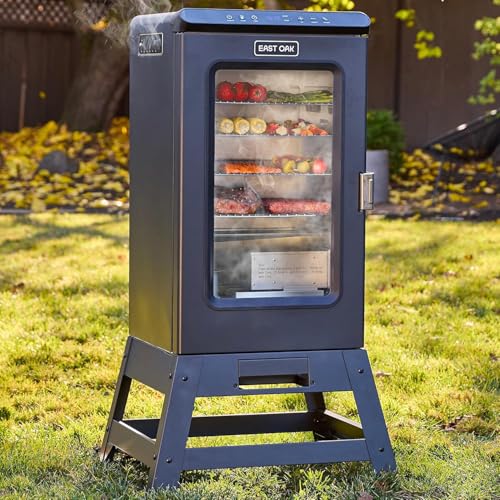
EAST OAK 30-Inch Electric Smoker with Mobility Stand
Badge: Best Value in Use
Strengths
- Built-in meat probe covers internal temperature monitoring out of the box
- Mobility stand answers the working-height and moving problem in one accessory
- Side chip loader is rated by the listing for up to six times longer uninterrupted smoke
Trade-offs
- Stand adds footprint compared with a cabinet sitting on its own feet
- No WiFi or Bluetooth is claimed, so readings stay on the unit
- 725 square inches is still divided across levels
Key specs from the listing
- Format: 30-inch electric smoker
- Cooking area: 725 square inches (per listing)
- Temperature monitoring: built-in meat probe
- Mobility: mobility stand included
- Wood loading: side chip loader
- Finish: Polar Night
This EAST OAK variant pairs the familiar 725 square inch cabinet, built-in meat probe and side chip loader with a mobility stand, in a Polar Night finish. The stand changes the ownership experience more than any single cooking feature: the smoker rolls out for a cook, rolls back for storage, and loads at a height that makes four-level cooking comfortable rather than a squat-and-lift exercise.
The limitation is space and supervision. A stand needs room, and the probe, while built in, still reports at the unit rather than to your phone. If your patio can spare the footprint, the trade is usually worth it for anyone who smokes often enough to feel the difference every single cook.
On the thermometer brief, the stand version adds nothing to the sensing and everything to the ergonomics, which matters because a probe you check comfortably is a probe you check often.
Best for: frequent smokers who move their cabinet in and out of storage / Not suited for: the tightest patios where every inch is spoken for
Check on Amazon to check the latest price on Amazon and confirm the current bundle before ordering.

Traeger Pro 22 Pellet Grill and Smoker
Badge: Best for Connected Control
Strengths
- Meat probe is included, so temperature monitoring is covered from day one
- 572 square inches with 6-in-1 versatility across grilling, smoking, baking, roasting, braising and barbecue
- 18 lb hopper is sized for long cooks without constant refilling
Trade-offs
- Pellet running costs and ash cleaning come with the format
- 450 degree maximum is lower than some rival pellet grills claim
- No WiFi is claimed in this listing, so control is at the controller
Key specs from the listing
- Format: wood pellet grill and smoker
- Cooking area: 572 square inches (per listing)
- Maximum temperature: 450 degrees F (per listing)
- Hopper: 18 lb (per listing)
- Temperature monitoring: meat probe included
- Functions: grill, smoke, bake, roast, braise and barbecue (per listing)
The Traeger Pro 22 is the pellet establishment in this pool: 572 square inches, a meat probe, an 18 lb hopper and a maximum temperature the listing puts at 450 degrees, wrapped in Traegers 6-in-1 promise to grill, smoke, bake, roast, braise and barbecue. Its temperature story is honest rather than flashy: a probe in the meat and a controller holding the set point, which is the combination that actually produces repeatable barbecue.
The limitation is the pellet routine itself: buy pellets, keep them dry, vacuum ash, and accept a ceiling temperature below dedicated grills. Owners who smoke and roast far more than they sear tend to call that a fair trade, and the Pro badge has been earned over many seasons of exactly that work.
On the thermometer brief, the Traeger’s included probe and its long pellet pedigree make it the traditionalist’s monitored smoker, proven across more seasons than its rivals here.
Best for: pellet-curious buyers who want a proven name and a probe included / Not suited for: buyers who need very high searing temperatures
Check on Amazon to check the latest price on Amazon and confirm the current bundle before ordering.

Pit Boss 700 Carbon Series Pellet Grill and Smoker
Badge: Best for Bigger Batches
Strengths
- Meat probe included for internal temperature monitoring
- 718 square inches is the roomiest pellet option in this particular pool
- LCD digital controller with a 180 to 500 degree range covers low smoking through hot grilling
Trade-offs
- 13.5 lb hopper is smaller than some rivals, so very long cooks need a top-up
- Pellet format brings ash cleaning and pellet storage with it
- Carbon Series styling is functional rather than premium in finish
Key specs from the listing
- Format: wood pellet grill and smoker
- Cooking space: 718 square inches (per listing)
- Temperature range: 180 to 500 degrees F (per listing)
- Hopper: 13.5 lb (per listing)
- Temperature monitoring: meat probe included
- Control: LCD digital controller
The Pit Boss 700 Carbon Series spreads 718 square inches under an LCD digital controller, runs from 180 to 500 degrees per its listing, feeds from a 13.5 lb hopper and includes a meat probe. That combination makes it the capacity pick among the pellet options here: more grate room than the Traeger in this pool, a wider stated temperature span, and monitoring hardware in the box.
The honest limitation is the hopper. At 13.5 lb it is the smaller reservoir in this company, so an overnight brisket plan should include a refill check rather than blind faith. Factor that one habit in and the 700 Carbon is a straightforward, roomy pellet cooker.
On the thermometer brief, the 700 Carbon pairs its probe with the most room in this pool, so big-batch cooks get monitored properly instead of hopefully.
Best for: bigger batches on a pellet platform with a probe included / Not suited for: set-and-forget overnight cooks without any refill check
Check on Amazon to check the latest price on Amazon and confirm the current bundle before ordering.

Pit Boss 500 Carbon Series Pellet Grill and Smoker
Badge: Best Alternative Format
Strengths
- Meat probe included, matching its bigger sibling
- 543 square inches suits smaller households without wasting patio space
- Same 180 to 500 degree LCD-controlled range as the 700 in a compact body
Trade-offs
- Less cooking room than the 700 for parties and big batches
- 13.5 lb hopper still asks for a check on the longest cooks
- Fewer square inches per cook when smoking for a crowd
Key specs from the listing
- Format: wood pellet grill and smoker
- Cooking space: 543 square inches (per listing)
- Temperature range: 180 to 500 degrees F (per listing)
- Hopper: 13.5 lb (per listing)
- Temperature monitoring: meat probe included
- Control: LCD digital controller
The Pit Boss 500 Carbon Series is the compact answer to the same question its 700 sibling answers at scale: 543 square inches, an LCD digital controller spanning 180 to 500 degrees per the listing, a 13.5 lb hopper and a meat probe in the box. For couples and small families that is not a compromise at all; it is the right size, heating less empty space and living more easily on a modest patio.
The limitation appears only when the guest list grows. Two large briskets or a party load of ribs will test 543 square inches in a way they would not test the 700. Buy the size your ordinary cooking needs, and this model stops looking like the smaller option and starts looking like the correct one.
On the thermometer brief, the 500 Carbon is the compact monitored pellet, giving smaller households the same probe discipline without the patio commitment of its sibling.
Best for: smaller households wanting pellet cooking with probe monitoring / Not suited for: regular cooking for large gatherings
Check on Amazon to check the latest price on Amazon and confirm the current bundle before ordering.
Comparison Table
| Pick | Format | Standout feature from the listing | Listing |
|---|---|---|---|
| EAST OAK 30-Inch Electric Smoker, Mist Black | 30-inch electric smoker | Built-in probe, viewing window and a long-smoke chip loader in the black 30-inch cabinet. | Check on Amazon |
| EAST OAK 30-Inch Electric Smoker, Mist Silver | 30-inch electric smoker | The same built-in probe package in the Mist Silver finish. | Check on Amazon |
| EAST OAK 30-Inch Electric Smoker with Mobility Stand | 30-inch electric smoker | Built-in probe plus a mobility stand for height and easy moving. | Check on Amazon |
| Traeger Pro 22 Pellet Grill and Smoker | wood pellet grill and smoker | A proven pellet name with meat probe, 572 square inches and 6-in-1 versatility. | Check on Amazon |
| Pit Boss 700 Carbon Series Pellet Grill and Smoker | wood pellet grill and smoker | The roomiest pellet pick here, 718 square inches, with probe and LCD control. | Check on Amazon |
| Pit Boss 500 Carbon Series Pellet Grill and Smoker | wood pellet grill and smoker | The compact pellet pick, 543 square inches, with the same probe and controller story. | Check on Amazon |
With monitoring equal across the table, the comparison turns on platform and size: cabinets divide their area across levels, pellet grills spread it on one surface, and the temperature ranges in each review tell you how far beyond smoking each machine will go.
How to Choose the Best Smokers With Thermometers for Your Cooking
First, separate the two temperatures in your head forever. Chamber temperature is the weather inside the smoker; meat temperature is the climate inside the brisket. A smoker can hold a perfect chamber and still serve raw chicken if the meat never arrived, which is why this guide insists on meat probes. When you shop beyond this pool, treat any thermometer claim as incomplete until you know which temperature it measures and where its sensor sits.
Second, choose your platform. Electric cabinets like the EAST OAK trio are dedicated smokers: steady, simple, and limited to smoking temperatures, with probes built into the cabinet so there is nothing extra to buy or store. Pellet grills add range, the Pit Boss models here run a stated 180 to 500 degrees, and grilling ability, at the cost of pellets, ash and size. Your cooking calendar decides: mostly low and slow points electric, a mixed grill-and-smoke life points pellet.
Third, size the machine to your ordinary cook. The pellet pair brackets the choice neatly: 543 square inches for smaller households, 718 for bigger batches, with the Traeger’s 572 sitting between them, while the electric cabinets divide their 725 across levels, which suits ribs, poultry and fish better than one huge cut. Buying one size up is forgivable; buying two sizes up means heating empty space for years.
Fourth, think about how you will read the probe. All six picks report at the unit, which suits cooks who stay nearby. If your life needs alerts in another room or another building, you are shopping for connectivity as well, a different search with a different pool. There is no shame in the simpler tool; a probe you read on the patio has finished more great barbecue than any app.
Finally, plan the verification ritual. Whatever you buy, test the probe in boiling water on day one, note any offset, and re-test each season. Keep a cheap instant-read thermometer as the court of final appeal for doneness. Two instruments that agree are confidence; one instrument assumed right is how undercooked poultry happens, and no badge on any box changes that.
How to Smoke by Temperature, Not by Time
Set up for a temperature-led cook from the start. Preheat the smoker with the door closed, fill the water pan if your model uses one, load chips or pellets, and let the chamber settle at your target before food goes in. Season the meat, then insert the probe into the thickest part of the largest piece, centred in the muscle and clear of bone and fat pockets, because a probe touching bone reads the bone’s temperature and lies to you with complete confidence.
Cook to the probe, and expect the stall. Large cuts climb steadily, then sit for hours while moisture evaporates, and beginners panic and crank the heat. The probe’s stillness is information, not failure: wrap if your method calls for it, hold your nerve, and let the temperature resume its climb. Judge brisket and shoulder by tenderness as the probe nears your target, sliding in with little resistance, because temperature proposes and tenderness disposes.
Use the window and the probe together on the EAST OAK cabinets: colour from the window, numbers from the probe, and the door stays shut. On the pellet grills, resist lifting the lid to admire progress; the probe exists precisely so admiration can wait. Every opening dumps heat the controller must replace, stretching the cook and drying the surface you worked to build.
Resting is part of the temperature story. Pull the meat at your target, wrap it, and let carryover and redistribution do their quiet work; temperatures equalise and juices settle back into the fibres. Slice too early and the board gets the juice the meat should have kept. While the meat rests, clean the probe carefully, washing the cable junction gently, since probes die at that junction more than anywhere else.
Problem: probe reads far above the controller → the tip is likely in a fat pocket or touching bone; reposition it in dense muscle and compare. Problem: two readings disagree wildly across one cut → the cut itself is uneven; cook to the thickest part and rest longer. Problem: probe readings jump erratically → moisture in the connector or a failing cable; dry the junction, reseat it, and replace the probe if the jumping persists, because decisions are only as good as the sensor.
Why the Meat Probe Changed Home Smoking
A generation ago, home smokers judged doneness by time, colour and hope, and the results swung accordingly. The affordable, accurate meat probe ended that era. It converted smoking from a vigil into a monitored process, which is why every pick in this guide leads with one and why the category’s remaining arguments are about format and size rather than measurement. The guides under How To Choose The Best Pellet Smokers Buyers Guide 2026 trace the same shift on the pellet side.
The probe also changed who smokes. A beginner with a probe and a target temperature can produce a respectable pork shoulder on their first attempt, because the instrument carries the knowledge that used to require seasons of apprenticeship. That democratisation is the real story of this pool: three electric cabinets and three pellet grills, every one of them reporting the number that matters.
Probe Care: The Unglamorous Half of Accuracy
Probes fail quietly. Cables get pinched in doors, junctions soak in dishwashers, tips bend, and each insult shows up not as an error message but as a wrong number delivered confidently. Treat the probe like the instrument it is: coil the cable loosely, keep the junction dry, never submerge more than the listing allows, and store it out of the drawer chaos. A probe kit kept well will outlast several smokers.
Build verification into your routine. Boiling water at your altitude gives a known reference, ice water gives another, and a thirty-second check each season catches drift before it catches a dinner. Keep notes if your probe reads a degree or two off and simply cook with the offset in mind. Accuracy is a habit, and the cooks who keep it are the ones whose thermometers deserve the trust this guide’s title implies.
Living With Your Choice: The First Season With Best smokers with thermometers
The first month with any pick in this guide follows a predictable arc, and knowing it in advance turns early friction into information instead of regret. Week one is calibration: you learn the physical handling, the order of operations, and the two or three small surprises every product keeps, a control that works differently than expected, a part that stores awkwardly, a step that takes longer than the listing implies. None of those surprises, on the picks recommended here, is a defect; they are the personality of a real object meeting a real household, and they fade into routine almost exactly as fast as you repeat the routine.
By the second month the product has either earned a place in the week’s rhythm or begun its slide toward the cupboard, the garage corner or the guest bathroom, and the difference is rarely performance. It is fit: whether the size suits the space, whether the routine suits the household’s patience, whether the feature you paid for is the feature you actually reach for. This is why the buying sections of this guide keep returning to your patterns rather than to specifications. A pick matched to your patterns compounds in value, because frequency teaches you its subtleties, and subtleties are where good products separate themselves from adequate ones in a way no first impression can reveal.
By the end of the first season, the right pick has become invisible in the best sense: it is simply how the thing gets done in your house. The wrong pick announces itself weekly. If you find yourself in the second situation, the honest response is not to persist out of pride but to re-read the trade-offs in this guide with your experience as data, because you are now the best-informed buyer of this exact category you will ever be. Experience is the one research input no guide can supply, and the picks above were chosen so that experience, whichever way it falls, teaches something useful rather than merely disappointing.
What This Guide Could Not Settle From the Listings Alone
Honesty about limits is part of this guide’s method, so it is worth naming the questions that listing research, however careful, cannot finally answer for best smokers with thermometers. Long-term durability is the largest: a listing can state materials and construction, but only years of heat cycles, cleaning and weather prove them, which is why this guide teaches care rituals and inspection habits instead of promising lifespans. Individual variation matters too; two units of the same model can differ slightly in fit, finish or behaviour, and your specific water, weather, space and household will bend any general advice toward your own case.
Subjective qualities sit in the same honest category. Scent, sound, the feel of a control, the look of a finish in your light rather than a studio’s: listings describe these, but only your senses can judge them, and this guide has tried to flag every place where a recommendation depends on such a judgement so you can weight it by your own taste. Where a decision truly hinges on a subjective factor, the multi-packs, finishes and variants within these pools exist precisely so the judgement can be made cheaply, with a single bottle, a smaller commitment or a finish sample, before the larger one.
What listing research can do, and what this guide has done, is eliminate the avoidable errors: the wrong product for the keyword, the misread specification, the feature claimed but not present, the size that cannot fit the space. What remains after those errors are gone is a shortlist of defensible choices and a set of methods for using them well. That is a genuinely strong position to buy from, stronger than any single verdict, because it survives contact with your actual household, which is where every product in this guide will ultimately be judged.
Common Buying Mistakes
Trusting the lid dial is the founding mistake of bad barbecue. Those dials measure air near the lid, age badly, and can sit far from the truth while looking authoritative. This entire guide exists because the meat probe answers the right question; use it, and let the dial be decoration.
Placing the probe badly is the second mistake: against bone, in fat, or poking through the far side of a thin cut. Each placement produces a precise, confident, wrong number. Centre the tip in the thickest muscle, and when a reading surprises you, move the probe before you move the food.
The third mistake is cooking large cuts by the clock because a recipe said six hours. Recipes describe their brisket in their smoker; yours differs. Time plans the day, temperature ends the cook, and tenderness signs the certificate. Buyers who internalise that trio stop producing the dry, early-pulled shoulders that give home smoking a mixed name.
Final Recommendation
If you want the thermometer brief answered in its purest form, take an EAST OAK: the built-in probe, the window and the long-smoke loader make the black 30-inch the first choice for dedicated electric smoking, with the silver as its finish twin and the mobility-stand version for anyone who moves or stores their smoker between cooks. These are smokers designed around knowing, at a glance and a reading, exactly where your food stands.
Choose a pellet pick when smoking shares your patio with grilling: the Pit Boss 700 for capacity, the 500 for compact households, and the Traeger Pro 22 for the proven middle path with its 6-in-1 range. Whichever badge you pick, do the boiling-water check on day one, cook to the probe from then on, and your results will steady in a way no other single change can match.
Ready to decide? Start with the first choice — Check on Amazon — or compare it with the runner-up — Check on Amazon — and check the latest price on Amazon for both before you order.
Readers working through neighbouring questions in the same cluster often consult How To Choose The Best Vertical Pellet Smokers A Buyers Guide, How To Choose The Best Propane Smokers Buyers Guide 2026 and 6 Best Cocktail Smokers Torch Battery And Electric 2026 alongside this guide, because those searches share much of the same shortlist, the same trade-offs and the same care and buying checks described above.
A final practical note for this guide to best smokers with thermometers: keep a simple log of your first several cooks or cleans, noting settings, timing, weather or water conditions where relevant, and the result. Products in this category reward owners who learn their specific unit’s habits, and five lines of notes after each session will teach you more about your own machine or routine than any specification sheet. The picks above were chosen to reward that learning rather than fight it, which is why the guide favours honest designs, clear listings and methods you can repeat exactly, week after week, with improving results.
It is also worth setting expectations about learning curves with best smokers with thermometers. The first session with any new product in this category is partly calibration: you are learning how this particular unit behaves in your space, with your conditions, your ingredients or your water. Judge a pick by its third use rather than its first, maintain it by the routine described above, and keep the listing and your purchase record somewhere safe. That patience, more than any single feature compared in this guide, is what separates satisfied long-term owners from disappointed ones.
Ownership rhythm matters as much as any specification in this guide. The households that get the most from a purchase like this are the ones whose routine fits the product: a regular day or moment in the week when it gets used, cleaned and put away properly, rather than heroic occasional efforts separated by neglect. Build that rhythm deliberately in the first month, while motivation is high, and the product stops being a purchase and becomes part of how the house runs. Every pick above was assessed with that test in mind, because a slightly less capable product used weekly outperforms a perfect one used twice a year, in results, in value and in the skills it quietly builds in its owner.
One more consideration deserves space before the questions below: buying for the household you have, not the one in the advertisement. Count the people, the space, the storage and the genuine appetite for the routine before letting any single feature dominate the decision. The comparison sections above were written to make that counting easy, separating what each pick does best from what it merely does adequately. If two picks still seem equal after that counting, choose the one whose daily handling you prefer, because daily handling is where satisfaction actually lives, in the small repeated moments of loading, checking, cleaning and putting away that no specification sheet can capture.
Storage and care between uses deserve the same attention as the purchase itself. Keep the product and its accessories together, clean and dry, in the place they will actually be reached for, because equipment stored awkwardly is equipment skipped. A cover, a designated shelf or a stationed bottle turns intention into routine. The guides in this series repeat that advice because it is the cheapest performance upgrade available in almost every category: the product you maintain is the product that performs, and the product that performs is the one still earning its place years after the listing that sold it has been forgotten.
Lastly, remember that every household in this guide’s audience is solving a slightly different version of the same problem, which is why the recommendations are ranked but not rigid. Your space, your people, your water, your weather and your patience are all variables no reviewer can hold constant. Use the ranking as the starting order for your own shortlist, read the trade-offs for the two or three picks nearest your situation, and then decide with confidence. A well-matched second-ranked pick will serve you better than a first-ranked pick bought against your own circumstances, and recognising that is the mark of a buyer who has actually read the guide.
There is a temptation, when comparing products like these, to hunt for a single decisive specification that settles the choice, and this category reliably frustrates that hunt. The decisive factors are distributed: a feature here, a dimension there, a habit of yours that one design flatters and another fights. That is why the detailed reviews in this guide are structured identically, so the same questions get answered for every pick in the same order, and why the comparison table compresses only what can honestly be compressed. What remains after that process is not indecision but a shortlist with reasons attached, which is the most any honest guide can hand you, and it is enough.
Frequently Asked Questions
What is the difference between a meat probe and a lid thermometer?
A lid thermometer measures the air near the top of the smoker, which can differ a lot from conditions at the food and says nothing about the food itself. A meat probe sits inside the cut and reports its internal temperature, the number that decides safety and doneness. Every pick in this guide includes a meat probe, which is why they were selected.
How accurate are built-in smoker probes?
Listings rarely state an accuracy figure, so the honest answer is to verify yours. Test it in boiling water when the smoker arrives and note any offset, then cook with that knowledge. Probes in this pool are built-in or included by reputable outdoor brands, and with a verified offset they are entirely trustworthy for barbecue work.
Where should I place the probe in a brisket or shoulder?
Insert it into the thickest part of the muscle, centred, avoiding bone and large fat deposits, which read hotter or cooler than the meat around them. If the reading seems implausible, reposition before acting on it. As the cook nears its target, check tenderness with the probe itself; it should slide in with little resistance when the meat is truly done.
Can I leave the probe in for the whole cook?
Yes, that is what these probes are designed for, and it is the point of them: continuous monitoring without opening the door. Route the cable so the door or lid does not pinch it, keep the connector end out of direct weather, and clean the probe after the cook, treating the cable junction gently because that is where probes most often fail.
Do I still need an instant-read thermometer?
It is a wise companion rather than a requirement. Use it to spot-check a second location at the end of a cook and to verify your built-in probe each season. Two instruments that agree give real confidence, and the instant-read also serves the rest of your kitchen, from chicken breasts to custards, long after the smoker is cleaned.
What temperature should I pull smoked meats at?
It depends on the cut, and any guide printing one magic number for everything is misleading you. Poultry is a food-safety question with firm official guidance; brisket and shoulder are tenderness questions that finish across a range. Use your probe to track progress, follow the specific guidance for the cut you are cooking, and let tenderness make the final call on the big low-and-slow cuts.


