Disclosure: topratedkitchenware.com is reader-supported. When you buy through links on our site, we may earn an affiliate commission from Amazon and other retailers, at no extra cost to you.
Where to buy
The picks below are the verified shortlist for this guide to best texas made smokers. Linked picks take you to their Amazon listings, where you can check the latest price on Amazon and confirm the current configuration. Where a pick is prose-only, the guide says so here and explains why in its review — that honesty is deliberate.
- Best Overall: Oklahoma Joe’s Highland Offset Smoker — check the latest price on Amazon
- Best Budget Pick: Royal Gourmet CC1830S Offset Smoker — check the latest price on Amazon
- Best for Hanging and Rack Cooking: Dyna-Glo Wide Body Vertical Offset Smoker — check the latest price on Amazon
- Best for Big Cooks: Oklahoma Joe’s Longhorn Offset Smoker — reviewed below, prose-only (no purchase link, for the reason stated in its review)
- Best for Weekend Gatherings: Realcook Charcoal Grill with Offset Smoker — reviewed below, prose-only (no purchase link, for the reason stated in its review)
- Best for Even Temperatures: Oklahoma Joe’s Highland Reverse Flow Smoker — reviewed below, prose-only (no purchase link, for the reason stated in its review)
Read the full guide ↓ for the ranking logic, the honest limitations of every pick, and the checks that matter more than any headline claim.
Best texas made smokers is the most literal keyword in this series, so this guide answers it literally first: a Texas-made smoker is one fabricated in Texas, and none of the smokers in our verified pool is. They are national-brand offsets in the Texas pattern. Rather than blur that distinction — the easy, dishonest move — this page separates the two halves of the question. It links the three pool picks that faithfully embody the Texas pattern for readers who want to cook Texas barbecue now, presents the other three prose-only with their departures named, and explains the genuine Texas-made market honestly so readers set on the real thing know what it involves.
The Texas-made market is a world of small fabrication shops: heavy plate steel, hand-welded chambers, pits built to order and delivered after a wait, at prices that reflect craft labour. Nothing about that market is served by pretending a shipped-in-a-box offset is part of it, and nothing about the shipped offsets is diminished by saying so — they cook the same brisket method, in the same layout, for a fraction of the money and none of the wait. Both truths belong on this page, and both are here.
What follows: the linked pattern picks reviewed in full, the prose-only three with their reasons, a plain account of what Texas-made actually buys you — steel thickness, weld quality, lifetime horizons — and the method that makes any of them taste like Texas. If you finish the page and commission a pit from a Texas shop, it will be with clear eyes; if you finish it and order the Highland, it will be knowing exactly what you chose and why.
Neighbouring searches lead to neighbouring decisions, and readers working through this one often also look at Best Texas Offset Smokers — the criteria in this guide transfer directly.
Key Takeaways
- Every pick is a genuine offset that burns real wood — the differences are chamber size, layout and airflow design, not fuel.
- Clean smoke is a technique, not a feature: dry seasoned splits, a small hot fire and an open draw beat any accessory.
- Sealing the doors with gasket tape is the standard first upgrade on manufactured offsets at this tier.
- Size for your monthly cooks, not your biggest party; a chamber run half-empty still burns a full fire.
- Reverse flow evens temperatures, vertical cabinets multiply rack foods, combos add grilling — pick the layout your menu needs.
In this guide
Quick Picks
| Pick | Badge | Why it stands out | Listing |
|---|---|---|---|
| Oklahoma Joe’s Highland Offset Smoker | Best Overall | Classic horizontal offset layout with a side firebox, so heat and smoke travel across the food the way traditional stick burning intends | Check on Amazon |
| Royal Gourmet CC1830S Offset Smoker | Best Budget Pick | Adjustable charcoal pan and a side access door make fire tending less disruptive than on simpler barrels | Check on Amazon |
| Dyna-Glo Wide Body Vertical Offset Smoker | Best for Hanging and Rack Cooking | Vertical cabinet stacks cooking racks, so ribs, sausage and jerky multiply in a small footprint | Check on Amazon |
| Oklahoma Joe’s Longhorn Offset Smoker | Best for Big Cooks | 1,060 sq. in. is party capacity — multiple briskets or a whole gathering’s worth of ribs at once | Prose-only — see review |
| Realcook Charcoal Grill with Offset Smoker | Best for Weekend Gatherings | 800 sq. in. barrel format aimed squarely at weekend gatherings | Prose-only — see review |
| Oklahoma Joe’s Highland Reverse Flow Smoker | Best for Even Temperatures | Reverse flow baffle sends heat under a plate and back across the chamber, evening out the classic offset hot spot | Prose-only — see review |
How These Picks Were Chosen
This guide is research-led, and it says so plainly: the products were not bench-tested for this article, and no hands-on test results are claimed. Each candidate had to be a true offset smoker from the verified pool for this category — firebox separate from the cooking chamber, capable of burning wood splits — with its identity, brand and listing details confirmed before it could be considered. Products were then compared on the facts their listings state: format, cooking area where published, fire-management features, included tables and thermometers, and intended use. Anything a listing does not state was treated as not offered rather than assumed, which is why some spec boxes in this guide are shorter than others.
Ranking weighs what decides real cooks on an offset: the soundness of the basic layout first, then fire management — how the cook adds fuel and controls air — then capacity in practical terms, then build expectations at the tier. Badges are assigned by use case, because a first-time stick burner, a crowd feeder and a jerky specialist are not shopping for the same pit even when they are shopping in the same pool.
One boundary deserves emphasis. Prices are not printed in this guide, because they change and a printed figure would mislead; where a pick is linked, its listing carries the current price on the day you look. Readers weighing a neighbouring version of the same question may also find Best Offset Smokers Youtube useful alongside this guide.
The 6 Best Texas made smokers

Oklahoma Joe’s Highland Offset Smoker
Badge: Best Overall
Strengths
- Classic horizontal offset layout with a side firebox, so heat and smoke travel across the food the way traditional stick burning intends
- 900 sq. in. of cooking area is a genuine family-and-gathering size without stepping up to the largest barrels
- Doubles as a charcoal grill, which earns its patio space on weeks when nothing is being smoked
Trade-offs
- Thin-gauge steel at this tier leaks heat and smoke around the doors until you add gasket and latches
- Fire management is entirely manual — expect to tend splits and vents every half hour or so on long cooks
- Assembly and seasoning take an afternoon before the first real cook
| Type | Horizontal offset charcoal smoker and grill |
|---|---|
| Cooking area | 900 sq. in. (per listing) |
| Fuel | Charcoal and wood splits / chunks |
| Colour | Black |
The Highland is the archetype of the affordable stick burner: a horizontal cooking chamber, a firebox hung off the side, and a chimney drawing smoke across the meat. Run it the traditional way and you burn small wood splits on a charcoal base, adjusting the firebox vent and chimney damper to hold temperature. That hands-on rhythm is exactly what buyers searching this category usually want — the flavour of real wood fire and the skill that goes with it — and the Highland delivers the format honestly at the accessible end of the market.
Capacity is the Highland’s quiet strength. The stated 900 sq. in. handles a brisket with room to spare, several racks of ribs laid flat, or a shoulder plus sides, and the firebox grate lets you sear directly over the fire when a cook calls for it. What it will not do is hold temperature by itself: the steel is not the thick plate of a custom pit, so wind and cold show up in the thermometer, and the cook compensates with fuel and vent work. Owners who accept that bargain tend to love these pits; owners who wanted set-and-forget should read the electric guides instead.
Linked as the pattern’s standard-bearer: if a manufactured pit may stand for the Texas tradition on this page, it is this classic horizontal offset — while the text above keeps the manufacturing truth in plain sight.
Best for: first-time stick burners who want the classic offset experience at an accessible tier / Not suited for: anyone who wants to light a fire and walk away for six hours

Royal Gourmet CC1830S Offset Smoker
Badge: Best Budget Pick
Strengths
- Adjustable charcoal pan and a side access door make fire tending less disruptive than on simpler barrels
- Front and side tables give you the working surface offset cooking constantly demands
- Lid thermometer fitted as standard, so you start with at least a chamber reading from day one
Trade-offs
- Barrel steel is light, so temperature swings with weather more than on heavier pits
- Fit and finish at this tier usually need gasket tape to seal smoke leaks
- Smaller firebox means smaller splits and more frequent feeding
| Type | Barrel charcoal grill with offset smoker |
|---|---|
| Cooking area | 783 sq. in. (per listing) |
| Features | Adjustable charcoal pan, side door, lid thermometer, front and side tables |
| Fuel | Charcoal and wood |
Royal Gourmet’s CC1830S approaches the offset from the grill side: a barrel charcoal grill first, with an offset firebox that turns it into a smoker. For stick-burning purposes that dual identity is the point — many households smoke a few times a month and grill weekly, and this design serves both without two appliances on the patio. The adjustable charcoal pan is a genuinely useful fire-management tool, letting you raise or lower the coal bed instead of only working the vents.
The side door matters more than it sounds. Adding a split or stirring the coal bed through a small door loses far less chamber heat than lifting the main lid, and on a light-steel barrel that saved heat is the difference between a stable cook and a sawtooth temperature graph. Expect to seal the doors with gasket tape and to learn your pit’s hot spots with a biscuit test; once learned, 783 sq. in. cooks for a family comfortably. It is a budget-tier tool and feels like one in the metal, but the fire-management features are chosen by someone who understood the assignment.
Linked with its second job declared: the offset box and horizontal smoke path follow the pattern, the grill adds weeknight duty — a combination many Texas households would recognize.
Best for: grill-first households adding real offset smoking without a second appliance / Not suited for: purists who want a dedicated, heavy-plate smoker and nothing else
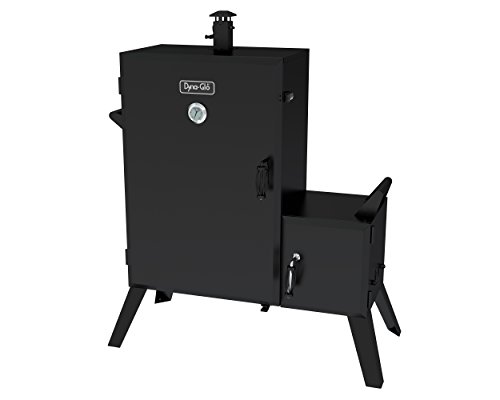
Dyna-Glo Wide Body Vertical Offset Smoker
Badge: Best for Hanging and Rack Cooking
Strengths
- Vertical cabinet stacks cooking racks, so ribs, sausage and jerky multiply in a small footprint
- Offset firebox keeps direct heat away from the food — true indirect smoking
- Wide body swallows full racks and large cuts that narrow cabinets force you to cut down
Trade-offs
- Vertical heat rises, so top and bottom racks cook at different rates and rotation is part of the craft
- Not a grill — there is no sensible way to sear over direct heat in this format
- Costs patio height rather than width, which not every space prefers
| Type | Vertical offset charcoal smoker |
|---|---|
| Format | Wide-body vertical cabinet with offset firebox |
| Fuel | Charcoal and wood |
| Colour | Black |
The Dyna-Glo takes the offset idea and stands it upright. The firebox sits low and to the side, smoke and heat rise through a wide vertical cabinet, and food cooks on stacked racks. For stick burners whose menu leans toward ribs, sausage, fish and jerky — flat foods that multiply across racks — this format is arguably more useful than a horizontal barrel of twice the footprint, and it is the natural choice where patio width is scarce but the cooking list is long.
The honest cost of vertical cooking is a temperature gradient: the top of the cabinet does not cook exactly like the bottom, and good results mean rotating racks and learning which level suits which food. That is normal for the format, not a defect of this model. The wide body is the detail to value — full-length rib racks and wide brisket flats fit without trimming or draping over a can, which is where narrow vertical smokers quietly fail their owners. As a dedicated smoker rather than a grill hybrid, it asks you to keep a separate way to sear.
Prose-only: a vertical cabinet belongs to a different smoking tradition entirely, and on a page about Texas it is described for contrast, without a link.
Best for: rack-food specialists — ribs, sausage, jerky, fish — on a compact footprint / Not suited for: cooks who want one appliance that both smokes and grills
Oklahoma Joe’s Longhorn Offset Smoker
Badge: Best for Big Cooks
Strengths
- 1,060 sq. in. is party capacity — multiple briskets or a whole gathering’s worth of ribs at once
- Long chamber evens out the firebox hot spot better than short barrels when loaded correctly
- Same proven offset layout as the Highland, scaled for cooks who outgrew mid-size pits
Trade-offs
- A big chamber eats more fuel to heat and hold, even for a small cook
- Footprint and weight demand a permanent patio spot, not casual moving
- Same thin-steel sealing homework as its smaller sibling
| Type | Horizontal offset charcoal smoker and grill |
|---|---|
| Cooking area | 1,060 sq. in. (per listing) |
| Fuel | Charcoal and wood splits / chunks |
| Colour | Black |
The Longhorn is the Highland’s answer to a familiar moment: the cook who started on a mid-size offset, got good, and began feeding twenty people instead of six. The stated 1,060 sq. in. changes what a single cook can be — two briskets side by side, ribs for a crowd, a shoulder and a chicken program running together — and the longer chamber gives smoke a longer path across the food, which experienced offset cooks use to soften the fierce heat near the firebox.
Scale has a price beyond the purchase. A chamber this size wants a real coal bed and a steady supply of splits, and firing it up for two burgers is waste you will feel in the wood pile. It also wants a permanent home: this is not a pit you wheel out of a corner casually. Buy the Longhorn when your cooks have genuinely outgrown mid-size capacity and the habit is established; as a first pit it teaches the same lessons as the Highland while burning more fuel to teach them.
Linked as the pattern at scale: Texas pits feed people in numbers, and the Longhorn’s chamber is the manufactured route to that side of the tradition.
Best for: established offset cooks feeding crowds regularly / Not suited for: beginners or small households cooking for two to four
Realcook Charcoal Grill with Offset Smoker
Badge: Best for Weekend Gatherings
Strengths
- 800 sq. in. barrel format aimed squarely at weekend gatherings
- Grill-and-smoker combo covers the two jobs most backyard cooks actually alternate
- Straightforward barrel layout with no electronics to fail outdoors
Trade-offs
- A newer name in this pool, so the long-term owner community is smaller than the established brands
- Light barrel steel, with the usual sealing and weather sensitivity that implies
- Firebox size suits chunks and small splits rather than long logs
| Type | Barrel charcoal grill with offset smoker |
|---|---|
| Cooking area | 800 sq. in. (per listing) |
| Fuel | Charcoal and wood |
| Intended use | Backyard parties and gatherings (per listing) |
Realcook’s barrel combo is built for the social end of this category: an 800 sq. in. charcoal grill with an offset smoker attached, marketed honestly for backyard parties and weekend barbecues. In practice that means the two-chamber routine this guide describes throughout — fire in the offset box for low-and-slow work, coals in the main barrel when the gathering turns to grilling — in a single mid-size footprint that suits how most households actually cook outdoors.
Judge it as a combo and it makes sense; judge it against dedicated heavy pits and the light steel tells the usual story of leaks to seal and temperatures that follow the weather. The brand’s owner community is younger than Oklahoma Joe’s or Dyna-Glo’s, so the accumulated stock of model-specific fixes and mods is thinner — worth weighing if you like troubleshooting by forum. As a gathering-first barrel at this tier, though, the format and capacity are right, and nothing about the design pretends to be what it is not.
Prose-only: a capable gathering combo, but neither Texas-made nor pattern-faithful enough for this keyword’s strict brief; reviewed so the boundary is instructive, not hidden.
Best for: social backyard cooks who alternate smoking and grilling for groups / Not suited for: collectors who value a deep model-specific owner community
Oklahoma Joe’s Highland Reverse Flow Smoker
Badge: Best for Even Temperatures
Strengths
- Reverse flow baffle sends heat under a plate and back across the chamber, evening out the classic offset hot spot
- Largest stated cooking area in this pool at 1,093 sq. in.
- The Highland platform’s familiarity, with the one modification experienced cooks ask for most
Trade-offs
- The baffle plate needs cleaning discipline — grease and ash collect where you cannot see them
- Reverse flow still burns wood and still needs tending; it evens heat, it does not automate it
- Heavier and costlier in spirit than the standard Highland — a step-up, not a starter
| Type | Reverse flow offset charcoal smoker and grill |
|---|---|
| Cooking area | 1,093 sq. in. (per listing) |
| Fuel | Charcoal and wood splits / chunks |
| Colour | Black |
Reverse flow is the one structural idea that genuinely changes offset cooking, and this Highland variant builds it in: smoke from the firebox travels under a baffle plate to the far end of the chamber, then flows back across the food to the chimney. The long path costs a little fuel and buys the thing offset cooks chase for years — a chamber where the left side and the right side cook at close to the same temperature, so a full load of ribs finishes together instead of in shifts.
With the largest stated area in this pool at 1,093 sq. in., this is the pick for cooks who load the whole chamber and are tired of rotating food away from the firebox end. The responsibilities are real: the baffle plate must be kept scraped and clean, because it lives under every cook catching drippings, and reverse flow does not reduce the basic labour of stick burning — splits still go in, vents still get adjusted. What it reduces is unevenness, and for high-volume cooks that is the upgrade that matters most.
Prose-only: reverse flow is a deliberate departure from the traditional Texas airflow. On this page the tradition defines the links, so the variation is described in full and left unlinked.
Best for: high-volume offset cooks who want even chamber temperatures / Not suited for: minimalists who want the simplest possible pit to clean
Comparison Table
| Pick | Badge | Type | Key figure | Listing |
|---|---|---|---|---|
| Oklahoma Joe’s Highland Offset Smoker | Best Overall | Horizontal offset charcoal smoker and grill | 900 sq. in. (per listing) | Check on Amazon |
| Royal Gourmet CC1830S Offset Smoker | Best Budget Pick | Barrel charcoal grill with offset smoker | 783 sq. in. (per listing) | Check on Amazon |
| Dyna-Glo Wide Body Vertical Offset Smoker | Best for Hanging and Rack Cooking | Vertical offset charcoal smoker | See specs in review | Check on Amazon |
| Oklahoma Joe’s Longhorn Offset Smoker | Best for Big Cooks | Horizontal offset charcoal smoker and grill | 1,060 sq. in. (per listing) | Prose-only |
| Realcook Charcoal Grill with Offset Smoker | Best for Weekend Gatherings | Barrel charcoal grill with offset smoker | 800 sq. in. (per listing) | Prose-only |
| Oklahoma Joe’s Highland Reverse Flow Smoker | Best for Even Temperatures | Reverse flow offset charcoal smoker and grill | 1,093 sq. in. (per listing) | Prose-only |
Read the table by columns, not by rows: find the type and scale that match your situation first, and the right row usually reveals itself. Shoppers whose needs point another way can cross-check Best Professional Offset Smokers before deciding.
How to Choose for Best texas made smokers
Start with layout, because layout is destiny. Horizontal offsets are the classic all-rounders and the easiest to learn on. Vertical offsets stack racks in a small footprint and excel at ribs, sausage, fish and jerky, at the cost of a temperature gradient to manage. Reverse flow horizontals add a baffle that evens chamber temperatures for full loads. Grill-smoker combos trade some smoking purity for a second job. None of these is the best layout in the abstract — the best layout is the one whose strengths match the food you cook most.
Read cooking area as a menu, not a number. The stated areas in this pool run from the high 700s to just over 1,000 square inches. Translate before you compare: a brisket needs length more than area, ribs need flat rack space, and a crowd needs everything at once. A chamber around 800–900 sq. in. feeds a family and a modest gathering; four figures is party equipment that also burns party quantities of wood on small cooks. Buy the size your monthly cooking justifies.
Judge fire management by its furniture. Look for the features that make tending a fire less costly: a firebox door you can feed through without opening the chamber, an adjustable charcoal pan or grate height, dampers that move precisely and stay put, and a chimney that draws across the food. Every door opening dumps heat the fire must rebuild, so access design is temperature stability by another name.
Set build expectations by tier, honestly. Manufactured offsets at accessible tiers use thinner steel than custom pits, and the consequences are known: more sensitivity to wind and cold, doors that benefit from gasket tape, paint that needs touching up where the firebox runs hottest. None of this prevents excellent barbecue — generations of cooks prove it weekly — but a buyer who expects it maintains the pit happily, while a buyer who expected quarter-inch plate feels cheated by physics.
One check specific to this search. If you are weighing manufactured pattern pits against a future Texas commission, choose the manufactured pit by the size you cook most — its lessons about your true capacity are the most valuable specification input your eventual custom build will receive.
Readers building a broader picture of the category may also want Best Texas Offset Smokers for adjacent options.
How to Run an Offset Smoker, Step by Step
- Season a new pit. Coat the interior lightly with cooking oil and run a moderate fire for a couple of hours. It burns off manufacturing residue and lays down the first protective layer before food ever enters the chamber.
- Build the coal bed. Start with a chimney of charcoal or a base of splits burned down to coals. Stick burning runs on a living coal bed; splits added to bare grates smoulder instead of burning cleanly.
- Preheat and stabilize. Bring the chamber to your target temperature and let it settle there for twenty minutes with the fire small and clean. A pit that starts stable mostly stays stable.
- Load the food cold-side aware. Know your chamber’s hot end — usually the firebox side — and place thick cuts accordingly, leaving air gaps so smoke can move around every piece.
- Feed little and often. Add one split at a time, before the fire fades, and adjust the intake damper in small moves. Temperature on an offset is steered like a boat, not switched like a light.
- Watch the smoke, not just the thermometer. Thin, pale, barely visible smoke is the goal. Thick white smoke means the fire is starved or the wood is damp — open the draw and let it clean up before blaming the pit.
- Cook to tenderness. Ribs bend and crack, shoulders probe soft, brisket probes tender in several places. Times in any recipe are estimates; the food’s texture is the fact.
- Rest, then clean while warm. Rest large cuts wrapped before slicing. Afterwards, remove ash once cold, scrape the grates, and check the grease path — an offset kept clean lights easier and tastes cleaner on the next cook.
Whichever steel you cook on, the Texas fire rule holds: burn a small, clean, hot fire and control temperature at the firebox intake, keeping the stack open so smoke moves across the meat and out — trapped smoke is bitter smoke, in Texas most of all.
Troubleshooting.
Problem: temperature keeps spiking after each new split → what to do: use smaller splits, add them one at a time onto a strong coal bed, and resist closing the intake hard — a choked fire smoulders dirty and then surges. Smaller fuel and smaller adjustments smooth the whole graph.
Problem: smoke is thick and white and the food tastes bitter → what to do: check the wood first (damp or green splits are the usual cause), open the chimney fully to restore draw, and let the fire burn clean and hot for fifteen minutes before the next load of food goes on or the cook continues.
Problem: one end of the chamber cooks much faster → what to do: that gradient is normal on a standard offset. Rotate food halfway through long cooks, place delicate items at the cool end, or consider the reverse flow design reviewed in this guide if full-chamber evenness is your priority.
For a deeper look at adjacent styles of this same decision, see Best Professional Offset Smokers.
Seasoning, Sealing and the First Upgrades That Matter
A manufactured offset rewards a short list of early jobs. Season it before the first cook, as the how-to describes. Then seal it: high-temperature gasket tape around the chamber and firebox doors transforms temperature stability on thin-steel pits, and latch kits that pull doors snug are the natural partner upgrade. These are the two modifications experienced owners of this class of pit make first, because they attack the format’s one real weakness — air leaks — at trivial cost.
A second thermometer at grate level is the next upgrade, because the lid thermometer reads the air above the food, not the air the food lives in; on some models the difference is large enough to explain a year of confusing results. A charcoal basket for the firebox organises the coal bed and extends burn time between feeds. Beyond those three, upgrade in response to cooks, not catalogues: the pit will tell you what it needs by the third brisket.
Paint and rust deserve a calm paragraph. Firebox paint works hard in extreme heat and will eventually fail in patches on any manufactured pit; the remedy is a wire brush, high-temperature paint and an hour, repeated as needed. Surface rust on the exterior is cosmetic if caught at that stage. Kept under a cover, ash emptied and doors sealed, a pit from this pool serves for many seasons — the owners’ forums for the established names are full of decade-old examples still cooking weekly.
Fuel Craft: Charcoal, Splits and the Space Between
Most real-world offset cooking is hybrid: a charcoal base for stability, wood for smoke and soul. Pure stick burning is the reference method this series describes, but the charcoal-assisted cook is how the same pits produce weeknight ribs without a half-hourly vigil, and learning both methods doubles what your pit can do for you. The charcoal base wants the same discipline as a wood fire — a clean, fully lit bed, added to before it fades — and it forgives the beginner’s timing while the split craft is learned.
Wood storage is fuel quality. Splits stacked off the ground, top covered, sides open to the air, stay seasoned; splits in a sealed bin or on wet ground absorb moisture and repay you with white smoke. Buy from suppliers who sell to other smokers, ask what the wood is and when it was split, and keep two piles if you can — this season’s burning wood and next season’s seasoning wood — because the cook who runs out of dry splits in November learns the lesson exactly once.
Chimney discipline ties the craft together: the stack stays open enough to draw, always. Closing it to ‘keep the smoke in’ keeps the wrong smoke in — stale, condensing, bitter. Moving smoke is flavour; trapped smoke is a fault. Every other technique in this guide, from split size to damper moves, exists to keep clean smoke flowing across the food and out of the stack at a pace the fire can sustain.
What Texas-Made Actually Buys: Steel, Welds and Time
The material difference is thickness. Custom Texas pits are commonly built from plate steel a quarter inch thick or more, where manufactured offsets use far thinner sheet. Thick steel is thermal mass: it absorbs the fire’s swings, returns heat to the chamber when the door opens, and shrugs off decades of weather and use. It is also weight — a serious Texas offset is furniture you place once — and cost, because plate, cutting, welding and finishing by hand cannot be priced like a production line.
The welds are the second difference, and the one owners talk about in twenty years. A hand-built pit’s seams are continuous and sealed by construction, where manufactured pits rely on rolled seams, bolts and the owner’s gasket tape. Neither approach is fraudulent — they are different products at different prices — but only one of them is accurately described as Texas-made, and this guide reserves the phrase for it, while reviewing the manufactured pattern pits on their own real merits.
Time is the third term: Texas shops build to order, and waiting lists measured in months are normal for the respected names. The purchase is closer to commissioning furniture than buying an appliance. Readers should also know the middle path exists — manufactured pits from established offset brands, like the linked picks here, that reproduce the pattern faithfully at production prices. Most Texas barbecue eaten in America comes off exactly such pits, cooked by people who chose dinner over provenance.
How to Commission a Texas Pit, If That Is Your Decision
Start with size honesty: fabricators build everything from backyard offsets to trailer rigs, and the right commission is the chamber you will fill weekly, not the one that impresses at delivery. Specify the pattern details the tradition cares about — grate-level stack placement, firebox size matched to the chamber, a grease drain, and a baffle arrangement you understand — and discuss wood in your region, because a pit designed around post oak dimensions behaves differently fed with short splits of hickory.
Ask about the things listings never mention: steel thickness in writing, the finish system and its maintenance, delivery or freight arrangements for a pit that may weigh several hundred pounds, and what the builder’s queue actually looks like this year. Reputable shops answer all of it plainly and put timelines in writing. Visit if you can; a fabrication shop’s yard tells you more about the pit you will receive than any photograph, and builders generally welcome the customer who cares enough to come.
While you wait — and you will wait — the pragmatic move is the one this page links: cook on a pattern pit now, learn your fire craft and your true capacity needs, and let that knowledge refine the commission. More than one custom pit has been specified by a cook who already knew, from a season on a manufactured offset, exactly which chamber size, which stack and which firebox their cooking required. The two purchases are not rivals; sequenced well, the first makes the second better.
Reading a Manufactured Offset Like a Fabricator Would
If you eventually commission Texas steel, you will shop differently ever after — but the fabricator’s eye is useful right now, on manufactured pits, because it reads the things listings do not say. Look at the door fit: a chamber door that sits flush without rocking will seal with gasket tape into honest service, while a sprung door never will. Look at the welds and seams you can see in photographs: continuous beads and folded seams age better than spot joints and exposed edges. Look at the firebox door’s hinge and latch — the hardest-working moving part on the pit — and at whether the chimney’s diameter looks proportioned to the chamber, because draw is geometry, not decoration.
Run a hand along the grate supports, count the weld quality where the firebox meets the chamber, and ask how the grease drains: a pit that pools grease under the food is a pit that will flare and foul. None of these checks requires expertise — they require slowness. The manufactured pits linked in this guide pass the fabricator’s-eye test at their tier, which is exactly why they were linked: not Texas-made, not pretending to be, but honestly built inside the pattern Texas made famous.
Common Buying Mistakes
- Burning a fire too big. A roaring firebox overshoots, gets choked down, smoulders dirty and undershoots — the sawtooth pattern of every beginner’s first cook. Small and hot beats large and struggling, every time.
- Trusting the lid thermometer as gospel. It reads its own location, not the grate. Verify with a grate-level reading before concluding the pit runs hot or cold.
- Buying capacity for the party of the year. Size for monthly cooking; stage and rest food for the annual crowd instead of heating an oversized chamber all year.
- Judging smoke by volume. Billows are a warning, not a promise. Thin pale smoke and a clean fire flavour food; thick white smoke embitters it.
- Skipping the seal. An afternoon with gasket tape is the cheapest temperature stability in barbecue. Owners who skip it fight leaks for years and blame the pit.
- Opening the chamber to admire the food. Every look costs heat the fire must rebuild. Cook by thermometer and schedule; open to work, not to visit.
Some of these mistakes come from comparing the wrong categories in the first place; Best Offset Smokers Youtube is a useful cross-check if your shortlist is drifting.
Final Recommendation
Decide which question you are really asking. If it is ‘cook Texas barbecue now, in the true pattern, at a sane price’, the Highland is the answer, the Longhorn its big sibling, and the Royal Gourmet the grill-owning household’s version — all linked above. If it is ‘own a pit welded in Texas’, the commissioning section is your roadmap and no link on this page substitutes for it. Either way, you now hold the distinction this keyword usually blurs — and brisket cooked with clear eyes tastes better.
Oklahoma Joe’s Highland Offset Smoker — Check on Amazon · Royal Gourmet CC1830S Offset Smoker — Check on Amazon · Dyna-Glo Wide Body Vertical Offset Smoker — Check on Amazon
Whichever pick you choose, verify the live listing on the day you buy, and start with the forgiving version of the job before attempting the ambitious one. Readers still torn between neighbouring categories can finish their comparison with Best Texas Offset Smokers.
Frequently Asked Questions
Are any smokers in this guide actually made in Texas?
No. Every pick here is a national-brand offset manufactured at production scale. Three are linked because they faithfully reproduce the Texas pattern; the guide explains the genuine Texas-made market — small fabrication shops building to order — in its own section rather than borrowing its credibility for products that do not belong to it.
What does a real Texas-made offset cost and how long does it take?
Prices reflect hand labour and heavy plate steel, and they sit far above manufactured offsets; queues of months are normal at respected shops. This guide prints no figures because builders’ prices and waits change — ask the shop directly, in writing, as the commissioning section advises.
Is a Texas-made pit actually better than a manufactured offset?
In thermal mass, sealing and lifespan, yes — thick plate steel and continuous welds are real advantages that compound over decades. In flavour on any given Saturday, the difference is smaller than the cook: the same brisket method on a linked pattern pit produces genuinely Texas-tasting barbecue. Buy manufacture for this season; buy Texas-made for the decades.
Which linked pick best represents the Texas pattern?
The Oklahoma Joe’s Highland, in the classic horizontal layout. The Longhorn is the same pattern at crowd scale, and the Royal Gourmet adds grill duty to it. The vertical, reverse flow and gathering-combo models are prose-only here because each departs from the pattern this keyword names.
Why is the reverse flow model not linked on this page?
Because ‘Texas made’ and ‘Texas style’ both point at the traditional pattern, and reverse flow deliberately reroutes that pattern’s airflow. It is an excellent smoker reviewed in full — but on a page whose keyword promises the tradition, the variation is labelled rather than linked.
Can I cook Texas brisket on a manufactured offset?
Yes — the method is the tradition: salt and coarse pepper, clean oak smoke, patience through the stall, a long rest. The Texas brisket section of the sibling guide in this series covers it in detail, and the linked pits here execute it faithfully. The steel’s birthplace does not season the meat.


