Disclosure: topratedkitchenware.com is reader-supported. When you buy through links on our site, we may earn an affiliate commission from Amazon and other retailers, at no extra cost to you.
Where to buy
One honest note shapes this whole guide: the verified pool for this keyword is made up entirely of hybrid mattresses, because hybrids are the side of this comparison that current mattress-in-a-box production actually sells. So all six picks below are linked hybrid examples — the traditional mattress side of the argument (classic connected-coil innersprings and all-foam beds) is covered in prose throughout, with no picks invented for it. Read the full guide ↓
- SayTale Queen Mattress 12 Inch Hybrid, Medium Firm — Check on Amazon
- Ailis Queen Mattress, 12 Inch Hybrid, Medium Firm — Check on Amazon
- Novilla 14 Inch Queen Hybrid Gel Memory Foam Mattress — Check on Amazon
- Novilla 12 Inch Queen Hybrid Mattress, Hypoallergenic, Back Pain Relief Positioning — Check on Amazon
- FP FLEXPEDIC Queen Mattress 14 Inch, Luxury Hotel Cooling Hybrid — Check on Amazon
- Neo Sleep Queen 8 Inch Cool Hybrid Mattress with Innerspring Coil Support — Check on Amazon
Read the full guide ↓
The mattress vs hybrid mattress question sounds like a shopping detail and is actually a decision about how your bed is built. A traditional mattress is one technology deep: either a connected system of steel coils doing everything, or a stack of foam layers doing everything. A hybrid mattress is a deliberate split of duties — foam on top to contour and relieve pressure, individually pocketed springs below to lift, breathe, and respond. Shoppers searching mattress vs hybrid mattress are usually standing between a bed style they grew up with and a newer construction they have heard good things about, and this guide works through that choice honestly, using six verified queen hybrids as the concrete examples of the hybrid side.
Here is the short version before the detail. Traditional innersprings win on simplicity, bounce, and a familiar firm feel, and they still suit stomach sleepers and anyone who dislikes foam entirely. All-foam mattresses win on motion isolation and contour, and they suit sleepers who want to feel cradled and undisturbed. Hybrids were engineered to take the middle: most of the foam bed’s pressure relief and isolation, most of the spring bed’s support, airflow, and edge strength, at the cost of being nobody’s pure favorite. Whether that middle is a compromise or the best of both depends on how you sleep, which is why the detailed sections below sort by sleeper first and product second. If your search narrows to a set spend, Best Hybrid Mattress Under $1000 collects the hybrid side by budget once you have picked your side.
Key Takeaways
- A hybrid splits the work: foam comfort layers on top, pocketed springs below. A traditional mattress asks one material system to do both jobs.
- Pocketed springs are the dividing line — they isolate motion and adapt locally in a way connected traditional coils do not.
- All six verified picks here are queen hybrids, from 8 to 14 inches; the traditional side is discussed in prose because the current boxed market barely sells it.
- Hybrids generally sleep cooler than all-foam beds and isolate motion better than traditional innersprings, while traditional beds keep an edge in pure bounce and simplicity.
- Edge support is the quiet hybrid advantage: sprung perimeters restore the full usable width that foam edges give away.
- Stated trials and foam certification are the risk controls that make a vs decision safe to reach online.
In this guide
Quick Picks
| Pick | Badge | Height | Stated feel | Link |
|---|---|---|---|---|
| SayTale 12 Inch Hybrid Queen Mattress | Best Overall Hybrid Example | 12 inches | Medium firm | Check on Amazon |
| Ailis 12 Inch Hybrid Queen Mattress | Best for Motion Isolation and Edges | 12 inches | Medium firm | Check on Amazon |
| Novilla 14 Inch Gel Hybrid Queen Mattress | Best Tall, Cooling Hybrid | 14 inches | Not stated plainly; tall gel build | Check on Amazon |
| Novilla 12 Inch Hybrid Queen Mattress | Best Platform-Friendly Hybrid | 12 inches | Not stated plainly; platform-friendly | Check on Amazon |
| FP FLEXPEDIC 14 Inch Luxury Cooling Hybrid | Best Premium Zoned Hybrid | 14 inches | Luxury hotel positioning; zoned | Check on Amazon |
| Neo Sleep 8 Inch Cool Hybrid Queen Mattress | Best Low-Profile Hybrid | 8 inches | Medium plush | Check on Amazon |
The table is deliberately honest about feel labels: two picks state medium firm, one states medium plush, and the rest ask you to read their construction rather than a label. Guest-room shoppers, who need the most forgiving middle feel of all, can cross-check with Best Hybrid Mattress For Guest Rooms Under $700.
How These Picks Were Chosen
This is a research-led comparison, not a sleep lab report, and it says so plainly. The six picks come from a verified product pool checked on 2026-11-20; every specification quoted in the spec boxes — height, construction, stated feel, certification, trial, materials notes — appears in the verified listing data for that product. No prices, ratings, or review counts are printed anywhere in this guide, because those numbers change constantly and quietly become wrong. Where the guide describes what owners tend to report about hybrids, traditional innersprings, or foam beds, it is summarizing the well-established behavior of each construction, not quoting invented statistics.
The pool’s one-sidedness required a decision, and the guide makes it openly rather than disguising it. All six verified products are hybrids, so the hybrid side gets the picks, the images, and the links, while the traditional side gets a fair prose hearing in every section — its genuine wins on bounce, simplicity, firm feel, and familiarity are stated where they apply, and no traditional product was invented to fill a slot. A vs guide that fabricated balance would be less useful than one that shows you the real market: walk into the current mattress-in-a-box world asking this question and hybrids are most of what you will be shown.
Within the hybrid side, picks were organized by the job each does best — the defining mainstream recipe, edges and isolation, tall cooling maximalism, platform-friendly materials, premium zoning, and low-profile versatility — so that a reader who settles the vs question can immediately settle the which-one question in the same sitting. Apartment dwellers weighing a tall bed against a small room will find the spatial side developed in Best Hybrid Mattress For Apartments Under $1000.
The Hybrid Side, Pick by Pick: Mattress vs Hybrid Mattress in Concrete Form

SayTale Queen Mattress 12 Inch Hybrid, Medium Firm
Badge: Best Overall Hybrid Example
Strengths
- The textbook hybrid recipe — memory foam comfort over pocketed springs — in the mainstream 12 inch, medium firm configuration.
- Pocketed springs are the hybrid component that separates partner motion, and motion isolation is named in the title.
- A stated 365-night trial is the longest risk-reversal in this roundup, which matters in a vs decision you cannot test in a store.
Trade-offs
- Medium firm is a compromise setting: committed plush lovers and strict firm-bed sleepers both sit one step away from their ideal.
- As a hybrid it still carries memory foam at the surface, so it sleeps warmer than a traditional spring mattress with a thin comfort layer.
- A mattress in a box needs expansion time, and its first-night feel is not its settled feel.
| Specification | Detail |
|---|---|
| Size | Queen |
| Height | 12 inches |
| Construction | Hybrid: memory foam over pocketed springs |
| Feel | Medium firm (per title) |
| Certification | CertiPUR-US Certified |
| Trial | 365-night trial (per title) |
| Format | Mattress in a box |
The SayTale is the cleanest possible illustration of the hybrid side of the mattress vs hybrid mattress argument, because its construction is the definition itself: memory foam on top for contour and pressure relief, pocketed springs underneath for lift, airflow, and independent response. At 12 inches and a stated medium firm feel, it sits exactly where the hybrid category has converged — tall enough for real comfort layers, firm enough in intent to serve back sleepers, soft enough at the surface to court side sleepers. If you want one product to explain what a hybrid is for, this is it.
The pocketed spring unit is doing the work that separates this bed from an all-foam mattress. Each spring responds on its own, so the side of the bed under a shoulder compresses differently from the side under a hip, and — the benefit couples actually buy hybrids for — movement on one side travels poorly to the other. A traditional connected-coil innerspring, by contrast, moves as a unit, which gives it bounce and simplicity but transmits a partner’s turning across the surface. An all-foam bed isolates motion even more completely, but gives back nothing: no bounce, less airflow, and a slower response when you change position. The hybrid claim is that pocketed springs recover most of the foam bed’s isolation while restoring the spring bed’s liveliness, and this design is built precisely on that claim.
Motion isolation is named in the title rather than left as an implication, and pressure relief is the foam layer’s stated job, so the two headline hybrid promises are both on the label. CertiPUR-US certification covers the foam component, which is the part of a hybrid a buyer cannot inspect and most needs verified. The stated 365-night trial then addresses the deepest problem with any vs verdict reached online: you cannot know which side of the argument your body agrees with until you have slept on the result for weeks, and a long trial converts that uncertainty from a gamble into a process.
The honest limitation is the compromise at its center. Medium firm hybrids are designed to offend the fewest sleepers, which means they rarely thrill the extremes. If you already know you love the deep hug of an all-foam bed, a hybrid’s spring layer will feel like a distraction pushing back. If you know you love a traditional firm innerspring, the memory foam surface will feel like unnecessary softness. This pick is for the large middle — and for couples whose preferences differ, where compromise is not a weakness but the entire point.
Best for: couples and undecided shoppers who want the defining hybrid recipe with a long stated trial to test the vs verdict at home. / Not suited for: committed all-foam devotees or strict traditionalists who already know their side of the argument.

Ailis Queen Mattress, 12 Inch Hybrid, Medium Firm
Badge: Best for Motion Isolation and Edges
Strengths
- Edge support is named explicitly, which is the hybrid advantage over all-foam beds that foam-only designs rarely match.
- Upgraded pocket springs are positioned for motion isolation, the second classic hybrid win over traditional connected coils.
- Breathable comfort language reflects the airflow a spring core allows and a solid foam core does not.
Trade-offs
- Strong edges and motion isolation are priorities for couples and sitters; a solo sleeper who never uses the edge pays for features they may not notice.
- Medium firm again targets the middle, so very light side sleepers may want more surface softness than the label promises.
- The title does not state a foam certification or trial length, so buyers should verify those on the listing before ordering.
| Specification | Detail |
|---|---|
| Size | Queen |
| Height | 12 inches |
| Construction | Hybrid with upgraded pocket springs |
| Feel | Medium firm (per title) |
| Features named | Motion isolation, strong edge support, breathable comfort |
| Format | Mattress in a box |
The Ailis hybrid argues the mattress vs hybrid mattress case from the two places all-foam beds are weakest: the edge and the air. Its title leads with upgraded pocket springs for motion isolation, then names strong edge support — a pairing that shows a clear understanding of why shoppers defect from foam. Anyone who has sat on the edge of an all-foam bed to tie their shoes, or slept near the edge of one and felt the surface slope away, knows that foam cores compress at the perimeter in a way a sprung perimeter does not. A hybrid with deliberate edge support gives back the full usable width of a queen bed, which matters most in smaller rooms where the bed cannot simply be sized up.
Edge support sounds like a minor specification until it is translated into daily life. It is the difference between a bed that works as a seat while dressing and one that does not, between a couple using the whole mattress and a couple negotiating for the middle, and between an older sleeper feeling secure getting in and out and feeling the bed tip beneath them. Traditional innerspring mattresses historically did edges well, because their coil units and border rods were built for it. One of the hybrid category’s genuine achievements is recovering that practical virtue without surrendering the foam comfort surface, and this pick puts that recovery at the center of its pitch.
The breathability point completes the comparison. A pocketed spring core is mostly air, and air moves through it as the sleeper moves, carrying heat away from the comfort layers in a way a solid foam core physically cannot. That does not make a hybrid a cool mattress by itself — the foam on top still governs the surface feel — but it explains the consistent owner pattern in which the same memory foam sleeps less warmly over springs than over foam. For shoppers whose objection to foam beds is temperature rather than feel, a hybrid like this one is the direct answer the category offers.
Its limitation is focus. This is a couples-and-practicality hybrid: motion isolation, edges, airflow. A lightweight side sleeper shopping purely for plush shoulder relief may find a medium firm surface with strong edges more bed than they need and less cushion than they want, and the absence of a stated trial or foam certification in the title means the careful buyer has one more verification step before ordering than with some rivals here.
Best for: couples who use the whole bed, anyone who sits or sleeps at the edge, and warm sleepers leaving all-foam designs. / Not suited for: shoppers whose single priority is the softest possible pressure relief at the shoulder.

Novilla 14 Inch Queen Hybrid Gel Memory Foam Mattress
Badge: Best Tall, Cooling Hybrid
Strengths
- At 14 inches it is joint-tallest here, giving the deepest comfort stack a hybrid format allows in this roundup.
- A cool-to-touch cover plus gel foam plus an airy coil core attacks heat at three levels of the bed at once.
- CertiPUR-US certification is stated for the foam, keeping the verifiable-quality baseline.
Trade-offs
- Fourteen inches of height demands deep-pocket sheets and raises the bed noticeably on any frame.
- A taller, plusher build leans toward softness, which strict firm-bed traditionalists will read as drift from their side.
- Height and plushness make this the hardest pick here to move, rotate, or carry up stairs.
| Specification | Detail |
|---|---|
| Size | Queen |
| Height | 14 inches |
| Construction | Hybrid: gel memory foam over pocketed coils |
| Cover | Cool-to-touch nylon blend (per title) |
| Certification | CertiPUR-US Certified |
| Features named | Adaptive body support, motion isolation |
Novilla’s 14 inch hybrid is the maximalist entry in the mattress vs hybrid mattress comparison: the tallest construction here, gel memory foam, a cool-to-touch nylon blend cover, and pocketed coils underneath. Height in a hybrid is not vanity. Extra inches are spent on thicker comfort layers and a more substantial transition between the soft surface and the spring core, and that depth is what lets a tall hybrid feel plush at first contact without letting the sleeper bottom out onto the coils. Traditional mattresses reached similar heights with pillow tops over connected coils; this design reaches it with modern foam over independent coils, which is a fair summary of how the category has evolved.
The cooling stack deserves the same layered reading. The cover is the first contact and the title calls it cool-to-touch, which addresses the initial impression when a warm sleeper gets into bed. Gel memory foam is the second level, moderating heat where the body rests longest. The pocketed coil core is the third, providing the airflow reservoir that foam cores lack. No single level makes a bed cold, and shoppers should distrust any that claims to, but a design that works at all three levels is making a serious rather than decorative attempt — and it highlights a structural truth of the vs debate: an all-foam bed simply has fewer levels available to work with.
Adaptive body support and motion isolation are the named performance claims, and both trace back to the pocketed coils. Independent coils adapt because each responds to the load directly above it, and they isolate because that response stays local. Under a shared queen bed, that combination is the hybrid’s core argument against the traditional innerspring, whose connected coils adapt and disturb as a group. CertiPUR-US certification, stated in the title, covers the foam layers doing the contouring above those coils.
The costs of maximalism are practical. Fourteen inches plus a frame and any foundation can make a tall bed that shorter sleepers climb into, standard sheets may not reach, and the whole assembly is heavy to rotate. Buyers in walk-up apartments or small bedrooms should weigh the guest-room and small-space framings in the internal guides linked below, because the best hybrid on paper still has to fit the room, the sheets, and the staircase it arrives by.
Best for: sleepers who want the deepest, coolest-leaning hybrid build here and have the sheets and space for a tall bed. / Not suited for: low-profile bed setups, standard-depth sheet collections, or anyone who moves house often.
Novilla 12 Inch Queen Hybrid Mattress, Hypoallergenic, Back Pain Relief Positioning
Badge: Best Platform-Friendly Hybrid
Strengths
- Fiberglass free is stated outright — a materials concern many mattress-in-a-box shoppers now check first.
- No box spring needed simplifies the setup and the budget math for platform and slatted frames.
- Hypoallergenic positioning plus certification gives allergy-conscious shoppers two checkable starting points.
Trade-offs
- Back pain relief is positioning language, not a medical claim any mattress can guarantee; results depend on the sleeper.
- The title does not state a firmness label as plainly as its rivals, so feel expectations need care.
- Platform-friendly designs still need a sound, closely spaced support surface; a worn foundation undermines any mattress.
| Specification | Detail |
|---|---|
| Size | Queen |
| Height | 12 inches |
| Construction | Hybrid with smart coils (per title) |
| Positioning | Hypoallergenic; back pain relief positioning |
| Materials note | Fiberglass free; CertiPUR-US Certified |
| Foundation | No box spring needed (per title) |
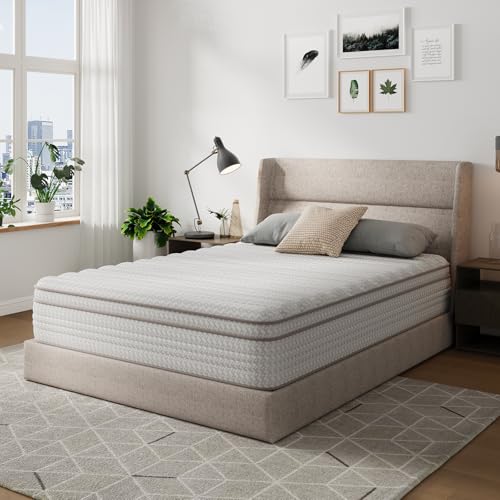
The second Novilla in this roundup takes the hybrid argument into the materials and setup territory where many real purchases are actually decided. Its title states fiberglass free — a phrase that matters because some budget mattresses in a box historically used fiberglass fire barriers that became a genuine household concern if the cover was removed or damaged. A hybrid that states the point plainly removes a research step for careful shoppers, and its CertiPUR-US certification covers the foam from the other direction. In a mattress vs hybrid mattress decision, these verifiable material facts are worth more than another adjective about comfort.
The no box spring needed line speaks to how hybrids have changed the furniture around the bed. Traditional innerspring mattresses were sold as a system with a matching box spring, and warranties once policed the pairing. A modern hybrid in a box is engineered for platform and slatted bases, which simplifies the purchase, lowers the total height, and suits the flat-pack furniture most bedrooms now use. Shoppers replacing a traditional set should still check their base honestly: closely spaced, rigid support is what any foam-topped mattress needs, and a sagging foundation will make a good mattress feel like a bad one regardless of which side of the vs argument it sits on.
Hypoallergenic and back pain relief positioning need the usual honest translation. Hypoallergenic describes materials and construction choices that resist common allergen build-up, a reasonable design goal that shoppers with sensitivities can weigh alongside cover washability and room hygiene. Back pain relief is positioning, not a promise: what a medium hybrid can legitimately offer a back sleeper is a surface that cushions without collapsing, over springs that keep the pelvis lifted rather than hammocked — the combination many back sleepers defected from both hard traditional beds and soft all-foam beds to find.
The limitation is specification clarity. Where rivals state medium firm outright, this title leaves the feel to inference, and feel is the one thing a vs shopper most needs pinned down. Read the listing’s firmness description carefully before ordering, and lean on the return terms if your first weeks disagree with the inference. The construction story here is strong; the feel story needs one extra verification step.
Best for: materials-conscious shoppers on platform bases who want a fiberglass-free, certified hybrid without buying a box spring. / Not suited for: buyers who need an unambiguous firmness label before they can commit.

FP FLEXPEDIC Queen Mattress 14 Inch, Luxury Hotel Cooling Hybrid
Badge: Best Premium Zoned Hybrid
Strengths
- Zoned pocket springs are the most sophisticated support idea in this roundup: different firmness where the body actually differs.
- Hip, shoulder, and lumbar support are named as separate targets rather than bundled into one comfort claim.
- Fiberglass-free materials, certification, and a stated 365-night trial stack every major risk control in one pick.
Trade-offs
- Premium positioning means this is the tier to skip if the budget is the first constraint on the purchase.
- Zoning benefits sleepers whose bodies match the zone layout; very tall or short sleepers may find zones landing off-target.
- At 14 inches it shares the tall-bed sheet and height considerations of the other 14 inch pick.
| Specification | Detail |
|---|---|
| Size | Queen |
| Height | 14 inches |
| Construction | Hybrid with zoned individual pocket springs |
| Support zones | Hip, shoulder, and lumbar support named |
| Materials note | Fiberglass-free; CertiPUR-US Certified |
| Trial | 365-night trial (per title) |
| Positioning | Luxury hotel cooling hybrid |
The FP FLEXPEDIC hybrid is where the mattress vs hybrid mattress argument reaches its most developed form, because zoning is something neither a traditional innerspring nor a simple all-foam bed does naturally. Its individual pocket springs are arranged in zones, with extra support named separately for hips, shoulders, and lumbar — an acknowledgment that a body is not one uniform load. Hips are heavy and need lift to keep the spine level for side sleepers. Shoulders are narrower and need give. The lumbar region needs filling support for back sleepers. A connected traditional coil unit answers all three with the same response; a zoned hybrid can answer each differently, and that is a genuine engineering distinction, not a styling one.
The luxury hotel positioning is also more meaningful than it first appears. Hotels converged on medium, accommodating beds because they must satisfy the widest range of bodies on the first night, and the hybrid format — cushioned surface, responsive support, decent edges, moderate temperature behavior — is the format that now fills that role. A shopper whose best sleep memory is a good hotel bed is usually remembering exactly this balance, and the cooling build plus 14 inch height here aim at that impression deliberately rather than accidentally.
The risk controls are the strongest in the roundup, and they matter because premium is a claim a buyer should make the product prove. Fiberglass-free construction is stated. CertiPUR-US certification covers the foam. A 365-night trial is stated in the title, giving the longest possible window for the one test that counts — your own back, across seasons. In vs terms, this is the hybrid side arguing that it no longer asks for faith: the materials are checkable and the verdict period is a year of your own sleep.
The cautions are proportionate. Premium positioning should be weighed against how long you will keep the bed and whether the zoned layout matches your height, since zones are placed for an average body plan and very tall or petite sleepers may find the transitions landing in unexpected places. And the 14 inch height carries the same deep-pocket sheet and bed-height homework as the Novilla tall pick. Zoning is the most body-dependent feature in this guide, which is precisely why the long stated trial belongs on this pick.
Best for: side and back sleepers who want zoned, differentiated support and premium materials with a long stated trial. / Not suited for: budget-first purchases, or sleepers whose height places them far from average zone layouts.

Neo Sleep Queen 8 Inch Cool Hybrid Mattress with Innerspring Coil Support
Badge: Best Low-Profile Hybrid
Strengths
- At 8 inches it is the low-profile answer for bunks, trundles, low platform frames, and rooms where the tall picks cannot go.
- Medium plush is the softest stated feel here, giving plush seekers a labeled option instead of an inference.
- An anti-slip bottom is a small, practical detail platform-bed owners will appreciate every sheet change.
Trade-offs
- Eight inches leaves less room for deep comfort layers, so heavier sleepers may reach the support core sooner.
- Medium plush is the wrong direction for firm-bed traditionalists and many stomach sleepers.
- A slim hybrid gives up some of the edge presence and grandeur that make the tall picks feel luxurious.
| Specification | Detail |
|---|---|
| Size | Queen |
| Height | 8 inches |
| Construction | Hybrid with innerspring coil support |
| Feel | Medium plush (per title) |
| Materials note | Fiberglass free; CertiPUR-US Certified |
| Base detail | Anti-slip bottom |
The Neo Sleep closes the roundup by proving the hybrid idea scales down. At 8 inches, with innerspring coil support under a medium plush comfort surface, it serves the beds the 12 and 14 inch picks physically cannot: low platform frames, guest setups, daybeds and trundles adapted to queen dimensions, and bedrooms where a tall bed would overwhelm the room or fight with low windows and sloped ceilings. The mattress vs hybrid mattress question does not disappear at this size — it sharpens, because at 8 inches every inch of construction has to justify itself and there is no depth to hide in.
Medium plush is the softest stated feel in this guide, and its presence matters for honesty’s sake. Most hybrids cluster at medium firm because that is where the market’s middle lives, but plush seekers exist in every category, and a labeled medium plush hybrid is a better answer for them than a medium firm bed they are told will soften. Side sleepers of lighter build, who often fail to compress medium firm surfaces enough to get pressure relief at the shoulder, are the natural audience — the same sleepers a traditional plush innerspring once served, now with a hybrid’s more modern support core underneath.
The anti-slip bottom is the kind of unglamorous detail that separates products designed by people who have lived with platform beds. Foam-and-coil mattresses on smooth slats or solid platforms can migrate a little with every entry and exit, and over weeks the bed creeps off-center. A grippy base layer addresses it silently. Combined with fiberglass free materials and CertiPUR-US certification, both stated in the title, the pick shows the value end of the hybrid market absorbing the material standards that were once premium-only talking points.
Its limits are the physics of thinness. Eight inches shared between comfort and support layers means heavier sleepers and couples will engage the coil core more directly, and the plush surface that delights a light side sleeper may let a stomach sleeper’s midsection sag. This is the pick for a specific room and a specific sleeper, chosen with open eyes — which, in a vs guide, is exactly what a good final option should be.
Best for: low-profile frames, guest rooms, and lighter side sleepers who want a labeled medium plush hybrid feel. / Not suited for: heavier couples needing deep comfort layers, or firm-bed sleepers of any build.
Comparison Table
| Pick | Height | Spring system | Materials / trial notes | Link |
|---|---|---|---|---|
| SayTale 12 Inch Hybrid Queen Mattress | 12 inches | Pocketed springs | CertiPUR-US; 365-night trial stated | Check on Amazon |
| Ailis 12 Inch Hybrid Queen Mattress | 12 inches | Upgraded pocket springs | Trial / certification not stated in title | Check on Amazon |
| Novilla 14 Inch Gel Hybrid Queen Mattress | 14 inches | Pocketed coils | CertiPUR-US; gel foam, cool-to-touch cover | Check on Amazon |
| Novilla 12 Inch Hybrid Queen Mattress | 12 inches | Smart coils | Fiberglass free; CertiPUR-US; no box spring needed | Check on Amazon |
| FP FLEXPEDIC 14 Inch Luxury Cooling Hybrid | 14 inches | Zoned individual pocket springs | Fiberglass-free; CertiPUR-US; 365-night trial stated | Check on Amazon |
| Neo Sleep 8 Inch Cool Hybrid Queen Mattress | 8 inches | Innerspring coil support | Fiberglass free; CertiPUR-US; anti-slip bottom | Check on Amazon |
Set against the traditional alternatives in prose: a classic innerspring would list a connected coil unit and no foam certification to check, and an all-foam bed would list no springs at all and lean entirely on foam density for support. The hybrid column above is what paying for both systems looks like. Side sleepers comparing within the hybrid side can continue at Best Hybrid Mattress For Side Sleepers Under $700.
How to Choose Between a Mattress and a Hybrid Mattress
Start with motion, because it is the difference you will feel every single night. If you share the bed and your partner’s movements wake you, a connected-coil traditional mattress is the worst of the three constructions and both foam and hybrid beds beat it, hybrids by isolating at the spring level and foam by absorbing at every level. If you sleep alone, motion drops down the list and other factors should lead. If you love bounce — for ease of moving, for a lively surface, for the traditional feel itself — the ranking reverses: innerspring first, hybrid second, foam last. There is no construction that wins both columns, which is the entire reason this vs question survives.
Next, temperature. All-foam beds sleep warmest as a class because the sleeper sinks into insulating material over a solid core. Traditional innersprings sleep coolest because the bed is mostly air and the sleeper rests on top. Hybrids sit between, closer to the spring end than most shoppers expect, because the coil core ventilates the foam above it. Hot sleepers who like foam’s feel are the hybrid’s natural constituency; hot sleepers who dislike foam’s feel should stay traditional and not let anyone talk them across.
Then be honest about edges and sitting. Foam beds concede the perimeter; traditional and hybrid beds with real edge support return it. If you sit to dress, sleep near the edge, share with a bed-hogging partner, or help someone in and out of bed, edge construction is not a footnote — it is usable width and daily safety, and it favors springs of either the traditional or pocketed kind. The Ailis pick above makes this its headline for a reason.
Finally, decide with your sleep position and your exit plan. Side sleepers need surface give that hybrids and foam provide and firm traditional beds often do not. Stomach sleepers need the flat firmness traditional beds still do best. Back sleepers are the swing voters both sides serve well. And whichever side you choose, weight the stated trial heavily: two of the picks here state a 365-night trial, and a long trial is the only mechanism that turns an online vs argument into personal evidence. Shoppers furnishing a compact room should run the height math in Best Hybrid Mattress For Small Bedrooms Under $700 before falling for a 14 inch build.
How to Set Up and Care for a Hybrid Mattress
Setup starts before the box opens. Confirm your base first: hybrids are engineered for platform, slatted, or solid foundations, and one pick here states no box spring is needed, but every hybrid needs support that is flat, rigid, and closely spaced. A tired traditional box spring under a new hybrid is a quiet way to ruin the experiment and then blame the mattress. Measure the total height — frame plus base plus an 8 to 14 inch mattress — against your preference for getting in and out of bed, and order deep-pocket sheets at the same time if you chose a tall pick.
Unbox in the bedroom, position the rolled mattress on the base before unwrapping, and let it expand for the period the maker states. Hybrids expand faster than all-foam beds because the springs do much of the work, but the foam layers still need time to reach full height and honest firmness. Ventilate the room during the first day; new foam has a manufacturing smell that fades, and airflow is the whole remedy. Sleep on it for weeks, not nights, before judging — bodies adapted to an old traditional bed recalibrate slowly, and the stated long trials on some picks exist precisely because week three is better evidence than night one.
Care is mostly rotation and restraint. Rotate head to foot on the schedule the maker suggests so the high-load zones share wear; do not flip a hybrid, since its layers are one-directional by design. Use a breathable protector if you want to guard the cover, and avoid heavy waterproof layers that seal in the heat the coil core is trying to vent. Keep the cover on: the fiberglass-free construction stated by several picks is a genuine reassurance, but covers are structural on any mattress in a box and are not meant to be removed for washing unless the maker explicitly designs them to be.
Troubleshooting follows the construction. Problem: the hybrid feels firmer than expected in week one → foam softens modestly with use and bodies adapt; give it the trial’s early weeks before concluding, and check the base is not an overly rigid board making the bed feel harder. Problem: you feel your partner more than the isolation claims suggested → confirm the bed is fully expanded and that the base itself is not a flexible, bouncy traditional box spring transmitting the motion the pocketed coils are trying to stop. Problem: the bed sleeps warmer than hoped → audit what is above the mattress first: protectors, pads, and flannel sheets can seal a ventilated hybrid under an insulating lid.
Traditional Mattresses: Where the Classic Constructions Still Win
Fairness to the traditional side is not a courtesy in this guide; it is information a hybrid seller would skip. A classic innerspring is the simplest bed that works: one coil system, minimal layers, a feel that has not changed in decades, and a price structure that reflects that simplicity. For a stomach sleeper who needs a flat, firm, bouncy surface and has never liked foam, the traditional bed is not the outdated option — it is the correct one, and every hybrid in this roundup would be a step sideways at best. Simplicity also ages predictably: there are fewer exotic failure modes in a coil bed than in a multi-layer foam stack.
The all-foam traditional mattress — the other branch of the classic family — keeps its own honest wins. Nothing isolates motion like a bed with no springs at all, nothing contours as completely, and for a solo sleeper who wants to feel held and undisturbed, foam’s total absorption is a feature hybrids deliberately dilute. Foam beds are also the quietest and often the easiest to move through tight stairwells. The hybrid argument is not that these virtues are imaginary; it is that most sleepers, most nights, want a blend — and blends are what the six picks above sell. If your priorities are pure rather than blended, the traditional side of this page is where you belong, and a good guide should be willing to say so.
What a Hybrid Actually Changes Night to Night
Strip away the marketing and a hybrid changes four physical things compared with the bed most people are replacing. It changes response time: pocketed springs push back immediately where foam pushes back slowly, so turning over feels like moving across a surface rather than climbing out of an impression. It changes the map of the bed: edges and center behave more alike, so the usable sleeping area grows without the mattress growing. It changes the air budget: the core breathes, so the comfort layers run closer to room temperature by morning. And it changes the failure mode: where an old foam bed dies by softening and an old innerspring dies by sagging springs, a hybrid’s two systems age semi-independently, which owners experience as a bed that changes character gradually rather than collapsing in one place.
Those four changes explain the pattern shoppers notice when they research this keyword: converts from traditional beds talk about pressure relief, converts from foam beds talk about edges, airflow, and ease of movement, and almost nobody talks about the springs directly. The springs are the enabling technology, not the experience. Judge the picks above by the experiences they enable for your sleep position and your room, and the vs question answers itself.
Common Buying Mistakes
The first mistake is treating hybrid as a synonym for better rather than a description of construction; a hybrid that mismatches your sleep position loses to a traditional bed that matches it. The second is buying height as a proxy for quality — 14 inches serves some sleepers and rooms and defeats others, while the 8 inch pick here is the right answer for a low frame. The third is putting a new hybrid on a worn traditional box spring and blaming the mattress for the result. The fourth is judging any mattress in a box during its first nights, before expansion and adaptation have finished. The fifth is removing a cover that was never designed to come off. The sixth is reading back-pain positioning as a medical promise: a well-matched mattress can improve surface comfort and alignment, and persistent pain deserves professional advice, not a product page.
Final Recommendation
If the mattress vs hybrid mattress question brought you here undecided, the hybrid side wins the general recommendation — and within it, the SayTale 12 Inch Hybrid Queen Mattress is the first pick: the defining recipe, medium firm, certified foam, and a stated 365-night trial to verify the verdict on your own back. Couples who live at the edges of the bed should start instead with the Ailis 12 Inch Hybrid Queen Mattress, and shoppers who want the tallest, coolest-leaning build should go straight to the Novilla 14 Inch Gel Hybrid Queen Mattress.
Choose the FP FLEXPEDIC if zoned support and premium materials lead your list, the 12 inch Novilla if materials and platform simplicity lead, and the Neo Sleep if your frame or room demands a low profile with a plush label. Stay traditional, with this guide’s blessing, if you are a committed stomach sleeper, a bounce lover, or a foam skeptic — no pick above will convert you, and none should try. For everyone in the genuine middle, which is most sleepers, the hybrid is not a compromise anymore; it is the mainstream answer, and the guest-room shortlist at Best Hybrid Mattress For Guest Rooms Under $1000 shows the same conclusion reached from the hosting side.
Frequently Asked Questions
What is the main difference between a mattress and a hybrid mattress?
Construction. A traditional mattress relies on one system — connected coils or foam layers — for both comfort and support. A hybrid splits the jobs: foam comfort layers on top for contour and pressure relief, individually pocketed springs below for lift, airflow, and localized response. That split is what produces the hybrid’s middle character in feel, temperature, and motion behavior.
Do hybrid mattresses sleep cooler than regular mattresses?
Compared with all-foam mattresses, generally yes, because the pocketed coil core is mostly air and ventilates the foam layers. Compared with a traditional innerspring, a hybrid usually sleeps slightly warmer, because its foam surface holds more contact heat than a thin traditional comfort layer. Covers and gel foams, like those on the Novilla pick, narrow the gap further.
Are hybrid mattresses better for back pain?
No mattress can promise that, and you should distrust any that does. What a medium-firm hybrid can offer is a supportive surface that cushions pressure points without letting the pelvis sink into a hammock, which is the combination many back sleepers are looking for when they leave both very hard traditional beds and very soft foam ones. Persistent pain is a medical question, not a mattress category.
How long does a hybrid mattress take to expand?
Hybrids usually reach most of their height faster than all-foam beds because the springs do much of the expanding, but the foam layers still need the maker’s stated period to reach full height and true firmness. Sleep on it if you must, but judge it after days, and evaluate the match over weeks — that is what the long stated trials on some picks are for.
Do I need a box spring with a hybrid mattress?
Usually not, and one pick here states no box spring is needed. Hybrids are designed for platform, slatted, or solid foundations that are flat and rigid. What they should not sit on is a worn, flexible traditional box spring, which can transmit motion and undermine support. Check the maker’s base requirements to keep any trial or warranty terms intact.
Which is better for couples, a traditional or a hybrid mattress?
For most couples, a hybrid. Pocketed springs isolate motion far better than connected traditional coils, edge support returns the full width of the bed to the couple, and a medium foam surface splits the difference between two people’s firmness preferences. An all-foam bed isolates motion even better, but concedes edges, bounce, and airflow to get there.
Will a hybrid mattress work on an adjustable or low-profile frame?
Low-profile frames suit the slimmer picks — the 8 inch Neo Sleep exists for exactly that case — while tall 14 inch hybrids can make a low frame tall overall, so measure the full stack. For adjustable bases, follow the maker’s stated compatibility rather than assuming, since thick, stiff constructions vary in how willingly they flex.