Disclosure: topratedkitchenware.com is reader-supported. When you buy through links on our site, we may earn an affiliate commission from Amazon and other retailers, at no extra cost to you.
Where to buy
Steak indoors is a heat problem wrapped in a smoke problem, and this guide to the best indoor smokeless grills for steaks ranks accordingly. The first four picks are linked — two Hamilton Beach searing grills and two Ninja Sizzle models with the highest verified temperatures in the group — and the last two are prose-only comparison picks, useful context but not the steak-first recommendations.
- Hamilton Beach Electric Indoor Searing Grill with Lid & Viewing Window — Check on Amazon
- Hamilton Beach Electric Indoor Searing Grill (25360) — Check on Amazon
- Ninja Sizzle Indoor Grill & Griddle GR101 (14”) — Check on Amazon
- Ninja Sizzle Pro XL Indoor Griddle & Grill GX101 (20”)
- NAUQUOHZ 1700W 2-in-1 Smokeless Indoor Grill with Cheese Pans — discussed in prose below as a comparison option (no purchase link in this guide)
- Techwood 1500W Smokeless Electric Indoor Grill with Tempered Glass Lid — discussed in prose below as a comparison option (no purchase link in this guide)
Read the full guide ↓
A steak asks an indoor grill for two things that fight each other. It wants violent surface heat — the kind that builds a deep brown crust in the first two minutes, before the interior overcooks — and it produces, in return, rendered fat and vapor that a kitchen has to absorb. Outdoor grills resolve the fight by letting smoke be weather. Indoor grills have to resolve it by design. That is why the search for the best indoor smokeless grills for steaks is really a search for verified searing heat plus a credible smoke strategy, in that order: a low-smoke grill that cannot sear is a steamer with good manners.
The four linked picks split into two searing philosophies. The two Hamilton Beach models — the viewing-window version and the 25360 — are lidded searing grills with adjustable control to a verified 450°F and 118 sq. in. PFAS-free removable surfaces: containment and even cooking, with the lid holding vapor down while the steak cooks. The two Ninja Sizzle models are open plates with the highest verified heat in the guide — 500°F edge-to-edge on the 14-inch GR101, ProTemp IQ edge-to-edge heat on the 20-inch Pro XL — trading containment for the hardest crust an indoor electric can honestly offer.
Two further models are covered in prose only. The NAUQUOHZ Korean BBQ set and the Techwood compact grill both carry smokeless designs, and both can cook a steak — but neither publishes the verified searing temperature a steak-first buyer should demand, and their formats point elsewhere. They are discussed honestly below, without links or images, so you can see the reasoning rather than just the ranking. If your steak cooking happens outdoors, that is a different category entirely — see Best Natural Gas Barbecue Grills — while everything here is electric, indoor, and judged on crust per unit of smoke.
Key Takeaways
- Verified temperature is the steak shopper’s first filter: the linked picks state 450°F (both Hamilton Beach models) and 500°F edge-to-edge (Ninja GR101) in their listings; the prose-only picks state no maximum temperature.
- The Ninja Sizzle GR101 is the crust-first recommendation — 500°F edge-to-edge heat with a grill plate built for char marks.
- The Hamilton Beach models are the containment-first recommendations: lids keep vapor and splatter in while 450°F sears and the PFAS-free removable surface simplifies cleanup.
- The Ninja Sizzle Pro XL brings the same high-heat philosophy to a 20-inch surface for households cooking several steaks at once.
- Thickness decides technique: thin steaks want maximum heat and speed; thick steaks want a hard sear followed by a step down in temperature, ideally under a lid.
- Smoke with steak is mostly fat behavior — trim excess surface fat, start with a clean plate, and keep the drip path clear, and any linked pick here will behave well.
In this guide
Quick Picks
Badges in this guide are steak-specific. The linked four were chosen because their listings verify the heat a steak needs; the prose-only two are included so shoppers who meet them in search results can see exactly why they sit a tier below for this particular job.
| Pick | Badge | Why it stands out | Where to check it |
|---|---|---|---|
| Hamilton Beach Electric Indoor Searing Grill with Lid & Viewing Window | Best Lidded Searing Grill | A searing grill with a viewing-window lid, adjustable heat to 450°F, and a 118 sq. in. PFAS-free removable nonstick surface in stainless steel. | Check on Amazon |
| Hamilton Beach Electric Indoor Searing Grill (25360) | Best Classic Searing Grill | The Hamilton Beach 25360: adjustable control to 450F, a 118 sq. in. surface that serves 6, and a PFAS-free removable nonstick grate in stainless steel. | Check on Amazon |
| Ninja Sizzle Indoor Grill & Griddle GR101 (14”) | Best Overall for Steaks | A 14-inch grill and griddle with interchangeable plates and 500°F edge-to-edge heat — the highest verified searing temperature in this guide. | Check on Amazon |
| Ninja Sizzle Pro XL Indoor Griddle & Grill GX101 (20”) | Best for Several Steaks at Once | A 20-inch XL grill and griddle with ProTemp IQ edge-to-edge heat, ceramic nonstick plates, a detachable ventilated lid, and grease control. | Check on Amazon |
| NAUQUOHZ 1700W 2-in-1 Smokeless Indoor Grill with Cheese Pans | Prose-Only: Korean BBQ Format | A 1700W 2-in-1 smokeless set with removable grill and griddle plates and 3 cheese pans — discussed here without a link because its listing states no maximum temperature and its format targets thin cuts. | Prose-only comparison pick |
| Techwood 1500W Smokeless Electric Indoor Grill with Tempered Glass Lid | Prose-Only: Compact Smokeless Grill | A compact 1500W smokeless grill with a tempered glass lid and 6-level control — covered here without a link because its listing states no maximum temperature or cooking area for steak judging. | Prose-only comparison pick |
How These Picks Were Chosen
Selection for this keyword began with a hard filter: a linked pick had to state a maximum temperature in its verified listing, because steak searing is the one indoor job where an unverified ceiling is not a detail but the whole question. Four models passed — the two Hamilton Beach searing grills at 450°F and the two Ninja Sizzle models, whose listings state 500°F edge-to-edge heat and ProTemp IQ edge-to-edge heat respectively. Surface facts were taken from the same listings, checked on 2026-11-22: the Hamilton Beach pair at 118 sq. in., the Ninjas at 14 and 20 inches.
Two smokeless models that shoppers commonly cross-shop were retained as prose-only picks rather than silently dropped. The NAUQUOHZ 1700W set and the Techwood 1500W grill are legitimate smokeless appliances, but neither listing states a maximum temperature, and the NAUQUOHZ’s Korean BBQ format is designed for thin cuts rather than steakhouse thickness. Presenting them without links, with the reasoning in the open, serves readers better than either promoting them beyond their evidence or pretending they do not exist.
This is a research-based guide with no hands-on testing claims, and it prints no prices, star ratings, or review counts — figures that change too fast to trust in static text. Check on Amazon carries the current numbers for the linked picks. What follows concentrates on the durable evidence: stated temperatures, surfaces, lids, and how those facts map onto a steak.
The 6 Best Options for Indoor Smokeless Grills for Steaks

Hamilton Beach Electric Indoor Searing Grill with Lid & Viewing Window
Badge: Best Lidded Searing Grill
Strengths
- Verified 450°F ceiling with adjustable control — sear hard, then step down to finish thick steaks without burning the crust
- Lid contains the vapor and splatter a searing steak produces, and the viewing window lets you judge doneness without releasing it
- PFAS-free removable nonstick surface lifts out for washing, so steak fat never becomes next session’s smoke
Trade-offs
- The lid traps some steam, so the crust finishes a shade softer than on the open 500°F Ninja plate
- 118 sq. in. is two good-sized steaks with room to work, not a four-steak surface
- 450°F is honest searing heat but sits below the GR101’s verified 500°F for readers chasing maximum char
| Maximum temperature | 450°F, adjustable |
|---|---|
| Cooking surface | 118 sq. in. |
| Surface type | PFAS-free removable nonstick |
| Lid | Yes, with viewing window |
| Exterior | Stainless steel |
The Hamilton Beach with the viewing window is the controlled-environment steak grill. Its sequence for a thick steak is the most complete in this guide: full 450°F heat for the sear, lid down to hold the vapor a hard sear creates, then a step down on the adjustable control while the center comes up to temperature under cover, with the window letting you watch the surface and judge the moment without breaking the environment open. That combination — verified heat, containment, and a finish phase — is exactly what thick cuts need indoors and what open plates make you improvise.
The trade is crust ceiling. A lidded chamber holds moisture near the meat, so while the browning is deep and even, the final texture is a notch less crisp than the Ninja’s open 500°F plate delivers, and readers whose steak religion is maximum char should weigh that honestly. For everyone else — especially anyone whose kitchen punishes smoke — this is the steak pick that respects both the meat and the room, with a removable surface that makes the cleanup as civilized as the cooking.
Best for: Thick steaks, smoke-sensitive kitchens, and cooks who like a controlled sear-and-finish routine / Not suited for: Maximum-char purists, or cooking more than two large steaks at once

Hamilton Beach Electric Indoor Searing Grill (25360)
Badge: Best Classic Searing Grill
Strengths
- Same verified 450F searing ceiling and adjustable control as its windowed sibling — the steak fundamentals are identical
- 118 sq. in. surface, described in its listing as serving 6, suits family steak nights in rounds
- PFAS-free removable nonstick grate keeps cleanup — and therefore future smoke — under control
Trade-offs
- No viewing window is stated for this model, so checking a steak means lifting the lid and releasing heat and vapor
- Like its sibling, the lidded format softens crust slightly versus an open 500°F plate
- One surface type: no griddle plate for the onions and mushrooms a steak night wants
| Maximum temperature | 450F, adjustable |
|---|---|
| Cooking surface | 118 sq. in. (serves 6, per listing) |
| Surface type | PFAS-free removable nonstick grate |
| Exterior | Stainless steel |
| Model | 25360 |
The 25360 is the same steak argument as the pick above, minus one refinement. The fundamentals match: adjustable heat to a verified 450F, a 118 sq. in. PFAS-free removable grate, stainless steel construction, and a lidded searing format that contains what a steak gives off while it cooks. If the two models are close in price when you check, the deciding question is simply how much you value the viewing window — and for steak, where the finish phase under the lid is where doneness is won or lost, the window’s ability to check without opening is a genuine cooking feature, not a luxury.
Without the window, the technique adjusts: you cook by time and touch, opening the lid as rarely as possible and accepting a small heat loss when you do check. The results remain strong — 450F is real searing heat, the lidded finish is forgiving for thick cuts, and the removable grate keeps the smoke discipline this keyword demands. Readers choosing between the siblings should treat them as one design at two trim levels, and readers choosing between this and the Ninjas are choosing containment over maximum char, a legitimate preference in either direction.
Best for: Family steak nights in rounds, and buyers happy to trade the viewing window for the classic version of the design / Not suited for: Cooks who check doneness visually and often, or who want a griddle plate for sides
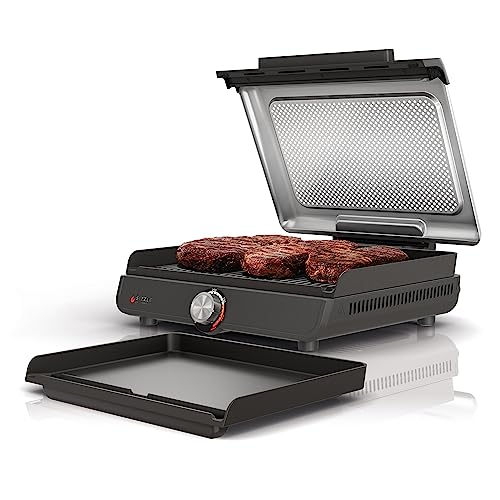
Ninja Sizzle Indoor Grill & Griddle GR101 (14”)
Badge: Best Overall for Steaks
Strengths
- Verified 500°F edge-to-edge heat: the strongest crust-building specification here, with no cool corners to steam a steak’s edges
- Grill plate delivers char marks and drainage channels; the griddle plate handles onions, mushrooms, and garlic butter finishes
- Dishwasher-safe lid offers a cover for the finishing phase and for cheese-topped variations
Trade-offs
- Open-plate searing produces the most vapor of the linked picks — its smoke strategy is heat efficiency and your extractor fan, not containment
- 14 inches fits two large steaks comfortably; more means rounds
- Plate swaps mid-meal need planning, since the resting steak’s timing and the sides’ timing must be choreographed
| Maximum temperature | 500°F, edge-to-edge |
|---|---|
| Size | 14” |
| Plates | Interchangeable nonstick grill plate and griddle plate |
| Lid | Dishwasher-safe |
| Finish | Grey/Silver |
| Model | GR101 |
For pure steak quality, this is the guide’s answer. Crust is a function of surface temperature and contact, and the GR101’s listing states the strongest version of both available indoors: 500°F, delivered edge-to-edge so the whole steak — not just its center — meets a surface hot enough to brown it before the interior overcooks. On the grill plate, that produces the char marks and deep browning steak lovers describe with the word steakhouse, and the plate’s channels give rendered fat somewhere to go besides pooling under the meat.
The smoke side of the bargain must be stated plainly: an open plate at 500°F with a fatty steak will produce vapor, and this model’s smokeless credentials rest on efficient, fast searing (less time at heat, less total vapor) plus your kitchen’s ventilation, rather than on a containing lid. With a clean plate, a dry steak surface, and the extractor running, the session is entirely manageable — but if your kitchen punishes any vapor at all, the Hamilton Beach picks above are the wiser match. Choose with your kitchen, not just your palate.
Best for: Crust-first steak lovers cooking one or two steaks with good kitchen ventilation / Not suited for: Smoke-sensitive small apartments, or family batches in a single round

Ninja Sizzle Pro XL Indoor Griddle & Grill GX101 (20”)
Badge: Best for Several Steaks at Once
Strengths
- 20-inch surface — verified 40% larger than the standard Sizzle — cooks a table’s worth of steaks in one round
- ProTemp IQ edge-to-edge heat addresses the big-plate failure mode: edges that cannot sear
- Ventilated detachable lid vents the steam of a full load while still knocking down splatter, and grease control manages a multi-steak fat volume
Trade-offs
- A full load of steaks renders a full load of fat — vapor management still depends on your extractor and a clean start
- The largest footprint in the guide; counter and storage must be planned
- Ceramic nonstick wants non-metal utensils, including when you are turning four steaks quickly
| Size | 20” |
|---|---|
| Cooking surface | 40% larger than the standard Sizzle (per listing) |
| Heat system | ProTemp IQ edge-to-edge heat |
| Plates | Ceramic nonstick |
| Lid | Detachable, ventilated |
| Model | GX101 |
Cooking steaks for four indoors usually means a relay: two steaks rest while two more cook, and the first pair cools past their prime. The Pro XL’s 20 inches end the relay. A full round of steaks goes down together, and ProTemp IQ edge-to-edge heat is the feature that makes the promise credible — large plates fail at their edges, and a heat system designed to push temperature to the perimeter is the difference between four seared steaks and two seared steaks flanked by two steamed ones. The ventilated lid is the smoke-aware detail: a full load generates steam that would otherwise condense back onto the crusts, and venting lets it escape in a controlled way while the lid still disciplines splatter.
Scale cuts the other way in two respects. The appliance is big, in the kitchen and in the cupboard, and a full batch of fatty steaks is the heaviest vapor load in this guide — grease control features help, but ventilation remains the cook’s responsibility. Households that regularly cook steak for a group will find both costs trivial. Households cooking for two should take the GR101 and enjoy the same philosophy at their scale.
Best for: Families and hosts cooking several steaks in one round with consistent edge-to-edge searing / Not suited for: Couples, small kitchens, or anyone whose ventilation is minimal
NAUQUOHZ 1700W 2-in-1 Smokeless Indoor Grill with Cheese Pans
Badge: Prose-Only: Korean BBQ Format
Strengths
- 1700W is strong power, and thin steaks or sliced steak for shared cooking suit its grill plate well
- Removable plates and dishwasher-safe design support the clean-start discipline steak cooking needs
- Temperature control lets a cook moderate heat for fattier cuts
Trade-offs
- No maximum temperature is stated in its listing, so its searing ceiling for thick steaks cannot be verified — the core requirement of this keyword
- The Korean BBQ format is designed around thin cuts cooked communally, not thick steaks cooked individually
- Prose-only in this guide: no link and no image, by design
| Power | 1700W |
|---|---|
| Format | 2-in-1 smokeless indoor grill, Korean BBQ style |
| Plates | Nonstick removable grill plate and griddle plate |
| Extras | 3 cheese pans |
| Cleanup | Dishwasher safe (per listing) |
This set is included so its many search appearances come with an explanation. It is a capable smokeless appliance, and if your steak habit runs to thin cuts — the sliced, marinated style of a Korean BBQ table — its grill plate will cook them enjoyably, with the griddle plate and cheese pans rounding out the meal. Nothing in this section argues the appliance is poor; the argument is narrower and, for this keyword, decisive.
A steak-first buyer needs to know the surface will reach and hold true searing heat for a thick cut, and this listing does not state a maximum temperature — so the claim cannot be verified, and this guide does not link what it cannot verify for the keyword’s core job. Readers who already own this set should use it for what it is: excellent for thin steak and shared cooking. Readers shopping specifically for steak should choose among the linked four, whose temperatures are on the record.
Best for: Thin-cut and Korean BBQ style steak cooking at the table (context pick) / Not suited for: Thick steakhouse cuts where a verified searing temperature is the requirement
Techwood 1500W Smokeless Electric Indoor Grill with Tempered Glass Lid
Badge: Prose-Only: Compact Smokeless Grill
Strengths
- Tempered glass lid contains vapor well, which is genuinely valuable for apartment steak cooking
- Compact, portable format with dishwasher-safe parts suits small kitchens
- 6-level control offers more heat gradation than basic dials
Trade-offs
- No maximum temperature or cooking area is stated in its listing, so neither searing ceiling nor steak capacity can be verified
- Compact size limits it to small steaks or single servings regardless of heat
- Prose-only in this guide: no link and no image, by design
| Power | 1500W |
|---|---|
| Temperature control | 6-level |
| Lid | Tempered glass |
| Format | Compact and portable |
| Cleanup | Dishwasher safe (per listing) |
| Color | Black |
The Techwood presents the mirror image of the pick above: its containment is excellent for steak — a glass lid over a searing steak is exactly what a small apartment wants — but its listing withholds the two numbers a steak buyer most needs. No maximum temperature is stated, so its sear cannot be verified against the 450°F and 500°F figures of the linked picks; no cooking area is stated, so its steak capacity is guesswork, though its compact format plainly implies small batches.
The result is a prose-only place in this guide, with respect for what the appliance is: a well-conceived compact smokeless grill that will cook a modest steak for one or two people in a small kitchen, and may do it very pleasantly. But a guide ranked for steaks must rank on steak evidence, and on the evidence published, the linked four make the verifiable case. If you already own a Techwood, cook your steak on it with a full preheat and a dry surface, and enjoy it; if you are buying for steak, buy on stated numbers.
Best for: Apartment cooks with modest steak ambitions who value containment (context pick) / Not suited for: Buyers shopping on verified searing temperature and capacity
Comparison Table
The pattern in this table is the guide’s thesis: the linked rows state their temperatures, and the prose-only rows do not. For most keywords that gap would be a footnote; for steaks, where the entire dish is a surface-temperature event, it is the ranking.
| Pick | Badge | Key attributes from the verified listing | Check it |
|---|---|---|---|
| Hamilton Beach Electric Indoor Searing Grill with Lid & Viewing Window | Best Lidded Searing Grill | Lidded searing grill; verified 450°F adjustable; 118 sq. in. PFAS-free removable nonstick; viewing window. | Check on Amazon |
| Hamilton Beach Electric Indoor Searing Grill (25360) | Best Classic Searing Grill | Lidded searing grill (25360); verified 450F adjustable; 118 sq. in. PFAS-free removable nonstick grate; stainless steel. | Check on Amazon |
| Ninja Sizzle Indoor Grill & Griddle GR101 (14”) | Best Overall for Steaks | Open plate grill; verified 500°F edge-to-edge; interchangeable grill and griddle plates; dishwasher-safe lid; 14”. | Check on Amazon |
| Ninja Sizzle Pro XL Indoor Griddle & Grill GX101 (20”) | Best for Several Steaks at Once | 20” XL plate grill/griddle; ProTemp IQ edge-to-edge heat; ceramic nonstick; ventilated detachable lid; grease control. | Check on Amazon |
| NAUQUOHZ 1700W 2-in-1 Smokeless Indoor Grill with Cheese Pans | Prose-Only: Korean BBQ Format | Prose-only: 1700W 2-in-1 Korean BBQ set; removable plates; 3 cheese pans; no stated maximum temperature. | Prose-only |
| Techwood 1500W Smokeless Electric Indoor Grill with Tempered Glass Lid | Prose-Only: Compact Smokeless Grill | Prose-only: compact lidded smokeless grill; 1500W; 6-level control; no stated maximum temperature or area. | Prose-only |
How to Choose the Best Indoor Smokeless Grills for Steaks
Demand a stated temperature. Steak is the least forgiving food in indoor grilling: below a true searing threshold, the surface greys and steams while the interior overcooks, and no technique rescues it. A listing that states 450°F or 500°F lets you predict the crust; a listing that states only wattage asks you to hope. Wattage matters secondarily — it governs how fast the surface recovers when a cold steak lands — but the ceiling comes first. This is why this guide’s linked picks are exactly the models whose listings put a temperature on the record, and it is a filter worth keeping for any model you consider beyond this list.
Decide your smoke strategy consciously, because the two honest strategies pull in opposite directions. Containment — a lidded grill — keeps vapor in the appliance and suits sensitive kitchens, at a small cost to crust crispness. Open high heat sears fastest and hardest, producing its vapor quickly and relying on your extractor to clear it. Neither is superior in the abstract; they are superior for different kitchens. A vented lid, like the Pro XL’s, is the engineered compromise, venting steam while disciplining splatter. Match the strategy to your ventilation and your alarm’s temperament before you fall in love with a temperature figure.
Size the surface to your steak count, remembering that steaks need elbow room. A crowded steak steams its neighbor; two large steaks on 118 sq. in. is a comfortable load, four is a crowd. The 20-inch Pro XL exists for households that cook steak as a group meal. Also consider plate geometry: grill plates print marks and drain fat into channels, which suits fatty cuts; flat griddle plates maximize contact and crust coverage, which suits leaner cuts and smash-style preparations. Interchangeable plates, as on both Ninjas, let one appliance serve both geometries — a real advantage for a cut as variable as steak. The outdoor comparison, for readers with a yard, lives under Best Natural Gas Bbq Grills, where these constraints relax and others appear.
Finally, think about the finish, not just the sear. Thick steaks need a second phase — lower heat, often covered — to bring the center up without burning the crust, which is why adjustable control and a lid matter beyond the headline temperature. Butter basting, resting, and sides all have their equipment implications too: a griddle plate for mushrooms and onions turns a steak grill into a steak dinner station. Buy for the whole arc of the meal, and the grill will feel chosen rather than merely purchased.
How to Cook a Steak on an Indoor Smokeless Grill
This sequence assumes any linked pick in the guide. It is built around the steak’s two phases — the sear and the finish — and around keeping the smoke where the design intends it to go.
- Bring the steak toward room temperature and dry it thoroughly. Twenty to thirty minutes out of the fridge, then pat every surface dry. Surface moisture is steam, steam is vapor, and vapor is the enemy of both crust and smoke control.
- Season simply and trim excess surface fat. Salt and pepper are enough for the grill itself. Large ribbons of external fat render heavily and smoke; trim the thickest excess, and save elaborate marinades — especially sugary ones — for after cooking.
- Preheat to the grill’s maximum, with the extractor running. The steak must meet a fully heated surface. On lidded models, preheat with the lid closed; on plates, wait for the full heat signal or the full preheat time.
- Sear the first side without moving the steak. Lay it down and leave it until the crust forms and the meat releases easily. Pressing and sliding tear the crust and squeeze juice onto the hot surface, where it smokes.
- Flip once, sear the second side, then step the heat down. For thick steaks, the finish phase — moderate heat, lid down where fitted — brings the center up gently. Thin steaks may need nothing beyond the two sears.
- Add butter and aromatics only in the final minute. Butter’s solids burn and smoke at searing heat; added at the end, it foams and bastes without burning. Garlic and herbs belong to this minute too.
- Rest the steak off the heat for at least five minutes. Resting redistributes juice and lets the crust set. Use the still-hot griddle plate, where you have one, for mushrooms, onions, or bread — the steak’s flavor is on that surface, and the sides should collect it.
After the meal, clean while the surface is warm. Steak fat left in grill-plate channels is precisely calibrated to smoke at the next session’s preheat, and the removable surfaces on every linked pick here exist to make that cleaning easy. A grill that starts clean is the smokeless grill the box promised.
Troubleshooting
Problem: The crust is pale even though the grill was at maximum → the steak went on wet, the surface was not fully preheated, or the plate was crowded. Dry the meat, wait for full preheat, and cook fewer steaks per round.
Problem: The steak is beautifully crusted but raw in the center → it is a thick cut cooked like a thin one. Add the finish phase: after searing both sides, step the temperature down and close the lid where fitted until the center catches up.
Problem: Smoke pours out when the steak lands → check for residue in the plate channels from previous sessions, and look at the steak’s surface fat — a very fatty exterior at maximum heat will smoke on any grill. Clean starts and trimmed fat solve most of it.
Best Indoor Smokeless Grills for Steaks: Thin Cuts vs. Thick Cuts
Thin steaks — the kind that cook in two or three minutes a side — are a pure heat event. They want the hottest surface available, total commitment, and no finish phase, which makes the Ninja GR101’s verified 500°F edge-to-edge plate their natural home. They are also the steaks that suit formats this guide ranks lower for thick cuts: on a Korean BBQ table, thin sliced steak is the main event. Thickness, not quality, is what separates those judgments.
Thick steaks are a two-phase dish, and the equipment ranking inverts accordingly. The sear still matters, but the finish — gentle, often covered, long enough for the center to rise without the crust burning — decides the result. That is the Hamilton Beach design’s home ground, with adjustable control and a lid, and it is why a slightly lower stated ceiling (450°F) paired with a finish-friendly format can out-cook a hotter open plate for a two-inch steak. Know your household’s default thickness, and you know which half of this guide is yours.
Reading a Steak Grill’s Spec Sheet Like a Skeptic
Three numbers do most of the honest work on a steak grill’s listing: the stated maximum temperature, the cooking area, and — where claimed — whether heat is edge-to-edge. A temperature without an area can hide a tiny surface; an area without a temperature can hide a timid element; both without an evenness claim can hide cold corners that steam a steak’s edges. The linked picks in this guide publish enough of that triangle to be judged, which is the real reason they are linked.
Treat wattage as supporting evidence, never the headline: it predicts recovery speed, not peak heat. And treat the word smokeless as a design description to be unpacked — lid, drip path, plate system — rather than a result to be assumed. Readers who apply the same skepticism outdoors will find it equally useful among Best Natural Gas Cast Iron Grills, where BTU figures play the same misleading headline role that wattage plays here.
Resting, Slicing, and Serving: The Steak After the Sear
Indoor steak guides usually end at the grill, which is where mediocre steak dinners are decided — because the minutes after cooking carry as much quality as the minutes on it. Resting is the first discipline: a steak pulled from a 450°F or 500°F surface is a system under pressure, its juices driven toward the center, and cutting it immediately spills that pressure across the board. Five minutes of rest for a modest steak, nearer ten for a thick one, lets the juices redistribute so the slice is moist throughout rather than wet on the plate and dry in the mouth. Tent loosely if your kitchen is cold; do not wrap tightly, which steams the crust you worked for.
Slicing is the second discipline, and it interacts with cut choice. Tougher, flavorful cuts — the flat, grained ones that indoor grills handle beautifully — transform when sliced thinly against the grain, each bite shortening the muscle fibers your teeth would otherwise fight. Tender cuts need only honest thick slices. Either way, slice on a board that catches juice, and return that juice to the meat or to the mushrooms and onions you finished on the griddle plate, where it becomes a sauce with no recipe at all.
Serving is where the indoor format quietly wins its own argument. The grill is steps from the table; the sides finished on the same surface, in the steak’s own fat and fond; the whole dinner arrives together, hot, without a patio door ever opening. Steakhouse theater is real, but so is this: a Tuesday-night steak, seared hard on a verified-hot indoor grill, rested properly, sliced against the grain, and eaten while the kitchen still smells like the best decision of the week. The equipment in this guide exists to make that Tuesday ordinary.
Common Buying Mistakes
Buying on wattage for a steak grill. Wattage is recovery, not ceiling. A steak needs a verified searing temperature first; shop the number that describes the surface, not the power cord.
Putting a wet steak on the grill. Surface moisture becomes steam, steam prevents crust and carries fat vapor into the room. The dry pat-down is the highest-value ten seconds in indoor steak cooking.
Cooking every steak at maximum from start to finish. Thick steaks need a finish phase at stepped-down heat, ideally under a lid. Maximum throughout gives you a burnt crust over a cold center — the worst of both settings.
Crowding steaks to save time. Steaks need space for vapor to escape and surfaces to stay hot. Rounds with room beat a single crowded batch on every measure, including total time once re-searing failures are counted.
Ignoring the prose-only lesson. If a listing will not state a maximum temperature, it has not made the case for steak. That standard, applied consistently, is what separates this guide’s linked picks from its context picks — and it applies to any model you meet elsewhere, including outdoor ones compared in Best Natural Gas Grills On Th Emarket.
Final Recommendation
For the best steak an indoor electric grill can honestly produce, choose the Ninja Sizzle GR101: verified 500°F edge-to-edge heat, a grill plate for marks and drainage, and a griddle plate for the sides. If you cook steak for a table, the Pro XL GX101 scales the same virtues to 20 inches with a ventilated lid that respects the room.
If your kitchen punishes vapor or your steaks run thick, choose a Hamilton Beach — the viewing-window model if you like to watch the finish, the 25360 if you do not need to. Both sear at a verified 450°F and contain what steak cooking gives off. And let the two prose-only picks stand as the guide’s closing lesson: in a category where one number decides the dish, buy the appliances that publish the number.
And a final calibration for the reader still torn between the two philosophies in this guide: cook one steak both ways in your imagination, honestly. If the pleasure you picture is the crust — dark, crisp, almost crackling, with the room smelling unmistakably of a steakhouse for an hour — your grill is the Ninja and your ventilation is part of the recipe. If the pleasure is control — the quiet chamber, the window, the thick center arriving exactly at blush while the kitchen stays composed — your grill is a Hamilton Beach. Both pictures are of an excellent dinner. Buy the one you pictured first.
And a final calibration for the reader still torn between the two philosophies in this guide: cook one steak both ways in your imagination, honestly. If the pleasure you picture is the crust — dark, crisp, almost crackling, with the room smelling unmistakably of a steakhouse for an hour — your grill is the Ninja and your ventilation is part of the recipe. If the pleasure is control — the quiet chamber, the window, the thick center arriving exactly at blush while the kitchen stays composed — your grill is a Hamilton Beach. Both pictures are of an excellent dinner. Buy the one you pictured first.
Related guides
Frequently Asked Questions
What temperature does an indoor grill need for a good steak sear?
A stated maximum around 450°F or higher is the practical threshold for a deep crust before the interior overcooks. The linked picks in this guide state 450°F (Hamilton Beach models) and 500°F edge-to-edge (Ninja GR101). Models whose listings state no maximum temperature cannot be verified for steak work, which is why two such models appear here as prose-only context.
Will a smokeless grill really handle a fatty ribeye indoors?
Yes, with technique: trim the thickest external fat, start with a clean plate and a clear drip path, dry the surface, and run the extractor. A lidded model contains the most vapor; an open high-heat plate sears fastest and relies more on ventilation. Either way, expect cooking aroma — the goal is managing smoke, not abolishing evidence of dinner.
Is a lid good or bad for steak?
Both, in sequence. An open surface gives the hardest crust during the sear; a lid helps during the finish, holding heat around a thick steak while the center rises, and it contains vapor throughout. Grills that offer a lid over a hot plate, or a lidded chamber with real searing heat, let you use each where it helps.
How many steaks can I cook at once on these grills?
On the 118 sq. in. Hamilton Beach models, two good-sized steaks with working room. The 14-inch Ninja GR101 handles two large steaks comfortably. The 20-inch Pro XL is the one-round option for a table of steaks. Crowding beyond those loads steams the meat and undermines the sear, so rounds are better than a packed surface.
Grill plate or griddle plate for steak?
A grill plate prints marks and drains fat into channels — ideal for fatty cuts. A flat griddle plate maximizes contact and crust coverage — ideal for leaner cuts and for finishing with butter. Models with interchangeable plates, like both Ninjas here, let the cut decide, and the griddle doubles as the sides station for mushrooms and onions.
Why are two grills in this guide not linked?
Because their listings do not state a maximum temperature, and this keyword’s core job — searing steak — cannot be verified without one. They are discussed in prose so you can see the reasoning and judge the appliances for other uses, but this guide links only picks whose steak credentials are on the record.
How do I stop my indoor grill smoking at the next session after steak night?
Clean the plate channels and drip areas while they are still warm after the meal. Steak fat left in the channels reheats at the next preheat and smokes before any food is involved. Every linked pick here has removable or dishwasher-friendly surfaces precisely to make that habit easy.
Should I oil the steak or the grill plate?
Oil the steak, lightly, just before it goes on. Oil spread on a very hot empty plate sits at searing temperature with nothing to protect it, and it can smoke and degrade before the food arrives — the opposite of this guide’s purpose. A thin film on the meat itself seasons the surface, helps salt adhere, and meets the heat at the same moment the steak does. On nonstick surfaces, keep the amount modest; the coating is doing most of the release work already.


