Disclosure: topratedkitchenware.com is reader-supported. When you buy through links on our site, we may earn an affiliate commission from Amazon and other retailers, at no extra cost to you.
Where to buy
The quickest route to each pick is below. Linked picks go straight to their Amazon listing so you can check the latest price on Amazon; picks marked prose-only failed a core requirement of this keyword — the detailed reviews explain exactly why, and they carry no purchase link so there is no confusion about the recommendation.
- Nermak 12V 10Ah LiFePO4 Battery (2 Pack) — check the latest price on Amazon
- VEMDIA 12V 100Ah LiFePO4 Battery (Group 31) — check the latest price on Amazon
- SUPER EMPOWER 12.8V 100Ah LiFePO4 Battery (Group 31) — check the latest price on Amazon
- yeagulch 12.8V 100Ah LiFePO4 Battery (Group 31) — check the latest price on Amazon
- Xeanerol 24V 5Ah Lithium Battery — prose-only in this guide (see its review below)
- VATRER POWER 12V 300Ah LiFePO4 Battery — prose-only in this guide (see its review below)
Read the full guide ↓
Finding the best small 12 volt battery starts with an honest argument about what ‘small’ means, because the market uses the word for two very different products. At one end are genuinely compact batteries — 10Ah to 20Ah blocks that power fish finders, LED lighting, gate openers, and small solar setups, and that you can carry in one hand. At the other end are full-capacity 100Ah batteries in standard Group 24 or Group 31 cases that sellers call small because lithium makes them lighter than the lead-acid units they replace. Both meanings are legitimate; confusing them is how buyers end up with a battery that does not fit the box, or one that runs flat by lunchtime.
This guide covers both meanings and labels them clearly. The pool researched for this article contains one true compact pick, three full-size 100Ah lithium batteries that earn their place as space-efficient upgrades, and two products that fail the brief in opposite directions — one is the wrong voltage entirely, and one is a 300Ah bank that no honest writer could call small. Those two are covered prose-only, with no purchase links, so you can see exactly why they were set aside rather than quietly dropped.
Every linked pick below is a 12V (or 12.8V nominal) lithium iron phosphate battery verified against the maker’s listing data, with its capacity, BMS rating, and protections stated in its own spec box. Read the sizing maths in the buying guide before you order: with small batteries, the difference between a perfect match and a frustrating one is usually a single honest calculation about how many watt-hours you actually use in a day.
Shoppers comparing compact power options often also weigh cell-format choices, and our guide to Best Rechargeable Aa Alkaline Batteries 15 Volt covers the smaller end of that same decision.
Key Takeaways
- True small 12V batteries are the 10–20Ah class: enough for electronics, lighting, and fish finders, not for propulsion or big inverters.
- A 100Ah Group 31 lithium battery is ‘small’ only in the sense of replacing lead-acid with less weight and one unit instead of a parallel pair.
- Match the BMS rating to your biggest continuous load — a 10A BMS and a 100A BMS serve completely different jobs.
- Voltage is non-negotiable: a 24V pack in a 12V system is a mismatch no adapter cable makes safe or sensible.
- LiFePO4 chemistry dominates this pool for good reason: long cycle life, stable behaviour, and usable capacity down to low charge levels.
In this guide
Quick Picks
All six products researched for the best small 12 volt battery brief, at a glance. Badges match the detailed reviews that follow.
| Pick | Badge | Headline specification | Status |
|---|---|---|---|
| Nermak 12V 10Ah LiFePO4 Battery (2 Pack) | Best Overall — Truly Small | Nominal voltage: 12V; Capacity: 10Ah per battery (2 pack); Chemistry: Lithium iron phosphate (LiFePO4) | Linked |
| VEMDIA 12V 100Ah LiFePO4 Battery (Group 31) | Best Full-Size Upgrade | Nominal voltage: 12V; Capacity: 100Ah; Energy: 1280Wh | Linked |
| SUPER EMPOWER 12.8V 100Ah LiFePO4 Battery (Group 31) | Best for Expanding Later | Nominal voltage: 12.8V; Capacity: 100Ah; Energy: 1280Wh | Linked |
| yeagulch 12.8V 100Ah LiFePO4 Battery (Group 31) | Best for Daily Solar Cycling | Nominal voltage: 12.8V; Capacity: 100Ah; Energy: 1280Wh | Linked |
| Xeanerol 24V 5Ah Lithium Battery | Prose-Only: Wrong Voltage | Nominal voltage: 24V; Capacity: 5Ah; Chemistry: Lithium-ion (Li-ion) | Prose-only |
| VATRER POWER 12V 300Ah LiFePO4 Battery | Prose-Only: Far Too Big to Be ‘Small’ | Nominal voltage: 12V; Capacity: 300Ah; Chemistry: Lithium iron phosphate (LiFePO4) | Prose-only |
How These Picks Were Chosen
The pool for this keyword was screened first on the two words that define it: 12 volt, and small. Any product whose nominal voltage was not 12V-class was removed from linked consideration regardless of its other merits, and any product whose capacity and case size made ‘small’ indefensible was treated the same way. What remained was scored on capacity honesty (amp-hours and watt-hours both stated), BMS rating against realistic loads, stated cycle class, low-temperature behaviour, and case size against standard battery boxes. This is a research-led guide: specifications come from verified listing data, cycle figures are reported as maker-stated rather than independently confirmed, and no hands-on testing is claimed. Where a product failed the brief, it is still reviewed in prose so the reasoning is visible.
The 6 Best Options for small 12 volt battery
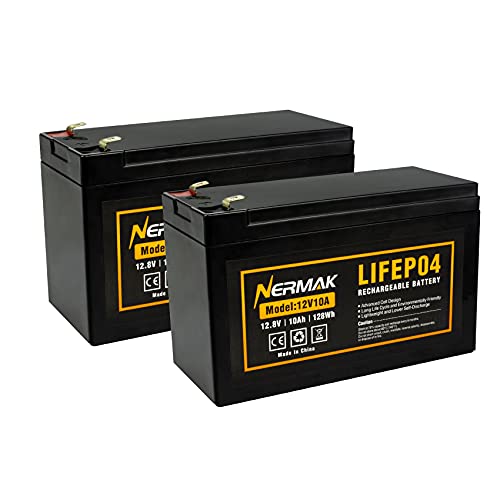
Nermak 12V 10Ah LiFePO4 Battery (2 Pack)
Badge: Best Overall — Truly Small
This is the only pick in the pool that is small in the everyday sense of the word: a 10Ah LiFePO4 block, sold as a two-pack, that one person can lift with one hand and mount in a kayak hatch, a fish-finder crate, or a small solar cabinet. Each battery carries a built-in 10A BMS, which matches the electronics-class loads it is meant for — sonar units, LED lighting, small pumps, and ride-on toy upgrades. The maker states 2000+ cycles, a lower figure than the big storage batteries below, but for weekend and seasonal duty that still translates into years of service. If your load list is measured in watts rather than kilowatts, start here.
Look at the specification as a system rather than a headline. The nominal voltage of 12V and a chemistry of Lithium iron phosphate (LiFePO4) defines what this battery can safely deliver hour after hour, while the stated cycle class tells you the duty it was built for. In a compact 12 volt power for electronics, lighting, fish finders, and small solar setups role, that combination matters more than any single number: a battery is only as useful as the weakest link between its capacity, its discharge ceiling, and the protection that keeps it alive when conditions turn cold, hot, or careless. Buyers who match those three things to their real load rarely think about the battery again, which is exactly the point.
Strengths
- Genuinely small and light — the true compact option in this pool
- Two batteries in the pack allow two separate small systems or a spare
- LiFePO4 chemistry is a durable step up from small sealed lead-acid blocks
Trade-offs
- 10Ah runs electronics and lighting, not propulsion or large inverters
- The 10A BMS caps continuous draw at small-device levels
- Cycle class is stated lower than the big storage batteries here
| Nominal voltage | 12V |
|---|---|
| Capacity | 10Ah per battery (2 pack) |
| Chemistry | Lithium iron phosphate (LiFePO4) |
| BMS | Built-in 10A BMS |
| Cycle class | 2000+ cycles (maker-stated) |
| Intended use (maker-stated) | Solar/wind power, scooters, lighting, Power Wheels, fish finders |
Best for: buyers who need compact 12 volt power for electronics, lighting, fish finders, and small solar setups and whose loads fit this battery’s stated limits / Not suited for: buyers whose voltage, capacity, or discharge requirements fall outside the specification above

VEMDIA 12V 100Ah LiFePO4 Battery (Group 31)
Badge: Best Full-Size Upgrade
Calling a Group 31 battery ‘small’ needs an honest qualifier: this VEMDIA is small only relative to the job it does. It packs 100Ah and 1280Wh into a standard Group 31 case with a 100A smart BMS and low-temperature protection, which makes it the compact way to get serious capacity into an RV bay, a trolling setup, or a cabin system without parallel wiring. Lithium construction keeps the weight far below an equivalent lead-acid unit, so one person can install it. Choose it when your ‘small’ means ‘the least hardware that still runs real loads’, not when you need something that fits in a tackle box.
The honest way to judge this battery is against the job named in this guide — compact 12 volt power for electronics, lighting, fish finders, and small solar setups. Its nominal voltage of 12V and a energy of 1280Wh is the figure to hold against your own load list. Everything else about the design, from the case format to the protection features, exists to make that central specification usable in the real world: in a compartment that gets hot in summer, on mornings when the temperature sits below freezing, and on the day someone connects a load bigger than the plan allowed. That is what the BMS is for, and it is why its rating appears in the spec box rather than in a footnote.
Strengths
- Full 100Ah capacity in a standard Group 31 case, so it drops into existing battery boxes and trays
- A 100A BMS supports substantial continuous loads for a battery of this class
- Low-temperature protection guards against charging damage on cold mornings
Trade-offs
- Group 31 is a full-size case — it is not a compact battery despite the lithium weight saving
- The 100A BMS ceiling rules out very high-draw inverter loads on a single unit
- Low-temperature protection is a cutoff, not heating, so cold-weather charging still pauses until the battery warms
| Nominal voltage | 12V |
|---|---|
| Capacity | 100Ah |
| Energy | 1280Wh |
| Case size | Group 31 |
| Chemistry | Lithium iron phosphate (LiFePO4) |
| BMS | Built-in 100A smart BMS |
| Cycle class | 15000+ deep cycles (maker-stated) |
| Protection | Low-temperature protection |
Best for: buyers who need compact 12 volt power for electronics, lighting, fish finders, and small solar setups and whose loads fit this battery’s stated limits / Not suited for: buyers whose voltage, capacity, or discharge requirements fall outside the specification above
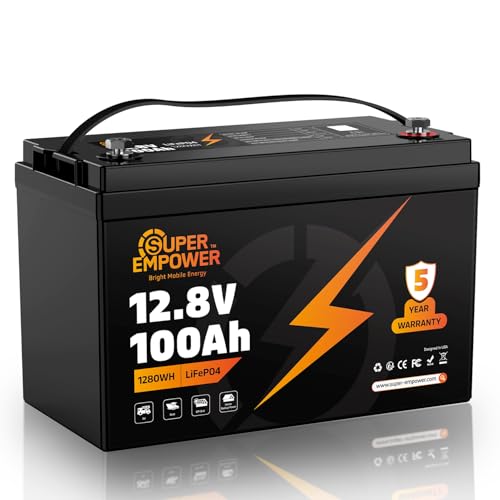
SUPER EMPOWER 12.8V 100Ah LiFePO4 Battery (Group 31)
Badge: Best for Expanding Later
The SUPER EMPOWER Group 31 matches the VEMDIA on headline numbers — 12.8V, 100Ah, 1280Wh, a 100A BMS, and low-temperature cutoff — and adds one meaningful difference: stated 4P4S expansion support up to 20.48kWh. That makes it the pick for buyers who want a single battery today and a credible path to a bigger bank tomorrow without replacing the first unit. As a standalone small-system battery it behaves like its peers; its advantage only appears when the system grows. If you know the installation is finished at one battery, the expansion support is a bonus you may never use.
Two ownership details separate a good purchase from a frustrating one here. First, charging: this battery expects a lithium-profile charger or a charge controller set for LiFePO4, and using the right profile is the cheapest lifespan insurance available. Second, expectations: maker-stated cycle figures describe laboratory duty, so the sensible reading is comparative, not absolute. Set against those two disciplines, the nominal voltage of 12.8V and a energy of 1280Wh and the overall design make this a battery you install, configure once, and then mostly ignore — the correct experience for a power component.
Strengths
- Stated 4P4S expansion support makes it a building block for larger banks
- Low-temperature cutoff protects the cells during cold-weather charging
- Group 31 footprint matches common RV and marine battery compartments
Trade-offs
- Expansion only pays off if you actually plan a multi-battery bank
- A single unit’s 100A BMS caps continuous discharge like its peers
- Series and parallel wiring adds cabling and balancing homework the listing cannot do for you
| Nominal voltage | 12.8V |
|---|---|
| Capacity | 100Ah |
| Energy | 1280Wh |
| Case size | Group 31 |
| Chemistry | Lithium iron phosphate (LiFePO4) |
| BMS | 100A BMS |
| Protection | Low-temperature cutoff |
| Expansion | Supports 4P4S expansion, up to 20.48kWh |
Best for: buyers who need compact 12 volt power for electronics, lighting, fish finders, and small solar setups and whose loads fit this battery’s stated limits / Not suited for: buyers whose voltage, capacity, or discharge requirements fall outside the specification above
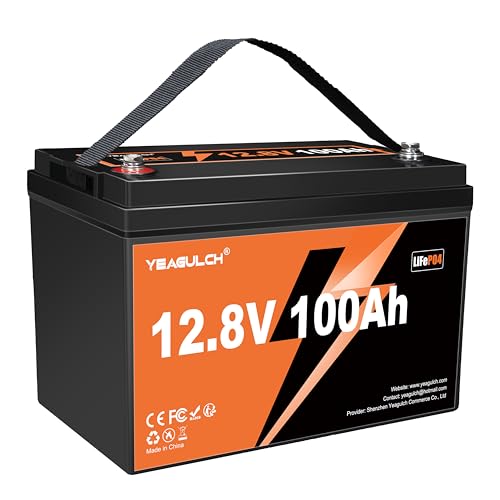
yeagulch 12.8V 100Ah LiFePO4 Battery (Group 31)
Badge: Best for Daily Solar Cycling
The yeagulch Group 31 is the daily-cycling entry in this line-up: 12.8V, 100Ah, a 100A BMS, low-temperature protection, and a maker-stated 15000+ deep-cycle class. Cycle claims are laboratory numbers rather than guarantees, but a battery marketed around deep cycling is the right shape for solar systems that charge and discharge every single day. In a small home backup or off-grid lighting system it offers the same 1280Wh as the other Group 31 picks, with its emphasis on longevity. Pick it when the battery will work daily rather than sit in storage between trips.
Look at the specification as a system rather than a headline. The nominal voltage of 12.8V and a energy of 1280Wh defines what this battery can safely deliver hour after hour, while the stated cycle class tells you the duty it was built for. In a compact 12 volt power for electronics, lighting, fish finders, and small solar setups role, that combination matters more than any single number: a battery is only as useful as the weakest link between its capacity, its discharge ceiling, and the protection that keeps it alive when conditions turn cold, hot, or careless. Buyers who match those three things to their real load rarely think about the battery again, which is exactly the point.
Strengths
- High stated cycle class suits daily-cycling solar and off-grid duty
- 100Ah and 1280Wh in a familiar Group 31 case simplifies upgrades from lead-acid
- Low-temperature protection is built in rather than left to the charger
Trade-offs
- Cycle-life figures are maker-stated under lab conditions, not a guarantee for your depth of discharge
- No self-heating, so sub-freezing charging waits on warmer conditions
- Brand support channels are thinner than legacy battery brands
| Nominal voltage | 12.8V |
|---|---|
| Capacity | 100Ah |
| Energy | 1280Wh |
| Case size | Group 31 (BIC) |
| Chemistry | Lithium iron phosphate (LiFePO4) |
| BMS | 100A BMS |
| Cycle class | 15000+ deep cycles (maker-stated) |
| Protection | Low-temperature protection |
Best for: buyers who need compact 12 volt power for electronics, lighting, fish finders, and small solar setups and whose loads fit this battery’s stated limits / Not suited for: buyers whose voltage, capacity, or discharge requirements fall outside the specification above
Xeanerol 24V 5Ah Lithium Battery
Badge: Prose-Only: Wrong Voltage
The Xeanerol pack is covered prose-only because it fails the first word of the brief after ‘small’: it is a 24V battery, not a 12V one. It is genuinely tiny — 5Ah with an included 2A charger and cable connector — and for 24V DIY projects, RC cars, LED strips, or CCTV cameras it may be exactly right. But wiring a 24V pack into a 12V system without a proper converter risks damaged electronics, and no amount of compactness fixes a voltage mismatch. It stays in this guide as a warning and a pointer: if your project is actually 24V, this is a candidate; if it is 12V, keep looking at the picks above.
The honest way to judge this battery is against the job named in this guide — compact 12 volt power for electronics, lighting, fish finders, and small solar setups. Its nominal voltage of 24V and a chemistry of Lithium-ion (Li-ion) is the figure to hold against your own load list. Everything else about the design, from the case format to the protection features, exists to make that central specification usable in the real world: in a compartment that gets hot in summer, on mornings when the temperature sits below freezing, and on the day someone connects a load bigger than the plan allowed. That is what the BMS is for, and it is why its rating appears in the spec box rather than in a footnote.
Strengths
- Ships with its own 2A charger and cable connector for small projects
- Very light and compact for bench, RC, and lighting experiments
- A ready-made pack for low-draw 24V electronics
Trade-offs
- 24V output — it cannot run a 12V system without conversion
- 5Ah is project-scale energy, far below deep-cycle storage batteries
- Lithium-ion chemistry, not LiFePO4, with a project-pack rather than storage-battery design
| Nominal voltage | 24V |
|---|---|
| Capacity | 5Ah |
| Chemistry | Lithium-ion (Li-ion) |
| Included | 2A fast charger and cable connector |
| Intended use (maker-stated) | 24V DIY projects, RC cars, LED light strips, CCTV cameras |
Best for: buyers who need compact 12 volt power for electronics, lighting, fish finders, and small solar setups and whose loads fit this battery’s stated limits / Not suited for: buyers whose voltage, capacity, or discharge requirements fall outside the specification above
VATRER POWER 12V 300Ah LiFePO4 Battery
Badge: Prose-Only: Far Too Big to Be ‘Small’
The VATRER POWER 300Ah is prose-only for the opposite reason to the Xeanerol: the voltage is right, but nothing about a 300Ah battery with a 200A BMS, self-heating, and app monitoring is small. It is a serious single-unit bank for RV and off-grid use, and its self-heating is genuinely useful in cold climates. Including it as a ‘small battery’ pick would mislead anyone shopping for compact power, so it is documented here honestly instead: if your space and budget actually allow a battery this size, it removes parallel wiring entirely — but measure your compartment first, twice.
Two ownership details separate a good purchase from a frustrating one here. First, charging: this battery expects a lithium-profile charger or a charge controller set for LiFePO4, and using the right profile is the cheapest lifespan insurance available. Second, expectations: maker-stated cycle figures describe laboratory duty, so the sensible reading is comparative, not absolute. Set against those two disciplines, the nominal voltage of 12V and a chemistry of Lithium iron phosphate (LiFePO4) and the overall design make this a battery you install, configure once, and then mostly ignore — the correct experience for a power component.
Strengths
- 300Ah in one unit removes the need for parallel wiring in mid-size banks
- Self-heating supports charging in genuinely cold conditions
- A 200A BMS suits larger inverter loads than 100A units allow
Trade-offs
- This is a large, heavy battery — the opposite of a small-footprint pick
- Capacity this size is wasted on modest daily loads
- App monitoring is a convenience layer, not a substitute for correct installation
| Nominal voltage | 12V |
|---|---|
| Capacity | 300Ah |
| Chemistry | Lithium iron phosphate (LiFePO4) |
| BMS | Built-in 200A BMS |
| Features | Self-heating and app monitoring |
| Protection | Low/high temperature cutoff |
Best for: buyers who need compact 12 volt power for electronics, lighting, fish finders, and small solar setups and whose loads fit this battery’s stated limits / Not suited for: buyers whose voltage, capacity, or discharge requirements fall outside the specification above
Comparison Table
The six products side by side on the attributes that decide this category. No prices and no ratings — both change too often to print honestly; use the links to check the latest price on Amazon.
| Product | Voltage | Capacity | Chemistry | Status | Link |
|---|---|---|---|---|---|
| Nermak 12V 10Ah LiFePO4 Battery (2 Pack) | 12V | 10Ah per battery (2 pack) | Lithium iron phosphate (LiFePO4) | Linked | Check on Amazon |
| VEMDIA 12V 100Ah LiFePO4 Battery (Group 31) | 12V | 100Ah | Lithium iron phosphate (LiFePO4) | Linked | Check on Amazon |
| SUPER EMPOWER 12.8V 100Ah LiFePO4 Battery (Group 31) | 12.8V | 100Ah | Lithium iron phosphate (LiFePO4) | Linked | Check on Amazon |
| yeagulch 12.8V 100Ah LiFePO4 Battery (Group 31) | 12.8V | 100Ah | Lithium iron phosphate (LiFePO4) | Linked | Check on Amazon |
| Xeanerol 24V 5Ah Lithium Battery | 24V | 5Ah | Lithium-ion (Li-ion) | Prose-only | Prose-only |
| VATRER POWER 12V 300Ah LiFePO4 Battery | 12V | 300Ah | Lithium iron phosphate (LiFePO4) | Prose-only | Prose-only |
How to Choose: Best Small 12 Volt Battery Buying Guide
Start with watt-hours, not amp-hours
Small-battery shopping goes wrong when buyers compare amp-hours without converting to energy. Watt-hours — amp-hours multiplied by nominal voltage — are what your loads actually consume. A 10Ah battery at 12V stores roughly 120Wh; a 20Ah stores about 256Wh; a 100Ah stores 1280Wh. List your devices, multiply each one’s watts by the hours it runs, and add the results. A fish finder drawing 15W for six hours needs about 90Wh, which a 10Ah battery covers with margin. A 12V fridge drawing an average of 40W over 24 hours needs close to 960Wh, which no genuinely small battery covers — that is 100Ah territory, and pretending otherwise ends in warm food.
The BMS rating is your real load limit
Every lithium battery in this pool has a battery management system, and its amp rating is the ceiling for continuous discharge. The compact Nermak’s 10A BMS supports roughly 120W of continuous load — perfect for electronics, useless for a 500W inverter. The 100A BMS units support roughly 1200W, which covers most small inverters and trolling motors at moderate settings. Surge loads matter too: motors and compressors draw several times their running watts at startup. If your biggest load sits near the BMS ceiling, step up a class rather than hoping the protection circuitry enjoys the exercise — a BMS that trips is doing its job, and your system stops with it.
Case size: Group 24, Group 31, and the small-block class
Standardised case sizes decide whether a battery physically fits. Group 24 is the smaller automotive-derived footprint; Group 31 is larger and is the commonest size for 100Ah lithium batteries. Below those sit the small-block batteries — the 10Ah and 20Ah class — which follow no single case standard, so measure the actual unit and your compartment before ordering. Also check terminal type and position: a battery that fits the box but puts its terminals against a metal lid is a short circuit waiting for a bumpy road. Leave room for cable bend radius, not just the battery’s own dimensions.
Charging a small lithium battery correctly
LiFePO4 batteries want a charger with a lithium profile: the right absorption voltage, no equalisation stage, and no lead-acid desulfation pulses. Many small batteries charge happily from a modest solar panel through a charge controller set to lithium, or from a small mains charger. Low-temperature protection, fitted to most picks here, blocks charging below freezing to protect the cells — helpful, but it means a battery in an unheated space may refuse a morning charge until it warms. The one prose-only exception, the self-heating 300Ah unit, solves that problem actively, at a size and price class this guide’s keyword is not really about.
If your project also involves keeping a 9V device running, the companion research on Best Rechargeable 9 Volt Batteries And Charger explains the charging side of that format.
How to Install and Maintain a Small 12V Battery
Installing a small 12V battery is straightforward work, but the order of operations matters. Begin by switching off every load and charger connected to the system. If you are replacing an existing battery, disconnect the negative terminal first and the positive last; reverse that order on installation, positive first and negative last, so a slipped wrench cannot easily short the battery. Mount the new battery so it cannot slide or tip — small lithium batteries are light enough to move under vibration, and a battery that migrates will eventually chafe a cable or loosen a terminal. Use a strap, tray, or foam blocking as the compartment requires.
Connect cables with clean, tight terminals and the correct polarity, then double-check polarity with a multimeter before switching anything on — reverse polarity is the one mistake small systems rarely forgive. Keep cable runs short and use wire thick enough for the current: voltage drop over thin, long cables wastes energy and can starve motors at startup. If the battery feeds a solar charge controller, connect the battery to the controller before connecting the panels, following the controller maker’s sequence, so the controller boots on battery voltage and configures itself correctly.
Maintenance for LiFePO4 is mostly neglect, done correctly. There is no water to top up and no equalisation charge to run. Keep terminals clean and snug, check them after the first few trips or weeks as connections settle, and keep the battery out of standing water even when its case is weather-resistant. For storage longer than a month, leave the battery partially charged rather than full or empty, store it somewhere cool and dry, and check it every few months. If the battery will sit through winter in an unheated space, remember that low-temperature protection may block charging on the coldest days; bringing the battery indoors for its top-up charge is the simple workaround.
Problem: the battery shuts off under a load it should handle → check the load’s startup surge against the BMS rating; motors and compressors can trip protection even when their running watts look safe. Reduce the load or step up to a higher-BMS battery.
Problem: the battery will not accept a charge on a cold morning → the low-temperature protection is likely active. Move the battery somewhere warmer, let it sit for a few hours, and charge again; do not bypass the protection.
Problem: runtime is far shorter than the maths promised → re-measure the real load with a plug meter or clamp meter, and check for a parasitic draw you forgot — a standby inverter or a light left on inside a compartment is the usual culprit.
For low-cost 9V replacements in smoke alarms and testers, see Best Inexpesive 9 Volt Batteries for the budget end of the market.
Small Batteries for Fish Finders, Kayaks, and Portable Electronics
The most natural home for a truly small 12V battery is portable electronics. Modern fish finders and chartplotters draw modest power, and a 10Ah LiFePO4 battery will run a typical unit for a long day on the water while weighing a fraction of the sealed lead-acid block it replaces. Kayak anglers value that weight saving twice: once carrying the battery to the launch, and again in how the boat handles. The two-pack format of the compact pick in this guide suits this world well — one battery in the crate, one charged and ready, or one each in two different setups.
The same logic covers camping lighting, CPAP backup for short outages (check your machine’s draw and any converter losses carefully), gate and door operators, and small off-grid sensor or camera systems. In each case the discipline is identical: measure the load in watts, multiply by hours, compare against watt-hours with a sensible reserve, and respect the BMS ceiling. Small batteries reward honest arithmetic and punish optimism, because there is no spare capacity to hide a mistake in.
When ‘Small’ Should Mean a 100Ah Battery Instead
There is a class of buyer for whom the compact batteries are a false economy: anyone running a 12V fridge, a trolling motor at real thrust settings, or a small inverter for tools and appliances. For those loads, the honest ‘small’ option is a single 100Ah battery — small in the sense of one unit, one set of cables, and no parallel bank to balance. The three Group 31 picks in this guide exist for that buyer, and the differences between them are about expansion support and cycling emphasis rather than headline capacity, which is identical.
Choosing between them comes down to your system’s future. If it might grow, the pick with stated 4P4S expansion support is the safer first brick. If it will cycle daily on solar, the pick marketed on deep-cycle class deserves the nod. If it is a straightforward RV or marine replacement, any of the three serves, and availability should decide. What none of them can do is shrink: if your compartment cannot take a Group 31 case, no specification on the page changes that, and the compact class — or a Group 24 — is where you must shop.
Vehicle-adjacent power projects sometimes lead readers to Best Car Mount Volt for the in-car side of a 12V setup.
Ownership Notes Worth Reading Before You Order
A note on nominal voltage: batteries sold as 12V lithium are usually 12.8V nominal, because four LiFePO4 cells in series rest at that voltage. This is normal and compatible with equipment designed for 12V lead-acid systems, whose charging voltages are actually higher than their name suggests. The 12V label describes a system class, not an exact resting voltage, which is why this guide treats 12V and 12.8V listings as the same category — and why a 24V or 22.2V–24V pack, at roughly double, is a genuinely different system.
Weight deserves a line of its own in a guide about small batteries. A 100Ah lead-acid battery is a two-handed, bend-your-knees lift; the lithium equivalents here are dramatically lighter, and the compact 10Ah class is lighter again by an order of magnitude. For portable use — carrying power to a boat, a blind, a market stall, or a worksite — weight is not a comfort feature but the deciding specification, and it is the strongest argument for lithium in genuinely mobile applications.
Finally, a word about stated cycle life. Every maker in this pool publishes a cycle figure, and none of them were verified by independent testing for this guide. Treat the numbers as a ranking signal within a brand’s own range rather than a promise: a battery marketed at a high deep-cycle class is built and warrantied with daily cycling in mind, while a lower figure signals weekend and seasonal intent. Your own depth of discharge will move the real number more than any digit on the box.
Terminal hardware is an unglamorous detail that decides whether a small battery installation stays reliable. Ring terminals should match the bolt size on the battery posts, cables should be crimped rather than twisted and taped, and every connection in a marine or outdoor environment deserves a smear of protection against corrosion and a tug test after tightening. A loose terminal on a small battery does not just waste energy as heat — on a high-draw load it can mimic a failing battery, sending owners troubleshooting in entirely the wrong direction. Ten minutes with the right hardware at installation prevents the commonest fault in small 12V systems.
Consider also what happens at the end of a small battery’s life, because LiFePO4 changes that calculation too. A compact lithium battery that delivers several thousand cycles at moderate depth of discharge may outlast two or three sealed lead-acid replacements in the same job, which reframes its higher purchase price as fewer purchases rather than a premium. When it does retire, it goes to a battery recycler — never household waste — and the replacement decision starts again from the load list, which by then you will know far better than any product page does.
One more sizing habit separates satisfied owners from disappointed ones: leave headroom for the load you have not bought yet. Small systems grow — a brighter light, a second screen, a pump upgrade — and a battery bought exactly at today’s arithmetic has nowhere to grow into. Choosing the next capacity step up, when the case size allows it, costs little in this category and converts a hard ceiling into a comfortable margin. The exception is genuinely portable gear, where weight is the binding constraint and headroom is paid for in kilograms on every trip.
Depth of discharge is the quiet variable behind every runtime estimate in this guide. LiFePO4 batteries tolerate deep discharge far better than lead-acid, which is why a 10Ah lithium battery genuinely competes with a much larger sealed lead-acid block in usable energy. Even so, routinely running any battery to its BMS cutoff shortens its life and leaves no reserve for the day the load runs long. Sizing so that a normal day ends with a fifth to a third of capacity remaining is the habit that makes small batteries feel bigger than they are.
And a practical note on buying two-packs and spares: batteries that will work together — in parallel, or as a rotation pair — age best when they are the same model bought at the same time. Mixing an old battery with a new one in parallel lets the weaker unit drag the pair’s behaviour toward its own limits. If you think you will want a second battery within a year or two, buying the matched pair now, as the compact pick in this guide is sold, is usually the cleaner engineering decision.
Common Buying Mistakes
- Buying by amp-hours alone and never converting to watt-hours, then discovering the battery stores half the energy the day actually needs.
- Ignoring the BMS rating and connecting an inverter or motor whose startup surge trips the protection every time it starts.
- Assuming any battery labelled ‘lithium’ is 12V — the pool for this very guide contained a 24V pack that would have been a costly, possibly damaging mistake.
- Ordering a Group 31 battery for a compartment built around a smaller case, because the capacity number was attractive.
- Charging LiFePO4 with an old lead-acid charger on an aggressive profile, or trying to charge a frozen battery instead of letting its protection do its job.
Final Recommendation
For most people who typed this keyword, the first pick is the answer: the Nermak 10Ah two-pack is the genuinely small 12 volt battery in this pool, sized and priced for electronics, lighting, and portable power, with LiFePO4 durability that small lead-acid blocks cannot match. It is the recommendation for fish finders, kayaks, camping lights, and small solar cabinets.
Start with the Nermak 12V 10Ah LiFePO4 Battery (2 Pack) if it matches your requirements.
The VEMDIA 12V 100Ah LiFePO4 Battery (Group 31) is the alternative to weigh before you decide.
The SUPER EMPOWER 12.8V 100Ah LiFePO4 Battery (Group 31) is the alternative to weigh before you decide.
If your loads turned out bigger than ‘small’ once you did the watt-hour maths — a fridge, a trolling motor, a real inverter — step up to one of the 100Ah Group 31 picks rather than stretching a compact battery past its BMS. Choose the expansion-ready SUPER EMPOWER if the system may grow, the yeagulch if it will cycle daily, and the VEMDIA for a straightforward single-battery installation. And keep the two prose-only entries in mind as the twin traps of this category: wrong voltage, and a battery three times the size the keyword asked for.
Frequently Asked Questions
How long will a 10Ah 12V battery run a fish finder?
It depends on the unit’s draw, which the maker states in watts or amps. A typical fish finder drawing about 1 amp will run for roughly eight to ten hours on a 10Ah LiFePO4 battery, since lithium can use most of its capacity. Larger screens with high brightness draw more and shorten that figure, so check your unit’s specification and keep a reserve for long days.
Can a small 12V battery run a trolling motor?
Only briefly, and it is rarely a good idea. Trolling motors draw tens of amps; a 10Ah battery with a 10A BMS will trip its protection or run flat in minutes. Trolling duty belongs to the 100Ah class with a 100A BMS. Small batteries are for electronics; propulsion needs capacity and discharge rating together.
What is the difference between Group 24 and Group 31 batteries?
They are standardised case sizes: Group 31 is the larger footprint, Group 24 the smaller. Both appear in 100Ah lithium form in this guide’s wider pool. The right one is whichever fits your battery box with room for cables — measure the compartment, including height for terminals, before choosing.
Can I charge a small LiFePO4 battery with a solar panel?
Yes, through a charge controller with a lithium profile — never connect a panel directly to the battery. A modest panel suits a small battery well; the controller manages voltage and the battery’s own BMS provides a second layer of protection. Set the controller to its LiFePO4 setting and let low-temperature protection pause charging on freezing mornings.
How long do small LiFePO4 batteries last?
Makers state cycle classes from 2000+ cycles for the compact pick here to much higher figures for the big storage batteries. Real life depends on depth of discharge, temperature, and charging habits, but even the conservative end of that range represents years of regular use — substantially longer than small sealed lead-acid batteries in the same jobs.
Can I connect two small 12V batteries together for more capacity?
Parallel connection of identical batteries — same model, same age, similar charge level — is a normal way to add capacity, and the two-pack format invites it. Series connection raises voltage instead and should only be done with batteries whose maker supports it. When in doubt, buy the single larger battery; it is the simpler and safer architecture.
