Disclosure: topratedkitchenware.com is reader-supported. When you buy through links on our site, we may earn an affiliate commission from Amazon and other retailers, at no extra cost to you.
Where to buy
The six verified picks for the best rv 12 volt lithium ion battery are listed below, each linking to its Amazon listing where you can check the latest price on Amazon and confirm the current configuration. Every pick in this pool passed the two checks that define the keyword: a nominal 12-volt (12.8V) lithium iron phosphate design — the chemistry the RV market means by a lithium RV battery — and a built-in battery management system. They differ where it matters: capacity, case group size, expansion support and low-temperature protection.
- VEMDIA 12V 100Ah LiFePO4 Battery, Group 31
- SUPER EMPOWER 12V 100Ah LiFePO4 Battery, Group 24, 2-Pack
- ABKPOWER 12V 20Ah LiFePO4 Battery
- SUPER EMPOWER 12.8V 100Ah LiFePO4 Battery, Group 31
- NERMAK 12V 10Ah LiFePO4 Battery, 2-Pack
- VEMDIA 12V 100Ah LiFePO4 Battery with Smart BMS, Group 31
Read the full guide ↓ for the capacity maths that decides how many amp-hours your rig actually needs, and for the charging and cold-weather checks that separate a good lithium conversion from an expensive lesson.
Choosing the best rv 12 volt lithium ion battery is really choosing the heart of your rig’s electrical system, because in a modern RV the house battery is no longer a background part. It runs the lights, the water pump, the furnace fan, the vent fans, the refrigerator’s control board, the slide-outs and the inverter that charges every device you own — and when it fades, the whole trip fades with it. Lithium iron phosphate changed the terms of that system: compared with the lead-acid batteries most RVs were built around, a LiFePO4 battery offers far more of its rated capacity as genuinely usable energy, holds its voltage steady through most of the discharge, weighs dramatically less per usable amp-hour, and survives deep cycling that would shorten a lead-acid battery’s life in a season.
This pool reflects how the market actually sells that upgrade. Four of the six picks are 100Ah-class batteries — the standard building block of an RV lithium conversion — in Group 31 or Group 24 cases, with 100A battery management systems and, in the SUPER EMPOWER pair, documented support for series and parallel expansion up to much larger banks. The other two picks are small-format batteries, a 20Ah ABKPOWER and a 10Ah NERMAK two-pack, included because RV electrical life is not only house banks: trolling-style auxiliary power, fish finders, lighting circuits and small dedicated loads all live in the same 12-volt world, and a good guide should cover the small end honestly rather than pretend every reader needs a bank.
Three questions organise everything that follows. How much capacity do you need, in watt-hours, for the way you actually camp? Will the battery charge properly from the sources you have — converter, alternator, solar — and protect itself in the cold your trips actually meet? And does its case fit the compartment, tray and cabling your RV already has? The picks below answer those questions in different proportions, and the buying guide after the reviews turns them into arithmetic you can do on your own rig before you spend anything.
Key Takeaways
- All six picks are 12V-class LiFePO4 batteries with built-in BMS protection — the chemistry and voltage this keyword means.
- The 100Ah picks store 1280Wh each; that is the standard building block for an RV house bank, and several support 4P4S expansion toward much larger systems.
- Group size is a fit question, not a quality question: Group 31 and Group 24 cases must match your tray and compartment.
- Low-temperature charge protection matters if you camp in the cold — two picks state low-temp cutoff explicitly, and it should be a checklist item on any listing you consider.
- The 20Ah and 10Ah picks are auxiliary batteries for small dedicated loads, not house banks; buy them for the jobs they are sized for.
- Lithium conversions reward a charging check: confirm your converter’s lithium compatibility and your alternator charging arrangement before the battery arrives.
- Track state of charge in amp-hours rather than voltage: iron phosphate holds a flat voltage through most of its discharge, so the old voltmeter habit misleads until the bank is nearly empty.
- Weight is a dividend, not a footnote: a lithium bank delivers roughly double the usable energy of the lead-acid it replaces at a fraction of the weight, and that saving lands on tongue weight, payload and your own back on installation day.
In this guide
Quick Picks
| Pick | Badge | Capacity | Case / BMS | Link |
|---|---|---|---|---|
| VEMDIA 12V 100Ah LiFePO4 Battery | Best Overall House Battery | 100Ah | Group 31 · 100A BMS | Check on Amazon |
| SUPER EMPOWER 12V 100Ah LiFePO4 Battery, 2-Pack | Best Ready-Made Pair | 100Ah × 2 | Group 24 · 100A BMS | Check on Amazon |
| ABKPOWER 12V 20Ah LiFePO4 Battery | Best Small Auxiliary Battery | 20Ah · 256Wh | 20A BMS | Check on Amazon |
| SUPER EMPOWER 12.8V 100Ah LiFePO4 Battery | Best for Expansion Builds | 100Ah · 1280Wh | Group 31 · 100A BMS | Check on Amazon |
| NERMAK 12V 10Ah LiFePO4 Battery, 2-Pack | Best for Light Dedicated Loads | 10Ah × 2 | 10A BMS | Check on Amazon |
| VEMDIA 12V 100Ah LiFePO4 Battery with Smart BMS | Best Cold-Climate Pick | 100Ah · 1280Wh | Group 31 · Smart BMS | Check on Amazon |
Owners planning the wider 12-volt refit around a new bank — air, water and charging included — will find useful companions in Best Home Built 12 Volt Air Compressor and Best Quality 12 Volt Diaphragm Pump, which cover two of the loads a house battery works hardest to feed.
How These Picks Were Chosen
This guide is research-led, built from the verified pick pool assigned to this keyword. Every product was cross-checked against its listing data, and the reviews use only confirmed specifications: nominal voltage, amp-hour capacity, watt-hours where stated, BMS rating, case group, cycle-life claims as stated by the maker, and named protections such as low-temperature cutoff. Where a figure was not in the pool data, we did not invent it. No prices are printed and no ratings are quoted, because both change constantly; check the latest price on Amazon for any pick. No hands-on testing is claimed.
The keyword’s core attributes were applied as a gate before ranking: a pick had to be a 12-volt-class lithium battery to belong in this guide at all. All six picks pass — each is a LiFePO4 battery at 12V or 12.8V nominal with a built-in BMS — so all six are linked, and the ranking work went instead into fit and purpose. We separated house-bank candidates (the four 100Ah picks) from auxiliary batteries (the 20Ah and 10Ah picks) and judged each group against its real job, because comparing a fish-finder battery against a house bank on capacity alone would mislead both audiences.
Within the 100Ah group, the separators are the ones RV owners actually live with: case group, because a battery that does not fit the tray does not fit the RV; expansion support, because many conversions grow from one battery to a bank; low-temperature protection, because lithium’s one genuine vulnerability is being charged below freezing; and BMS rating, because a 100A ceiling decides what inverter and loads a single battery can serve. Badges name the job each pick does best, and the buying guide converts those differences into decisions.
The 6 Best RV 12 Volt Lithium Ion Battery Picks, Reviewed

VEMDIA 12V 100Ah LiFePO4 Battery, Group 31
Badge: Best Overall House Battery
Strengths
- The standard conversion specification: 100Ah in a Group 31 case with a built-in 100A BMS.
- Deep-cycle design rated by the maker for very high cycle counts, aimed at solar, RV, marine and home energy use.
- A single-battery answer for rigs whose compartment takes one Group 31.
Trade-offs
- Low-temperature protection is not stated in this listing’s pool data — verify it if you camp in freezing weather.
- One battery means one 100A BMS ceiling for inverter loads.
- Group 31 is the larger case; measure before assuming it fits a Group 24 tray.
Spec box: Nominal 12V · Capacity 100Ah · Chemistry LiFePO4 · Case Group 31 · BMS 100A built in · Applications listed: solar, home energy, RV, marine.
If the lithium conversion has a default setting, it is a battery like this: a hundred amp-hours of iron phosphate in the big standard case, protected by its own management system, ready to drop into the compartment a lead-acid battery vacated and immediately double the usable energy in it. The VEMDIA’s appeal is that it asks no questions of the buyer beyond fit. It is the pick for the largest group of converters — owners of travel trailers and motorhomes who boondock a few nights at a time, run the standard 12-volt loads, and want the conversion finished in an afternoon rather than engineered over a winter.
Its limits are the limits of any single-battery bank. A 100A BMS is a ceiling on continuous draw, which suits lights, pumps, fans and a modest inverter, and argues for a second battery in parallel if a large inverter is in your plans. And because low-temperature protection is not stated in the data we verified, cold-climate campers should confirm that detail at the listing — or choose the VEMDIA smart-BMS sibling reviewed last in this guide, where low-temperature protection is explicit. For the mainstream conversion, though, this is the straightforward first choice.
Best for: the standard one-battery lithium conversion in a Group 31 compartment / Not suited for: large-inverter rigs or unverified cold-weather charging.

SUPER EMPOWER 12V 100Ah LiFePO4 Battery, Group 24, 2-Pack
Badge: Best Ready-Made Pair
Strengths
- Two matched 100Ah batteries in one purchase — a 200Ah bank at 12V in parallel, without a second shopping trip.
- Group 24 cases fit the trays many RVs were built with, and low-temp cutoff is stated.
- Documented 4P4S expansion support, up to 20.48kWh in a full configuration.
Trade-offs
- Two cases to house, cable and secure instead of one.
- Matched-pair value is wasted if you only need a single battery.
- Parallel wiring needs proper cabling and fusing to share load evenly.
Spec box: Nominal 12V · Capacity 100Ah each, 2-pack · Energy 1280Wh each · Case Group 24 · BMS 100A · Low-temp cutoff · Expansion 4P4S, up to 20.48kWh.
Most RV lithium banks are pairs, and this pick simply sells the pair as a pair: two matched 100Ah batteries whose capacities and management systems start life identical, which is exactly what parallel banks want. Wired in parallel they give a 12-volt system 200Ah of capacity — the point at which a travel trailer’s lights, pump, furnace fan and device charging stop being a nightly calculation — and the Group 24 footprint suits the battery boxes a generation of RVs were built around. The stated low-temperature cutoff removes the cold-charging worry that shadows lithium conversions in northern use.
The expansion documentation is the quiet headline: support for 4P4S configurations means this pair can be the first stage of a much larger system rather than a dead end, and buyers planning solar-heavy boondocking should weigh that heavily. The costs are physical and procedural — two batteries to mount securely, interconnect cables to size properly, and a bank that is only as balanced as its wiring. None of that is difficult, and the guide’s how-to section walks through it. As a purchase, this is the most complete starting point in the pool for a two-battery rig.
Best for: two-battery conversions and rigs planning to grow toward solar / Not suited for: single-battery compartments or buyers who need just one.

ABKPOWER 12V 20Ah LiFePO4 Battery
Badge: Best Small Auxiliary Battery
Strengths
- 256Wh of lithium in a small, light format for dedicated loads — fish finders, lighting, small solar and backup circuits.
- 20A BMS matched to its size, with a maker-stated cycle life in the thousands.
- An easy, low-commitment entry into LiFePO4 for auxiliary jobs.
Trade-offs
- Not a house battery: 20Ah will not run an RV’s main 12-volt system for long.
- The 20A ceiling excludes pumps and inverters beyond small sizes.
- RV use is auxiliary by definition at this capacity.
Spec box: Nominal 12V · Capacity 20Ah · Energy 256Wh · Chemistry LiFePO4 · BMS 20A · Maker-stated cycles 6000+ · Listed uses: fish finder, solar, RV, marine, home backup, lighting.
Every rig has small electrical jobs that deserve their own power: the fish finder on the boat the RV tows, a lighting circuit in a storage bay, a small solar-maintained backup for a CPAP-adjacent drawer of devices, a powered cooler station. The ABKPOWER is sized for that world. Twenty amp-hours of iron phosphate with a proportionate 20A management system is a battery you can mount almost anywhere, charge from almost anything 12-volt, and forget — and its maker-stated cycle life means the forgetting can last for years of weekends.
Judge it strictly inside its job description. It appears in this guide because the keyword’s world includes auxiliary RV power, not because it competes with the 100Ah picks; wired as a house battery it would be a disappointment measured in hours. Bought as an auxiliary, it is the right tool at the right size, and its presence in the pool is a useful reminder that a good electrical system matches battery to load instead of buying one size for everything.
Best for: dedicated auxiliary loads — fish finders, lighting, small solar and backup / Not suited for: house-bank duty or any large continuous load.
SUPER EMPOWER 12.8V 100Ah LiFePO4 Battery, Group 31
Badge: Best for Expansion Builds
Strengths
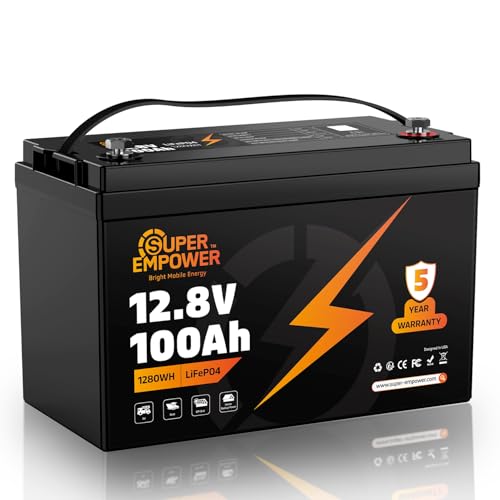
- 100Ah and 1280Wh in a Group 31 case, with low-temp cutoff stated.
- Documented 4P4S expansion up to 20.48kWh — the growth path is specified, not assumed.
- 100A BMS suits house-bank duty for RV, trolling motor, marine and solar work.
Trade-offs
- Sold as a single battery; a bank must be assembled purchase by purchase.
- Group 31 case needs the larger compartment.
- Expansion done later should use matched batteries of the same age and model.
Spec box: Nominal 12.8V · Capacity 100Ah · Energy 1280Wh · Case Group 31 · BMS 100A · Low-temp cutoff · Expansion 4P4S, up to 20.48kWh.
This is the builder’s battery: a full-size 100Ah unit whose listing does the thing expansion-minded buyers most need, which is state the expansion rules. Series and parallel support to a 4P4S ceiling, with the total energy of a full configuration published, turns “can I add more later?” from a forum question into a specification. Combined with stated low-temperature cutoff and a Group 31 case, it is the pick for owners who know their system will grow — solar this year, a second battery next, a bigger inverter when the budget allows — and who want the first purchase to be the foundation rather than a placeholder.
The discipline it asks in return is matching: banks expand best with identical batteries bought reasonably close together, so the growth plan should be a plan, with this model at its centre. As a single-battery conversion it performs the same duty as the other 100Ah picks, with the cold protection its VEMDIA counterpart’s listing does not state. For planners, it is the most future-proof single battery in the pool.
Best for: staged system builds and cold-aware buyers who will expand / Not suited for: buyers who want a matched pair in one box today.
NERMAK 12V 10Ah LiFePO4 Battery, 2-Pack
Badge: Best for Light Dedicated Loads
Strengths
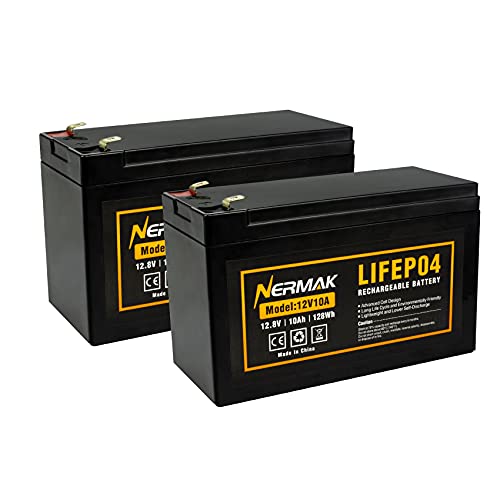
- Two small 10Ah lithium batteries for light, dedicated 12-volt jobs — lighting, fish finders, scooters, small solar and wind setups.
- Built-in 10A BMS per battery and a maker-stated 2000+ cycle life.
- Tiny and light enough to mount where a house battery could never go.
Trade-offs
- The smallest capacity here: strictly an auxiliary, never a house bank.
- A 10A BMS ceiling limits it to genuinely light loads.
- Two small batteries are a system to manage, not a single drop-in.
Spec box: Nominal 12V · Capacity 10Ah each, 2-pack · Chemistry LiFePO4 · BMS 10A built in · Maker-stated cycles 2000+ · Listed uses: solar/wind, scooters, lighting, Power Wheels, fish finder.
The NERMAK pair closes the small end of this guide the way the ABKPOWER opened it: as auxiliary power, honestly labelled. Ten amp-hours is a lighting circuit, a fish finder, a small device’s dedicated supply — the long tail of 12-volt jobs that RV and boat owners accumulate, and that lithium serves beautifully because the batteries are light, tolerant of deep discharge, and content to sit between uses in a way lead-acid never was. Two in the box means two separate jobs powered, or one job with a charged spare rotating through it.
Nothing about this pick should be read as house-bank competition, and its review exists partly to make that boundary unmissable: an RV’s main system would drain one of these before the evening’s lights had warmed up. Inside the boundary, it is a tidy, durable answer to small problems, and small problems are most of electrical life.
Best for: light dedicated loads and small solar or lighting projects / Not suited for: any house-bank or high-draw application.

VEMDIA 12V 100Ah LiFePO4 Battery with Smart BMS, Group 31
Badge: Best Cold-Climate Pick
Strengths
- 100Ah and 1280Wh with a smart 100A BMS and low-temperature protection stated in the listing.
- Maker-stated deep-cycle life of 15000+ cycles for RV, marine, solar, home and off-grid use.
- Group 31 case keeps it a standard-compartment conversion.
Trade-offs
- A single battery’s 100A ceiling still applies to inverter sizing.
- Smart-BMS features vary by production run — confirm the current configuration at the listing.
- Cold protection prevents charging damage; it does not make a frozen battery deliver full capacity.
Spec box: Nominal 12V · Capacity 100Ah · Energy 1280Wh · Case Group 31 · Smart BMS 100A · Low-temp protection · Maker-stated cycles 15000+.
Cold is lithium’s one honest weakness, and this VEMDIA variant is the pool’s direct answer to it. Iron phosphate batteries should not be charged below freezing — the chemistry can be damaged by it — so a management system that refuses the charge until the battery warms is not a luxury in a ski-country or shoulder-season rig; it is the difference between a battery that survives January and one that quietly doesn’t. Here that protection is stated, wrapped around the same 100Ah, Group 31, 1280Wh foundation as its sibling, with a smart BMS and a maker-stated cycle life at the top of this guide’s range.
That makes it the natural first choice for northern and four-season campers, and a strong default for anyone whose rig sleeps outside in winter while plugged into a charger that might decide to work on a freezing morning. Warm-climate buyers gain less from its headline feature but lose nothing by it. Between the two VEMDIA 100Ah picks, this is the one whose protection set is fully documented in the data we verified — and in a purchase meant to last a decade of trips, documentation is a feature.
Best for: cold-climate and four-season RVers, and anyone whose rig charges outdoors in winter / Not suited for: buyers who need more than a single battery’s 100A ceiling.
Comparison Table
| Pick | Capacity | Energy | Case | BMS | Low-temp protection | Link |
|---|---|---|---|---|---|---|
| VEMDIA 100Ah (B0FWYTX56G) | 100Ah | — | Group 31 | 100A | Not stated in pool data | Check on Amazon |
| SUPER EMPOWER 100Ah 2-Pack | 100Ah × 2 | 1280Wh each | Group 24 | 100A | Cutoff stated | Check on Amazon |
| ABKPOWER 20Ah | 20Ah | 256Wh | Small format | 20A | Not stated in pool data | Check on Amazon |
| SUPER EMPOWER 100Ah (B0FN35WZ68) | 100Ah | 1280Wh | Group 31 | 100A | Cutoff stated | Check on Amazon |
| NERMAK 10Ah 2-Pack | 10Ah × 2 | — | Small format | 10A | Not stated in pool data | Check on Amazon |
| VEMDIA 100Ah Smart BMS | 100Ah | 1280Wh | Group 31 | 100A smart | Protection stated | Check on Amazon |
How to Choose an RV Lithium Battery: The Capacity Maths
Start with an honest audit of a day off-grid, in watt-hours. List what runs: LED lighting for an evening, the water pump’s short bursts, the furnace fan across a cold night, vent fans, phone and laptop charging, the refrigerator’s electronics and fans where fitted. Multiply each load’s watts by its hours, add the results, and you have a daily number. For many travel trailers that number lands in the few-hundred watt-hour range for lights-and-comfort camping, and climbs steeply the moment an inverter starts running microwaves, hair dryers or air conditioning. A single 100Ah battery holds 1280Wh, nearly all of it usable in lithium service — which is why one battery transforms a weekend and why heavy inverter users build banks of two, three or four, using the expansion paths the SUPER EMPOWER picks document.
Then check the three fits. The physical fit: measure the compartment and tray, and match the case group — Group 31 picks need the larger footprint, the Group 24 pair suits the boxes many RVs already have. The current fit: your largest continuous load must sit under the BMS ceiling — 100A per battery in the big picks here — remembering that parallel batteries share current, so a pair doubles the ceiling as well as the capacity. The charging fit: confirm your converter offers a lithium profile or plan its upgrade, treat alternator charging as a system question rather than an assumption, and if solar is fitted or planned, size the bank and the array together. Shoppers still arranging the charging side should note Best Car Charger For Volt covers vehicle-side charging gear in the same 12-volt family, though an RV house bank deserves a proper DC-to-DC or converter solution rather than a plug-in afterthought.
Finally, decide about cold before the weather decides for you. If the rig will ever be charged below freezing — stored plugged in through winter, camped in the mountains in October — low-temperature charge protection moves from a nice feature to the feature, and the picks here that state it should lead your list. If the rig lives in mild climates and sleeps indoors, it matters less, and capacity and case fit can lead instead. Either way, decide on paper; batteries are heavy, return shipping is nobody’s friend, and the right battery chosen once is the cheapest version of this upgrade.
How to Install and Live With a Lithium House Bank
- Disconnect and remove the old battery safely — negative terminal first — and clean the tray and cable ends while the compartment is empty.
- Secure the new battery in the tray with its hold-down; lithium is lighter than the lead-acid it replaces, which makes securing it properly more important, not less.
- Connect positive, then negative, with clean, tight terminals; for parallel pairs, use matched interconnect cables of equal length so the batteries share work evenly.
- Set the charging sources to lithium — converter profile, solar controller settings — before the first charge, and confirm the battery charges fully and rests at a healthy voltage.
- Test the system on a driveway night before the first trip: run the furnace fan, pump, lights and fans, and watch how the bank behaves under your real loads.
- Store it right: for long storage, a partial charge in a cool, dry place is kinder than a full charge in a hot compartment — and never leave a charger pushing into a frozen battery that lacks low-temp protection.
Troubleshooting follows the chemistry. Problem: the bank seems to die suddenly rather than fading → lithium’s flat discharge curve means voltage looks healthy until late, and the BMS then disconnects to protect the cells; the fix is capacity awareness — track amp-hours, not voltage, or add capacity. Problem: charging stops in cold weather → if your battery has low-temp protection, that is it working; warm the compartment or wait for the day to warm before charging. Problem: one battery in a parallel pair runs warmer or empties faster → check interconnect cable lengths and terminal tightness; uneven wiring makes uneven banks. None of these require a dealer — they require the calm, mechanical attention that RV ownership always eventually teaches.
Lithium Versus the Lead-Acid Battery You Are Replacing
The comparison that motivates every pick in this guide deserves one plain paragraph. A lead-acid house battery should only be discharged about halfway if it is to live, so a nominal 100Ah of lead-acid is really about 50Ah of working energy; a 100Ah LiFePO4 battery delivers nearly its full rating, cycle after cycle, which is why a single lithium battery so often replaces two lead-acid ones while weighing less than either. Lithium also holds its voltage under load, so pumps spin properly and lights stay bright deep into the discharge, and it accepts charge faster, which shortens generator and solar charging windows. Its costs are the purchase itself, the charging-profile attention this guide has described, and the cold-charging rule. For rigs that camp unplugged with any regularity, the exchange is not close — and the secondhand evidence of a decade of conversions agrees. For a rig that lives permanently on shore power, the honest answer is that the upgrade matters less, and even this guide will tell you so.
Solar, Alternators and Shore Power: Charging a Lithium Bank From Every Source
An RV battery rarely has one master. Most rigs charge from three sources across a trip — the converter when plugged into shore power, the tow vehicle or engine alternator while driving, and solar whenever the sun cooperates — and a lithium bank asks each source a slightly different question. The converter’s question is profile: iron phosphate wants a charging voltage and absorption behaviour matched to its chemistry, and many converters fitted in the lead-acid era approximate that well enough to work while never quite filling the battery. Owners who find their bank “never quite full” after a conversion usually find the answer here, and a lithium-profile converter or an external charger is the standard cure. The alternator’s question is protection in both directions: a lithium bank’s low resistance lets it accept charge hungrily, and a DC-to-DC charger between alternator and bank is the component that keeps that appetite healthy for both machines. Rigs that drive long miles between camps should treat that charger as part of the conversion, not an accessory.
Solar’s question is arithmetic. Panels make watt-hours; the bank stores them; the audit from the buying guide spends them. A bank sized at 1280Wh with a modest array is a balanced system for lights-and-comfort camping, while inverter-heavy rigs need array and bank to grow together — a huge bank under a small array is just a heavier way to run out slowly. The expansion-documented picks in this guide exist for exactly this growth pattern: add a battery when the audit grows, add panels when the recharge window shrinks, and let the system stay balanced at every stage. Throughout all three sources, one habit protects everything: know your state of charge in amp-hours, because lithium’s flat voltage curve makes the old voltmeter glance nearly meaningless until the bank is almost empty.
Weight, Placement and the Hidden Dividends of the Conversion
The dividend nobody lists on the box is weight, and on an RV weight is never abstract. A lithium house battery delivers roughly double the usable energy of the lead-acid unit it replaces at a fraction of the weight, and that saving lands exactly where RVs are most sensitive: tongue weight on a trailer, payload in a small motorhome, and the owner’s back on installation day. Weight saved in the battery compartment is weight available for water, food, tools or simply margin — and margin is safety on every scale ticket. Placement flexibility compounds the point. Because LiFePO4 batteries do not vent the gases lead-acid batteries do, they can live in orientations and interior-adjacent compartments that were forbidden to their predecessors, subject always to the maker’s instructions and sensible securing. That freedom lets owners move the bank closer to the loads it serves, shortening cable runs and the voltage drop that travels with them.
The water system is a useful place to feel the difference: a pump fed by a bank that holds its voltage under load runs at full pressure deep into the evening, which is why battery upgrades and pump upgrades so often arrive together — the pairing discussed in Best Quality 12 Volt Diaphragm Pump. None of these dividends appear in a capacity figure, and all of them are real. When owners say the conversion changed how the rig feels, not just how long it runs, this section is what they mean.
Reading Cycle-Life Claims and Other Numbers on a Battery Listing
Battery listings speak in numbers, and a buyer should know which numbers are specifications, which are claims, and which are arithmetic. Amp-hours and watt-hours are specifications: they describe the size of the tank, and the conversion between them at this voltage is simple — a 100Ah battery at 12.8V nominal stores 1280Wh, a figure several picks here state outright. BMS amperage is a specification too, and a hard one: it is the ceiling the battery itself enforces. Case group is a physical fact you can verify with a tape measure, which makes it the most trustworthy number on any listing.
Cycle life is a claim, and should be read as one. When a maker states thousands of deep cycles — figures in this pool run from a stated 2000+ on the small NERMAK pair to 15000+ on the VEMDIA smart-BMS pick — the honest reading is directional: iron phosphate chemistry is genuinely long-lived, makers test under their own conditions, and a higher stated figure signals a maker’s confidence in its cells and management rather than a promise about your specific decade. What protects a buyer is not choosing the largest number but understanding that real-world life will be governed more by how the battery is treated — depth of discharge habits, charging discipline, temperature — than by the difference between two large claims. Buy the specification, respect the claim, and keep the receipts: in a category where the product is expected to serve for years, the listing you verified on purchase day is the document your future self will want.
A Final Word on the Upgrade
Owners consistently describe the lithium conversion as the single change that most altered how their RV feels to live in — longer evenings, quieter nights without a generator, systems that simply work at the end of a long driving day. The picks in this guide span that upgrade from a single Group 31 battery to documented multi-battery banks, and from house power down to the small auxiliary jobs that make a rig feel finished. Choose by audit, fit and climate, install it carefully, and the battery will repay the attention on every trip that follows.
Common Buying Mistakes
- Buying capacity by the badge, not the audit. Do the watt-hour maths for your own camping before choosing between 100Ah, a pair, or a bank.
- Ignoring case group. A Group 31 battery in a Group 24 tray is a return, not a conversion — measure first.
- Forgetting the BMS ceiling. Inverter ambitions must fit under the battery’s continuous current rating, or under a parallel bank’s combined rating.
- Skipping the charging check. Converter profile, alternator arrangement and solar settings are part of the purchase, not afterthoughts.
- Charging a frozen lithium battery. Without stated low-temperature protection, a freezing-morning charge can damage the battery permanently.
- Using an auxiliary battery as a house battery. The 20Ah and 10Ah picks are excellent at their jobs and hopeless at the big one; size follows load.
Final Recommendation
For the mainstream conversion — one battery, standard compartment, weekends off-grid — start with the VEMDIA 12V 100Ah LiFePO4 Battery, and choose its sibling, the VEMDIA 100Ah with Smart BMS, instead if your rig charges in the cold, because its low-temperature protection is stated outright. Two-battery rigs should buy the pair as a pair: the SUPER EMPOWER Group 24 2-Pack. Planners building toward a larger solar system should found it on the SUPER EMPOWER Group 31 reviewed above, whose expansion path is documented in its own listing.
The small picks have their own clear verdicts: the ABKPOWER 20Ah for a dedicated auxiliary circuit with real work to do, the NERMAK 10Ah pair for light loads and small projects. Every pick in this guide is a genuine 12-volt lithium battery with its own management system — the differences are capacity, case, protection and purpose, and the right choice is simply the one whose answers match your rig’s questions.
Frequently Asked Questions
Is LiFePO4 the same as a lithium ion battery for an RV?
In RV usage, yes: the house batteries sold for RVs are lithium iron phosphate, a lithium-ion chemistry chosen for its stability, long cycle life and tolerance of deep discharge. Every pick in this guide is LiFePO4 at 12V or 12.8V nominal, which is what the keyword means in practice.
How many amp-hours does my RV need?
Audit a day off-grid in watt-hours — lights, pump, furnace fan, fans, device charging — and divide by twelve for a rough amp-hour figure. Light campers often thrive on a single 100Ah battery (1280Wh); inverter-heavy rigs should plan on a parallel pair or more, using the expansion support several picks here document.
Can I just swap a lithium battery for my lead-acid one?
Physically, usually yes, if the case group fits. Electrically, check three things first: your converter’s charging profile, how the alternator will charge it, and whether anything in the system assumes lead-acid voltages. The swap is an afternoon’s work; the checks are what make it a good one.
Why does low-temperature protection matter?
Charging a lithium iron phosphate battery below freezing can damage it. A BMS with low-temperature cutoff simply refuses the charge until the battery warms, which protects a rig that is stored plugged in or camped in cold weather. Two picks here state low-temp cutoff and one states low-temp protection explicitly.
What does the BMS rating — 100A, 20A, 10A — actually limit?
The continuous current the battery will deliver before its management system disconnects to protect the cells. A 100A BMS supports serious house loads and a modest inverter; the 20A and 10A units in this guide are sized for the auxiliary loads they are reviewed for, and should not be asked to do house-bank work.
How should I store an RV lithium battery between trips?
Partially charged, cool and dry is the kind storage formula for iron phosphate: avoid leaving the battery sitting at a full charge in a hot compartment for months, and avoid storing it empty. If the rig is stored plugged in, confirm the charger will not push charge into a freezing battery — either choose a pick with stated low-temperature protection, as several here have, or disconnect and store the battery where the cold cannot reach it while charged. A battery stored kindly for five winters will out-perform a larger battery stored carelessly for two.
Will a lithium battery run my RV air conditioner?
Air conditioning is the load that separates house banks from power systems. A rooftop unit draws heavily and continuously, and running one for hours takes a large bank, a large inverter whose draw must fit under the bank’s combined BMS ceiling, and a realistic expectation measured in hours rather than days. A single 100Ah pick from this guide is not an air-conditioning solution, and no honest guide will call it one; it is the foundation a serious off-grid system is built on, two or four at a time, using the expansion paths documented here. Size for the loads you truly run nightly — lights, fans, furnace, devices — and treat air conditioning as the separate engineering project it is.
Can I expand one battery into a bank later?
Yes, with the right battery: the SUPER EMPOWER picks document 4P4S expansion up to 20.48kWh. Expand with identical models in similar condition, wire parallel interconnects evenly, and treat the first battery as the foundation of the system you are planning — because it is.
