Disclosure: topratedkitchenware.com is reader-supported. When you buy through links on our site, we may earn an affiliate commission from Amazon and other retailers, at no extra cost to you.
Where to buy
If you want the short version, start with the verified options below. Linked picks take you to the Amazon listing so you can check the latest price on Amazon and confirm current details before you decide; picks marked prose-only are covered in full in the reviews but carry no link, for the reason explained in the notes that follow the picks. This guide then explains, in plain language, how the best rv 12 volt rv battery options differ and which buyer each one actually suits.
- yeagulch 12.8V 100Ah LiFePO4 Lithium Battery, Group 31 — Best Overall RV Battery.
- SUPER EMPOWER 12V 100Ah LiFePO4 Battery, Group 24, 2 Pack — Best Dual-Battery Setup.
- SUPER EMPOWER 12.8V 100Ah LiFePO4 Battery, Group 31 — Best Single Battery That Can Grow.
- ABKPOWER 12V 20Ah LiFePO4 Battery — Best Auxiliary for Small RV Loads.
- yeagulch 24V 314Ah LiFePO4 Lithium Battery — Prose-Only: Wrong Voltage for a 12 Volt RV System (prose-only, no link).
- VEMDIA 12V 100Ah LiFePO4 Battery with Smart BMS, Group 31 — Best Protected Drop-In.
Read the full guide ↓
The phrase “best rv 12 volt rv battery” is repetitive because the job is specific: not the battery that starts the engine, but the house battery — the one that runs the lights, the water pump, the furnace fan, the fridge controls and the device chargers that make an RV a home. This guide covers that job. Five of the six verified picks are 12 volt LiFePO4 house batteries or auxiliaries and are linked. The sixth is a very large battery of the wrong voltage — 24 volts — and it is covered prose-only, without a link or image, as a worked example of the most important rule in RV electrics: match the voltage.
Why the pool is lithium: the house-battery job is deep, frequent cycling, and LiFePO4 has become the default answer for it — deep usable capacity, steady voltage, fast charging, light weight and cycle life in the thousands, all guarded by a built-in BMS. Lead-acid still exists at lower purchase prices, and the buying guide addresses it fairly, but a buyer reading a 12 volt RV battery guide today is, in practice, choosing among lithium options and sizes.
The picks divide by role: three 100Ah house batteries with different protection and expansion stories, a matched two-pack for dual-battery rigs, one small auxiliary for a single critical load, and the 24V cautionary tale. Sizing arithmetic — the skill that decides satisfaction more than brand does — gets its own section, and readers planning a full electrical refit may also want Best 6 Volt Agm Rv Battery comparisons for the legacy series-pair setups some older rigs still run.
A note on what this guide does not do: it does not print prices, because battery listings move with promotions and seasons, and a stale figure would mislead exactly the comparison a buyer needs to make today. Use the links to check the latest price on Amazon for each pick at the moment you shop, and judge value per usable watt-hour and per protected feature rather than per headline amp-hour. That discipline, plus the voltage discipline that runs through the whole guide, will keep an RV battery purchase boring — and boring, in electrical systems, is the highest praise available.
Key Takeaways
- House battery ≠ starting battery: this guide is about the deep-cycle battery that runs the RV’s living loads.
- Voltage is non-negotiable: a 12 volt system needs 12 volt batteries — the 24V pick here is prose-only for exactly that reason.
- Three ways to buy 100Ah: complete-and-protected (yeagulch), expandable (SUPER EMPOWER Group 31), or as a matched pair (SUPER EMPOWER two-pack).
- Low-temperature protection is the cold-climate feature — it stops chargers injuring frozen lithium cells.
- An auxiliary is not a bank: the 20Ah pick serves one small critical load, by design.
- Size with watt-hours: your daily consumption, times days off-grid, plus margin, equals your bank.
- Convert completely: batteries as a set, lithium profiles on every charger, and a shunt monitor — half-conversions cause most RV electrical grief.
In this guide
Quick Picks
| Pick | Badge | Why it stands out | Link |
|---|---|---|---|
| yeagulch 12.8V 100Ah LiFePO4 Lithium Battery, Group 31 | Best Overall RV Battery | Group 31, 1280Wh, 100A BMS, low-temp protection and a 15,000+ cycle rating — the complete standard RV battery. | Check on Amazon |
| SUPER EMPOWER 12V 100Ah LiFePO4 Battery, Group 24, 2 Pack | Best Dual-Battery Setup | A matched pair for a 200Ah parallel bank, with low-temp cutoff and 4P4S expansion support. | Check on Amazon |
| SUPER EMPOWER 12.8V 100Ah LiFePO4 Battery, Group 31 | Best Single Battery That Can Grow | Group 31 single with low-temp cutoff and published 4P4S expansion — buy one now, build a bank later. | Check on Amazon |
| ABKPOWER 12V 20Ah LiFePO4 Battery | Best Auxiliary for Small RV Loads | 256Wh and a 20A BMS — a dedicated small battery for a CPAP, lighting or electronics, at true auxiliary scale. | Check on Amazon |
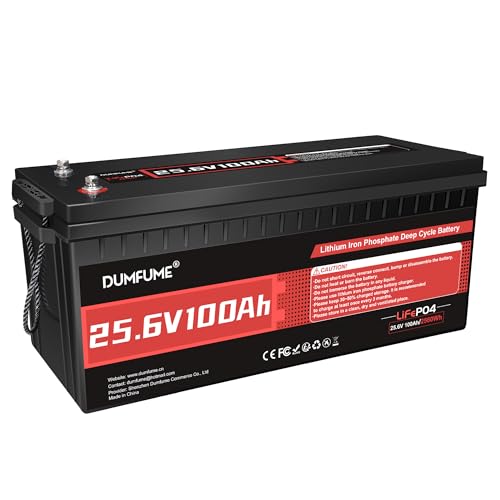
| yeagulch 24V 314Ah LiFePO4 Lithium Battery | Prose-Only: Wrong Voltage for a 12 Volt RV System | A huge 24V, 8038.4Wh battery — impressive, and unusable as a drop-in for a 12 volt RV, so prose-only. | Prose-only |
| VEMDIA 12V 100Ah LiFePO4 Battery with Smart BMS, Group 31 | Best Protected Drop-In | Smart 100A BMS with low-temp protection and a 15,000+ cycle rating in the standard Group 31 case. | Check on Amazon |
How These Picks Were Chosen
Every pick comes from the verified pool for this category, and every specification quoted is from the verified listing data — capacities, energies, case groups, BMS ratings, expansion claims and cycle ratings, the last always labelled as maker ratings. The screening applied two tests: is it a deep-cycle battery suited to RV house duty, and is it 12 volts? Five picks passed both. One pick, a 24V battery, failed the voltage test outright and was demoted to prose-only coverage with the reason stated wherever it appears.
Within the qualifying five, we organised by ownership pattern rather than by brand: the complete single, the expandable single, the matched pair, the protected drop-in and the auxiliary. That structure mirrors how RV owners actually buy — most know their rig’s layout and appetite before they know any battery brand — and it keeps near-identical 100Ah specifications honest by focusing on the features that genuinely differ: protection, expansion and fit.
We are research-led rather than hands-on with these units, and the guide says so: cycle-life figures are comparative signals, not verified measurements, and no performance claim appears here that the verified data does not support.
The 6 Best RV 12 Volt RV Battery Options — Five Linked, One Cautionary
Badges state each battery’s role, including the prose-only status of the 24V unit. In this category, read voltage first, capacity second, brand last.
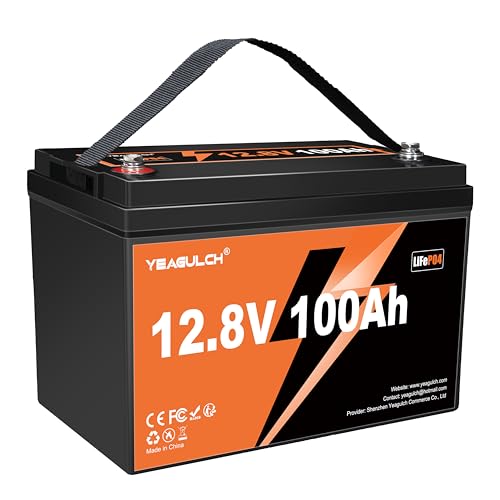
yeagulch 12.8V 100Ah LiFePO4 Lithium Battery, Group 31
Badge: Best Overall RV Battery
Strengths
- Full protection set including low-temperature charge protection
- Group 31 case matches the most common RV battery compartments
- High maker cycle rating suits daily-cycled house duty
Trade-offs
- One battery is a modest reservoir for power-hungry rigs
- 100A BMS bounds single-battery inverter size
- No published expansion scheme in the verified title, unlike the SUPER EMPOWER picks
| Nominal voltage | 12.8V |
|---|---|
| Capacity | 100Ah |
| Energy | 1280Wh |
| Chemistry | LiFePO4 |
| Case group | Group 31 |
| BMS | 100A, low-temperature protection |
| Cycle rating | 15,000+ deep cycles (maker rating) |
If an RV owner asked for “the battery” with no further detail, this yeagulch is the shape of the correct answer: a 12.8V, 100Ah LiFePO4 house battery in a Group 31 case, storing 1280Wh behind a 100A BMS with low-temperature protection and a maker rating of 15,000+ deep cycles. Every element of that specification maps to a real RV need — the case to the compartment, the capacity to a day of house loads, the BMS to the loads themselves, the low-temp protection to the mornings when a solar controller would otherwise charge a frozen battery.
House duty is a specific rhythm: many shallow-to-deep discharges, long slow drains from lights, fans, pumps and electronics, and recharges from whatever is available — shore power, solar, generator, alternator. A deep-cycle lithium battery is built for exactly that rhythm, in a way a starting battery never is. The flat voltage delivery means the furnace fan and lights behave the same at dusk and at 2 a.m., and the cycle rating means the battery treats a season of boondocking as a light workload.
Its limits are the class limits, stated plainly. A single 100Ah battery is a starting point: rigs with big inverter loads, residential fridges or long off-grid stays will want a parallel partner, and a 100A BMS means very large inverters need that partner before they need anything else. Within those bounds, this is the most complete standard RV battery in the pool.
Best for: most RV owners replacing or upgrading a house battery / Not suited for: rigs needing a documented multi-battery expansion system from day one

SUPER EMPOWER 12V 100Ah LiFePO4 Battery, Group 24, 2 Pack
Badge: Best Dual-Battery Setup
Strengths
- Matched pair builds a balanced 200Ah bank immediately
- Low-temperature cutoff protects the bank in cold camps
- Documented expansion path to much larger systems
Trade-offs
- Group 24 cases may need tray adaptation in Group 31 compartments
- A 200Ah bank deserves a shunt monitor and proper cabling from the start
- Two batteries, two sets of terminals to install and check
| Nominal voltage | 12V |
|---|---|
| Capacity | 100Ah per battery, 2 pack |
| Energy | 1280Wh per battery |
| Chemistry | LiFePO4 |
| Case group | Group 24 |
| BMS | 100A, low-temperature cutoff |
| Expansion | Supports 4P4S, up to 20.48kWh |
A great many RVs were built for two house batteries, and this SUPER EMPOWER two-pack is the lithium version of that classic layout: two matched 12V 100Ah batteries that parallel into a 200Ah, roughly 2560Wh bank. Buying them as a pair matters more than it might seem — parallel batteries share work best when they are the same model, capacity and age, and a factory pair guarantees that symmetry from the first cycle.
The supporting features suit bank life. Each battery’s 100A BMS and low-temperature cutoff protect the pair in cold weather, and the published 4P4S expansion support, up to 20.48kWh, means the two-battery rig of today can become the four-battery solar rig of next year without starting over. For travel trailers and motorhomes whose owners boondock in earnest, this is the natural centre of the electrical system.
Plan the supporting hardware honestly: a bank this size wants appropriately gauged, symmetric cabling, a proper fuse, and a shunt-based monitor, because you cannot manage what you cannot measure and lithium’s flat voltage will not measure it for you. The Group 24 cases are a size down from Group 31, so check the compartment fit. Do those things and this pair is the best dual-battery answer in the guide.
Best for: RVs built for two house batteries and owners who boondock regularly / Not suited for: single-battery compartments with no room or need for a pair
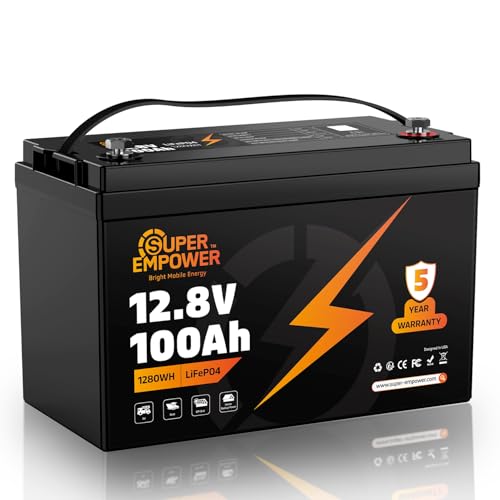
SUPER EMPOWER 12.8V 100Ah LiFePO4 Battery, Group 31
Badge: Best Single Battery That Can Grow
Strengths
- Expansion support makes it a first brick rather than a dead end
- Low-temp cutoff for cold-climate charging safety
- Group 31 drop-in fit for standard compartments
Trade-offs
- Growing later with a fresh battery beside an aged one is less ideal than a matched pair bought together
- Single-battery capacity and BMS limits apply until you expand
- Cold cutoff protects but does not heat — frozen banks still wait to warm
| Nominal voltage | 12.8V |
|---|---|
| Capacity | 100Ah |
| Energy | 1280Wh |
| Chemistry | LiFePO4 |
| Case group | Group 31 |
| BMS | 100A, low-temperature cutoff |
| Expansion | Supports 4P4S, up to 20.48kWh |
This SUPER EMPOWER Group 31 is the strategist’s single battery. Its present-tense specification is the class standard — 12.8V, 100Ah, 1280Wh, 100A BMS with low-temperature cutoff — and its future tense is the differentiator: published 4P4S expansion support up to 20.48kWh. An owner can install this battery today, learn their true consumption for a season, and then expand into a bank built from the same model with the maker’s blessing.
That plan suits how RV ownership actually unfolds. Few owners know their real watt-hour appetite before their first lithium season; buying one expandable battery converts an expensive guess into a measured decision. The low-temperature cutoff covers the cold-climate risk in the meantime, and the Group 31 case keeps the physical side simple.
One honest caveat about growing later: a new battery added beside a year-old one will not be a perfectly matched pair, and banks are happiest matched. The practical compromise — expand within a reasonable window, with the identical model — works well in real life. If you already know you need 200Ah today, the two-pack above is the cleaner buy. If you are finding out, start here.
Best for: owners who want one battery now with a documented path to a bank / Not suited for: owners certain they need maximum capacity immediately

ABKPOWER 12V 20Ah LiFePO4 Battery
Badge: Best Auxiliary for Small RV Loads
Strengths
- Light and small enough to live at the load it serves
- Strong cycle rating for a nightly-cycled auxiliary
- Isolates a critical small load from the main bank’s fortunes
Trade-offs
- Not a house battery — 20Ah is a fraction of house scale
- 20A BMS restricts it to modest loads
- Serves one named job well and general duty poorly
| Nominal voltage | 12V |
|---|---|
| Capacity | 20Ah |
| Energy | 256Wh |
| Chemistry | LiFePO4 |
| BMS | 20A |
| Cycle rating | 6,000+ cycles (maker rating) |
Every RV has one small load that matters out of proportion to its size — the CPAP that must not blink, the router that keeps the rig online, the lighting that makes an outdoor kitchen work. The ABKPOWER 20Ah exists for those jobs: a 256Wh LiFePO4 auxiliary with a 20A BMS and a 6,000+ cycle maker rating, small enough to mount beside its load and cycle nightly for years.
The auxiliary pattern is sound electrical design. A dedicated battery cannot be drained by an evening of television, charges independently, and shortens cable runs to its load, which reduces voltage drop on exactly the sensitive electronics that dislike it. In a rig whose house bank is healthy, an auxiliary is a luxury; in a rig whose bank is marginal, it is insurance for the one load that cannot fail.
The boundary is absolute, and this guide will state it in every auxiliary review it writes: 20Ah is not a house battery, and a 20A BMS is not an inverter supply. Assign this battery one named job, sized with the arithmetic in the buying guide, and it will do that job superbly. Ask it to be a bank and it will be a disappointment by Friday.
Best for: one critical small load — CPAP, lighting, router, electronics / Not suited for: house-bank or inverter duty
yeagulch 24V 314Ah LiFePO4 Lithium Battery
Badge: Prose-Only: Wrong Voltage for a 12 Volt RV System
Strengths
- Enormous energy capacity for a genuine 24V system
- 200A BMS supports very large loads in that system
- Low-temperature protection and noted certifications
Trade-offs
- 24 volts: incompatible with a 12 volt RV electrical system as a drop-in
- Would require a 24V-native rig or conversion hardware and a system redesign
- Prose-only here: no link, no image
| Nominal voltage | 24V (not 12V) |
|---|---|
| Capacity | 314Ah |
| Energy | 8038.4Wh |
| Chemistry | LiFePO4 |
| BMS | 200A, low-temperature protection |
| Certifications noted | UL 1973, UN38.3 |
| Cycle rating | 15,000+ deep cycles (maker rating) |
This yeagulch battery is the most powerful product in the pool and the clearest prose-only call in the guide, because its mismatch is a single number: 24. It is a 24V, 314Ah LiFePO4 battery storing 8038.4Wh behind a 200A BMS, with low-temperature protection and serious certifications noted in its title. As a battery, it is formidable. As an answer to a search for a 12 volt RV battery, it is the wrong voltage — and in electrical systems, voltage is not a detail.
An RV’s 12 volt system is an ecosystem built around that voltage: the converter, the fuse panel, the lights, pumps, fans, control boards and appliances all expect roughly twelve volts. Connect a 24V battery directly and you do not get twice the performance; you get damaged equipment. Serving a 12V rig from a 24V bank requires deliberate conversion hardware and a redesigned system — a legitimate project for a custom build, and a nonsense suggestion as a drop-in recommendation.
So this battery is reviewed here, without a link or image, for the minority it genuinely serves: owners building or running a native 24V system — some large custom rigs, off-grid cabins and marine setups do — for whom its capacity class is exactly right. If that is you, research it in the 24V category where it belongs. If you own a normal RV, the five 12 volt picks around it are your list.
Best for: native 24V system builders only / Not suited for: any standard 12 volt RV — which is to say, nearly every RV
Prose-only pick: no Amazon link and no product image, for the reason recorded in the sources note for this guide.

VEMDIA 12V 100Ah LiFePO4 Battery with Smart BMS, Group 31
Badge: Best Protected Drop-In
Strengths
- Smart BMS with low-temperature protection guards against the two classic lithium accidents
- High cycle rating for a fit-and-forget service life
- Group 31 case keeps the physical swap simple
Trade-offs
- No expansion scheme published in the verified title
- 100A BMS ceiling, as with all single 100Ah picks here
- Protection cannot substitute for correct charger profiles
| Nominal voltage | 12V |
|---|---|
| Capacity | 100Ah |
| Energy | 1280Wh |
| Chemistry | LiFePO4 |
| Case group | Group 31 |
| BMS | Built-in 100A smart BMS, low-temperature protection |
| Cycle rating | 15,000+ deep cycles (maker rating) |
The VEMDIA smart-BMS model is the protection maximalist’s 100Ah battery. Its base specification matches the class — 12V, 100Ah, 1280Wh, Group 31 — and its distinctions are guardrails: a smart 100A BMS with low-temperature protection, standing watch over a cell pack rated by its maker at 15,000+ deep cycles. For an owner who wants to install a house battery and then think about it as little as possible, those guardrails are the product.
It is worth being precise about what a good BMS does for an RV battery, because it is unglamorous and essential. It refuses over-charge and over-discharge, cuts off short circuits and excessive current, and — with the low-temperature function — refuses to let a charger injure frozen cells. Most RV battery tragedies are one of those events happening to an unguarded battery. A guarded one turns them into stories about a battery that briefly disconnected and then recovered.
The remaining homework is the owner’s: chargers still want lithium profiles to charge fully and efficiently, and a single 100Ah battery still pairs with a second for heavy off-grid appetites, with no expansion scheme published in this one’s title to guide that build. Judge it as what it is — the most self-protective single drop-in in the pool — and it earns its badge.
Best for: owners who want maximum built-in protection in a standard drop-in / Not suited for: builders who need a published expansion architecture
Comparison Table
| Pick | Chemistry | Capacity | Case / format | Status / standout | Link |
|---|---|---|---|---|---|
| yeagulch 12.8V 100Ah LiFePO4 Lithium Battery, Group 31 | LiFePO4 | 12.8V 100Ah | Group 31 | Low-temp protection, 100A BMS | Check on Amazon |
| SUPER EMPOWER 12V 100Ah LiFePO4 Battery, Group 24, 2 Pack | LiFePO4 | 12V 100Ah x2 | Group 24 | 4P4S expansion, low-temp cutoff | Check on Amazon |
| SUPER EMPOWER 12.8V 100Ah LiFePO4 Battery, Group 31 | LiFePO4 | 12.8V 100Ah | Group 31 | 4P4S expansion, low-temp cutoff | Check on Amazon |
| ABKPOWER 12V 20Ah LiFePO4 Battery | LiFePO4 | 12V 20Ah | 256Wh | 20A BMS, auxiliary class | Check on Amazon |
| yeagulch 24V 314Ah LiFePO4 Lithium Battery | LiFePO4 | 24V 314Ah | Large-format | Wrong voltage for this guide (prose-only) | Prose-only |
| VEMDIA 12V 100Ah LiFePO4 Battery with Smart BMS, Group 31 | LiFePO4 | 12V 100Ah | Group 31 | Smart BMS, low-temp protection | Check on Amazon |
Five rows say 12 volts and one says 24. That single contrast is the most important thing in the table: the 24V battery out-specs everything here on energy and still cannot serve the system this guide is about. Specifications only count inside the correct voltage.
Among the 12V house batteries, capacities cluster at 100Ah per unit, so the real comparison is architecture: buy a protected single, an expandable single, or a matched pair. The auxiliary row is a different product class sharing a voltage, included for the small-load jobs RVs genuinely have.
One more reading skill for the table: BMS amperage adds in parallel. Two 100A batteries in a matched pair present roughly 200A of BMS ceiling between them, which is why the pair pattern, not the single, is the answer for rigs with serious inverter loads.
How to Choose the Best RV 12 Volt RV Battery for Your Rig
House battery versus starting battery: know which one you are replacing
Motorhomes have both: a starting (chassis) battery that cranks the engine, and house batteries that run the living space. Travel trailers and fifth wheels have only the house side. The two jobs demand opposite designs — starting batteries deliver huge brief currents and live shallow; house batteries deliver modest currents for hours and live deep. Every pick in this guide is a house battery. Putting a house battery in starting duty, or a starting battery in house duty, shortens both lives and satisfies neither job.
Diagnosis follows from the distinction. Lights dimming, furnace fan slowing and the fridge control complaining are house-battery symptoms. Slow cranking is a chassis symptom. Replace the battery that owns the symptom, and when you replace house batteries, replace the set together — a new battery paralleled with a tired one inherits the tired one’s habits.
The sizing conversation, in watt-hours
Work out your daily appetite honestly. Add up the watt-hours: LED lighting is cheap, the furnace fan and water pump are moderate, a television evening is noticeable, a residential fridge or a big inverter is a budget-breaker. Multiply the daily figure by the days you want between charges, add a margin for weather and optimism, and you have your bank size in watt-hours. Divide by roughly 1,280Wh per 100Ah lithium battery to get your unit count.
Most couples in most rigs land at one or two 100Ah batteries — which is why this guide’s centre of gravity sits exactly there. Solo travellers with light loads can live on one. Families, remote workers and residential-fridge owners should start at two and read the expansion notes carefully. And keep the auxiliary pattern in mind: sometimes the smart purchase is not a bigger bank but a small dedicated battery for the one load that must never die.
Voltage discipline and the 24V question
Your RV is a 12 volt ecosystem. The converter, fuse panel, lighting, pumps, fans, awning and slide motors, fridge and furnace controls — all of it is built for roughly twelve volts. Batteries must match the ecosystem. That is why the 24V battery in this pool is prose-only: connected directly, it would damage the equipment it was bought to power.
Could a 24V bank ever serve an RV? In custom builds, yes — with a 24V-native design or with step-down conversion for the 12V loads and an inverter doing heavy work at 24V. That is a system architecture project, chosen deliberately by builders, not a battery purchase. If you are reading a buying guide for a 12 volt battery, you do not have that project; buy 12 volt batteries. Related legacy questions, like the series-pair arrangements in Best Agm Deep Cycle 6 Volt Battery setups, follow the same rule: the system voltage at the panel is what must come out right.
Protection, expansion and the features that differ
With capacity clustered, features decide. Low-temperature protection — stated on the yeagulch, both SUPER EMPOWER picks and the VEMDIA — guards against the classic lithium accident of charging frozen cells, and matters to anyone who camps where nights freeze. Expansion support, published for the SUPER EMPOWER batteries as 4P4S up to 20.48kWh, matters to anyone whose solar array or travel style is still growing. A smart BMS, as on the VEMDIA, matters to owners who want the battery to police itself comprehensively.
Case group is the humble decider: Group 31 is the commonest RV house size, Group 24 its smaller sibling. Measure the compartment, check the tray, and remember lithium’s light weight makes adapters and padding easy but never optional — a battery must be secured as if the road intends to move it, because it does.
Charging the house bank properly
A house battery is only as good as its charging chain: converter on shore power, solar controller in the sun, DC-DC charger from the alternator, generator through the converter. Lithium batteries want lithium profiles on each of those — correct absorption voltage, no equalisation pulses. Modern gear usually offers the profile; older converters may need a module or replacement to charge lithium fully.
Audit the chain at battery-swap time, set every profile, and verify with a monitor that the bank actually reaches full. Owners of older rigs sometimes ask about keeping one foot in lead-acid; our advice is to commit the house bank to one chemistry and one profile, because mixed charging compromises are where both chemistries go to be mediocre.
How to Replace and Maintain an RV House Battery
Swap day, step by step
Shore power off, and the negative terminal disconnected first — that order prevents the classic wrench-meets-chassis spark. Photograph the wiring, label the cables if the rig’s loom is creative, and remove the old batteries. Clean the tray and terminals, set the new battery in and secure it against movement in all directions, then connect positive first and negative last, with the recommended fuse on the positive lead near the battery.
Set every charger to its lithium profile before the first charge: converter, solar controller, DC-DC charger. Then exercise the system at home — an evening of lights, fan and pump on battery alone — and watch the monitor, so the first trip tests your holiday rather than your wiring.
Living with the bank
Fit a shunt-based monitor if your bank did not come with trustworthy state-of-charge reporting; lithium’s flat voltage curve makes the panel voltmeter a liar in the middle ranges. With a monitor, house-battery life becomes simple: watch the percentage, charge when convenient, and let the BMS handle the edges.
Seasonal habits: for storage, leave lithium at a partial charge with parasitic loads disconnected, in the coolest dry place available, and check it occasionally. Keep terminals clean and tight — road vibration loosens what fingers tightened. That is nearly the whole liturgy; house lithium, properly installed, is the least demanding battery technology RVs have had.
Troubleshooting house-battery symptoms
Problem: everything 12V dies at once, then recovers when a charger connects → the BMS has cut off on low voltage or an over-current event. Find the load or the depth that triggered it; the battery protected itself, and the fix is behavioural or electrical, not a new battery.
Problem: the bank never reaches full on solar → check the controller’s profile first, then panel shading and connections. A lead-acid profile on a lithium bank is the most common cause.
Problem: in cold weather the battery will not accept charge → on protected models, that is the low-temperature cutoff working. Warm the compartment and charging resumes. Do not bypass it; the protection is cheaper than the battery.
Which RV Types Need What: A Quick Matching Guide
Small travel trailers and teardrops: one 100Ah battery covers weekends of lights, pump and devices, and the weight saving over lead-acid is proportionally huge. Family trailers and fifth wheels: start with the two-pack pattern — furnace nights, more lights, more screens — and let expansion support carry you if solar grows. Motorhomes: the house bank often also feeds a residential fridge or a big inverter; two batteries is the floor, and the BMS arithmetic — 100A per battery, paralleled — becomes part of the inverter conversation.
Van conversions and truck campers live closest to the auxiliary pattern: space is precious, loads are curated, and a 100Ah main with a small dedicated auxiliary is a common, sensible architecture. Full-timers should buy cycle life and expansion headroom above all, because their batteries work like a house’s, not a holiday’s. Across all types, the method is the same — appetite first, architecture second, brand last — and it is the method this guide’s badges encode.
Solar, Generators and the Charging Ecosystem
A house battery does not live alone; it lives in a charging ecosystem, and the battery choice should be made with the whole system in view. Solar owners should confirm their controller offers a lithium profile and that panel wattage roughly matches bank size — a large bank behind a small array is a reservoir that never fills, while a small bank behind a large array wastes noon. Generator users should remember that lithium’s fast charge acceptance is a generator virtue: where lead-acid needed hours of droning to finish its slow final stage, lithium takes charge quickly, so generator runs get shorter and quieter.
Alternator charging, in motorhomes and tow setups, deserves one caution: lithium’s low internal resistance lets it accept very high currents, which is why a DC-DC charger between alternator and house bank is the correct architecture — it feeds the battery properly and protects the alternator. None of this is exotic; it is the standard modern RV electrical pattern, and every battery in this guide slots into it. Buy the battery and its charging chain as one decision and the system will feel designed, because it was.
The Lead-Acid Question, Answered Fairly
Lead-acid house batteries — flooded, AGM, gel — built RVing for decades and still sell on one honest virtue: purchase price. Against that stand the lithium facts rehearsed throughout this guide: roughly double the usable fraction of each rated amp-hour, a fraction of the weight, steadier voltage, faster charging, no watering or venting worries, and cycle life measured in thousands rather than hundreds. Over a ownership of any length, the cost-per-cycle arithmetic has moved decisively, which is why a verified pool for this search is a lithium pool.
Where lead-acid still argues its case: the very occasional user whose battery mostly sits, in a rig whose charger cannot be set to a lithium profile and will not be upgraded, may rationally buy one more AGM and defer the conversion. Everyone else is buying time — the swap is coming — and the picks above are where it lands. Owners researching the older architectures will find the Best 6 Volt Laterns era of RV electrics well documented; the modern answer is the one in this guide’s table.
Common Buying Mistakes
Connecting the wrong voltage. A 24V battery in a 12V system damages equipment. Voltage is the first line of every battery listing — read it before capacity, before price, before brand.
Replacing one battery of an old pair. A fresh battery paralleled with a tired one ages fast and performs poorly. House banks are replaced as sets.
Confusing starting and house duty. They are different designs for different jobs. Diagnose which battery owns your symptom before buying anything.
Skipping the monitor. Lithium hides its state of charge behind a flat voltage curve. Without a shunt monitor you are navigating by guesswork.
Leaving charger profiles on lead-acid. The battery will survive it — the BMS sees to that — but it will charge slowly or incompletely. Set every profile at swap time.
Mounting the battery loose because it is light. Lithium’s low weight tempts owners to skip the straps and brackets. The road does not care how light a battery is; an unsecured battery becomes a projectile in a hard stop and a chafed cable waiting to short. Secure it as carefully as the lead-acid it replaced.
Final Recommendation
Start with the yeagulch Group 31 if you want the complete standard answer in a single battery, or the VEMDIA smart-BMS model if built-in protection is your top priority. Choose the SUPER EMPOWER Group 31 if your system will grow, and its two-pack sibling if you already know it has grown. Add the ABKPOWER auxiliary only for a named small job.
And leave the 24V battery to the 24V builders. The best RV 12 volt battery is, before anything else, a 12 volt battery — matched to your system, sized to your appetite, and protected for your climate. Get those three fundamentals right and the brand takes care of itself.
If you are converting from lead-acid, do the whole job in one weekend: batteries as a set, profiles on every charger, a monitor on the panel, and an evening test at home. Half-converted systems are where most RV electrical misery lives; a complete conversion is where the lithium reputation for effortlessness comes from.
Start your shortlist here: yeagulch 12.8V 100Ah LiFePO4 Lithium Battery, Group 31, VEMDIA 12V 100Ah LiFePO4 Battery with Smart BMS, Group 31, SUPER EMPOWER 12.8V 100Ah LiFePO4 Battery, Group 31.
Frequently Asked Questions
What is the difference between an RV house battery and a car battery?
A car battery is a starting battery: it delivers a huge burst to crank an engine, then recharges immediately, and it is damaged by deep discharge. An RV house battery is a deep-cycle battery: it delivers modest power for hours — lights, pumps, fans, electronics — and is designed to be discharged deeply and recharged daily. All the picks in this guide are house batteries.
How long will a 100Ah lithium battery run an RV?
It depends entirely on the loads. As orientation: 100Ah of lithium stores 1280Wh, most of it usable. A frugal evening-and-night of LED lights, water pump, furnace fan and phone charging might use a third of that; add a television, laptops and a coffee inverter and you can use all of it in a day. The sizing section’s arithmetic, done with your own loads, is the only honest answer — and it takes five minutes.
Can I mix a new lithium battery with my old lead-acid battery?
No — not in the same bank. The two chemistries want different charge voltages and discharge at different curves; paralleled together, both perform badly and the lithium’s advantages evaporate. Convert the house bank as a set, and set the chargers to lithium profiles at the same time.
Do I need a special charger for a lithium RV battery?
You need chargers with a lithium profile to get the best from the battery: converter, solar controller and any DC-DC charger should each be set to lithium or LiFePO4 mode. The battery’s BMS will protect it behind an older lead-acid charger, but charging may be slower or incomplete. Many owners upgrade the converter at swap time for exactly this reason.
Why is the biggest battery in the pool not recommended?
Because it is a 24 volt battery and RV house systems are 12 volt. Its 8038.4Wh would be wonderful in a native 24V build; connected to a 12V RV it would damage the equipment it powered. It is covered in this guide, without a link, as an example of why voltage is the first specification to check on any battery, however impressive the rest of its numbers are.
Where should the house battery live in the RV?
Wherever it is secure, dry and — for lithium in cold climates — preferably inside the heated envelope, since LiFePO4 batteries are sealed and do not need venting the way flooded lead-acid does. Always follow the maker’s mounting guidance, secure against movement in every direction, and keep cable runs to the distribution panel reasonably short. Owners planning the wider refit may also consult Best Prices On Used Chevy Volt — a different vehicle question entirely, and a reminder to keep automotive and RV battery shopping separate.