Where to buy
Check the latest price, availability and delivery on Amazon. Orders are placed on Amazon. We may earn a commission from qualifying purchases.
- Best overall: Buffy Cloud Comforter, Full/Queen — Check on Amazon
- Egyptian Bedding Siberian Goose Down Comforter, Queen — Check on Amazon
- REST Evercool Cooling Comforter, Full/Queen — Check on Amazon
- APSMILE All Season Down Comforter, Queen — Check on Amazon
See 2 more Amazon options
- Pacific Coast Goose Feather Down Fiber Comforter, Queen — Check on Amazon
- Serta Goose Feather Down Fiber Comforter, Queen — Check on Amazon
Read the full guide ↓
Disclosure: As an Amazon Associate, topratedkitchenware.com earns from qualifying purchases. Links to Amazon on this page are affiliate links; they cost you nothing extra. Listing details such as price and availability change often, so check the current Amazon listing before you buy.
Apartment bedrooms punish the usual comforter advice. The standard approach — a summer quilt, a winter duvet, a spare in the linen closet — assumes storage you do not have, a laundry room that is yours alone, and a thermostat you control. In a small rental, the realistic goal is different: one genuinely good comforter, warm enough for January and survivable in a radiator-blasted March, that you can wash without a car, store without a linen closet, and carry up the stairs and out again on moving day without a second trip. Two hundred dollars, spent once and spent well, buys exactly that class of comforter in the queen size — and every pick in this guide is judged in the queen or Full/Queen size, because comforters climb steeply by size and a twin headline helps nobody.
So this guide re-judges the six strongest comforters under $200 through the apartment lens. For most renters we would begin with the Buffy Cloud: one washable, all-season comforter that never needs a seasonal understudy, which means it never needs storage space either. If your building runs cold and drafty, the Egyptian Bedding Siberian packs real down’s warmth into the most compressible, easiest-to-store package here. And if your radiators answer to nobody, the REST Evercool is the one pick built for a bedroom whose temperature you do not control. Below you will find a quick picks table, detailed notes on each of the six, a comparison table, a buying checklist written for renters, the mistakes apartment shoppers make most at this price, and answers to the questions that come up again and again.
A note on prices: two of the six picks make sense only when discounted on their regular sale cycle, and one sits near the top of this guide’s budget. Prices change often, so check the current price on Amazon for the queen size before you buy. If a pick is showing above this budget on the day you shop, move to the next row of the table — there is always another honest option here.
In this guide
Quick Picks
Short on time, or comparing several options at once? Each row below names a renter type and the product that suits it, with a link to the listing. Each pick is judged in the queen size — check price on Amazon for the size you need.
| Buyer type | Pick | Why it stands out | Link |
|---|---|---|---|
| Best overall for apartments | Buffy Cloud Comforter, Full/Queen | One washable all-season comforter — nothing to store, ever | Check on Amazon |
| Best for cold, drafty rentals | Egyptian Bedding Siberian Goose Down Comforter, Queen | Maker-stated 750 fill power and 60 oz of goose down; compresses smallest for storage | Check on Amazon |
| Best for radiator-heated apartments | REST Evercool Cooling Comforter, Full/Queen | Cool-to-the-touch shell for bedrooms you cannot cool down; buy it on sale | Check on Amazon |
| Best down-and-feather blend | APSMILE All Season Down Comforter, Queen | 46 oz of down and feather fiber in an organic cotton cover | Check on Amazon |
| Best buy-it-once pedigree | Pacific Coast Goose Feather Down Fiber Comforter, Queen | Hotel-supplier build and eight cover loops, right at the budget line | Check on Amazon |
| Best value | Serta Goose Feather Down Fiber Comforter, Queen | Real goose feather fiber and a cotton cover at the value end of this tier | Check on Amazon |
How These Picks Were Chosen
The first filter was the budget itself, applied to the queen size. Every product below is a real Amazon listing whose queen or Full/Queen size fits this guide’s under-$200 budget in the United States — at its regular positioning, or, in one clearly flagged case, when it is discounted on the sale cycle it returns to again and again. Anything whose queen size lives permanently above the line was left out, however good it might be: Brooklinen’s all-season down comforter, for example, is a fine product whose Full/Queen size sits well above this tier on Amazon, and it belongs to a different guide. Where a pick only fits the budget when discounted, the review says so plainly.
The second filter was the apartment itself, and it cut harder than the budget did. Each pick had to survive four renter questions. Can you wash it in the real world — a shared basement laundry room, a laundromat’s front-loaders, a small in-unit machine — or does it demand dry cleaning you will pay for forever? Where does it go in the off-season, in a home whose entire linen storage might be one shelf above the coats? How does it behave in a bedroom whose heat comes from a radiator the landlord controls, in a building where the top floor roasts and the ground floor shivers? And can one person carry it up the stairs, wash it, dry it and move out with it, alone? Picks that failed a question were not automatically excluded — the dry-clean-only value pick below is still here — but the failure is printed in its review as a cost, not hidden.
We did not sleep under these comforters ourselves. We read the maker listings and specification pages, compared fill types, fill weights, fill-power claims, shell fabrics and dimensions, and cross-checked prices against retailer listings and deal coverage. Warmth words — all-season, medium warmth, extra fluffy — are maker descriptions, and we treat them that way throughout: a comforter’s real warmth is set by how much fill is inside it and how lofty that fill is, not by the adjectives on the box. Details were checked the slow way, on the maker’s own Amazon listing or storefront where one could be read, and otherwise across at least two independent sources; where the evidence is thinner than we would like, the review and this guide’s sources note say so openly. Check the current price on Amazon on the day you buy — the live listing is the final word.
One thing we checked carefully was what each fill actually is. At this tier the listings mix four different things — cluster down, down fiber, feather fiber and synthetic down-alternative — and they are not interchangeable, however similar the product photos look. In an apartment the difference is practical as much as thermal: cluster down compresses into a vacuum bag a fraction of its lofted size, feather fiber barely compresses at all, and a lightweight synthetic can fold flat on a closet shelf. Each review names the fill precisely as the maker states it, including the percentages where the maker publishes them, so you know whether you are buying down, feathers, or polyester wearing a down costume — and what that means for your storage shelf.
The 6 Best Comforters for Apartments Under $200
Buffy Cloud Comforter, Full/Queen
Who it suits: Renters who want the one-comforter solution — a single premium, washable, all-season comforter that makes a second, seasonal comforter (and the storage space it would eat) unnecessary.
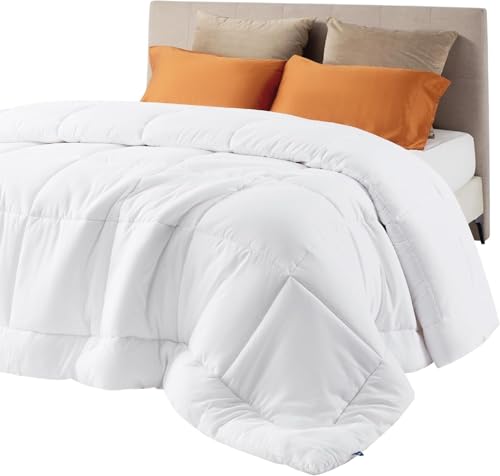
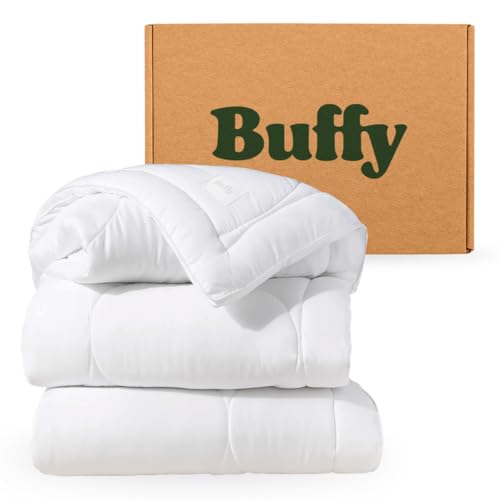
The Cloud is the comforter that built Buffy’s name, and it earns the hero spot in an apartment guide for a specifically renter reason: it is the pick that asks the least of your space. The shell is eucalyptus lyocell — listed as rayon from eucalyptus on the Amazon page — which feels smooth and cool rather than papery, and the fill is layers of fiber made from recycled plastic bottles; Buffy says each comforter keeps about 50 bottles out of landfill, which is a maker claim, but the fill itself is real, lofty and evenly distributed in stitched quilting. The Full/Queen measures 90 by 90 inches, it goes in a washing machine, and it has corner tabs for tying into a duvet cover. Check the current price on Amazon for the Full/Queen — the listing is sold by Buffy Inc. itself, and Buffy also sells the same size direct.
Run it through the four renter questions. Washing: it is machine washable, which already puts it ahead of every dry-clean-only pick — but be honest about bulk, because a queen comforter is a big load in any machine, and this one belongs in the large front-loaders of a laundry room or laundromat rather than a compact in-unit washer. Storage: this is the all-season weight, and for the large majority of heated apartments it is the only comforter you need all year, which means the off-season storage problem simply never arises — the strongest storage feature a comforter can have is not needing to be stored. Heat: the lyocell shell’s cool, smooth hand makes it the most forgiving of the warm picks in a radiator building, though a genuinely overheated bedroom still belongs to the Evercool below. Moving: it is one item, in one bag, up the stairs. Note the size trap on the listing: the King/Cal King sits above this guide’s budget, so make sure the Full/Queen option is the one in the cart and check price on Amazon for the size selected — in most rentals, the Full/Queen is also the size your bed actually is.
- Eucalyptus lyocell shell that feels cool and smooth, not plasticky.
- Machine washable — no dry-cleaning costs, ever.
- All-season weight: one comforter year-round means zero storage space spent.
Honest limitation: It is a synthetic fill, however good: it will not match real down’s warmth-to-weight ratio, and very cold sleepers in unheated or drafty rooms will want the heavier winter version, which costs more than this budget allows in queen.
Choose it if you want one washable, all-season comforter that feels premium and asks nothing of your space. Skip it if you are set on genuine down, or your apartment is unheated enough that you sleep genuinely cold.
Egyptian Bedding Siberian Goose Down Comforter, Queen
Who it suits: Renters in cold, drafty, poorly insulated buildings — the ground-floor and pre-war apartments where the radiator loses — who want real down’s warmth in the smallest possible storage footprint.
This is the genuine article: a queen comforter filled with Siberian goose down at a maker-stated 750 fill power, with 60 ounces of fill in the queen size — a generous fill weight that explains the loft reviewers keep remarking on. The cover is 600 thread count 100 percent Egyptian cotton, the construction is baffle box, which gives the down room to loft instead of being sewn flat, and the finished size is a true 90 by 90 inches. Mattress Clarity’s reviewers, who did sleep under it, called it one of the loftiest, most luxurious down comforters they had tried. Check the current price on Amazon before you buy — it sits deep inside this budget for specs that usually sit in a higher tier, and we would rather point you to the live listing than dress up a figure from older coverage.
The apartment case for down is compression. Of every fill in this guide, cluster down squeezes down the furthest: rolled into a vacuum storage bag, this comforter shrinks to a flat slab that slides under a bed or stands on a closet shelf, then re-lofts when you shake it out in autumn. It is also the lightest warm option to carry — up four flights on moving day, or down to the laundry room — because down’s whole point is warmth without weight. The cautions are equally apartment-specific. Sixty ounces of 750 fill power down is a genuinely warm comforter, and in a radiator apartment whose heat you cannot turn down it will be too much for much of the year; this pick is for cold buildings, not hot ones. Washing a down queen is a large-machine, long-drying job — plan on the laundromat’s big front-loader and a full, patient dry, and lean on a duvet cover so the job stays rare. And the honest context is the brand: Egyptian Bedding is an Amazon-native label, not a heritage down house, its thread-count and origin language is marketing-rich, and some owners report the occasional escaping feather, the classic down-comforter tax. Buy it for the fill, inspect it on arrival, and air it out and fluff it properly before judging the loft, because vacuum-packed down needs hours to recover.
- Maker-stated 750 fill power goose down — the highest claim in this guide.
- 60 oz fill weight in queen, in a 600 TC Egyptian cotton baffle-box shell.
- Compresses smaller than any other pick — the storage-friendly warm comforter.
Honest limitation: An Amazon-native brand with marketing-heavy copy and occasional feather leakage reported; the down claims are the maker’s, and there is no long brand warranty standing behind them.
Choose it if your apartment runs cold and real down loft is the whole point of the purchase. Skip it if your radiators run hot, or brand pedigree, a sleep trial and painless returns matter more to you than fill specifications.
REST Evercool Cooling Comforter, Full/Queen
Who it suits: Renters in radiator-heated buildings — heat included, thermostat nowhere, top-floor unit under a hot roof — who sleep warm in rooms they cannot cool down.
The Evercool is a different species from the other five picks: a lightweight cooling blanket-comforter whose proprietary Evercool shell fabric is designed to feel cool on contact and stay that way, wrapped around a light plant-based fiber fill. It measures 90 by 90 inches in Full/Queen, weighs about 5.5 pounds — far less than the down picks here — is machine washable, and carries Good Housekeeping bedding awards, which the listing makes much of. REST does not publish a Q-Max coolness figure for this fabric, a point in its favor for honesty: the Q-Max numbers quoted by rival cooling brands describe a fraction of a second of first contact, not the temperature under the quilt at 3 a.m. What owners consistently report is simpler — it feels cool when you get in and does not turn into a sauna by morning. In a building where the radiators clank on in October and the windows stay cracked in January to compensate, that contact coolness is not a luxury feature; it is the difference between sleeping and negotiating with your own bedding all night.
It is also, quietly, the most apartment-practical object in this guide. At 5.5 pounds and thin with it, it is the one queen comforter here that a small in-unit or shared laundry-room machine handles without drama, and it dries in a single ordinary dryer cycle instead of two — real money when the machines take coins or a card swipe per cycle. Off-season, it folds nearly flat onto a closet shelf or into a drawer, no vacuum bag required. The pricing needs the honest treatment this guide gives straddlers. The Evercool’s regular positioning sits above this budget — on Amazon and on REST’s own site — but it is discounted on a regular cycle, and that discounted positioning is the only basis on which it belongs in this guide. Our advice is printed here rather than buried: check the current price on Amazon, buy it only when it fits this guide’s budget, and walk away when it does not.
- Purpose-built cooling shell that feels cool on contact — built for overheated rentals.
- Lightweight at about 5.5 lb in queen: washes in smaller machines, dries in one cycle, stores flat.
- Machine washable, and a repeat Good Housekeeping award winner per the maker.
Honest limitation: Its regular price sits above this guide’s budget; it only qualifies when discounted, and cold sleepers in drafty, underheated apartments will find a 5.5 lb cooling blanket far too light for winter.
Choose it if your building’s heat is your actual problem and you can catch it when it fits this guide’s budget. Skip it if your apartment runs cold, you want year-round warmth, or the listing is showing its regular above-budget price on the day you shop.
APSMILE All Season Down Comforter, Queen
Who it suits: Renters who want a real down-and-feather fill in a natural cotton cover at a mid-tier price — warm enough for a normally heated apartment, unflashy enough to keep for years.
APSMILE is a factory brand that sells an enormous range of feather and down bedding, and its all-season queen is the sensible middle of that range: 90 by 90 inches, 46 ounces of down and feather fiber fill, and a 100 percent organic cotton cover, with corner tabs for a duvet cover and OEKO-TEX certification claimed on the listing. The brand markets the line on high fill power — 750 is the figure attached to its hotel-collection comforters, a maker claim — and the all-season fill weight is the medium of its three warmth levels, aimed at year-round use in a normally heated home, which is precisely the duty cycle an apartment asks for. Check the current price on Amazon for the queen — it sits comfortably inside this budget as a mid-tier pick in this guide, which helps when you are also budgeting separately for a decent duvet cover and a pair of vacuum storage bags, the rest of the apartment comforter kit.
Read the fill description the way this guide teaches: this is down and feather fiber — processed down and feather material — not the intact clusters of the Egyptian Bedding pick above, so expect a slightly flatter, more uniform loft and a comforter that feels a touch heavier for its warmth. In apartment terms that trade cuts both ways. The extra substance makes it a better single year-round layer in a building with ordinary, controllable heat; the same substance means it compresses less eagerly than cluster down for storage, and a wash — which the listing claims is possible at home — is still a large-machine job, as every queen comforter wash is. What you get in exchange is a natural-fiber fill that breathes better than polyester, a cotton cover that does not rustle like plastic, and corner tabs that keep it anchored inside its cover. For a small rental’s main bed on a mid budget, it is the balanced buy.
- 46 oz of down and feather fiber in a 100 percent organic cotton cover.
- OEKO-TEX certification claimed; corner tabs for cover use.
- Mid-tier positioning in this guide — check price on Amazon; leaves room in the overall budget for a cover and storage bags.
Honest limitation: Down and feather fiber is not cluster down — loft and lightness are a step below the Siberian pick — and APSMILE’s many near-identical listings make it easy to order the wrong warmth level or size, a mistake a renter without a spare room feels immediately.
Choose it if you want natural fill and a cotton shell at a fair mid price, with money left over for the cover. Skip it if maximum loft per ounce or maximum compressibility for storage is your priority.
Pacific Coast Goose Feather Down Fiber Comforter, Queen
Who it suits: Renters making a buy-it-once purchase — Pacific Coast has made down bedding for hotels for decades, and this is its consumer all-season queen, built to be kept through several leases.
Pacific Coast Feather Company is the quiet incumbent of this category: a long-running American down processor whose bedding supplies hotel programs, selling the same constructions direct on Amazon. Its all-season queen is a 90 by 90 inch insert filled with white goose feather and down fiber — independent spec roundups put the down fiber share at about 50 percent — with baffle-box construction and no fewer than eight corner and center loops, the most duvet-cover attachment points in this guide. That last detail is worth more in an apartment than it sounds: rental beds so often stand against a wall that you make the bed from one side, half-climbing across it, and an insert that migrates and bunches inside its cover is a daily small misery. Eight loops is what stops the migration. Check the current price on Amazon for the queen — it sits near the top of this guide’s budget, with little headroom, and that is worth saying plainly.
Two cautions belong at the top of this pick’s file, and we print them rather than footnoting them. First, the price: check the current price on Amazon before ordering, because even a small drift near the top of the budget puts this size over the line and the king sizes are well beyond it. Second, availability: one recent check of this listing showed no featured offer available, so check that there is a live offer that fits this guide’s budget before planning around this pick — if there is not, the Egyptian Bedding and APSMILE picks above are where this guide would send you instead. What this top-of-budget positioning buys, when it is available, is process rather than novelty: a specialist down house washes, sorts and sterilizes its fill to a standard the no-name listings do not describe, and owners of Pacific Coast bedding tend to keep it for years, refluffing rather than replacing — exactly the ownership pattern a renter wants from the one expensive soft thing in the bedroom. Nothing about it is fashionable: no cooling fabric, no recycled-bottle story, no trial-period fanfare.
- Decades-old down specialist that supplies hotel bedding programs.
- Eight corner and center loops — the best duvet-cover anchoring here, and it matters on a wall-side bed.
- Goose feather and down fiber fill with baffle-box construction.
Honest limitation: It sits near the top of this guide’s budget with little room for price drift, and one recent check showed no featured offer on the listing — check availability and check the current price on Amazon first.
Choose it if proven processing and durability matter more than features and you find a live offer that fits this guide’s budget. Skip it if the live queen price has drifted above this guide’s budget, no featured offer is showing, or you want a washable synthetic instead.
Serta Goose Feather Down Fiber Comforter, Queen
Who it suits: Value-hunting renters who want real goose feather fill and a cotton cover for the price of a microfiber insert — and who have a workable answer for its one big apartment problem.
Every guide at this budget needs its reality check, and this is it: a branded comforter, made for Serta by Blue Ridge Home Fashions, filled with 90 percent white goose feather fiber and 10 percent white goose down fiber inside a 100 percent cotton cover. The queen is 90 by 90 inches, sewn in boxes to keep the fill spread, rated by the maker for all-season medium warmth, and labeled hypoallergenic by the maker — a label we repeat as the maker’s, since feather products are not the obvious choice for the truly feather-sensitive. Check the current price on Amazon — it is positioned at the value end of this tier, and it is the most affordable genuine feather-and-down comforter from a household name that we could verify in this guide. For a renter furnishing a first apartment, that value-end positioning helps across everything else the bedroom needs.
The apartment audit is where this pick pays for its price. Care is the headline cost: the listing’s guidance is dry clean only, which for a renter means a recurring bill and a recurring trip — hauling a bulky queen comforter to a cleaner, twice a year or so, for the life of the product. The usual renter answer is a duvet cover washed at home, which stretches professional cleaning to a rare event, but go in with your eyes open: of the six picks, this is the only one whose care instructions fight apartment life outright. Storage is the second cost: feather fiber is the heaviest, least compressible fill in this guide, so the off-season version of this comforter is a bulky roll that wants the top of a closet, not a slim vacuum slab under the bed. And feather fiber feels substantial rather than cloud-like, with an occasional quill sensation possible through a thin cover — which a duvet cover mostly solves. Judged purely as warmth for its tier positioning, though, a cotton-covered goose feather comforter at the value end of this guide has no rival here, and it remains a real, natural-fill product positioned below the other picks in this guide.
- Real goose feather and down fiber in a 100 percent cotton cover.
- Value-end positioning in this tier — check price on Amazon.
- Licensed brand made by an established bedding manufacturer.
Honest limitation: Dry clean only — a recurring cost and errand that sits badly with shared-laundry life — and a feather-fiber fill that is heavier, flatter and far less compressible for storage than down, with the possibility of feeling a quill through the cover without a duvet cover over it.
Choose it if you want natural fill at the lowest possible price, will use a duvet cover, and have a dry cleaner you can actually get to. Skip it if home washing is non-negotiable or your storage space is measured in inches.
Comparison Table
| Product | Fill (as maker states) | Apartment strength | Link |
|---|---|---|---|
| Buffy Cloud Comforter, Full/Queen | Recycled fiber, lyocell shell | One washable comforter all year — nothing to store; check price on Amazon | Check on Amazon |
| Egyptian Bedding Siberian Goose Down, Queen | Goose down, stated 750 fill power, 60 oz | Warmest pick for drafty rentals; compresses smallest; check price on Amazon | Check on Amazon |
| REST Evercool Cooling Comforter, Full/Queen | Plant-based fiber, cooling shell | Radiator-proof and laundry-friendly — buy only when discounted to fit this budget; check price on Amazon | Check on Amazon |
| APSMILE All Season Down Comforter, Queen | Down and feather fiber, 46 oz | Natural fill in organic cotton; check price on Amazon | Check on Amazon |
| Pacific Coast Goose Feather Down Fiber, Queen | Goose feather and down fiber | Hotel-grade processing and eight loops, near the top of this budget; check price on Amazon | Check on Amazon |
| Serta Goose Feather Down Fiber, Queen | 90% goose feather fiber, 10% down fiber | Value natural fill; check price on Amazon — but dry clean only | Check on Amazon |
How to Choose a Comforter for an Apartment Under $200
- Buy one good comforter, not a seasonal rotation. Two mediocre comforters cost as much as one good one and demand storage you do not have for half the year each. An all-season weight plus a duvet cover covers nearly every heated apartment.
- Diagnose your building’s heat before the fill. Radiator heat you cannot control, a top-floor unit, a small room that warms fast — buy lighter, or buy the cooling pick. Drafty windows, ground floor, heat that barely arrives — that is what real down is for.
- Audit your laundry reality, honestly. Where will a queen comforter actually get washed — a basement laundry room, a laundromat, a compact in-unit machine it will not fit? The answer decides whether dry-clean-only is a minor note or a permanent tax.
- Default to a duvet cover. In a small home the cover is the laundry strategy: it washes in any machine, dries in one cycle, and keeps the bulky insert out of the wash for months. Buy the cover the same day as the comforter.
- Check the storage before the warmth level. Measure the actual space — under-bed clearance, the closet shelf, the gap above the wardrobe. Cluster down compresses to a fraction of its size; feather fiber barely compresses at all. Pick the fill your shelf can hold.
- Match the size to the rental bed you have. Most apartment beds are full or queen, and the Full/Queen picks here cover both. Confirm the size selector shows your size before comparing prices — king prices quoted on the same page are above this budget.
- Count the loops if the bed stands against a wall. Making a wall-side bed means dragging the bedding from one side; an insert with only corner tabs migrates. Eight attachment points, like the Pacific Coast’s, is the fix.
- Read fill power and fill weight together. Fill power is loft per ounce; fill weight is how many ounces you get. A 750 fill power comforter with 60 oz of fill is a warm comforter. Either number quoted alone is marketing.
- Treat discounted positioning as the real test for straddlers. The Evercool only belongs here when discounted to fit this budget, never at its regular positioning above the tier; the Pacific Coast sits near the top of this budget, so verify the live price — check the current price on Amazon — and that a featured offer exists before ordering either.
- Think about the stairs. Everything in a walk-up apartment gets carried — in, down to the laundry, and out at the end of the lease. A 5.5 lb cooling comforter and a 7-plus lb feather-fiber one are different objects on the fourth floor.
The Radiator Problem: Why Apartment Bedrooms Run Warm
The most common apartment sleep complaint is not cold — it is heat the sleeper does not control. In radiator and steam-heated buildings, the heat is often included in the rent, governed by a boiler in the basement and a schedule set for the coldest unit in the building, and delivered to your bedroom whether you want it or not. Small rooms make it worse: a bedroom barely bigger than the bed has little air volume to buffer a radiator running full tilt, upper floors collect the whole building’s rising warmth, and the classic renter thermostat is a window cracked open in January. If that is your building, the comforter advice inverts. Fill weight stops being a luxury and becomes a liability, and the warmest pick in this guide — 60 ounces of high-loft down — is the wrong purchase no matter how good the deal looks.
Match the pick to the building you actually live in. For the overheated majority, the REST Evercool exists precisely for you: its cool-touch shell works on the exact problem, which is a room that starts warm and a bed that traps the warmth against your skin. The Buffy Cloud is the middle answer — an all-season weight under a smooth lyocell shell that does not feel clammy, fine in a normally heated apartment and survivable in a warm one, especially uncovered rather than sealed inside a heavy flannel duvet cover. Save the down picks for the buildings that earn them: the drafty pre-war walk-up, the ground-floor unit over an unheated basement, the converted space where the radiator is more rumor than appliance. In those apartments a real down comforter is not indulgence; it is the heating system that works. The mistake is buying for the season name on the box instead of for your building — “winter weight” in a steam-heated studio is a punishment, and a cooling blanket in a drafty attic conversion is a different one.
Wash Day in a Shared Laundry Room: The Bulk Problem
A queen comforter is one of the bulkiest objects a renter owns, and washing one is a logistics exercise before it is a cleaning one. As a rule, a queen comforter needs a large-capacity front-loader — the big machines in a laundry room or laundromat — because a compact in-unit washer or a small top-loader leaves it wadded in a ball that neither washes nor rinses properly, and can strain the machine besides. Drying is the second half of the bill: a thick down or feather-fiber comforter can take two full dryer cycles to dry to the core, and a comforter put away even slightly damp is a comforter that smells by the weekend. When every cycle is paid per use, the honest cost of owning a washable comforter includes those cycles — and the honest cost of a dry-clean-only one includes the cleaner’s bill and the trip, several times over the product’s life.
This is why the duvet cover does such heavy lifting in this guide. A cotton or linen cover is an ordinary laundry load: it fits the small machine, dries in one cycle, and takes the weekly dirt, the spills and the friction, so the insert itself needs washing a few times a year instead of monthly. The Evercool, at 5.5 lb, is the only pick here that washes and dries like a blanket — one ordinary cycle each way. The Buffy washes at home in a full-size machine and dries normally. The down and feather picks are laundromat jobs, with a duvet cover keeping them rare. And the Serta’s dry-clean-only label is weighed in its review: its value-end positioning is a genuine bargain, but some of the saving is spent back, a little at a time, at the cleaner’s counter. None of this makes any pick wrong — it makes the care label a first-order buying decision in a home where laundry is shared, paid and carried.
No Linen Closet: Storing the Off-Season Comforter
Ask a renter where the spare bedding lives and you will hear the real floor plan of apartment storage: the top shelf of the one closet, the flat space under the bed, the gap above the wardrobe, a vacuum bag behind the coats. A comforter that is out of service for six months has to fit one of those spaces, and how small it packs is a property of its fill. Cluster down compresses the furthest — a queen down comforter in a vacuum storage bag flattens to a slab a few inches thick that slides under most bed frames, then re-lofts with a shake and an hour of air when the season turns. Premium synthetics like the Buffy compress moderately and forgive the treatment. Feather fiber is the stubborn one: it resists compression, springs back against the bag, and stores as a bulky roll that claims the whole closet shelf — one more reason the Serta’s bargain positioning is not the whole cost.
Two storage rules are worth the space they take. First, store any comforter clean and completely dry — in a small apartment a stored comforter sits close to the clothes you wear daily, and trapped damp is how bedding develops the smell that no airing quite removes. Second, treat vacuum bags as a moving and seasonal tool, not a permanent state: down prefers a large breathable cotton bag for long stretches, with the vacuum bag reserved for months when space truly runs out. And hold the simplest option in mind, because it is the one this guide’s hero pick embodies: the all-season comforter that never leaves the bed needs no storage at all. In a home measured in square feet, the best storage feature is the one you never use.
Common Buying Mistakes
- Buying a winter-weight comforter for a radiator-heated apartment because it sounded more luxurious, then sleeping on top of it until April.
- Comparing a twin headline price against a rival’s queen price and concluding the first brand is cheaper.
- Ordering a dry-clean-only comforter with no plan for the dry cleaning — no nearby cleaner, no car, no intention — then machine washing it into lumps.
- Assuming a queen comforter fits your in-unit washer because it fits in the drum dry; wet, it needs room to tumble, and a compact machine is a laundromat trip deferred, not avoided.
- Putting a comforter away for the season before it is fully dry, and meeting the smell in October.
- Vacuum-bagging down for a full year and wondering why the loft never quite comes back — rotate it into a breathable bag.
- Buying on fill power alone and receiving a beautifully graded wisp of down — always find the fill weight.
- Believing the title word “down” without reading the fill percentages in the specification table.
- Paying the Evercool’s regular above-budget price when its discounted sales recur on a regular cycle — check the current price on Amazon and buy only when it fits this budget.
- Ordering the Pacific Coast near the top of this budget without checking that a featured offer is actually live on the listing and that the live price still fits the budget.
- Skipping the duvet cover in a small home, and signing up for monthly battles with the laundry room’s biggest machine.
Final Recommendation
- Most renters: Buffy Cloud Comforter, Full/Queen.
- Cold, drafty buildings: Egyptian Bedding Siberian Goose Down Comforter, Queen.
- Radiator heat you cannot control: REST Evercool Cooling Comforter, Full/Queen — on sale only.
- Natural fill, mid price: APSMILE All Season Down Comforter, Queen.
- Buy it once, keep it for years: Pacific Coast Goose Feather Down Fiber Comforter, Queen.
- Tightest budget: Serta Goose Feather Down Fiber Comforter, Queen.
Our top two are the Buffy Cloud for most renters and the Egyptian Bedding Siberian for cold buildings, because they answer the two situations that define apartment bedding: the ordinary heated rental where one washable comforter should simply work all year and never ask for storage, and the underheated one where real down’s warmth-to-weight — and its small compressed footprint — earns its keep every night. If your building’s radiators make the decisions, both step aside for the Evercool when it is discounted to fit this budget. None of these will out-spec a premium flagship well above this tier on provenance, and they do not try to. They are the honest $200 layer, judged the way a renter has to judge: check the queen size is selected, check the current price on Amazon against this guide’s budget, check it against your laundry room and your storage shelf, and buy the one that fits the apartment you actually live in.
Frequently Asked Questions
Is one $200 comforter really better than two cheap ones in an apartment?
For most renters, yes, and storage is the reason. Two budget comforters in rotation mean one is always in storage — eating the closet shelf or the under-bed space for half the year — and budget fills clump and flatten fast enough that both feel tired within a couple of winters. One all-season comforter at this tier, under a washable duvet cover, covers the year in a normally heated apartment, feels better every night of it, and asks for no storage at all. The exception is a building at a thermal extreme: a genuinely freezing or genuinely overheated apartment is better served by one specialist pick — real down, or the cooling comforter — than by a compromise.
Will a queen comforter fit in my building’s washing machines?
It fits the large front-loaders found in most laundry rooms and laundromats, which is where queen comforters belong. A compact in-unit washer or a small top-loader is usually too small: the comforter wads into a ball, washes unevenly and can strain the machine. The REST Evercool is the exception in this guide — at about 5.5 lb it washes like a blanket in ordinary machines. For the rest, plan on the big machine a few times a year, use a duvet cover to keep those trips rare, and budget for two dryer cycles on the thick down and feather picks so the fill dries to the core.
Which comforter is best for an apartment with radiator heat?
The REST Evercool, bought when it is discounted to fit this budget — its shell is designed to feel cool on contact, which is the precise problem a radiator bedroom presents, and its light fill will not trap a hot room’s warmth against you. The Buffy Cloud is the runner-up for moderately warm buildings: an all-season weight with a smooth, cool-feeling lyocell shell. Avoid heavy down and feather-fiber picks in a building whose heat you cannot turn down; their warmth is real, and in an overheated room it works against you all night.
How do I store a comforter when I have no linen closet?
Compress it and use the flat spaces: a vacuum storage bag under the bed, on the closet’s top shelf, or above the wardrobe. Cluster down compresses the most — a queen down comforter flattens to a slab a few inches thick — synthetics compress moderately, and feather fiber barely compresses at all, so store that as a roll on the shelf instead. Store it clean and completely dry, and give down a breathable cotton bag for long stretches rather than a full year under vacuum. Or choose the all-season route and skip the problem: a comforter that stays on the bed in every season needs no storage space at all.
Is dry-clean-only a dealbreaker for a renter?
Not automatically, but weigh the cost in. The Serta in this guide is dry clean only, and for a renter that means a recurring bill plus a recurring trip with a bulky queen comforter, for as long as you own it. A duvet cover stretches professional cleaning to a rare event, which makes the arrangement workable for many people — and at its value-end positioning in this tier, the Serta still sits below the other picks here even after allowing for the cleaning costs. It becomes a dealbreaker when there is no cleaner you can realistically reach, or when you know the comforter will end up machine washed anyway; in that case, the Buffy or the Evercool is the honest pick.
Should I buy full or queen for a rental bed?
Buy the size of the bed you have — measure it if you are not sure, because rental bedrooms hold plenty of full beds that their owners call queens. The Buffy Cloud and REST Evercool in this guide are Full/Queen sizes that serve either bed; the other four picks are true queens at 90 by 90 inches. A queen comforter on a full bed simply drapes lower, which many people like; a full comforter on a queen bed leaves the sides short. And check the size selector on the listing twice: king sizes of several picks here sit above this guide’s budget on the same page.
Do I really need a duvet cover in a small apartment?
It is the single highest-value accessory in this guide. The cover is what makes apartment laundry work: it washes in any machine, dries in one cycle, and absorbs the weekly dirt so the bulky insert stays out of the big machines for months. It also protects the investment — a comforter at this tier behind a washable cover ages far more slowly — and on the feather-fiber picks it softens the occasional quill. Tie or clip the insert’s loops to the cover’s ties; the Pacific Coast’s eight loops exist precisely because a migrating insert is the most common complaint about cover use. If storage ever forces a choice, keep the covered comforter and let almost anything else go.
What if the Evercool is showing its regular above-budget price when I shop?
Wait, or buy something else — do not pay it. The Evercool is discounted on a regular cycle, and this guide only includes it as a pick for this budget when that discounted positioning fits the tier. Set a price alert, or, if you need a comforter now, take the Buffy Cloud — check its current price on Amazon — and revisit the cooling question when the next sale lands. The same discipline applies at the other end of the table: the Pacific Coast sits near the top of this budget, so a small drift upward — or a listing with no featured offer that day — should send you to the APSMILE or the Egyptian Bedding instead.