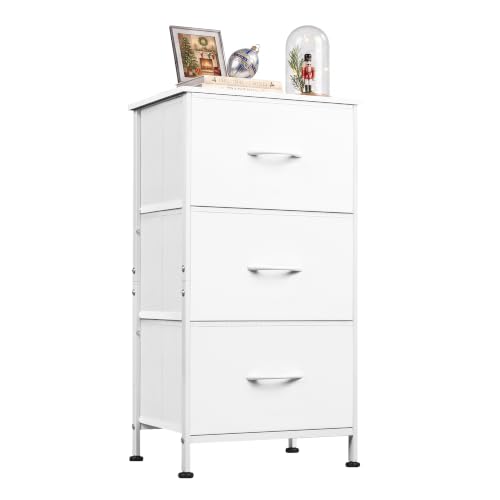
Where to buy
Check the latest price, availability and delivery on Amazon. Orders are placed on Amazon. We may earn a commission from qualifying purchases.
- Best overall: Walker Edison Sloane 6-Drawer Solid Wood Dresser, 52 Inch, Caramel — Check on Amazon
- Sauder Cannery Bridge 6-Drawer Dresser, Sindoori Mango — Check on Amazon
- LEYAOYAO Fluted 6-Drawer Dresser, 48 Inch, Light Grey — Check on Amazon
- Delta Children Brooks 6-Drawer Dresser with Interlocking Drawers, Soft Beige — Check on Amazon
See 2 more Amazon options
- Storkcraft Brookside 6-Drawer Dresser, White — Check on Amazon
- Prepac Sonoma 6-Drawer Double Dresser, Espresso — Check on Amazon
Read the full guide ↓
Disclosure: As an Amazon Associate, topratedkitchenware.com earns from qualifying purchases. Links to Amazon on this page are affiliate links; they cost you nothing extra. Listing details such as price and availability change often, so check the current Amazon listing before you buy.
A dresser is the hardest piece of furniture an apartment dweller buys, and the difficulty has almost nothing to do with the dresser itself. It is the 30-inch bedroom door, the stairwell turn that defeats every long box, the fourth-floor walk-up, the lease that ends in eleven months, and the security deposit waiting at the end of it. A $400 budget buys genuinely good dressers — the best flat-pack on the market and even one solid-pine dresser — but in an apartment the right question is not just “which dresser is best?” It is “which dresser fits my path in, survives my lease, anchors to my landlord’s wall without costing me my deposit, and has a plan for the day I move out?” This guide answers both questions with the same six dressers.
Every pick below is a real Amazon listing with a verified ASIN — check price on Amazon for the current figure — the same six dressers as our general under-$400 guide, re-judged here for rental life. The apartment lens changes some verdicts. Weight stops being a simple sign of quality when you will personally carry the dresser down three flights next spring. A tall, narrow case that wastes wall width in a house becomes the smart shape in a nine-by-eleven bedroom. And assembly, which a homeowner does once in a garage, a renter does on the bedroom floor, in the room, because there is nowhere else. Below you will find a quick picks table, detailed notes on each dresser, a comparison table, a renter’s buying checklist, frank sections on getting a dresser through an apartment building, anchoring without losing a deposit, and what happens to each of these at lease end, the mistakes renters make most, and answers to the questions that come up again and again.
In this guide
Quick Picks
Short on time, or comparing several options at once? Each row below names a renter situation and the dresser that suits it, with a link to the listing.
| Buyer type | Pick | Why it stands out | Link |
|---|---|---|---|
| Best overall for renters | Walker Edison Sloane 6-Drawer Dresser, 52 Inch, Caramel | Solid pine: the one that moves with you, apartment after apartment | Check on Amazon |
| Best for a long lease | Sauder Cannery Bridge 6-Drawer Dresser, Sindoori Mango | 142 lb of engineered wood — buy it if you are staying put for years | Check on Amazon |
| Best small footprint | LEYAOYAO Fluted 6-Drawer Dresser, 48 Inch, Light Grey | Compact 48-inch case with the shallowest depth here | Check on Amazon |
| Best for renters with kids | Delta Children Brooks 6-Drawer Dresser, Soft Beige | Interlocking drawers and a tall, narrow footprint | Check on Amazon |
| Easiest build in a small room | Storkcraft Brookside 6-Drawer Dresser, White | Drawer tracks come pre-installed; GREENGUARD Gold certified | Check on Amazon |
| Best for a short lease | Prepac Sonoma 6-Drawer Double Dresser, Espresso | 59 inches wide and budget-friendly — painless to leave behind; check price on Amazon | Check on Amazon |
How These Picks Were Chosen
The first filter was the budget, applied honestly. Every dresser below is a real Amazon listing with a verified ASIN, selected to sit within this guide’s budget — check price on Amazon, as live listings move. Where a dresser normally sits comfortably under the line but has a history of moving above it, we say so in its review rather than quietly rounding the price down. Anything that sits above the budget — however good it might be — was left out of the linked picks, and the strongest of those are named, unlinked, in the section on what this budget cannot buy.
We did not assemble these dressers ourselves. We read the maker listings and specification pages, compared footprints, drawer counts, materials and hardware, and cross-checked listing details against maker specifications. On top of the general guide’s filters — metal drawer runners instead of wooden glides where the budget allows, safety stops, panel thickness, anti-tip hardware — the apartment lens added four tests of its own. First, the path in: every pick arrives flat, so the box, not the finished dresser, is what has to survive your hallway, but assembled width and depth still decide whether the finished piece turns the corner into the bedroom. Second, the weight you will move: assembled weights are printed wherever the listing states them, because a renter moves their own furniture. Third, the wall: every pick includes or expects a tipping restraint, and the anchoring section below covers fitting one in a rental without forfeiting a deposit. Fourth, the exit: we asked what each dresser is worth, and what it costs you, on moving day.
One thing we looked at closely was safety hardware, because dressers are the most dangerous ordinary furniture in a home — a point the tip-over section below covers in full. Two of the six picks are nursery dressers, and that is deliberate rather than a category error: the nursery brands are required to think about interlocking drawers and tip resistance in ways the adult flat-pack brands are not, and in an apartment — where the dresser often stands in the same room a toddler naps in — their hardware is often the best in the room. One strong seller, the T4TREAM farmhouse 6-drawer dresser, is not linked: it sells briskly as a mid-range option according to market coverage, but we could not tie it to a verified Amazon listing for the dresser itself, so it is named here rather than linked blind.
The 6 Best Dressers for Apartments Under $400
Walker Edison Sloane 6-Drawer Dresser, 52 Inch, Caramel
Who it suits: Renters who move often but keep their furniture — the serial mover who wants one dresser that survives every lease.
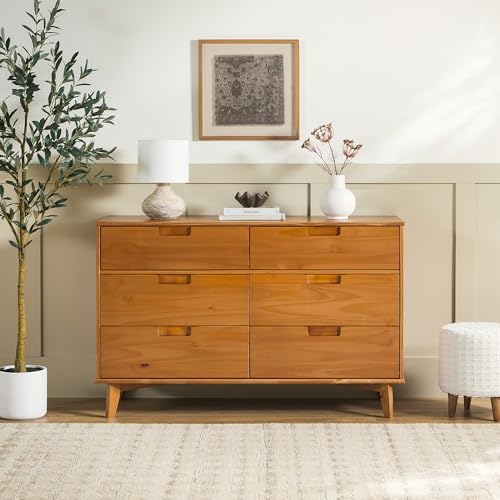
This is the only dresser in the guide built from solid wood — solid pine, per Walker Edison — and for an apartment dweller that fact matters in a specific way: flat-pack furniture is assembled once and forgives being moved rarely, while a solid-wood case can be carried out whole, loaded into a truck, and carried into the next apartment without a cam lock ever being asked to hold twice. The case measures 52 inches wide, 19 inches deep and about 33 inches high, with six drawers behind groove-handle fronts — no protruding knobs to snag on door frames or catch a hip in a narrow bedroom. Tapered solid-wood legs lift it off the floor, and the Caramel finish shows actual grain, because there is actual wood underneath it. Check price on Amazon for the current figure — it lives at the top of this guide’s budget tier and occasionally leans on the ceiling.
The rental trade-offs deserve plain words. Pine is a softwood: it dents more easily than oak or acacia, and moving is exactly when dressers get dented — wrap it in a moving blanket and it will collect a honorable scar or two rather than structural damage, which is more than a laminate panel can promise. It arrives flat like everything here, so the box fits your hallway, but the assembled case is heavy and 52 inches wide: measure the turn from your hallway into the bedroom before you build it, because you will carry it through that turn fully assembled on moving day. Assembly is a two-person project measured in hours. Anchor it to the wall when you are done, as you should with every dresser in this guide — the anchoring section below covers doing that in a rental.
- The only solid-wood double dresser verifiably under $400 on Amazon.
- Moves as furniture, not as a kit — the renter’s long-term buy.
- Groove handles: nothing to snag in tight hallways or small bedrooms.
Honest limitation: Pine is soft and marks with use, a move will test it, and it sits near the top of the budget — check price on Amazon, and if the live price has crossed $400, this pick breaks its own budget and the Sauder below becomes the sensible buy.
Choose it if you expect to keep the same dresser through two or more apartments. Skip it if your lease is short, your stairs are brutal, or you need soft-close drawers and hardwood.
Sauder Cannery Bridge 6-Drawer Dresser, Sindoori Mango
Who it suits: Renters on a long lease — two years or more, with an elevator or a ground floor — who want the safest possible flat-pack purchase.
Sauder has been building flat-pack furniture in Ohio for decades, and this dresser shows what that experience buys: a case 56.22 inches wide, 17.56 inches deep and 31.88 inches high that weighs 142.5 pounds assembled, with six drawers on metal runners with safety stops, per Sauder’s specification for the model, and a warm Sindoori Mango finish that hides dust and minor marks better than white or grey. In a house, that weight is pure virtue — panel thickness, a case that does not sway when you open a loaded drawer. In an apartment it is a commitment, and this guide will not pretend otherwise: you will assemble it in the room it will live in, and on moving day it goes out whole, down in the elevator or down the stairs with a second person and a furniture dolly, or it does not go at all. On price, check price on Amazon and check the live listing before you commit — it sits in the mid-range of this guide’s budget.
What you get for that commitment is the dresser in this guide we would least worry about in five years: an established brand with a spare-parts service that actually exists, a real manual, clear cam-and-dowel instructions, and drawers on metal hardware instead of grooves worn into particleboard. The case is engineered wood under a laminate finish — a deep scratch shows pale board underneath, and water left standing on the top will eventually swell an edge. For a renter who renews, this is the buy once, cry once pick. For a renter already browsing listings for next year’s neighborhood, it is a 142-pound mistake, and the Prepac at the bottom of this guide exists for you.
- 142.5 lb assembled weight: the most substantial flat-pack case here.
- Metal drawer runners with safety stops, per Sauder’s spec.
- Established brand with replacement parts and support behind it.
Honest limitation: It is laminate over engineered wood, and at 142 lb it is effectively a fixture of the apartment — plan its exit before you buy it, because “we’ll figure it out on moving day” is how dressers get abandoned on curbs.
Choose it if your lease is long, your building has an elevator, and you want the lowest-risk purchase in the guide. Skip it if you are in a walk-up above the second floor or expect to move within a year.
LEYAOYAO Fluted 6-Drawer Dresser, 48 Inch, Light Grey
Who it suits: Renters in small bedrooms who want the room to look deliberate, not stored-in — and who need the dresser to take up the least wall and floor.
Fluting — the vertical reeding across the drawer fronts — is the defining furniture detail of the moment, and this is the dresser that delivers it in a mid-range tier — check price on Amazon. For apartment purposes its dimensions are the headline: 48 inches wide, 15.4 inches deep and 29.6 inches high is the smallest footprint in this guide, and in a nine-by-eleven bedroom those saved inches are the difference between a dresser that fits the only free wall and one that blocks the closet door. The Blue, Natural and Walnut colorways of the same dresser share the same compact case, so the footprint argument holds whichever finish you choose. The listing includes an anti-tip device; fit it, as with every dresser here.
Now the plain truths. At 15.4 inches deep this is the shallowest case in the guide, and drawer depth is where dressers earn their keep: folded sweaters and jeans fit, bulky hoodies and spare bedding mostly do not — in a small apartment, that often means the bedding lives under the bed instead, which may be a trade you are happy to make. The construction is engineered wood, the fluted fronts are a moulded surface rather than carved timber, and LEYAOYAO is a young Amazon-native brand — the listing support and parts pipeline behind it are not Sauder’s. As a moving proposition it sits in the sensible middle: a compact case one strong person can shift around a room and two people can carry downstairs without drama. Buy it for the look and the footprint, keep the drawers for clothes rather than books, and it does its job handsomely.
- The fluted, curved look in a mid-range tier — check price on Amazon.
- Smallest footprint in the guide: 48 inches wide and only 15.4 inches deep.
- Anti-tip device included in the listing; several colorways available.
Honest limitation: The 15.4-inch depth makes these the smallest drawers in the guide, and a young brand cannot promise the decade of parts support the established names can.
Choose it if your bedroom is small and its look matters to you. Skip it if you need deep drawers for bulky clothes or plan to hand this dresser down.
Delta Children Brooks 6-Drawer Dresser with Interlocking Drawers, Soft Beige
Who it suits: Renters with a baby or toddler — and any apartment where floor space is scarce but vertical space is free.
The Brooks is built around one idea that adult dressers should steal: interlocking drawers. Only one drawer can be open at a time, which sounds like a small thing until you understand tip-over mechanics — a dresser falls when weight shifts forward, and several open, loaded drawers are exactly how that happens, especially with a child climbing them. Lock the other five shut and the most common accident sequence cannot start. In apartment terms, its shape is the second argument: listed at 46.3 inches wide, 19.3 inches deep and 43.3 inches high, it takes the narrowest wall footprint of the full-depth dressers here and stores upward instead — the top works at changing-table height now, and the drawers keep working as a child’s dresser for years. Delta Children includes three sets of knobs in the box, so the look can change as the room does. Check price on Amazon on the live listing before you buy.
The limitations are about fit rather than quality. At 123.5 pounds it is nearly as heavy as the Sauder, in a taller case that is awkward on stairs — this is a two-person, plan-the-route move, and in a walk-up it should be a considered decision, not an impulse. A 43-inch-tall dresser is also a deliberate nursery proportion: as a main adult dresser it gives up the long, low top surface most people use for a mirror, a tray and the morning routine, and the Soft Beige palette is a nursery palette. Assembly is required. None of that matters if a child will ever climb, pull or yank in the room it stands in — in that room, this is the pick, and the wall anchor goes in the same day it is built.
- Interlocking drawers: only one opens at a time, by design.
- Tall, narrow format stores vertically in a small footprint.
- Three sets of knobs included, so the look can change with the room.
Honest limitation: At 123.5 lb in a tall case it is one of the harder moves in this guide.
Choose it if a child will use or climb near this dresser, ever. Skip it if you want a long low dresser top for a mirror and daily dressing, or your stairs defeat tall furniture.
Storkcraft Brookside 6-Drawer Dresser, White
Who it suits: Renters furnishing a nursery or kids’ room who have the least possible space and patience for assembly.
Storkcraft’s Brookside takes the route that matters most in a small apartment: the drawer tracks are fitted at the factory. Pre-installed tracks remove the fiddliest, most error-prone stage of a flat-pack build — the stage where a runner mounted one hole off makes a drawer bind for the life of the furniture — and they also remove the stage that needs the most floor space, with panels spread out and hardware sorted around you. In a bedroom you are already sleeping in, a shorter, simpler build is worth real money. The Brookside carries the same interlocking-drawer safety system as the Brooks above, and it is GREENGUARD Gold Certified, the low-emissions certification that matters most in a room where a baby sleeps — a genuine consideration in a small, closed-up rental bedroom. The footprint is a standard double-dresser size, about 48 inches wide with a 16.7-inch depth per the listing. Check price on Amazon — it is a budget-friendly option in this guide, with one sharp caveat below.
That caveat is volatility. Its pricing and availability have moved sharply at times, and Amazon listings have at times shown no featured offer for it at all. Neither fact disqualifies it; both mean you check the live listing carefully before you buy. When it is available within this guide’s budget it is one of the best-value safety-certified dressers on Amazon; if the live price has moved above the budget, the Brooks above is the buy instead. Beyond price, the limitations are the nursery ones it shares with the Brooks — a look and scale aimed at children’s rooms first.
- Pre-installed drawer tracks: the shortest, least space-hungry build here.
- GREENGUARD Gold Certified, with interlocking safety drawers.
- Budget-friendly tier in this guide — check price on Amazon.
Honest limitation: Availability is volatile and the featured offer comes and goes, so check price on Amazon and buy only when the live listing sits within this guide’s budget.
Choose it if you find it available within budget and want the easiest nursery build in the least floor space. Skip it if the live price has spiked, or you want an adult-proportioned dresser.
Prepac Sonoma 6-Drawer Double Dresser, Espresso
Who it suits: Renters on a short or uncertain lease who need maximum drawer width for minimum money — and minimum regret at move-out.
The Sonoma is the elder of this guide — a Canadian-made Prepac design that has been selling in this form for years — and its apartment argument is its budget tier and easy exit. At 59 inches wide, 17.5 inches deep and 29 inches high it is the widest dresser here, with six genuinely broad drawers, as the budget pick here — check price on Amazon. In a studio, that long low case can double as a room divider with storage in it. And as a budget-tier pick, the lease-end decision is painless in a way no other pick matches: if it moves with you, good; if it sells in the building’s group chat in an afternoon, good; if it is simply not worth a truck slot, leaving it behind is easy to accept. For a first apartment, a work relocation, or a lease you already know you will not renew, that easy exit is hard to argue with.
The age shows in the hardware. Per Prepac’s specification the drawers run on wooden glides rather than metal runners: they work, they are quiet, and they will never feel as smooth as the Sauder’s metal runners, especially under a heavy drawer in year three. The finish is a laminate, the styling is plain to the point of invisibility, and listing crawls suggest the featured offer on this ASIN comes and goes — if it is absent when you shop, the dresser is usually still orderable through the listing’s other offers, but check who is selling and shipping it. Prepac includes a tipping restraint with its dressers; on a 59-inch case this wide, anchor it anyway. What you are buying is honest, capacious, unfashionable storage — and as a budget-tier buy, that is a respectable thing to be.
- Widest case in the guide at 59 inches, in a budget tier — check price on Amazon.
- Cheap enough that every lease-end outcome — move it, sell it, leave it — is acceptable.
- A proven, long-running design from a Canadian maker.
Honest limitation: Wooden drawer glides instead of metal runners, a plain laminate finish, and a featured offer that flickers in and out on the listing.
Choose it if storage per dollar and an easy exit are the whole decision. Skip it if drawer feel matters to you daily — the Sauder’s metal runners are the upgrade.
Comparison Table
| Product | Footprint (W × D × H) | Drawers | Best use | Link |
|---|---|---|---|---|
| Walker Edison Sloane 6-Drawer, Caramel | 52 × 19 × 32.9 in | 6 | Solid pine; the keeper across moves | Check on Amazon |
| Sauder Cannery Bridge 6-Drawer, Sindoori Mango | 56.22 × 17.56 × 31.88 in | 6 | Long-lease flat-pack; heaviest case here | Check on Amazon |
| LEYAOYAO Fluted 6-Drawer, Light Grey | 48 × 15.4 × 29.6 in | 6 | Smallest footprint; the designer look | Check on Amazon |
| Delta Children Brooks 6-Drawer, Soft Beige | 46.3 × 19.3 × 43.3 in | 6 | Nursery safety; vertical storage | Check on Amazon |
| Storkcraft Brookside 6-Drawer, White | ~48 × 16.7 × ~34 in | 6 | Easiest nursery assembly | Check on Amazon |
| Prepac Sonoma 6-Drawer, Espresso | 59 × 17.5 × 29 in | 6 | Short-lease value; most width per dollar | Check on Amazon |
How to Choose a Dresser for an Apartment Under $400
- Measure the path before the wall. Note every door width, the hallway turn, and the stairwell or elevator on the route to the bedroom. Everything in this guide arrives flat, so the box will fit almost anywhere — but the assembled dresser has to make the same trip on moving day, and a 59-inch case that entered as panels leaves as a 59-inch case.
- Then measure the wall, and the drawers. Case width is the headline number, but drawer depth decides what fits. A 19-inch-deep case holds folded jeans and sweaters in comfort; a 15.4-inch case is a clothes-only proposition. In a small bedroom, also check what the dresser blocks: a closet door swing and a dresser drawer opening compete for the same floor.
- Decide the lease honestly. Think about how long the dresser will actually serve you, not just what it costs today. A budget pick like the Prepac suits a short lease you already know will end; a keeper like the Sloane earns its place when it serves lease after lease. Short lease, buy budget-friendly or buy portable. Long lease, buy quality.
- Weigh the exit, literally. Assembled weight is the easiest honesty check in flat-pack, and for a renter it is also a moving cost: the 142 lb Sauder and the 123 lb Delta are two-person, plan-the-route moves, while a compact case like the LEYAOYAO is a manageable carry. If your building has no elevator, weight outranks almost everything else on this list.
- Plan the assembly space. You will build on the bedroom floor, in the room the dresser will live in. A six-drawer build wants a clear area roughly the size of the dresser top, several times over, for panels and drawers-in-progress. If that floor space does not exist, the Brookside’s pre-installed tracks remove the longest stage of the job.
- Have an anchoring plan before the box arrives. Every pick here includes or expects a wall tipping restraint, and fitting one in a rental is a solved problem — see the anchoring section below. “I rent, so I can’t anchor” is not a plan; it is the accident’s first sentence.
- Check the live price on Amazon. Dresser prices on Amazon change often, and one pick in this guide has at times moved above this guide’s budget. Check price on Amazon on the live listing, and be willing to wait rather than buy at a peak.
- Read the return terms before the box arrives. A 140 lb dresser is not something you casually re-box, and freight terms differ by seller. Confirm who pays return freight on the listing, and inspect panels for shipping damage before you start building, while a replacement is still a simple conversation.
Getting a Dresser Into an Apartment: Doors, Stairs and the Box It Comes In
Here is the apartment dweller’s one great advantage in the dresser market: everything in this guide arrives flat. The box for a six-drawer dresser is long, flat and heavy rather than bulky, and it will go through a 30-inch door, up a switchback stair and into a small elevator that would all refuse the assembled piece. Delivery day is rarely the problem. The problems come later, and they are worth rehearsing before you order.
The first is the turn. An assembled dresser leaves the bedroom the way a sofa does — tilted, rotated, negotiated — and a 59-inch-wide case like the Prepac, or a 43-inch-tall case like the Brooks, needs its route measured with the same care you would give a couch: door width, the angle of the hallway corner, the height of the stairwell turn. Measure before you build, because the day you discover the turn does not work should not be moving day, with a truck idling downstairs. The second problem is weight on stairs. The Sauder at 142.5 pounds and the Brooks at 123.5 pounds are two-person carries with a plan, rest stops and a clear stairwell; in a fourth-floor walk-up, they are also a legitimate reason to choose differently — the LEYAOYAO’s compact case, or the Prepac’s low-stakes price, both forgive a walk-up in ways the heavy cases do not.
The third problem is the build itself. A homeowner assembles in a garage and carries the dresser in; a renter assembles in the bedroom, on the floor the bed does not occupy, because there is no other floor. Clear an area, protect the flooring with the cardboard the dresser came in, sort every part before step one, and use a screwdriver on a low torque setting rather than muscling cam locks by hand — a cam lock forced with full torque splits the panel it was meant to hold. Build the case where it will stand: a finished six-drawer dresser is not something you slide around a small room for fun, and every repositioning is a chance to rack the case or scuff the landlord’s floor.
Anchoring a Dresser in a Rental Without Losing Your Deposit
Dressers tip. It is the most serious fact in this guide, and it is not a formality: US safety regulators have tracked hundreds of tip-over deaths over the past two decades, most of them children, and dressers are the furniture category most often involved. A dresser falls when its center of gravity moves past its front edge — which is exactly what open drawers do, one after another, and exactly what a climbing toddler adds weight to. Federal rules now require new dressers sold in the US to pass stability testing, and the better makers design for it, but no test makes an unanchored dresser safe in every real room, on every carpet, against every determined three-year-old. Renting changes none of this. It only changes how you fit the anchor.
The standard restraint — a strap or bracket screwed into a wall stud and into the back of the dresser — leaves two small screw holes in the wall. In most rentals, that is a ten-minute repair at move-out: fill, sand, a dab of the paint the landlord used, and the wall is whole. Weighed against a typical deposit, two filled pin-holes are among the cheapest marks a tenant can leave, and many leases and local rules treat minor picture-hook-class holes as ordinary wear. If your lease explicitly forbids holes, talk to the landlord before you conclude you cannot anchor: landlords fear liability more than filler, and a written permission for a safety anchor is one of the easier yeses in renting. What does not work is skipping the anchor and compensating with care — care fails on the one afternoon a visiting toddler treats the drawers as stairs. This is also why two nursery dressers earned places in this guide: the Brooks and the Brookside mechanically prevent the multi-drawer opening that starts most tip-overs, with interlocking systems that let only one drawer open at once. If a child will ever be in the room unsupervised — yours, a grandchild, a visitor — that hardware is worth more than solid pine, and the strap goes in the same day regardless.
The rest of the rules are simple and absolute. Put the heaviest items in the lowest drawers. Never open more than one drawer at a time on a non-interlocking dresser, and teach children that drawers are not steps, ladders or hiding places. Keep the dresser on a hard floor or short-pile rug where you can — deep carpet under a tall case adds a lean you do not want.
The Lease-End Test: What $400 Buys, and What Each Dresser Costs You When You Leave
Every apartment dresser purchase is really two purchases: the dresser, and its exit. Flat-pack furniture has an honest weakness here — cam-and-dowel cases are built to be assembled once, and a case that is disassembled, moved and rebuilt usually comes back looser than it was. So the realistic exits are three: move it whole, sell it in place, or leave it behind. Judge each pick by which exits it keeps open. The Sloane moves whole, indefinitely — solid pine is the only construction here that treats a fourth apartment as a non-event, which is how a dresser near the top of the budget becomes the best value on this page over time. The Sauder moves whole too, but at 142 pounds each move is an occasion; over a long tenancy that hardly matters, over three short ones it dominates the purchase. The LEYAOYAO is light enough to be unremarkable either way. The nursery dressers, if children have outgrown them, sell readily to the next family in the building. And the Prepac, as the budget pick here, is the one dresser here whose worst exit — leaving it for the next tenant — still leaves the original decision looking sensible.
That is also the honest answer to “when is a $400 dresser too much for an apartment?” When the lease is short and the exit is bad. A top-of-budget dresser kept for eleven months and abandoned is poor value for storage a budget dresser would have provided just as well; the same dresser kept for five years spreads its cost over years of use. If you know your horizon, the choice makes itself — and if you do not know it, buy for the exit you can afford: the portable Sloane, the compact LEYAOYAO, or the disposable-cheap Prepac, rather than the magnificent, immovable Sauder.
Finally, know what the $400 ceiling itself does and does not buy, because apartment money has other claims on it. At this tier you get the best flat-pack — thicker panels, metal runners with safety stops, 120–140 lb cases — and entry solid wood in pine. You do not get hardwood, dovetailed drawers or soft-close slides on a full six-drawer dresser: Sauder’s own Harvey Park 6-drawer sits just over the line in recent roundup coverage and is still laminate flat-pack, and a genuinely premium six-drawer dresser — solid acacia, dovetails, soft-close ball-bearing slides — sits in a premium tier at design retailers. Above this budget, you are mostly paying for size and finish, not a different category of construction. For a renter, whose next certain expense is a deposit on the next place, stopping at the value peak is not settling. It is the correct allocation.
Common Buying Mistakes
- Measuring the bedroom wall but not the route — then building a dresser that cannot make the hallway turn on moving day.
- Buying the heaviest, best-built flat-pack for a fourth-floor walk-up and discovering the exit cost on the stairs.
- Skipping the wall anchor because “it’s a rental” — the accident sequence does not check your lease, and two screw holes are a ten-minute repair.
- Paying near $400 for a lease you already know ends in under a year, then abandoning the dresser and its cost at move-out.
- Assembling in the hallway or living room, then trying to move a finished 140 lb case through a doorway it barely fits.
- Buying on headline width alone and discovering the drawers are too shallow for anything bulkier than T-shirts.
- Buying a price spike: dresser prices on Amazon move often, and the patient buyer waits for a calmer live price rather than buying at a peak.
- Judging a dresser by its finish name. “Mango wood” on a flat-pack listing is a printed finish, not the timber; read the materials line, not the color name.
- Loading the top drawers with the heaviest items, raising the center of gravity on day one.
- Ignoring who actually sells and ships the listing when the featured offer disappears — third-party freight terms on a 140 lb box vary wildly, and so do return costs.
Final Recommendation
- Most renters: Walker Edison Sloane 6-Drawer Dresser — the one that keeps its value across moves.
- Long leases: Sauder Cannery Bridge 6-Drawer Dresser — the lowest-risk purchase in the guide.
- Small bedrooms: LEYAOYAO Fluted 6-Drawer Dresser.
- Renters with kids: Delta Children Brooks 6-Drawer Dresser.
- Easiest build in a small room: Storkcraft Brookside 6-Drawer Dresser — check price on Amazon first.
- Short or uncertain leases: Prepac Sonoma 6-Drawer Double Dresser.
Our top two are the Walker Edison Sloane for renters who move with their furniture — it is the only pick whose construction treats the next apartment as a plan rather than a problem — and the Sauder Cannery Bridge for renters who are staying, because over a long lease its weight stops mattering and its engineering is the best in the guide. If the room will ever hold a child, overrule both and take the Brooks, and fit its wall anchor the day it is built. Whichever you choose, measure the path before the wall, check price on Amazon on the live listing, and treat the anchor strap as part of the furniture, not packaging.
Frequently Asked Questions
Will a six-drawer dresser fit through my apartment door?
As a box, almost certainly yes — every dresser in this guide arrives flat, and a long flat box goes through standard 30–32 inch doors and up most stairwells. The real question is the assembled dresser on moving day: measure your door widths and the hallway turn against the case dimensions in the comparison table above, especially for the 59-inch Prepac and the 43-inch-tall Brooks, before you build.
How do I anchor a dresser in a rental without damaging the wall?
Use the restraint kit included or expected with every pick here: a strap or bracket screwed into a wall stud and the back of the case. It leaves two small screw holes, which fill and touch up in about ten minutes at move-out — ordinary wear in most rentals. If your lease forbids holes, ask the landlord in writing first; permission for a child-safety anchor is one of the easier approvals to get, and it protects the landlord as much as you.
Is a $400 dresser worth it on a one-year lease?
Only if it leaves with you. A top-of-budget dresser you abandon after a year is poor value — the Prepac in this guide does the same job as a budget-tier pick and can be left behind without regret. A dresser you keep for three leases spreads its cost over years of use. Match the dresser to the horizon: short lease, buy the Prepac or the portable Sloane; long lease, the Sauder earns its price.
Which of these dressers is easiest to move at lease end?
The LEYAOYAO, for its compact 48-inch case, and the Sloane, for its construction — solid pine travels as furniture and shrugs off the knocks that crack laminate panels. The hardest exits are the Sauder at 142.5 lb and the tall Brooks at 123.5 lb: both are two-person moves that reward an elevator and punish a walk-up.
Can I assemble one of these alone in a small bedroom?
Mostly, with patience — but plan for two moments in every six-drawer build where a second pair of hands holds a panel while you fix it, and borrow those hands rather than improvising. Build in the room, on cardboard to protect the floor, in a cleared area. If assembly dread or floor space is your main constraint, the Brookside’s pre-installed drawer tracks remove the longest and fiddliest stage.
My building has no elevator. What should I buy?
Remember the box has to go up the stairs too, and flat-pack boxes for six-drawer dressers are heavy. Favor the lighter, more compact cases — the LEYAOYAO first, the Prepac for value — and think hard before ordering the 142 lb Sauder or the tall 123 lb Brooks. If your heart is set on a heavy case, budget for a delivery service that carries to your floor, and confirm it before you order, not after the box is in the lobby.
Can you really get a solid wood dresser for under $400?
Yes — in pine. The Walker Edison Sloane in this guide is a solid-pine six-drawer dresser — check price on Amazon for the current figure. What you cannot get within this budget is hardwood: oak, acacia and walnut dressers with furniture-grade joinery sit in a premium tier well above this guide’s budget. Pine is softer and dents more easily, but it is genuinely solid, repairable and — for a renter — the construction most likely to still be with you in your next apartment.