Where to buy
Check the latest price, availability and delivery on Amazon. Orders are placed on Amazon. We may earn a commission from qualifying purchases.
- Best overall: Signature Design by Ashley Drystan 6-Drawer Dresser — Check on Amazon
- Signature Design by Ashley Cambeck 6-Drawer Dresser — Check on Amazon
- Signature Design by Ashley Hyanna 6-Drawer Dresser — Check on Amazon
- LEYAOYAO Fluted 6-Drawer Dresser, 48-Inch — Check on Amazon
See 2 more Amazon options
- Storkcraft Crescent 6-Drawer Dresser, Espresso — Check on Amazon
- Storkcraft Brookside 6-Drawer Dresser, White — Check on Amazon
Read the full guide ↓
Disclosure: As an Amazon Associate, topratedkitchenware.com earns from qualifying purchases. Links to Amazon on this page are affiliate links; they cost you nothing extra. Listing details such as price and availability change often, so check the current Amazon listing before you buy.
A renter shopping for a dresser with a $1,000 budget deserves two honest findings before any product names. The first is about the market: on Amazon, the $1,000 dresser barely exists. Even the most expensive dresser we could fully verify — confirmed listing, dimensions and materials we could stand behind — sits well below the top of this budget; check the current price on Amazon before you buy, because listings change often. Dressers recorded near four figures on Amazon do exist, and two are named below, but for neither could we verify the listing well enough to link it — this series does not link what it cannot verify. The second finding is about renting: most renters should spend only a fraction of this budget anyway. A dresser is the hardest furniture you own to move, and its value to you is set by your lease — how long you will stay, whether the case fits the route in and the route out, and whether you are allowed to anchor it to the wall it stands against.
So this guide ranks the six dressers we could verify end to end — listing, dimensions and materials, each within the $1,000 budget — and then judges each one the way a renter has to: by the door it must pass through, the floor space its assembly will consume, the wall it must be anchored to under someone else’s rules, and the van it will ride in when the lease ends. The list runs from a factory-assembled Ashley that arrives ready to load — no build, no tools, no living-room workshop — through three large six-drawer cases and a compact fluted piece, to two safety-tested Storkcraft dressers at the accessible end of the budget — the sensible answer for most renters. Below: a quick picks table, detailed notes on each dresser, a comparison table, a renter’s buying checklist, honest guidance on spending toward $1,000 on a lease, a section on anchoring in a home you do not own, the mistakes renters make most, and answers to recurring questions.
In this guide
Quick Picks
Each row names a renter situation and the product that suits it, with a link to the listing.
| Buyer type | Pick | Why it stands out | Link |
|---|---|---|---|
| Best overall | Signature Design by Ashley Drystan 6-Drawer Dresser | Arrives fully assembled — no build space, no tools, no assembly weekend | Check on Amazon |
| Best finished look | Signature Design by Ashley Cambeck 6-Drawer Dresser | Whitewash farmhouse finish and lined drawers; travels flat, builds in place | Check on Amazon |
| Best warm-wood value | Signature Design by Ashley Hyanna 6-Drawer Dresser | The most accessible big-brand six-drawer in this guide | Check on Amazon |
| Best for small apartments | LEYAOYAO Fluted 6-Drawer Dresser, 48-Inch | Fluted fronts in a compact 48-inch footprint that moves easily | Check on Amazon |
| Best safety-tested | Storkcraft Crescent 6-Drawer Dresser, Espresso | ASTM F2057-tested claim in a full-size double-dresser format | Check on Amazon |
| Best for most renters | Storkcraft Brookside 6-Drawer Dresser, White | Interlocking drawers and GREENGUARD Gold at the accessible end of the budget | Check on Amazon |
How These Picks Were Chosen
The first filter was the budget itself, applied strictly: every product below is a real Amazon listing that sits within the $1,000 budget. Check the current price on Amazon before you buy, because prices change often. Anything whose listing we could not verify was named without a link and with the reason, however good it looked — that rule removed at least three dressers, including the tier’s natural solid-wood hero, and the ceiling discussion below names them all.
The second filter was the apartment test, and it has four questions. Can it get in — through the front door, up the stairs, around the hallway turn, as a built case or as flat-pack boxes? Can it be built here — does assembly need a cleared floor the size of the dresser itself, a second pair of hands, power tools your lease or your toolkit may not allow? Can it be anchored — because every dresser in this guide needs a tip restraint fitted into a wall stud, and in a rental that means a landlord, a lease clause and two small holes you will patch at move-out. And can it leave — what does it weigh, does it come apart again, and what will it cost to move or replace at the end of the lease? A dresser that fails the fourth question is not a bargain at any price; it is a liability with drawers.
We did not use these products ourselves. We read the maker listings and specification pages, compared widths, depths, drawer counts, materials and glide types, and weighed what the extra money at this tier genuinely buys: factory assembly instead of a flat pack, lined drawers, and safety testing with a standard attached. One honesty note on materials, because dresser marketing blurs it hardest exactly where the money is: every linked pick in this guide is engineered wood — MDF, particleboard or wood composites under a laminate or veneer finish — and each review says so. The genuinely solid-wood dressers in this price conversation are named, unlinked, below, described by their position in this budget rather than by any figure. Load and stability figures, where they appear at all, are maker claims printed as such; where no figure could be verified, we say so instead of inventing a number.
The 6 Best Dressers for Apartments Under $1,000
Signature Design by Ashley Drystan 6-Drawer Dresser
Who it suits: Renters on a long lease — or landlords furnishing a let — who want a full-size dresser with zero assembly, and whose building gives a built case a clear route in.
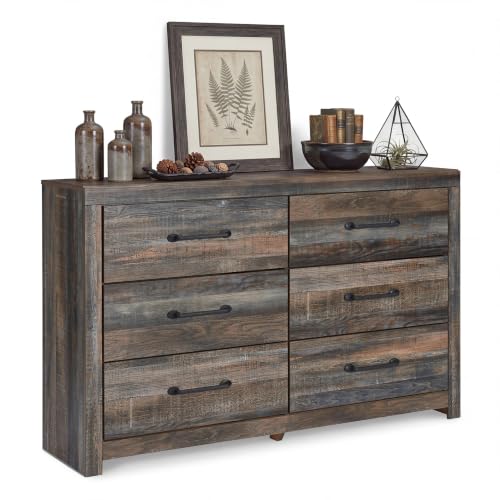
The Drystan leads this guide for one concrete reason: it is the only pick that arrives fully assembled. At 58.75 inches wide, 15.5 inches deep and 36.5 inches tall, it is a full-size six-drawer case, and Ashley ships it built — your entire setup job is reversing the pre-installed handles and mounting the included tip restraint. Flat-pack assembly needs a cleared floor area roughly twice the dresser’s footprint, a free afternoon and usually a second person; an apartment bedroom rarely has the first and a solo renter rarely has the third. The Drystan skips all of it: no cam locks, no misaligned drawer fronts, no assembly-quality lottery — the largest source of complaints across this category. It sits at the top of this guide’s verified range — check the current price on Amazon before you buy. The finish is a replicated barn-board look over engineered wood and laminate, the drawers run on side-roller glides, and the drawer interiors carry a faux linen lining that reads a step above bare board.
The trade is the route, and it is absolute. An assembled dresser cannot be carried in pieces: the whole 58.75-inch case must pass your front door, turn your hallway corners and fit your building’s elevator — or be carried up the stairs as one rigid object. Measure the route before you order, including door swing and stairwell turns: a built dresser that cannot reach the bedroom is a return you will have to carry back down. The same applies at lease end — this is a two-person or movers item, not a one-trip car load. The listing states the dresser meets the ASTM F2057 stability standard when anchored with its included tip restraint — the listing’s own claim — and one that still requires fitting the restraint into a stud, which in a rental means the permission conversation in the anchoring section below. Finally, the honest context is volatility: this listing’s price has swung widely over time, so check its price history before you order and let an unusually high figure talk you into waiting.
- Arrives fully assembled — reverse the handles, mount the tip restraint, done; no build space needed.
- Six drawers at 58.75 inches wide, with faux-linen-lined interiors and side-roller glides.
- Sits at the top of this guide’s verified range — check price on Amazon; the listing states ASTM F2057 compliance when anchored.
Honest limitation: It is engineered wood under a replicated-wood laminate, not solid timber; it must travel your route whole, which is the hardest delivery and the hardest move-out in this guide; and its price is the most volatile here, so the figure you see may differ sharply from one week to the next — check the current price on Amazon before you commit.
Choose it if your lease is long, your route is generous — wide doors, an elevator, a straight stair — and you want the dresser finished the day it arrives. Skip it if your building has tight turns or a walk-up stairwell, or your lease is short: an assembled case is the worst possible furniture to move twice.
Signature Design by Ashley Cambeck 6-Drawer Dresser
Who it suits: Renters who want the finished, furniture-store look — whitewash finish, lined drawers — and would rather build in the room than gamble on moving a built case through it.
The Cambeck is the Drystan’s sibling in size and role: 58.7 inches wide, 15.31 inches deep and 36.46 inches tall, six drawers, engineered wood construction, and a whitewash finish that is the reason most buyers land on it. The decisive renter difference is how it travels: flat, in boxes, up stairs and around corners that would stop the assembled Drystan outright, then built in the room it will live in. Its drawers carry the same faux linen lining as the Drystan’s — where this tier quietly separates from the lower-priced tier, because clothes slide instead of snagging and the interior wipes clean. It sits just below the top of this guide’s verified range — check the current price on Amazon.
Plan around the build first: a 58.7-inch case assembled on a bedroom floor needs that floor cleared and a helper for the heavy panels, so schedule it before the rest of the room is arranged. The second is weight and exit. At 140 lb built, flat-pack furniture generally does not survive being fully disassembled and rebuilt — cam locks and particleboard holes loosen — so at lease end expect to move it whole, sell it in place, or accept it as a one-lease purchase. The whitewash finish also shows edge chips more than the Drystan’s busier grain pattern does, which matters in a rental that will be moved and bumped. Buy it for the look, the lined drawers and the route-friendly delivery — check the current price on Amazon.
- Whitewash farmhouse finish over a full-size 58.7-inch, six-drawer case.
- Ships flat — the route-friendly way to get a big dresser into a tricky apartment.
- Faux-linen-lined drawers; check price on Amazon.
Honest limitation: At 140 lb built it is a two-person move and a committed placement, and flat-pack construction rarely survives a full disassembly-and-rebuild cycle — measure the room, build it where it will stand, and assume it leaves whole or not at all.
Choose it if the whitewash look is the point and your route rules out an assembled case. Skip it if you expect to move within the year and would have to carry it out built — the compact LEYAOYAO below is the kinder exit — or if you would rather pay a little more to skip assembly entirely where the route allows it.
Signature Design by Ashley Hyanna 6-Drawer Dresser
Who it suits: Renters who want the big-brand, full-size dresser in a warm golden-oak tone, at the most accessible Ashley price point in this guide — the spend-less route that still buys brand support.
The Hyanna completes the Ashley trio at 58.7 inches wide, 15.31 inches deep and 36.42 inches tall — the same full-size footprint as the Cambeck, in a golden oak finish with a cleaner, more contemporary face. The construction is engineered wood — MDF and particleboard under a decorative laminate — and the drawers are faux-linen-lined and described by the maker as smooth-gliding. Assembly is required, and like the Cambeck it arrives flat, which keeps the delivery route easy and puts the build in the room. It is the most accessible of the three Ashley cases in this guide — check the current price on Amazon.
What the Hyanna offers over the no-name end of the market is not materials — it is accountability. Ashley is a real furniture company with model numbers, replacement parts and a dealer network, and the Hyanna (model B1050-31) sits in its current catalog rather than in a marketplace brand’s rotating lineup; for a renter who cannot afford a dresser failure mid-lease, that support network is a real feature. What it does not yet offer is a track record on this listing: long-term owner evidence for this exact listing is still limited, noticeably thinner than the track record behind the Storkcraft picks below. That is not a defect in the dresser; it is a fact about the evidence, and it is why this pick sits third rather than first despite its accessible price point. Its exit math is the Cambeck’s: built, it is a full-size case that leaves whole or stays behind.
- Full-size 58.7-inch six-drawer case in a warm golden-oak finish, delivered flat.
- Faux-linen-lined, smooth-gliding drawers; engineered wood with decorative laminate.
- The most accessible Ashley case in this guide — check price on Amazon.
Honest limitation: Long-term owner evidence for this exact listing is still thin, so how it holds up over years is less documented than the Storkcraft picks below, and the MDF-and-particleboard construction wants the usual care: no standing water on the top, and coasters under anything wet.
Choose it if you want the Ashley name and parts support at the most accessible Ashley price point in this guide, on a lease long enough to justify a full-size case. Skip it if a long owner track record matters more to you than the brand — the two Storkcraft picks below offer that, at a lower price point.
LEYAOYAO Fluted 6-Drawer Dresser, 48-Inch
Who it suits: Small apartments, studios and guest corners that want a dresser with actual design presence — fluted fronts are the current furniture look — in a footprint that is easy to get in and easy to get out.
Every other pick in this guide is a variation on the flat-fronted box; the LEYAOYAO is here because it is not. Its six drawer fronts are fluted — vertical wavy grooves with metal knobs — in a distressed brown farmhouse finish, and at 48 inches wide, 15.4 inches deep and 29.6 inches tall it is deliberately smaller than the Ashley cases: a dresser that can double as a TV console or entryway piece without swallowing a small room’s only wall. For renters, the size is the feature twice over — it fits the wall a studio actually has, and at lease end it is the one dresser here a single determined person can plausibly move with a hand truck and a friend’s car. The listing includes an anti-tip device, and it ships flat with labeled parts and step-by-step instructions — check the current price on Amazon.
The honest framing is that you are buying the fronts. The listing describes the piece in the loose language of marketplace furniture — “high-quality wood” without a species or a construction breakdown — so plan on engineered-wood-class durability rather than heirloom timber, and note the 29.6-inch height: it is a low, wide console-style dresser, which suits a TV or a small room better than a primary bedroom where a taller case earns its keep. Its price history is the other thing to know: this listing has dipped in past sales, so patient buyers can reasonably wait for the next dip — check the current price on Amazon against its history before you buy.
- Fluted drawer fronts with metal knobs — the only design-led piece in this guide.
- Compact 48-inch footprint, low 29.6-inch height: dresser, console or entryway piece, and the easiest exit here.
- Mid-range in this guide — check price on Amazon — with an anti-tip device per the listing.
Honest limitation: The listing never specifies its materials with the precision the Ashley and Storkcraft listings do, the brand is an Amazon-native label without a dealer network behind it, and the low profile that makes it a good console makes it a small primary dresser — check the drawer volume against your wardrobe, not just the width against your wall.
Choose it if the fluted look is what your room is missing and 48 inches is the right size of dresser for it — especially in a smaller apartment. Skip it if you need maximum drawer volume in a primary bedroom — the full-size picks above hold meaningfully more — or if unspecified materials make you uneasy at any price.
Storkcraft Crescent 6-Drawer Dresser, Espresso
Who it suits: Renters who want the most heavily safety-tested dresser in this guide — and one of its longest track records — whether the room holds a child now, hosts visiting kids, or is simply a bedroom for years.
Storkcraft sells the Crescent as a nursery and kids’ dresser, and the things that make it good for a nursery make it good, full stop — doubly relevant in rentals, where a visiting niece or a roommate’s toddler turns tip-over safety from an abstraction into your problem. It measures 53.35 inches wide, 16.73 inches deep and 33.31 inches tall, with six drawers on Euro glides, built from wood composites under a PU-coated laminate the maker describes as durable and easy to clean. The listing states the dresser is tested at third-party, accredited laboratories to meet or exceed the ASTM F2057 stability standard for clothing storage units — the tip-over standard — alongside CPSIA requirements; we print that as the maker’s tested claim, which is a stronger form of words than most dresser listings offer. It sits at the accessible end of this budget — check the current price on Amazon — and it carries one of the longest track records in this guide alongside its sibling below.
The Crescent’s trade is identity, not quality. It is styled and sized as a universal dresser — 53 inches is a real double-dresser width — but it is merchandised for the nursery, accepts a changing topper sold separately, and wears the plain, flat-fronted look of kids’ furniture rather than the farmhouse detailing of the Ashley cases. Assembly is required, though at 53 inches it builds more manageably in a small room than the 59-inch cases, and composite construction at this price point means the same care rules as every engineered-wood pick here. What you get is the category’s safety paperwork well within this guide’s budget, from a brand whose entire business is passing children’s-furniture standards — and, for a renter, a dresser affordable enough that leaving it behind at lease end is a shrug rather than a loss.
- Listing states third-party testing to meet or exceed ASTM F2057 and CPSIA standards.
- Six drawers on Euro glides at 53.35 inches wide; PU-coated, easy-clean laminate.
- At the accessible end of this budget — check price on Amazon — from a brand built around children’s-furniture standards.
Honest limitation: It is nursery furniture by design and by styling — flat fronts, a changing-topper ecosystem, composite construction — so if the room is a grown-up primary bedroom and the look matters, the Ashley picks read as furniture in a way this does not. Assembly is required, and the topper compatibility is a feature you may simply never use.
Choose it if certified safety testing and a deep owner track record outrank styling, or if a child will sleep, visit or play in the room at any point in the dresser’s life. Skip it if you want the primary bedroom to look like one — take an Ashley — or if you need a taller case; at 33.31 inches this is a standard double-dresser height.
Storkcraft Brookside 6-Drawer Dresser, White
Who it suits: Most renters, honestly — and safety-first households in particular: this is the strongest drawer-safety system in the guide, at the most accessible price point in this guide, in a dresser affordable enough to walk away from.
The Brookside is the Crescent’s sibling with one genuinely different idea: an interlocking drawer system that lets only one drawer open at a time. That mechanism is the single most effective anti-tip feature a dresser can build in, because a dresser’s tip risk peaks exactly when several loaded drawers are open and a child climbs them — the Brookside makes that configuration impossible by design, and it still ships with a tip-over restraint kit for the wall anchor you should fit anyway. In a rental, the interlock carries a second, quieter benefit: it is the one safety feature that does not depend on your landlord’s permission, which matters in the anchoring discussion below. The listing carries GREENGUARD Gold certification, which the maker describes as testing for over 10,000 chemicals and VOC emissions — a real differentiator in a category where most listings certify nothing. At 53.5 inches wide, 16.5 inches deep and 33.25 inches tall, with six drawers, pre-installed Euro drawer tracks and construction from wood composites and pine under a PU-coated laminate, it is a full-size double dresser. It is the most accessible verified pick in this guide — check the current price on Amazon — and it carries the longest track record here.
The pre-installed tracks deserve their sentence: drawer-track alignment is where flat-pack dressers go wrong, and Storkcraft removes that step — a genuine mercy when building on a bedroom floor between work shifts — though the maker still recommends two adults for assembly. The honest trades are the family ones: this is unambiguously children’s furniture in styling, with bracket feet and metal handles sized for a kid’s room, and the interlock that protects a toddler will mildly annoy an adult who wants two drawers open while dressing. It is also the most affordable verified way in this guide to put a full-size, safety-engineered dresser in a room — check the current price on Amazon — which is why, for a renter counting lease months rather than decades, it is the default recommendation.
- Interlocking drawer system: only one drawer opens at a time, plus a tip-over restraint kit.
- GREENGUARD Gold certified per the listing; pre-installed drawer tracks speed assembly.
- The most accessible pick in this guide — check price on Amazon.
Honest limitation: The interlock is a safety feature that cuts both ways — adults dressing in a hurry cannot open two drawers at once — and the styling is plainly nursery-first. The composite-and-pine construction is durable everyday furniture, not a decades-long heirloom, and assembly, while eased by the pre-installed tracks, is still a two-adult job per the maker.
Choose it if your lease is short or uncertain, a child will ever climb, lean on or dress from this dresser, or you simply want the strongest safety engineering at the most accessible price point in the guide. Skip it if the interlock would irritate you daily and no child will use the room — the Crescent above offers the same testing culture without it.
Comparison Table
| Product | Size (W × D × H) | Best use | Link |
|---|---|---|---|
| Signature Design by Ashley Drystan 6-Drawer | 58.75 × 15.5 × 36.5 in | The assembled, no-weekend-project dresser for long leases | Check on Amazon |
| Signature Design by Ashley Cambeck 6-Drawer | 58.7 × 15.31 × 36.46 in | Farmhouse and coastal rooms that want the whitewash look | Check on Amazon |
| Signature Design by Ashley Hyanna 6-Drawer | 58.7 × 15.31 × 36.42 in | The big-brand dresser at the most accessible Ashley price point | Check on Amazon |
| LEYAOYAO Fluted 6-Drawer | 48 × 15.4 × 29.6 in | Design-led storage for smaller apartments, guests and entries | Check on Amazon |
| Storkcraft Crescent 6-Drawer, Espresso | 53.35 × 16.73 × 33.31 in | Safety-tested storage with a long track record | Check on Amazon |
| Storkcraft Brookside 6-Drawer, White | 53.5 × 16.5 × 33.25 in | Short leases and kids’ rooms: interlocking drawers, certified low emissions | Check on Amazon |
How to Choose a Dresser for an Apartment Under $1,000
- Run the lease test first. Weigh what a dresser costs you against how long you are confident you will stay: spread over a long lease, a pricier case can make sense, while over a short or uncertain stay the same dresser is an expensive one. The lease length decides — and if your plans are unsure, the honest pick is a more affordable one. Check the current price on Amazon for each pick before you decide.
- Measure the route before the wall. Wall width, depth and height decide the shortlist — the picks here run 48 to 58.75 inches wide and 29.6 to 36.5 inches tall. But in an apartment the route decides first: doorways and their swing, hallway turns, stairwell landings, elevator dimensions. An assembled dresser like the Drystan must travel that route whole; a flat pack travels it in boxes. Measure both, twice.
- Choose your assembly life. Factory-assembled (the Drystan), flat-pack with pre-installed drawer tracks (the Brookside), and full flat-pack assembly are three different weekends, and apartment assembly also needs floor space — roughly twice the dresser’s footprint, cleared. Weigh your own time honestly: the gap between the flat-pack Cambeck and the assembled Drystan is the assembled option’s premium, where the route allows it — check the current price on Amazon for both.
- Plan the exit on the day you buy. Flat-pack dressers rarely survive being dismantled and rebuilt; assume any pick here leaves your apartment whole, gets sold in place, or gets left behind. Weight is the proxy: a 140 lb built case is a movers line-item, a 48-inch console is a friend-and-hand-truck job. Buy the exit you can afford.
- Read the materials line like a contract. Every verified pick here is engineered wood — MDF, particleboard or wood composites under laminate — and that is the honest state of Amazon’s dresser market under $1,000. Listings that say “wood dresser” without naming a species or a construction are telling you the same thing less clearly. True solid wood at this budget exists, but mostly off Amazon; the lease section below names where.
- Plan the anchor before the dresser arrives. Every pick here either includes a tip restraint or an anti-tip device, and every one needs it fitted into a stud. In a rental that means checking your lease, asking permission where holes are restricted, and knowing that two small screw holes patch in minutes at move-out. If a child will use or visit the room, treat the interlocking-drawer Brookside as the default rather than an upgrade.
- Check the price history before you pay. Dresser prices on Amazon swing harder than almost any furniture category. A free price tracker takes two minutes and tells you whether today’s figure is the listing’s normal level, its dip or its spike. Check the current price on Amazon before you buy, and treat a large gap from the listing’s usual level as information, not noise.
- Count drawers against the wardrobe, not the photo. Six drawers is the standard here, but drawer volume follows the case: a 58.75-inch dresser and a 48-inch console with the same drawer count are not the same storage. Fold a real load — a week of clothes for the people using it — and compare honestly.
The Lease Test: What $1,000 Actually Buys a Renter
Start with the market, because it disciplines everything else. At the accessible end of this budget you can buy a competent, safety-tested flat-pack double dresser — the two Storkcraft picks live there. Higher up, the verified market tops out: bigger cases, lined drawers, better finishes, and in the Drystan’s case, factory assembly. And then — on Amazon, among listings we could verify — the market simply stops, well below the full $1,000. The most expensive fully verified dresser in this guide sits at the top of that verified range, and it is not for lack of looking: we chased solid-pine, Amish-style and premium-brand listings specifically, and the pattern was consistent. The closer a dresser gets to $1,000 on Amazon, the more likely its listing is to be unverifiable, out of stock, or priced by a third-party seller at a figure no tracker corroborates.
The near-$1,000 dressers are real, and here is what we found, named without links and with the reasons attached. The Signature Design by Ashley Porter is a 65.63-inch, seven-drawer dresser with dovetail drawers, felt-lined top drawers and cedar-lined bottom drawers in Ashley’s own catalog; a dresser roundup recorded it near the top of this budget on Amazon, but we could not verify the listing’s ASIN from its text, so it is named here rather than linked. The Babyletto Swell six-drawer was recorded by the same roundup just under this budget’s ceiling, with the same verification gap. The strongest solid-wood candidate is the Grain Wood Furniture Greenport six-drawer: 100% solid pine, GREENGUARD Gold certified, soft-close glides and an interlocking safety mechanism, sold by its maker and other retailers in the middle-to-upper part of this budget range. We could not confirm its Amazon listing’s ASIN from the listing text available to us, so it is named unlinked — and it is the first swap-in for this guide, arguably as the hero, if that ASIN and a live Amazon listing verify at publish. The Walker Edison Sloane, a solid-pine six-drawer, and the Sauder Cannery Bridge, whose specifications verified cleanly, failed on the same point: no current Amazon listing we could verify. And the cliff above the budget is real too — Ashley’s Ardenfield nine-drawer has been listed above this budget on Amazon in deal coverage — but a renter has even less reason than a homeowner to chase it.
Which brings up the renter’s version of the arithmetic. A homeowner furnishing two rooms for the long term can pair two full-size cases and be done for a decade. A renter’s rooms are temporary, so the honest plans look different. The default plan for most renters is one dresser, not two: the Brookside — or the Crescent — with the bulk of the budget deliberately unspent, because money not converted into furniture is money that moves with you for free. The long-lease plan, for a renter confident of two or three years, pairs the assembled Drystan with the compact LEYAOYAO for a second room or an entry wall: a combination that fits comfortably within this budget with room to spare, both pieces chosen because one needs no building and the other is the easiest exit in the guide. The exception that genuinely justifies spending toward the full $1,000 is the furnished let: if you are a landlord, or a renter subletting furnished with the landlord’s blessing, dressers are income-producing assets — two full-size, lined-drawer cases can pay for themselves in the rent premium a furnished room commands, and their cost spreads over tenancies. Outside those cases, the lesson is plain: above the verified market’s ceiling, extra money in a single Amazon dresser buys unverifiable listings and price spikes — the Drystan itself has spiked toward the top of this budget without changing a single screw — and for a renter, all of it still has to be carried down the stairs at the end.
Getting It In, Getting It Out: Doors, Stairs and Moving Day
Apartment furniture fails at the threshold more often than at the wall, so walk the route before you order anything in this guide. Start outside: can a delivery driver reach your door, and does your building restrict freight-elevator hours? Then the path itself — front door width and swing, the turn from entry to hallway, the stairwell landing where a long case has to pivot, the bedroom door. A flat-pack dresser travels that route as a stack of boxes one person can shuttle; the built Drystan travels it as a single 58.75-inch rigid case that needs two people, clear corners and an elevator it actually fits. The assembled case is the right buy in a modern building with a freight elevator and the wrong buy in a third-floor walk-up with a switchback stair, and the tape measure, not the product photo, tells you which building you live in.
Then run the same walk in reverse, because lease end is where apartment furniture budgets quietly die. Assume every dresser here leaves whole: flat-pack joints loosen when dismantled, and a rebuilt case wobbles in a way landlords and buyers both notice. Whole means weight and bulk — the built Cambeck at 140 lb is a two-person carry down any stair, the 53-inch Storkcrafts are manageable with a hand truck, and the 48-inch LEYAOYAO is the only pick here that fits the “one friend, one car, one trip” standard. Weigh the exit honestly: a professional move of one large dresser can cost a meaningful fraction of an affordable dresser’s entire value. The cheaper and lighter the dresser, the more of its value survives the move — and an affordable dresser you can give away without regret has, for many renters, already beaten a pricier one you have to pay to relocate.
Anchoring in a Rental: Safety vs. the Security Deposit
A dresser is the most dangerous ordinary object in a bedroom, in a rented one exactly as much as in an owned one. Dressers tip when drawers open and weight shifts forward, and the victims are overwhelmingly small children climbing drawer fronts like stairs. The US standard that addresses it is ASTM F2057, the stability specification for clothing storage units, and the honest way to shop is to look for three things: a listing that names the standard, a restraint kit in the box, and a design that resists the failure mode. This guide’s picks cover all three patterns: the Drystan’s listing states F2057 compliance when anchored with its included restraint; the Crescent’s states third-party laboratory testing to meet or exceed F2057; and the Brookside adds the strongest design answer, an interlocking system that physically prevents more than one drawer opening at once. The risk is not theoretical: in July 2026 the US Consumer Product Safety Commission recalled a line of tall fabric dressers sold on Amazon for tip-over and entrapment hazards, a reminder that the hazard lives in exactly this product category.
Renting adds one step, and it is a step, not a stop. A tip restraint screws into a wall stud, and many leases restrict holes in walls — so read yours, and where it restricts them, ask. Landlords refuse permission for satellite dishes and paint colors far more readily than for a child-safety anchor, and asking in writing costs nothing. If permission is granted, the physical reality is reassuringly small: a restraint uses one or two screws into a stud, and at move-out those holes fill with spackle and paint in about ten minutes — a trivial, normal repair. What does not count as anchoring is the adhesive strap or the drywall-only anchor: a loaded dresser in motion will pull both out of the wall, and a restraint that fails is worse than none because it felt like safety. If your landlord refuses outright — rare, but real — the fallback hierarchy is design and placement, not hope: choose a low, wide dresser over a tall one, put the Brookside’s interlock to work, load the heaviest items in the bottom drawers, keep televisions off the top, and place the dresser where a climbing child is least likely to test it. Fit the restraint the day the dresser arrives, not the weekend after; the ten minutes with a stud finder is the most important purchase in this guide, and in a rental it is also the cheapest conversation you will ever have with your landlord.
Common Buying Mistakes
- Spending the full $1,000 because it is there. The verified market tops out well below the full budget; for most renters the right spend is one good dresser and the rest unspent, and unspent money is the only furniture that moves for free.
- Paying a spike. Dresser prices swing violently — this guide’s hero has swung across a very wide range — and the shopper who checks a price history rarely pays the top of the range.
- Measuring the wall and forgetting the route. A factory-assembled 58.75-inch dresser that cannot turn your hallway corner or fit your elevator is a return you will have to carry back down yourself.
- Assuming a flat-pack dresser can be dismantled and rebuilt at the next apartment. Cam locks and particleboard holes loosen; plan on moving it whole, selling it in place, or leaving it behind.
- Skipping the wall anchor because the lease discourages holes, or because the dresser “feels solid.” Two spackle-filled screw holes are a ten-minute repair; a tipped dresser is not. Ask permission, anchor into a stud, patch at move-out.
- Substituting an adhesive strap for a screwed restraint and calling it anchored. It is not, and the failure happens at the worst possible moment.
- Loading the top drawers with the heaviest things. Weight belongs low — it is both a glide-longevity rule and the basic physics of tip-over.
- Buying by width alone. Depths here run 15.31 to 16.73 inches and heights 29.6 to 36.5; the low console-style dresser and the tall case hold very different wardrobes at the same drawer count — and small rooms feel depth more than width.
- Treating any printed figure as a live quote. Prices change constantly; check the current price on Amazon before you buy, and let a large difference from a listing’s usual level change your timing, not your shortlist.
Final Recommendation
- Long leases, easy routes: Signature Design by Ashley Drystan 6-Drawer Dresser.
- The farmhouse finish: Signature Design by Ashley Cambeck 6-Drawer Dresser.
- Big-brand value: Signature Design by Ashley Hyanna 6-Drawer Dresser.
- Small apartments and easy exits: LEYAOYAO Fluted 6-Drawer Dresser, 48-Inch.
- Safety-tested all-rounder: Storkcraft Crescent 6-Drawer Dresser, Espresso.
- Most renters, most leases: Storkcraft Brookside 6-Drawer Dresser, White.
Our top two for renters are deliberately split by lease. If yours is long and your building’s route is kind, the Drystan is the one genuine luxury the verified market sells at this tier — a dresser that is finished the day it arrives, with no build to schedule and no assembly lottery — and the Cambeck is its route-friendly sibling where the whitewash finish matters. But the recommendation we would hand most renters is the Brookside: interlocking drawers that need no landlord’s permission to protect a child, certified low emissions, the longest track record in this guide, and an accessible price point that leaves most of this budget unspent and portable — check the current price on Amazon. None of these dressers will give you the dovetail-and-cedar casegood of a furniture showroom, and they do not pretend to. They are the top of a verifiable market, judged the renter’s way: measure the room and the route, weigh the cost against your lease, check the live price against its history, anchor the case to a stud — and let the remainder stay unspent rather than converting it into a heavier version of the same six drawers.
Frequently Asked Questions
Should a renter really spend up to $1,000 on a dresser?
Usually not — and this guide says so plainly. The most expensive dresser we could fully verify on Amazon sits well below the top of this budget, and the two Storkcraft picks deliver certified safety testing and full-size storage at the accessible end of it — check the current price on Amazon for each. Spending toward $1,000 makes sense in three cases: a long lease of two or three years in a home you expect to keep furnishing, a furnished let where the furniture earns rent, or a deliberate two-room allocation. For a one-year or uncertain lease, buy the Brookside or the Crescent and keep the rest of the budget liquid.
Can you actually buy a dresser for close to $1,000 on Amazon?
Barely — and not verifiably, in our research. A dresser roundup recorded an Ashley Porter seven-drawer near the top of this budget and a Babyletto Swell just under its ceiling on Amazon, and deal coverage has listed an Ashley nine-drawer above the budget, so four-figure-adjacent dressers exist there. But for none of them could we verify the listing well enough to link, and the most expensive dresser we could fully verify sits well below them. This guide links only what it can stand behind, and names the rest with the reason.
Is any dresser in this guide solid wood?
No — and the guide says so in every review rather than letting the word “wood” blur it. All six linked picks are engineered wood: MDF, particleboard or wood composites under laminate or veneer finishes. The solid-wood dressers in this price conversation — the Grain Wood Greenport, sold by its maker and other retailers in the middle-to-upper part of this budget range, and the Walker Edison Sloane — could not be verified on Amazon to this series’ standard, so they are named unlinked above and described by their position in this budget. If the Greenport’s Amazon listing verifies at publish, it is the first swap-in for this guide.
Am I allowed to anchor a dresser in a rented apartment?
In most cases, yes — with one conversation first. A tip restraint screws into a wall stud, and many leases restrict holes, so check yours and ask your landlord in writing where it does; safety anchoring is among the most commonly granted permissions in renting. The physical footprint is tiny — one or two screws — and the holes patch with spackle and paint in minutes at move-out. If permission is refused, do not rely on adhesive straps, which are not anchoring; choose a low, wide dresser, prefer the Brookside’s interlocking drawers, and load the bottom drawers heaviest.
Is an assembled dresser a good idea in an apartment?
It is the best idea in this guide or the worst, and your building decides. The Drystan arrives built, which eliminates the assembly weekend, the cleared-floor problem and the build-quality lottery — real luxuries in a small apartment. But it must travel your route whole: door, hallway turns, stairs or elevator, as one 58.75-inch case, on the way in and again on the way out. Measure the route before ordering; where the route is generous and the lease is long, assembled is the premium worth paying for.
What happens to a flat-pack dresser when I move?
Plan on one of three exits, because a fourth — dismantle, move, rebuild — rarely works: cam-lock joints and particleboard screw holes loosen on disassembly, and a rebuilt case usually wobbles. So the realistic options are moving it whole (two people for the big cases, a hand truck for the smaller ones), selling it in place to the next tenant, or leaving it behind. That exit math is a buying input, not an afterthought: it is the strongest argument for the cheaper Storkcraft picks on a short lease.
How much weight can these drawers hold?
Plan conservatively, because most dresser listings — including most of this guide’s picks — publish no per-drawer load rating we could verify, and we print none rather than invent figures. The working rules: distribute weight across drawers rather than concentrating it, keep the heaviest loads in the bottom drawers, and treat a drawer of folded clothes as the design load. Books, tools and dumbbells belong on shelving built for them, not in any dresser drawer in this guide.